
Real Estate
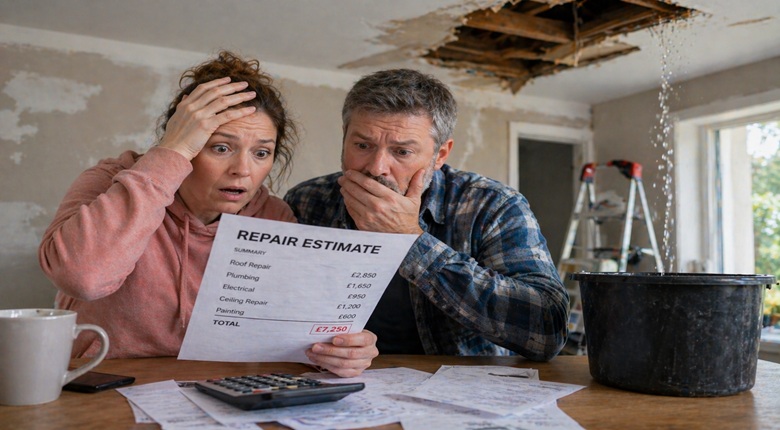
Home Repair Costs: Real Stories From Shocked Homeowners

Table of Contents
- Nobody Warns You About This Part of Homeownership
- The Big Picture: How Much Are Homeowners Actually Spending?
- Reader Story 1: The Roof That Became an Insurance Crisis
- Reader Story 2: The Sewer Line That Nobody Saw Coming
- Reader Story 3: Foundation Issues, and the Number That Made Them Sit Down
- Reader Story 4: The HVAC That Quit in August
- Reader Story 5: The Water Heater Cascaded Into Something Much Worse
- Reader Story 6: The Mould Nobody Smelled Until They Did
- The Cluster Effect: When Multiple Systems Fail at Once
- What the Numbers Say: The Real Cost Table
- What Every Homeowner Should Do Before the Bill Arrives
- Conclusion: The Bill Is Coming — You Choose When You’re Ready
- Frequently Asked Questions
- External References and Further Reading
Nobody Warns You About This Part of Homeownership
The mortgage officer did not mention it. The real estate agent smiled right past it. The home inspector’s report was twelve pages long and somehow none of it prepared you for the phone call that would arrive three years later, the one from a plumber standing in your backyard telling you what the camera scope had found.Homeownership is sold as an investment. An asset. A wealth-building vehicle. And it can be all of those things — provided that you also understand it is a physical structure, aging every year, with systems that will eventually fail. The roof. The HVAC. The water heater. The sewer line. The foundation. All of them have lifespans. Most of them will outlast your patience and then fail at the worst possible time.
According to Hippo Insurance’s 2026 Housepower Report, a startling 76 percent of US homeowners had at least one home-related issue that impacted their financial stability in the past year. Angi’s 2026 State of Home Spending Pulse Report found that 62 percent of homeowners express greater worry about affording upkeep than they did in 2024, and 48 percent say that stress from mandatory repairs has intensified since January 2025.
This article is for the rest of us — the people who got the bill and needed to sit down. We’ve collected real homeowner stories, paired them with current national cost data, and assembled the information that the mortgage officer should have given you but didn’t. Because the worst time to learn what a sewer line replacement costs is when your neighbour’s contractor is already in your backyard.
The bottom line before we start: In 2025, the average household spent $2,041 on routine maintenance and $1,143 on emergency repairs. But emergency repairs can run far higher. According to Angi’s State of Home Spending Report, Millennials led all generations in spending with an average total home spend of $14,199 including $1,519 in emergency expenditures. And those are the average numbers. The stories below are not average.
The Big Picture: How Much Are Homeowners Actually Spending?
Before we get to the stories, let’s establish why the numbers shock people who have not owned a home before — or who have owned one and somehow avoided a major repair until now.Home maintenance costs have climbed 61 percent over the past decade, driven by inflation in material prices, labour shortages across the skilled trades, and the simple physics of an ageing housing stock. According to Consumer Affairs’ 2026 home maintenance breakdown, the median US home was built in 1981, meaning its core systems are operating deep into or well past their designed service lives. A 44-year-old home almost certainly has a roof that has been replaced once and may be due again. It has plumbing that predates modern materials. Its HVAC system is statistically likely to be approaching or past the end of a 15-to-20-year lifespan.
NerdWallet found that 44 percent of homeowners experienced their first surprise repair within the first year after closing, and 12 percent faced one in the first month. Forty-six percent of homeowners spent more than $5,000 out of pocket on home repairs in 2024 according to Hippo Insurance — a 28 percent increase over the prior year’s 36 percent. Yet most households carry no dedicated repair reserve. The traditional 1 percent rule — set aside 1 percent of your home’s value per year for maintenance — amounts to $4,000 annually on a $400,000 home. Financial advisers are increasingly recommending 2 to 4 percent for homes over 30 years old. Most households save nothing close to that.
Reader Story 1: The Roof That Became an Insurance Crisis
🏠 Marcus & Delia, Tampa FL — $18,400 "We knew the roof was getting old. The inspector when we bought it said 'five to seven years left.' That was six years ago. Then we got a letter from our insurance company saying they'd be non-renewing our policy unless we replaced the roof within 60 days. Not if we didn't fix the leak. Replace the entire roof. We hadn't budgeted for anything like this. We ended up financing $14,000 of it on a home equity line."Marcus and Delia’s story is not unusual, and it is becoming more common. Cliff Auerswald, president of All Reverse Mortgage, described exactly this pattern to finance.yahoo.com in 2026: “So now you’ve got a homeowner, often a retiree on a fixed income, being told you need to spend $8,000 to $13,000 on a new roof or you’re going to lose your homeowners insurance. It’s a financial emergency on top of an emotional one.”
In Florida and several other coastal states, insurance companies have increasingly added age and condition of roof to their underwriting requirements. An aging roof does not just risk a leak — it risks coverage altogether. The average cost of a roof replacement in 2026 is approximately $11,000, with a typical range of $8,000 to $22,000 depending on size, materials, roof complexity, and geographic location. In high-cost coastal markets, premium materials, local labour rates, and storm damage specifications can push that figure well above $20,000.
What Marcus and Delia did not know until the bill arrived: homeowners insurance does not cover wear-and-tear deterioration. It covers sudden, accidental damage from covered perils. A roof that simply aged out is the homeowner’s problem entirely.
Reader Story 2: The Sewer Line That Nobody Saw Coming
🏠 Jennifer, Portland OR — $28,000 "I bought my house in 2019. The inspection checked the drains from inside but we didn't do a sewer scope. About four years in, drains started backing up. A plumber scoped the line and found roots had completely infiltrated the original clay pipe from the 1940s. The quote was $28,000 for a full replacement, which involved digging up a section of my front yard. I had to take a personal loan. My homeowner's insurance didn't cover a penny of it. I still have nightmares about that camera footage."The sewer line is one of the most overlooked systems in a home purchase, and one of the most expensive to replace. Dean Bennett, a residential contractor quoted in a 2026 Yahoo Finance piece, put the numbers plainly: a sewer pipe replacement will vary by length and region but “can easily cost an eye-popping $20,000 to $40,000.” He strongly recommends that anyone buying a house have a plumber independently scope the sewer line as part of the inspection process.
Jennifer’s experience with the 1940s clay pipe is particularly common in older homes. Clay sewer lines, once the standard, are highly susceptible to root intrusion and deterioration after 40 to 60 years. Homeowners insurance almost universally excludes sewer line replacement unless the homeowner has purchased a specific sewer line rider, which most do not. The repair often involves excavating landscaping, replacing concrete, and restoring the surface — all adding to a final bill that arrives without warning.
Prevention tip: A camera scope inspection of the sewer line costs approximately $100 to $250 and can be added to a standard home inspection. Cody Schuiteboer, CEO of Best Interest Financial, recommends this for every home purchase: “It’s easy to avoid a $30,000 expense with a mere $400 inspection stack.”
Reader Story 3: Foundation Issues, and the Number That Made Them Sit Down
🏠 The Okafor Family, Dallas TX — $42,000 "We noticed a few cracks in the drywall above the doorframes. We'd heard this was normal Texas settling. Two years later, the cracks had spread and one exterior door wouldn't close properly. We had a structural engineer come out. The quote from the foundation company was $42,000. Apparently there was significant soil movement under the back of the house. We had to put it on a second mortgage. We tell every friend who's buying a home: GET A FOUNDATION INSPECTION. Don't assume cracks are normal."Foundation problems are widely considered the most expensive repair a homeowner can face, and the Okafor family’s experience illustrates how the signs are easy to rationalise as “normal.” Courtney Klosterman, home insights expert at Hippo Insurance, noted that “a few cracks in the walls could seem small, but they may be a sign that your home’s structure is damaged.”
The cost range for foundation repairs is wide. Basic stabilisation work runs $2,200 to $8,100 nationally. When structural lifting or leveling is required — as it was for the Okafors — costs average $20,000 to $30,000 and can exceed $50,000 for large homes or severe movement. Dallas and other Texas markets are particularly prone to foundation issues due to the expansive clay soils that shift dramatically with moisture changes, making this a regional risk that every Texas buyer should understand before closing.
Foundation repair is a specialist market with significant variation in quality and price between contractors. A structural engineer’s independent assessment (typically $300 to $700) before accepting any foundation contractor’s quote is widely recommended — foundation companies have an obvious incentive to recommend the most extensive work.
Reader Story 4: The HVAC That Quit in August
🏠 Sandra, Phoenix AZ — $14,200 (with ductwork) "The AC stopped cooling on August 3rd. I called three companies. The first two said the 17-year-old unit was done and quoted replacement. The third said the same but also found that the ductwork in the attic was in terrible shape — torn insulation, gaps at the joins — and that replacing the unit without fixing the ducts would be wasting money. The full job was $14,200. In Phoenix in August, you don't have the luxury of shopping around for two weeks. I had a quote by noon and I signed by 3pm."Sandra’s story captures something that frustrates many homeowners: HVAC emergencies happen in the worst weather, when negotiating power is minimal and contractors are at peak demand. A Phoenix August without air conditioning is not survivable for many residents, particularly the elderly. That urgency translates directly into pricing power for whoever answers the phone first.
A new HVAC system averages approximately $7,500 nationally, with a range of $5,000 to $15,000 depending on system size and type. Sandra’s additional $6,700 in ductwork reflects a common compounding problem: neglected ducts can make even a new system perform at 50 to 70 percent efficiency, making the entire investment less effective. John Gabrielli, owner of Air Temp Solutions HVAC in Delaware, told Consumer Affairs: “There’s a big cost difference once systems hit 10 to 15 years old.” A 17-year-old system in Phoenix, running almost year-round, is operating years past typical service life.
The HVAC industry is also one of the sectors with the highest rate of price variation between contractors and the most common source of homeowner complaints about uninvited upselling. Sandra’s experience of accepting a quote the same day under extreme heat pressure is exactly the scenario that consumer advocates recommend against — yet it is also the reality of an August HVAC failure in the American Southwest.
Reader Story 5: The Water Heater Cascaded Into Something Much Worse
🏠 The Nguyens, Seattle WA — $31,000 "Our water heater started leaking on a Friday night. By the time we noticed Saturday morning, it had been seeping for hours into the subfloor of our utility room. We had a restoration company come and they found mold had already started to form in the wall cavity. The water heater itself cost $1,400. The water damage remediation, subfloor replacement, drywall, mold treatment, and repainting cost just under $30,000. Our insurance covered $18,000. We paid the rest out of pocket."The Nguyens’ story illustrates the cascade effect that makes home repairs so financially dangerous: the original failure is small and repairable, but the secondary damage from a delay of even hours can multiply the cost many times over. A standard water heater replacement runs $800 to $1,500. A water damage remediation project, particularly one involving subfloor replacement and mold treatment, can easily reach $10,000 to $30,000 or more.
Mold remediation adds a specific complication. Professional mold removal costs $1,500 to $9,000 nationally, but when mold infiltrates wall cavities, HVAC systems, or structural components, the bill can exceed $30,000. The Nguyens were fortunate that their insurance covered most of the water damage — but their policy had a $5,000 deductible per incident and excluded the mold treatment, which is a common exclusion in standard homeowners policies.
The lesson from their experience: water heaters have a typical service life of 8 to 12 years. Newer models have been failing in as few as five years in some regions. Knowing the age of your water heater and inspecting the area around it quarterly costs nothing. Ignoring a rust-stained floor or a subtle warm-smell from the utility room can cost $30,000.
Reader Story 6: The Mould Nobody Smelled Until They Did
🏠 Craig, Baltimore MD — $22,500 "We bought a 1960s Cape Cod. We knew it needed updating. What we didn't know was that a slow roof leak over the bedroom dormer had been feeding mold in the knee wall and attic for what the remediation company estimated was at least five years. We didn't smell it. We didn't see it. We only found it when we had an air quality test done after my wife started getting unexplained headaches. The mold remediation plus structural drying plus the roof repair was $22,500. The original leak was probably a $200 flashing repair."Craig’s story is the most common form of the home repair horror story: a tiny, invisible failure that compounds silently over years into something enormous and expensive. The $200 flashing repair that nobody scheduled growing into a $22,500 remediation is not exceptional. It is, according to every contractor interviewed for this article, the standard pattern.
Mold grows wherever water is present, temperature is moderate, and organic material (wood, drywall, insulation) provides a food source. Attic and wall cavity mold from roof leaks is particularly common in older homes in humid climates because the leak may be small enough that no visible water intrusion reaches the living space for years. By the time symptoms appear — musty odour, health effects, visible spots on ceilings — the infestation is typically extensive.
Homeowners insurance coverage for mold is one of the most common sources of claim disputes. Sudden water damage (a burst pipe) is generally covered. Gradual leaks that lead to mold are frequently denied as the result of neglected maintenance — even if the homeowner had no way of knowing the leak existed.
The Cluster Effect: When Multiple Systems Fail at Once
Every homeowner in this article discovered something that housing research confirms repeatedly: major repairs do not arrive politely, one at a time. A joint analysis of homeowner repair data from the r/homeowners Reddit community, conducted by JoinHomeowners.org in late 2025, found a consistent “cluster effect” in which multiple systems failed within approximately two-year windows.The explanation is physics, not bad luck. A home built at one time had components installed at one time. Those components had similar design lifespans. Roofing, HVAC systems, water heaters, and certain plumbing materials installed in the same era will approach end-of-life within years of each other. The homeowner who deferred a roof repair for three years because it was not yet leaking may find, when the roof finally forces the issue, that the HVAC system chose the same season to announce its own retirement.
Real homeowner quote (r/homeowners, 2025): “Even a small problem starts at $1k these days, and any mid-size problem is $10k minimum.” This single comment received over 3,000 upvotes from fellow homeowners, suggesting it captured a widely shared experience.
The financial consequence of the cluster effect is severe. A homeowner with a $10,000 repair reserve who faces simultaneous roof ($18,000), HVAC ($12,000), and water heater ($1,400) failures within 18 months is looking at $31,400 in repairs against savings of $10,000. The gap requires a home equity line, a personal loan, high-interest credit, or deferred maintenance that compounds into larger future bills.
What the Numbers Say: The Real Cost Table
| Repair Type | Low End | Typical Range | High End / Worst Case | Insurance Coverage? |
| Roof replacement (1,200 sq ft) | $8,000 | $11,000–15,000 | $22,000+ | Only sudden storm damage; not age/wear |
| Foundation repair | $2,200 | $8,000–15,000 | $42,000–60,000+ | Rare; usually excludes settling/soil movement |
| HVAC full replacement | $5,000 | $7,500–12,500 | $15,000+ with ductwork | Usually not covered (wear and tear) |
| Sewer line replacement | $8,000 | $15,000–25,000 | $40,000+ | Not covered without specific sewer rider |
| Water heater replacement | $800 | $1,200–1,800 | $3,000 (tankless install) | Depends on cause; failure usually not covered |
| Water damage remediation | $3,000 | $10,000–18,000 | $30,000+ | Covered if sudden; denied if gradual leak |
| Mould remediation | $1,500 | $5,000–12,000 | $30,000+ | Usually denied if gradual; often excluded |
| Electrical rewiring (full house) | $5,000 | $10,000–15,000 | $20,000+ | Not covered (maintenance issue) |
| Plumbing repipe | $5,000 | $8,000–12,000 | $20,000+ | Depends on cause; wear and tear excluded |
| Septic system replacement | $8,000 | $10,000–12,000 | $15,000+ | Not covered |
What Every Homeowner Should Do Before the Bill Arrives
The homeowners in this article all had one thing in common before their bills arrived: they did not have a system for staying ahead of their home’s condition. Most of them would not have described themselves as neglectful. They were simply uninformed about what to look for, when to look for it, and how much the consequences of delay would cost. Here is what every homeowner — new or experienced — should put in place now.Build a Dedicated Repair Reserve
The traditional 1 percent rule (set aside 1 percent of your home’s value per year) is a starting point. For homes over 20 years old, financial planners increasingly recommend 2 to 4 percent. For a $400,000 home, that means setting aside $8,000 to $16,000 per year in a dedicated, liquid account. This is separate from your emergency fund. When the roof quote arrives, you draw from this account, not from your retirement savings.Get an Annual Systems Inspection
A thorough annual walkthrough of your home’s major systems — roof, HVAC, plumbing, foundation, electrical — costs $200 to $500 per inspection. Against the repair costs in the table above, this is one of the highest-return investments available to a homeowner. Most problems, when caught early, are a fraction of the cost of the same problem discovered three years later.Scope the Sewer Before You Buy (or This Year if You Haven’t)
If you bought your home without a sewer scope and the house is more than 30 years old, schedule one now. A camera scope costs $100 to $250 and takes an hour. The cost of finding root intrusion in a clay pipe early, when it can be treated with hydro-jetting or a partial liner, is $500 to $2,000. Finding it after a blockage or backup means a full replacement.Know Your Insurance Coverage and Its Gaps
Most homeowners discover what their insurance does not cover when they file a claim. Read your policy now. Understand which water damage events are covered (sudden, accidental) and which are not (gradual, wear and tear). Check whether you have a sewer line rider, mold coverage, and equipment breakdown coverage. If your policy is missing protections that matter for your home’s age and systems, consider whether a home warranty is worth the cost for mechanical and appliance coverage.- Know your deductible for each covered peril. High-deductible policies lower premiums but increase out-of-pocket exposure in a claim.
- Check whether your roof’s age affects your coverage. In some states and with some carriers, a roof over 15 years may have actual cash value (depreciated value) coverage rather than replacement cost coverage.
- Ask about flood and sewer backup coverage as separate riders. Both are frequently excluded from standard policies and frequently the source of large, uncovered losses.
Conclusion
Every person whose story appears in this article is a reasonably intelligent, financially competent adult who simply did not know what they did not know. They were not reckless. They were not negligent by any conventional measure. They owned a home, and the home aged, and eventually the age of the home presented a bill.The difference between a $28,000 surprise and a $28,000 expected expense is not the money. It is the preparation. A family with $25,000 in a dedicated repair reserve, a recently scoped sewer line, and an annual inspection on the calendar receives the same quote from the same contractor on the same Tuesday. They pay it. They rebuild the reserve over the following 18 months. They do not take out a personal loan, drain their emergency fund, or defer the work until it cascades into something larger.
The bill is coming. Every home has a foundation, a roof, an HVAC system, a sewer line, and a water heater. All of them will eventually need attention. The question is not whether you will write a large check for your home at some point in the next decade. The question is whether you will write it on your own terms or on the contractor’s.
The homeowners who shared their stories for this article were unanimous on one piece of advice: start saving more than you think you need, start inspecting your home more regularly than feels necessary, and scope the sewer line. No matter how old the house is. Scope the sewer line.
Frequently Asked Questions
How much should I budget for home repairs each year?
The traditional rule is 1 percent of your home’s value per year. For a $400,000 home, that is $4,000 annually. For homes over 20 or 30 years old, most financial planners now recommend 2 to 4 percent, or $1 per square foot of living space, whichever is higher. In addition to the annual maintenance budget, financial advisers recommend maintaining a dedicated emergency repair reserve of $10,000 to $25,000 in liquid savings specifically for major unexpected repairs.What are the most expensive home repairs homeowners typically face?
Foundation repair ($2,200 to $60,000+), roof replacement ($8,000 to $22,000+), sewer line replacement ($8,000 to $40,000+), full HVAC replacement ($5,000 to $15,000+), water damage remediation ($3,000 to $30,000+), mould remediation ($1,500 to $30,000+), and full electrical rewiring ($5,000 to $20,000+) are consistently the largest individual repair categories. Multiple simultaneous failures — the cluster effect — can push total costs well above $50,000.Does homeowners insurance cover expensive repairs like foundations and sewer lines?
Generally no. Standard homeowners insurance covers sudden, accidental damage from covered perils (fire, storm, sudden water damage from internal systems). It does not cover gradual wear and tear, mechanical breakdown, settling, soil movement, or sewer line failure. Sewer line coverage requires a specific rider. Flood damage requires a separate NFIP or private flood policy. Mould from gradual leaks is frequently excluded. Understanding your policy’s exclusions before a claim is essential.What is a sewer scope and why do homeowners recommend it so strongly?
A sewer scope is a camera inspection of your home’s sewer line from the house to the main street connection. A plumber inserts a camera into the cleanout or drain access and inspects the pipe’s condition. It costs $100 to $250 and takes about an hour. It can reveal root intrusion, pipe deterioration, bellied sections, and blockages — any of which can lead to a $15,000 to $40,000 replacement if left undetected. Most home inspectors do not include sewer scoping in a standard inspection; it must be specifically requested.Why did my home repair cost so much more than the estimate I read online?
National average cost figures represent the middle of a very wide range. Actual costs vary significantly by geographic region (labour and material costs are higher in coastal metros and lower in the Midwest and South), by home age and condition (older homes require more prep work and often reveal additional problems once work begins), by the specific scope of work, and by the time of year (emergency service rates are higher, and certain seasons drive demand and therefore prices up for roofing, HVAC, and other contractors).What is the cluster effect in home repairs?
The cluster effect is the documented tendency for multiple major home systems to fail within a short window of time. It occurs because homes built at one time have components installed with similar design lifespans. A roof, HVAC system, water heater, and certain plumbing materials installed in the same decade will all approach end-of-life simultaneously. Homeowners who defer one repair often find that the delay brings multiple systems past their limits at the same time.What should I look for to catch expensive home problems early?
For foundations: cracks above door frames and in drywall, doors or windows that stick or no longer latch, uneven floors, gaps at wall-ceiling joins. For roofs: missing or curling shingles, granules in gutters, water stains on ceiling or in attic, sagging roofline. For sewer lines: multiple slow-draining fixtures simultaneously, gurgling from drains, sewage odour in the yard. For HVAC: unusual noises, inconsistent temperatures, unexpected energy bill spikes, the system running constantly without reaching thermostat setting.How do I find a trustworthy contractor for major repairs?
Get at least three independent quotes, not estimates. Verify licence and insurance through your state contractor licensing board. Check reviews on multiple platforms (Google, Yelp, Angi, Nextdoor). Ask for references from recent, comparable jobs and call them. Be wary of high-pressure closing tactics, quotes that arrive with an immediate deadline, unusually low bids (which often indicate the contractor will find ‘additional work’ once started), and door-to-door solicitation after storms.Should I get a home warranty?
A home warranty covers mechanical breakdown of appliances and systems (HVAC, plumbing, electrical) for an annual fee, typically $400 to $800. It fills a specific gap that homeowners insurance does not cover: equipment failure from normal use. The value depends heavily on your home’s age, the specific systems covered, and the warranty company’s claims track record. For homes with ageing HVAC systems, water heaters, or major appliances nearing end of life, a warranty can represent significant value. Research specific providers carefully — the home warranty industry has a mixed consumer reputation.What is the 1% rule for home maintenance and is it still valid?
The 1 percent rule — saving 1 percent of your home’s purchase price annually for maintenance and repairs — is a reasonable starting point but is widely considered insufficient for older homes in 2026. For a $400,000 home, 1 percent is $4,000 per year. Given that a single roof replacement, HVAC failure, or sewer line issue can easily exceed $15,000, many financial planners recommend 2 to 4 percent for homes over 20 years old, combined with a separate emergency repair reserve of $10,000 to $25,000. Maintenance costs have risen 61 percent over the past decade, making the older 1 percent benchmarks particularly inadequate.External References and Further Reading
Hippo Insurance — Most Expensive Home Repairs 2025, Consumer Affairs — Home Maintenance Costs: A Breakdown (2026), SoFi — What Are the Most Common Home Repair Costs? (January 2026), Frontier Inspections — The Hidden Costs Lurking in Homes (March 2026), Yahoo Finance — The Silent Killers of Real Estate Wealth: 6 Surprise Home Repairs (April 2026), North Country Now — Home Repairs, Replacements and Insurance: What Homeowners Need to Know (February 2026), Saving Advice — The Most Expensive Home Repairs People Didn’t See Coming (2025), JoinHomeowners.org — How Much Should You Save for Home Repairs? Real Costs From Homeowners (December 2025), ScMillHills — Home Repair Costs Are Rising — What Homeowners Should Expect (March 2026), NerdWallet / NEA Member Benefits — 5 Unexpected Costs of Homeownership
0 Comments
Be the first to share your thoughts on this article.