
Savings
How Much Savings Should You Have at 30? What Data Shows

Fidelity milestone 1x salary at 30 (about $59,800 for the median earner aged 25–34). Reality: Vanguard 401(k) ages 25–34 average $50,261, median $18,732; Fidelity ages 30–34 average $51,700; Federal Reserve (2022) under 35 median retirement savings $18,880. Cash and net worth (Fed SCF 2022, under 35): median transaction-account balance $5,400; median net worth about $39,000 (mean $183,500). Cushion and debt (Bankrate 2026): only 38% of millennials have more emergency savings than card debt; 35% have more card debt than savings; 19% have neither. Only 46% of Americans could cover three months of expenses. My arithmetic: a $59,800 earner saving 15% a year to 67 at a constant 7% reaches about $1.44 million from age 30 vs about $989,000 from 35 (a $450,000 cost of waiting).
The honest answer has several layers, because “savings” means different things. There is retirement money, emergency cash, down-payment money and the bigger picture of net worth. This guide takes each in turn, shows the benchmarks and, importantly, what typical 30-year-olds really have, so you can judge yourself against reality rather than against the most impressive person in your feed.
It is a guideline, not a test. It assumes steady saving from your mid-twenties, an employer match and retirement around 67. If you started later, earn less or have a pension, your path may look different. Treat the number as a direction of travel rather than a verdict on your worth.
Compare those with the benchmark. The Vanguard median of $18,732 is about 31% of one year of the median salary, and the average is about 84%. Fidelity’s 30-to-34 average is about 86%. So averages come close to 1x, but the median 30-year-old is at roughly a third of it. The average is pulled up by a minority of high savers; the median is the better picture of the typical person.
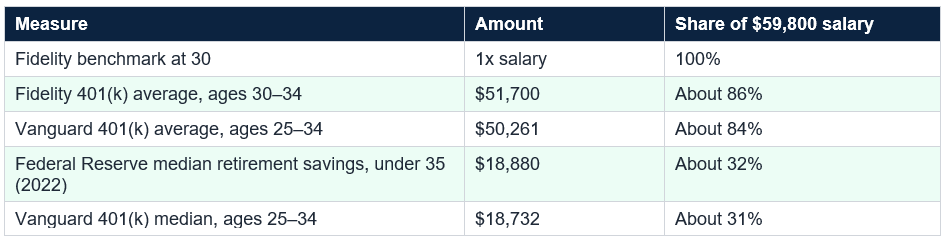
Ages 25–34 (Vanguard, 2026): average 401(k) $50,261, median $18,732. Ages 30–34 (Fidelity): average $51,700. Under 35 (Fed, 2022): median $18,880. Median earnings for ages 25–34: about $59,800 a year.
Most people are short of the guideline. Bankrate’s 2026 survey found that only 47% of Americans could cover a $1,000 emergency and 46% three months of expenses. Among millennials, ages 30 to 45, only 38% have more emergency savings than credit card debt, 35% have more card debt than savings and 19% have neither. If you have no cushion, start with $1,000, then build up in steps.
Debt is the other side of the ledger. About 14.3 million federal student loan borrowers are aged 25 to 34, with an average balance of more than half a year’s median salary, according to one summary of government data. Millennials carried an average credit card balance of $6,961 in Experian’s 2025 data. Americans owed $1.263 trillion on credit cards in total as of the second quarter. Carrying a balance at about 21% costs far more than savings earn, so high-interest debt is usually the first target.
Net worth, averages and medians come from different surveys and years, and the Federal Reserve figures are from 2022. Treat them as rough reference points, and use the median for a realistic comparison.
At $500 a month, with no interest, saving a 10% down payment would take about seven years. That is why many people combine a modest down payment with other strategies. The home goal competes with retirement and emergency savings, so decide the order. A sensible sequence is a starter emergency fund, the 401(k) match, high-interest debt, then the down payment, with the rest going to retirement.

This is not meant to frighten you. It is meant to show that time is the most valuable thing you have, and that the first years of saving do a disproportionate share of the work. It also works in your favor: even your existing balance has time to grow. The median $18,732, left alone at 7% for 37 years, would grow to about $229,000 before any new contributions.
The numbers: $59,800 salary, 15% saved a year, to age 67 at a constant 7%: about $1.44 million starting at 30 vs about $989,000 starting at 35 (cost of waiting about $450,000). At 5%: about $912,000 vs $675,000. Illustrative constant-return arithmetic.
Fifth, automate everything, since automatic enrollment lifts participation to 94% from 64%, according to Vanguard. Sixth, consider a Roth IRA, with a 2026 limit of $7,500, and in a Roth, qualified withdrawals are tax-free. Seventh, review once a year and raise your savings with each raise. To see the effect, my arithmetic shows that saving $500 a month at 7% could lift a median $18,732 balance to about $60,800 in five years, roughly 1x salary, though returns will vary.
A few mistakes are worth avoiding at 30. Do not leave your emergency fund in an account paying next to nothing when top savings accounts pay 4.34% to 4.50%. Do not skip the employer match, which is free money. Do not cash out a 401(k) when you change jobs if you can roll it over. Do not compare yourself with social media, where wins are posted and debts are not. And do not wait for a perfect moment: Vanguard found that only 21% of participants aged 25 to 34 who were offered a Roth 401(k) chose it, so many young savers are leaving a flexible option untouched. Start imperfectly, and improve as you go. Pick one step this week: open a savings account for your starter fund, raise your 401(k) contribution by 1% or set an automatic $50 transfer. Small and automatic beats large and abandoned.
Do not let the gap discourage you. Thirty is early, and the habits you build now matter far more than the balance you have today. Build a cushion, capture the match, pay down expensive debt, automate your savings and raise them with every raise. A $59,800 earner who starts saving 15% at 30 could, at a constant 7% return, reach about $1.44 million by 67, roughly $450,000 more than by waiting five years. This is general education, not personalized advice, and a qualified adviser can help tailor it.
A common rule of thumb from Fidelity is about one times your annual salary in retirement savings by 30. For the median full-time worker aged 25 to 34, who earns about $59,800 a year, that is roughly $60,000. Alongside that, aim for three to six months of expenses in emergency savings and no high-interest debt.
What do most 30-year-olds actually have saved?
Far less than the rule of thumb. Vanguard’s 2026 report shows a median 401(k) balance of $18,732 for ages 25 to 34, with an average of $50,261. Fidelity reports an average of $51,700 for ages 30 to 34. The Federal Reserve’s 2022 survey put median household net worth for under-35s at about $39,000 and median cash in transaction accounts at $5,400.
Is it too late if I have nothing saved at 30?
No. Thirty is early. In my illustration, a $59,800 earner who saves 15% of income from 30 to 67 at a constant 7% return reaches about $1.44 million. Waiting until 35 with the same habit reaches about $989,000, a gap of roughly $450,000. Starting now matters, but you have decades.
Should I pay off debt or save first at 30?
Do both in order: a small starter emergency fund, then pay down high-interest debt such as credit cards, while capturing any 401(k) match. Bankrate found that 35% of millennials have more credit card debt than emergency savings, and only 38% have more savings than card debt.
How much do I need for a down payment?
It depends on the price and loan. On the $417,500 median existing home, 3.5% down is about $14,600, 10% about $41,800 and 20% about $83,500. At a 7.40% mortgage rate, the principal-and-interest payment is about $2,790, $2,602 or $2,313 a month respectively, before taxes and insurance.
Table of Contents
- The Question Everyone Asks at 30
- The Short Answer
- Retirement Savings: The 1x Salary Benchmark
- What 30-Year-Olds Actually Have
- Emergency Savings: The Cushion
- Cash, Net Worth and Debt
- Saving for a Home
- Putting It Together: A Scorecard
- The Cost of Waiting
- If You Are Behind: Where to Start
- Conclusion
- Frequently Asked Questions
The Question Everyone Asks at 30
Thirty has a way of making people take stock. Friends are buying houses, posting about promotions and talking about their 401(k)s, and you wonder whether you are behind. Maybe you have been paying off student loans. Maybe you changed careers. Maybe you simply never got around to opening that account. Whatever the reason, the question arrives: how much savings should I have by now?The honest answer has several layers, because “savings” means different things. There is retirement money, emergency cash, down-payment money and the bigger picture of net worth. This guide takes each in turn, shows the benchmarks and, importantly, what typical 30-year-olds really have, so you can judge yourself against reality rather than against the most impressive person in your feed.
The Short Answer
A popular benchmark is about one times your salary in retirement savings by 30, three to six months of expenses in an emergency fund and no high-interest debt. For the median full-time worker aged 25 to 34, who earns about $59,800 a year, that means roughly $60,000 for retirement and perhaps $9,000 to $18,000 for emergencies. But most 30-year-olds are well short of that. The median 401(k) balance for ages 25 to 34 is $18,732, according to Vanguard’s 2026 report. If you are behind, you are in good company, and the gap is fixable.Retirement Savings: The 1x Salary Benchmark
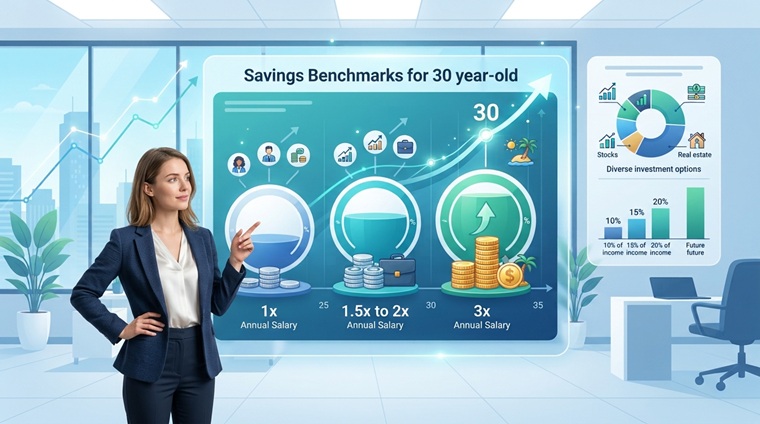
The best-known guideline comes from Fidelity: about 1 times your salary saved by 30, 2 times by 35, 3 times by 40 and 10 times by 67. The idea is that early savings have the longest to compound, so building the habit in your twenties pays off later. At a $59,800 salary, 1x is $59,800. At $90,000, it is $90,000.It is a guideline, not a test. It assumes steady saving from your mid-twenties, an employer match and retirement around 67. If you started later, earn less or have a pension, your path may look different. Treat the number as a direction of travel rather than a verdict on your worth.
What 30-Year-Olds Actually Have
Now the reality check. Vanguard’s How America Saves 2026 report, based on year-end 2025 data, shows that 401(k) participants aged 25 to 34 had an average balance of $50,261 and a median of $18,732. Fidelity reports an average of $51,700 for ages 30 to 34, and $26,600 for ages 25 to 29. The Federal Reserve’s 2022 survey put median retirement savings for people under 35 at $18,880, with an average of $49,130.Compare those with the benchmark. The Vanguard median of $18,732 is about 31% of one year of the median salary, and the average is about 84%. Fidelity’s 30-to-34 average is about 86%. So averages come close to 1x, but the median 30-year-old is at roughly a third of it. The average is pulled up by a minority of high savers; the median is the better picture of the typical person.
Ages 25–34 (Vanguard, 2026): average 401(k) $50,261, median $18,732. Ages 30–34 (Fidelity): average $51,700. Under 35 (Fed, 2022): median $18,880. Median earnings for ages 25–34: about $59,800 a year.
Emergency Savings: The Cushion
Emergency savings may matter more at 30 than the retirement milestone, because they protect everything else. The usual guideline is three to six months of essential expenses. If your essentials are $3,000 a month, that is $9,000 to $18,000. It is held in an insured savings account, not in investments, so it is there when you need it. In mid-October, top savings accounts paid 4.34% to 4.50%, so $9,000 earns about $391 a year.Most people are short of the guideline. Bankrate’s 2026 survey found that only 47% of Americans could cover a $1,000 emergency and 46% three months of expenses. Among millennials, ages 30 to 45, only 38% have more emergency savings than credit card debt, 35% have more card debt than savings and 19% have neither. If you have no cushion, start with $1,000, then build up in steps.
Cash, Net Worth and Debt
Two other measures show where 30-year-olds stand. The Federal Reserve’s 2022 survey found that families under 35 had a median transaction-account balance of just $5,400, with an average of $20,536, and a median net worth of about $39,000, with a mean of $183,500. Net worth is your assets minus your debts, so it can be low or even negative when student loans are large.Debt is the other side of the ledger. About 14.3 million federal student loan borrowers are aged 25 to 34, with an average balance of more than half a year’s median salary, according to one summary of government data. Millennials carried an average credit card balance of $6,961 in Experian’s 2025 data. Americans owed $1.263 trillion on credit cards in total as of the second quarter. Carrying a balance at about 21% costs far more than savings earn, so high-interest debt is usually the first target.
Net worth, averages and medians come from different surveys and years, and the Federal Reserve figures are from 2022. Treat them as rough reference points, and use the median for a realistic comparison.
Saving for a Home
Many 30-year-olds are also saving for a home, and the numbers have become daunting. The median existing-home price was $417,500 in September, and the 30-year mortgage rate was 7.40% in mid-October. On that price, a 3.5% down payment is about $14,600, 10% is about $41,800 and 20% is about $83,500. The principal-and-interest payment is about $2,790, $2,602 and $2,313 a month respectively, before taxes and insurance.At $500 a month, with no interest, saving a 10% down payment would take about seven years. That is why many people combine a modest down payment with other strategies. The home goal competes with retirement and emergency savings, so decide the order. A sensible sequence is a starter emergency fund, the 401(k) match, high-interest debt, then the down payment, with the rest going to retirement.
Putting It Together: A Scorecard
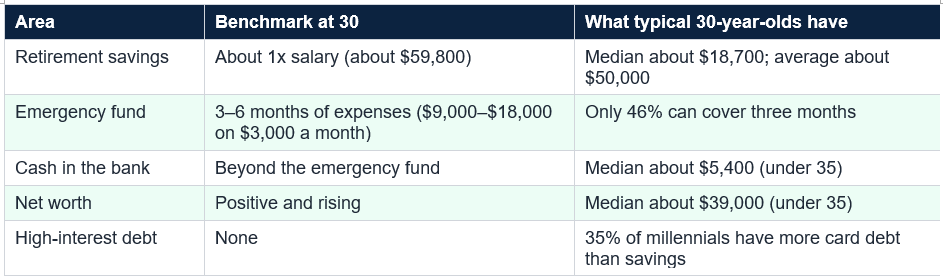
Here is a simple scorecard for 30, with a benchmark and what the median person actually has. Use it as a map, not a grade. Notice the pattern: the typical 30-year-old is behind on most dimensions, which is normal, and the right move is to pick the next step rather than to feel guilty about all of them.
The Cost of Waiting
Here is why thirty matters, in my own illustration. Take a $59,800 earner who saves 15% of income, about $8,970 a year or $748 a month, and earns a constant 7% a year until 67. Starting at 30 produces about $1.44 million, or 24 times salary. Starting at 35 produces about $989,000, or 16.5 times salary. The five-year delay costs roughly $450,000. At a 5% return, the figures are $912,000 and $675,000, a gap of about $236,000.This is not meant to frighten you. It is meant to show that time is the most valuable thing you have, and that the first years of saving do a disproportionate share of the work. It also works in your favor: even your existing balance has time to grow. The median $18,732, left alone at 7% for 37 years, would grow to about $229,000 before any new contributions.
The numbers: $59,800 salary, 15% saved a year, to age 67 at a constant 7%: about $1.44 million starting at 30 vs about $989,000 starting at 35 (cost of waiting about $450,000). At 5%: about $912,000 vs $675,000. Illustrative constant-return arithmetic.
If You Are Behind: Where to Start
If you are behind, take these steps in order. First, build a $1,000 starter emergency fund, then work toward three months of expenses. Second, capture any employer match in your 401(k); Vanguard’s data show that 86% of its plans offer matching contributions. Third, pay down credit card debt, which costs about 21%. Fourth, raise your retirement contribution. Vanguard found the average employee deferral was 7.6% and the median 6.6%, and recommends a total of 12% to 15% including the employer share.Fifth, automate everything, since automatic enrollment lifts participation to 94% from 64%, according to Vanguard. Sixth, consider a Roth IRA, with a 2026 limit of $7,500, and in a Roth, qualified withdrawals are tax-free. Seventh, review once a year and raise your savings with each raise. To see the effect, my arithmetic shows that saving $500 a month at 7% could lift a median $18,732 balance to about $60,800 in five years, roughly 1x salary, though returns will vary.
A few mistakes are worth avoiding at 30. Do not leave your emergency fund in an account paying next to nothing when top savings accounts pay 4.34% to 4.50%. Do not skip the employer match, which is free money. Do not cash out a 401(k) when you change jobs if you can roll it over. Do not compare yourself with social media, where wins are posted and debts are not. And do not wait for a perfect moment: Vanguard found that only 21% of participants aged 25 to 34 who were offered a Roth 401(k) chose it, so many young savers are leaving a flexible option untouched. Start imperfectly, and improve as you go. Pick one step this week: open a savings account for your starter fund, raise your 401(k) contribution by 1% or set an automatic $50 transfer. Small and automatic beats large and abandoned.
Conclusion
So, how much savings should you have at 30? The textbook answer is about one times your salary for retirement, three to six months of expenses in an emergency fund and no high-interest debt. The real-world answer is that most people are behind: the median 401(k) balance for ages 25 to 34 is $18,732, the median under-35 household holds $5,400 in cash and only 46% of Americans could cover three months of expenses.Do not let the gap discourage you. Thirty is early, and the habits you build now matter far more than the balance you have today. Build a cushion, capture the match, pay down expensive debt, automate your savings and raise them with every raise. A $59,800 earner who starts saving 15% at 30 could, at a constant 7% return, reach about $1.44 million by 67, roughly $450,000 more than by waiting five years. This is general education, not personalized advice, and a qualified adviser can help tailor it.
Frequently Asked Questions
How much should I have saved by 30?A common rule of thumb from Fidelity is about one times your annual salary in retirement savings by 30. For the median full-time worker aged 25 to 34, who earns about $59,800 a year, that is roughly $60,000. Alongside that, aim for three to six months of expenses in emergency savings and no high-interest debt.
What do most 30-year-olds actually have saved?
Far less than the rule of thumb. Vanguard’s 2026 report shows a median 401(k) balance of $18,732 for ages 25 to 34, with an average of $50,261. Fidelity reports an average of $51,700 for ages 30 to 34. The Federal Reserve’s 2022 survey put median household net worth for under-35s at about $39,000 and median cash in transaction accounts at $5,400.
Is it too late if I have nothing saved at 30?
No. Thirty is early. In my illustration, a $59,800 earner who saves 15% of income from 30 to 67 at a constant 7% return reaches about $1.44 million. Waiting until 35 with the same habit reaches about $989,000, a gap of roughly $450,000. Starting now matters, but you have decades.
Should I pay off debt or save first at 30?
Do both in order: a small starter emergency fund, then pay down high-interest debt such as credit cards, while capturing any 401(k) match. Bankrate found that 35% of millennials have more credit card debt than emergency savings, and only 38% have more savings than card debt.
How much do I need for a down payment?
It depends on the price and loan. On the $417,500 median existing home, 3.5% down is about $14,600, 10% about $41,800 and 20% about $83,500. At a 7.40% mortgage rate, the principal-and-interest payment is about $2,790, $2,602 or $2,313 a month respectively, before taxes and insurance.
0 Comments
Be the first to share your thoughts on this article.