

Savings
Inflation Is at 3.7% — These Savings Accounts Beat It

September 2026 CPI: 3.70% (BLS, released October 14, 2026). National average savings rate: 0.38%-0.60%. Top HYSAs and CDs: 4.00%-5.00%+. Beating inflation or losing to it: the gap is larger than most people realise.
The Bureau of Labor Statistics released its September 2026 Consumer Price Index report on October 14, 2026. The number that came out was 3.70% annual inflation — up from the earlier 2026 readings of approximately 2.4%-2.8% and driven largely by a 5.20% surge in energy prices. For anyone with savings sitting in a bank account, that number has a direct and immediate financial meaning: every account earning less than 3.70% APY is losing purchasing power right now. Not eventually. Not theoretically. Today, this month, at the compounding rate of exactly how far below 3.70% your rate sits. The national average savings account rate in 2026 is approximately 0.38% to 0.60% APY. That means the average American’s savings account is currently losing somewhere between 3.10% and 3.32% in real value per year. On a $10,000 balance, that is approximately $310-$332 in silent annual loss. The good news, and it is genuine good news: Raisin’s October 14 CPI analysis confirms that top high-yield savings accounts and fixed-rate CDs offering 4.50% to 5.00%+ are still outpacing inflation. The gap between what the best accounts pay and what most accounts pay is, as Bankrate’s senior industry analyst Ted Rossman has noted, ‘huge.’ This article sets out exactly which accounts are beating September’s 3.70% inflation, which are not, and what the actual real-return numbers look like.
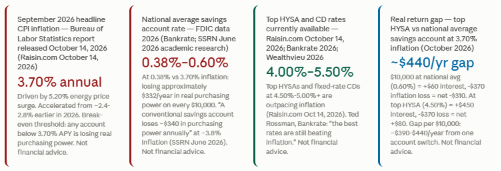
September 2026 CPI: 3.70% annual (BLS report released October 14, 2026 — Raisin.com). National average savings rate: 0.38%-0.60% (FDIC 2026; Bankrate). Real loss at national average vs 3.70% inflation: approximately -3.10% to -3.32%/year. $10,000 at 0.38% vs 3.70% inflation: loses approximately $332 in purchasing power annually. Top HYSAs/CDs at 4.50%-5.00%: positive real return of approximately +0.80%-+1.30%.
Best for: Emergency fund (3-6 months expenses). Short-term savings. Money needed within 1-3 years. Savers who need full liquidity and want to beat inflation with no lock-up. Watch out: Variable rate — falls when Fed cuts. Review rate every quarter. Some banks offer teaser rates that drop after 3-6 months. Look at ongoing APY, not introductory rate.
I-Bond real return: by design approximately equal to the fixed rate (0.90% for May-October 2026) in real terms. If inflation is 3.70% and the I-Bond rate = 0.90% + inflation component, the real return above inflation is approximately the 0.90% fixed rate. Compare: HYSA at 4.50% vs 3.70% inflation = +0.80% real return. Similar in real terms; I-Bond provides certainty but with liquidity restrictions. Best for: Long-term inflation hedging within the $10,000 annual limit. Savers who fear inflation accelerating beyond current HYSA rates. Complementary to HYSAs and CDs, not a replacement. Works best held for 5+ years to avoid the 3-month penalty. Watch out: $10,000/year purchase limit per person. Cannot redeem for 1 year. Redeem before 5 years: lose last 3 months' interest. Rate resets every 6 months — if inflation falls, I-Bond rate falls too. Cannot be held in an IRA or 401(k).
The Bureau of Labor Statistics released the September 2026 Consumer Price Index report on October 14, 2026. Headline CPI inflation came in at 3.70% on an annual basis, according to Raisin.com's breakdown of the BLS data. This was an acceleration from earlier 2026 readings of approximately 2.4%-2.8%, largely driven by a 5.20% surge in energy prices. Core CPI (excluding food and energy) is approximately 3.0%-3.2% annually (Wealthvieu 2026). This 3.70% headline figure is the threshold: any savings account or CD earning below 3.70% APY is losing real purchasing power.
What savings account rate beats 3.70% inflation?
Any account earning above 3.70% APY before taxes is generating a positive real return against September 2026 inflation. Raisin.com's October 14, 2026 analysis confirms that top high-yield savings accounts and fixed-rate CDs offering 4.50%-5.00%+ are currently outpacing inflation. Bankrate's Ted Rossman's 2026 forecast confirms that the best savings rates are still well above the inflation rate. The national average (0.38%-0.60%) is far below the threshold and should not be accepted as the default. Not financial advice — verify current rates before opening any account.
Should I choose a HYSA or a CD in the current environment?
Wealthvieu's 2026 deposit account guide recommends the combination: emergency fund in HYSA (fully liquid, currently 4.00%-5.50%), extra savings you won't need for 12+ months in a CD (locked-in rate, currently 3.90%-4.50%). The case for HYSA: full liquidity, still beating inflation. The case for CD: rate certainty — a CD locked at 4.30% today stays at 4.30% for its entire term even if the Fed cuts rates and HYSA rates fall to 3.75%. Bankrate's 2026 CD forecast makes the case for locking in: 'Right now can be a good time to lock in a CD rate, as high APYs are still outpacing inflation and are likely to drop in 2026.' The practical rule: money you might need = HYSA. Money you won't need for a defined period = CD.
Are I-Bonds a good inflation hedge right now?
Series I Bonds remain a structurally sound inflation hedge for the portion of savings within the $10,000 annual purchase limit. The SSRN June 2026 academic research confirms the I-Bond's structure for May-October 2026 issuances: 0.90% fixed rate plus a variable component tied to CPI. This means the I-Bond rate adjusts automatically if inflation rises further. At current top HYSA rates of 4.50%+ versus 3.70% inflation, the I-Bond's real return (+0.90% by design) is slightly below the HYSA's real return (+0.80% pre-tax). However, if inflation re-accelerates, the I-Bond rate adjusts while the HYSA rate may not. The I-Bond is best used as a complement to a HYSA and CD strategy, not as a replacement. Its liquidity restrictions (1-year minimum, 3-month interest penalty if redeemed before 5 years) make it unsuitable for emergency funds.
When should I review my savings account rate?
Gerald.com's 2026 savings account guide is specific: 'Revisit your account rates every 6 months — banks quietly drop rates and most people never notice.' Wealthvieu recommends the same cadence. The practical implementation: set a calendar reminder for April and October each year (when the Fed typically meets and makes rate decisions) to check your account rate against the current CPI figure. The real return formula is simple: your rate minus the current inflation rate. If the result is negative, switch. Bankrate's rate comparisons and NerdWallet's HYSA tracker are free tools for comparing current rates in real time.
The Bureau of Labor Statistics released its September 2026 Consumer Price Index report on October 14, 2026. The number that came out was 3.70% annual inflation — up from the earlier 2026 readings of approximately 2.4%-2.8% and driven largely by a 5.20% surge in energy prices. For anyone with savings sitting in a bank account, that number has a direct and immediate financial meaning: every account earning less than 3.70% APY is losing purchasing power right now. Not eventually. Not theoretically. Today, this month, at the compounding rate of exactly how far below 3.70% your rate sits. The national average savings account rate in 2026 is approximately 0.38% to 0.60% APY. That means the average American’s savings account is currently losing somewhere between 3.10% and 3.32% in real value per year. On a $10,000 balance, that is approximately $310-$332 in silent annual loss. The good news, and it is genuine good news: Raisin’s October 14 CPI analysis confirms that top high-yield savings accounts and fixed-rate CDs offering 4.50% to 5.00%+ are still outpacing inflation. The gap between what the best accounts pay and what most accounts pay is, as Bankrate’s senior industry analyst Ted Rossman has noted, ‘huge.’ This article sets out exactly which accounts are beating September’s 3.70% inflation, which are not, and what the actual real-return numbers look like.
Table of Contents
- What 3.70% Inflation Actually Means for Your Savings Account
- The Real Return Formula: How to Know If Your Money Is Growing or Shrinking
- Accounts Currently Beating September 2026 Inflation
- Account 1 High-Yield Savings Account (HYSA)
- Account 2 Fixed-Rate Certificate of Deposit (CD)
- Account 3 Money Market Account (MMA)
- Account 4 Treasury I-Bonds (Series I Savings Bonds)
- Accounts Currently Losing to Inflation
- The Comparison Table: Every Account Type vs 3.70% Inflation
- UK Note: The Same Maths, Different Numbers
- Conclusion: The Gap Between the Average and the Best Is the Opportunity
- Frequently Asked Questions
What 3.70% Inflation Actually Means for Your Savings Account
Inflation at 3.70% means that a basket of goods costing $1,000 today will cost $1,037 in twelve months. A savings account that pays less than 3.70% APY means your money is growing in dollar terms but shrinking in what it can buy. The difference between the two is called the real return — and it is the only number that actually matters for a savers’ financial health. Raisin’s October 14 analysis of the September 2026 CPI report, published on the same day as the BLS data release, states the threshold directly: ‘With annual CPI inflation at 3.70%, a savings account or CD needs to yield at least 3.70% APY before taxes to break even in real purchasing power.’ The academic research published in SSRN in June 2026 makes the cost of being below this threshold concrete: ‘A conventional savings account would lose approximately $340 in purchasing power annually’ at 3.8% inflation when earning the national average of 0.38% APY. The national average rate in the US is approximately 0.38% to 0.60% APY according to FDIC data. At that rate, savers are not just failing to beat inflation. They are losing roughly $310 to $332 in real value on every $10,000 they hold in a standard account, every single year.September 2026 CPI: 3.70% annual (BLS report released October 14, 2026 — Raisin.com). National average savings rate: 0.38%-0.60% (FDIC 2026; Bankrate). Real loss at national average vs 3.70% inflation: approximately -3.10% to -3.32%/year. $10,000 at 0.38% vs 3.70% inflation: loses approximately $332 in purchasing power annually. Top HYSAs/CDs at 4.50%-5.00%: positive real return of approximately +0.80%-+1.30%.
The Real Return Formula: How to Know If Your Money Is Growing or Shrinking
The calculation is straightforward. Real Return = Account APY − Inflation Rate. At 3.70% September 2026 inflation: any account below 3.70% APY has a negative real return. Any account above 3.70% has a positive real return. Gerald.com’s 2026 inflation and savings guide frames the concept with appropriate simplicity: ‘Beating inflation with savings doesn’t mean getting rich — it means not getting poorer. The interest rate on your savings needs to equal or exceed the current inflation rate to preserve purchasing power.’ Wealthvieu’s deposit account guide gives the worked example: a HYSA at 4.50% APY against mid-2026 inflation of approximately 3%: ‘Real return of +1.2-1.7%.’ Applied to September’s 3.70%: a HYSA at 4.50% delivers approximately +0.80% real return. That is not spectacular growth. But it is the difference between savings that maintain their value and savings that are silently eroded every month. The second important qualifier: real return is pre-tax. If your savings interest is taxable income and you pay 22% federal income tax, a 4.50% APY becomes approximately 3.51% after-tax — still above the 3.70% threshold but with a narrower margin. Holding high-yield savings in a tax-advantaged account (Roth IRA for emergency fund-adjacent money, or within the HYSA itself if it is in a tax-deferred wrapper) maximises the real return.
Accounts Currently Beating September 2026 Inflation
Four account types are currently providing positive real returns for savers relative to the 3.70% September 2026 inflation rate. Each has a different profile of rate, liquidity, access, and risk. Not financial advice.Account 1 High-Yield Savings Account (HYSA) | 4.00%-5.50% APY
Status: Yes — currently beating 3.70% inflation at top rates
The high-yield savings account is the single most practical tool available to American savers in October 2026, and the gap between what it offers and what most people are currently earning is extraordinary. Raisin’s October 14, 2026 breakdown of the September CPI data confirms: ‘Top high-yield savings accounts offering yields between 4.50% and 5.00%+ allow cash savings to continue outpacing inflation.’ With September 2026 inflation at 3.70%, any HYSA earning above that threshold is delivering a positive real return — meaning your money is genuinely gaining purchasing power in the most basic sense. Gerald.com’s 2026 inflation and savings guide is specific: ‘High-yield savings accounts currently offer rates that can exceed the inflation rate, making them the strongest short-term savings vehicle for most people.’ Wealthvieu’s 2026 deposit account analysis identifies the current opportunity clearly: ‘The era of 5%+ savings rates has passed, but 4.35%-4.75% APY is still historically excellent — and it still beats 2026 inflation of ~3%.’ The critical limitation of the HYSA: rates are variable and will fall when the Federal Reserve cuts rates. Bankrate’s Ted Rossman warns that ‘further reductions are likely in 2026,’ meaning the real return advantage is available now but may narrow. For emergency fund and short-term accessible savings, the HYSA is the correct vehicle: keep it in a competitive online bank or credit union, review the rate every quarter, and switch if your rate falls below the inflation threshold. $10,000 at 4.50% APY for 12 months = $450 interest. At 3.70% inflation: $370 inflation erosion. Net real gain: approximately +$80. Compare: same $10,000 at national average (0.60%) = +$60 interest, -$370 real loss. The gap: $450 vs.Best for: Emergency fund (3-6 months expenses). Short-term savings. Money needed within 1-3 years. Savers who need full liquidity and want to beat inflation with no lock-up. Watch out: Variable rate — falls when Fed cuts. Review rate every quarter. Some banks offer teaser rates that drop after 3-6 months. Look at ongoing APY, not introductory rate.
Account 2 Fixed-Rate Certificate of Deposit (CD) | 3.90%-4.50% APY (6-12 month terms, October 2026)
Status: Yes — currently beating 3.70% inflation at competitive rates
The CD’s advantage over the HYSA in the current environment is rate certainty. A HYSA earning 4.50% today may earn 3.80% in six months if the Fed cuts. A CD locked at 4.30% today earns 4.30% for its entire term regardless of what the Fed does. Raisin’s October 14, 2026 CPI breakdown confirms: ‘Fixed-rate CDs offering yields between 4.50% and 5.00%+ allow cash savings to continue outpacing inflation.’ Bankrate’s 2026 CD forecast makes the strategic case explicitly: ‘Right now can be a good time to lock in a CD rate, as high APYs are still outpacing inflation and are likely to drop in 2026.’ Ted Rossman, Bankrate’s senior industry analyst, frames the big-picture context: ‘There is a huge gap between the best rates and the national averages, and the best rates are still beating inflation.’ Wealthvieu’s deposit account guide specifically recommends locking in for 12-24 months to protect against rate falls: ‘If you have savings you won’t need for 12-24 months, a CD locks in today’s rate before further Fed cuts.’ For savers who have money beyond their emergency fund that they will not need for a defined period, the 12-month or 18-month CD at current rates represents inflation-beating, FDIC-protected return with the added benefit of rate certainty through a likely period of Fed rate cuts. $10,000 at 4.30% APY for 12 months = $430 interest. At 3.70% inflation: $370 erosion. Net real gain: approximately +$60. At 4.00%: +$30. At 3.70% exactly: break-even (no real gain, no real loss). Not financial advice — verify current rates. Best for: Savings with a defined term (6, 12, 18, or 24 months). Money beyond emergency fund. Savers who believe rates will fall and want to lock in now. Goal-based savings (down payment, planned large purchase). Watch out: Early withdrawal penalty (typically 3-6 months interest). Do not put emergency fund money in a CD. If inflation rises above your locked CD rate, you cannot benefit until the CD matures.Account 3 Money Market Account (MMA) | 3.80%-4.50% APY (October 2026)
Status: Yes — at top rates, beating 3.70% inflation
The money market account occupies the space between a standard savings account and a CD: it typically offers higher rates than a standard savings account with more flexibility than a CD, while maintaining FDIC insurance. Raisin’s June 2026 guide to parking $50,000 identifies money market accounts among the current inflation-beating options alongside HYSAs and CDs. Bankrate’s 2026 savings and money market account forecast confirms that top rates are still outpacing inflation despite the Fed’s rate-cutting cycle. The practical difference between a HYSA and an MMA in 2026 is narrowing: many online banks offer competitive HYSAs that function identically to money market accounts. The MMA’s traditional advantage — check-writing privileges and debit card access — makes it more practical for retirees or savers who want immediate access to funds. For savers comparing the two: the rate is what matters most. If a HYSA at your preferred institution offers 4.50% and the MMA offers 4.00%, the HYSA is the better choice unless you specifically need check-writing. Always compare the ongoing APY, not the headline number. $10,000 at 4.00% APY = $400 interest. At 3.70% inflation: $370 erosion. Net real gain: approximately +$30. At 4.50%: +$80. Not financial advice. Best for: Savers who want check-writing access alongside competitive rates. Larger balances (some MMAs have higher minimum deposits for best rates). Retirees drawing from savings regularly. Watch out: Some MMAs have minimum balance requirements to access the best rates. Rates are variable like HYSAs. Compare the ongoing rate, not just the opening rate.Account 4 Treasury I-Bonds (Series I Savings Bonds) | Fixed 0.90% + CPI semiannual adjustment (May-October 2026 issuance)
Status: Yes — by design; rate is linked to CPI
Series I Savings Bonds are the only savings instrument that is contractually guaranteed to at minimum keep pace with inflation. The SSRN academic paper published June 2026 on beating inflation with savings vehicles confirms the I-Bond’s structure: the fixed rate for May-October 2026 issuances is 0.90% (US Treasury 2026), with a second component that adjusts semiannually based on the Consumer Price Index. With September 2026 CPI at 3.70%, an I-Bond issued in this period combines the 0.90% fixed component with the inflation-tracking variable component — the total rate is always calibrated to protect purchasing power. This is the I-Bond’s specific advantage over HYSAs and CDs: if inflation accelerates further beyond 3.70%, the I-Bond’s rate adjusts upward automatically. A HYSA earning 4.50% is beating today’s inflation. But if inflation moved to 5.50%, the HYSA’s advantage could disappear overnight. The I-Bond adjusts to the new rate. The limitations are meaningful: the annual purchase limit is $10,000 per person electronically, with an additional $5,000 in paper bonds via tax refund. Minimum hold period is one year. Redemption within five years of purchase forfeits the last three months of interest. And as the SSRN research notes, ‘Unlike I Bonds, HYSA rates have no direct contractual link to inflation.’ The reverse is equally true: I-Bonds have no rate floor above the fixed component. In a falling-inflation environment, the I-Bond rate can fall below competitive HYSA rates.I-Bond real return: by design approximately equal to the fixed rate (0.90% for May-October 2026) in real terms. If inflation is 3.70% and the I-Bond rate = 0.90% + inflation component, the real return above inflation is approximately the 0.90% fixed rate. Compare: HYSA at 4.50% vs 3.70% inflation = +0.80% real return. Similar in real terms; I-Bond provides certainty but with liquidity restrictions. Best for: Long-term inflation hedging within the $10,000 annual limit. Savers who fear inflation accelerating beyond current HYSA rates. Complementary to HYSAs and CDs, not a replacement. Works best held for 5+ years to avoid the 3-month penalty. Watch out: $10,000/year purchase limit per person. Cannot redeem for 1 year. Redeem before 5 years: lose last 3 months' interest. Rate resets every 6 months — if inflation falls, I-Bond rate falls too. Cannot be held in an IRA or 401(k).
Accounts Currently Losing to Inflation
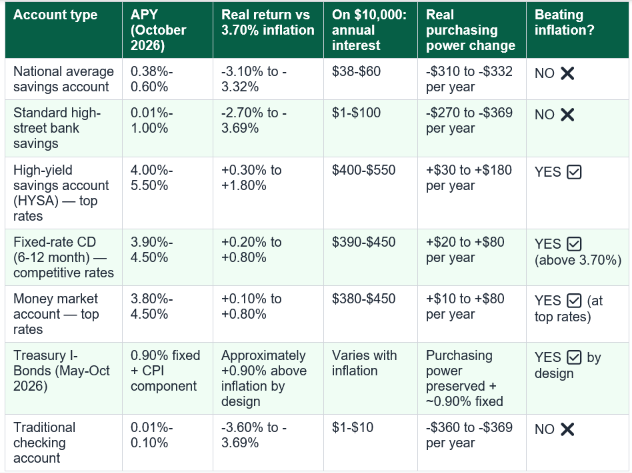
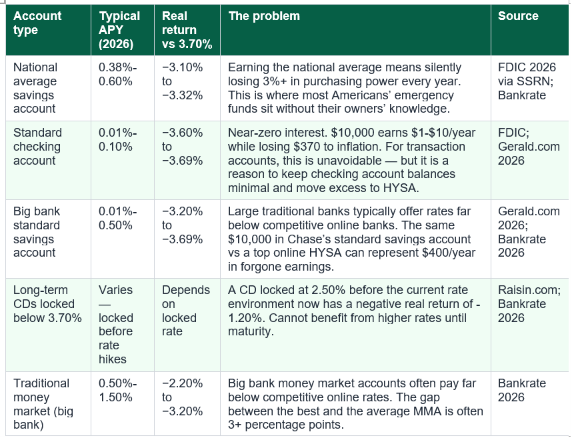
Equally important to identify: the accounts that are failing to beat September’s 3.70% inflation threshold.
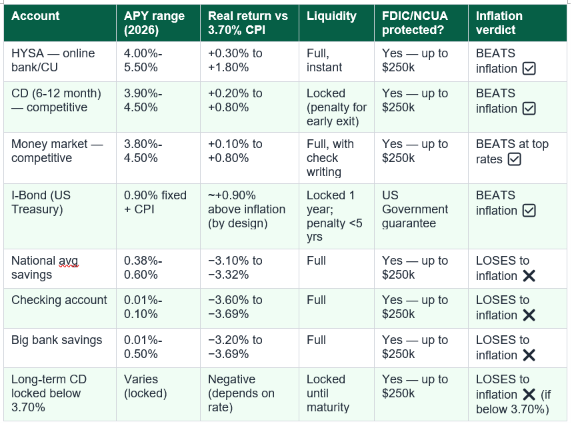
The Comparison Table: Every Account Type vs 3.70% Inflation
Source: Raisin.com October 14, 2026; Bankrate 2026; Wealthvieu 2026; Gerald.com 2026; SSRN June 2026. All rates approximate and change daily. Not financial advice. Verify before opening any account.
UK Note: The Same Maths, Different Numbers
UK savers face an equivalent calculation with different rate figures. UK CPI inflation in 2026 has been tracking the Bank of England’s gradual disinflation path, but the core principle is identical: any savings account earning below the current UK CPI rate is losing real purchasing power. The best UK cash ISA and fixed-rate bond rates in 2026 are approximately 4.50%-5.00%+ from competitive online providers, placing them in similar inflation-beating territory to their US equivalents. The ISA’s additional advantage: interest earned within the £20,000 annual ISA allowance is completely tax-free, improving the after-tax real return compared to a taxable savings account. Standard UK savings account rates at high-street banks remain far below these competitive rates — the same gap exists as in the US. The same advice applies: compare the ongoing rate of your savings account against the current UK CPI figure (available at ons.gov.uk), and switch to a competitive cash ISA or fixed-rate bond if your rate falls below the inflation threshold.Conclusion
The September 2026 CPI report at 3.70% did not change the fundamental savings landscape — it made the importance of where your money sits more urgent. The gap between the national average savings rate (0.38%-0.60%) and the best available HYSA or CD rates (4.00%-5.50%) is larger than at almost any point in recent history. Bankrate’s Ted Rossman put it directly: ‘There is a huge gap between the best rates and the national averages, and the best rates are still beating inflation.’ The decision to move savings from a standard bank account to an online HYSA or a competitive CD takes approximately twenty minutes and produces a rate improvement of 3 to 4 percentage points in most cases. On $20,000, that difference is approximately $600 to $800 per year in additional interest — from a single account switch, not from any investment or risk-taking. Gerald.com’s guidance is practical and precise: ‘Revisit your account rates every 6 months — banks quietly drop rates and most people never notice.’ With inflation at 3.70% and Bankrate projecting that the Fed may cut rates further before year-end, the window for locking in inflation-beating CD rates may narrow. The time to act is the moment after reading this article, not six months from now.Frequently Asked Questions
What is the current US inflation rate as of October 2026?The Bureau of Labor Statistics released the September 2026 Consumer Price Index report on October 14, 2026. Headline CPI inflation came in at 3.70% on an annual basis, according to Raisin.com's breakdown of the BLS data. This was an acceleration from earlier 2026 readings of approximately 2.4%-2.8%, largely driven by a 5.20% surge in energy prices. Core CPI (excluding food and energy) is approximately 3.0%-3.2% annually (Wealthvieu 2026). This 3.70% headline figure is the threshold: any savings account or CD earning below 3.70% APY is losing real purchasing power.
What savings account rate beats 3.70% inflation?
Any account earning above 3.70% APY before taxes is generating a positive real return against September 2026 inflation. Raisin.com's October 14, 2026 analysis confirms that top high-yield savings accounts and fixed-rate CDs offering 4.50%-5.00%+ are currently outpacing inflation. Bankrate's Ted Rossman's 2026 forecast confirms that the best savings rates are still well above the inflation rate. The national average (0.38%-0.60%) is far below the threshold and should not be accepted as the default. Not financial advice — verify current rates before opening any account.
Should I choose a HYSA or a CD in the current environment?
Wealthvieu's 2026 deposit account guide recommends the combination: emergency fund in HYSA (fully liquid, currently 4.00%-5.50%), extra savings you won't need for 12+ months in a CD (locked-in rate, currently 3.90%-4.50%). The case for HYSA: full liquidity, still beating inflation. The case for CD: rate certainty — a CD locked at 4.30% today stays at 4.30% for its entire term even if the Fed cuts rates and HYSA rates fall to 3.75%. Bankrate's 2026 CD forecast makes the case for locking in: 'Right now can be a good time to lock in a CD rate, as high APYs are still outpacing inflation and are likely to drop in 2026.' The practical rule: money you might need = HYSA. Money you won't need for a defined period = CD.
Are I-Bonds a good inflation hedge right now?
Series I Bonds remain a structurally sound inflation hedge for the portion of savings within the $10,000 annual purchase limit. The SSRN June 2026 academic research confirms the I-Bond's structure for May-October 2026 issuances: 0.90% fixed rate plus a variable component tied to CPI. This means the I-Bond rate adjusts automatically if inflation rises further. At current top HYSA rates of 4.50%+ versus 3.70% inflation, the I-Bond's real return (+0.90% by design) is slightly below the HYSA's real return (+0.80% pre-tax). However, if inflation re-accelerates, the I-Bond rate adjusts while the HYSA rate may not. The I-Bond is best used as a complement to a HYSA and CD strategy, not as a replacement. Its liquidity restrictions (1-year minimum, 3-month interest penalty if redeemed before 5 years) make it unsuitable for emergency funds.
When should I review my savings account rate?
Gerald.com's 2026 savings account guide is specific: 'Revisit your account rates every 6 months — banks quietly drop rates and most people never notice.' Wealthvieu recommends the same cadence. The practical implementation: set a calendar reminder for April and October each year (when the Fed typically meets and makes rate decisions) to check your account rate against the current CPI figure. The real return formula is simple: your rate minus the current inflation rate. If the result is negative, switch. Bankrate's rate comparisons and NerdWallet's HYSA tracker are free tools for comparing current rates in real time.
0 Comments
Be the first to share your thoughts on this article.