
Savings
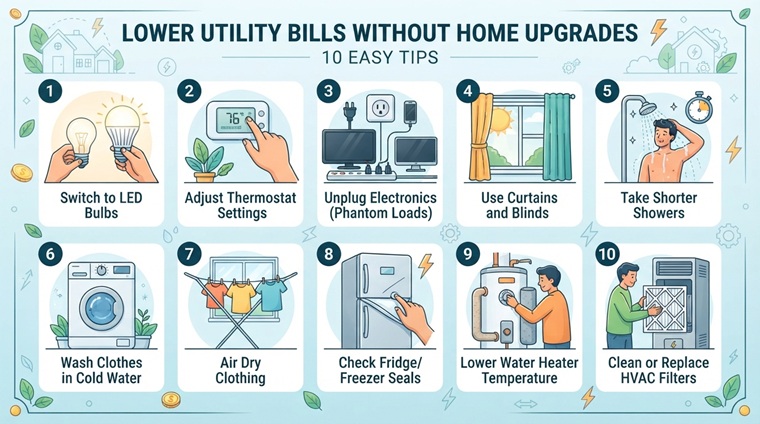
Lower Utility Bills Without Home Upgrades: 10 Easy Tips

Your utility bills arrive every month without asking permission, but most households treat them as fixed costs rather than variable ones. They are not fixed. The Energy Information Administration forecasts the average residential summer electricity bill will reach $192 per month in 2026 — up 3.7% from 2025 — even as average electricity use actually declines. That means utility rates are rising faster than consumption is falling, and the gap between what you currently pay and what you could pay is significant. The good news: you do not need to renovate your home, replace your appliances, or install solar panels to produce meaningful reductions in your monthly utility bills. You need to understand where the money goes — heating and cooling alone account for nearly half of all home energy use — and apply a set of low-cost, low-effort interventions that consistently deliver measurable results. The ten strategies in this article cost between nothing and $30. Some take five minutes. All of them work.
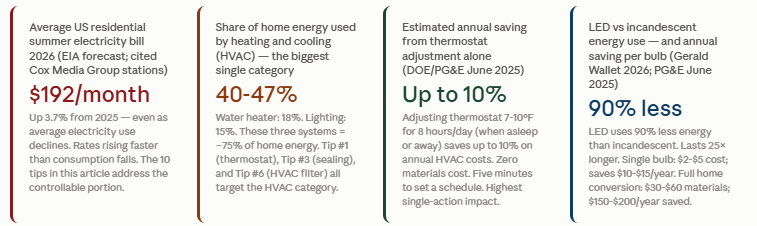
The response most households are not taking is to reduce consumption in the categories that make the biggest difference. Heating and cooling account for nearly half of all home energy use. The water heater accounts for another 18%. Lighting takes 15%. Together, these three systems account for roughly 75% of residential energy consumption — and all three can be meaningfully reduced with no renovation, no contractor, and no capital investment beyond a few dollars in materials and an hour of attention. This article addresses exactly those interventions. Not financial advice.
Average residential summer electricity bill: $192/month in 2026, up 3.7% from 2025 (EIA forecast; Cox Media Group stations 2026). Home energy use breakdown: HVAC heating/cooling 40-47%; water heater 18%; lighting 15%. Average monthly US utilities: electricity $117-$192; natural gas $60-$100; water $40-$75; internet $50-$80 (Gerald Wallet 2026). Sources cited. Not financial advice.
The practical implication of this breakdown is a priority ranking. If you make every single change in the lighting category, you can affect at most 15% of your bill. If you make a meaningful change in heating and cooling — which requires nothing more than a thermostat schedule and some cheap weatherstripping — you can affect nearly half of it. The tips in this article are ordered approximately by impact potential. The highest-impact tips come first. Not all will apply to every home, but the ones that do apply produce their results regardless of climate, home size, or renter/owner status. Not financial advice.
PG&E (June 18, 2025): 'Heating and cooling account for a significant portion of home energy use, so adjusting your thermostat — even slightly — can yield major savings.' Gerald Wallet (2026): 'Small behavioral changes (smart thermostats, LED bulbs, shorter showers) can meaningfully reduce monthly utility costs without major renovations.' EIA/Cox Media Group stations (2026): 'Implementing smart habits can lower bills without sacrificing comfort.' Source: PG&E June 2025; Gerald Wallet 2026; Cox Media Group affiliates 2026. Not financial advice.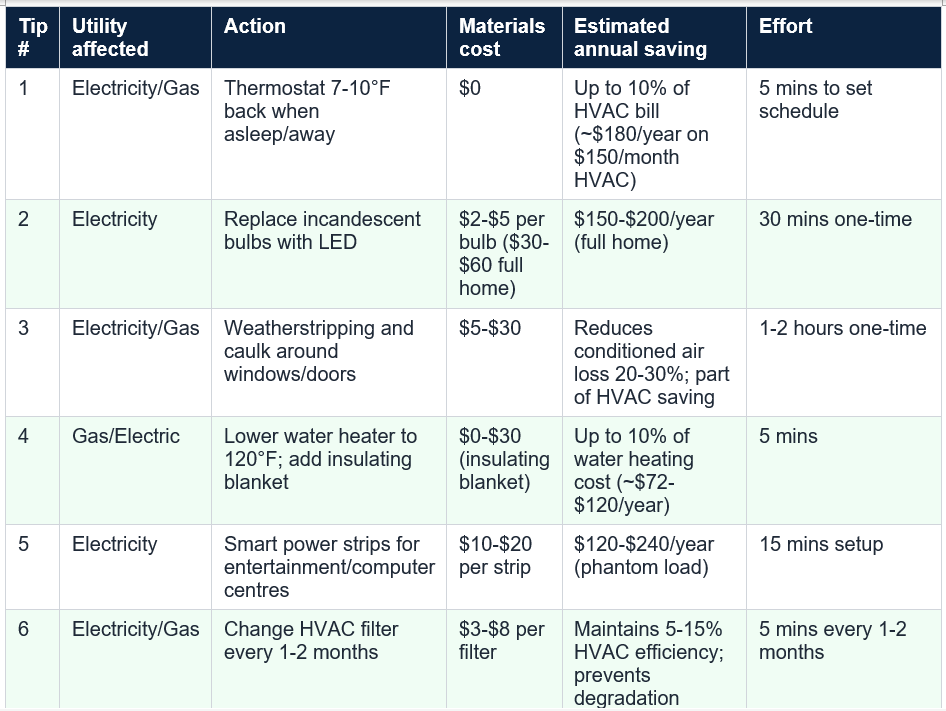
The EIA’s 2026 forecast makes the urgency clear: the average summer electricity bill is now $192 per month, up 3.7% from last year, and the trend is not reversing. The utility rate environment of 2026 rewards households that have addressed their controllable energy waste and penalises those that have not. The place to start is the thermostat — because heating and cooling is nearly half the bill, and a schedule adjustment costs nothing and can save up to 10% immediately. Then LED bulbs. Then weatherstripping. Then the water heater. Then the power strips. Each completed tip reduces the bill a little more. The compounding of multiple small reductions produces the most significant outcomes.
Based on the data compiled in this article from PG&E (June 2025), Gerald Wallet (2026), and EIA/Cox Media Group (2026), a household that implements five to seven of the ten tips in this article can realistically expect annual utility savings of $400-$800, depending on their starting consumption levels, local utility rates, and home size. The highest-impact individual changes are thermostat scheduling (up to 10% of the HVAC bill, which represents 40-47% of total energy use), LED lighting conversion ($150-$200/year), phantom load elimination via power strips ($120-$240/year), and negotiating internet rates ($120-$240/year). These four changes alone, with a materials cost of $50-$80, can produce $400-$680 in annual savings before any other changes. None requires renovation, professional installation, or significant disruption. Not financial advice. Individual results vary.
What is the single biggest way to reduce an electricity bill?
Adjusting the thermostat schedule is consistently identified as the highest-impact single action because heating and cooling account for nearly half of a home's total energy use (40-47% per Gerald Wallet 2026; EIA data). Setting the thermostat back 7-10°F for 8 hours per day — when asleep or away — can save up to 10% on annual heating and cooling costs, according to Department of Energy guidance cited by PG&E in June 2025. On a $150/month combined HVAC-related electricity and gas bill, this produces approximately $180 per year in savings at zero cost. The EIA forecast for average summer electricity bills in 2026 is $192 per month — up 3.7% from 2025 — making the HVAC category both the largest share of the bill and the fastest-growing. Source: PG&E June 2025; Gerald Wallet 2026; Cox Media Group/EIA 2026. Not financial advice.
Does switching to LED bulbs really make a noticeable difference?
Yes, particularly for households that still have incandescent or older CFL bulbs. LED bulbs use up to 90% less energy than incandescent bulbs and last 25 times longer (PG&E June 2025; assetbar March 2026). Lighting accounts for approximately 15% of a typical home's electricity usage (PG&E June 2025). A single LED bulb costs $2-$5 and saves $10-$15 annually compared to an equivalent incandescent (Gerald Wallet 2026). A full home conversion for a typical three-bedroom property costs $30-$60 in new bulbs and can save $150-$200 per year in electricity. LED bulbs are now manufactured to closely replicate the warm colour temperature of incandescent bulbs, so no sacrifice in light quality is involved in most residential applications. The change is purely financial. Sources: PG&E June 2025; Gerald Wallet 2026; assetbar March 2026. Not financial advice.
What is phantom load and how much does it cost?
Phantom load (also called standby power or vampire energy) is the electricity consumed by devices that are plugged in but not actively in use — televisions, gaming consoles, chargers, desktop computers, kitchen appliances with displays, and smart home devices. These devices draw a small but continuous current that adds up across a typical home. Gerald Wallet's 2026 utility guide estimates that a basic power strip costing $10-$20 can save $10-$20 per month when used to cut power to idle devices — $120-$240 per year. PG&E's June 2025 guide recommends smart power strips that cut power automatically when a connected main device enters standby. Academic estimates suggest standby power accounts for 5-10% of residential electricity consumption. The fix requires no behaviour change after the initial setup: plug entertainment centres and computer stations into smart power strips and let them manage the standby power automatically. Sources: Gerald Wallet 2026; PG&E June 2025. Not financial advice.
Can renters use these tips, or are they only for homeowners?
Almost all of the ten tips in this article apply equally to renters and homeowners. Thermostat scheduling (Tip #1), LED bulb replacement (Tip #2), faucet aerators (Tip #7), off-peak appliance timing (Tip #8), requesting a utility energy audit (Tip #9), and negotiating internet rates (Tip #10) are all fully available to renters with no landlord permission required. Weatherstripping and caulk (Tip #3) can be done by renters using removable weatherstripping tape that leaves no residue, and window insulation film is also temporary and removable. Water heater temperature (Tip #4) may require landlord permission in some rental situations, but many renters can access the water heater thermostat independently. HVAC filter changes (Tip #6) are typically a renter responsibility. Power strips (Tip #5) require no permission. Gerald Wallet's 2026 guide notes that basic programmable thermostats ($30-$50) are appropriate even for renters or those hesitant about upfront costs. Sources: Gerald Wallet 2026; PG&E June 2025. Not financial or tenancy advice.
Table of Contents
- Why Your Utility Bills Are Higher Than They Should Be
- Where Home Energy Actually Goes: The Breakdown
- Tip #1 [THERMOSTAT]: Adjust Your Thermostat Schedule — The Biggest Single Habit Change
- Tip #2 [LED LIGHTING]: Replace Every Remaining Incandescent Bulb With LED
- Tip #3 [AIR SEALING]: Seal Draughts Around Windows and Doors With Weatherstripping
- Tip #4 [WATER HEATER]: Lower Your Water Heater Temperature to 120°F
- Tip #5 [PHANTOM LOAD]: Eliminate Standby Power With Power Strips and Smart Plugs
- Tip #6 [HVAC FILTERS]: Change Your HVAC Filter Every 1-2 Months
- Tip #7 [WATER]: Fix Leaky Faucets and Install Low-Flow Fixtures
- Tip #8 [PEAK RATES]: Shift High-Use Appliances Away From Peak Rate Hours
- Tip #9 [AUDITS AND PROGRAMS]: Request a Free Utility Energy Audit
- Tip #10 [INTERNET AND SUBSCRIPTIONS]: Negotiate or Switch Your Internet and Subscription Services
- The Complete Utility Savings Checklist
- Conclusion: Start With the Thermostat. Build From There.
- Frequently Asked Questions
Why Your Utility Bills Are Higher Than They Should Be
There is a specific reason utility bills feel like they are increasing without obvious cause: they are. The Energy Information Administration forecasts the average residential summer electricity bill will reach $192 per month in 2026, up 3.7% from 2025 — and the explanation is that this rise is happening even as average electricity use declines. Rates are rising faster than households are cutting consumption. The gap is structural: ageing grid infrastructure, increased demand from data centres and electric vehicles, and general energy market conditions are all pushing rates upward regardless of what individual households do.The response most households are not taking is to reduce consumption in the categories that make the biggest difference. Heating and cooling account for nearly half of all home energy use. The water heater accounts for another 18%. Lighting takes 15%. Together, these three systems account for roughly 75% of residential energy consumption — and all three can be meaningfully reduced with no renovation, no contractor, and no capital investment beyond a few dollars in materials and an hour of attention. This article addresses exactly those interventions. Not financial advice.
Average residential summer electricity bill: $192/month in 2026, up 3.7% from 2025 (EIA forecast; Cox Media Group stations 2026). Home energy use breakdown: HVAC heating/cooling 40-47%; water heater 18%; lighting 15%. Average monthly US utilities: electricity $117-$192; natural gas $60-$100; water $40-$75; internet $50-$80 (Gerald Wallet 2026). Sources cited. Not financial advice.
Where Home Energy Actually Goes: The Breakdown
Understanding which systems in your home consume the most energy is the foundation of effective utility bill management. Without this picture, it is easy to focus on low-impact changes (turning off lights) while ignoring high-impact ones (the thermostat). The data is consistent across multiple 2026 sources: heating and cooling is the dominant category at 40-47% of total home energy use, the water heater is second at approximately 18%, and lighting is third at approximately 15%. Together these three categories account for roughly 75% of residential energy consumption.The practical implication of this breakdown is a priority ranking. If you make every single change in the lighting category, you can affect at most 15% of your bill. If you make a meaningful change in heating and cooling — which requires nothing more than a thermostat schedule and some cheap weatherstripping — you can affect nearly half of it. The tips in this article are ordered approximately by impact potential. The highest-impact tips come first. Not all will apply to every home, but the ones that do apply produce their results regardless of climate, home size, or renter/owner status. Not financial advice.
PG&E (June 18, 2025): 'Heating and cooling account for a significant portion of home energy use, so adjusting your thermostat — even slightly — can yield major savings.' Gerald Wallet (2026): 'Small behavioral changes (smart thermostats, LED bulbs, shorter showers) can meaningfully reduce monthly utility costs without major renovations.' EIA/Cox Media Group stations (2026): 'Implementing smart habits can lower bills without sacrificing comfort.' Source: PG&E June 2025; Gerald Wallet 2026; Cox Media Group affiliates 2026. Not financial advice.
T#1 [THERMOSTAT]: Adjust Your Thermostat Schedule — The Biggest Single Habit Change
Heating and cooling account for nearly half of a home’s entire energy use — approximately 40-47% of the total, according to Gerald Wallet’s 2026 utility guide and EIA data cited by multiple Cox Media Group affiliates. This means the thermostat is the most powerful single control in your home, and adjusting the schedule around your actual presence is the single most impactful no-cost habit change available. The Department of Energy’s guidance, cited by PG&E in June 2025, is specific: setting the thermostat back 7-10°F for eight hours per day — when you are asleep or away — can save up to 10% on heating and cooling per year. In winter, keep the home at 68°F when awake and present, and let it drop by 7-10°F overnight and during work hours. In summer, raise the target temperature when the home is empty and cool it before you return. The logic is simple: every degree of heating or cooling you are not using costs money. The EIA forecasts the average residential summer electricity bill will reach $192 per month in 2026 — up 3.7% from 2025 — even as average electricity use declines. That figure reflects rising rates, not rising consumption. The thermostat is the fastest and cheapest way to push back against it.#2 [LED LIGHTING]: Replace Every Remaining Incandescent Bulb With LED
Lighting accounts for approximately 15% of a typical home’s electricity usage, according to PG&E’s June 2025 utility savings guide. If any incandescent bulbs remain in your home, replacing them with LED is one of the clearest positive-return investments in home utility management. A single LED bulb costs between $2 and $5 and saves between $10 and $15 annually in electricity compared to an equivalent incandescent (Gerald Wallet 2026). LEDs use up to 90% less energy and last 25 times longer than incandescent bulbs (assetbar/SearchAtlas March 2026; PG&E June 2025). A typical home that has not yet fully converted can reduce its lighting electricity consumption by 75-85% through a complete LED switch, adding up to $150-$200 in annual savings on average. The upfront cost is minimal — a full home conversion for a typical three-bedroom property can be accomplished for $30-$60 in new bulbs. Most LED bulbs are now designed to replicate the warm colour temperature of incandescent bulbs, so the visual difference is imperceptible in most installations. There is no sacrifice involved. This is purely a financial optimisation.#3 [AIR SEALING]: Seal Draughts Around Windows and Doors With Weatherstripping
Air leaks around windows and doors are a silent and continuous drain on your heating and cooling budget. Warm or cool air escapes through the gaps you cannot see; conditioned air you have paid to heat or cool leaks out and is replaced by unconditioned air from outside. Cox Media Group affiliate stations, citing EIA data in 2026, identify sealing with weatherstripping or caulk as one of the most cost-effective ways to reduce heating and cooling costs. Gerald Wallet’s 2026 utility guide notes that small behavioural changes and cheap fixes — including air sealing — show up immediately on the bill. The materials cost almost nothing: a roll of weatherstripping runs $5-$15; a tube of weatherproof caulk is $3-$8. The installation requires no professional skills — weatherstripping peels and sticks; caulk applies with a basic gun. The impact can be meaningful: a poorly sealed home can lose 20-30% of its conditioned air through draughts, and sealing the most significant gaps can reduce that loss substantially. For renters who cannot make permanent changes, removable draught excluders and window insulation film are available at hardware stores for under $20 and can be removed without damage.#4 [WATER HEATER]: Lower Your Water Heater Temperature to 120°F
Most water heaters are factory-set to 140°F — a temperature hotter than needed for any normal household use and hotter than recommended by the Consumer Product Safety Commission for households with children under five. Lowering the temperature to 120°F saves between 3% and 5% on energy costs (Gerald Wallet 2026) and, when combined with insulating the water heater tank and exposed hot water pipes with inexpensive insulating blankets or foam sleeves, can save up to 10% on water heating costs overall (PG&E June 2025). The water heater accounts for approximately 18% of a home’s total energy use, according to Gerald Wallet’s 2026 guide. At 18% of the bill, a 10% reduction in water heating costs translates to approximately 1.8% of the total utility bill — a small but guaranteed annual saving achieved with a five-minute adjustment to a dial. The practical downside: virtually none. Most people cannot distinguish 120°F from 140°F water in normal use. Hot showers, dishwashers, and washing machines all function normally at 120°F. The only exception is households where someone has a suppressed immune system and higher temperature may be recommended for safety — always verify with a healthcare provider in that case.#5 [PHANTOM LOAD]: Eliminate Standby Power With Power Strips and Smart Plugs
Phantom load — also called standby power or vampire energy — is the electricity consumed by devices when they are switched off but still plugged in. Televisions, game consoles, chargers, desktop computers, and kitchen appliances all draw power continuously when plugged in, even when not actively used. Gerald Wallet’s 2026 guide estimates that a basic power strip costs $10-$20 but can save $10-$20 monthly when used to cut power to idle devices, totalling $120-$240 per year. Smart power strips — which automatically cut power when a connected main device goes into standby — automate this behaviour without requiring anyone to manually switch anything off. The strategy is straightforward: plug entertainment centres (TV, soundbar, streaming device, game console) into a single smart power strip controlled by the TV’s on/off status; plug desktop computers and monitors into a second strip; plug phone and tablet chargers into a third that you switch off at night. The cognitive overhead is minimal once the strips are installed. For households that consistently leave multiple devices in standby, the annual saving can be substantial. The Journal of Industrial Ecology estimates that standby power accounts for 5-10% of residential electricity use in developed countries.#6 [HVAC FILTERS]: Change Your HVAC Filter Every 1-2 Months
A dirty HVAC filter forces the heating and cooling system to work harder to move air through the home. The harder the system works, the more energy it uses, and the faster the mechanical components wear out. PG&E’s June 2025 utility savings guide recommends changing HVAC filters regularly, and Gerald Wallet’s 2026 guide notes that clean filters equal lower bills plus better indoor air quality. The general guidance for most homes is to replace the filter every one to two months, depending on household composition (pets and multiple occupants mean faster filter clogging). Standard 1-inch filters cost $3-$8. This is one of the lowest-cost, highest-consistency utility savings available: a $5 filter changed every two months costs $30 per year and can maintain HVAC efficiency that would otherwise degrade by 5-15% as the filter restricts airflow. For households that have not checked their filter recently, pulling it out for inspection often reveals the problem immediately — a grey, clogged filter that has been restricting airflow for months. Replacing it costs five minutes and $5.#7 [WATER]: Fix Leaky Faucets and Install Low-Flow Fixtures
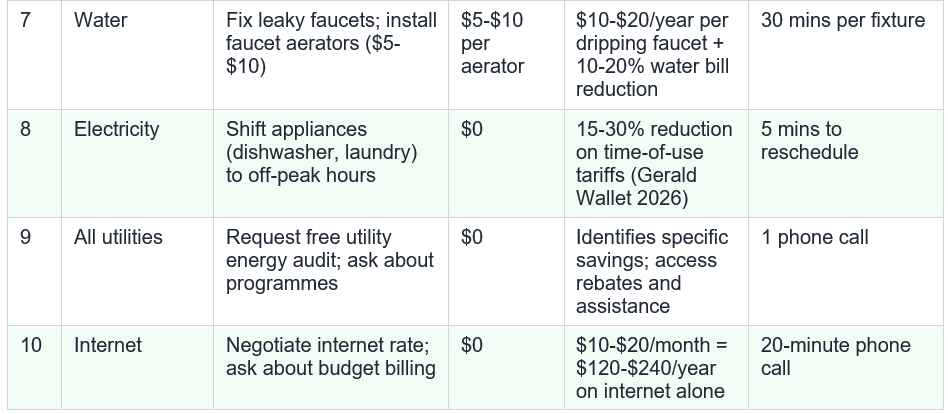
A leaky faucet is not a minor annoyance. A faucet dripping once per second wastes approximately 3,000 gallons of water per year. At average US water rates, that single dripping tap can add $10-$20 to the annual water bill. Multiple leaky fixtures multiply the waste and the cost. PG&E, wsoctv.com, and multiple Cox Media Group affiliate stations all identify fixing leaky faucets as an immediate bill-reducing action for homeowners and, where permitted, renters. Beyond repair, low-cost water-saving fixtures reduce consumption without the experience of reduced pressure or comfort. Faucet aerators, which cost $5-$10 each, reduce water flow by mixing air into the stream — the flow feels the same because the pressure is maintained, but the water volume is reduced by 30-50% (Gerald Wallet 2026). Low-flow showerheads, cited by Cox Media Group affiliate stations in 2026, reduce water usage without sacrificing the shower experience. The combination of fixing leaks and installing aerators can reduce household water bills by 10-20%. Washing laundry in cold water rather than hot also delivers meaningful energy savings per load without requiring any equipment change.#8 [PEAK RATES]: Shift High-Use Appliances Away From Peak Rate Hours
Many US utility providers now use time-of-use (TOU) pricing, where electricity costs significantly more during peak demand hours — typically 4-9 PM on weekdays — than during off-peak periods. Gerald Wallet’s 2026 guide notes that tracking usage patterns and adjusting habits during peak-rate hours can lower the electricity bill by 15-30%. The practical implementation requires very little behaviour change: run the dishwasher overnight rather than immediately after dinner; schedule the washing machine and dryer to run in the morning before 4 PM or late at night; charge devices and electric vehicles overnight. Most modern appliances have delay-start functions specifically for this purpose. The first step is to check whether your utility uses time-of-use pricing — not all do, and the savings are irrelevant if you are on a flat rate. If you are on a TOU tariff, even moving two appliance cycles per day to off-peak hours can produce meaningful savings at the end of the month. If you are unsure whether your utility has a TOU option, it is worth calling to ask, as opting into TOU pricing is sometimes voluntary and can benefit households where daytime consumption is low.#9 [AUDITS AND PROGRAMS]: Request a Free Utility Energy Audit
One of the most underused utility cost tools is the free home energy audit, which many utility companies offer at no charge to customers. Gerald Wallet’s 2026 utility guide notes that many utility companies offer these free audits, and they can identify specific sources of energy waste in your home that general guidance cannot. A utility energy audit typically involves a trained technician who uses blower door tests and thermal imaging to pinpoint where conditioned air is escaping, where insulation is insufficient, and which appliances are using more energy than they should. The output is a specific, prioritised list of improvements, typically starting with the free or cheap ones and moving to larger investments. Beyond audits, Gerald Wallet’s 2026 guide identifies two additional programs worth investigating: budget billing, which smooths utility costs evenly across twelve months to eliminate seasonal bill spikes, and low-income assistance programs that may provide credits, reduced rates, or free efficiency upgrades. Even households who do not qualify for low-income programs may qualify for rebates on LED bulbs, smart thermostats, or efficient appliances through their utility’s energy efficiency incentive programmes.#10 [INTERNET AND SUBSCRIPTIONS]: Negotiate or Switch Your Internet and Subscription Services
Internet bills are a utility that most households pay without reviewing the rate they are on or the alternatives available. The typical US household pays $50-$80 per month for broadband internet (Gerald Wallet 2026). In most markets, multiple providers compete for customers, and loyalty does not typically produce lower rates — it produces the opposite, as introductory rates expire and prices drift upward. A simple annual exercise: call your internet provider and ask what the best available rate is for your service level. Mention that you are reviewing alternatives. In many cases, a single phone call produces a retention offer that reduces the monthly bill by $10-$20 without any change in service. If not, comparison sites for internet providers exist in most markets and can identify competitors. Beyond internet, review all recurring household service costs annually: insurance (home, car, renters), phone, and any ongoing service contracts. Gerald Wallet’s 2026 guide notes that asking your utility about rate options is always worth the call. Budget billing, off-peak rate switching, and available rebate programmes are all things most households never ask about and would benefit from knowing.13. The Complete Utility Savings Checklist
Conclusion
The ten strategies in this article have a combined savings potential of hundreds of dollars per year in a typical US household, with a total materials cost of $50-$100 and a time investment of a few hours across the first month. None of them require a contractor. None require structural changes to the home. None will be noticed in terms of reduced comfort, because the tips have been chosen specifically to preserve comfort while reducing waste.The EIA’s 2026 forecast makes the urgency clear: the average summer electricity bill is now $192 per month, up 3.7% from last year, and the trend is not reversing. The utility rate environment of 2026 rewards households that have addressed their controllable energy waste and penalises those that have not. The place to start is the thermostat — because heating and cooling is nearly half the bill, and a schedule adjustment costs nothing and can save up to 10% immediately. Then LED bulbs. Then weatherstripping. Then the water heater. Then the power strips. Each completed tip reduces the bill a little more. The compounding of multiple small reductions produces the most significant outcomes.
Frequently Asked Questions
How much can I realistically save on utility bills without renovating?Based on the data compiled in this article from PG&E (June 2025), Gerald Wallet (2026), and EIA/Cox Media Group (2026), a household that implements five to seven of the ten tips in this article can realistically expect annual utility savings of $400-$800, depending on their starting consumption levels, local utility rates, and home size. The highest-impact individual changes are thermostat scheduling (up to 10% of the HVAC bill, which represents 40-47% of total energy use), LED lighting conversion ($150-$200/year), phantom load elimination via power strips ($120-$240/year), and negotiating internet rates ($120-$240/year). These four changes alone, with a materials cost of $50-$80, can produce $400-$680 in annual savings before any other changes. None requires renovation, professional installation, or significant disruption. Not financial advice. Individual results vary.
What is the single biggest way to reduce an electricity bill?
Adjusting the thermostat schedule is consistently identified as the highest-impact single action because heating and cooling account for nearly half of a home's total energy use (40-47% per Gerald Wallet 2026; EIA data). Setting the thermostat back 7-10°F for 8 hours per day — when asleep or away — can save up to 10% on annual heating and cooling costs, according to Department of Energy guidance cited by PG&E in June 2025. On a $150/month combined HVAC-related electricity and gas bill, this produces approximately $180 per year in savings at zero cost. The EIA forecast for average summer electricity bills in 2026 is $192 per month — up 3.7% from 2025 — making the HVAC category both the largest share of the bill and the fastest-growing. Source: PG&E June 2025; Gerald Wallet 2026; Cox Media Group/EIA 2026. Not financial advice.
Does switching to LED bulbs really make a noticeable difference?
Yes, particularly for households that still have incandescent or older CFL bulbs. LED bulbs use up to 90% less energy than incandescent bulbs and last 25 times longer (PG&E June 2025; assetbar March 2026). Lighting accounts for approximately 15% of a typical home's electricity usage (PG&E June 2025). A single LED bulb costs $2-$5 and saves $10-$15 annually compared to an equivalent incandescent (Gerald Wallet 2026). A full home conversion for a typical three-bedroom property costs $30-$60 in new bulbs and can save $150-$200 per year in electricity. LED bulbs are now manufactured to closely replicate the warm colour temperature of incandescent bulbs, so no sacrifice in light quality is involved in most residential applications. The change is purely financial. Sources: PG&E June 2025; Gerald Wallet 2026; assetbar March 2026. Not financial advice.
What is phantom load and how much does it cost?
Phantom load (also called standby power or vampire energy) is the electricity consumed by devices that are plugged in but not actively in use — televisions, gaming consoles, chargers, desktop computers, kitchen appliances with displays, and smart home devices. These devices draw a small but continuous current that adds up across a typical home. Gerald Wallet's 2026 utility guide estimates that a basic power strip costing $10-$20 can save $10-$20 per month when used to cut power to idle devices — $120-$240 per year. PG&E's June 2025 guide recommends smart power strips that cut power automatically when a connected main device enters standby. Academic estimates suggest standby power accounts for 5-10% of residential electricity consumption. The fix requires no behaviour change after the initial setup: plug entertainment centres and computer stations into smart power strips and let them manage the standby power automatically. Sources: Gerald Wallet 2026; PG&E June 2025. Not financial advice.
Can renters use these tips, or are they only for homeowners?
Almost all of the ten tips in this article apply equally to renters and homeowners. Thermostat scheduling (Tip #1), LED bulb replacement (Tip #2), faucet aerators (Tip #7), off-peak appliance timing (Tip #8), requesting a utility energy audit (Tip #9), and negotiating internet rates (Tip #10) are all fully available to renters with no landlord permission required. Weatherstripping and caulk (Tip #3) can be done by renters using removable weatherstripping tape that leaves no residue, and window insulation film is also temporary and removable. Water heater temperature (Tip #4) may require landlord permission in some rental situations, but many renters can access the water heater thermostat independently. HVAC filter changes (Tip #6) are typically a renter responsibility. Power strips (Tip #5) require no permission. Gerald Wallet's 2026 guide notes that basic programmable thermostats ($30-$50) are appropriate even for renters or those hesitant about upfront costs. Sources: Gerald Wallet 2026; PG&E June 2025. Not financial or tenancy advice.
0 Comments
Be the first to share your thoughts on this article.