

Savings
We've Spent a Lifetime Saving — Now What?
Only 29% of pre-retirees have a plan for withdrawing money in retirement. The financial industry spent forty years teaching you how to save. It spent almost no time teaching you how to spend. Married retirees with $100,000 or more in assets withdraw just 2.1% per year from their savings — while the Morningstar-tested safe rate is 3.9%. They are leaving $18,000 a year in uncaptured income on a $1 million portfolio, out of fear that the number will go down. This guide is about the other side of retirement — the part nobody prepares you for.
Fund You's comprehensive decumulation guide, published June 28, 2026, describes the gap plainly: 'The financial industry spent 40 years teaching you how to save. It spent almost zero time teaching you how to spend.' The result is a generation of savers who have done everything right — maxed their 401(k)s, reinvested their dividends, stayed the course through market crashes — and now sit at retirement with significant assets and no coherent plan for converting them into income.
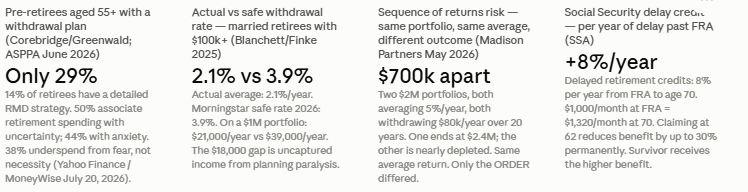
The data confirms the gap. Only 29% of pre-retirees aged 55 or older have a plan for withdrawing money in retirement, according to the Corebridge Decumulation Planning Gap Study conducted by Greenwald Research in late 2025 and cited by ASPPA in June 2026. A 2025 study in the Financial Planning Review by David Blanchett and Michael Finke found that married 65-year-olds with at least $100,000 in assets withdraw just 2.1% per year from their retirement accounts — while Morningstar's 2026 State of Retirement Income report suggests 3.9% is the safe starting rate for a 90% probability of not running out over 30 years. That gap between 2.1% and 3.9% represents approximately $18,000 per year in uncaptured income on a $1 million portfolio. Retirees who worked decades for financial security are living below the level that security could provide.
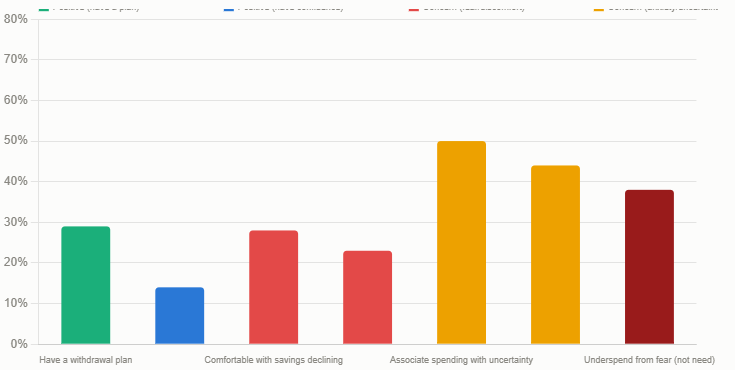
Only 29% of pre-retirees aged 55+ have a plan for withdrawing money in retirement (Corebridge/Greenwald Research; ASPPA June 2026). 14% of retirees have a detailed RMD strategy. 50% associate retirement spending with uncertainty; 44% with anxiety. 38% of retirees underspend from fear, not necessity (Yahoo Finance / MoneyWise July 20, 2026). Actual average withdrawal rate: 2.1%/year (Blanchett/Finke 2025). Morningstar safe rate 2026: 3.9%. Gap: $18,000/year on a $1 million portfolio. Sequence of returns risk: two $2M portfolios with the same 5% average return can end up $700,000 apart based solely on return order (Madison Partners May 2026). 21% of workers and 25% of retirees feel 'very confident' about retirement income sufficiency (EBRI 2026).
Yahoo Finance and MoneyWise's July 20, 2026 reporting on new survey data puts the scale of the paradox in concrete terms: 38% of retirees underspend — not from financial necessity but from fear of shrinking the nest egg. The Corebridge survey of 2,210 adults aged 45-79 with $100,000 or more in investable assets found that only 28% are comfortable with their retirement savings declining to cover living expenses, and 70% say it is very important that their nest egg not shrink. The headline from the research: 'Many retirees never make the descent. It's the retirement paradox: they finally have money to spend, but they protect the balance instead.'
The behavioural finance explanation is well established. Wisdom Wealth Strategies' April 2026 analysis of the EBRI 2026 Retirement Confidence Survey identifies loss aversion as the primary driver: we feel the pain of a loss (a shrinking portfolio balance) approximately twice as intensely as the joy of an equivalent gain. Seeing the number go down feels like failure — even if that is exactly what the money was accumulated for. The result is what Wisdom Wealth calls 'Regret Risk': the very real possibility of reaching the end of life with a large bank account and a long list of missed experiences and unfulfilled dreams.
The Corebridge research offers a powerful counterpoint to the paralysis. Those who have a documented decumulation plan — even a basic one — show dramatically different emotional relationships with retirement spending: those highly confident about managing retirement spending are five times more likely to feel empowered and three times more likely to feel rewarded when drawing down savings, versus those without a plan. The decumulation paradox is not a permanent condition. It is a planning gap. And planning gaps can be closed.
The most important reframe: the goal was never to die with the largest possible balance. The goal was to fund a life. A portfolio that has grown through decades of disciplined saving and compound returns exists for one reason: to be spent, in a tax-efficient, sequentially sensible, inflation-protected way, on the retirement you imagined when you made the sacrifice to save. Not financial advice — but a necessary perspective shift that precedes every effective decumulation plan.
Phase 1 — Bridge to Medicare (Ages 59½ to 65): For retirees who leave the workforce before Medicare eligibility at 65, this phase requires specific planning. Health insurance must be sourced independently — either via COBRA (expensive and time-limited), ACA marketplace plans (income-dependent, can be cost-effective at lower income levels), or a spouse's employer plan. On the income side, this phase often offers the lowest tax bracket years in the decumulation journey: no Medicare IRMAA applies yet, no Social Security if delayed, and RMDs are years away. These are potentially the best years for Roth conversions.
Phase 2 — Pre-RMD Sweet Spot (Ages 65 to 72): Medicare is now in effect. Social Security can be claimed but delaying further increases the eventual benefit at 8% per year of delay up to age 70. RMDs have not yet begun. This is the decumulation 'golden window' for tax planning — similar to the 'golden window' for Roth conversions described in the retirement tax mistakes guide. Withdrawals from traditional IRA/401(k) accounts at controlled rates can fill the lower tax brackets without IRMAA risk, and Roth conversions remain valuable.
Phase 3 — The RMD Era (Ages 73 to 80): Under SECURE 2.0, Required Minimum Distributions begin at age 73 for most current retirees. From this point, the IRS mandates minimum annual withdrawals calculated from account balance and life expectancy tables. Coordinating RMDs with Social Security income and managing the combined impact on Social Security taxability, IRMAA Medicare surcharges, and marginal tax bracket becomes the central financial management task of this phase.
Phase 4 — The Legacy Phase (Ages 80+): Spending typically declines in the later decades of retirement — healthcare costs rise but other spending categories fall. The focus shifts toward estate planning: beneficiary designations, charitable giving strategies, possible trust structures, and long-term care planning if not already addressed. QCDs become increasingly valuable as a tool to redirect mandatory RMD income to charitable causes while removing it from AGI. Fund You's guide notes: 'Simplify. Review estate documents.'
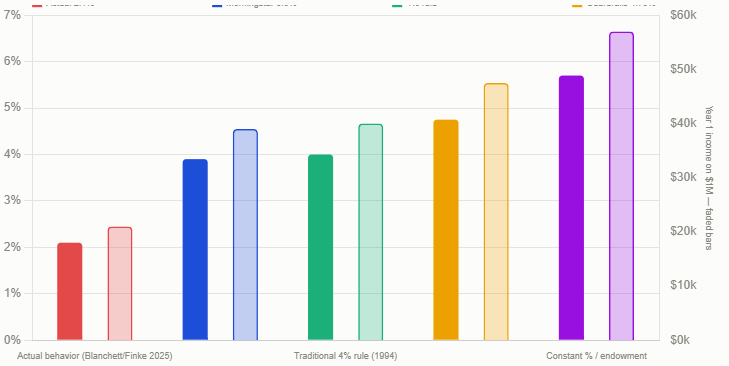
Morningstar's 2026 State of Retirement Income report, published December 2025 and referenced extensively in March 2026 coverage by Yahoo Finance, updates the framework. The report suggests 3.9% is the highest safe starting withdrawal rate for retirees seeking a consistent level of inflation-adjusted spending, assuming a 90% probability of having funds remaining at the end of a 30-year retirement. This is modestly lower than the 4% benchmark — reflecting current equity valuations and the interest rate environment.
But Morningstar's analysis also offers a route to higher withdrawal rates for retirees willing to be flexible. Two strategies tested in the report allow starting withdrawal rates as high as 5.7%: the constant percentage method (withdrawing a fixed percentage of the current portfolio value each year, meaning withdrawals fall when markets fall) and the endowment method (similar principle). These flexible approaches deliver higher spending in good years and require lower spending in bad ones — a trade-off that suits retirees who can adjust their discretionary spending without financial distress.
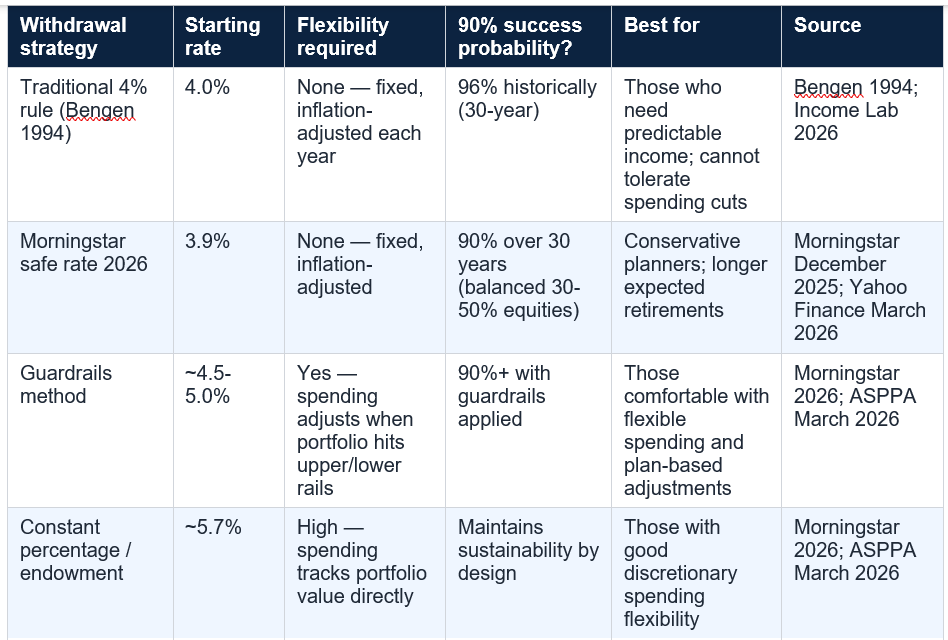
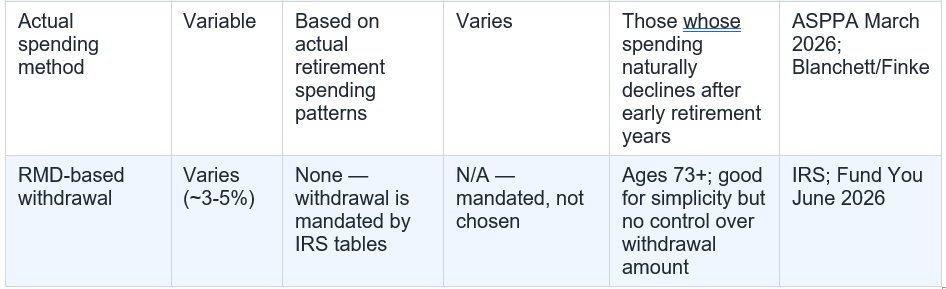
Source: Morningstar December 2025 / March 2026; Yahoo Finance March 1, 2026; ASPPA March 20, 2026; Bengen 1994 cited Income Lab July 2026; Fund You June 2026; Blanchett/Finke 2025. Not financial advice — individual safe withdrawal rates depend on portfolio composition, time horizon, flexibility, and other income sources. Consult a qualified financial adviser.
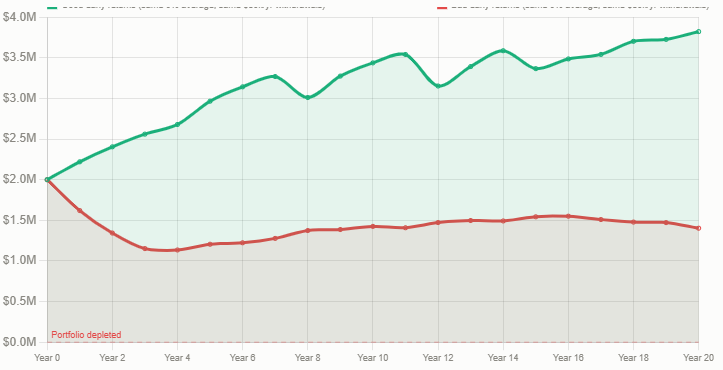
Madison Partners' May 8, 2026 analysis of sequence of returns risk illustrates the divergence with a precisely structured example. Two retirees each have $2 million. Both withdraw $80,000 per year, inflation-adjusted. Both earn an average of 5% per year over 20 years. By arithmetic, they should end up in the same place. They do not. One finishes with approximately $2.4 million. The other finishes with about $700,000 less — dangerously close to running out of money. Same portfolio. Same withdrawals. Same average return. The only difference is the order in which the returns appeared.
The mechanism is straightforward. When a portfolio declines early in retirement — say, -25% in year one — and withdrawals continue at the same dollar amount, those withdrawals represent a much larger percentage of the now-smaller portfolio. The shares sold to fund year-one withdrawals after a crash are sold at low prices and are not available to participate in the recovery. The portfolio is permanently impaired relative to one that experienced the same crash later, when compounding had built a larger base. Morningstar's 2026 retirement income research identifies 'the retirement risk zone' as the five years before and five years after the retirement date — the period when a sustained market decline is most dangerous.
Four strategies specifically address sequence risk. First, maintaining a cash buffer of one to two years of living expenses allows the portfolio to weather a market downturn without forced selling at depressed prices — the withdrawals come from cash, not from equities, while the market recovers. Second, flexible withdrawal adjustments — accepting a spending reduction of 10-20% in years when the portfolio falls below a guardrail threshold — significantly reduce the risk of permanent impairment. Third, delaying Social Security to the maximum benefit age reduces the portfolio withdrawal rate needed in all years, which directly reduces sequence exposure. Fourth, annuitising a portion of the portfolio creates a guaranteed income floor that is independent of sequence risk entirely.
The most dangerous year-one behaviour: starting retirement with an aggressive equity allocation and full withdrawal rate simultaneously, with no cash buffer. This is the exact scenario in which a market decline in year one or two creates permanent, unfixable impairment to portfolio longevity. The period just before and after the retirement date is when portfolio risk management matters most. Source: Madison Partners May 2026; Morningstar 2026. Not financial advice.
Bucket 1 is cash and near-cash: one to two years of living expenses held in a savings account, money market fund, or short-term CDs. This bucket funds the next 12 to 24 months of spending without any need to touch the investment portfolio. When markets fall — as they inevitably do — withdrawals continue coming from Bucket 1. The investor knows the bills are covered regardless of what the stock market does, which eliminates the most destructive retirement behaviour: panic-selling equities during a downturn to fund living expenses.
Bucket 2 is intermediate-term income: three to seven years of projected spending in bonds, bond funds, CDs, and possibly fixed annuities. This bucket is the replenishment mechanism — when Bucket 1 runs low, it is replenished from Bucket 2. The assets here are selected for relative stability and predictable income, not for growth. They will not deliver the returns of equities, but they will not experience equity-level volatility either.
Bucket 3 is long-term growth: the remainder of the portfolio in equities, real estate investment trusts, and other growth assets. This bucket does not need to be touched for eight to ten or more years. It has time to recover from market downturns, time for compound returns to work, and no obligation to provide income in the near term. The psychological function is as important as the financial one: knowing that Bucket 3 will not be touched for a decade removes the emotional pressure to react to every market swing.
The bucket strategy does not necessarily generate higher returns than a single-portfolio approach — the underlying assets are similar. What it does is provide a structural mechanism that prevents the most common and costly retirement mistake: selling growth assets at exactly the wrong time (during a market decline) to fund current expenses. The three-bucket framework converts a potentially volatile investment experience into something manageable, understandable, and sustainable. Source: Retirement Benefits Guide; Income Lab July 2026; Fund You June 2026. Not financial advice.
The conventional wisdom — and the most common starting point — is to draw from taxable accounts first, then tax-deferred accounts (traditional IRA/401(k)), then Roth accounts last. The logic: taxable accounts have already been partially taxed (on dividends and realised gains each year), so there is no benefit to deferring. Drawing from them first preserves the tax-free compounding in Roth accounts as long as possible. Drawing from traditional accounts last, forced by RMDs from age 73, allows continued tax-deferred growth in those accounts.
But this conventional sequence has important exceptions. During the pre-RMD window (ages 65-72), strategically drawing from traditional accounts at controlled rates — filling the 12% or 22% bracket deliberately — can be more tax-efficient than waiting for RMDs to force larger distributions at potentially higher brackets. This is the same bracket-filling logic that drives Roth conversion strategy. A retiree who draws $20,000 from a traditional IRA at 12% now avoids drawing $40,000 from the same account at 22% when RMDs begin.
Income Lab's July 2026 retirement decumulation framework describes the withdrawal sequence as a continuous optimisation, not a one-time decision: 'A retirement distribution strategy is the framework an advisor uses to turn a portfolio into reliable monthly income for an unknown number of years. This isn't a one-time planning event. The modern approach to distribution is continuous. It continuously monitors the plan, updating values and recalculating risks, and calls for an adjustment when thresholds called guardrails are crossed.'
Withdrawal sequence priority guide (general framework — not tax advice). Phase 1-2 (before RMDs, ages 59½-72): (1) Required distributions (SIMPLE IRA if applicable; RMDs from inherited IRAs if applicable); (2) Social Security income if claimed; (3) Taxable brokerage account proceeds; (4) Traditional IRA/401(k) at controlled rates to fill lower brackets and/or execute Roth conversions; (5) Roth IRA last — allow continued tax-free growth as long as possible. Phase 3-4 (ages 73+): (1) RMDs from traditional accounts first (mandatory); (2) Supplement with taxable or Roth as needed; (3) QCDs for charitable portions of RMD to exclude from AGI; (4) Roth distributions for income above the RMD with no tax or IRMAA impact. Individual sequencing depends on tax brackets, IRMAA thresholds, estate goals, and other factors. Consult a qualified CPA or financial adviser.
Claiming at 62 — the earliest possible age — permanently reduces the Social Security benefit by up to 30% compared to claiming at Full Retirement Age (FRA, which is 67 for those born after 1960), per the Social Security Administration. Delaying past FRA earns delayed retirement credits of 8% per year — the benefit grows by 8% for every year of delay from FRA to age 70. The total potential swing: $1,000 per month at FRA becomes approximately $700 at age 62 and $1,320 at age 70. That $620 monthly difference ($7,440 per year) compounds as a permanent, inflation-adjusted, guaranteed income stream for the rest of the retiree's life.
The break-even calculation is commonly used to evaluate claiming timing: the age at which the cumulative benefits from delayed claiming overtake the cumulative benefits from early claiming. For most retirees, the break-even between claiming at 62 versus 70 is approximately age 80-82. Retirees who live past that age are financially better off having waited. For a 65-year-old whose life expectancy is 85-90, the probability of living past the break-even age is high.
For couples, the Social Security timing strategy has a second dimension: survivor benefits. When one spouse dies, the surviving spouse receives the higher of the two benefits, not both. This means the higher earner's decision to delay to 70 creates the maximum possible survivor benefit — permanently protecting the lower-earning spouse (who statistically is more likely to outlive the higher earner) with the largest guaranteed income available. The coordination of the two spouses' claiming strategies is one of the most valuable areas where a financial adviser's guidance pays tangible dividends.
Social Security timing worked example. Couple: high earner's FRA benefit $3,000/month; low earner's FRA benefit $1,500/month. Strategy A — both claim at 62: high earner $2,100 + low earner $1,050 = $3,150/month combined. Strategy B — high earner delays to 70, low earner claims at 62: high earner $3,960 (at 70) + low earner $1,050 = $5,010/month at full benefit. After high earner dies: survivor receives $3,960/month (Strategy B) vs $2,100/month (Strategy A) — $1,860/month more for the survivor, permanently. Strategy B's additional lifetime value (assuming both live to 85): high earner receives $1,860 x 12 months x 15 years = $334,800 more. Plus: survivor receives $1,860/month more for potentially 5-15 years more. Total additional lifetime value of coordinated claiming: potentially $500,000+. Source: Social Security Administration; Fund You June 2026. Not financial advice — individual break-even and claiming decisions depend on health, marital status, need for early income, and other factors.
RMDs do not care about your tax situation, your income from other sources, your Medicare surcharge tier, or your desire to keep income below a Social Security threshold. They are a mandatory distribution that adds to your taxable income regardless of whether you need the money. For retirees with large traditional IRA balances who also have Social Security income and a pension, the combination can push income into the 22% or 24% bracket, trigger 85% Social Security taxability, and generate IRMAA surcharges — all simultaneously. This is the tax torpedo described in the retirement tax mistakes guide.
The QCD strategy is the most powerful RMD management tool available. From age 70½, an IRA owner can direct up to $111,000 per year (2026 limit, indexed for inflation) directly from the IRA to a qualified charity. The QCD counts as a distribution for RMD purposes — it satisfies all or part of the annual RMD requirement — but is excluded from gross income entirely. It does not appear in AGI, does not count toward the Social Security provisional income formula, and does not count toward IRMAA MAGI. For a retiree who is charitably inclined, the QCD eliminates the tax cost of mandatory charitable giving while simultaneously managing the RMD income impact.
For retirees approaching age 73 with significant traditional IRA balances, the years between retirement and the first RMD are the optimal window to reduce the eventual RMD burden through Roth conversions. Converting $40,000-$50,000 per year from age 65 to 72 reduces the traditional IRA balance — and therefore the mandatory RMD at 73 — by hundreds of thousands of dollars in pre-tax value. The conversions are taxed at current rates (often 12% or 22% in the low-income pre-RMD years) rather than at the potentially higher effective rates that result from stacking RMDs on top of Social Security and other retirement income.
MoneyWise and Yahoo Finance's July 20, 2026 coverage of the Corebridge research captures the core tension: 'They train to save; they don't train to spend.' For forty years, the financial identity of most serious retirement savers has been defined by delayed gratification — the discipline to invest rather than consume, to build rather than spend. That identity does not disappear on a specific date. It persists into retirement, where it manifests as the 38% underspending rate, the 44% anxiety association, and the 70% who feel it is very important that the nest egg not shrink.
The research consistently shows that a documented plan is the most powerful antidote. Those with a decumulation plan are five times more likely to feel empowered about retirement spending. The plan does not need to be elaborate — it needs to answer four questions: how much will I spend per year, from which accounts will I draw and in what order, what is my withdrawal rate relative to the safe range, and what contingency exists if markets fall significantly in the first five years? Retirees who can answer those four questions have done most of the psychological work that makes spending feel legitimate rather than irresponsible.
Wisdom Wealth's April 2026 analysis of the EBRI Retirement Confidence Survey data names the specific fear precisely: 'Regret Risk — the very real possibility of reaching the end of life with a large bank account but a long list of missed experiences and unfulfilled dreams.' The goal of decumulation planning is to ensure that neither side of this failure mode occurs: neither running out of money nor dying with money you were afraid to spend on the retirement you saved for. Both outcomes represent planning failures. A good decumulation plan makes both unlikely.
The number going down is not failure. It is the point. Every dollar you saved was saved for a reason, and the reason was not to have the largest possible balance at the end of your life. The reason was to fund a retirement — travel, security, family, experiences, rest, health — the life that the discipline of saving was supposed to make possible. A portfolio that converts into a lifetime of confident, dignified, comfortable spending has served its purpose. A portfolio that sits untouched because the thought of it going down is unbearable has not.
The tools exist. A 3.9% safe withdrawal rate. The bucket strategy that lets you sleep through market downturns. A Social Security claiming strategy that maximises lifetime guaranteed income. Roth conversions in the pre-RMD window that reduce future forced tax events. QCDs that redirect RMD income to charitable causes while removing it from AGI. A withdrawal sequence that minimises lifetime taxes. A documented plan that converts spending from anxiety to intention. The financial industry that spent forty years building accumulation tools also built these. You just need to use them.
Not financial advice. Individual retirement outcomes depend on many factors including portfolio size, asset allocation, health, longevity, inflation, and other income sources. Consult a qualified financial adviser before making any retirement income or withdrawal decisions.
Decumulation is the process of converting accumulated retirement savings into a reliable income stream that lasts throughout retirement. It is the opposite of accumulation, which is the process of saving and investing over your working years. The term matters because decumulation requires a fundamentally different skill set: instead of focusing on contribution rates, asset allocation for growth, and compound return optimisation, decumulation requires managing withdrawal rates, tax sequencing, sequence of returns risk, RMD rules, and Social Security timing. A 2025 study by David Blanchett and Michael Finke in the Financial Planning Review found that married 65-year-olds with at least $100,000 in assets withdraw just 2.1% per year on average — while Morningstar's 2026 safe withdrawal rate research suggests 3.9% is sustainable with 90% probability over 30 years. This gap represents significant uncaptured retirement income. Most retirees face it because the financial planning industry has historically focused on accumulation, not decumulation. Income Lab's July 2026 decumulation strategy guide frames it: 'When a client stops adding to their portfolio and starts living on it, the job of the financial plan has changed with it.'
What is the safe withdrawal rate in 2026?
Morningstar's 2026 State of Retirement Income report (published December 2025; covered extensively in Yahoo Finance's March 1, 2026 analysis) suggests that 3.9% is the highest safe starting withdrawal rate for retirees seeking a consistent level of inflation-adjusted spending from a balanced portfolio (30-50% in equities), with a 90% probability of not running out of money over a 30-year retirement. This is modestly below the traditional 4% rule from William Bengen's landmark 1994 study (which found 96% historical success). Retirees willing to be flexible with spending can withdraw more — Morningstar tested strategies allowing starting rates as high as 5.7% using the constant percentage or endowment methods, which adjust spending down when portfolios fall and allow more when portfolios rise. Fund You's June 2026 decumulation guide notes: 'Morningstar's 2024 research suggests a safer starting withdrawal rate for 2026 retirees is closer to 3.3% to 3.7%, depending on asset allocation.' At 3.9% on a $1 million portfolio: $39,000/year. At the actual average withdrawal rate of 2.1%: $21,000/year. Not financial advice — individual safe rates depend on time horizon, flexibility, and other income sources.
What is sequence of returns risk and how do I protect against it?
Sequence of returns risk is the danger that poor market returns in the early years of retirement can permanently impair portfolio longevity, even if the long-term average return is adequate. Madison Partners' May 8, 2026 analysis illustrates it precisely: two retirees with the same $2 million portfolio, the same $80,000/year withdrawal, and the same 5% average annual return over 20 years can end up hundreds of thousands of dollars apart based solely on the order in which annual returns appeared. Morningstar's 2026 retirement income research identifies the five years before and five years after retirement as 'the retirement risk zone.' The four primary protections against sequence risk are: (1) a cash buffer of 1-2 years of living expenses that funds spending during market downturns without requiring portfolio sales at depressed prices; (2) flexible withdrawal adjustments — accepting reduced spending when the portfolio falls below a guardrail threshold; (3) delaying Social Security to the maximum benefit age, which reduces portfolio withdrawal requirements and therefore sequence exposure; (4) partial annuitisation to create a guaranteed income floor that is independent of market sequence entirely. Not financial advice.
When should I start taking Social Security?
The Social Security timing decision is one of the highest-impact financial decisions in retirement and one of the few that is largely irreversible. The key facts: claiming at 62 permanently reduces the benefit by up to 30% compared to Full Retirement Age (FRA, which is 67 for those born after 1960). Delaying past FRA earns 8% per year in delayed retirement credits up to age 70. The break-even between claiming at 62 versus 70 is approximately age 80-82 — retirees who live past that age are better off having waited. For couples, the coordination of both spouses' claiming strategies is critical: the higher earner delaying to 70 maximises the survivor benefit, which the lower-earning spouse (statistically more likely to outlive the higher earner) will receive for the rest of their life. Per Yahoo Finance's July 2026 reporting on the Corebridge survey: 'If you take your Social Security retirement benefit early (as early as age 62), you'll end up with a permanently reduced benefit, by up to 30%.' Not financial advice — claiming decisions depend on health, financial need, break-even analysis, and spousal coordination. Consult a qualified financial adviser.
What is the bucket strategy in retirement and does it work?
The bucket strategy divides retirement assets into three separate pools based on time horizon: Bucket 1 (cash, 1-2 years of living expenses in savings or money market accounts), Bucket 2 (intermediate bonds and CDs, 3-7 years of projected spending), and Bucket 3 (equities and growth assets, the remainder that does not need to be touched for 8-10+ years). The strategy addresses sequence of returns risk by ensuring that near-term spending is funded from Bucket 1 — which is not invested in equities — regardless of what markets are doing. When equity markets fall, withdrawals continue from Bucket 1; Bucket 3 has time to recover before it needs to be accessed. As Bucket 1 is depleted, it is replenished from Bucket 2; as Bucket 2 is depleted, it is replenished from Bucket 3 during market recovery periods. The Retirement Benefits Guide's decumulation overview notes: 'When markets decline, you draw from Bucket 1 instead of selling stocks at a loss. Meanwhile, long-term investments have time to recover. This approach can reduce emotional stress during market volatility because you know short-term expenses are already covered.' Not financial advice — the bucket strategy's effectiveness depends on bucket sizing, asset allocation within each bucket, and spending discipline.
Table of Contents
- The Skill Nobody Taught You
- The Decumulation Paradox: Why Retirees Underspend
- The Four Phases of Retirement Spending
- Safe Withdrawal Rates: What the Research Actually Says in 2026
- Sequence of Returns Risk: The Hidden Danger in the First Five Years
- The Bucket Strategy: Three Buckets That Let You Sleep at Night
- The Withdrawal Sequence: Which Account to Draw From First
- Social Security Timing: The One Decision That Cannot Be Undone
- Managing RMDs: The Tax Engine You Did Not Design
- The Psychological Shift: From Saver to Spender
- Conclusion: The Number Going Down Is Not Failure — It Is the Point
- Frequently Asked Questions
The decumulation gap: planning anxiety vs empowerment
Safe withdrawal rates: what the research says for 2026
Sequence of returns: the hidden risk in the first 5 years
The Skill Nobody Taught You
There is a moment that arrives for millions of Americans every year — the moment they finally stop adding to a retirement account that has been growing for decades and start the process of drawing from it. Some call it retirement. Financial planners call it decumulation. Either way, it is a fundamentally different skill from accumulation, and almost nobody teaches it.Fund You's comprehensive decumulation guide, published June 28, 2026, describes the gap plainly: 'The financial industry spent 40 years teaching you how to save. It spent almost zero time teaching you how to spend.' The result is a generation of savers who have done everything right — maxed their 401(k)s, reinvested their dividends, stayed the course through market crashes — and now sit at retirement with significant assets and no coherent plan for converting them into income.
The data confirms the gap. Only 29% of pre-retirees aged 55 or older have a plan for withdrawing money in retirement, according to the Corebridge Decumulation Planning Gap Study conducted by Greenwald Research in late 2025 and cited by ASPPA in June 2026. A 2025 study in the Financial Planning Review by David Blanchett and Michael Finke found that married 65-year-olds with at least $100,000 in assets withdraw just 2.1% per year from their retirement accounts — while Morningstar's 2026 State of Retirement Income report suggests 3.9% is the safe starting rate for a 90% probability of not running out over 30 years. That gap between 2.1% and 3.9% represents approximately $18,000 per year in uncaptured income on a $1 million portfolio. Retirees who worked decades for financial security are living below the level that security could provide.
Only 29% of pre-retirees aged 55+ have a plan for withdrawing money in retirement (Corebridge/Greenwald Research; ASPPA June 2026). 14% of retirees have a detailed RMD strategy. 50% associate retirement spending with uncertainty; 44% with anxiety. 38% of retirees underspend from fear, not necessity (Yahoo Finance / MoneyWise July 20, 2026). Actual average withdrawal rate: 2.1%/year (Blanchett/Finke 2025). Morningstar safe rate 2026: 3.9%. Gap: $18,000/year on a $1 million portfolio. Sequence of returns risk: two $2M portfolios with the same 5% average return can end up $700,000 apart based solely on return order (Madison Partners May 2026). 21% of workers and 25% of retirees feel 'very confident' about retirement income sufficiency (EBRI 2026).
The Decumulation Paradox: Why Retirees Underspend
The decumulation paradox is one of the most consistent findings in retirement research: retirees who spent their entire working lives optimising savings — living below their means, deferring gratification, watching the number grow — often cannot bring themselves to let the number go down, even when that is precisely what the money is for.Yahoo Finance and MoneyWise's July 20, 2026 reporting on new survey data puts the scale of the paradox in concrete terms: 38% of retirees underspend — not from financial necessity but from fear of shrinking the nest egg. The Corebridge survey of 2,210 adults aged 45-79 with $100,000 or more in investable assets found that only 28% are comfortable with their retirement savings declining to cover living expenses, and 70% say it is very important that their nest egg not shrink. The headline from the research: 'Many retirees never make the descent. It's the retirement paradox: they finally have money to spend, but they protect the balance instead.'
The behavioural finance explanation is well established. Wisdom Wealth Strategies' April 2026 analysis of the EBRI 2026 Retirement Confidence Survey identifies loss aversion as the primary driver: we feel the pain of a loss (a shrinking portfolio balance) approximately twice as intensely as the joy of an equivalent gain. Seeing the number go down feels like failure — even if that is exactly what the money was accumulated for. The result is what Wisdom Wealth calls 'Regret Risk': the very real possibility of reaching the end of life with a large bank account and a long list of missed experiences and unfulfilled dreams.
The Corebridge research offers a powerful counterpoint to the paralysis. Those who have a documented decumulation plan — even a basic one — show dramatically different emotional relationships with retirement spending: those highly confident about managing retirement spending are five times more likely to feel empowered and three times more likely to feel rewarded when drawing down savings, versus those without a plan. The decumulation paradox is not a permanent condition. It is a planning gap. And planning gaps can be closed.
The most important reframe: the goal was never to die with the largest possible balance. The goal was to fund a life. A portfolio that has grown through decades of disciplined saving and compound returns exists for one reason: to be spent, in a tax-efficient, sequentially sensible, inflation-protected way, on the retirement you imagined when you made the sacrifice to save. Not financial advice — but a necessary perspective shift that precedes every effective decumulation plan.
The Four Phases of Retirement Spending
One of the most useful frameworks for retirement income planning is the recognition that retirement is not a single phase but a sequence of distinct financial environments, each with its own tax considerations, income sources, and strategic priorities. Fund You's June 2026 comprehensive decumulation guide identifies four phases.Phase 1 — Bridge to Medicare (Ages 59½ to 65): For retirees who leave the workforce before Medicare eligibility at 65, this phase requires specific planning. Health insurance must be sourced independently — either via COBRA (expensive and time-limited), ACA marketplace plans (income-dependent, can be cost-effective at lower income levels), or a spouse's employer plan. On the income side, this phase often offers the lowest tax bracket years in the decumulation journey: no Medicare IRMAA applies yet, no Social Security if delayed, and RMDs are years away. These are potentially the best years for Roth conversions.
Phase 2 — Pre-RMD Sweet Spot (Ages 65 to 72): Medicare is now in effect. Social Security can be claimed but delaying further increases the eventual benefit at 8% per year of delay up to age 70. RMDs have not yet begun. This is the decumulation 'golden window' for tax planning — similar to the 'golden window' for Roth conversions described in the retirement tax mistakes guide. Withdrawals from traditional IRA/401(k) accounts at controlled rates can fill the lower tax brackets without IRMAA risk, and Roth conversions remain valuable.
Phase 3 — The RMD Era (Ages 73 to 80): Under SECURE 2.0, Required Minimum Distributions begin at age 73 for most current retirees. From this point, the IRS mandates minimum annual withdrawals calculated from account balance and life expectancy tables. Coordinating RMDs with Social Security income and managing the combined impact on Social Security taxability, IRMAA Medicare surcharges, and marginal tax bracket becomes the central financial management task of this phase.
Phase 4 — The Legacy Phase (Ages 80+): Spending typically declines in the later decades of retirement — healthcare costs rise but other spending categories fall. The focus shifts toward estate planning: beneficiary designations, charitable giving strategies, possible trust structures, and long-term care planning if not already addressed. QCDs become increasingly valuable as a tool to redirect mandatory RMD income to charitable causes while removing it from AGI. Fund You's guide notes: 'Simplify. Review estate documents.'
Safe Withdrawal Rates: What the Research Actually Says in 2026
The 4% rule is the most famous guideline in retirement income planning, and also one of the most misunderstood. William Bengen's original 1994 study found that a 4% initial withdrawal rate — adjusted annually for inflation — would have survived every historical 30-year retirement period for a portfolio holding roughly 50% equities and 50% bonds. That is what the rule says: historically, 4% worked. It does not say 4% is guaranteed, it does not account for sequence of returns risk in the first five years, and it was designed for a 30-year horizon from age 65.Morningstar's 2026 State of Retirement Income report, published December 2025 and referenced extensively in March 2026 coverage by Yahoo Finance, updates the framework. The report suggests 3.9% is the highest safe starting withdrawal rate for retirees seeking a consistent level of inflation-adjusted spending, assuming a 90% probability of having funds remaining at the end of a 30-year retirement. This is modestly lower than the 4% benchmark — reflecting current equity valuations and the interest rate environment.
But Morningstar's analysis also offers a route to higher withdrawal rates for retirees willing to be flexible. Two strategies tested in the report allow starting withdrawal rates as high as 5.7%: the constant percentage method (withdrawing a fixed percentage of the current portfolio value each year, meaning withdrawals fall when markets fall) and the endowment method (similar principle). These flexible approaches deliver higher spending in good years and require lower spending in bad ones — a trade-off that suits retirees who can adjust their discretionary spending without financial distress.
Source: Morningstar December 2025 / March 2026; Yahoo Finance March 1, 2026; ASPPA March 20, 2026; Bengen 1994 cited Income Lab July 2026; Fund You June 2026; Blanchett/Finke 2025. Not financial advice — individual safe withdrawal rates depend on portfolio composition, time horizon, flexibility, and other income sources. Consult a qualified financial adviser.
Sequence of Returns Risk: The Hidden Danger in the First Five Years
If there is one concept that most clearly separates the accumulation phase from the decumulation phase, it is sequence of returns risk. During accumulation, the order in which annual returns appear is essentially irrelevant — a 20-year average return of 7% is worth the same to an accumulator whether the good years come first or last. During decumulation, the order matters enormously.Madison Partners' May 8, 2026 analysis of sequence of returns risk illustrates the divergence with a precisely structured example. Two retirees each have $2 million. Both withdraw $80,000 per year, inflation-adjusted. Both earn an average of 5% per year over 20 years. By arithmetic, they should end up in the same place. They do not. One finishes with approximately $2.4 million. The other finishes with about $700,000 less — dangerously close to running out of money. Same portfolio. Same withdrawals. Same average return. The only difference is the order in which the returns appeared.
The mechanism is straightforward. When a portfolio declines early in retirement — say, -25% in year one — and withdrawals continue at the same dollar amount, those withdrawals represent a much larger percentage of the now-smaller portfolio. The shares sold to fund year-one withdrawals after a crash are sold at low prices and are not available to participate in the recovery. The portfolio is permanently impaired relative to one that experienced the same crash later, when compounding had built a larger base. Morningstar's 2026 retirement income research identifies 'the retirement risk zone' as the five years before and five years after the retirement date — the period when a sustained market decline is most dangerous.
Four strategies specifically address sequence risk. First, maintaining a cash buffer of one to two years of living expenses allows the portfolio to weather a market downturn without forced selling at depressed prices — the withdrawals come from cash, not from equities, while the market recovers. Second, flexible withdrawal adjustments — accepting a spending reduction of 10-20% in years when the portfolio falls below a guardrail threshold — significantly reduce the risk of permanent impairment. Third, delaying Social Security to the maximum benefit age reduces the portfolio withdrawal rate needed in all years, which directly reduces sequence exposure. Fourth, annuitising a portion of the portfolio creates a guaranteed income floor that is independent of sequence risk entirely.
The most dangerous year-one behaviour: starting retirement with an aggressive equity allocation and full withdrawal rate simultaneously, with no cash buffer. This is the exact scenario in which a market decline in year one or two creates permanent, unfixable impairment to portfolio longevity. The period just before and after the retirement date is when portfolio risk management matters most. Source: Madison Partners May 2026; Morningstar 2026. Not financial advice.
The Bucket Strategy: Three Buckets That Let You Sleep at Night
The bucket strategy — one of the most widely used retirement income frameworks — addresses both sequence of returns risk and the psychological challenge of watching a portfolio fluctuate. It divides retirement assets into three distinct buckets based on time horizon, each with a different purpose, a different asset allocation, and a different psychological function.Bucket 1 is cash and near-cash: one to two years of living expenses held in a savings account, money market fund, or short-term CDs. This bucket funds the next 12 to 24 months of spending without any need to touch the investment portfolio. When markets fall — as they inevitably do — withdrawals continue coming from Bucket 1. The investor knows the bills are covered regardless of what the stock market does, which eliminates the most destructive retirement behaviour: panic-selling equities during a downturn to fund living expenses.
Bucket 2 is intermediate-term income: three to seven years of projected spending in bonds, bond funds, CDs, and possibly fixed annuities. This bucket is the replenishment mechanism — when Bucket 1 runs low, it is replenished from Bucket 2. The assets here are selected for relative stability and predictable income, not for growth. They will not deliver the returns of equities, but they will not experience equity-level volatility either.
Bucket 3 is long-term growth: the remainder of the portfolio in equities, real estate investment trusts, and other growth assets. This bucket does not need to be touched for eight to ten or more years. It has time to recover from market downturns, time for compound returns to work, and no obligation to provide income in the near term. The psychological function is as important as the financial one: knowing that Bucket 3 will not be touched for a decade removes the emotional pressure to react to every market swing.
The bucket strategy does not necessarily generate higher returns than a single-portfolio approach — the underlying assets are similar. What it does is provide a structural mechanism that prevents the most common and costly retirement mistake: selling growth assets at exactly the wrong time (during a market decline) to fund current expenses. The three-bucket framework converts a potentially volatile investment experience into something manageable, understandable, and sustainable. Source: Retirement Benefits Guide; Income Lab July 2026; Fund You June 2026. Not financial advice.
The Withdrawal Sequence: Which Account to Draw From First
Retirees with multiple account types — taxable brokerage accounts, traditional IRAs and 401(k)s, and Roth IRAs — face an important sequencing decision that significantly affects the total taxes paid over the entire retirement. The general principle of tax-efficient withdrawal sequencing is to draw from accounts in an order that minimises the total lifetime tax bill, not the current-year tax bill.The conventional wisdom — and the most common starting point — is to draw from taxable accounts first, then tax-deferred accounts (traditional IRA/401(k)), then Roth accounts last. The logic: taxable accounts have already been partially taxed (on dividends and realised gains each year), so there is no benefit to deferring. Drawing from them first preserves the tax-free compounding in Roth accounts as long as possible. Drawing from traditional accounts last, forced by RMDs from age 73, allows continued tax-deferred growth in those accounts.
But this conventional sequence has important exceptions. During the pre-RMD window (ages 65-72), strategically drawing from traditional accounts at controlled rates — filling the 12% or 22% bracket deliberately — can be more tax-efficient than waiting for RMDs to force larger distributions at potentially higher brackets. This is the same bracket-filling logic that drives Roth conversion strategy. A retiree who draws $20,000 from a traditional IRA at 12% now avoids drawing $40,000 from the same account at 22% when RMDs begin.
Income Lab's July 2026 retirement decumulation framework describes the withdrawal sequence as a continuous optimisation, not a one-time decision: 'A retirement distribution strategy is the framework an advisor uses to turn a portfolio into reliable monthly income for an unknown number of years. This isn't a one-time planning event. The modern approach to distribution is continuous. It continuously monitors the plan, updating values and recalculating risks, and calls for an adjustment when thresholds called guardrails are crossed.'
Withdrawal sequence priority guide (general framework — not tax advice). Phase 1-2 (before RMDs, ages 59½-72): (1) Required distributions (SIMPLE IRA if applicable; RMDs from inherited IRAs if applicable); (2) Social Security income if claimed; (3) Taxable brokerage account proceeds; (4) Traditional IRA/401(k) at controlled rates to fill lower brackets and/or execute Roth conversions; (5) Roth IRA last — allow continued tax-free growth as long as possible. Phase 3-4 (ages 73+): (1) RMDs from traditional accounts first (mandatory); (2) Supplement with taxable or Roth as needed; (3) QCDs for charitable portions of RMD to exclude from AGI; (4) Roth distributions for income above the RMD with no tax or IRMAA impact. Individual sequencing depends on tax brackets, IRMAA thresholds, estate goals, and other factors. Consult a qualified CPA or financial adviser.
Social Security Timing: The One Decision That Cannot Be Undone
The decision of when to claim Social Security benefits is one of the highest-impact, longest-lasting financial decisions in retirement — and one of the few that is largely irreversible after it is made. Claiming early permanently reduces the monthly benefit; claiming late permanently increases it. The difference between the two extremes is substantial.Claiming at 62 — the earliest possible age — permanently reduces the Social Security benefit by up to 30% compared to claiming at Full Retirement Age (FRA, which is 67 for those born after 1960), per the Social Security Administration. Delaying past FRA earns delayed retirement credits of 8% per year — the benefit grows by 8% for every year of delay from FRA to age 70. The total potential swing: $1,000 per month at FRA becomes approximately $700 at age 62 and $1,320 at age 70. That $620 monthly difference ($7,440 per year) compounds as a permanent, inflation-adjusted, guaranteed income stream for the rest of the retiree's life.
The break-even calculation is commonly used to evaluate claiming timing: the age at which the cumulative benefits from delayed claiming overtake the cumulative benefits from early claiming. For most retirees, the break-even between claiming at 62 versus 70 is approximately age 80-82. Retirees who live past that age are financially better off having waited. For a 65-year-old whose life expectancy is 85-90, the probability of living past the break-even age is high.
For couples, the Social Security timing strategy has a second dimension: survivor benefits. When one spouse dies, the surviving spouse receives the higher of the two benefits, not both. This means the higher earner's decision to delay to 70 creates the maximum possible survivor benefit — permanently protecting the lower-earning spouse (who statistically is more likely to outlive the higher earner) with the largest guaranteed income available. The coordination of the two spouses' claiming strategies is one of the most valuable areas where a financial adviser's guidance pays tangible dividends.
Social Security timing worked example. Couple: high earner's FRA benefit $3,000/month; low earner's FRA benefit $1,500/month. Strategy A — both claim at 62: high earner $2,100 + low earner $1,050 = $3,150/month combined. Strategy B — high earner delays to 70, low earner claims at 62: high earner $3,960 (at 70) + low earner $1,050 = $5,010/month at full benefit. After high earner dies: survivor receives $3,960/month (Strategy B) vs $2,100/month (Strategy A) — $1,860/month more for the survivor, permanently. Strategy B's additional lifetime value (assuming both live to 85): high earner receives $1,860 x 12 months x 15 years = $334,800 more. Plus: survivor receives $1,860/month more for potentially 5-15 years more. Total additional lifetime value of coordinated claiming: potentially $500,000+. Source: Social Security Administration; Fund You June 2026. Not financial advice — individual break-even and claiming decisions depend on health, marital status, need for early income, and other factors.
Managing RMDs: The Tax Engine You Did Not Design
For retirees with significant balances in traditional IRAs and 401(k)s, Required Minimum Distributions begin at age 73 (under SECURE 2.0, for those born 1951-1959). From that point, the IRS mandates a minimum annual withdrawal calculated by dividing the prior December 31 account balance by a life expectancy factor from the Uniform Lifetime Table. The withdrawal grows as a percentage of the account each year as the life expectancy factor declines.RMDs do not care about your tax situation, your income from other sources, your Medicare surcharge tier, or your desire to keep income below a Social Security threshold. They are a mandatory distribution that adds to your taxable income regardless of whether you need the money. For retirees with large traditional IRA balances who also have Social Security income and a pension, the combination can push income into the 22% or 24% bracket, trigger 85% Social Security taxability, and generate IRMAA surcharges — all simultaneously. This is the tax torpedo described in the retirement tax mistakes guide.
The QCD strategy is the most powerful RMD management tool available. From age 70½, an IRA owner can direct up to $111,000 per year (2026 limit, indexed for inflation) directly from the IRA to a qualified charity. The QCD counts as a distribution for RMD purposes — it satisfies all or part of the annual RMD requirement — but is excluded from gross income entirely. It does not appear in AGI, does not count toward the Social Security provisional income formula, and does not count toward IRMAA MAGI. For a retiree who is charitably inclined, the QCD eliminates the tax cost of mandatory charitable giving while simultaneously managing the RMD income impact.
For retirees approaching age 73 with significant traditional IRA balances, the years between retirement and the first RMD are the optimal window to reduce the eventual RMD burden through Roth conversions. Converting $40,000-$50,000 per year from age 65 to 72 reduces the traditional IRA balance — and therefore the mandatory RMD at 73 — by hundreds of thousands of dollars in pre-tax value. The conversions are taxed at current rates (often 12% or 22% in the low-income pre-RMD years) rather than at the potentially higher effective rates that result from stacking RMDs on top of Social Security and other retirement income.
The Psychological Shift: From Saver to Spender
The planning frameworks, withdrawal rates, and tax strategies in this guide are necessary but not sufficient. The hardest part of retirement decumulation — the part that none of the spreadsheets address — is the psychological transition from a lifetime identity as a saver to the unfamiliar role of a deliberate spender.MoneyWise and Yahoo Finance's July 20, 2026 coverage of the Corebridge research captures the core tension: 'They train to save; they don't train to spend.' For forty years, the financial identity of most serious retirement savers has been defined by delayed gratification — the discipline to invest rather than consume, to build rather than spend. That identity does not disappear on a specific date. It persists into retirement, where it manifests as the 38% underspending rate, the 44% anxiety association, and the 70% who feel it is very important that the nest egg not shrink.
The research consistently shows that a documented plan is the most powerful antidote. Those with a decumulation plan are five times more likely to feel empowered about retirement spending. The plan does not need to be elaborate — it needs to answer four questions: how much will I spend per year, from which accounts will I draw and in what order, what is my withdrawal rate relative to the safe range, and what contingency exists if markets fall significantly in the first five years? Retirees who can answer those four questions have done most of the psychological work that makes spending feel legitimate rather than irresponsible.
Wisdom Wealth's April 2026 analysis of the EBRI Retirement Confidence Survey data names the specific fear precisely: 'Regret Risk — the very real possibility of reaching the end of life with a large bank account but a long list of missed experiences and unfulfilled dreams.' The goal of decumulation planning is to ensure that neither side of this failure mode occurs: neither running out of money nor dying with money you were afraid to spend on the retirement you saved for. Both outcomes represent planning failures. A good decumulation plan makes both unlikely.
Conclusion
The financial industry spent forty years building elaborate systems to help you accumulate. Employer matching, automatic contribution escalation, target-date funds, dollar-cost averaging, compound return calculators — all of these tools are oriented toward one goal: making the number go up. When you finally get to the other side, when you have spent a lifetime saving and the question shifts from 'how do I build this' to 'how do I live from this,' the framework changes completely.The number going down is not failure. It is the point. Every dollar you saved was saved for a reason, and the reason was not to have the largest possible balance at the end of your life. The reason was to fund a retirement — travel, security, family, experiences, rest, health — the life that the discipline of saving was supposed to make possible. A portfolio that converts into a lifetime of confident, dignified, comfortable spending has served its purpose. A portfolio that sits untouched because the thought of it going down is unbearable has not.
The tools exist. A 3.9% safe withdrawal rate. The bucket strategy that lets you sleep through market downturns. A Social Security claiming strategy that maximises lifetime guaranteed income. Roth conversions in the pre-RMD window that reduce future forced tax events. QCDs that redirect RMD income to charitable causes while removing it from AGI. A withdrawal sequence that minimises lifetime taxes. A documented plan that converts spending from anxiety to intention. The financial industry that spent forty years building accumulation tools also built these. You just need to use them.
Not financial advice. Individual retirement outcomes depend on many factors including portfolio size, asset allocation, health, longevity, inflation, and other income sources. Consult a qualified financial adviser before making any retirement income or withdrawal decisions.
Frequently Asked Questions
What is decumulation and why does it matter?Decumulation is the process of converting accumulated retirement savings into a reliable income stream that lasts throughout retirement. It is the opposite of accumulation, which is the process of saving and investing over your working years. The term matters because decumulation requires a fundamentally different skill set: instead of focusing on contribution rates, asset allocation for growth, and compound return optimisation, decumulation requires managing withdrawal rates, tax sequencing, sequence of returns risk, RMD rules, and Social Security timing. A 2025 study by David Blanchett and Michael Finke in the Financial Planning Review found that married 65-year-olds with at least $100,000 in assets withdraw just 2.1% per year on average — while Morningstar's 2026 safe withdrawal rate research suggests 3.9% is sustainable with 90% probability over 30 years. This gap represents significant uncaptured retirement income. Most retirees face it because the financial planning industry has historically focused on accumulation, not decumulation. Income Lab's July 2026 decumulation strategy guide frames it: 'When a client stops adding to their portfolio and starts living on it, the job of the financial plan has changed with it.'
What is the safe withdrawal rate in 2026?
Morningstar's 2026 State of Retirement Income report (published December 2025; covered extensively in Yahoo Finance's March 1, 2026 analysis) suggests that 3.9% is the highest safe starting withdrawal rate for retirees seeking a consistent level of inflation-adjusted spending from a balanced portfolio (30-50% in equities), with a 90% probability of not running out of money over a 30-year retirement. This is modestly below the traditional 4% rule from William Bengen's landmark 1994 study (which found 96% historical success). Retirees willing to be flexible with spending can withdraw more — Morningstar tested strategies allowing starting rates as high as 5.7% using the constant percentage or endowment methods, which adjust spending down when portfolios fall and allow more when portfolios rise. Fund You's June 2026 decumulation guide notes: 'Morningstar's 2024 research suggests a safer starting withdrawal rate for 2026 retirees is closer to 3.3% to 3.7%, depending on asset allocation.' At 3.9% on a $1 million portfolio: $39,000/year. At the actual average withdrawal rate of 2.1%: $21,000/year. Not financial advice — individual safe rates depend on time horizon, flexibility, and other income sources.
What is sequence of returns risk and how do I protect against it?
Sequence of returns risk is the danger that poor market returns in the early years of retirement can permanently impair portfolio longevity, even if the long-term average return is adequate. Madison Partners' May 8, 2026 analysis illustrates it precisely: two retirees with the same $2 million portfolio, the same $80,000/year withdrawal, and the same 5% average annual return over 20 years can end up hundreds of thousands of dollars apart based solely on the order in which annual returns appeared. Morningstar's 2026 retirement income research identifies the five years before and five years after retirement as 'the retirement risk zone.' The four primary protections against sequence risk are: (1) a cash buffer of 1-2 years of living expenses that funds spending during market downturns without requiring portfolio sales at depressed prices; (2) flexible withdrawal adjustments — accepting reduced spending when the portfolio falls below a guardrail threshold; (3) delaying Social Security to the maximum benefit age, which reduces portfolio withdrawal requirements and therefore sequence exposure; (4) partial annuitisation to create a guaranteed income floor that is independent of market sequence entirely. Not financial advice.
When should I start taking Social Security?
The Social Security timing decision is one of the highest-impact financial decisions in retirement and one of the few that is largely irreversible. The key facts: claiming at 62 permanently reduces the benefit by up to 30% compared to Full Retirement Age (FRA, which is 67 for those born after 1960). Delaying past FRA earns 8% per year in delayed retirement credits up to age 70. The break-even between claiming at 62 versus 70 is approximately age 80-82 — retirees who live past that age are better off having waited. For couples, the coordination of both spouses' claiming strategies is critical: the higher earner delaying to 70 maximises the survivor benefit, which the lower-earning spouse (statistically more likely to outlive the higher earner) will receive for the rest of their life. Per Yahoo Finance's July 2026 reporting on the Corebridge survey: 'If you take your Social Security retirement benefit early (as early as age 62), you'll end up with a permanently reduced benefit, by up to 30%.' Not financial advice — claiming decisions depend on health, financial need, break-even analysis, and spousal coordination. Consult a qualified financial adviser.
What is the bucket strategy in retirement and does it work?
The bucket strategy divides retirement assets into three separate pools based on time horizon: Bucket 1 (cash, 1-2 years of living expenses in savings or money market accounts), Bucket 2 (intermediate bonds and CDs, 3-7 years of projected spending), and Bucket 3 (equities and growth assets, the remainder that does not need to be touched for 8-10+ years). The strategy addresses sequence of returns risk by ensuring that near-term spending is funded from Bucket 1 — which is not invested in equities — regardless of what markets are doing. When equity markets fall, withdrawals continue from Bucket 1; Bucket 3 has time to recover before it needs to be accessed. As Bucket 1 is depleted, it is replenished from Bucket 2; as Bucket 2 is depleted, it is replenished from Bucket 3 during market recovery periods. The Retirement Benefits Guide's decumulation overview notes: 'When markets decline, you draw from Bucket 1 instead of selling stocks at a loss. Meanwhile, long-term investments have time to recover. This approach can reduce emotional stress during market volatility because you know short-term expenses are already covered.' Not financial advice — the bucket strategy's effectiveness depends on bucket sizing, asset allocation within each bucket, and spending discipline.

0 Comments Comments