

Savings
The Chinese Secret of Saving Money: What the West Misses
China’s gross savings rate was 43.4% of GDP in 2024. Chinese households saved 31.67% of their disposable income in 2023 — while American households saved just 4.4%. As incomes in China rose five-fold over two decades, the savings rate went up, not down. This is not simply a story about economics. It is a story about Confucian philosophy, centuries of scarcity, the absence of a safety net, and a grandmother who kept her banknotes under the mattress. This guide unpacks every layer — cultural, structural, and practical — so you can decide which parts of China’s savings secret are worth adopting.
At the household level, the data is equally striking. In 2023, using official National Bureau of Statistics China data, Chinese households saved 31.67% of their disposable income and spent 68.33%. American households spent 95.60% of disposable income and saved just 4.40% (Paul Dixon Substack, citing official NBS and US data). China’s household disposable income as a proportion of GDP (41.50%) is actually lower than America’s (51.89%), meaning Chinese households are saving a larger fraction of a smaller share of national income. They are doing more with less, by every measure.
What makes this number genuinely surprising — and the reason economists have spent decades studying it — is that it defied the expected trajectory of economic development. Standard economic theory predicts that as incomes rise, savings rates fall: wealthier people feel more secure and spend more freely. In China, as per-capita income rose roughly five-fold between the mid-1990s and the 2010s, the urban household savings rate rose from approximately 19% to 30% of disposable income. Rising prosperity produced rising thrift. The normal rules did not apply. This article examines why. Not financial advice.
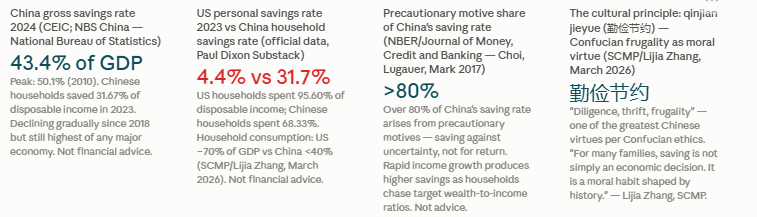
China gross savings rate 2024: 43.4% of GDP (CEIC; NBS China). Peak: 50.1% (2010). US savings rate 2023: 4.4% of GDP. China household savings rate 2023: 31.67% of disposable income; US: 4.40% (official NBS China and US data, Paul Dixon Substack). Household consumption as % of GDP: China <40%, US ~70% (SCMP/Lijia Zhang, March 2026). China urban household savings rose from 19% to 30% of disposable income as incomes rose five-fold (IMF; ChinaACC). China GDP per capita 2024: $13,306 USD (CEIC). Sources: CEIC; NBS China; Paul Dixon Substack; SCMP. Not financial advice.
This image — cash under the mattress, physical, tangible, immediately accessible — is not an eccentric individual habit. It is the embodied expression of a savings philosophy that is centuries old, shaped by repeated experiences of scarcity, political upheaval, hyperinflation, and institutional unreliability. For generations of Chinese families who lived through the Great Leap Forward, the Cultural Revolution, and the hyperinflationary episodes of the late Republican period, the lesson that institutions can fail, that currency can lose its value, and that the only reliable resource is what you physically control — was learned and relearned across multiple generations.
Zhang’s conclusion is important: ‘For many families, saving is not simply an economic decision. It is a moral habit shaped by history.’ This framing is crucial to understanding why Chinese saving rates have remained high even as China has become a middle-income country with improving institutional stability. The habit was formed in conditions that no longer fully exist, but the moral framework that justified the habit — the cultural architecture that made thrift a virtue rather than a sacrifice — remains deeply embedded.
Lijia Zhang, social commentator and author (South China Morning Post, March 19, 2026): 'Growing up in a workers' family in Nanjing, I was repeatedly told that one of the greatest Chinese virtues is thrift and frugality (勤俭节约). Nothing was wasted -- leftovers reappeared in new dishes... Economists often explain China's weak consumption through structural factors. High housing prices, rising medical costs, income inequality and a limited social welfare system all encourage households to save rather than spend. These explanations are valid. But they overlook China's deep cultural instinct for thrift. For many families, saving is not simply an economic decision. It is a moral habit shaped by history.' Source: SCMP, March 19, 2026.
This matters enormously for understanding the persistence of high savings rates across changing economic conditions. When frugality is a virtue, spending extravagantly is not merely financially imprudent; it is a moral failure. The social stigma attached to conspicuous consumption in traditional Chinese culture — while it has softened significantly among younger urban Chinese who have grown up in a period of genuine consumer abundance — has deep roots that make the cultural switch toward Western-style consumption harder and slower than pure economic incentives would predict.
The word ‘secret’ in the title of this article is a mild provocation — there is nothing hidden about qínjiản jiéyuē. It is explicitly taught, socially reinforced, and institutionally supported (the Chinese government periodically runs thrift campaigns). What makes it ‘secret’ to Western audiences is that it represents a fundamentally different relationship between financial behaviour and identity. In the Western model, consumption is identity — what you buy signals who you are. In the traditional Chinese model, what you save signals who you are. Not financial advice.
Confucian Principle: Confucian principles underlying Chinese savings culture: (1) Filial piety (孝 xiào): the obligation to care for parents and grandparents, which requires accumulating resources for elder care -- a direct financial incentive rooted in moral duty. (2) Long-term thinking: Confucian ethics emphasise obligations to future generations, encouraging present sacrifice for future wellbeing. (3) Avoidance of shame: conspicuous debt or inability to provide for one's family is a source of profound social shame in Chinese culture, incentivising precautionary saving against this eventuality. (4) Community over individual: saving for family members, especially children's education, reflects the primacy of collective over individual wellbeing. (5) qinjian jieyue (勤俭节约): frugality explicitly framed as a moral virtue, not a deprivation. Sources: SCMP; Atlantis Press academic paper; NBER research.
Dr Christabel Zhang’s PhD thesis (Federation University Australia, 2015) on the cultural influence on China’s household saving identified five distinct cultural themes that shape Chinese savings behaviour: precautionary motives; habit formation; children’s education; consumer credit avoidance; and the active teaching of thrift. The synthesis of these five themes, all rooted in Confucian values, produces a savings culture that operates simultaneously as individual financial strategy, family obligation, and moral identity.
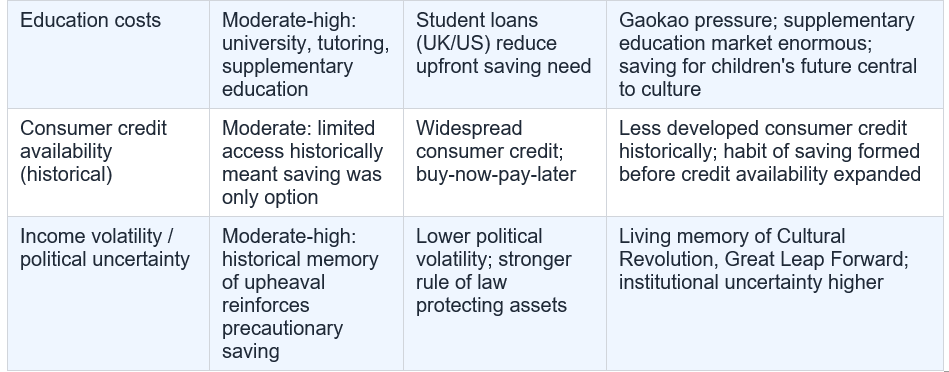
The education dimension is particularly significant. Chinese families routinely save substantial sums for children’s education — a tradition that long predates the Chinese university system and reflects the Confucian elevation of education as the primary route to social advancement. This savings motivation is not purely precautionary (against job loss or health emergency); it is aspirational and multi-generational, directed at improving the family’s social position across time. The combination of precautionary and aspirational saving motives, both rooted in Confucian values, produces a savings culture that is more robust than purely reactive financial behaviour would be.
The most significant structural driver is the absence of a comprehensive social safety net. China has a healthcare system but medical costs remain substantially borne by individuals, particularly outside the urban formal sector. The pension system has expanded significantly in recent decades but coverage outside urban state employment remains limited.
Unemployment insurance exists but is narrow in coverage and limited in duration. Most importantly, the cultural expectation that families — specifically children — are responsible for elderly parents’ care means that the informal safety net is the family itself, and saving is what makes that net strong. As Lijia Zhang (SCMP, March 2026) articulated: high housing prices, rising medical costs, income inequality, and a limited social welfare system all encourage households to save rather than spend.
A second structural driver is housing cost. Home ownership is deeply embedded in Chinese cultural expectations of adulthood, marriage readiness, and family formation. The cost of urban housing — particularly in tier-one cities like Beijing, Shanghai, Shenzhen, and Guangzhou — has been extraordinarily high relative to incomes, requiring years of aggressive saving to accumulate a deposit. Unlike the UK or US, where mortgage markets allow buyers to purchase homes with 5–10% deposits and leverage the rest, Chinese mortgage requirements and social norms around homeownership have historically required larger equity stakes, driving higher precautionary and aspirational saving. Not financial advice.
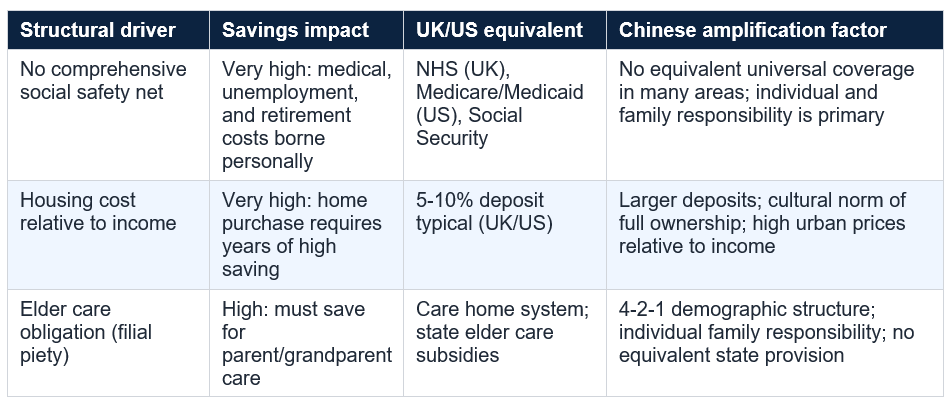
This structure creates an extraordinary savings imperative. A single-child household where both partners are only children faces the mathematical reality that their combined household will bear elder care responsibility for up to eight parents and grandparents. Even with cooperative siblings in non-one-child families, the per-person elder care burden is far greater than in societies with larger families, stronger state provision, or less demanding filial obligation norms. The only rational response, given the structural conditions of Chinese elder care, is to save aggressively from early in the working life, building sufficient assets to meet this obligation.
The academic research underscores this demographic driver. The Atlantis Press paper on Chinese household savings rates identifies population fertility policy as a key variable, explaining why household savings rate rose alongside the one-child policy’s demographic effects. As the working-age population grew faster than the dependent population during the one-child policy era, the ratio of earners to dependents temporarily improved, boosting aggregate savings capacity. But simultaneously, the expectation of future dependency on a single child increased the precautionary savings motive at the individual household level.
The mechanism is straightforward once you understand the precautionary saving motive. Chinese households were not primarily saving to earn a return; they were saving to accumulate a specific target amount — enough to cover a medical emergency, a child’s education, a parent’s care, a housing deposit. When the interest rate on their savings accounts was high, the target amount was easier to reach because the interest supplemented their contributions. When interest rates were low, they had to save more of their own income to reach the same target. The goal was fixed; the savings rate adjusted to meet it.
This target-saving dynamic — saving to hit a specific wealth level rather than saving to earn a return — is a fundamentally different model of savings behaviour from the Western ‘savings-as-investment’ model. It implies that Chinese households would continue to save even if interest rates fell to zero or below, because the need to accumulate the target wealth is not conditional on the rate of return. For individuals and families in Western countries who want to adopt elements of the Chinese savings approach, this distinction is practically important: effective saving does not require high-return accounts. It requires consistent, disciplined contribution toward a specific target. Not financial advice.
The mechanism works as follows. A Chinese household that earns $10,000 per year and has a target wealth buffer of two years’ income needs $20,000 in savings. If its income grows to $12,000 per year — a 20% increase — the target wealth buffer also rises, to $24,000. The household must now save not just for current consumption smoothing but to close the gap between its current wealth level and its new, higher target. Rapid income growth creates a perpetual savings drive as households scramble to maintain their target wealth ratio.
This explains why China’s savings rate rose from 20% of GDP in 1981 to above 43% in 2024 alongside rapid economic growth, rather than declining as growth occurred. As Chinese incomes rose rapidly, so did target wealth levels, driving higher saving rates. The decline in savings rates since 2018 — noted in the Atlantis Press paper — may reflect a slowdown in income growth (requiring less catch-up saving to maintain the target ratio) or a gradual loosening of the target ratio itself among younger generations. Either interpretation is consistent with the Choi-Lugauer-Mark model.
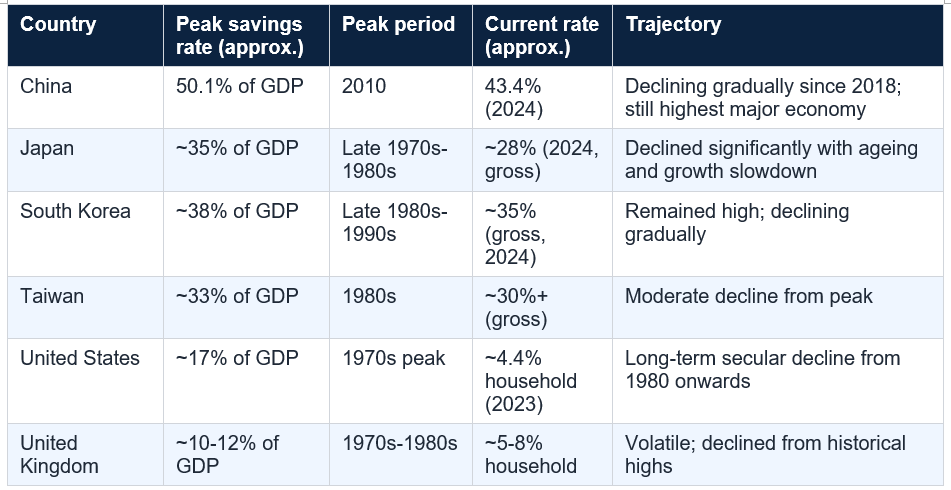
Japan’s savings rate peaked above 30% in the 1970s and 1980s during its high-growth era, then declined as growth slowed, the population aged, and social welfare provision improved. South Korea followed a similar trajectory with a lag of roughly a decade. Taiwan’s pattern is comparable. In each case, high savings during the rapid development phase funded the capital investment that drove growth, and the savings rate subsequently moderated as incomes plateaued and institutions developed.
China’s savings rate has been higher and more persistent than the other East Asian tigers for structural reasons: its population is larger (making the domestic capital market more important), its social safety net has developed more slowly relative to income levels, its property market pressures have been more severe, and the one-child policy legacy has maintained the savings imperative longer. But the underlying dynamic — Confucian cultural foundations combined with rapid income growth, precautionary motives, and developing institutions — is the same. Not financial advice.
China’s leaders are acutely aware of this problem. At the ‘two sessions’ legislative meetings in 2026, policymakers again emphasised the need to boost domestic consumption — a goal that has been stated and restated for well over a decade without the household savings rate responding proportionally. With exports facing geopolitical headwinds (tariffs, trade tensions) and the property sector struggling, the need to unlock domestic consumption has become urgent. Yet the structural and cultural forces driving saving are proving more durable than policy pressure to spend.
For individual Chinese households, the personal cost of the high savings rate is also real. Years of aggressive saving while neighbours and peers in other countries enjoy consumer goods, leisure, and lifestyle options represents a genuine sacrifice of present consumption for future security. Zhang’s grandmother, keeping banknotes under the mattress, was not enjoying the pleasure of spending. The wisdom in her approach — financial resilience, generational provision, moral identity through thrift — came at a real cost in present consumption. Not financial advice.
The limits of the Chinese savings model: (1) Underconsumption risk: an economy where households save 30%+ cannot generate sufficient domestic consumer demand for balanced growth -- China's export and investment dependency is a structural vulnerability. (2) Psychological cost: perpetual deferred gratification has real welfare costs; extreme thrift can produce anxiety and deprivation rather than security. (3) Diminishing returns on precautionary saving: above a certain wealth buffer, additional saving produces no additional security benefit. (4) Cultural shift among younger Chinese: urban millennials and Gen Z in China are increasingly adopting consumption-oriented lifestyles, signalling that the savings culture is moderating. (5) Safety net development reduces the necessity argument: as China's social safety net improves, the strongest structural justification for extreme saving weakens. Not financial advice.
In Western economies, the default is inverted. Consumption is the norm; saving is the discipline required to override the norm. Consumer credit, advertising, peer comparison, and social media all reinforce consumption as the natural expression of financial success. The Chinese savings secret, at its most basic, is a different default: spending is the exception that requires justification; saving is the baseline. This is not a tip or a trick. It is a reorientation of the relationship between income and expenditure at the level of cultural identity.
Practical implementation of the 'spend less than earn -- radically' principle: (1) Set a savings target FIRST, before budgeting for spending. Decide what percentage of your income goes to savings as a non-negotiable first allocation -- then spend the remainder. This is the 'pay yourself first' principle that mirrors the Chinese savings instinct structurally. (2) Target at minimum 20% savings rate. The Chinese average is 31.67%; the UK/US average is 4-10%. Even moving from 5% to 20% represents a fourfold improvement. (3) Automate the saving. The Chinese grandmother kept cash under the mattress because it was physical and irreversible. The modern equivalent: automated transfer to a separate savings account on the day income arrives -- before it can be spent. Not financial advice.
Western households with access to NHS healthcare (UK), social security benefits, unemployment insurance, and state pension provision face lower precautionary saving needs than Chinese households. But the precautionary motive remains valid. Even in the UK and US, the experience of the COVID-19 pandemic demonstrated that households with no savings buffer faced devastating outcomes: forced into debt at high interest rates, unable to meet rent obligations, financially unable to manage even temporary income disruption. The Chinese model of maintaining a substantial precautionary buffer — typically measured in years of living expenses rather than months — protects against exactly this vulnerability.
For the typical Western household, the practical application of the precautionary saving principle means targeting a larger emergency fund than the commonly recommended three-to-six months of expenses — and building toward one to two years of core living expenses in liquid, accessible savings before moving aggressively into investment accounts. The Chinese model does not distinguish sharply between ‘emergency fund’ and ‘savings’ — the entire accumulated wealth is available in genuine emergency, providing a buffer that the Western emergency-fund-plus-investment-account model compartmentalises unnecessarily. Not financial advice.
Lifestyle inflation is the primary mechanism by which Western households fail to accumulate wealth despite earning genuinely comfortable incomes. A household earning £30,000 per year and saving 5% accumulates £1,500 annually. A household earning £70,000 per year and saving 5% accumulates £3,500 annually. The higher earner saves more in absolute terms but the same in proportional terms — and both are saving very little relative to their income. The Chinese model suggests that the appropriate response to higher income is to increase the savings rate, not the spending level, at least until the target wealth-to-income ratio is achieved.
The practical implication is straightforward but requires deliberate choice: when income rises (pay raise, bonus, promotion), commit the majority of the increase to savings rather than lifestyle upgrades. This is Ramsey’s ‘Baby Steps’ logic applied to income growth; it is also the mechanism behind China’s counter-intuitive savings trajectory. Not financial advice.
The lifestyle inflation antidote, Chinese-style: next time income rises, implement the 80/20 rule on the increase -- 80% of any income increase goes directly to savings or investment, 20% to lifestyle improvement. This is not deprivation; it is the deliberate maintenance of a low lifestyle-to-income ratio that allows wealth to compound. Over ten years, this single habit applied to a modest career income can produce wealth that a higher earner who upgrades their lifestyle with every pay rise never approaches. Not financial advice.
This multi-generational orientation produces a qualitatively different relationship with money. Money saved for a child’s education has a specific, emotionally meaningful purpose that is harder to rationalise spending than money saved ‘for retirement’ or ‘for a rainy day.’ The family saving motive also creates social accountability: other family members know about and depend on the accumulated savings, making impulsive drawdowns socially as well as financially costly. The savings pot is not just yours; it belongs to the family.
For Western households, the practical application is to articulate specific, named savings goals that connect financial accumulation to family meaning — rather than saving into a generic ‘savings account’ with no specified purpose. A pot named ‘children’s university’ is psychologically harder to raid for a holiday than a pot named ‘savings.’ The Chinese savings culture implicitly uses this psychological naming effect through its explicit family-oriented saving framework. Not financial advice.
This psychological reframing has enormous practical power. Research on behaviour change consistently finds that identity-based habits are dramatically more persistent than goal-based habits. A person who thinks of themselves as a saver will save; a person who thinks of themselves as someone who is ‘trying to save more’ will save inconsistently. The difference between these two psychological positions is not a matter of willpower or information; it is a matter of identity.
Western personal finance has begun to understand this through movements like FIRE (Financial Independence, Retire Early), which also frames frugality as identity and meaning rather than sacrifice. The resonance of FIRE with millions of Western practitioners — people who genuinely enjoy tracking their savings rate and living deliberately below their means — is the Western approximation of what qínjiản jiéyuē produces culturally in China. The Chinese version is simply more widespread, more deeply embedded, and more culturally supported. Not financial advice.
The identity shift: stop framing savings goals as how much you need to cut back. Start framing them as what kind of person you are and want to be. 'I am the kind of person who builds genuine financial security' is a more durable identity than 'I am trying to save more this year.' Connect the saving habit to values that matter to you -- family security, freedom, integrity, generosity -- and the habit becomes self-reinforcing rather than requiring constant willpower renewal. This is the deepest lesson of qinjian jieyue: frugality as character, not constraint. Not financial advice.
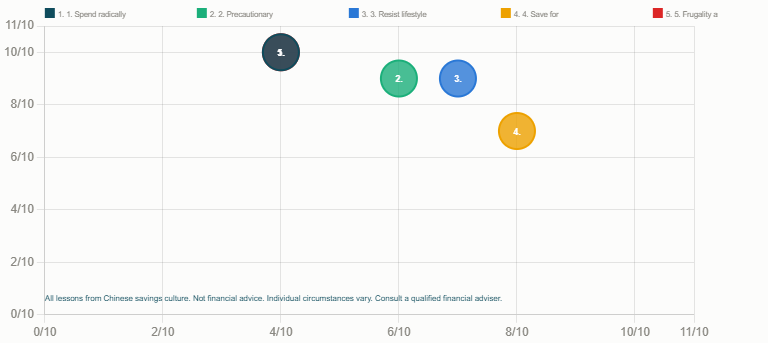
The five practical lessons embedded in this philosophy — spend radically less than you earn, build a genuine precautionary buffer, resist lifestyle inflation, save for the family not just yourself, and make frugality an identity not a punishment — are all accessible to Western households regardless of cultural background. None of them requires a Confucian philosophical framework. All of them are made easier if you understand why they work: not as financial strategies aimed at a numerical target but as expressions of a relationship with money that prioritises resilience, provision, and integrity over present consumption.
The grandmother keeping banknotes under the mattress understood something that no personal finance algorithm has yet improved upon: the money you save today is the security you have tomorrow. In a world of economic uncertainty, geopolitical instability, and financial system complexity, that insight is not culturally specific. It is universally useful. Not financial advice. Consult a qualified independent financial adviser for guidance specific to your circumstances.
China's gross savings rate was 43.4% of GDP in 2024 (CEIC; NBS China). At the household level, Chinese households saved 31.67% of disposable income in 2023, compared to the US household savings rate of 4.40% of disposable income in 2023 (official NBS China and US data via Paul Dixon Substack). The UK household savings rate typically ranges from 5-10% in normal years, with spikes during crises. Household consumption as a share of GDP is less than 40% in China versus approximately 70% in the United States. China's savings rate peaked at 50.1% of GDP in 2010 and has gradually declined since 2018, though it remains the highest of any major economy. Sources: CEIC; Paul Dixon Substack; SCMP.
Why do Chinese people save so much money?
The high Chinese savings rate reflects both cultural and structural factors. Culturally: the Confucian principle of qinjian jieyue (勤俭节约) frames frugality as a moral virtue; filial piety creates multi-generational saving obligations; and historical experience of scarcity and institutional unreliability embedded a deep precautionary saving instinct. Structurally: the absence of a comprehensive social safety net (healthcare, unemployment insurance, state pension) means medical, education, housing, and elder care costs are largely borne individually; the 4-2-1 demographic structure from the one-child policy amplifies elder care saving pressure; and high housing costs require years of accumulated savings. Academic research (Choi, Lugauer, Mark 2017 -- NBER/Journal of Money Credit and Banking) found that over 80% of China's saving rate arises from precautionary motives. Not financial advice.
What is qinjian jieyue (勤俭节约)?
Qinjian jieyue (勤俭节约) is a four-character Chinese idiom meaning 'diligence, thrift, and frugality' -- one of the central moral virtues in Confucian ethics. It frames frugality not merely as a financial strategy but as a moral quality that reflects good character, self-discipline, and social responsibility. Lijia Zhang (SCMP, March 2026) describes growing up in Nanjing being 'repeatedly told that one of the greatest Chinese virtues is thrift and frugality' -- a moral instruction delivered alongside cooking and homework, not just financial education. This cultural framing makes the savings habit identity-based rather than goal-based, which behavioural science research indicates produces more durable long-term behaviour change. Sources: SCMP/Lijia Zhang (March 2026); Atlantis Press academic paper.
Can Western people apply the Chinese savings philosophy?
Yes, with adaptation. The five core lessons from China's savings culture that are directly applicable to Western households regardless of cultural background: (1) save a large fraction of income consistently (target 20%+ of disposable income); (2) build a genuine precautionary buffer of 12-24 months of core expenses, not just 3-6 months; (3) resist lifestyle inflation by directing the majority of income increases to savings; (4) give savings goals specific family meaning (education, care, provision) to make them emotionally durable; (5) reframe frugality from deprivation to identity. None of these requires a Confucian philosophical framework, but understanding the cultural context helps explain why they work. Not financial advice. Consult a qualified independent financial adviser.
Is China's savings rate declining?
Yes, since approximately 2018. The Atlantis Press academic paper notes a declining trend in China's savings rate from 2018, though the rate remains very high by global standards (43.4% of GDP in 2024, near the 43.2% of 2023). The decline is attributed to several factors: slowing income growth (reducing the catch-up saving effect identified by Choi, Lugauer, Mark); generational change among urban millennials and Gen Z who have grown up in a period of consumer abundance and are more consumption-oriented; gradual improvement in social safety net provision; and the property market correction reducing the housing savings motive somewhat. China's government is actively encouraging greater household consumption to rebalance the economy away from export and investment dependence. Sources: Atlantis Press; CEIC; SCMP.
Table of Contents
- The Number That Stops Every Conversation
- The Grandmother Under the Mattress: Where It All Starts
- Qinˬjiản Jiéyuē (勤俭节约): Frugality as a Moral Virtue
- The Confucian Architecture of Chinese Saving
- The Structural Drivers: When Saving Is an Existential Necessity
- The 4-2-1 Problem: Why One Child Saves for Six People
- The IMF Paradox: Why Lower Returns Produce Higher Saving
- The Income Growth Effect: Why Rising Wealth Means Saving More
- The East Asian Pattern: China Is Not Alone
- What China’s Savings Rate Costs: The Consumption Deficit
- Lesson One: Spend Less Than You Earn — Radically
- Lesson Two: Build the Precautionary Buffer
- Lesson Three: Resist Lifestyle Inflation
- Lesson Four: Save for the Family, Not Just for Yourself
- Lesson Five: Make Frugality an Identity, Not a Punishment
- Conclusion: The Secret Is a Philosophy, Not a Trick
- Frequently Asked Questions
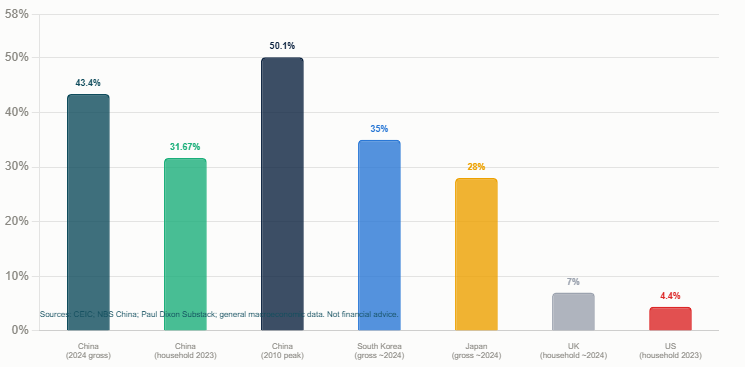
Savings rate comparison — China vs the world
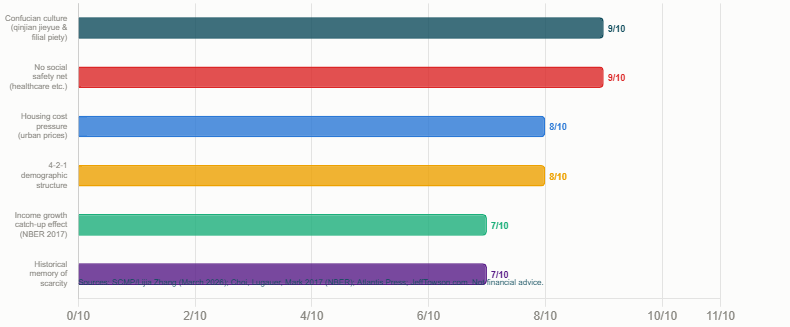
Why China saves so much — the six drivers
Five lessons from Chinese savings culture
The Number That Stops Every Conversation
China’s gross savings rate was 43.4% of GDP in 2024, according to CEIC Data compiled from the National Bureau of Statistics. This figure has been remarkably stable — 43.2% in 2023, and a trajectory that reached a peak of 50.1% in 2010 after climbing from approximately 20% of GDP in 1981. For comparison, the United States’ personal savings rate in 2023 was 4.4% of GDP. The United Kingdom’s household savings rate fluctuates between 5% and 10% in normal years, with spikes during crisis periods.At the household level, the data is equally striking. In 2023, using official National Bureau of Statistics China data, Chinese households saved 31.67% of their disposable income and spent 68.33%. American households spent 95.60% of disposable income and saved just 4.40% (Paul Dixon Substack, citing official NBS and US data). China’s household disposable income as a proportion of GDP (41.50%) is actually lower than America’s (51.89%), meaning Chinese households are saving a larger fraction of a smaller share of national income. They are doing more with less, by every measure.
What makes this number genuinely surprising — and the reason economists have spent decades studying it — is that it defied the expected trajectory of economic development. Standard economic theory predicts that as incomes rise, savings rates fall: wealthier people feel more secure and spend more freely. In China, as per-capita income rose roughly five-fold between the mid-1990s and the 2010s, the urban household savings rate rose from approximately 19% to 30% of disposable income. Rising prosperity produced rising thrift. The normal rules did not apply. This article examines why. Not financial advice.
China gross savings rate 2024: 43.4% of GDP (CEIC; NBS China). Peak: 50.1% (2010). US savings rate 2023: 4.4% of GDP. China household savings rate 2023: 31.67% of disposable income; US: 4.40% (official NBS China and US data, Paul Dixon Substack). Household consumption as % of GDP: China <40%, US ~70% (SCMP/Lijia Zhang, March 2026). China urban household savings rose from 19% to 30% of disposable income as incomes rose five-fold (IMF; ChinaACC). China GDP per capita 2024: $13,306 USD (CEIC). Sources: CEIC; NBS China; Paul Dixon Substack; SCMP. Not financial advice.
The Grandmother Under the Mattress: Where It All Starts
Lijia Zhang, a rocket-factory worker turned social commentator and the author of the novel Lotus, opened her March 2026 South China Morning Post column on Chinese savings with a personal story that illuminates the cultural depth of the phenomenon better than any statistical analysis can. Her grandmother, she wrote, kept banknotes under the mattress. Even after savings accounts became common, even after the money given by Zhang and her siblings began to accumulate in an account, her grandmother still preferred to hide cash at home. She loved saving. She hated spending.This image — cash under the mattress, physical, tangible, immediately accessible — is not an eccentric individual habit. It is the embodied expression of a savings philosophy that is centuries old, shaped by repeated experiences of scarcity, political upheaval, hyperinflation, and institutional unreliability. For generations of Chinese families who lived through the Great Leap Forward, the Cultural Revolution, and the hyperinflationary episodes of the late Republican period, the lesson that institutions can fail, that currency can lose its value, and that the only reliable resource is what you physically control — was learned and relearned across multiple generations.
Zhang’s conclusion is important: ‘For many families, saving is not simply an economic decision. It is a moral habit shaped by history.’ This framing is crucial to understanding why Chinese saving rates have remained high even as China has become a middle-income country with improving institutional stability. The habit was formed in conditions that no longer fully exist, but the moral framework that justified the habit — the cultural architecture that made thrift a virtue rather than a sacrifice — remains deeply embedded.
Lijia Zhang, social commentator and author (South China Morning Post, March 19, 2026): 'Growing up in a workers' family in Nanjing, I was repeatedly told that one of the greatest Chinese virtues is thrift and frugality (勤俭节约). Nothing was wasted -- leftovers reappeared in new dishes... Economists often explain China's weak consumption through structural factors. High housing prices, rising medical costs, income inequality and a limited social welfare system all encourage households to save rather than spend. These explanations are valid. But they overlook China's deep cultural instinct for thrift. For many families, saving is not simply an economic decision. It is a moral habit shaped by history.' Source: SCMP, March 19, 2026.
Qínjiản Jiéyuē (勤俭节约): Frugality as a Moral Virtue
The four-character Chinese idiom qínjiản jiéyuē (勤俭节约) translates roughly as ‘diligence, thrift, and frugality’ and has been a central tenet of Chinese moral and social instruction for centuries. It is not simply a financial principle; it is a moral category. In the same way that Western ethical traditions have historically framed virtues like honesty, courage, or compassion as intrinsically valuable regardless of their instrumental outcomes, Chinese tradition has framed thrift as a virtue with its own intrinsic worth — a reflection of good character, social responsibility, and respect for the effort required to produce what one consumes.This matters enormously for understanding the persistence of high savings rates across changing economic conditions. When frugality is a virtue, spending extravagantly is not merely financially imprudent; it is a moral failure. The social stigma attached to conspicuous consumption in traditional Chinese culture — while it has softened significantly among younger urban Chinese who have grown up in a period of genuine consumer abundance — has deep roots that make the cultural switch toward Western-style consumption harder and slower than pure economic incentives would predict.
The word ‘secret’ in the title of this article is a mild provocation — there is nothing hidden about qínjiản jiéyuē. It is explicitly taught, socially reinforced, and institutionally supported (the Chinese government periodically runs thrift campaigns). What makes it ‘secret’ to Western audiences is that it represents a fundamentally different relationship between financial behaviour and identity. In the Western model, consumption is identity — what you buy signals who you are. In the traditional Chinese model, what you save signals who you are. Not financial advice.
Confucian Principle: Confucian principles underlying Chinese savings culture: (1) Filial piety (孝 xiào): the obligation to care for parents and grandparents, which requires accumulating resources for elder care -- a direct financial incentive rooted in moral duty. (2) Long-term thinking: Confucian ethics emphasise obligations to future generations, encouraging present sacrifice for future wellbeing. (3) Avoidance of shame: conspicuous debt or inability to provide for one's family is a source of profound social shame in Chinese culture, incentivising precautionary saving against this eventuality. (4) Community over individual: saving for family members, especially children's education, reflects the primacy of collective over individual wellbeing. (5) qinjian jieyue (勤俭节约): frugality explicitly framed as a moral virtue, not a deprivation. Sources: SCMP; Atlantis Press academic paper; NBER research.
The Confucian Architecture of Chinese Saving
Confucian philosophy, which has shaped Chinese social norms for more than 2,500 years, provides the ideological architecture within which Chinese saving behaviour makes sense. The core Confucian values of filial piety (caring for parents and ancestors), long-term thinking, social harmony, and the subordination of individual desires to family and community obligations all point in the same financial direction: save more, spend less, defer gratification, and build resources sufficient to meet obligations not just to yourself but to your extended family across time.Dr Christabel Zhang’s PhD thesis (Federation University Australia, 2015) on the cultural influence on China’s household saving identified five distinct cultural themes that shape Chinese savings behaviour: precautionary motives; habit formation; children’s education; consumer credit avoidance; and the active teaching of thrift. The synthesis of these five themes, all rooted in Confucian values, produces a savings culture that operates simultaneously as individual financial strategy, family obligation, and moral identity.
The education dimension is particularly significant. Chinese families routinely save substantial sums for children’s education — a tradition that long predates the Chinese university system and reflects the Confucian elevation of education as the primary route to social advancement. This savings motivation is not purely precautionary (against job loss or health emergency); it is aspirational and multi-generational, directed at improving the family’s social position across time. The combination of precautionary and aspirational saving motives, both rooted in Confucian values, produces a savings culture that is more robust than purely reactive financial behaviour would be.
The Structural Drivers: When Saving Is an Existential Necessity
While the cultural dimension of Chinese saving is profound and real, it cannot be separated from the structural conditions that made high saving rates an existential necessity for Chinese families across multiple generations. Even a family with no exposure to Confucian philosophy and no cultural instinct toward thrift would save heavily if confronted with the structural realities of the Chinese social and economic environment.The most significant structural driver is the absence of a comprehensive social safety net. China has a healthcare system but medical costs remain substantially borne by individuals, particularly outside the urban formal sector. The pension system has expanded significantly in recent decades but coverage outside urban state employment remains limited.
Unemployment insurance exists but is narrow in coverage and limited in duration. Most importantly, the cultural expectation that families — specifically children — are responsible for elderly parents’ care means that the informal safety net is the family itself, and saving is what makes that net strong. As Lijia Zhang (SCMP, March 2026) articulated: high housing prices, rising medical costs, income inequality, and a limited social welfare system all encourage households to save rather than spend.
A second structural driver is housing cost. Home ownership is deeply embedded in Chinese cultural expectations of adulthood, marriage readiness, and family formation. The cost of urban housing — particularly in tier-one cities like Beijing, Shanghai, Shenzhen, and Guangzhou — has been extraordinarily high relative to incomes, requiring years of aggressive saving to accumulate a deposit. Unlike the UK or US, where mortgage markets allow buyers to purchase homes with 5–10% deposits and leverage the rest, Chinese mortgage requirements and social norms around homeownership have historically required larger equity stakes, driving higher precautionary and aspirational saving. Not financial advice.
The 4-2-1 Problem: Why One Child Saves for Six People
China’s one-child policy, implemented from 1980 to 2015, had a profound and enduring effect on savings behaviour that has not yet fully unwound even after the policy’s liberalisation to two and then three children. The demographic structure it created — known informally as the 4-2-1 structure — means that one adult child can be responsible for supporting two parents and four grandparents, often simultaneously, while also raising their own children.This structure creates an extraordinary savings imperative. A single-child household where both partners are only children faces the mathematical reality that their combined household will bear elder care responsibility for up to eight parents and grandparents. Even with cooperative siblings in non-one-child families, the per-person elder care burden is far greater than in societies with larger families, stronger state provision, or less demanding filial obligation norms. The only rational response, given the structural conditions of Chinese elder care, is to save aggressively from early in the working life, building sufficient assets to meet this obligation.
The academic research underscores this demographic driver. The Atlantis Press paper on Chinese household savings rates identifies population fertility policy as a key variable, explaining why household savings rate rose alongside the one-child policy’s demographic effects. As the working-age population grew faster than the dependent population during the one-child policy era, the ratio of earners to dependents temporarily improved, boosting aggregate savings capacity. But simultaneously, the expectation of future dependency on a single child increased the precautionary savings motive at the individual household level.
The IMF Paradox: Why Lower Returns Produce Higher Saving
One of the most counterintuitive findings in the economics of Chinese saving is what might be called the IMF paradox, documented in research cited by ChinaACC.com: the worse that Chinese banks treated their customers — meaning the lower the deposit interest rates they offered — the more that Chinese customers saved. This is the opposite of what standard economic theory predicts. In the Western model, low interest rates reduce the incentive to save (the return on saving is low, so why sacrifice consumption today?). In China, low interest rates increased saving.The mechanism is straightforward once you understand the precautionary saving motive. Chinese households were not primarily saving to earn a return; they were saving to accumulate a specific target amount — enough to cover a medical emergency, a child’s education, a parent’s care, a housing deposit. When the interest rate on their savings accounts was high, the target amount was easier to reach because the interest supplemented their contributions. When interest rates were low, they had to save more of their own income to reach the same target. The goal was fixed; the savings rate adjusted to meet it.
This target-saving dynamic — saving to hit a specific wealth level rather than saving to earn a return — is a fundamentally different model of savings behaviour from the Western ‘savings-as-investment’ model. It implies that Chinese households would continue to save even if interest rates fell to zero or below, because the need to accumulate the target wealth is not conditional on the rate of return. For individuals and families in Western countries who want to adopt elements of the Chinese savings approach, this distinction is practically important: effective saving does not require high-return accounts. It requires consistent, disciplined contribution toward a specific target. Not financial advice.
The Income Growth Effect: Why Rising Wealth Means Saving More
The research by Choi, Lugauer, and Mark (published in the Journal of Money, Credit and Banking, 2017, and as NBER Working Paper w20527) provides the most rigorous academic explanation for why Chinese savings rates rose alongside rising incomes rather than falling, as standard theory would predict. Their key finding: precautionary savers have target wealth-to-income ratios, and rapid income growth necessitates high saving rates to maintain the ratio.The mechanism works as follows. A Chinese household that earns $10,000 per year and has a target wealth buffer of two years’ income needs $20,000 in savings. If its income grows to $12,000 per year — a 20% increase — the target wealth buffer also rises, to $24,000. The household must now save not just for current consumption smoothing but to close the gap between its current wealth level and its new, higher target. Rapid income growth creates a perpetual savings drive as households scramble to maintain their target wealth ratio.
This explains why China’s savings rate rose from 20% of GDP in 1981 to above 43% in 2024 alongside rapid economic growth, rather than declining as growth occurred. As Chinese incomes rose rapidly, so did target wealth levels, driving higher saving rates. The decline in savings rates since 2018 — noted in the Atlantis Press paper — may reflect a slowdown in income growth (requiring less catch-up saving to maintain the target ratio) or a gradual loosening of the target ratio itself among younger generations. Either interpretation is consistent with the Choi-Lugauer-Mark model.
The East Asian Pattern: China Is Not Alone
China’s high savings rate is extreme but not unique within East Asia. As JeffTowson.com notes, Japan, Taiwan, and South Korea all hit 30%+ savings rates during their early development phases. The East Asian savings pattern appears to be a recurring feature of the Confucian cultural sphere combined with rapid industrialisation and the absence of developed social safety nets during the critical growth decades.Japan’s savings rate peaked above 30% in the 1970s and 1980s during its high-growth era, then declined as growth slowed, the population aged, and social welfare provision improved. South Korea followed a similar trajectory with a lag of roughly a decade. Taiwan’s pattern is comparable. In each case, high savings during the rapid development phase funded the capital investment that drove growth, and the savings rate subsequently moderated as incomes plateaued and institutions developed.
China’s savings rate has been higher and more persistent than the other East Asian tigers for structural reasons: its population is larger (making the domestic capital market more important), its social safety net has developed more slowly relative to income levels, its property market pressures have been more severe, and the one-child policy legacy has maintained the savings imperative longer. But the underlying dynamic — Confucian cultural foundations combined with rapid income growth, precautionary motives, and developing institutions — is the same. Not financial advice.
What China’s Savings Rate Costs: The Consumption Deficit
No account of China’s savings culture would be honest without acknowledging its costs. The same savings rate that has funded China’s extraordinary capital investment and economic growth has also produced what economists call a consumption deficit: household consumption as a share of GDP in China is less than 40%, compared to nearly 70% in the United States (SCMP/Lijia Zhang, March 2026). This means that Chinese economic growth has been driven by investment and exports rather than domestic consumer demand — a model that creates structural dependencies and vulnerabilities.China’s leaders are acutely aware of this problem. At the ‘two sessions’ legislative meetings in 2026, policymakers again emphasised the need to boost domestic consumption — a goal that has been stated and restated for well over a decade without the household savings rate responding proportionally. With exports facing geopolitical headwinds (tariffs, trade tensions) and the property sector struggling, the need to unlock domestic consumption has become urgent. Yet the structural and cultural forces driving saving are proving more durable than policy pressure to spend.
For individual Chinese households, the personal cost of the high savings rate is also real. Years of aggressive saving while neighbours and peers in other countries enjoy consumer goods, leisure, and lifestyle options represents a genuine sacrifice of present consumption for future security. Zhang’s grandmother, keeping banknotes under the mattress, was not enjoying the pleasure of spending. The wisdom in her approach — financial resilience, generational provision, moral identity through thrift — came at a real cost in present consumption. Not financial advice.
The limits of the Chinese savings model: (1) Underconsumption risk: an economy where households save 30%+ cannot generate sufficient domestic consumer demand for balanced growth -- China's export and investment dependency is a structural vulnerability. (2) Psychological cost: perpetual deferred gratification has real welfare costs; extreme thrift can produce anxiety and deprivation rather than security. (3) Diminishing returns on precautionary saving: above a certain wealth buffer, additional saving produces no additional security benefit. (4) Cultural shift among younger Chinese: urban millennials and Gen Z in China are increasingly adopting consumption-oriented lifestyles, signalling that the savings culture is moderating. (5) Safety net development reduces the necessity argument: as China's social safety net improves, the strongest structural justification for extreme saving weakens. Not financial advice.
Lesson One: Spend Less Than You Earn — Radically
The first and most fundamental lesson from China’s savings culture is the simplest, and the most challenging for Western households to implement: spend significantly less than you earn, consistently and as a matter of habit rather than occasional discipline. The 31.67% savings rate of Chinese households does not happen through occasional budget-tightening or annual savings challenges. It happens because the default position of Chinese household culture is that saving is normal and spending everything you earn is not.In Western economies, the default is inverted. Consumption is the norm; saving is the discipline required to override the norm. Consumer credit, advertising, peer comparison, and social media all reinforce consumption as the natural expression of financial success. The Chinese savings secret, at its most basic, is a different default: spending is the exception that requires justification; saving is the baseline. This is not a tip or a trick. It is a reorientation of the relationship between income and expenditure at the level of cultural identity.
Practical implementation of the 'spend less than earn -- radically' principle: (1) Set a savings target FIRST, before budgeting for spending. Decide what percentage of your income goes to savings as a non-negotiable first allocation -- then spend the remainder. This is the 'pay yourself first' principle that mirrors the Chinese savings instinct structurally. (2) Target at minimum 20% savings rate. The Chinese average is 31.67%; the UK/US average is 4-10%. Even moving from 5% to 20% represents a fourfold improvement. (3) Automate the saving. The Chinese grandmother kept cash under the mattress because it was physical and irreversible. The modern equivalent: automated transfer to a separate savings account on the day income arrives -- before it can be spent. Not financial advice.
Lesson Two: Build the Precautionary Buffer
The Choi-Lugauer-Mark research found that over 80% of China’s saving rate arises from the precautionary motive — saving against uncertainty rather than saving for specific desired purchases. In a country without a comprehensive safety net, the precautionary buffer is what stands between a family and catastrophe when a medical emergency, job loss, or family crisis occurs. The size of the target precautionary buffer reflects the severity of the risks faced and the absence of other mitigation mechanisms.Western households with access to NHS healthcare (UK), social security benefits, unemployment insurance, and state pension provision face lower precautionary saving needs than Chinese households. But the precautionary motive remains valid. Even in the UK and US, the experience of the COVID-19 pandemic demonstrated that households with no savings buffer faced devastating outcomes: forced into debt at high interest rates, unable to meet rent obligations, financially unable to manage even temporary income disruption. The Chinese model of maintaining a substantial precautionary buffer — typically measured in years of living expenses rather than months — protects against exactly this vulnerability.
For the typical Western household, the practical application of the precautionary saving principle means targeting a larger emergency fund than the commonly recommended three-to-six months of expenses — and building toward one to two years of core living expenses in liquid, accessible savings before moving aggressively into investment accounts. The Chinese model does not distinguish sharply between ‘emergency fund’ and ‘savings’ — the entire accumulated wealth is available in genuine emergency, providing a buffer that the Western emergency-fund-plus-investment-account model compartmentalises unnecessarily. Not financial advice.
Lesson Three: Resist Lifestyle Inflation
One of the most powerful lessons embedded in China’s savings data is the income growth effect: as incomes rose rapidly over two decades, Chinese household savings rates rose rather than fell. This is the direct opposite of the Western ‘lifestyle inflation’ pattern, where every income increase is met with a corresponding increase in spending — new car, larger house, more expensive holidays, upgraded wardrobe — such that the savings rate remains roughly constant regardless of income level.Lifestyle inflation is the primary mechanism by which Western households fail to accumulate wealth despite earning genuinely comfortable incomes. A household earning £30,000 per year and saving 5% accumulates £1,500 annually. A household earning £70,000 per year and saving 5% accumulates £3,500 annually. The higher earner saves more in absolute terms but the same in proportional terms — and both are saving very little relative to their income. The Chinese model suggests that the appropriate response to higher income is to increase the savings rate, not the spending level, at least until the target wealth-to-income ratio is achieved.
The practical implication is straightforward but requires deliberate choice: when income rises (pay raise, bonus, promotion), commit the majority of the increase to savings rather than lifestyle upgrades. This is Ramsey’s ‘Baby Steps’ logic applied to income growth; it is also the mechanism behind China’s counter-intuitive savings trajectory. Not financial advice.
The lifestyle inflation antidote, Chinese-style: next time income rises, implement the 80/20 rule on the increase -- 80% of any income increase goes directly to savings or investment, 20% to lifestyle improvement. This is not deprivation; it is the deliberate maintenance of a low lifestyle-to-income ratio that allows wealth to compound. Over ten years, this single habit applied to a modest career income can produce wealth that a higher earner who upgrades their lifestyle with every pay rise never approaches. Not financial advice.
Lesson Four: Save for the Family, Not Just for Yourself
Chinese saving culture is explicitly multi-generational and family-oriented in a way that Western personal finance discourse rarely is. Dr Christabel Zhang’s research identified children’s education as one of the five cultural themes shaping Chinese savings behaviour. Filial piety — the moral obligation to care for parents and grandparents — is another. The Chinese household saves not for the individual but for the family unit across time: for the children’s educational opportunities, for the parents’ elder care, for the grandchildren’s starting position in life.This multi-generational orientation produces a qualitatively different relationship with money. Money saved for a child’s education has a specific, emotionally meaningful purpose that is harder to rationalise spending than money saved ‘for retirement’ or ‘for a rainy day.’ The family saving motive also creates social accountability: other family members know about and depend on the accumulated savings, making impulsive drawdowns socially as well as financially costly. The savings pot is not just yours; it belongs to the family.
For Western households, the practical application is to articulate specific, named savings goals that connect financial accumulation to family meaning — rather than saving into a generic ‘savings account’ with no specified purpose. A pot named ‘children’s university’ is psychologically harder to raid for a holiday than a pot named ‘savings.’ The Chinese savings culture implicitly uses this psychological naming effect through its explicit family-oriented saving framework. Not financial advice.
Lesson Five: Make Frugality an Identity, Not a Punishment
The deepest lesson from Chinese savings culture is the one that is hardest to import directly: the reframing of frugality from deprivation to virtue. Qínjiản jiéyuē is not experienced by its practitioners as a sacrifice they endure in service of a distant financial goal. It is experienced as an expression of who they are — a demonstration of good character, self-discipline, and respect for the resources they steward. The grandmother who keeps banknotes under the mattress is not suffering; she is expressing her values.This psychological reframing has enormous practical power. Research on behaviour change consistently finds that identity-based habits are dramatically more persistent than goal-based habits. A person who thinks of themselves as a saver will save; a person who thinks of themselves as someone who is ‘trying to save more’ will save inconsistently. The difference between these two psychological positions is not a matter of willpower or information; it is a matter of identity.
Western personal finance has begun to understand this through movements like FIRE (Financial Independence, Retire Early), which also frames frugality as identity and meaning rather than sacrifice. The resonance of FIRE with millions of Western practitioners — people who genuinely enjoy tracking their savings rate and living deliberately below their means — is the Western approximation of what qínjiản jiéyuē produces culturally in China. The Chinese version is simply more widespread, more deeply embedded, and more culturally supported. Not financial advice.
The identity shift: stop framing savings goals as how much you need to cut back. Start framing them as what kind of person you are and want to be. 'I am the kind of person who builds genuine financial security' is a more durable identity than 'I am trying to save more this year.' Connect the saving habit to values that matter to you -- family security, freedom, integrity, generosity -- and the habit becomes self-reinforcing rather than requiring constant willpower renewal. This is the deepest lesson of qinjian jieyue: frugality as character, not constraint. Not financial advice.
Conclusion
China’s extraordinary savings rate — 43.4% of GDP in 2024, with households saving 31.67% of disposable income against the United States’ 4.40% — is not the product of a savings hack, a financial product, or a government programme. It is the product of a philosophy: qínjiản jiéyuē, the Confucian principle of diligent frugality as moral virtue, embedded over centuries into cultural identity, reinforced by structural necessity (the absence of a safety net, the 4-2-1 demographic structure, housing costs), and sustained through the precise dynamic that standard economic theory would have predicted it to reverse (rising incomes producing rising savings rates, not falling ones).The five practical lessons embedded in this philosophy — spend radically less than you earn, build a genuine precautionary buffer, resist lifestyle inflation, save for the family not just yourself, and make frugality an identity not a punishment — are all accessible to Western households regardless of cultural background. None of them requires a Confucian philosophical framework. All of them are made easier if you understand why they work: not as financial strategies aimed at a numerical target but as expressions of a relationship with money that prioritises resilience, provision, and integrity over present consumption.
The grandmother keeping banknotes under the mattress understood something that no personal finance algorithm has yet improved upon: the money you save today is the security you have tomorrow. In a world of economic uncertainty, geopolitical instability, and financial system complexity, that insight is not culturally specific. It is universally useful. Not financial advice. Consult a qualified independent financial adviser for guidance specific to your circumstances.
Frequently Asked Questions
What is China's savings rate compared to the US and UK?China's gross savings rate was 43.4% of GDP in 2024 (CEIC; NBS China). At the household level, Chinese households saved 31.67% of disposable income in 2023, compared to the US household savings rate of 4.40% of disposable income in 2023 (official NBS China and US data via Paul Dixon Substack). The UK household savings rate typically ranges from 5-10% in normal years, with spikes during crises. Household consumption as a share of GDP is less than 40% in China versus approximately 70% in the United States. China's savings rate peaked at 50.1% of GDP in 2010 and has gradually declined since 2018, though it remains the highest of any major economy. Sources: CEIC; Paul Dixon Substack; SCMP.
Why do Chinese people save so much money?
The high Chinese savings rate reflects both cultural and structural factors. Culturally: the Confucian principle of qinjian jieyue (勤俭节约) frames frugality as a moral virtue; filial piety creates multi-generational saving obligations; and historical experience of scarcity and institutional unreliability embedded a deep precautionary saving instinct. Structurally: the absence of a comprehensive social safety net (healthcare, unemployment insurance, state pension) means medical, education, housing, and elder care costs are largely borne individually; the 4-2-1 demographic structure from the one-child policy amplifies elder care saving pressure; and high housing costs require years of accumulated savings. Academic research (Choi, Lugauer, Mark 2017 -- NBER/Journal of Money Credit and Banking) found that over 80% of China's saving rate arises from precautionary motives. Not financial advice.
What is qinjian jieyue (勤俭节约)?
Qinjian jieyue (勤俭节约) is a four-character Chinese idiom meaning 'diligence, thrift, and frugality' -- one of the central moral virtues in Confucian ethics. It frames frugality not merely as a financial strategy but as a moral quality that reflects good character, self-discipline, and social responsibility. Lijia Zhang (SCMP, March 2026) describes growing up in Nanjing being 'repeatedly told that one of the greatest Chinese virtues is thrift and frugality' -- a moral instruction delivered alongside cooking and homework, not just financial education. This cultural framing makes the savings habit identity-based rather than goal-based, which behavioural science research indicates produces more durable long-term behaviour change. Sources: SCMP/Lijia Zhang (March 2026); Atlantis Press academic paper.
Can Western people apply the Chinese savings philosophy?
Yes, with adaptation. The five core lessons from China's savings culture that are directly applicable to Western households regardless of cultural background: (1) save a large fraction of income consistently (target 20%+ of disposable income); (2) build a genuine precautionary buffer of 12-24 months of core expenses, not just 3-6 months; (3) resist lifestyle inflation by directing the majority of income increases to savings; (4) give savings goals specific family meaning (education, care, provision) to make them emotionally durable; (5) reframe frugality from deprivation to identity. None of these requires a Confucian philosophical framework, but understanding the cultural context helps explain why they work. Not financial advice. Consult a qualified independent financial adviser.
Is China's savings rate declining?
Yes, since approximately 2018. The Atlantis Press academic paper notes a declining trend in China's savings rate from 2018, though the rate remains very high by global standards (43.4% of GDP in 2024, near the 43.2% of 2023). The decline is attributed to several factors: slowing income growth (reducing the catch-up saving effect identified by Choi, Lugauer, Mark); generational change among urban millennials and Gen Z who have grown up in a period of consumer abundance and are more consumption-oriented; gradual improvement in social safety net provision; and the property market correction reducing the housing savings motive somewhat. China's government is actively encouraging greater household consumption to rebalance the economy away from export and investment dependence. Sources: Atlantis Press; CEIC; SCMP.

0 Comments Comments