

Savings
Your Best Money Saving Tips for 2026: 10 That Work

Saving money is one of those things nearly everyone intends to do and fewer people actually manage. WalletHub’s 2026 budgeting survey found that 95% of Americans plan to budget better this year — a figure that has stayed roughly the same for years, which tells you something about the gap between intention and action. The US personal savings rate fell to 3.6% in December 2025, down from a pandemic peak of 31.8% in April 2020. Nearly one in four Americans has no emergency savings. Forty-seven percent say the cost of living is the biggest obstacle to saving. These are not people with a motivation problem. They are people who are trying to save in a financial environment that makes it difficult, often without the specific tools and habits that make the difference between a plan that lasts and one that evaporates by February. This article gives you the ten money saving tips that research, behavioural economics, and financial educators consistently agree produce the best results. Not every tip will apply to every situation. But most of them will — and combining three or four that are relevant to your circumstances tends to produce compounding improvements that exceed the sum of their individual parts.
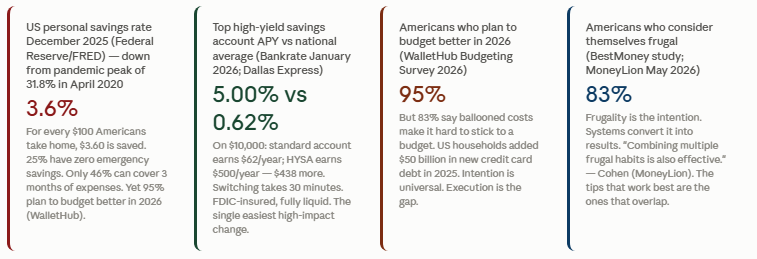
The ten tips in this article are not aspirational lifestyle changes or dramatic sacrifices. They are specific, behavioural, and research-backed actions that work because they address the actual mechanisms by which savings intentions fail. The most common mechanism of failure is decision fatigue: when saving requires a daily decision, daily pressures defeat it. The tips that work most reliably are the ones that convert a daily decision into a one-time system. Automation is the foundational principle. The rest is optimisation. Not financial advice.
Savings crisis by the numbers: savings rate 3.6% December 2025 (FRED). 25% of Americans have zero emergency savings (Financer.com 2026). Only 46% can cover 3 months of expenses. 35% very dissatisfied with savings (Yahoo Finance/Marist). 95% plan to budget better in 2026 (WalletHub). $50B new credit card debt added by US households in 2025. Sources cited. Not financial advice.
Set up a standing order on payday — before you spend anything. $50/month automatically = $600/year + interest. Even $5/week = $240/year. Not financial advice.
Switch to a high-yield savings account (5.00% APY vs 0.62% national average, January 2026): $10,000 balance earns $438 more per year. Takes minutes. Not financial advice.
Track spending for one month — research finds $200+ in forgotten expenses is consistently uncovered. Anna Frank (First Commonwealth Bank): 'It can be hard to know what to cut back on if you don't know what you are spending.' Not financial advice.
Cancel unused subscriptions: $20/month = $240/year per service (Financer.com 2026). Review bank statements for every recurring charge quarterly. Renegotiate the ones you keep. Not financial advice.
A 2024 worker lunch survey found that 78% of workers changed their lunch habits because of inflation — meaning the majority of working adults have already found that home-prepared lunches are materially cheaper than purchased ones. WPXI adds the practical observation: do not go to the grocery store hungry, because hunger drives impulse purchases that defeat the purpose of the meal plan. MoneyLion's May 2026 reporting on frugal habits noted that 'combining multiple frugal habits is also effective when shopping for groceries' — the savings stack when you combine a meal plan with a shopping list with a store-brand preference. The meal plan does not have to be elaborate. It is a list of five dinners and three lunches for the week, built before you open a food delivery app.
Meal planning saves ~$40/meal vs takeout = $500+/year (2026 savings guides). 78% of workers changed lunch habits due to inflation (2024 survey). Combine with shopping list and store brands. Not financial advice.
Debt avalanche: pay minimum on all debts, throw every extra dollar at the highest-rate balance. 20-25% APR credit card debt eliminated = guaranteed 20-25% 'return'. US households added $50B in new CC debt in 2025. Not financial advice.
25% of Americans have zero emergency savings (Financer.com 2026). Target: 3 months of essential expenses. In a high-yield savings account (5.00% APY). Emergency fund first, investing second. Not financial advice.
Smart thermostat: 10-15% off heating/cooling = $150+ savings/year (Financer.com 2026). LED bulbs + draught sealing: noticeable utility savings (Bankrate/Dallas Express January 2026). Compare tariffs annually. Not financial advice.
95% plan to budget better in 2026 (WalletHub). 83% consider themselves frugal (BestMoney/MoneyLion May 2026). But intention ≠ action. Specific + automated goals convert intention into results. Not financial advice.
Employer 401(k) match: contribute enough to capture 100% — it's free money at 50-100% instant return. 2026 limit: $23,500 under-50; $7,500 catch-up 50+. Capture match before any other savings priority. Not financial advice.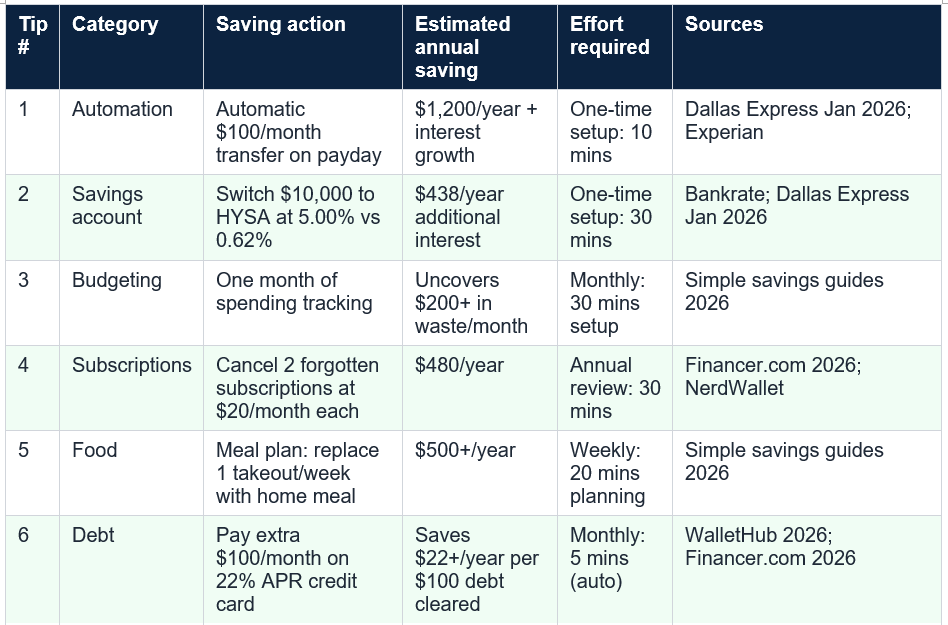
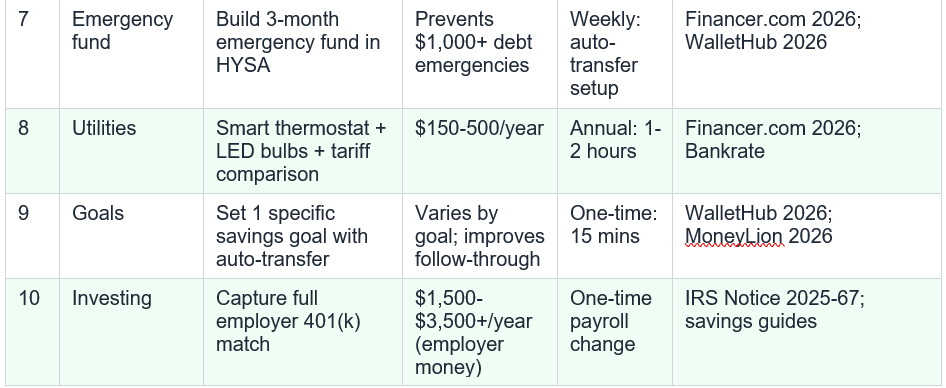
Note: Savings estimates are illustrative, based on research cited in this article. Individual results vary significantly based on income, existing balances, employer match formula, and spending patterns. The table represents combined potential savings, not guaranteed outcomes. Not financial advice. Always verify with current rates and your specific financial situation.
The compounding principle applies here too: three tips working together produce better results than one tip alone. If you automate a monthly transfer, switch to a high-yield savings account, and cancel two forgotten subscriptions, you have potentially freed up $200+ per month with a total time investment of under an hour. That $200 compounding at 5% APY over ten years becomes approximately $31,000. The math rewards action. The hardest part is picking the first tip and starting this week. Not financial advice.
Consistently, the most recommended starting point for anyone who has not previously saved regularly is automation: setting up an automatic transfer from your current account to a savings account on payday, before you have the opportunity to spend the money. Dallas Express cited Experian advice in January 2026: 'Consistency is key to successful saving, and starting small is better than not starting at all.' The size of the transfer matters less than its consistency — even $5 a week is $240 per year (WPXI, citing NerdWallet). Once the automation is established, the next high-impact action is switching to a high-yield savings account (5.00% APY vs 0.62% national average in January 2026, per Bankrate). These two steps together — automate the transfer, put it in the right account — handle the mechanics before any lifestyle change is required. Sources: Dallas Express January 2026; WPXI; Bankrate. Not financial advice.
How much should I save each month?
The most widely cited framework for allocation is the 50/30/20 rule: 50% of after-tax income to needs, 30% to wants, and 20% to savings and debt repayment (NerdWallet, updated January 1, 2026; cited Dallas Express January 2026). This is a starting framework, not a mandate — someone with significant high-interest debt should direct a larger share toward debt repayment; someone with no emergency fund should prioritise building it. WalletHub's 2026 budgeting experts recommend structuring the initial budget around building a three-month emergency fund first, then applying the savings discipline to other goals. For those just starting: even $50 a month, automated and consistent, is far more effective than a larger but irregular amount. Sources: Dallas Express January 2026; WalletHub 2026; Financer.com 2026. Not financial advice.
What is a high-yield savings account and is it safe?
A high-yield savings account (HYSA) is a savings account that pays a significantly higher interest rate than a standard savings account, typically offered by online-only banks with lower overhead costs. In January 2026, top HYSA rates in the US reached 5.00% APY, compared to a national average of 0.62% APY for standard accounts (Bankrate, cited Dallas Express January 2026). HYSAs in the US are FDIC-insured up to $250,000 per depositor, per bank — the same protection as any other bank account. The money is accessible (typically within 1-2 business days). There is no cost to switching. The only practical difference from a standard account is the higher interest rate and the fact that the account is often not at the same bank as your current account. On a $10,000 balance, switching from 0.62% to 5.00% produces an additional $438 per year in interest. Sources: Bankrate January 2026; Dallas Express January 2026. Not financial advice. Verify current rates before switching.
What is the 50/30/20 rule and how do I use it?
The 50/30/20 rule is a budgeting framework that divides your after-tax income into three categories: 50% to needs (housing, food, utilities, insurance, minimum debt payments), 30% to wants (entertainment, dining out, subscriptions, travel), and 20% to savings and debt repayment. It was popularised by Senator Elizabeth Warren and appears in NerdWallet's updated guidance (January 1, 2026), cited by the Dallas Express in January 2026 as a core budgeting framework. To use it: calculate your monthly after-tax income. Multiply by 0.50 (that is your needs budget), 0.30 (wants), and 0.20 (savings/debt). Most people find their actual needs are higher than 50% and their wants are correspondingly over-budget. This is useful information. The framework does not require perfect 50/30/20 split to be helpful — it is most useful as a diagnostic: if you are spending 70% on needs and 20% on wants, the 50% needs target is the problem to solve. Source: NerdWallet January 1, 2026; Dallas Express January 2026. Not financial advice.
How do I find forgotten subscriptions and cancel them?
The most reliable method is to review every line of your bank and credit card statements for the past three months and look for recurring charges. Many people find subscriptions they had entirely forgotten about — streaming services from a free trial that converted to paid, gym memberships not used, premium tiers of free apps. A 2026 savings guide from Financer.com recommends reviewing statements quarterly, as subscriptions accumulate over time. The practical steps: pull up three months of bank and card statements. Highlight every recurring charge. For each one, ask: do I use this? For any unused service, cancel immediately — the cancellation process for most modern subscriptions takes under two minutes. WPXI, citing NerdWallet expert Sara Rathner, also recommends calling to renegotiate the rates on subscriptions and services you do keep — providers frequently offer retention discounts to customers who call to cancel. Even keeping a subscription but at a lower negotiated rate produces savings. Sources: Financer.com 2026; WPXI/NerdWallet. Not financial advice.
Table of Contents
- Why Saving Money Is Harder Than It Should Be — and Why These Tips Work
- Tip #1 [AUTOMATION]: Pay Yourself First — Automatically
- Tip #2 [SAVINGS ACCOUNT]: Move to a High-Yield Savings Account Today
- Tip #3 [BUDGETING]: Track Every Penny for One Month — Just One
- Tip #4 [SUBSCRIPTIONS]: The Subscription Audit — Cancel Everything You Forgot About
- Tip #5 [FOOD]: Meal Planning: The $500 Annual Saving Nobody Does
- Tip #6 [DEBT]: Attack the Highest-Interest Debt First
- Tip #7 [EMERGENCY FUND]: Build Your Emergency Fund Before Anything Else
- Tip #8 [UTILITIES]: Cut Utility Costs With Low-Effort Changes
- Tip #9 [GOALS]: Set Specific Savings Goals — Not Vague Intentions
- Tip #10 [INVESTING]: Capture Your Employer’s 401(k) Match — Every Single Dollar
- The Annual Savings Impact Table: What These Tips Add Up To
- Conclusion: Start With One. Add Another. Repeat.
- Frequently Asked Questions
Why Saving Money Is Harder Than It Should Be — and Why These Tips Work
The personal savings rate in the United States fell to 3.6% in December 2025, according to Federal Reserve Economic Data. That means for every $100 Americans take home, $3.60 ends up in savings. The rest is spent. This is not primarily a motivation problem — WalletHub’s 2026 budgeting survey found that 95% of Americans plan to budget better, and a BestMoney study cited by MoneyLion found that 83% consider themselves frugal. The problem is more structural: 83% say ballooned costs are the main reason it is challenging to stick to a budget, and 47% cite the cost of living as the single biggest obstacle to saving (Yahoo Finance/Marist survey, cited WPXI).The ten tips in this article are not aspirational lifestyle changes or dramatic sacrifices. They are specific, behavioural, and research-backed actions that work because they address the actual mechanisms by which savings intentions fail. The most common mechanism of failure is decision fatigue: when saving requires a daily decision, daily pressures defeat it. The tips that work most reliably are the ones that convert a daily decision into a one-time system. Automation is the foundational principle. The rest is optimisation. Not financial advice.
Savings crisis by the numbers: savings rate 3.6% December 2025 (FRED). 25% of Americans have zero emergency savings (Financer.com 2026). Only 46% can cover 3 months of expenses. 35% very dissatisfied with savings (Yahoo Finance/Marist). 95% plan to budget better in 2026 (WalletHub). $50B new credit card debt added by US households in 2025. Sources cited. Not financial advice.
#1 [AUTOMATION]: Pay Yourself First — Automatically
The most powerful money saving tip is also the simplest: automate the transfer. Set up a standing order or automatic transfer that moves a fixed amount from your current account to your savings account on the same day your salary arrives — before you have any chance to spend it. This is called paying yourself first, and it works because it removes the decision entirely. Willpower is a finite resource; you will always find a reason to not transfer money manually on a busy Tuesday. The automatic transfer has no such problem. Start small if you need to — $5 a week is $240 a year. A $50 monthly automatic transfer is $600 a year, before any interest. The Dallas Express reported in January 2026 that automating savings transfers stands out as 'a highly effective tactic' across all income levels, and Experian notes: 'Consistency is key to successful saving, and starting small is better than not starting at all.' The size of the transfer matters less than the consistency and the automation. Even a modest automated savings habit, maintained without interruption, compounds meaningfully over years.Set up a standing order on payday — before you spend anything. $50/month automatically = $600/year + interest. Even $5/week = $240/year. Not financial advice.
#2 [SAVINGS ACCOUNT]: Move to a High-Yield Savings Account Today
This is the easiest high-impact financial change most people are not making. The national average savings account rate in early January 2026 was 0.62% APY, according to Bankrate. The top high-yield savings account rates were up to 5.00% APY at the same point (Dallas Express, January 2026). On a $10,000 balance, the difference is not abstract: the standard account earns $62 per year; the high-yield account earns $500. That is $438 in additional interest you are leaving behind every year by keeping money in the wrong account — and you will almost certainly never notice the money leaving your current account because it never arrives there in the first place. Switching to a high-yield savings account takes minutes and has no impact on your day-to-day banking. Online-only banks tend to offer the best rates. The money is still accessible, still FDIC-insured (in the US) or FSCS-protected (in the UK), and still liquid. There is genuinely no reason to leave money in a standard account once a better rate is available. The only risk is not checking.Switch to a high-yield savings account (5.00% APY vs 0.62% national average, January 2026): $10,000 balance earns $438 more per year. Takes minutes. Not financial advice.
#3 [BUDGETING]: Track Every Penny for One Month — Just One
Before you can reduce spending, you need to know where it is actually going — not where you think it is going. These two things are rarely the same. Most people significantly underestimate their spending in specific categories, most commonly eating out, subscriptions, and small daily purchases. Anna Frank, a financial educator at First Commonwealth Bank, recommends a two-week tracking challenge in a specific category: 'Just pick one thing that you are spending money on and figure out how much you are spending on it for two weeks. If you spend $15 in two weeks, that is $30 a month — and it can be hard to know what to cut back on if you don't know what you are spending.' $30 a month on snacks that you have not noticed is $360 a year. Several tracking guides from 2026 report that spending tracking for one month consistently uncovers $200 or more in forgotten or unnoticed recurring expenses. You do not need a complicated app for this. A spreadsheet, a note in your phone, or even a paper list works. The goal for month one is not to cut anything. It is to know. Once you know, the cuts tend to make themselves obvious.Track spending for one month — research finds $200+ in forgotten expenses is consistently uncovered. Anna Frank (First Commonwealth Bank): 'It can be hard to know what to cut back on if you don't know what you are spending.' Not financial advice.
#4 [SUBSCRIPTIONS]: The Subscription Audit — Cancel Everything You Forgot About
Subscriptions are the friction-free way to spend money without noticing. They charge monthly on a card you check infrequently, for services you may have started using once and then forgotten. The Financer.com 2026 money saving guide includes cancelling unused subscriptions as a core savings strategy, with the estimate that cancelling just one unused service saves $20 per month — $240 per year per subscription. In practice, many households are carrying three, four, or five forgotten subscriptions simultaneously. WPXI, citing NerdWallet expert Sara Rathner, recommends renegotiating now for better rates on subscriptions and insurance, noting this is often possible with a single phone call. The practical approach: pull up the last three months of your bank and credit card statements and look for every recurring charge. For each one, ask: did I use this in the last 30 days? If the answer is no, cancel it today. If the answer is yes, ask whether you are getting value from it. Set a calendar reminder to repeat this exercise quarterly. The subscriptions will accumulate again. They always do.Cancel unused subscriptions: $20/month = $240/year per service (Financer.com 2026). Review bank statements for every recurring charge quarterly. Renegotiate the ones you keep. Not financial advice.
#5 [FOOD]: Meal Planning: The $500 Annual Saving Nobody Does
Meal planning is one of the most frequently cited and consistently under-implemented money saving strategies. The savings guide data is consistent: replacing each takeout or restaurant meal with a planned home-cooked alternative saves approximately $40 per meal, and doing this consistently over a year produces savings of around $500 or more annually.A 2024 worker lunch survey found that 78% of workers changed their lunch habits because of inflation — meaning the majority of working adults have already found that home-prepared lunches are materially cheaper than purchased ones. WPXI adds the practical observation: do not go to the grocery store hungry, because hunger drives impulse purchases that defeat the purpose of the meal plan. MoneyLion's May 2026 reporting on frugal habits noted that 'combining multiple frugal habits is also effective when shopping for groceries' — the savings stack when you combine a meal plan with a shopping list with a store-brand preference. The meal plan does not have to be elaborate. It is a list of five dinners and three lunches for the week, built before you open a food delivery app.
Meal planning saves ~$40/meal vs takeout = $500+/year (2026 savings guides). 78% of workers changed lunch habits due to inflation (2024 survey). Combine with shopping list and store brands. Not financial advice.
#6 [DEBT]: Attack the Highest-Interest Debt First
Every dollar you pay in credit card interest at 20-25% APR is a dollar that cannot be saved, invested, or used for anything else. US households added $50 billion in new credit card debt in 2025 (WalletHub 2026). The Financer.com 2026 guide is direct: 'Credit card debt at 20% to 25% APR is the most expensive money you can borrow.' WalletHub's expert budgeting tips for 2026 include as a core principle: adjust your budget to make minimum payments on all debts, then apply every extra dollar to the highest interest rate balance — the debt avalanche method. Each dollar of credit card debt at 22% APR effectively costs you 22 cents per year. Each dollar of that debt you eliminate produces an immediate guaranteed 22% return — a return that no savings account or conventional investment reliably produces. Paying down high-interest debt is, in the language of personal finance, a guaranteed risk-free return at the interest rate being eliminated. It is the highest-return action available to most people who carry such debt. Not financial advice.Debt avalanche: pay minimum on all debts, throw every extra dollar at the highest-rate balance. 20-25% APR credit card debt eliminated = guaranteed 20-25% 'return'. US households added $50B in new CC debt in 2025. Not financial advice.
#7 [EMERGENCY FUND]: Build Your Emergency Fund Before Anything Else
Nearly 1 in 4 Americans (25%) have zero emergency savings, and only 46% can cover three months of expenses, according to Financer.com's 2026 savings guide. An emergency fund is not a savings goal in the conventional sense — it is the layer of protection that prevents small financial problems from becoming large financial disasters. Without one, any unexpected car repair, medical bill, or gap in income forces a choice between going into credit card debt at 20%+ APR, or not handling the emergency at all. Either outcome is significantly more expensive than the emergency itself would have been if cash were available. WalletHub's expert budgeting tips for 2026 identify 'prioritise building an emergency fund' as the fourth core principle, with the target of at least three months of expenses. The 50/30/20 budgeting framework (from NerdWallet, updated January 2026) structures the emergency fund build through the 20% allocation: 20% of after-tax income goes to savings and debt repayment, and the emergency fund is the first beneficiary of that allocation until it reaches three months of expenses. Not financial advice.25% of Americans have zero emergency savings (Financer.com 2026). Target: 3 months of essential expenses. In a high-yield savings account (5.00% APY). Emergency fund first, investing second. Not financial advice.
#8 [UTILITIES]: Cut Utility Costs With Low-Effort Changes
Utility bills are a category where genuinely easy, low-effort changes produce consistent annual savings. Financer.com's 2026 savings guide identifies smart thermostats (Nest, Ecobee) as capable of cutting heating and cooling costs by 10-15%, saving $150 or more annually — a saving that more than covers the cost of the device within the first year in most cases. Dallas Express, citing Bankrate guidance, notes that switching to LED bulbs and sealing draughts are low-cost changes that yield noticeable savings on energy bills. More broadly, reviewing your utility tariffs and switching providers when better rates are available is a consistent annual opportunity that many households defer indefinitely. Comparison sites for energy, broadband, and insurance make the price of inaction visible: a household on a standard variable tariff that switched to the best available deal might save £200-500 per year in the UK, or $200-400 in the US, depending on location and current tariff. The effort required is approximately one hour per year.Smart thermostat: 10-15% off heating/cooling = $150+ savings/year (Financer.com 2026). LED bulbs + draught sealing: noticeable utility savings (Bankrate/Dallas Express January 2026). Compare tariffs annually. Not financial advice.
#9 [GOALS]: Set Specific Savings Goals — Not Vague Intentions
WalletHub's 2026 budgeting survey found that nearly 95% of Americans plan to budget better in the new year — a figure that has been remarkably consistent over many years of similar surveys. The challenge is converting that intention into a behavioural change that persists beyond February. The evidence from multiple 2026 financial planning sources is consistent: goal-setting works significantly better when the goal is specific, measurable, and attached to an automated action. 'Save more money' is not a goal. 'Transfer $200 per month to my emergency fund until I reach $6,000, then redirect $200 per month to my holiday fund' is a goal. The Financer.com 2026 guide recommends setting specific savings goals as one of its 181 tips, with the observation that the automation of those goals removes the ongoing decision requirement. The BestMoney study cited by MoneyLion in May 2026 found that 83% of Americans now consider themselves frugal — the intention is almost universally present. The mechanism for converting that intention into results is specificity and automation.95% plan to budget better in 2026 (WalletHub). 83% consider themselves frugal (BestMoney/MoneyLion May 2026). But intention ≠ action. Specific + automated goals convert intention into results. Not financial advice.
#10 [INVESTING]: Capture Your Employer’s 401(k) Match — Every Single Dollar
If your employer offers a 401(k) match, contributing enough to capture the full match is the highest guaranteed return available in personal finance — and it is frequently missed. The savings guides universally describe the employer match as 'free money' and advise against leaving any of it on the table. At a 50% match on the first 6% of salary, a $60,000 earner who contributes 6% ($3,600) receives $1,800 from the employer at zero additional cost. Not contributing enough to reach the match threshold is equivalent to voluntarily giving up part of your salary — a decision that compounds for every year it is sustained. The 2026 US contribution limits are $23,500 for those under 50 (IRS Notice 2025-67), with a $7,500 standard catch-up for those 50 and over. The point of the employer match is that it is the most important financial step before any other savings strategy. Emergency fund and high-yield savings account matter enormously — but not before capturing every dollar of the employer match. Not financial advice. Verify your plan's specific match formula with your employer.Employer 401(k) match: contribute enough to capture 100% — it's free money at 50-100% instant return. 2026 limit: $23,500 under-50; $7,500 catch-up 50+. Capture match before any other savings priority. Not financial advice.
The Annual Savings Impact Table: What These Tips Add Up To
Note: Savings estimates are illustrative, based on research cited in this article. Individual results vary significantly based on income, existing balances, employer match formula, and spending patterns. The table represents combined potential savings, not guaranteed outcomes. Not financial advice. Always verify with current rates and your specific financial situation.
Conclusion
None of the ten tips in this article require exceptional discipline, unusual financial knowledge, or a dramatic change to how you live. They require specific actions, most of which are one-time system changes rather than ongoing behavioural commitments. Automation removes the decision. A better savings account removes the drag of a poor interest rate. A subscription audit removes the invisible drains. Meal planning removes the default of the food delivery app. These are not tips for people who already have their finances perfectly organised. They are tips for people who are trying to save more and finding it harder than it should be.The compounding principle applies here too: three tips working together produce better results than one tip alone. If you automate a monthly transfer, switch to a high-yield savings account, and cancel two forgotten subscriptions, you have potentially freed up $200+ per month with a total time investment of under an hour. That $200 compounding at 5% APY over ten years becomes approximately $31,000. The math rewards action. The hardest part is picking the first tip and starting this week. Not financial advice.
Frequently Asked Questions
What is the most effective money saving tip for beginners?Consistently, the most recommended starting point for anyone who has not previously saved regularly is automation: setting up an automatic transfer from your current account to a savings account on payday, before you have the opportunity to spend the money. Dallas Express cited Experian advice in January 2026: 'Consistency is key to successful saving, and starting small is better than not starting at all.' The size of the transfer matters less than its consistency — even $5 a week is $240 per year (WPXI, citing NerdWallet). Once the automation is established, the next high-impact action is switching to a high-yield savings account (5.00% APY vs 0.62% national average in January 2026, per Bankrate). These two steps together — automate the transfer, put it in the right account — handle the mechanics before any lifestyle change is required. Sources: Dallas Express January 2026; WPXI; Bankrate. Not financial advice.
How much should I save each month?
The most widely cited framework for allocation is the 50/30/20 rule: 50% of after-tax income to needs, 30% to wants, and 20% to savings and debt repayment (NerdWallet, updated January 1, 2026; cited Dallas Express January 2026). This is a starting framework, not a mandate — someone with significant high-interest debt should direct a larger share toward debt repayment; someone with no emergency fund should prioritise building it. WalletHub's 2026 budgeting experts recommend structuring the initial budget around building a three-month emergency fund first, then applying the savings discipline to other goals. For those just starting: even $50 a month, automated and consistent, is far more effective than a larger but irregular amount. Sources: Dallas Express January 2026; WalletHub 2026; Financer.com 2026. Not financial advice.
What is a high-yield savings account and is it safe?
A high-yield savings account (HYSA) is a savings account that pays a significantly higher interest rate than a standard savings account, typically offered by online-only banks with lower overhead costs. In January 2026, top HYSA rates in the US reached 5.00% APY, compared to a national average of 0.62% APY for standard accounts (Bankrate, cited Dallas Express January 2026). HYSAs in the US are FDIC-insured up to $250,000 per depositor, per bank — the same protection as any other bank account. The money is accessible (typically within 1-2 business days). There is no cost to switching. The only practical difference from a standard account is the higher interest rate and the fact that the account is often not at the same bank as your current account. On a $10,000 balance, switching from 0.62% to 5.00% produces an additional $438 per year in interest. Sources: Bankrate January 2026; Dallas Express January 2026. Not financial advice. Verify current rates before switching.
What is the 50/30/20 rule and how do I use it?
The 50/30/20 rule is a budgeting framework that divides your after-tax income into three categories: 50% to needs (housing, food, utilities, insurance, minimum debt payments), 30% to wants (entertainment, dining out, subscriptions, travel), and 20% to savings and debt repayment. It was popularised by Senator Elizabeth Warren and appears in NerdWallet's updated guidance (January 1, 2026), cited by the Dallas Express in January 2026 as a core budgeting framework. To use it: calculate your monthly after-tax income. Multiply by 0.50 (that is your needs budget), 0.30 (wants), and 0.20 (savings/debt). Most people find their actual needs are higher than 50% and their wants are correspondingly over-budget. This is useful information. The framework does not require perfect 50/30/20 split to be helpful — it is most useful as a diagnostic: if you are spending 70% on needs and 20% on wants, the 50% needs target is the problem to solve. Source: NerdWallet January 1, 2026; Dallas Express January 2026. Not financial advice.
How do I find forgotten subscriptions and cancel them?
The most reliable method is to review every line of your bank and credit card statements for the past three months and look for recurring charges. Many people find subscriptions they had entirely forgotten about — streaming services from a free trial that converted to paid, gym memberships not used, premium tiers of free apps. A 2026 savings guide from Financer.com recommends reviewing statements quarterly, as subscriptions accumulate over time. The practical steps: pull up three months of bank and card statements. Highlight every recurring charge. For each one, ask: do I use this? For any unused service, cancel immediately — the cancellation process for most modern subscriptions takes under two minutes. WPXI, citing NerdWallet expert Sara Rathner, also recommends calling to renegotiate the rates on subscriptions and services you do keep — providers frequently offer retention discounts to customers who call to cancel. Even keeping a subscription but at a lower negotiated rate produces savings. Sources: Financer.com 2026; WPXI/NerdWallet. Not financial advice.
0 Comments
Be the first to share your thoughts on this article.