

Savings
What Are the Smartest CDs to Consider Right Now?

National average savings account rate: 0.39%. Top CD rates in October 2026: up to 4.50% APY. The gap between what most people earn and what they could earn is one of the largest in banking history. Here is how to use it.
There is a quiet financial opportunity sitting in the background of 2026 that most people are either not taking advantage of, or taking advantage of less fully than they could. The national average interest rate on a savings account in the United States is approximately 0.39% APY, according to FDIC data cited by Yahoo Finance. The top certificate of deposit rates available from online banks and credit unions, as of October 2026, are at 4.00% to 4.50% APY. That is more than ten times the return for the same money, at the same FDIC-insured safety level. The catch: a CD locks your money for a defined period, from three months to five years. The question of which CD to choose right now is really two questions: what rate are you getting, and for how long should you lock in? In October 2026, both of those questions have specific, data-supported answers. The Federal Reserve has held rates steady so far in 2026, but the forecast from Bankrate, MyBankTracker, and NerdWallet all point in the same direction: rates are expected to fall further. Locking in today’s rates before that happens is the specific strategic case for CDs in the current moment. This article covers the smartest CD options for October 2026 by term, the gap between national averages and the best available rates, the CD ladder strategy for savers who do not want to commit everything to one term, and the specific numbers you need to decide where your savings belong.
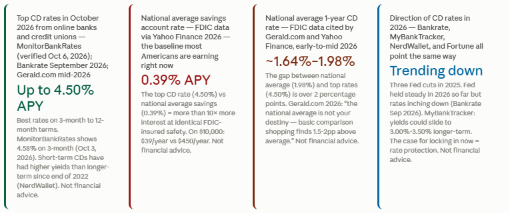
The difference in dollar terms is not subtle. On $10,000 in a standard savings account earning 0.39% APY for one year, you earn approximately $39. On $10,000 in a top 1-year CD at 4.40% APY, you earn approximately $440. On $50,000, the comparison is $195 versus $2,200. The only thing standing between these two outcomes is which account you chose to open.
National average savings account: 0.39% APY (FDIC via Yahoo Finance 2026). Top CD rates October 2026: 4.00%–4.50% APY (MonitorBankRates; Bankrate; Gerald.com). National average 3-month CD: 2.08% APY (MonitorBankRates, 8,500+ banks, October 6, 2026). Top 3-month CD rates: 4.30%–4.58% APY (MonitorBankRates October 3-6, 2026). Gap between national average and best available: often over 2 percentage points (Gerald.com 2026).
The forecast from multiple sources points the same way. Bankrate’s 2026 CD rate forecast projects the national average one-year CD rate will be approximately 1.7%-1.9% APY for the full year — implying further declines from current competitive rates. MyBankTracker’s 2026 forecast specifically identifies the strategic implication: ‘If the long-term CD rate forecast holds and yields slide closer to 3.00%-3.50%, locking in a higher rate today could help you score a higher return.’ Fortune’s August 2026 coverage makes the same point: ‘Locking in a CD now ahead of any future Fed rate reductions is probably a smart way to ensure your money works for you.’ This is the core argument for CDs in October 2026: the rates are still attractive relative to where they appear to be heading.
Fed context: 11 rate hikes March 2022 - July 2023 (0.25%-0.5% → 5.25%-5.5%). Three cuts in 2025. Steady in 2026 but forecasts point downward. Bankrate forecast: national average 1-year CD could reach 1.7% by end of 2026. MyBankTracker: yields could slide to 3.00%-3.50% longer-term. The case for locking in today is the gap between current top rates (4.40%+) and where they may be in 12-18 months.
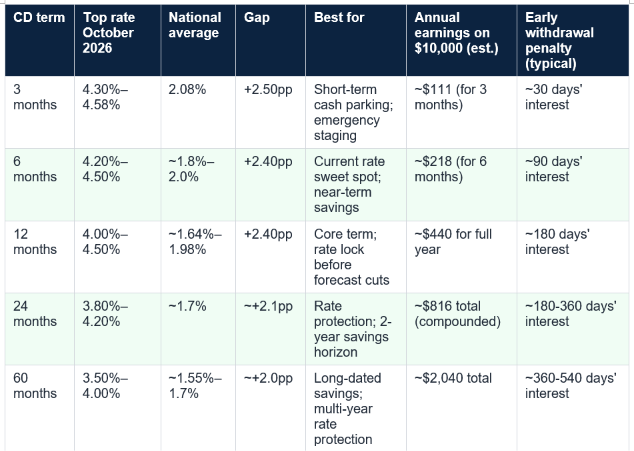
Best for: short-term cash parking (emergency fund supplement, tax staging, upcoming large expense within 90 days). Top rates above 4.30% available at online banks and credit unions per MonitorBankRates October 6, 2026. Always verify current rate before opening.
$10,000 at 4.50% APY for 3 months: approximately $111 interest. $25,000 at 4.50% APY: approximately $278. Compare: same $10,000 in a national average savings account (0.39% APY) for 3 months: approximately $10. Not financial advice. Verify current rates.
Three-month CDs mature quickly — if you do not reinvest promptly, the proceeds may sit in a low-rate deposit account for days or weeks. Set a calendar reminder 7 days before maturity and research current rates before deciding whether to roll over or move elsewhere.
Best for: savings that will not be needed for 6 months — house down payment staging, vacation fund, end-of-year expense preparation, general savings with a 6-month horizon. The current sweet spot according to Bankrate September 2026 and Fortune August 2026.
$10,000 at 4.40% APY for 6 months: approximately $218 interest. $25,000 at 4.40% APY: approximately $544. $50,000 at 4.40% APY: approximately $1,088. Compare: $10,000 in a standard savings account at 0.39% APY: approximately $19 over 6 months.
Do not use a 6-month CD for emergency fund money. The early withdrawal penalty (typically 3 months' interest at most institutions) means accessing this money early costs you a portion of the earned interest. Keep 3-6 months of expenses in a liquid high-yield savings account first, then CD the remainder.
The benchmark term. Best for: savings with a 12-month horizon; locking in today's rates before forecast rate cuts; the core position in a CD ladder strategy. The 2-percentage-point gap between national average (1.98%) and top rates (4.40%) makes shopping for the best rate the single most impactful decision.
$10,000 at 4.40% APY for 12 months: approximately $440 interest. $20,000 at 4.40%: approximately $880. $50,000 at 4.40%: approximately $2,200. Same $10,000 at national average (1.98%): approximately $198. The difference (at $50k): approximately $1,215/year just from finding the right bank.
When comparing 1-year CDs, look at the total APY (which compounds) rather than the stated interest rate, and check the early withdrawal penalty — typically 6 months' interest for a 1-year CD at most institutions. Also confirm whether the CD auto-renews at maturity and at what rate.
Best for: two-year horizon savings; rate protection play against forecast Fed cuts; component of a CD ladder. Most appropriate for savers who believe current rates are near the top of a cycle and want to preserve them.
$10,000 at 4.00% APY for 24 months: approximately $816 interest (compounded annually). $25,000 at 4.00%: approximately $2,040. $50,000 at 4.00%: approximately $4,080. All figures approximate — actual compounding frequency varies by institution.
Two-year early withdrawal penalties can be steep — typically 6-12 months of interest. Before locking in for two years, ensure you have adequate liquid savings (3-6 months of expenses in a HYSA) so you are not forced to break the CD early.
Best for: genuinely long-dated savings that will not be needed for 5 years; maximum rate protection against a multi-year falling rate cycle; savers who prioritise certainty over flexibility. Only appropriate when the top rate (3.50-4.00%) is meaningfully above what you expect rates to be in 2-3 years.
$10,000 at 3.75% APY for 60 months: approximately $2,040 interest total. $25,000 at 3.75%: approximately $5,100. Compare: same $10,000 at 5-year national average (1.55%): approximately $798 total. Difference over 5 years: approximately $1,242 from shopping for the right rate.
Five-year early withdrawal penalties are significant — often 12-18 months of interest. Do not put emergency fund money, near-term goal savings, or money you might need into a 5-year CD. The penalty for early withdrawal can wipe out months of earned interest.
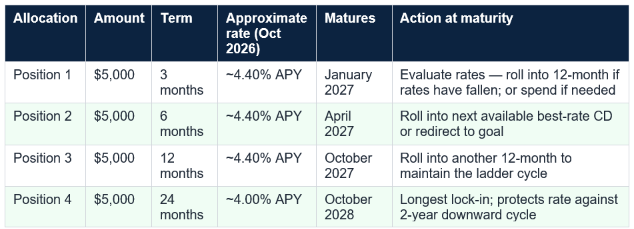
Ladder example based on MyBankTracker 2026 CD rate forecast framework; NerdWallet; CDValet 2026; Gerald.com. Total $20,000 example. Rates approximate and change daily. This is not financial advice — amounts, terms, and strategy should reflect your own financial situation and goals. Consult a qualified financial adviser.
The 2026 CD vs HYSA decision: HYSA for emergency fund (always liquid); CD for savings with a defined term. The specific case for CDs over HYSAs in 2026 is rate protection: your CD rate is fixed; HYSA rates will fall as Fed cuts further. A 12-month CD at 4.40% today protects that rate until October 2027 regardless of Fed decisions.
MonitorBankRates' verified October 6, 2026 data found CD rates ranging from 4.07% to 10.00% APY nationally (the high end reflecting promotional and credit union share certificate specials with specific membership and balance requirements). More typically, top competitive CD rates from online banks and credit unions sit at 4.00% to 4.50% APY for 3-month to 12-month terms, according to Bankrate September 2026, Gerald.com's mid-2026 snapshot, and Fortune's August 2026 coverage. The national average 3-month CD rate is 2.08% APY as of October 6, 2026 (MonitorBankRates, 8,500+ US banks). The national average 1-year CD is approximately 1.64%-1.98% APY (Yahoo Finance; Gerald.com; FDIC data). Always verify current rates directly with the institution before opening an account — rates change daily.
Is it a good time to lock in a CD in 2026?
The consensus from Bankrate, MyBankTracker, Fortune, and NerdWallet is: yes, locking in now ahead of expected further Fed rate cuts is a smart approach for money you can commit for a defined term. MyBankTracker's 2026 CD forecast is specific: 'If the long-term CD rate forecast holds and yields slide closer to 3.00%-3.50%, locking in a higher rate today could help you score a higher return.' Fortune (August 20, 2026): 'Locking in a CD now ahead of any future Fed rate reductions is probably a smart way to ensure your money works for you.' Bankrate confirms that in 2026, competitive CD rates have continued inching down slowly even without new Fed cuts. The risk of waiting is that the rates you are waiting to capture have already begun declining.
Should I use a CD ladder?
For most savers who have more than they need in their emergency fund, a CD ladder is the most practically recommended strategy across all the major sources covering CDs in 2026. NerdWallet calls it a way to 'reduce the stress around timing your CDs.' CDValet describes it as combining 'yield protection with periodic opportunities to compare new offers.' Yahoo Finance recommends it as a way to 'take advantage of today's high CD rates without tying up all of your money for several years.' A simple four-rung ladder (3-month, 6-month, 12-month, 24-month) with equal allocations gives you a CD maturing every few months, meaning you are never completely locked out of your savings and never missing the opportunity to reinvest at current rates when each rung matures.
How much more do I earn in a top CD vs a regular savings account?
On $10,000: regular savings account at 0.39% APY earns approximately $39/year. Top 1-year CD at 4.40% APY earns approximately $440/year. On $25,000: $97.50/year in savings vs $1,100 in top CD. On $50,000: $195/year vs $2,200. The gap on $50,000 is approximately $2,005 per year — from a decision that costs nothing but twenty minutes of account comparison and opening. Gerald.com's 2026 analysis notes that the gap between national average and best available rates is 'enormous — often over 2 percentage points' and that 'the national average is not your destiny.' Not financial advice. Verify current rates before opening.
Are CDs safe? What about FDIC insurance?
CDs held at FDIC-insured banks are among the safest financial products available to US savers. The FDIC insures deposits up to $250,000 per depositor, per institution, per ownership category. This means there is zero risk of loss up to this limit even if the institution fails — the federal government guarantees the principal and accrued interest. Credit unions offer equivalent protection through NCUA (National Credit Union Administration) insurance. For savings above $250,000 at one institution, spread across multiple FDIC/NCUA-insured institutions or ownership categories (individual, joint, retirement) to maintain full coverage. This is worth noting because the online banks offering the highest CD rates in 2026 have identical FDIC coverage to the big banks offering the lowest rates — the safety does not decline as the rate increases.
There is a quiet financial opportunity sitting in the background of 2026 that most people are either not taking advantage of, or taking advantage of less fully than they could. The national average interest rate on a savings account in the United States is approximately 0.39% APY, according to FDIC data cited by Yahoo Finance. The top certificate of deposit rates available from online banks and credit unions, as of October 2026, are at 4.00% to 4.50% APY. That is more than ten times the return for the same money, at the same FDIC-insured safety level. The catch: a CD locks your money for a defined period, from three months to five years. The question of which CD to choose right now is really two questions: what rate are you getting, and for how long should you lock in? In October 2026, both of those questions have specific, data-supported answers. The Federal Reserve has held rates steady so far in 2026, but the forecast from Bankrate, MyBankTracker, and NerdWallet all point in the same direction: rates are expected to fall further. Locking in today’s rates before that happens is the specific strategic case for CDs in the current moment. This article covers the smartest CD options for October 2026 by term, the gap between national averages and the best available rates, the CD ladder strategy for savers who do not want to commit everything to one term, and the specific numbers you need to decide where your savings belong.
Table of Contents
- The Rate Gap No One Is Talking About Enough
- Why Right Now Matters: The Fed Rate Direction in 2026
- How CDs Work and What Makes One ‘Smart’
- The 3-Month CD: 4.30%–4.58% APY
- The 6-Month CD: 4.20%–4.50% APY
- The 12-Month (1-Year) CD: 4.00%–4.50% APY
- The 2-Year CD: 3.80%–4.20% APY
- The 5-Year CD: 3.50%–4.00% APY
- The CD Ladder Strategy: How to Combine Terms Intelligently
- National Average vs Online Bank Rates: The Comparison Table
- CD vs High-Yield Savings Account: Which Wins in 2026?
- Conclusion: Lock In Before the Window Narrows
- Frequently Asked Questions
The Rate Gap No One Is Talking About Enough
The national average savings account interest rate in the United States is approximately 0.39% APY, according to FDIC data cited by Yahoo Finance. The top certificate of deposit rates available right now from online banks and credit unions are 4.00% to 4.50% APY. That is a gap of more than four percentage points between what most people earn and what they could earn — at identical FDIC-insured safety levels, on the same type of account. Gerald.com’s 2026 CD analysis is blunt about the implication: ‘The national average is not your destiny. With some basic comparison shopping, most savers can find rates 1.5-2 percentage points above the average.’ And above the national average does not mean settling for 2% — it means finding 4% to 4.50% at competitive online banks and credit unions.The difference in dollar terms is not subtle. On $10,000 in a standard savings account earning 0.39% APY for one year, you earn approximately $39. On $10,000 in a top 1-year CD at 4.40% APY, you earn approximately $440. On $50,000, the comparison is $195 versus $2,200. The only thing standing between these two outcomes is which account you chose to open.
National average savings account: 0.39% APY (FDIC via Yahoo Finance 2026). Top CD rates October 2026: 4.00%–4.50% APY (MonitorBankRates; Bankrate; Gerald.com). National average 3-month CD: 2.08% APY (MonitorBankRates, 8,500+ banks, October 6, 2026). Top 3-month CD rates: 4.30%–4.58% APY (MonitorBankRates October 3-6, 2026). Gap between national average and best available: often over 2 percentage points (Gerald.com 2026).
Why Right Now Matters: The Fed Rate Direction in 2026
From March 2022 to July 2023, the Federal Reserve raised its benchmark interest rate eleven times, lifting it from 0.25%-0.5% to 5.25%-5.5% — the fastest and most aggressive rate hiking cycle in decades (NerdWallet). That cycle is what created the current CD rate environment. Banks and credit unions competing for deposit business raised their CD rates broadly in line with the Fed, producing the 4-5% CD rates that have been available since 2023. The Fed then cut rates three times in 2025 (NerdWallet; Yahoo Finance), beginning the descent. In 2026, Bankrate’s September analysis found the Fed had held rates steady so far, but competitive CD rates ‘have still inched down, slowly.’ The direction is clear.The forecast from multiple sources points the same way. Bankrate’s 2026 CD rate forecast projects the national average one-year CD rate will be approximately 1.7%-1.9% APY for the full year — implying further declines from current competitive rates. MyBankTracker’s 2026 forecast specifically identifies the strategic implication: ‘If the long-term CD rate forecast holds and yields slide closer to 3.00%-3.50%, locking in a higher rate today could help you score a higher return.’ Fortune’s August 2026 coverage makes the same point: ‘Locking in a CD now ahead of any future Fed rate reductions is probably a smart way to ensure your money works for you.’ This is the core argument for CDs in October 2026: the rates are still attractive relative to where they appear to be heading.
Fed context: 11 rate hikes March 2022 - July 2023 (0.25%-0.5% → 5.25%-5.5%). Three cuts in 2025. Steady in 2026 but forecasts point downward. Bankrate forecast: national average 1-year CD could reach 1.7% by end of 2026. MyBankTracker: yields could slide to 3.00%-3.50% longer-term. The case for locking in today is the gap between current top rates (4.40%+) and where they may be in 12-18 months.
How CDs Work and What Makes One ‘Smart’
A certificate of deposit is a savings account that locks your money for a defined term in exchange for a guaranteed interest rate. The rate is fixed at the time you open the account and does not change regardless of what happens to market rates during your term. This is the defining advantage of a CD in a falling-rate environment: if you lock in 4.40% today for twelve months and the Fed cuts rates twice before your CD matures, you still earn 4.40% for the full term. A high-yield savings account earning 4.20% today might be earning 3.50% by April 2027. Your CD does not follow the same path. The three factors that define a ‘smart’ CD in October 2026 are: the rate (find the highest APY for your chosen term), the term (match the term to the horizon of your savings — not shorter, and not longer than you can commit to), and the institution (FDIC-insured banks and NCUA-insured credit unions provide identical safety at any rate level).
The 3-Month CD: Top Rates 4.30%–4.58% APY
The three-month CD is the shortest conventional term and currently one of the more competitive in the inverted yield environment that has persisted since late 2022. MonitorBankRates’ verified October 6, 2026 data puts the top three-month rates at 4.58% APY and notes movement — one institution went from 4.32% on September 27 to 4.58% by October 3. The national average for three-month CDs is 2.08% APY (MonitorBankRates, 8,500+ US banks) — meaning the best rates are more than double the national average. The three-month CD is the right choice for two types of savers: those who genuinely need their money back within three months (emergency fund supplement, down payment staging, tax bill preparation) and those who believe rates may tick up and want to keep their options open without locking in for longer. NerdWallet’s analysis confirms that short-term CD rates have had higher yields than longer-term rates since the end of 2022 — an unusual yield inversion where locking in for longer does not currently reward you with meaningfully higher rates. The downside: at three months, the interest earned in absolute dollar terms is modest. A $10,000 deposit at 4.50% APY over three months earns approximately $111. Not spectacular. But for money that is genuinely short-dated, it beats the national average savings account rate of 0.39% by a very wide margin.Best for: short-term cash parking (emergency fund supplement, tax staging, upcoming large expense within 90 days). Top rates above 4.30% available at online banks and credit unions per MonitorBankRates October 6, 2026. Always verify current rate before opening.
$10,000 at 4.50% APY for 3 months: approximately $111 interest. $25,000 at 4.50% APY: approximately $278. Compare: same $10,000 in a national average savings account (0.39% APY) for 3 months: approximately $10. Not financial advice. Verify current rates.
Three-month CDs mature quickly — if you do not reinvest promptly, the proceeds may sit in a low-rate deposit account for days or weeks. Set a calendar reminder 7 days before maturity and research current rates before deciding whether to roll over or move elsewhere.
The 6-Month CD: Top Rates 4.20%–4.50% APY
The six-month CD is consistently identified as one of the sweet spots in the current rate environment. Bankrate’s September 2026 analysis finds that the highest CD rates right now are mostly on short-term CDs of five to twelve months. Gerald.com’s mid-2026 snapshot puts six-month CDs at the top of its rate comparison table with available rates of 4.20%–4.50% from online banks and credit unions. The logic for the six-month CD in October 2026 is specifically tied to the rate direction outlook: both MyBankTracker and Bankrate’s 2026 CD rate forecasts suggest that the Federal Reserve is likely to loosen monetary policy further, creating downward pressure on CD yields. A six-month lock-in captures today’s attractive rates while keeping the maturity date close enough that you will be back at the comparison table by April 2027 — in a position to make a fresh decision rather than watching rates fall beneath a long-term lock-in you already committed to. Fortune’s August 20, 2026 coverage makes this point directly: ‘Locking in a CD now ahead of any future Fed rate reductions is probably a smart way to ensure your money works for you for months or years to come.’ For savings that are liquid but not immediately needed, the six-month CD threads the needle between rate capture and flexibility.Best for: savings that will not be needed for 6 months — house down payment staging, vacation fund, end-of-year expense preparation, general savings with a 6-month horizon. The current sweet spot according to Bankrate September 2026 and Fortune August 2026.
$10,000 at 4.40% APY for 6 months: approximately $218 interest. $25,000 at 4.40% APY: approximately $544. $50,000 at 4.40% APY: approximately $1,088. Compare: $10,000 in a standard savings account at 0.39% APY: approximately $19 over 6 months.
Do not use a 6-month CD for emergency fund money. The early withdrawal penalty (typically 3 months' interest at most institutions) means accessing this money early costs you a portion of the earned interest. Keep 3-6 months of expenses in a liquid high-yield savings account first, then CD the remainder.
The 12-Month (1-Year) CD: Top Rates 4.00%–4.50% APY
The one-year CD is the standard benchmark for CD rate comparisons and the most widely purchased term in the market. Gerald.com’s 2026 CD rate forecast notes that the national average 1-year CD stands at approximately 1.98% APY (FDIC data), while top rates from online banks and credit unions reach 4.00%–4.50% — a gap of over 2 percentage points that Gerald identifies as ‘enormous.’ The conclusion is explicit: ‘The national average is not your destiny. With some basic comparison shopping, most savers can find rates 1.5-2 percentage points above the average.’ MyBankTracker’s 2026 CD rate forecast makes the specific case for locking in now: ‘If the long-term CD rate forecast holds and yields slide closer to 3.00%-3.50%, locking in a higher rate today could help you score a higher return.’ On a one-year term, the difference between a 4.40% APY and a 3.20% APY on $20,000 is approximately $240 in foregone interest — real money for a decision that costs nothing but a few minutes of rate comparison. The one-year CD is the practical choice for savings with a defined 12-month horizon: year-end tax staging, annual expense reserves, medium-term savings goals.The benchmark term. Best for: savings with a 12-month horizon; locking in today's rates before forecast rate cuts; the core position in a CD ladder strategy. The 2-percentage-point gap between national average (1.98%) and top rates (4.40%) makes shopping for the best rate the single most impactful decision.
$10,000 at 4.40% APY for 12 months: approximately $440 interest. $20,000 at 4.40%: approximately $880. $50,000 at 4.40%: approximately $2,200. Same $10,000 at national average (1.98%): approximately $198. The difference (at $50k): approximately $1,215/year just from finding the right bank.
When comparing 1-year CDs, look at the total APY (which compounds) rather than the stated interest rate, and check the early withdrawal penalty — typically 6 months' interest for a 1-year CD at most institutions. Also confirm whether the CD auto-renews at maturity and at what rate.
The 2-Year CD: Top Rates 3.80%–4.20% APY
The two-year CD occupies a middle position in the current rate landscape — still offering competitive rates well above national averages, but at a slight discount to the 6-12 month sweet spot due to the inverted yield curve on CDs. NerdWallet’s analysis of national average and high-yield CDs found that short-term CD rates have had higher yields than longer-term rates since the end of 2022 — the two-year term reflects this: rates are competitive but not as high as you might expect for the additional commitment. The case for the two-year CD in the current environment is about forecasting. If the Federal Reserve does pursue additional rate cuts in 2026 and rates continue drifting toward the 3.00%-3.50% range that Bankrate and MyBankTracker forecast for the national average, then locking in at 3.80%–4.20% for two years preserves a meaningfully higher rate than what may be available in 12-18 months. The two-year CD fits savers who are relatively confident they will not need the money for two years and who want to protect their rate against a downward cycle. CDValet’s 2026 analysis notes that a CD ladder can divide deposits among several maturity dates, combining yield protection with periodic opportunities to compare new offers — the two-year CD is a natural component of such a ladder.Best for: two-year horizon savings; rate protection play against forecast Fed cuts; component of a CD ladder. Most appropriate for savers who believe current rates are near the top of a cycle and want to preserve them.
$10,000 at 4.00% APY for 24 months: approximately $816 interest (compounded annually). $25,000 at 4.00%: approximately $2,040. $50,000 at 4.00%: approximately $4,080. All figures approximate — actual compounding frequency varies by institution.
Two-year early withdrawal penalties can be steep — typically 6-12 months of interest. Before locking in for two years, ensure you have adequate liquid savings (3-6 months of expenses in a HYSA) so you are not forced to break the CD early.
The 5-Year CD: Top Rates 3.50%–4.00% APY
The five-year CD is the longest standard term and currently the least recommended in a falling-rate environment where short-to-mid-term CDs offer comparable or higher rates. Bankrate’s 2026 forecast puts the national average five-year CD at approximately 1.55% APY — but top rates from competitive institutions still reach 3.50%–4.00%. The inverted yield curve on CDs means that locking in for five years does not reward you with a meaningfully higher rate than a one-year CD — yet it commits your money for four additional years. That said, there is a specific use case where the five-year CD makes sense: if you have savings that you genuinely will not need for five years, want guaranteed FDIC-insured returns, and are concerned that rates will fall significantly over the next several years (which the Bankrate and MyBankTracker forecasts support), then locking in at 3.75%–4.00% for five years protects against that decline. Bankrate’s CD rate forecast notes that even at the national average of 1.93% on a $5,000 deposit, a CD earns $96.50 more than a variable-rate savings account that lowers its rate over time. At the competitive rate of 3.80%+ on $20,000 over five years, the earnings are substantial.Best for: genuinely long-dated savings that will not be needed for 5 years; maximum rate protection against a multi-year falling rate cycle; savers who prioritise certainty over flexibility. Only appropriate when the top rate (3.50-4.00%) is meaningfully above what you expect rates to be in 2-3 years.
$10,000 at 3.75% APY for 60 months: approximately $2,040 interest total. $25,000 at 3.75%: approximately $5,100. Compare: same $10,000 at 5-year national average (1.55%): approximately $798 total. Difference over 5 years: approximately $1,242 from shopping for the right rate.
Five-year early withdrawal penalties are significant — often 12-18 months of interest. Do not put emergency fund money, near-term goal savings, or money you might need into a 5-year CD. The penalty for early withdrawal can wipe out months of earned interest.
The CD Ladder Strategy: How to Combine Terms Intelligently
The CD ladder is the most frequently recommended strategy by every major source covering CDs in 2026 — NerdWallet, MyBankTracker, CDValet, Gerald.com, and Yahoo Finance all explicitly recommend it as a way to combine the rate benefits of CDs with the practical need for periodic liquidity. The logic is simple: instead of putting all your savings into one CD at one term, you split the money across multiple CDs with different maturity dates. When each CD matures, you either use the funds or roll them into a new CD at whatever rate is then available. NerdWallet’s analysis summarises the appeal: the CD ladder ‘reduces the stress around timing your CDs.’ CDValet 2026 adds precision: it ‘combines yield protection with periodic opportunities to compare new offers.’ MyBankTracker’s 2026 CD forecast provides a concrete example: a $20,000 ladder spread across multiple CD terms with staggered maturities. A practical version for October 2026: $5,000 each into 3-month, 6-month, 12-month, and 24-month CDs. By March 2027, the 3-month CD matures and you reinvest (or spend) at whatever rate is then available. By April 2027, the 6-month follows. You never have all your savings locked up indefinitely, and every maturity is an opportunity to respond to the new rate environment rather than being trapped in a decision made today.Ladder example based on MyBankTracker 2026 CD rate forecast framework; NerdWallet; CDValet 2026; Gerald.com. Total $20,000 example. Rates approximate and change daily. This is not financial advice — amounts, terms, and strategy should reflect your own financial situation and goals. Consult a qualified financial adviser.
National Average vs Online Bank Rates: The Comparison Table
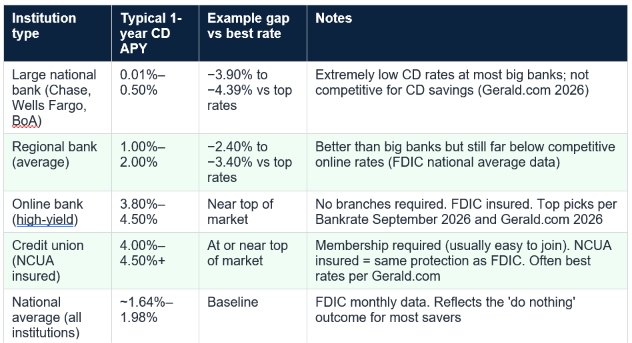
The single most important action a CD saver can take in 2026 is to not default to the bank where they have their checking account. Gerald.com’s 2026 CD analysis identifies the key insight: big banks like Chase and Wells Fargo offer CD rates significantly below competitive online banks. NerdWallet confirms that high-yield CDs tend to be at online banks and online credit unions, which have ‘rates that are whole percentages higher than national average CD rates.’ The safety is identical: FDIC-insured banks provide the same $250,000 per depositor coverage regardless of whether the bank has branches or exists only online. The rate difference is the only variable that changes.
CD vs High-Yield Savings Account: Which Wins in 2026?
The question of CD versus high-yield savings account (HYSA) in 2026 is not a simple one-wins-one-loses comparison. They serve different purposes in a smart savers’ toolkit. A HYSA earns competitive rates (above 4% APY at top institutions per NerdWallet) with full liquidity — you can withdraw money at any time without penalty. A CD earns a comparable or slightly higher rate but locks your money for a defined term and penalises early withdrawal. NerdWallet’s CD rate forecast recommends HYSAs for emergency funds and near-term liquidity needs, and CDs for money with a defined horizon. The specific 2026 argument for CDs over HYSAs is rate trajectory: a HYSA’s rate is variable and will decline as the Fed cuts rates. The CD’s rate is fixed and protected. Money you put in a 12-month CD today at 4.40% will still earn 4.40% in April 2027 even if the HYSA rate has dropped to 3.50% by then. Gerald.com’s 2026 CD analysis summarises the practical guideline: ‘If liquidity matters, a high-yield savings account gives you most of the rate benefit with full flexibility.’ The smart approach for most savers: emergency fund (3-6 months of expenses) in a HYSA always; everything above the emergency fund in a CD or CD ladder to capture the rate protection benefit.The 2026 CD vs HYSA decision: HYSA for emergency fund (always liquid); CD for savings with a defined term. The specific case for CDs over HYSAs in 2026 is rate protection: your CD rate is fixed; HYSA rates will fall as Fed cuts further. A 12-month CD at 4.40% today protects that rate until October 2027 regardless of Fed decisions.
Conclusion
The smartest CD decisions in October 2026 share a common logic: capture today’s still-attractive rates before the forecast rate cuts narrow the gap between what online banks offer and what they will offer in 12 to 18 months. The six-month and twelve-month terms currently offer the highest rates in an inverted yield curve environment where longer-term CDs do not reward you proportionally for the additional commitment. The online banks and credit unions offering 4.00% to 4.50% APY are offering more than double — often more than triple — what the national average provides at identical FDIC-insured safety levels. The CD ladder offers the best of both worlds: rate capture on current attractive terms with periodic liquidity as each rung matures. And the one action that produces the highest single return on time invested for most savers — switching from a big-bank or standard savings account to an online bank CD — takes about twenty minutes and a willingness to look beyond where the checking account already lives.Frequently Asked Questions
What is the highest CD rate available in October 2026?MonitorBankRates' verified October 6, 2026 data found CD rates ranging from 4.07% to 10.00% APY nationally (the high end reflecting promotional and credit union share certificate specials with specific membership and balance requirements). More typically, top competitive CD rates from online banks and credit unions sit at 4.00% to 4.50% APY for 3-month to 12-month terms, according to Bankrate September 2026, Gerald.com's mid-2026 snapshot, and Fortune's August 2026 coverage. The national average 3-month CD rate is 2.08% APY as of October 6, 2026 (MonitorBankRates, 8,500+ US banks). The national average 1-year CD is approximately 1.64%-1.98% APY (Yahoo Finance; Gerald.com; FDIC data). Always verify current rates directly with the institution before opening an account — rates change daily.
Is it a good time to lock in a CD in 2026?
The consensus from Bankrate, MyBankTracker, Fortune, and NerdWallet is: yes, locking in now ahead of expected further Fed rate cuts is a smart approach for money you can commit for a defined term. MyBankTracker's 2026 CD forecast is specific: 'If the long-term CD rate forecast holds and yields slide closer to 3.00%-3.50%, locking in a higher rate today could help you score a higher return.' Fortune (August 20, 2026): 'Locking in a CD now ahead of any future Fed rate reductions is probably a smart way to ensure your money works for you.' Bankrate confirms that in 2026, competitive CD rates have continued inching down slowly even without new Fed cuts. The risk of waiting is that the rates you are waiting to capture have already begun declining.
Should I use a CD ladder?
For most savers who have more than they need in their emergency fund, a CD ladder is the most practically recommended strategy across all the major sources covering CDs in 2026. NerdWallet calls it a way to 'reduce the stress around timing your CDs.' CDValet describes it as combining 'yield protection with periodic opportunities to compare new offers.' Yahoo Finance recommends it as a way to 'take advantage of today's high CD rates without tying up all of your money for several years.' A simple four-rung ladder (3-month, 6-month, 12-month, 24-month) with equal allocations gives you a CD maturing every few months, meaning you are never completely locked out of your savings and never missing the opportunity to reinvest at current rates when each rung matures.
How much more do I earn in a top CD vs a regular savings account?
On $10,000: regular savings account at 0.39% APY earns approximately $39/year. Top 1-year CD at 4.40% APY earns approximately $440/year. On $25,000: $97.50/year in savings vs $1,100 in top CD. On $50,000: $195/year vs $2,200. The gap on $50,000 is approximately $2,005 per year — from a decision that costs nothing but twenty minutes of account comparison and opening. Gerald.com's 2026 analysis notes that the gap between national average and best available rates is 'enormous — often over 2 percentage points' and that 'the national average is not your destiny.' Not financial advice. Verify current rates before opening.
Are CDs safe? What about FDIC insurance?
CDs held at FDIC-insured banks are among the safest financial products available to US savers. The FDIC insures deposits up to $250,000 per depositor, per institution, per ownership category. This means there is zero risk of loss up to this limit even if the institution fails — the federal government guarantees the principal and accrued interest. Credit unions offer equivalent protection through NCUA (National Credit Union Administration) insurance. For savings above $250,000 at one institution, spread across multiple FDIC/NCUA-insured institutions or ownership categories (individual, joint, retirement) to maintain full coverage. This is worth noting because the online banks offering the highest CD rates in 2026 have identical FDIC coverage to the big banks offering the lowest rates — the safety does not decline as the rate increases.
0 Comments
Be the first to share your thoughts on this article.