

Planning
How to Put “Extra” Biweekly Paychecks Toward a 2027 Goal Now

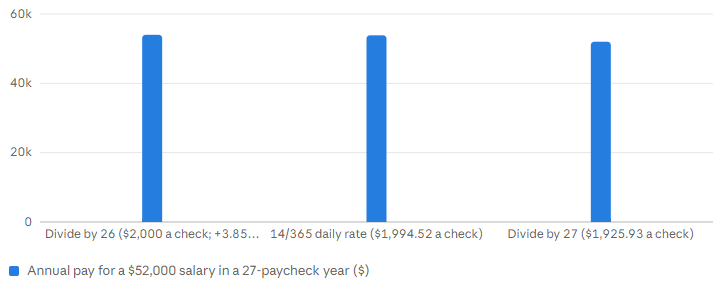
The calendar: paid every other Friday starting January 1, 2027 means 27 paychecks (three in January, July and December); starting January 8 means 26 (three in April and October); every other biweekly start gets 26 with two three-paycheck months. 2027 has 53 Fridays. Is it extra? A $52,000 salary pays $2,000 a check if divided by 26 ($54,000 over 27 checks, +3.85%), $1,925.93 if divided by 27 ($52,000 total) or $1,994.52 under a 14/365 daily-rate method ($53,852). My arithmetic with a $2,000 take-home check: budgeting on 24 checks leaves $4,000 a year (26 checks) or $6,000 (27 checks); $4,000 on a $5,000 card at 20.9% saves about $1,566 of interest; $4,000 a year invested for 30 years at 7% grows to about $377,800; $4,000 a year in a 4.34% savings account reaches $9,000 in three years.
Total pay for the year ($) by Wisemonk's $52,000 salary example; the 27th check applies only to every-other-Friday schedules starting January 1, 2027
That is no reason to be glum. A third paycheck is still a useful gift of timing: budget as though it does not exist and it becomes a lump of money you can aim at a goal. This guide explains which months bring three paychecks in 2027, when the extra check is real and when it is a mirage, and how to put it to work on debt, savings or retirement.
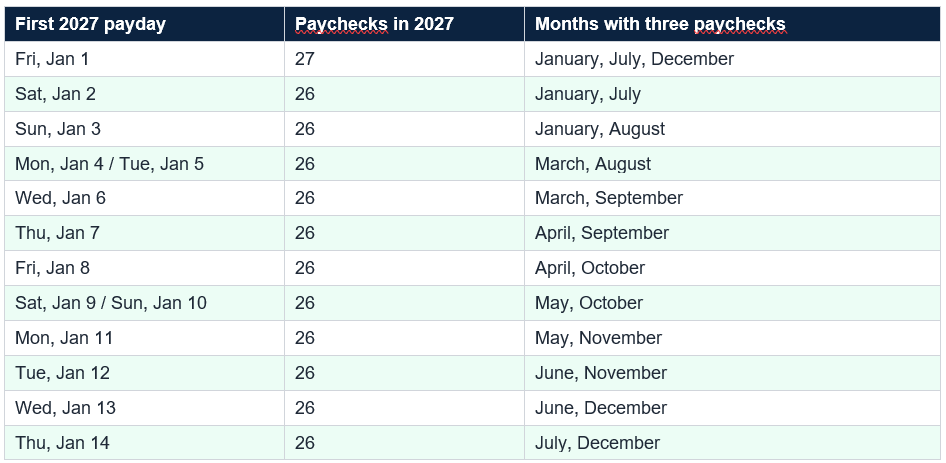
Your months depend on where your payday cycle falls in early January. I computed the table below by counting every 14 days from each possible first payday in January 2027, and it matches published calendars, such as Thursday paydays starting January 7 (April and September) and January 14 (July and December). Find your first January payday on your pay stub and read across.
January 1 is a federal holiday. Some employers on the January 1 schedule will pay on Thursday, December 31, 2026, leaving you 26 paychecks in 2027, starting January 15, with three-paycheck months of July and December. Published calendars show both versions, so check your employer’s actual pay dates. Every other Friday from Jan 1, 2027: 27 paychecks (Jan 1, 15, 29; Jul 2, 16, 30; Dec 3, 17, 31 are the three-check months). Every other Friday from Jan 8: 26 paychecks, with April 2, 16, 30 and October 1, 15, 29 as the three-check months. Other schedules: 26 paychecks, two three-check months.
Wisemonk’s $52,000 example, in the table below, shows that even on the 27-check schedule you might get a real raise, no raise or something in between. Benefit deductions can differ too: some employers take them over 24 periods and skip the third check in a month, and flat-dollar deductions set for 26 periods can over-collect if taken 27 times. Ask HR how your company handles it.

With a $2,000 take-home paycheck, my assumption, 26 checks bring $52,000. Living on 24 checks, $48,000, leaves $4,000, about 7.7% of take-home. With 27 checks and a full extra paid, the leftover is $6,000. If your employer divides by 27 there is no extra, but budgeting on 24 still creates cushion the calendar makes easy to spot.
That is a guaranteed return of roughly 21% a year, which no investment can reliably match. With several cards, send the check to the highest rate first. Credit card balances totaled $1.263 trillion in the second quarter, so you are in large company.

The interest is modest, about $43 in six months on a $2,000 check at 4.34%, but the value is stability: a cushion keeps one broken transmission from becoming credit card debt. With inflation at 3.7% in September, keep it in an insured account that pays at least that much.

If you contribute to a 401(k) as a percentage of pay, contributions flow with every check, including the third, so watch the limit. The 2026 401(k) limit of $24,500 is about $942 per check over 26 checks or about $907 over 27, and a family HSA limit of $8,750 is about $337 per check over 26. To max a plan, divide the limit by the number of checks you will receive.

Returns of 7% are an assumption, not a promise, and markets can fall. Treat these as illustrations of how small amounts compound, not forecasts.
Intentions fade; transfers do not. Many employers let you split direct deposit between accounts, so you can send the whole third check to savings. Otherwise, set a calendar reminder on each three-paycheck date and move the money the same day, before the balance looks like spending money. Vanguard found automatic enrollment lifts retirement-plan participation to 94% from 64%, the same principle.
Write the plan down. On a January 8 schedule, the April 30 check goes to the credit card and the October 29 check to the emergency fund. On the January 1 schedule, January 29 goes to a starter fund, July 30 to debt or the Roth IRA and December 31 to next year’s retirement account, assuming your employer pays 27 checks.

Fourth, locking everything into a retirement account before you have an emergency fund. Fifth, ignoring taxes: withholding is based on each check, so look at your year-end totals. And sixth, assuming everyone gets this: monthly and semi-monthly workers have no extra checks.
The practical answer is the same in every case: budget on two checks a month and name the third before it arrives. In my illustration with a $2,000 check, that is $4,000 or $6,000 a year, enough to clear most of a $5,000 card balance and save about $1,566 of interest, build a $9,000 emergency fund in about three years or start a retirement habit worth about $377,800 over 30 years at 7%. Pick one goal, automate it and let the calendar do the rest. A qualified adviser can help you decide.
It depends on your payday. If you are paid every other Friday and one payday is January 1, 2027, you get 27 paychecks, with three in January, July and December. If your Friday paydays start January 8, you get 26 paychecks, with three in April and October. Other weekdays shift the months: for example, every other Thursday starting January 14 gives July and December. Check your pay stub or ask HR.
Is the third paycheck in a month extra money?
Usually not. If you are paid a salary divided by 26, you receive the same annual pay either way; the third check is a timing quirk, not a raise. Only in a 27-paycheck year, and only if your employer keeps paying the same amount per check, do you actually receive an extra check. Employers can also divide the salary by 27, which makes every check slightly smaller.
What if my employer pays on December 31, 2026 instead of January 1, 2027?
Because January 1 is a federal holiday, some employers will pay that check early on December 31, 2026. In that case your 2027 paychecks start January 15, you receive 26 checks in 2027 and your three-paycheck months are July and December. The check you would have received on January 1 lands in 2026 instead.
Should I spend the extra paycheck or save it?
A good default is to budget on two paychecks per month and send the third to a goal you set in advance, such as high-interest debt, an emergency fund or retirement. Spending it is not wrong, but plan the choice before the money arrives so it does not disappear into everyday spending. This is general education, not personal advice.
Do monthly or twice-a-month workers get extra paychecks?
No. Monthly pay is 12 checks and semi-monthly pay is 24 fixed-date checks, so there are no extra paychecks. The effect comes only from biweekly pay, which is 26 or 27 checks a year, or weekly pay, which has 52 or 53.
Table of Contents
- The Paycheck That Is Not Quite Extra
- The Short Answer
- Which Months Bring Three Paychecks in 2027?
- Is It Really Extra Money?
- The 24-Check Budget
- Pick the Goal: A Priority Ladder
- Goal 1: Knock Down High-Interest Debt
- Goal 2: Build the Emergency Fund
- Goal 3: Fund Retirement, a Roth IRA or an HSA
- Goal 4: Park It in a Higher-Rate Home
- Make It Automatic
- Mistakes to Avoid
- Conclusion
- Frequently Asked Questions
Is the 27th paycheck a raise? It depends on how your employer handles it ($)
Total pay for the year ($) by Wisemonk's $52,000 salary example; the 27th check applies only to every-other-Friday schedules starting January 1, 2027
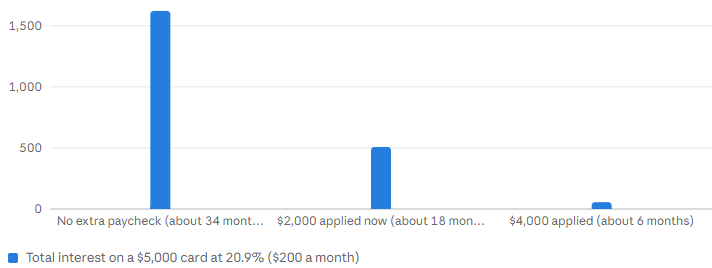
Goal 1: what a third paycheck does to credit card interest ($)
Total interest ($) by Author's arithmetic at a constant 20.9% APR with a $200 monthly payment; saves about $1,114 and $1,566 respectively
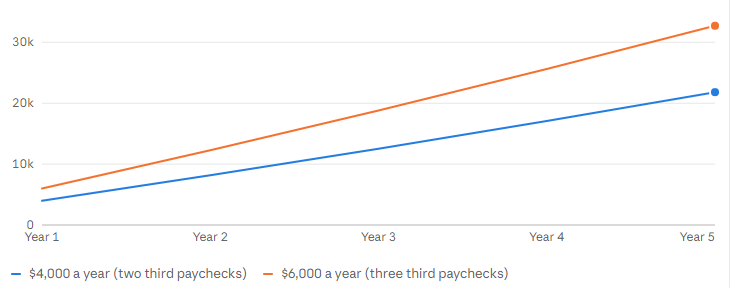
Goal 2: building an emergency fund with third paychecks at 4.34% ($)
The Paycheck That Is Not Quite Extra
If you are paid every other week, you may have heard the good news: some months bring three paychecks, and in 2027 one payday schedule gets a bonus 27th check. It sounds like free money, the sort of thing that sets off a quiet shopping spree. But a paycheck is only extra if it is extra to your annual pay, and for most salaried people it is not. It is the same pay on a different calendar.That is no reason to be glum. A third paycheck is still a useful gift of timing: budget as though it does not exist and it becomes a lump of money you can aim at a goal. This guide explains which months bring three paychecks in 2027, when the extra check is real and when it is a mirage, and how to put it to work on debt, savings or retirement.
The Short Answer
If you are paid every other Friday and one payday is January 1, 2027, you get 27 paychecks, with three in January, July and December. If your Friday paydays start January 8, you get 26, with three in April and October. Other biweekly schedules also get 26, with two three-paycheck months. For salaried workers the third check is usually just timing; only an employer that keeps the same amount per check in a 27-check year hands you a true extra. Budget on two checks a month and give the third a job before it arrives.Which Months Bring Three Paychecks in 2027?
Biweekly pay is 14 days apart, so 26 checks cover 364 days and the leftover day adds up. Because 2027 starts on a Friday and has 53 Fridays, every other Friday starting January 1 lands a payday on both January 1 and December 31, for 27 paychecks. Sources agree this is the only biweekly schedule that gets 27. Everyone else gets 26, which still leaves two months with three checks because 26 does not divide evenly into 12 months.Your months depend on where your payday cycle falls in early January. I computed the table below by counting every 14 days from each possible first payday in January 2027, and it matches published calendars, such as Thursday paydays starting January 7 (April and September) and January 14 (July and December). Find your first January payday on your pay stub and read across.
January 1 is a federal holiday. Some employers on the January 1 schedule will pay on Thursday, December 31, 2026, leaving you 26 paychecks in 2027, starting January 15, with three-paycheck months of July and December. Published calendars show both versions, so check your employer’s actual pay dates. Every other Friday from Jan 1, 2027: 27 paychecks (Jan 1, 15, 29; Jul 2, 16, 30; Dec 3, 17, 31 are the three-check months). Every other Friday from Jan 8: 26 paychecks, with April 2, 16, 30 and October 1, 15, 29 as the three-check months. Other schedules: 26 paychecks, two three-check months.
Is It Really Extra Money?
Here is the part the headlines skip. If you are paid hourly, a 27th payday pays you for hours worked, so it is real money. If you are salaried, your annual pay is set, and an employer has three lawful ways to handle a 27th check: divide the salary by 26 and pay a full extra check (about 3.85% more cost to the employer), divide by 27 so each check is smaller and the annual total is unchanged, or use a 14/365 daily rate.Wisemonk’s $52,000 example, in the table below, shows that even on the 27-check schedule you might get a real raise, no raise or something in between. Benefit deductions can differ too: some employers take them over 24 periods and skip the third check in a month, and flat-dollar deductions set for 26 periods can over-collect if taken 27 times. Ask HR how your company handles it.
The 24-Check Budget
The simplest way to use a three-paycheck month is to build your budget on 24 checks, two a month, as though the others did not exist. Bills, groceries and rent are covered by the first two checks, and the third, when it arrives, is outside the budget and ready for a goal. It is the same idea as saving a raise before you see it, and it works because you never get used to spending it.With a $2,000 take-home paycheck, my assumption, 26 checks bring $52,000. Living on 24 checks, $48,000, leaves $4,000, about 7.7% of take-home. With 27 checks and a full extra paid, the leftover is $6,000. If your employer divides by 27 there is no extra, but budgeting on 24 still creates cushion the calendar makes easy to spot.
Pick the Goal: A Priority Ladder
Choose the goal before the money arrives. A sensible order for most people: a $1,000 starter emergency fund; any employer 401(k) match, which is free money; high-interest debt, since the average card rate was about 20.9% in the second quarter; a full emergency fund of three to six months of essentials, because Bankrate found only 47% of Americans could cover a $1,000 emergency and 46% three months; then a Roth IRA, health savings account or other retirement saving; and finally goals such as a down payment.Goal 1: Knock Down High-Interest Debt
If you carry a card balance, a third paycheck is your cleanest weapon. In my illustration, a $5,000 balance at 20.9% paid at $200 a month takes about 34 months and costs about $1,622 in interest. A $2,000 third paycheck applied now clears it in about 18 months for about $508, saving about $1,114; $4,000, two extra checks, clears the rest in about six months for about $56, saving about $1,566.That is a guaranteed return of roughly 21% a year, which no investment can reliably match. With several cards, send the check to the highest rate first. Credit card balances totaled $1.263 trillion in the second quarter, so you are in large company.
Goal 2: Build the Emergency Fund
With no high-interest debt, the next job is a cushion. If essentials cost $3,000 a month, three months is $9,000 and six is $18,000. In my illustration, $4,000 a year in a savings account paying 4.34% passes $9,000 in the third year, and $6,000 a year passes it in the second. Top savings accounts paid 4.34% to 4.50% in October, according to MyMoneyBlog, versus 0.38% for the average account.The interest is modest, about $43 in six months on a $2,000 check at 4.34%, but the value is stability: a cushion keeps one broken transmission from becoming credit card debt. With inflation at 3.7% in September, keep it in an insured account that pays at least that much.
Goal 3: Fund Retirement, a Roth IRA or an HSA
Once your cushion is in place, retirement is where a few thousand dollars a year makes the biggest long-term difference. In my illustration, $4,000 a year invested for 30 years at a constant 7% grows to about $377,800, and $6,000 a year to about $566,800. The 2026 Roth IRA limit is $7,500, so $4,000 would fund about 53% of it and $6,000 about 80%; the IRS had not announced 2027 limits.If you contribute to a 401(k) as a percentage of pay, contributions flow with every check, including the third, so watch the limit. The 2026 401(k) limit of $24,500 is about $942 per check over 26 checks or about $907 over 27, and a family HSA limit of $8,750 is about $337 per check over 26. To max a plan, divide the limit by the number of checks you will receive.
Returns of 7% are an assumption, not a promise, and markets can fall. Treat these as illustrations of how small amounts compound, not forecasts.
Goal 4: Park It in a Higher-Rate Home
If your cushion is built and retirement is on track, a third paycheck can serve a nearer goal such as a down payment or a future repair. For money you will not need for at least a year, an I bond is worth a look: TreasuryDirect set a 5.51% rate, with a 1.40% fixed rate, for bonds bought from November 2026 to April 2027, with a $10,000 annual limit per person and a 12-month lockup. A T-bill or CD can suit a fixed date. Match the account to the timeline: money for emergencies should be reachable the same day.Intentions fade; transfers do not. Many employers let you split direct deposit between accounts, so you can send the whole third check to savings. Otherwise, set a calendar reminder on each three-paycheck date and move the money the same day, before the balance looks like spending money. Vanguard found automatic enrollment lifts retirement-plan participation to 94% from 64%, the same principle.
Write the plan down. On a January 8 schedule, the April 30 check goes to the credit card and the October 29 check to the emergency fund. On the January 1 schedule, January 29 goes to a starter fund, July 30 to debt or the Roth IRA and December 31 to next year’s retirement account, assuming your employer pays 27 checks.
Mistakes to Avoid
The first mistake is counting on a check that does not come: if your employer pays January 1 on December 31, 2026, or divides your salary by 27, the third check may not be extra at all, so confirm before you spend. The second is lifestyle creep, spending at a 26-check level and then feeling squeezed in two-check months. The third is forgetting deductions: if benefits are taken over 24 periods, your third check will be larger, and flat deductions taken 27 times can over-collect.Fourth, locking everything into a retirement account before you have an emergency fund. Fifth, ignoring taxes: withholding is based on each check, so look at your year-end totals. And sixth, assuming everyone gets this: monthly and semi-monthly workers have no extra checks.
Conclusion
The “extra” paychecks of 2027 are real as a calendar fact and often illusory as a financial one. Every other Friday from January 1 means 27 checks, with three in January, July and December; from January 8, 26 checks, with three in April and October; most other schedules have 26 checks and two three-paycheck months. For salaried workers the extra is usually just timing, and only an employer that pays a full extra check in a 27-check year gives you real new money.The practical answer is the same in every case: budget on two checks a month and name the third before it arrives. In my illustration with a $2,000 check, that is $4,000 or $6,000 a year, enough to clear most of a $5,000 card balance and save about $1,566 of interest, build a $9,000 emergency fund in about three years or start a retirement habit worth about $377,800 over 30 years at 7%. Pick one goal, automate it and let the calendar do the rest. A qualified adviser can help you decide.
Frequently Asked Questions
Which months have three paychecks in 2027?It depends on your payday. If you are paid every other Friday and one payday is January 1, 2027, you get 27 paychecks, with three in January, July and December. If your Friday paydays start January 8, you get 26 paychecks, with three in April and October. Other weekdays shift the months: for example, every other Thursday starting January 14 gives July and December. Check your pay stub or ask HR.
Is the third paycheck in a month extra money?
Usually not. If you are paid a salary divided by 26, you receive the same annual pay either way; the third check is a timing quirk, not a raise. Only in a 27-paycheck year, and only if your employer keeps paying the same amount per check, do you actually receive an extra check. Employers can also divide the salary by 27, which makes every check slightly smaller.
What if my employer pays on December 31, 2026 instead of January 1, 2027?
Because January 1 is a federal holiday, some employers will pay that check early on December 31, 2026. In that case your 2027 paychecks start January 15, you receive 26 checks in 2027 and your three-paycheck months are July and December. The check you would have received on January 1 lands in 2026 instead.
Should I spend the extra paycheck or save it?
A good default is to budget on two paychecks per month and send the third to a goal you set in advance, such as high-interest debt, an emergency fund or retirement. Spending it is not wrong, but plan the choice before the money arrives so it does not disappear into everyday spending. This is general education, not personal advice.
Do monthly or twice-a-month workers get extra paychecks?
No. Monthly pay is 12 checks and semi-monthly pay is 24 fixed-date checks, so there are no extra paychecks. The effect comes only from biweekly pay, which is 26 or 27 checks a year, or weekly pay, which has 52 or 53.
0 Comments
Be the first to share your thoughts on this article.