

Computer
Microsoft Ignite Nov 17: Will the Copilot Seat Count Return?

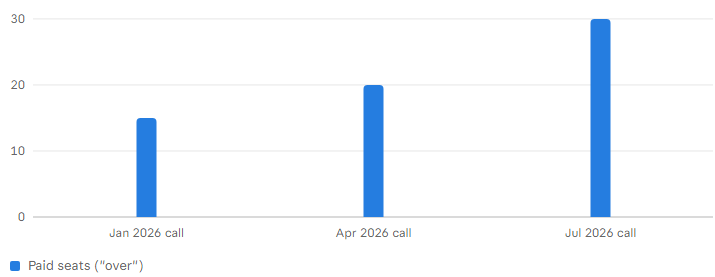
The software giant skipped that number in October, after sharing it three quarters straight. Paid Copilot seats: 15M (Jan), 20M+ (Apr), 30M+ (Jul), none in Oct; revenue $92.3B (+19%); stock $523.88 (13 Nov); about 29 times adjusted earnings.
My honest answer is that nobody outside Microsoft knows, and the company has given a fairly clear hint about why the number went missing. Executives now talk about usage, revenue and a new billing model. A seat count is still possible at Ignite, but one source I read thinks the January earnings report is a likelier place for a fresh figure than a developer and IT conference. This post lays out what Microsoft has said, why the omission matters, and what each possible outcome could tell you. It is education, not a recommendation.
Key takeaway: The last number was over 30 million paid seats. A new figure is possible at Ignite, but the company seems to be steering attention toward usage and revenue instead.
Those figures imply additions of at least 5 million seats in the April quarter and at least 10 million in the July quarter (my calculation from the rounded numbers). Because each figure was given as "over" a round number, the true totals may have been higher.
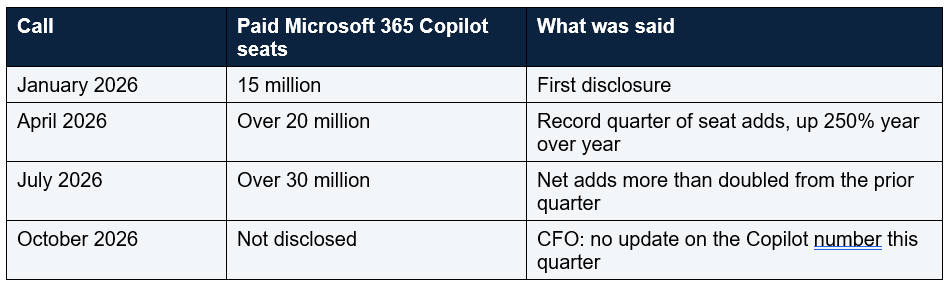
A note on sources. Some outlets say the last count of "over 30 million" came from the July call, while one says it appeared in Nadella's annual shareholder letter on 21 October, and the proxy statement says the number surpassed 30 million during fiscal 2026. These are not necessarily in conflict, because the same figure can be repeated in different documents. The important point is that no newer number has been given.
The Copilot seat count, though, was missing from both the press release and the call. When an analyst asked directly, CFO Amy Hood answered plainly: "We did not disclose, to answer your direct question, an update on the Copilot number this quarter." She pointed instead to "momentum in revenue and usage".
That is a notable change. Having built the seat count into the industry's favourite scorecard for workplace AI, Microsoft stopped updating it, which means outsiders cannot tell whether paid adoption kept up its pace.
The coverage I read says the number of customers using Copilot credits under usage-based billing grew more than 75% in the quarter. There is also a newer suite, Microsoft 365 E7, priced at $99 per user and combining Copilot, E5, Entra and Agent 365. Hood said E7 has already reached "millions of paid seats".
If some customers pay by use and others buy a bundle, a single "paid Copilot seats" figure becomes harder to define. The Fool article makes the same point: as more customers pay by usage, a seat count may become a less complete gauge of the business over time.
Let me add a caution. That is a reasonable explanation, not a confirmed one. Companies also stop reporting numbers when growth slows. I have no evidence that is the case here, and Hood said December-quarter growth will come mainly from average revenue per user, not from seat growth, according to one summary [9]. But the absence of a number means you cannot rule anything out.
Large customers named on the call included Volkswagen, which plans to deploy Copilot to more than 330,000 employees. Earlier in the year, Accenture was cited with over 740,000 seats.
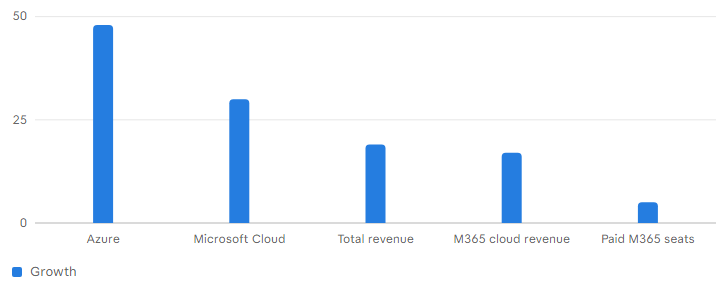
Paid Microsoft 365 commercial seats grew 5%, which one source describes as the slowest of the five quarters Microsoft shows, down from 7% in the prior quarter. Another source adds that from fiscal 2027 the seat count also includes paid GitHub seats, so the figure is a slightly wider measure than before. I could not verify that detail, and a different summary has the prior quarter at 6%, so treat the comparison loosely.
Hood also named "weaker sales execution in our M365 E3 and standalone SKUs" as a drag. These usage statistics are encouraging, but they do not tell you how many seats are paid for, which is exactly what the missing number would have shown.
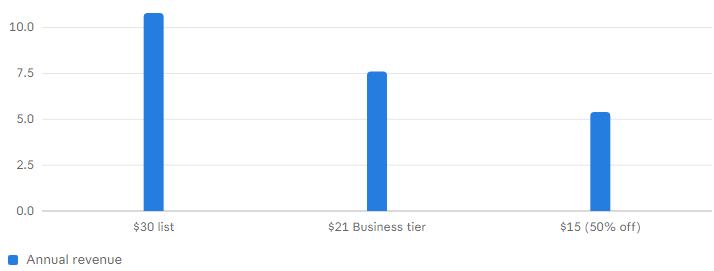
My own arithmetic agrees: 30 million seats times $30 times 12 months is $10.8 billion, or about 3.1% of $347 billion. But that is generous, because discounts and bundles mean few customers pay list price. The article calls it a rough upper bound, and I agree.
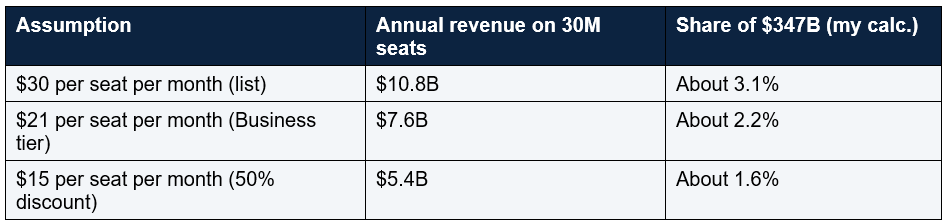
The $21 line uses the Microsoft 365 Copilot Business price for companies with fewer than 300 users, which was announced at last year's Ignite. I include it only to show a range. I do not know the real blended price, and Microsoft has not said. The point is scale. Even at full list price, Copilot is a small slice of a very large company, which is why a number that is "well above 30 million", or better a revenue figure, would matter.
Valuation is roughly 29 times adjusted earnings, based on non-GAAP earnings of $18.04 per share over the last four quarters, down from about 31 times at the early November high. At $523.88 I get 29.0 times (my calculation). Market value is about $3.89 trillion. The 52-week range is $349.20 to $559.15, which differs from the $555.80 record close because the range uses intraday prices. The stock has had a big run over the year, so expectations are not low.
Ignite is mainly a product event. Last year it focused on Agent 365, for managing and securing AI agents, Work IQ, which helps Copilot understand a person's role and company, and Microsoft 365 Copilot Business at $21 per user per month. This year, buyers are expected to focus on pricing, Teams, agent control and security, according to UC Today, and whether Microsoft talks about value and usage in terms customers can take to a renewal.
Last year Microsoft also said that more than 90% of the Fortune 500 used Microsoft 365 Copilot. That was a usage figure, not a paid one, and the paid count only came later, on the January call. It is a useful reminder that Ignite statistics are not always the same thing as earnings disclosures.
First, Microsoft gives a new seat number. That would be a clear positive signal if it were well above 30 million. The company has an incentive to share good news, and Nadella is on stage.
Second, Microsoft gives usage or customer metrics but no seats, continuing the October approach. This seems the most consistent with what Hood and Nadella said recently.
Third, Microsoft gives a dollar figure for Copilot, such as an annualised revenue run rate. That would be the most informative of all, but the company has not offered one so far [1]. One summary notes that Microsoft gave no updated AI run rate in July or October either.
The Fool author suggests January's earnings report is a likelier place for a new seat count or a revenue figure than Ignite. That fits the pattern that earlier seat numbers came from earnings calls, not conferences.
Each extra 5 million paid seats at $30 a month adds about $1.8 billion a year at list price, which is about 0.5% of $347 billion in revenue. If the pace of the July quarter, at least 10 million added, repeated, the total would be about 40 million and the list-price value about $14.4 billion.
There is also the base to consider. In January, Microsoft's paid commercial base was over 450 million seats according to one summary. On that base, 15 million Copilot seats is about 3.3% and 30 million is about 6.7% (my calculation, which ignores growth in the base since January, so it overstates the later figure). Even if Copilot reached 40 million, penetration would remain in single digits.
Two cautions apply. A seat count can include free trials, discounted bundles and large pilot deals, so a bigger number is not automatically more revenue. And a smaller increase than before would not necessarily mean trouble, since the first millions of seats may be the easiest sales.
Be careful: A seat count is a useful clue but not a profit figure. Revenue per seat, usage and churn all matter, and Microsoft has not shared them.
The bear case: the seat count was withheld, paid seat growth slowed to 5%, Copilot is only about 3% of revenue even at list prices, and quarterly capital spending was reported at $45.2 billion. At about 29 times earnings, a stock priced for AI success has less room for disappointment. Both cases rely on the same facts. What you believe depends on whether you read the missing number as a change in how Microsoft reports or as a sign of slower sales.
For now, the fair summary is that Copilot is growing quickly but is still small compared with the whole company, and that the market is waiting for a clearer figure. Whether you see that as an opportunity or a warning depends on your own view and risk tolerance. This post is education only, not advice.
Tuesday 17 November to Friday 20 November 2026 at the Moscone Center in San Francisco, with Satya Nadella giving the opening keynote.
What was the last paid Copilot seat count?
Over 30 million paid Microsoft 365 Copilot seats, reported in July.
Why did Microsoft skip the seat count in October?
The CFO said only that the company did not disclose an update and pointed to momentum in revenue and usage. The likely context is a shift toward usage-based billing, but Microsoft has not given a reason in so many words.
How much revenue could 30 million seats bring in?
Up to about $10.8 billion a year at the $30 list price (my calculation), though discounts and bundles mean the real figure is probably lower.
Will Microsoft announce a new seat count at Ignite?
Nobody outside the company knows. One analyst view is that January earnings is likelier, and the company has recently stressed usage metrics.
Table of Contents
- The quick answer
- What Microsoft disclosed, and when
- What changed in October
- Why a seat count may matter less now
- What Microsoft said instead
- How big is Copilot next to Microsoft?
- The stock and its valuation
- What to expect at Ignite
- Will Microsoft update the number?
- What a new number would tell you
- Bull case versus bear case
- What to watch next
- Conclusion
- FAQ
Paid Microsoft 365 Copilot seats disclosed (millions)
Million seats by Source: Microsoft earnings calls; Oct 2026: no figure given
Annual revenue on 30M Copilot seats ($B)
US$ billions per year by My calculation; blended price unknown, upper bound at list
Microsoft Q1 FY2027: year-over-year growth (%)
% growth by Source: Microsoft results via UC Today, LicenseQ, Benzinga
The quick answer
Microsoft's Ignite conference opens on 17 November in San Francisco, and investors have one question on their minds: will the company finally give an updated count of paid Microsoft 365 Copilot seats? It reported the figure on three earnings calls in a row in 2026, then left it out on 28 October.My honest answer is that nobody outside Microsoft knows, and the company has given a fairly clear hint about why the number went missing. Executives now talk about usage, revenue and a new billing model. A seat count is still possible at Ignite, but one source I read thinks the January earnings report is a likelier place for a fresh figure than a developer and IT conference. This post lays out what Microsoft has said, why the omission matters, and what each possible outcome could tell you. It is education, not a recommendation.
Key takeaway: The last number was over 30 million paid seats. A new figure is possible at Ignite, but the company seems to be steering attention toward usage and revenue instead.
What Microsoft disclosed, and when
Microsoft started 2026 by putting a number on its AI assistant for office work. On the January earnings call, CEO Satya Nadella said there were 15 million paid Microsoft 365 Copilot seats. By April the total topped 20 million. In July it crossed 30 million, and Nadella said net seat additions had more than doubled from the quarter before.Those figures imply additions of at least 5 million seats in the April quarter and at least 10 million in the July quarter (my calculation from the rounded numbers). Because each figure was given as "over" a round number, the true totals may have been higher.
A note on sources. Some outlets say the last count of "over 30 million" came from the July call, while one says it appeared in Nadella's annual shareholder letter on 21 October, and the proxy statement says the number surpassed 30 million during fiscal 2026. These are not necessarily in conflict, because the same figure can be repeated in different documents. The important point is that no newer number has been given.
What changed in October
Microsoft reported fiscal first-quarter 2027 results on 28 October, for the three months to 30 September. Revenue rose 19% to $92.3 billion, and the Microsoft Cloud reached $63.9 billion, up 30% [2][4]. By almost any measure it was a strong report, with Azure up 48% according to the coverage I read.The Copilot seat count, though, was missing from both the press release and the call. When an analyst asked directly, CFO Amy Hood answered plainly: "We did not disclose, to answer your direct question, an update on the Copilot number this quarter." She pointed instead to "momentum in revenue and usage".
That is a notable change. Having built the seat count into the industry's favourite scorecard for workplace AI, Microsoft stopped updating it, which means outsiders cannot tell whether paid adoption kept up its pace.
Why a seat count may matter less now
The most likely reason, based on what executives said, is that the way Microsoft charges for Copilot is changing. On the earnings call, Nadella said the business model "is expanding from per-seat subscriptions to include consumption". In plain terms, customers will increasingly pay for how much they use, not just for the number of people with a licence.The coverage I read says the number of customers using Copilot credits under usage-based billing grew more than 75% in the quarter. There is also a newer suite, Microsoft 365 E7, priced at $99 per user and combining Copilot, E5, Entra and Agent 365. Hood said E7 has already reached "millions of paid seats".
If some customers pay by use and others buy a bundle, a single "paid Copilot seats" figure becomes harder to define. The Fool article makes the same point: as more customers pay by usage, a seat count may become a less complete gauge of the business over time.
Let me add a caution. That is a reasonable explanation, not a confirmed one. Companies also stop reporting numbers when growth slows. I have no evidence that is the case here, and Hood said December-quarter growth will come mainly from average revenue per user, not from seat growth, according to one summary [9]. But the absence of a number means you cannot rule anything out.
What Microsoft said instead
While the seat count was missing, Microsoft did share other Copilot figures. Daily Copilot users rose almost 50% from the previous quarter and more than fivefold from a year earlier. The number of customers with more than 50,000 Copilot seats grew more than eightfold year over year.Large customers named on the call included Volkswagen, which plans to deploy Copilot to more than 330,000 employees. Earlier in the year, Accenture was cited with over 740,000 seats.
Paid Microsoft 365 commercial seats grew 5%, which one source describes as the slowest of the five quarters Microsoft shows, down from 7% in the prior quarter. Another source adds that from fiscal 2027 the seat count also includes paid GitHub seats, so the figure is a slightly wider measure than before. I could not verify that detail, and a different summary has the prior quarter at 6%, so treat the comparison loosely.
Hood also named "weaker sales execution in our M365 E3 and standalone SKUs" as a drag. These usage statistics are encouraging, but they do not tell you how many seats are paid for, which is exactly what the missing number would have shown.
How big is Copilot next to Microsoft?
The Fool article offers a simple size check. Microsoft lists the Microsoft 365 Copilot add-on for large businesses at $30 per user per month. If all 30 million seats paid the full price, Copilot would bring in about $11 billion a year, roughly 3% of Microsoft's revenue over the last four quarters of about $347 billion.My own arithmetic agrees: 30 million seats times $30 times 12 months is $10.8 billion, or about 3.1% of $347 billion. But that is generous, because discounts and bundles mean few customers pay list price. The article calls it a rough upper bound, and I agree.
The $21 line uses the Microsoft 365 Copilot Business price for companies with fewer than 300 users, which was announced at last year's Ignite. I include it only to show a range. I do not know the real blended price, and Microsoft has not said. The point is scale. Even at full list price, Copilot is a small slice of a very large company, which is why a number that is "well above 30 million", or better a revenue figure, would matter.
The stock and its valuation
The shares closed at $523.88 on 13 November, according to the quote shown with the Fool article. The article says the stock was trading around $521 when it was written, about 6% below its record close of $555.80 on 4 November. My own calculation gives about 5.7% below the record at $523.88.Valuation is roughly 29 times adjusted earnings, based on non-GAAP earnings of $18.04 per share over the last four quarters, down from about 31 times at the early November high. At $523.88 I get 29.0 times (my calculation). Market value is about $3.89 trillion. The 52-week range is $349.20 to $559.15, which differs from the $555.80 record close because the range uses intraday prices. The stock has had a big run over the year, so expectations are not low.
What to expect at Ignite
Ignite runs from Tuesday 17 November to Friday 20 November 2026 at the Moscone Center in San Francisco. Nadella gives the opening keynote on Tuesday. One Morgan Stanley preview, which I saw only as search snippets, says the core session is at 1 p.m. Eastern on 17 November, with an analyst question-and-answer session with Nadella later that day and a meeting with Hood and investor relations on 18 November.Ignite is mainly a product event. Last year it focused on Agent 365, for managing and securing AI agents, Work IQ, which helps Copilot understand a person's role and company, and Microsoft 365 Copilot Business at $21 per user per month. This year, buyers are expected to focus on pricing, Teams, agent control and security, according to UC Today, and whether Microsoft talks about value and usage in terms customers can take to a renewal.
Last year Microsoft also said that more than 90% of the Fortune 500 used Microsoft 365 Copilot. That was a usage figure, not a paid one, and the paid count only came later, on the January call. It is a useful reminder that Ignite statistics are not always the same thing as earnings disclosures.
Will Microsoft update the number?
I will give a view, but I want to label it clearly as my judgement, not a prediction. There are three broad possibilities.First, Microsoft gives a new seat number. That would be a clear positive signal if it were well above 30 million. The company has an incentive to share good news, and Nadella is on stage.
Second, Microsoft gives usage or customer metrics but no seats, continuing the October approach. This seems the most consistent with what Hood and Nadella said recently.
Third, Microsoft gives a dollar figure for Copilot, such as an annualised revenue run rate. That would be the most informative of all, but the company has not offered one so far [1]. One summary notes that Microsoft gave no updated AI run rate in July or October either.
The Fool author suggests January's earnings report is a likelier place for a new seat count or a revenue figure than Ignite. That fits the pattern that earlier seat numbers came from earnings calls, not conferences.
What a new number would tell you
Suppose a number does appear. How should you read it? Here is some simple arithmetic to set expectations (my calculation, at list price, so an upper bound).Each extra 5 million paid seats at $30 a month adds about $1.8 billion a year at list price, which is about 0.5% of $347 billion in revenue. If the pace of the July quarter, at least 10 million added, repeated, the total would be about 40 million and the list-price value about $14.4 billion.
There is also the base to consider. In January, Microsoft's paid commercial base was over 450 million seats according to one summary. On that base, 15 million Copilot seats is about 3.3% and 30 million is about 6.7% (my calculation, which ignores growth in the base since January, so it overstates the later figure). Even if Copilot reached 40 million, penetration would remain in single digits.
Two cautions apply. A seat count can include free trials, discounted bundles and large pilot deals, so a bigger number is not automatically more revenue. And a smaller increase than before would not necessarily mean trouble, since the first millions of seats may be the easiest sales.
Be careful: A seat count is a useful clue but not a profit figure. Revenue per seat, usage and churn all matter, and Microsoft has not shared them.
Bull case versus bear case
The bull case: revenue grew 19%, Azure grew 48%, commercial backlog was reported at $677 billion, daily Copilot users are up fivefold in a year, and E7 has already reached millions of seats. If Ignite brings a big number or a revenue figure, it could support the idea that Copilot is turning into a real business.The bear case: the seat count was withheld, paid seat growth slowed to 5%, Copilot is only about 3% of revenue even at list prices, and quarterly capital spending was reported at $45.2 billion. At about 29 times earnings, a stock priced for AI success has less room for disappointment. Both cases rely on the same facts. What you believe depends on whether you read the missing number as a change in how Microsoft reports or as a sign of slower sales.
What to watch next
If you follow Microsoft, these are the points I would track over the coming days and weeks: The Ignite keynote on 17 November: whether Nadella gives any seat, customer or revenue number for Copilot. Analyst sessions: the question-and-answer sessions and any comments from Hood on 18 November. Billing changes: coverage mentions Copilot billing becoming metered by default from 1 December, though I did not retrieve the details, so check Microsoft's own documentation. The January earnings call: the likeliest place for a fresh figure, in the Fool author's view. Paid commercial seat growth: whether it stays near 5%.Conclusion
Microsoft gave a paid Copilot seat count on three earnings calls in 2026, 15 million, then over 20 million, then over 30 million, and then skipped it on 28 October while pointing to usage and revenue instead. Ignite could bring an update, but the company seems to be moving toward usage-based metrics, and a fresh number might wait until the next earnings report.For now, the fair summary is that Copilot is growing quickly but is still small compared with the whole company, and that the market is waiting for a clearer figure. Whether you see that as an opportunity or a warning depends on your own view and risk tolerance. This post is education only, not advice.
FAQ
When is Microsoft Ignite 2026?Tuesday 17 November to Friday 20 November 2026 at the Moscone Center in San Francisco, with Satya Nadella giving the opening keynote.
What was the last paid Copilot seat count?
Over 30 million paid Microsoft 365 Copilot seats, reported in July.
Why did Microsoft skip the seat count in October?
The CFO said only that the company did not disclose an update and pointed to momentum in revenue and usage. The likely context is a shift toward usage-based billing, but Microsoft has not given a reason in so many words.
How much revenue could 30 million seats bring in?
Up to about $10.8 billion a year at the $30 list price (my calculation), though discounts and bundles mean the real figure is probably lower.
Will Microsoft announce a new seat count at Ignite?
Nobody outside the company knows. One analyst view is that January earnings is likelier, and the company has recently stressed usage metrics.
0 Comments
Be the first to share your thoughts on this article.