

Investing
The 5 Best Cheap Stocks (Under $10) to Buy: A Reality Check!

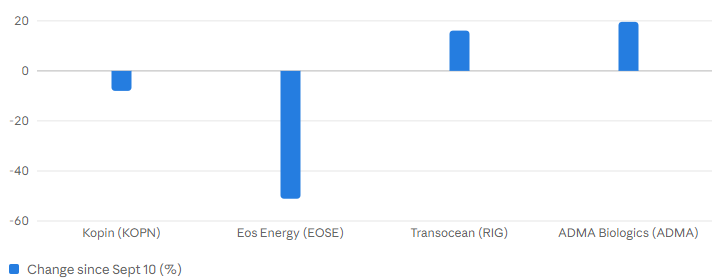
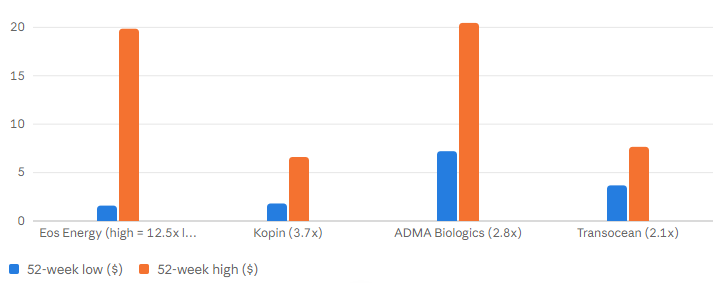
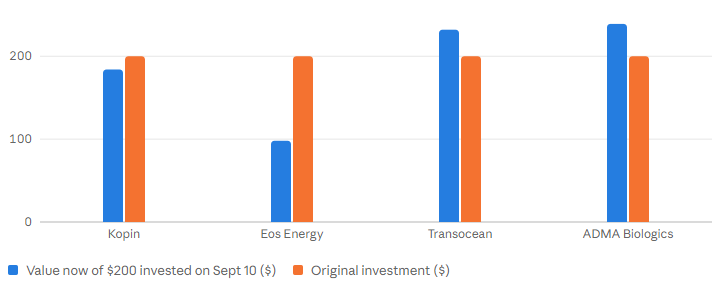
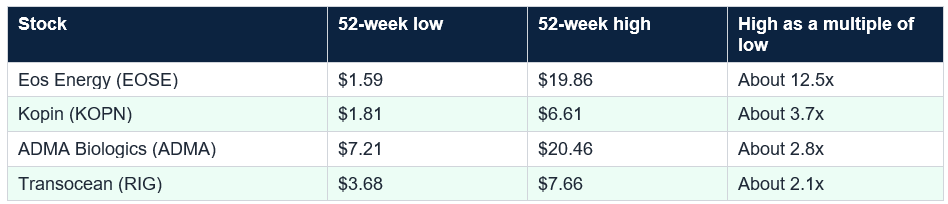
Kopin $4.39; Eos Energy $3.99; Transocean $5.77; Dauch $6.55; ADMA $9.39. Late October: Kopin about $4.00–$4.09 (−8%); Eos about $1.92–$1.98 (about −51%); Transocean $6.70 (+16%); ADMA $11.23 on Oct 20 (+20%, now above $10); Dauch not verified. Volatility: 52-week ranges of $1.59–$19.86 (Eos, about 12.5x), $7.21–$20.46 (ADMA), $1.81–$6.61 (Kopin) and $3.68–$7.66 (Transocean); Kopin fell about 32% in a month; betas of about 2.4–3.6. Analysts: Transocean’s consensus target is $6.56, about 2% below its price; Kopin’s average target about $8.43 (about +106%); ADMA’s $17 target about +51% from $11.23. My arithmetic: an equal-weight basket of the four stocks with current prices is down about 5.9% since Sept 10; $200 in each would be about $753 of $800; Eos would need about +104% to recover.
That makes this an unusually good moment for a reality check. Kiplinger published a list of five cheap stocks under $10 on September 10. It is now October 29, seven weeks later, and the five have gone very different ways. This guide looks at the original picks, what they have done since and what the experience teaches about buying stocks because they are low-priced.
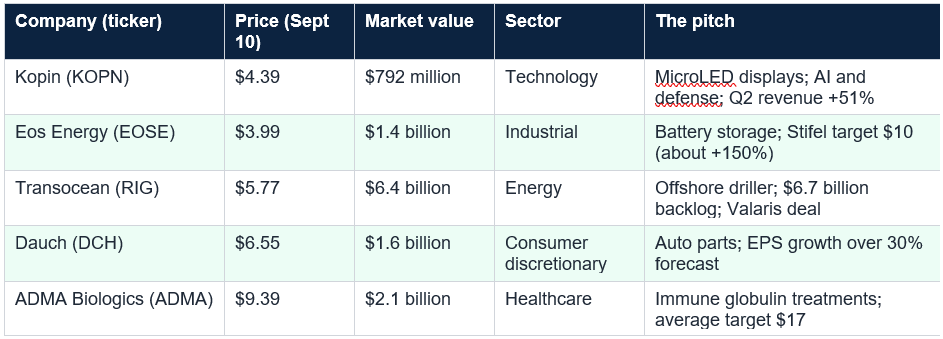
Cheap stocks also come with warnings. Kiplinger notes that they often have weak fundamentals and are risky and volatile, and it quotes the SEC’s warning that over-the-counter stocks tend to be illiquid, are frequent targets of alleged manipulation and generate negative and volatile returns on average. The five stocks here trade on major exchanges, which is safer than penny-stock markets, but they are still small, volatile companies. Focused on companies that analysts like and that showed strong growth. As of September 10, the five were Kopin at $4.39, Eos Energy at $3.99, Transocean at $5.77, Dauch at $6.55 and ADMA Biologics at $9.39. Each had a consensus Buy rating from analysts tracked by S&P Global Market Intelligence, though the strength of that support varied from Kopin, where all six analysts said Strong Buy, to Eos, where seven of eleven said Hold.
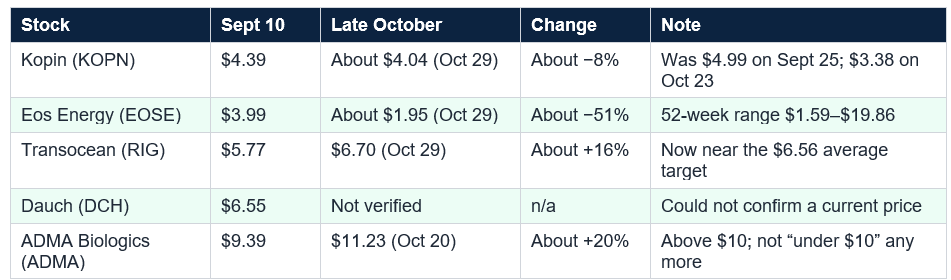
Sept 10 to late October: Eos about −51%; Kopin about −8% (after a 32% one-month drop); Transocean about +16%; ADMA about +20%. An equal-weight basket of those four is down about 5.9%. Dauch not verified.
Eos Energy is the cautionary tale. The battery storage company fell more than 39% in February after a revenue miss and a wider loss, recovered on better production and revenue, and then lost roughly half its value between September 10 and October 29. Its 52-week high was about $20, so a stock that ranged from $1.59 to nearly $20 is by definition a high-wire act. Stifel’s $10 target looks very far from a price near $2. That does not mean the analyst is wrong, only that the distance between target and price is a measure of uncertainty.
Transocean, an offshore driller, has been the steadiest of the group. It reported second-quarter adjusted EBITDA of $312 million and a backlog of about $6.7 billion, then added about $1.1 billion of backlog with Shell and Equinor, secured regulatory clearance for its $5.8 billion all-stock Valaris acquisition and extended its credit facility to $750 million. The stock is up about 61% this year, and its 13 analysts’ average target of $6.56 is slightly below the current $6.70. The easy gain from the analysts’ view appears to be done.
Dauch, formerly American Axle, is an automotive supplier that bought Dowlais in February, lifting first-quarter revenue 69% and earnings 54%. Analysts forecast earnings growth above 30% a year over three to five years, with seven of 13 rating it Buy or Strong Buy and six Hold. I could not verify its current price. ADMA Biologics makes immune-globulin therapies; its shares have ranged from $7.21 to $20.46 over 52 weeks, fell after a sharp revenue decline in its BIVIGAM product, and have since risen above $10, with an average analyst target of $17.
Fourth, the list is a snapshot. Kiplinger itself says cheap stocks move quickly and recommends small amounts of capital you can afford to lose. Other lists name completely different stocks: U.S. News highlighted Brazilian banks and international names, 24/7 Wall St. featured Grab and Ericsson, and SoFi listed high-yield names such as AGNC and Western Union. The overlap among “best cheap stocks” lists is small, which tells you there is no consensus, only candidates.
Notice what happened: two winners and two losers, with the biggest loss wiping out half of one position. If you had put the whole $800 into Eos, you would have about $391 left. If you had put it all into ADMA, you would have about $957. Same list, wildly different outcomes. The takeaway is not to pick better, which is hard, but to size smaller and diversify, so that no single miss hurts.
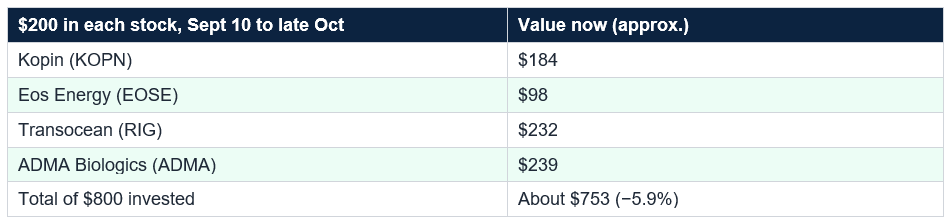
This is a seven-week snapshot using approximate prices, excluding Dauch, which I could not verify. It illustrates volatility, not a verdict on any company. Short-term moves say little about long-term results.
Also compare the upside with the alternatives. The S&P 500 was up about 11.4% for the year as of October 23, and a 52-week Treasury bill yielded about 4.46%. A stock that could double also can halve, and the second outcome happens more often than the headlines suggest. Treat cheap stocks as the speculative slice of a portfolio, not the foundation, and never as money you will need soon.
Before buying any stock under $10, write down the company’s profit status, cash runway, a reason you expect the price to rise and the amount you could lose without regret. If you cannot fill in all four, you are not ready to buy.
So treat any list of cheap stocks as a place to start research, not a shopping list. Remember that a low share price is not a low valuation, keep positions small, diversify and compare with simple alternatives such as index funds and Treasury bills. And keep in mind that this article is general education, not personal advice, and that prices move constantly. A qualified adviser can help you decide what fits your situation.
There is no single best, and the answer changes quickly. Kiplinger’s September 10 list named Kopin, Eos Energy, Transocean, Dauch and ADMA Biologics, but seven weeks later Eos had roughly halved, ADMA had risen above $10 and Transocean had reached its analyst target. A low share price tells you little about quality, so check the business, the balance sheet and the valuation.
Are cheap stocks the same as undervalued stocks?
No. A cheap stock has a low share price; an undervalued stock trades below its estimated worth. A $4 stock can be wildly overvalued and a $400 stock can be a bargain. Kiplinger makes this distinction itself, noting that cheap in this context refers to share price, not valuation measures such as price relative to earnings or book value.
Are stocks under $10 riskier?
On average, yes. They tend to be smaller, more volatile and sometimes less liquid, and many are unprofitable. The SEC warns that over-the-counter stocks are often illiquid, targets of alleged manipulation and tend to deliver negative, volatile returns. Even exchange-listed names in this article had 52-week ranges from about 2 to 12 times from low to high.
How much should I put into a cheap stock?
Only an amount you could lose without changing your plans. In my illustration, a $200 position in Eos Energy would have been worth about $98 after seven weeks, while the same amount in ADMA would have been worth about $239. Small positions and diversification limit the damage when one idea fails. This is general education, not personal advice.
Is there a safer way to own low-priced stocks?
Broad small-cap index funds spread your money across hundreds of companies instead of betting on a few, and fractional shares let you buy expensive, high-quality stocks with small amounts. Broker platforms such as Fidelity and Robinhood offer fractional shares from $1. A cheap share price is rarely a reason to choose a stock.
Table of Contents
- The Allure of the Under-$10 Stock
- The Short Answer
- Cheap Is Not the Same as Undervalued
- Seven Weeks Later
- The Five Stocks, One by One
- Lessons From the Reality Check
- The Math of Small Bets
- A Checklist for Cheap Stocks
- Safer Ways to Get the Same Exposure
- Conclusion
- Frequently Asked Questions
Seven weeks later: how cheap-stock picks have moved since Sept 10 (%)
Change in share price (%) by Sept 10 prices vs. quotes Oct 20-29 (third-party pages); Dauch not verified. ADMA is above $10 now
Cheap stocks swing wildly: 52-week low and high prices ($)
Share price ($) by Quote pages, October 2026 (Morningstar, Robinhood, Kiplinger, Yahoo Finance)
The math of small bets: what $200 in each stock became ($)
Value ($) by Author's arithmetic on approximate prices; $800 became about $753 (-5.9%); Dauch excluded
The Allure of the Under-$10 Stock
There is something irresistible about a stock that costs less than a lunch. It feels like getting in on the ground floor, and the math of a stock moving from $4 to $8 feels simpler than one moving from $400 to $800. Kiplinger acknowledges the pull, noting that people like cheap stocks for affordability and for the chance of big gains in a short time, then adds the other half of the sentence: investors can suffer big losses in a hurry.That makes this an unusually good moment for a reality check. Kiplinger published a list of five cheap stocks under $10 on September 10. It is now October 29, seven weeks later, and the five have gone very different ways. This guide looks at the original picks, what they have done since and what the experience teaches about buying stocks because they are low-priced.
The Short Answer
The five stocks Kiplinger named, Kopin, Eos Energy Enterprises, Transocean, Dauch and ADMA Biologics, are interesting companies with real analyst support. But they are not safe, and the price you see is not a bargain label. Since September 10, Eos has roughly halved, Kopin has been on a roller coaster, Transocean has risen to its analyst target and ADMA has climbed above $10. The lesson is that a low share price says nothing about quality, risk or value, and that position size matters more than the pick.Cheap Is Not the Same as Undervalued
The word “cheap” is doing sneaky work in these lists. A cheap stock has a low share price. An undervalued stock trades below what the business is worth. They are different things. A company with 100 million shares at $4 is worth $400 million, while one with 1 million shares at $400 is worth the same. Kiplinger makes the same point, clarifying that its list refers to share price, not valuation measures such as price-to-earnings or price-to-book ratios.Cheap stocks also come with warnings. Kiplinger notes that they often have weak fundamentals and are risky and volatile, and it quotes the SEC’s warning that over-the-counter stocks tend to be illiquid, are frequent targets of alleged manipulation and generate negative and volatile returns on average. The five stocks here trade on major exchanges, which is safer than penny-stock markets, but they are still small, volatile companies. Focused on companies that analysts like and that showed strong growth. As of September 10, the five were Kopin at $4.39, Eos Energy at $3.99, Transocean at $5.77, Dauch at $6.55 and ADMA Biologics at $9.39. Each had a consensus Buy rating from analysts tracked by S&P Global Market Intelligence, though the strength of that support varied from Kopin, where all six analysts said Strong Buy, to Eos, where seven of eleven said Hold.
Seven Weeks Later
Here is where the stocks traded in late October, using third-party quote pages. Eos Energy was around $1.92 to $1.98 on October 29, down roughly 51% from $3.99. Kopin traded around $4.00 to $4.09, about 8% lower than its September 10 price, but that hides a wild ride: it was $4.99 on September 25 and about $3.38 on October 23. Transocean closed at $6.69 to $6.70, up about 16%. ADMA closed at $11.23 on October 20, up about 20% and no longer under $10. I could not verify a current price for Dauch.Sept 10 to late October: Eos about −51%; Kopin about −8% (after a 32% one-month drop); Transocean about +16%; ADMA about +20%. An equal-weight basket of those four is down about 5.9%. Dauch not verified.
The Five Stocks, One by One
Kopin makes microLED displays and has been riding enthusiasm for defense and AI infrastructure. Second-quarter revenue grew 51% and the company expects to reach GAAP profitability in the fourth quarter, according to a transcript summary. But the stock is intensely volatile, with a beta of 2.4 to 3.6, a 52-week range of $1.81 to $6.61 and a price-to-earnings ratio of roughly 70 to 120. Analyst targets range from $6.50 to well above $8, so even the experts disagree. It reports earnings in early to mid-November.Eos Energy is the cautionary tale. The battery storage company fell more than 39% in February after a revenue miss and a wider loss, recovered on better production and revenue, and then lost roughly half its value between September 10 and October 29. Its 52-week high was about $20, so a stock that ranged from $1.59 to nearly $20 is by definition a high-wire act. Stifel’s $10 target looks very far from a price near $2. That does not mean the analyst is wrong, only that the distance between target and price is a measure of uncertainty.
Transocean, an offshore driller, has been the steadiest of the group. It reported second-quarter adjusted EBITDA of $312 million and a backlog of about $6.7 billion, then added about $1.1 billion of backlog with Shell and Equinor, secured regulatory clearance for its $5.8 billion all-stock Valaris acquisition and extended its credit facility to $750 million. The stock is up about 61% this year, and its 13 analysts’ average target of $6.56 is slightly below the current $6.70. The easy gain from the analysts’ view appears to be done.
Dauch, formerly American Axle, is an automotive supplier that bought Dowlais in February, lifting first-quarter revenue 69% and earnings 54%. Analysts forecast earnings growth above 30% a year over three to five years, with seven of 13 rating it Buy or Strong Buy and six Hold. I could not verify its current price. ADMA Biologics makes immune-globulin therapies; its shares have ranged from $7.21 to $20.46 over 52 weeks, fell after a sharp revenue decline in its BIVIGAM product, and have since risen above $10, with an average analyst target of $17.
Lessons From the Reality Check
Four lessons stand out. First, volatility is the point, and also the problem: 52-week highs were about 12.5 times the lows for Eos, 3.7 times for Kopin, 2.8 for ADMA and 2.1 for Transocean. Second, analyst targets are not guarantees: Kopin’s average target implied about 100% upside at both prices, yet the stock has not moved toward it. Third, a good story is not a good price: all five had compelling narratives on September 10, and the market still re-priced them sharply.Fourth, the list is a snapshot. Kiplinger itself says cheap stocks move quickly and recommends small amounts of capital you can afford to lose. Other lists name completely different stocks: U.S. News highlighted Brazilian banks and international names, 24/7 Wall St. featured Grab and Ericsson, and SoFi listed high-yield names such as AGNC and Western Union. The overlap among “best cheap stocks” lists is small, which tells you there is no consensus, only candidates.
The Math of Small Bets
Losses are asymmetric. Eos fell about 51%, which means it would need to rise about 104% to get back to its September 10 price. That is why position size matters more than pick quality. In my illustration, suppose you had put $200 into each of the four stocks I can price on September 10. Seven weeks later, your Kopin position would be worth about $184, Eos about $98, Transocean about $232 and ADMA about $239, a total of about $753 from $800, down about 6%.Notice what happened: two winners and two losers, with the biggest loss wiping out half of one position. If you had put the whole $800 into Eos, you would have about $391 left. If you had put it all into ADMA, you would have about $957. Same list, wildly different outcomes. The takeaway is not to pick better, which is hard, but to size smaller and diversify, so that no single miss hurts.
This is a seven-week snapshot using approximate prices, excluding Dauch, which I could not verify. It illustrates volatility, not a verdict on any company. Short-term moves say little about long-term results.
A Checklist for Cheap Stocks
If you are drawn to low-priced stocks, a few checks can help. Is the company profitable, or burning cash? Eos’ price-to-earnings ratio of about −0.3 reflects losses. How long can it fund itself without issuing shares, which dilutes you? What is the debt load? Is the stock liquid, with millions of shares trading daily? Is there a catalyst, such as earnings on November 2 for Transocean, and how much is already priced in? And do the analysts agree, or is support thin?Also compare the upside with the alternatives. The S&P 500 was up about 11.4% for the year as of October 23, and a 52-week Treasury bill yielded about 4.46%. A stock that could double also can halve, and the second outcome happens more often than the headlines suggest. Treat cheap stocks as the speculative slice of a portfolio, not the foundation, and never as money you will need soon.
Safer Ways to Get the Same Exposure
If what attracts you is the idea of owning small, growing companies, a diversified small-cap index fund spreads your risk across hundreds of names instead of five. If what attracts you is the low entry price, fractional shares are the better answer: Fidelity and Robinhood offer them from $1, so you can own a slice of a high-quality, higher-priced stock without needing to buy whole shares. In both cases, you avoid the idea that a $4 share price is a bargain.Before buying any stock under $10, write down the company’s profit status, cash runway, a reason you expect the price to rise and the amount you could lose without regret. If you cannot fill in all four, you are not ready to buy.
Conclusion
The 5 best cheap stocks under $10, as chosen by Kiplinger on September 10, were Kopin, Eos Energy, Transocean, Dauch and ADMA Biologics. Seven weeks later, Eos had roughly halved, Kopin had whipsawed, Transocean had reached its analyst target and ADMA had climbed above $10. An equal-weight basket of the four stocks I could price was down about 6%. The picks were reasonable ideas backed by real analysts, and they still behaved like the volatile stocks they are.So treat any list of cheap stocks as a place to start research, not a shopping list. Remember that a low share price is not a low valuation, keep positions small, diversify and compare with simple alternatives such as index funds and Treasury bills. And keep in mind that this article is general education, not personal advice, and that prices move constantly. A qualified adviser can help you decide what fits your situation.
Frequently Asked Questions
What is the best cheap stock to buy under $10?There is no single best, and the answer changes quickly. Kiplinger’s September 10 list named Kopin, Eos Energy, Transocean, Dauch and ADMA Biologics, but seven weeks later Eos had roughly halved, ADMA had risen above $10 and Transocean had reached its analyst target. A low share price tells you little about quality, so check the business, the balance sheet and the valuation.
Are cheap stocks the same as undervalued stocks?
No. A cheap stock has a low share price; an undervalued stock trades below its estimated worth. A $4 stock can be wildly overvalued and a $400 stock can be a bargain. Kiplinger makes this distinction itself, noting that cheap in this context refers to share price, not valuation measures such as price relative to earnings or book value.
Are stocks under $10 riskier?
On average, yes. They tend to be smaller, more volatile and sometimes less liquid, and many are unprofitable. The SEC warns that over-the-counter stocks are often illiquid, targets of alleged manipulation and tend to deliver negative, volatile returns. Even exchange-listed names in this article had 52-week ranges from about 2 to 12 times from low to high.
How much should I put into a cheap stock?
Only an amount you could lose without changing your plans. In my illustration, a $200 position in Eos Energy would have been worth about $98 after seven weeks, while the same amount in ADMA would have been worth about $239. Small positions and diversification limit the damage when one idea fails. This is general education, not personal advice.
Is there a safer way to own low-priced stocks?
Broad small-cap index funds spread your money across hundreds of companies instead of betting on a few, and fractional shares let you buy expensive, high-quality stocks with small amounts. Broker platforms such as Fidelity and Robinhood offer fractional shares from $1. A cheap share price is rarely a reason to choose a stock.
0 Comments
Be the first to share your thoughts on this article.