
Budgeting
What To Budget For An EV Besides The Purchase Price: A Guide

The sticker price is only the start. Here are the other bills that decide whether an electric car really saves you money. Home charger install $700-$3,000; home electricity about 18-19 cents per kWh; public fast charging about 41-53 cents per kWh; EV insurance reported 15-49% higher; battery replacement out of warranty $5,000-$18,000.
When people shop for an electric car, the conversation usually stops at the price on the window. That is understandable, but it leaves out a long list of costs that start the day you take delivery: a home charger, a higher insurance bill, quicker tire wear, registration fees and, above all, how fast the car loses value.
The good news is that EVs also save money in places a petrol car cannot, mainly fuel and routine servicing. Whether you come out ahead depends on where you charge, what you pay to insure the car and how long you keep it. One 2026 analysis puts it plainly: fuel savings of $500 to $1,200 a year and maintenance savings of $330 to $850 are real, but only if you charge mostly at home. This guide walks through each cost in the order you are likely to meet it. I have tried to give ranges instead of single numbers, because the honest answer to most of these questions is "it depends".
Key takeaway: Budget for a charger, a bigger insurance quote, more frequent tires and fast depreciation. Then compare that total against your fuel and servicing savings, not against the sticker price alone.
The wide spread comes from your house, not the charger. If your electrical panel is old or full, one Canadian guide says an upgrade can add another $2,000 to $4,000, something dealers rarely mention. Get at least two quotes from licensed electricians before you buy the car so there are no surprises. Rebates may help. One 2026 roundup notes that some utilities offer $500 to $1,000 toward home charger installation, along with special time-of-use electricity rates for EV owners. The federal 30% home charger credit is a different story, covered below.
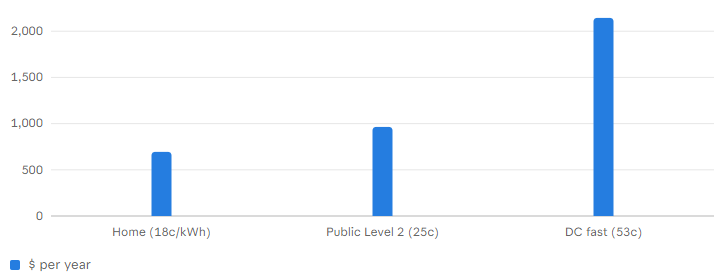
The gap matters because it decides your annual bill. Using Qmerit figures, an average driver covering 13,489 miles a year would spend about $694 charging at home at 18 cents per kWh, about $964 on public Level 2 at 25 cents, and about $2,144 relying on DC fast charging at 53 cents. Even the top figure stays below some gasoline costs in that analysis, but the margin narrows quickly.
There is a caution here. The same NextCarReview analysis says a Tesla Supercharger at the $0.60 per kWh median price in federal data works out to about 18 cents per mile, and that relying only on fast charging can cost as much as gas or more. If you cannot charge at home, budget for the public numbers, not the home ones. Where you live changes everything. A state-by-state table puts home charging at about 11 cents per kWh in Utah but about 45 cents in Hawaii and 31 cents in California. That table is from a commercial site, so treat it as a guide and check your own utility bill.
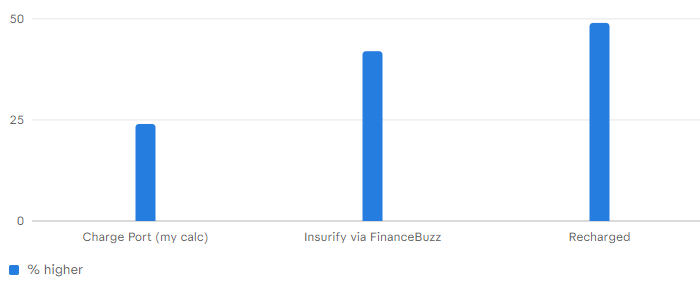
Using that last pair, the gap is about $440 a year, or roughly 24% (my calculation). So the honest range is somewhere between 15% and nearly 50%, which is far too wide to plan around. Your own quote is the only number that counts. Why are premiums higher? One Canadian guide says insurers price premiums to cover expected claim costs, and that parts scarcity pushes those costs up. A UK source adds that repairers once lacked the training and parts to fix battery-electric cars efficiently. Location matters too: AutoGuide reports Washington, D.C. as the priciest market for EV insurance, at an average of $6,394 a year. My advice, which is general and not personal: get insurance quotes for the exact model before you buy it, and ask whether a higher deductible or a telematics discount changes the picture.
Tires are the exception. EVs are heavier and deliver instant torque, so Tenet says owners often replace tires every 20,000 to 30,000 miles instead of 40,000 to 50,000. A set for a Model 3 costs $600 to $900 installed, which could mean an extra $600 to $900 over five years. Jouleio says to budget $800 to $1,200 for a full set. Do not forget the small items. Recharged lists tires, wiper blades, cabin air filters, the 12-volt battery and sometimes brake pads as the main replacements. None is dramatic, but together they are the reason maintenance is lower, not zero.
That is a modest line, but it adds up and it is easy to forget. Recharged notes that fees and taxes can move the total by thousands of dollars either way depending on where you live, because some states add EV surcharges while others still offer rebates. If you are buying in a state with sales tax on vehicles, remember that a more expensive EV also means a larger tax bill at purchase. That is simple arithmetic rather than a sourced figure, but worth a minute with a calculator.
The 30C home charger credit, worth 30% of costs up to $1,000, is described as ending for chargers placed in service after 30 June 2026, so only installs from January to June can still be claimed on 2026 returns. That means anyone installing a charger now should assume there is no federal help. What is left is mostly local. New York's Drive Clean Rebate offers $2,000, and some utilities give $500 to $1,000 toward chargers. Programs change often, so check your state and utility sites before you commit.
Those are estimates, and individual models vary a lot, so I would not treat either number as a forecast. But the direction is consistent across sources: if you buy new and sell within a few years, resale value may matter more than every other item in this guide combined. Used EVs flip the equation. Recharged notes that a used buyer inherits a simpler maintenance schedule and often remaining battery warranty, after the first owner absorbed the steepest drop in value. If you are price-sensitive, that is worth serious thought.
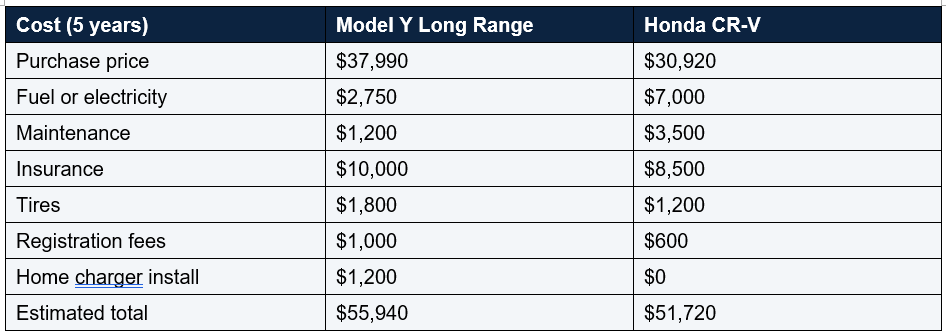
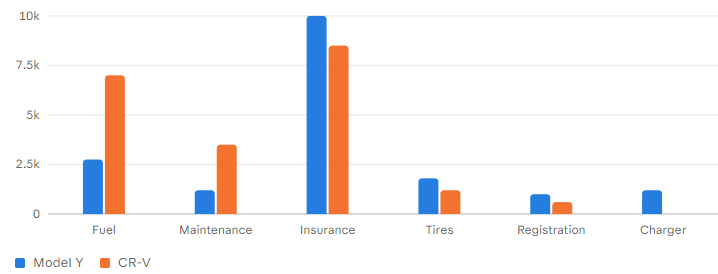
Subtract the purchase prices and the picture is more interesting. By my calculation the EV's non-purchase costs come to $17,950 against $20,800 for the gas car, so running costs are about $2,850 lower, but the EV starts $7,070 higher. The net result is the $4,220 gap in the table, in favour of the gas car in this example. Change the assumptions and the answer moves. Buy used, charge on cheap off-peak electricity, or live where gas is expensive, and the EV can win. Pay a high insurance premium and rely on public chargers, and it loses by more. That sensitivity is the whole point of budgeting for the extras.
Charge at home as much as you can and save public fast charging for road trips. Keep tires properly inflated and rotate them on schedule, because tire wear is the main maintenance cost that rises. And consider a used EV with a battery health report, which gives you the depreciation benefit with less risk. Finally, build a small annual reserve for surprises such as out-of-warranty repairs, which one guide flags among the costs buyers do not expect. A cushion turns a nasty surprise into a planned expense.
Before you sign, try these questions. Can I charge at home or at work, and what will that cost to set up? What is the insurance quote for this exact car? What are my state's registration fees? How long do I plan to keep it, and what might it be worth then? What does the battery warranty cover, and for how long? Then add up the answers using the same five-year method as the example above. If the EV still looks better, you are buying with your eyes open. If it does not, a plug-in hybrid, a used EV or a gas car may suit you better. A licensed financial adviser or your insurer can help with the parts that depend on your personal situation.
Sources range from about $700 to $3,000 for a Level 2 charger, with $1,500 a commonly cited average. An electrical panel upgrade can add $2,000 to $4,000 in one Canadian guide.
Is EV insurance really more expensive?
Usually, yes, but estimates range from 15% to about 49% more, depending on the source. Get a quote for your exact model.
Is public fast charging more expensive than home charging?
Yes. One 2026 analysis puts home charging at about 19 cents per kWh and DC fast charging at 40 to 50 cents [6]. Relying only on fast charging can cost as much as gas or more.
Is there still a federal tax credit for EVs?
Several 2026 sources say the $7,500 new-EV credit ended for vehicles acquired after 30 September 2025, and the 30C charger credit ended for installs after 30 June 2026. Check the IRS and your state for current programs.
How much does an EV battery replacement cost?
Out of warranty, sources say $5,000 to $15,000 or $8,000 to $18,000, though only about 2.5% of EVs ever need one in one analysis.
Table of Contents
- A home charger and the wiring behind it
- Electricity: home versus public charging
- Insurance: the line item that surprises people
- Tires, maintenance and repairs
- Registration fees and taxes
- Incentives: what has gone and what is left
- Depreciation: the biggest cost of all
- The battery: out-of-warranty risk
- A five-year example
- Ways to keep the extras down
- Questions to ask before you sign
- Conclusion
- FAQ
Annual charging cost by where you charge (13,489 miles)
US dollars by Source: Qmerit 2026 via EVConnect
EV insurance premium vs gas car: sources disagree (%)
% higher than gas by Sources: Charge Port; FinanceBuzz; Recharged, 2026
5-year costs: Model Y Long Range vs Honda CR-V
US dollars by Source: Tenet illustrative estimate (excludes purchase price, depreciation)When people shop for an electric car, the conversation usually stops at the price on the window. That is understandable, but it leaves out a long list of costs that start the day you take delivery: a home charger, a higher insurance bill, quicker tire wear, registration fees and, above all, how fast the car loses value.
The good news is that EVs also save money in places a petrol car cannot, mainly fuel and routine servicing. Whether you come out ahead depends on where you charge, what you pay to insure the car and how long you keep it. One 2026 analysis puts it plainly: fuel savings of $500 to $1,200 a year and maintenance savings of $330 to $850 are real, but only if you charge mostly at home. This guide walks through each cost in the order you are likely to meet it. I have tried to give ranges instead of single numbers, because the honest answer to most of these questions is "it depends".
Key takeaway: Budget for a charger, a bigger insurance quote, more frequent tires and fast depreciation. Then compare that total against your fuel and servicing savings, not against the sticker price alone.
A home charger and the wiring behind it
If you can park off the street, a home charger is the single most useful extra. Sources disagree on the price. Recharged gives a typical US range of $800 to $3,000 for a Level 2 installation, depending on wiring and panel upgrades. FinanceBuzz puts the average at about $1,500, and Tenet estimates $700 to $1,700, split between $500 to $900 for the unit and $200 to $800 for the electrician.The wide spread comes from your house, not the charger. If your electrical panel is old or full, one Canadian guide says an upgrade can add another $2,000 to $4,000, something dealers rarely mention. Get at least two quotes from licensed electricians before you buy the car so there are no surprises. Rebates may help. One 2026 roundup notes that some utilities offer $500 to $1,000 toward home charger installation, along with special time-of-use electricity rates for EV owners. The federal 30% home charger credit is a different story, covered below.
Electricity: home versus public charging
Charging at home is where EVs shine. One 2026 analysis puts the average home electricity price at about 19 cents per kWh, which works out to roughly $14 for a full 75 kWh charge. Public DC fast charging runs about 40 to 50 cents per kWh, or $30 to $38 for the same charge. Another source uses the July 2026 US average residential rate of 18.31 cents and estimates about 5.5 cents per mile at home.The gap matters because it decides your annual bill. Using Qmerit figures, an average driver covering 13,489 miles a year would spend about $694 charging at home at 18 cents per kWh, about $964 on public Level 2 at 25 cents, and about $2,144 relying on DC fast charging at 53 cents. Even the top figure stays below some gasoline costs in that analysis, but the margin narrows quickly.
There is a caution here. The same NextCarReview analysis says a Tesla Supercharger at the $0.60 per kWh median price in federal data works out to about 18 cents per mile, and that relying only on fast charging can cost as much as gas or more. If you cannot charge at home, budget for the public numbers, not the home ones. Where you live changes everything. A state-by-state table puts home charging at about 11 cents per kWh in Utah but about 45 cents in Hawaii and 31 cents in California. That table is from a commercial site, so treat it as a guide and check your own utility bill.
Insurance: the line item that surprises people
Insurance is the cost people are most surprised by, and it is also the one where the sources disagree most. FinanceBuzz cites 2026 Insurify research showing EV premiums about 42% higher than for a gas car. Recharged says about 49%. Jouleio, citing MoneyGeek, says 15% to 25% more, averaging $3,281 a year for full coverage. The Charge Port shows an average of about $2,280 a year for an EV against $1,840 for a gas car.Using that last pair, the gap is about $440 a year, or roughly 24% (my calculation). So the honest range is somewhere between 15% and nearly 50%, which is far too wide to plan around. Your own quote is the only number that counts. Why are premiums higher? One Canadian guide says insurers price premiums to cover expected claim costs, and that parts scarcity pushes those costs up. A UK source adds that repairers once lacked the training and parts to fix battery-electric cars efficiently. Location matters too: AutoGuide reports Washington, D.C. as the priciest market for EV insurance, at an average of $6,394 a year. My advice, which is general and not personal: get insurance quotes for the exact model before you buy it, and ask whether a higher deductible or a telematics discount changes the picture.
Tires, maintenance and repairs
Servicing is where EVs usually win. Recharged says 2025 analyses cluster EV maintenance around $900 to $950 a year including tires and wear items, against about $1,200 for gas. Jouleio cites the US Department of Energy at 6.1 cents per mile for an EV versus 10.1 cents for gas, about a 40% advantage. No oil changes, no spark plugs and often fewer brake jobs all help.Tires are the exception. EVs are heavier and deliver instant torque, so Tenet says owners often replace tires every 20,000 to 30,000 miles instead of 40,000 to 50,000. A set for a Model 3 costs $600 to $900 installed, which could mean an extra $600 to $900 over five years. Jouleio says to budget $800 to $1,200 for a full set. Do not forget the small items. Recharged lists tires, wiper blades, cabin air filters, the 12-volt battery and sometimes brake pads as the main replacements. None is dramatic, but together they are the reason maintenance is lower, not zero.
Registration fees and taxes
Many states now charge an extra annual EV registration fee to make up for the gas tax EVs do not pay. Tenet says these run from $50 to $250 or more per year, so check your own state. In its five-year example, Tenet estimates $1,000 of registration fees for the EV against $600 for the gas car.That is a modest line, but it adds up and it is easy to forget. Recharged notes that fees and taxes can move the total by thousands of dollars either way depending on where you live, because some states add EV surcharges while others still offer rebates. If you are buying in a state with sales tax on vehicles, remember that a more expensive EV also means a larger tax bill at purchase. That is simple arithmetic rather than a sourced figure, but worth a minute with a calculator.
Incentives: what has gone and what is left
This is the section where articles have changed most. Several 2026 sources say the $7,500 federal new-EV credit and the $4,000 used-EV credit ended for vehicles acquired after 30 September 2025. One outlet instead says the credit ended on 30 September 2026. Two other sources agree on the 2025 date, so I have used that, but check the IRS before counting on any credit.The 30C home charger credit, worth 30% of costs up to $1,000, is described as ending for chargers placed in service after 30 June 2026, so only installs from January to June can still be claimed on 2026 returns. That means anyone installing a charger now should assume there is no federal help. What is left is mostly local. New York's Drive Clean Rebate offers $2,000, and some utilities give $500 to $1,000 toward chargers. Programs change often, so check your state and utility sites before you commit.
Depreciation: the biggest cost of all
Depreciation is usually the biggest cost of owning a new car, often larger than fuel or maintenance, and EVs have had a bumpy ride. The Charge Port says EVs depreciate about 55% to 60% over five years, which is bad for new buyers and good for used shoppers. A Jouleio comparison assumes 55% for an EV and 40% for a gas car.Those are estimates, and individual models vary a lot, so I would not treat either number as a forecast. But the direction is consistent across sources: if you buy new and sell within a few years, resale value may matter more than every other item in this guide combined. Used EVs flip the equation. Recharged notes that a used buyer inherits a simpler maintenance schedule and often remaining battery warranty, after the first owner absorbed the steepest drop in value. If you are price-sensitive, that is worth serious thought.
9. The battery: out-of-warranty risk
The battery is the part everyone worries about. If it fails outside warranty, replacement can be expensive. Sources give $5,000 to $15,000 [10] and $8,000 to $18,000, depending on the model and whether the pack is new or remanufactured. That range is a reminder to check the warranty terms before buying a used EV. The risk looks small in practice. Jouleio cites Recurrent Auto's analysis of 20,000 vehicles finding only 2.5% ever needed an out-of-warranty battery replacement. The Charge Port says most packs last 8 to 10 years or more, with about 2.3% annual degradation. A reasonable budgeting habit is to think of battery risk as a possibility, not a monthly bill. If you plan to keep the car beyond its warranty, a small yearly set-aside is a sensible cushion. If you sell within a few years, it matters much less.A five-year example
To see how this adds up, here is an example from Tenet that compares a Tesla Model Y Long Range with a Honda CR-V over five years. It is one source's illustration and leaves out depreciation, so treat it as a template for your own sums, not a verdict.Subtract the purchase prices and the picture is more interesting. By my calculation the EV's non-purchase costs come to $17,950 against $20,800 for the gas car, so running costs are about $2,850 lower, but the EV starts $7,070 higher. The net result is the $4,220 gap in the table, in favour of the gas car in this example. Change the assumptions and the answer moves. Buy used, charge on cheap off-peak electricity, or live where gas is expensive, and the EV can win. Pay a high insurance premium and rely on public chargers, and it loses by more. That sensitivity is the whole point of budgeting for the extras.
Ways to keep the extras down
You cannot control every cost, but several are within reach. Shop for insurance on the exact model before buying and again each year. Get multiple charger quotes and ask your utility about rebates and time-of-use rates, since off-peak charging at about 9 cents per kWh could cut a typical annual home charging bill roughly in half, according to one comparison.Charge at home as much as you can and save public fast charging for road trips. Keep tires properly inflated and rotate them on schedule, because tire wear is the main maintenance cost that rises. And consider a used EV with a battery health report, which gives you the depreciation benefit with less risk. Finally, build a small annual reserve for surprises such as out-of-warranty repairs, which one guide flags among the costs buyers do not expect. A cushion turns a nasty surprise into a planned expense.
Before you sign, try these questions. Can I charge at home or at work, and what will that cost to set up? What is the insurance quote for this exact car? What are my state's registration fees? How long do I plan to keep it, and what might it be worth then? What does the battery warranty cover, and for how long? Then add up the answers using the same five-year method as the example above. If the EV still looks better, you are buying with your eyes open. If it does not, a plug-in hybrid, a used EV or a gas car may suit you better. A licensed financial adviser or your insurer can help with the parts that depend on your personal situation.
13. Conclusion
An EV's price tag tells you very little about what it will really cost. A home charger might add $700 to $3,000, insurance can run noticeably higher, tires wear faster, registration fees are creeping in, and depreciation can dwarf everything else. Against that, cheap home electricity and light servicing can save thousands. The sensible approach is to build your own five-year budget with real quotes, not averages from the internet. Where the sources disagree, as they do on insurance and battery costs, take the cautious number. Do that, and you can enjoy the car instead of worrying about the bills that follow.FAQ
How much does it cost to install a home EV charger?Sources range from about $700 to $3,000 for a Level 2 charger, with $1,500 a commonly cited average. An electrical panel upgrade can add $2,000 to $4,000 in one Canadian guide.
Is EV insurance really more expensive?
Usually, yes, but estimates range from 15% to about 49% more, depending on the source. Get a quote for your exact model.
Is public fast charging more expensive than home charging?
Yes. One 2026 analysis puts home charging at about 19 cents per kWh and DC fast charging at 40 to 50 cents [6]. Relying only on fast charging can cost as much as gas or more.
Is there still a federal tax credit for EVs?
Several 2026 sources say the $7,500 new-EV credit ended for vehicles acquired after 30 September 2025, and the 30C charger credit ended for installs after 30 June 2026. Check the IRS and your state for current programs.
How much does an EV battery replacement cost?
Out of warranty, sources say $5,000 to $15,000 or $8,000 to $18,000, though only about 2.5% of EVs ever need one in one analysis.
0 Comments
Be the first to share your thoughts on this article.