
Finance
Bondora Go & Grow Review 2026: 6% Return Explained
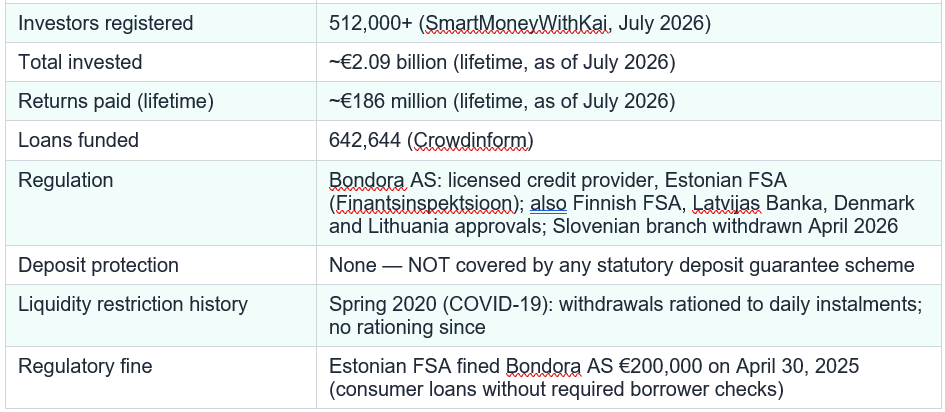
Founded in 2008, Bondora is one of Europe’s oldest peer-to-peer lending platforms. In April 2026 its flagship product rebranded as a standalone company: Go & Grow. Over 512,000 investors have used it. €2.09 billion has been invested on the platform. The return is 6% per annum, accruing daily, with withdrawals in 1–3 days for a €1 fee. Here is everything you need to know before investing — including the risks the platform’s own marketing understates.

Platform Scale, Return History And Financial Health
Go & Grow vs Alternatives, Return, Risk And Protection Comparison
In April 2026, Bondora rebranded Go & Grow as a standalone company with its own identity. The underlying loan originator — Bondora AS — continues to operate independently. The result is two distinct brands: Go & Grow (the investor-facing product) and Bondora (the lending business behind it). The rebranding reflects Go & Grow’s enormous commercial success: with over 512,000 investors and approximately €2.09 billion invested on the platform since inception, it has become one of the most recognisable P2P investment products in Europe.
This review covers the complete picture in 2026: the 6% return, the April 2025 rate reduction from 6.75%, the new August 2026 Go & Grow Pocket product, the platform’s financial health, the regulatory environment (including a €200,000 fine in April 2025), the risk dimensions the marketing materials do not foreground, and the specific investor profiles for whom Go & Grow is and is not a suitable tool.
Platform: Go & Grow (formerly Bondora Go & Grow, rebranded April 20, 2026). Founded: 2008. Current return: 6% p.a. (reduced from 6.75% on April 1, 2025). Investors: 512,000+. Total invested: ~€2.09 billion. Returns paid lifetime: ~€186 million. Minimum: €1. Fee: €1/withdrawal. Withdrawal speed: 1–3 business days. Markets: Estonia, Finland, Netherlands, Denmark, Latvia.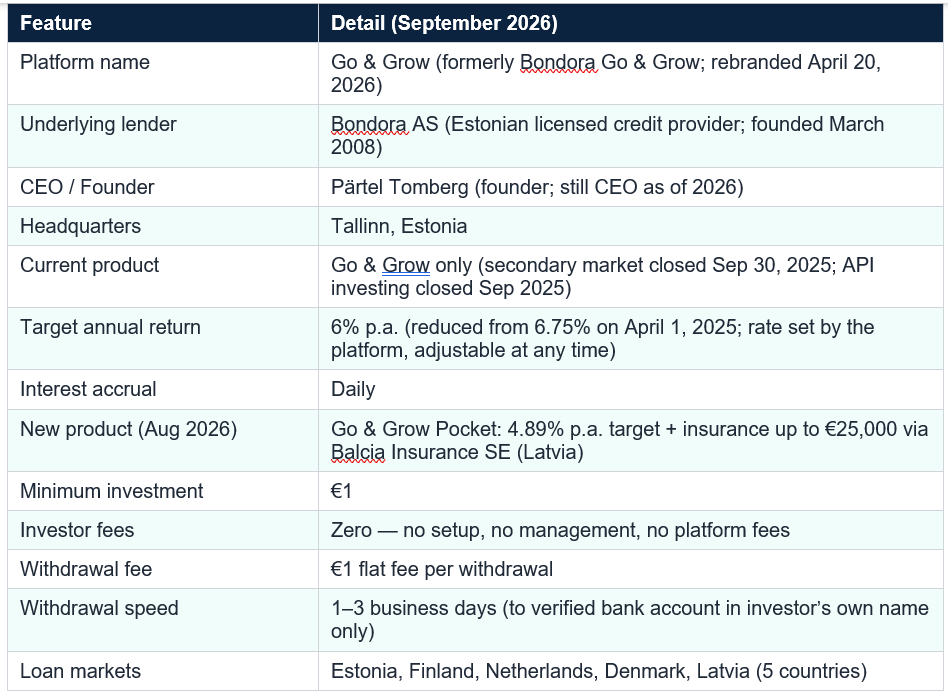
The platform’s product evolution:
When an investor deposits money into Go & Grow, the funds are not directly lent to specific borrowers. Instead, the investor acquires loan claims from Go & Grow OÜ (the platform entity), which in turn holds a diversified pool of consumer loans originated by Bondora AS. The investor’s return is paid by Go & Grow OÜ from the income those loans generate. The investor does not select loans, cannot see individual loan performance, and cannot sell loan claims on a secondary market. The 6% target return is paid regardless of the actual performance of the underlying loan book, within the limits of Go & Grow OÜ’s ability to pay it.
Key mechanics:
Go & Grow functions more like a high-yield investment product than a traditional P2P lending account. The investor's return is 6% whether or not the underlying loans perform well — up to the point where the platform's ability to pay is impaired. This simplicity is genuinely valuable; it is also the source of the product's most significant risk: the investor cannot see or assess the quality of the underlying loan book, and relies entirely on Go & Grow OÜ's financial capacity and willingness to maintain the target return.
The practical implications for investors are limited — the product works identically before and after the rebrand. SmartMoneyWithKai’s July 2026 review describes it succinctly: ‘Two pillars, two focuses, room for each side to grow independently.’ The separation allows the Go & Grow brand to focus on the investor experience and proposition, while Bondora AS focuses on consumer lending operations.
The rebrand also introduced a ‘Goals’ feature, which allows investors to set specific savings targets and track progress against them — similar to goals-based savings features seen in neobanks. This feature reflects Go & Grow’s positioning as a competitor to savings accounts rather than a competitor to traditional investment platforms.
Despite the rebrand and the separate company structure, the investor's exposure remains to the same underlying risk: the performance of consumer loans originated by Bondora AS. The rebrand changes the branding and the corporate structure, but does not add regulatory protection, deposit insurance, or any new guarantee on the 6% return. Investors should verify on goandgrow.eu (not bondora.com) for current terms after the rebrand.
This is a meaningful product development because it directly addresses Go & Grow’s most cited weakness: the absence of any form of capital protection. The standard Go & Grow account has no deposit guarantee, no buyback guarantee, and no insurer backing. Go & Grow Pocket provides a private insurance policy covering up to €25,000 per investor.
The critical clarifications from rethink-p2p.de’s August 2026 analysis:
The platform-level statistics are also strong: approximately €2.09 billion invested on the platform to date, €186 million paid in returns to investors across its lifetime, and 512,000+ registered investors (SmartMoneyWithKai, July 2026). Independent tracking of 441 real investor portfolios by Crowdinform finds an average return of 6.4% across all years and 6.0% over the last 12 months — consistent with the platform’s advertised rate.
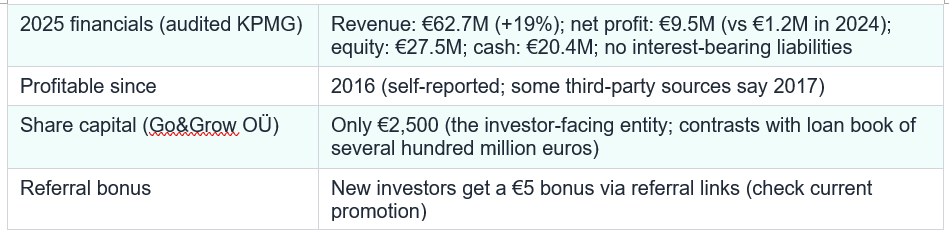
One structural concern is worth noting explicitly: the investor-facing entity, Go&Grow OÜ, has reported share capital of only €2,500. This means the legal entity with which investors contract has an extremely thin equity buffer relative to the loan book of several hundred million euros it manages. The financial strength of the broader Bondora Group (€27.5 million equity at Bondora AS level) provides the substantive support, but investors should be aware that these are separate legal entities.
The rate reduction disappointed some investors. Revenue.land’s January 2026 review notes it ‘disappointed some investors.’ However, context matters:
New investors registering through referral links typically receive a €5 bonus added to their account, which effectively offsets several months of withdrawal fees. Check current promotions on goandgrow.eu as these offers change.
More specifically, Go & Grow suits investors who: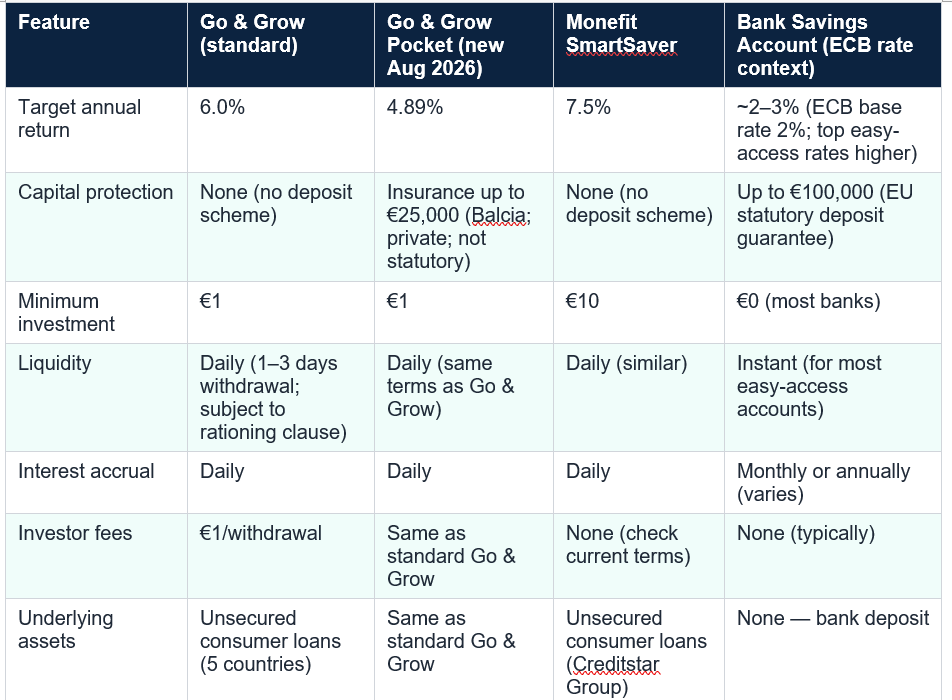
The product’s limitations are equally specific. It is not a bank account. Your capital is at risk. The return can be reduced. Withdrawals can be rationed. There is no deposit protection. The underlying loan book carries the default risk that all consumer lending carries. These limitations do not make Go & Grow a poor investment — they define the conditions under which it is appropriate.
For investors who understand those conditions — and who are using Go & Grow as a liquid, higher-yield alternative to a savings account rather than as a substitute for a guaranteed deposit — the product occupies a genuine and useful role in a diversified personal finance strategy. The new Go & Grow Pocket product (4.89% + €25,000 private insurance) adds a second option for more risk-averse investors who want the platform’s simplicity with a capital protection layer, at the cost of approximately 1.1 percentage points in annual return.
The search volume data provided by the user (90,500 monthly searches, +614% growth since discovery in May 2023) reflects a genuine and growing public interest in accessible, simple investment products that outperform savings rates. Go & Grow answers that interest directly. As with any investment decision, the right response to that interest is informed rather than impulsive engagement. This review aims to provide the complete picture.
Go & Grow is one of the most established P2P investment products in Europe, with an 18-year operating history and a track record of delivering its advertised return to all investors. However, 'safe' in the investment context has an important caveat: your capital is at risk, and Go & Grow is not covered by any statutory deposit protection scheme. If the platform were to fail, you would be an unsecured creditor with no automatic safety net. The 2020 COVID-19 withdrawal rationing episode, the €200,000 Estonian FSA fine in April 2025, and the Slovenian branch withdrawal in April 2026 are all worth noting in a full risk assessment. Go & Grow is relatively safe for a P2P investment product — it is not as safe as a regulated bank deposit.
What is the current interest rate on Go & Grow in 2026?
The current target annual return is 6% per annum, reduced from 6.75% on April 1, 2025. The rate accrues daily and has been at 6% since April 2025. Throughout its entire history, the advertised return has been achieved for all investors. Independent tracking of 441 real investor portfolios confirms a 6.0% average return over the last 12 months (Crowdinform, August 2026). The rate is set by the platform and can be adjusted at any time — there is no contractual lock on the rate. The new Go & Grow Pocket product (launched August 2026) offers 4.89% p.a. with private insurance coverage up to €25,000.
What is the difference between Go & Grow and Go & Grow Pocket?
The standard Go & Grow account offers a 6% per annum target return with daily liquidity, no capital protection, and a €1 withdrawal fee. Go & Grow Pocket, launched in August 2026, is a separate investment pot within the same account. It offers a lower target return of 4.89% per annum in exchange for private insurance coverage of up to €25,000 per investor through Latvian insurer Balcia Insurance SE. This is not a statutory deposit guarantee — it is a private insurance policy subject to the insurer's policy terms, exclusions, and ability to pay. The €25,000 coverage cap means Pocket offers meaningful protection for smaller balances but does not scale to cover larger investments.
Can I withdraw my money from Go & Grow at any time?
Under normal conditions, yes. Withdrawals are processed and typically reach your bank account within 1–3 business days for a flat €1 fee. However, the platform contractually reserves the right to slow withdrawals if too many investors attempt to exit simultaneously — a clause it activated in spring 2020 during the COVID-19 pandemic, resulting in withdrawals being paid in daily instalments for approximately three months. This clause has not been activated since 2020. Withdrawals go only to a previously verified bank account in your own name, for security purposes.
Is Go & Grow regulated?
The regulatory situation has two dimensions. The underlying lender, Bondora AS, is a licensed credit provider regulated by the Estonian Financial Supervisory Authority (Finantsinspektsioon), as well as by the Finnish FSA, Latvijas Banka (Latvia), and with recent approvals in Denmark and Lithuania. The investor-facing entity, Go&Grow OÜ, does not hold a financial services licence and is not regulated as an investment firm — it operates under general Estonian commercial and consumer protection law. There is no deposit protection scheme covering investor funds. Go & Grow is subject to EU regulations including GDPR. The Estonian FSA fined Bondora AS €200,000 in April 2025 for lending without required borrower creditworthiness checks.
How does Go & Grow compare to a savings account?
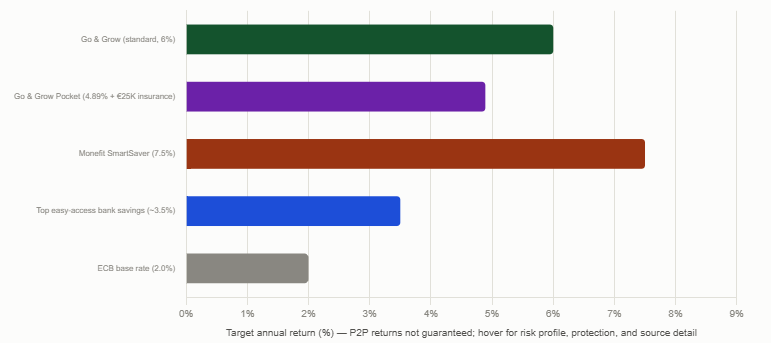
Go & Grow offers a significantly higher target return than most easy-access savings accounts in 2026. With the ECB base rate at 2% (October 2025), the best easy-access bank savings rates in the eurozone are typically 2–3.5%. Go & Grow's 6% target is 2–4 percentage points above this. However, the comparison carries an important caveat: bank deposits up to €100,000 are covered by the EU statutory deposit guarantee scheme, meaning you cannot lose money held in a bank deposit (up to the limit) even if the bank fails. Go & Grow carries no such protection. The higher return reflects, in part, this higher risk. For many investors, maintaining a portion of liquid savings in Go & Grow (accepting the P2P risk in exchange for a higher return) while keeping the bulk of cash in a guaranteed bank account represents a rational allocation strategy.
Platform Scale, Return History And Financial Health
Go & Grow vs Alternatives, Return, Risk And Protection Comparison
Table of Contents
- What Is Bondora / Go & Grow?
- A Quick-Reference Fact Card: Everything in One Place
- The History: 18 Years from Estonia’s First P2P to 512,000 Investors
- How Go & Grow Works: The Mechanics of the 6% Return
- The April 2026 Rebrand: Bondora Becomes Go & Grow
- New in August 2026: Go & Grow Pocket and the Insurance Question
- Platform Scale and Financial Health in 2026
- The Return History: From 6.75% to 6% and What Changed
- The Risks: What Go & Grow’s Marketing Doesn’t Emphasise
- The Regulatory Picture: Licensed, Fined, and Evolving
- Fees and Getting Started
- Who Is Go & Grow Best Suited For?
- How Go & Grow Compares: A Side-by-Side Table
- Pros and Cons: The Honest Assessment
- Conclusion: A Reliable Tool With Specific Use Cases
- Frequently Asked Questions
What Is Bondora / Go & Grow?
Bondora is an Estonian fintech company founded in March 2008 that originates unsecured consumer loans across five European countries. Its flagship product — Go & Grow — allows retail investors to earn a targeted 6% annual return on money that is automatically deployed across thousands of those consumer loans. Launched in 2018, Go & Grow was designed to strip away the complexity of traditional peer-to-peer lending: no loan selection, no auto-invest configuration, no secondary market. You deposit money, it earns 6% per year accruing daily, and you can withdraw at any time for a flat €1 fee.In April 2026, Bondora rebranded Go & Grow as a standalone company with its own identity. The underlying loan originator — Bondora AS — continues to operate independently. The result is two distinct brands: Go & Grow (the investor-facing product) and Bondora (the lending business behind it). The rebranding reflects Go & Grow’s enormous commercial success: with over 512,000 investors and approximately €2.09 billion invested on the platform since inception, it has become one of the most recognisable P2P investment products in Europe.
This review covers the complete picture in 2026: the 6% return, the April 2025 rate reduction from 6.75%, the new August 2026 Go & Grow Pocket product, the platform’s financial health, the regulatory environment (including a €200,000 fine in April 2025), the risk dimensions the marketing materials do not foreground, and the specific investor profiles for whom Go & Grow is and is not a suitable tool.
Platform: Go & Grow (formerly Bondora Go & Grow, rebranded April 20, 2026). Founded: 2008. Current return: 6% p.a. (reduced from 6.75% on April 1, 2025). Investors: 512,000+. Total invested: ~€2.09 billion. Returns paid lifetime: ~€186 million. Minimum: €1. Fee: €1/withdrawal. Withdrawal speed: 1–3 business days. Markets: Estonia, Finland, Netherlands, Denmark, Latvia.
A Quick-Reference Fact Card: Everything in One Place
The History: 18 Years from Estonia’s First P2P to 512,000 Investors
Bondora’s history spans nearly two decades of European fintech evolution. Founded in March 2008 in Tallinn by Pärtel Tomberg — who remains CEO — it began as a traditional peer-to-peer lending platform where individual investors selected specific loans to fund. Over the subsequent decade, it built a track record as one of Europe’s oldest and most established P2P platforms.The platform’s product evolution:
- 2008–2018 (Classic P2P era): investors selected individual loans across Estonian, Finnish, Spanish, and later other European markets. Products included Portfolio Manager and Portfolio Pro, which offered double-digit annual returns to investors comfortable with active loan selection. Some experienced investors report returns of 9–20% net in this period (revenue.land, April 2026).
- 2018: Go & Grow launched. Priced initially at 6.75% per annum, it transformed Bondora’s addressable market by eliminating the need for any investment decision-making. The product immediately attracted investors who had been deterred by the complexity of traditional P2P.
- February 2023: Portfolio Manager and Portfolio Pro discontinued. Go & Grow became the only active investment product.
- September 2025: API investing and the secondary market both closed, completing the pivot to a single, simplified product.
- April 1, 2025: Go & Grow rate reduced from 6.75% to 6% — the first rate change in seven years.
- April 20, 2026: Go & Grow rebranded as a standalone company (Go&Grow OÜ), separate from the Bondora Group, with its own brand identity and website (goandgrow.eu).
- • August 2026: Go & Grow Pocket launched — a separate investment pot offering 4.89% p.a. with private insurance coverage up to €25,000 through Latvian insurer Balcia Insurance SE.
How Go & Grow Works: The Mechanics of the 6% Return
Go & Grow is not a traditional peer-to-peer investment product. Understanding what it actually is — as opposed to what the name might imply — is the most important foundation for evaluating it.When an investor deposits money into Go & Grow, the funds are not directly lent to specific borrowers. Instead, the investor acquires loan claims from Go & Grow OÜ (the platform entity), which in turn holds a diversified pool of consumer loans originated by Bondora AS. The investor’s return is paid by Go & Grow OÜ from the income those loans generate. The investor does not select loans, cannot see individual loan performance, and cannot sell loan claims on a secondary market. The 6% target return is paid regardless of the actual performance of the underlying loan book, within the limits of Go & Grow OÜ’s ability to pay it.
Key mechanics:
- Interest accrual: 6% per year, calculated and credited daily. On a €10,000 investment, this is approximately €1.64 per day, or approximately €600 per year, before any withdrawal fees. The daily accrual supports compounding if the balance is not withdrawn.
- Minimum investment: €1. No upper limit is specified. The product is accessible to investors at all wealth levels, from those parking a small emergency fund to those managing five-figure savings.
- Deposits: via bank transfer or card. Funds are available for investment as soon as they reach the platform.
- Withdrawals: available at any time, subject to the platform’s liquidity terms. The €1 flat fee per withdrawal is the only investor-facing cost. Withdrawals go only to a previously verified bank account in the investor’s own name — a security measure that prevents fund misdirection.
- Compounding: the daily-accruing interest is added to the account balance and itself earns interest, producing compound growth over time. Over a full year at 6%, the effective annual rate with daily compounding is approximately 6.18%.
Go & Grow functions more like a high-yield investment product than a traditional P2P lending account. The investor's return is 6% whether or not the underlying loans perform well — up to the point where the platform's ability to pay is impaired. This simplicity is genuinely valuable; it is also the source of the product's most significant risk: the investor cannot see or assess the quality of the underlying loan book, and relies entirely on Go & Grow OÜ's financial capacity and willingness to maintain the target return.
The April 2026 Rebrand: Bondora Becomes Go & Grow
On April 20, 2026, the investor-facing business rebranded from ‘Bondora Go & Grow’ to ‘Go & Grow’, establishing itself as a standalone company (Go&Grow OÜ) with its own website (goandgrow.eu) and brand identity. The bondora.com domain now redirects visitors to goandgrow.eu. Bondora AS continues as the lending entity that originates the consumer loans underlying the product.The practical implications for investors are limited — the product works identically before and after the rebrand. SmartMoneyWithKai’s July 2026 review describes it succinctly: ‘Two pillars, two focuses, room for each side to grow independently.’ The separation allows the Go & Grow brand to focus on the investor experience and proposition, while Bondora AS focuses on consumer lending operations.
The rebrand also introduced a ‘Goals’ feature, which allows investors to set specific savings targets and track progress against them — similar to goals-based savings features seen in neobanks. This feature reflects Go & Grow’s positioning as a competitor to savings accounts rather than a competitor to traditional investment platforms.
Despite the rebrand and the separate company structure, the investor's exposure remains to the same underlying risk: the performance of consumer loans originated by Bondora AS. The rebrand changes the branding and the corporate structure, but does not add regulatory protection, deposit insurance, or any new guarantee on the 6% return. Investors should verify on goandgrow.eu (not bondora.com) for current terms after the rebrand.
New in August 2026: Go & Grow Pocket and the Insurance Question
In August 2026, Go & Grow launched a second investment product — Go & Grow Pocket — as a separate pot alongside the standard Go & Grow account. Pocket offers a lower target return of 4.89% per annum (compared with 6% for standard Go & Grow) in exchange for insurance coverage of up to €25,000 through Latvian insurer Balcia Insurance SE.This is a meaningful product development because it directly addresses Go & Grow’s most cited weakness: the absence of any form of capital protection. The standard Go & Grow account has no deposit guarantee, no buyback guarantee, and no insurer backing. Go & Grow Pocket provides a private insurance policy covering up to €25,000 per investor.
The critical clarifications from rethink-p2p.de’s August 2026 analysis:
- This is a private insurance policy, not a statutory deposit guarantee scheme such as the EU’s €100,000 bank deposit guarantee. The cover applies only in the event of a defined insured event and is subject to the coverage limits and exclusions of the Balcia Insurance SE policy.
- The return trade-off is more than one percentage point: 4.89% versus 6% is a reduction of 1.11 percentage points, or approximately 18.5% of the base return. On a €10,000 investment, this is approximately €111 per year in foregone returns.
- Coverage is capped at €25,000 per investor, regardless of the total balance in the Pocket account.
- The insurer’s own financial capacity and willingness to pay in a defined event is the limiting factor, not Go & Grow’s creditworthiness.
Platform Scale and Financial Health in 2026
Bondora Group’s 2025 annual accounts, audited by KPMG, present a financially healthy picture at the lending entity level:- Revenue: €62.7 million, up 19% versus 2024.
- Net profit: €9.5 million, a substantial increase versus €1.2 million in 2024. The jump partly reflects lower loan impairment and a one-off sale of Finnish loans.
- Operating cash flow: €13.0 million.
- Cash on hand: €20.4 million.
- Equity: €27.5 million.
- No interest-bearing liabilities.
- Total assets: €36.8 million.
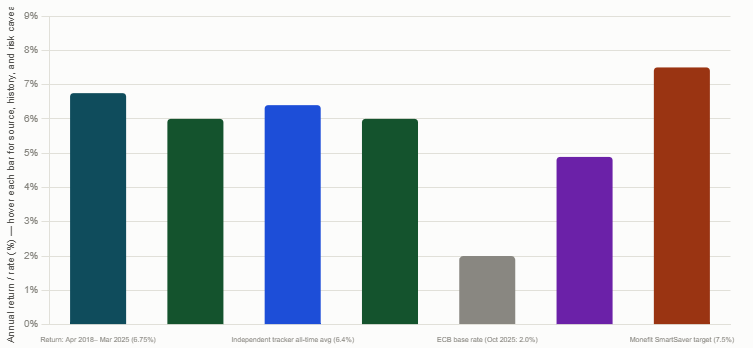
The platform-level statistics are also strong: approximately €2.09 billion invested on the platform to date, €186 million paid in returns to investors across its lifetime, and 512,000+ registered investors (SmartMoneyWithKai, July 2026). Independent tracking of 441 real investor portfolios by Crowdinform finds an average return of 6.4% across all years and 6.0% over the last 12 months — consistent with the platform’s advertised rate.
One structural concern is worth noting explicitly: the investor-facing entity, Go&Grow OÜ, has reported share capital of only €2,500. This means the legal entity with which investors contract has an extremely thin equity buffer relative to the loan book of several hundred million euros it manages. The financial strength of the broader Bondora Group (€27.5 million equity at Bondora AS level) provides the substantive support, but investors should be aware that these are separate legal entities.
The Return History: From 6.75% to 6% and What Changed
From April 2018 — when Go & Grow launched — to April 1, 2025, the target annual return was 6.75%. This seven-year consistency was one of Go & Grow’s defining characteristics and a significant marketing advantage. On April 1, 2025, the rate was reduced to 6% per annum, where it remains as of September 2026.The rate reduction disappointed some investors. Revenue.land’s January 2026 review notes it ‘disappointed some investors.’ However, context matters:
- The ECB base rate fell to 2% in October 2025, making Go & Grow’s 6% return significantly more competitive relative to bank savings accounts than it appeared when the ECB rate was higher in 2022–2023. Northern Finance’s August 2026 review observes: ‘instant access savings accounts are practically dead: the current ECB base rate stands at just 2%. So it’s no wonder that more and more savers are specifically looking for better alternatives.’
- The rethink-p2p.de August 2026 review confirms that throughout Go & Grow’s entire history, the advertised return has been achieved for all investors — a strong track record of delivering on the stated target.
- The crowdinform.com August 2026 analysis of 441 real investor portfolios shows an average of 6.0% over the last 12 months, exactly matching the advertised rate. The all-time average across all years was 6.4%, reflecting the period when the 6.75% rate applied.
The Risks: What Go & Grow’s Marketing Doesn’t Emphasise
Go & Grow’s marketing positions the product as simple, liquid, and reliable. All three of those characterisations are approximately accurate under normal conditions. The critical caveat is ‘under normal conditions.’ The following risks are real, documented, and deserve explicit attention from any prospective investor:- Credit risk: the underlying assets are unsecured consumer loans. Borrowers can and do default. Crowdinform’s external data service analysis estimates that approximately €216 million of the €786 million outstanding loan book is behind on payments or has been written off. Bondora itself does not publish a euro loss figure, making independent verification of the true loan book quality difficult. Go & Grow OÜ absorbs these losses internally rather than passing them through to investors — but this relies on its ability to continue absorbing them from its spread.
- Liquidity risk: Go & Grow’s most visible risk is the 2020 COVID-19 precedent. When many investors simultaneously tried to withdraw funds in spring 2020, the platform activated its contractual right to ration withdrawals and paid out in daily instalments over approximately three months. The platform has not used this mechanism since. However, the contractual right remains, and any significant loss of investor confidence could trigger it again. Jean Galea’s June 2026 review is explicit: ‘One honest caveat: Bondora keeps the contractual right to slow withdrawals if too many investors try to exit at once, which it used briefly in early 2020 and has not needed since.’
- Platform risk: there is no deposit protection scheme. If Go & Grow OÜ or Bondora AS were to fail, investors would have no statutory claim to their funds from a guarantee fund. They would be unsecured creditors in any insolvency proceeding.
- Rate risk: the 6% return is a target, not a contractual guarantee. The platform can change the rate at any time. The April 2025 reduction from 6.75% to 6% is evidence that this risk is real. Future reductions are possible.
- Regulatory risk: the April 2025 €200,000 regulatory fine and the April 2026 withdrawal of Slovenian branch permission illustrate that the regulatory relationship is not frictionless. Further regulatory action, in any of the five operating markets, could affect the platform’s ability to originate loans in that market.
- Transparency limitation: Bondora does not publish what investors have actually earned after taxes or bad debts. The reports section of the platform has been described as ‘being rebuilt’ since August 2024 (Crowdinform). Two independent researchers were refused data. The 6% figure is what the platform promises and what independent tracking confirms — but the underlying loan book transparency is limited.
The Regulatory Picture: Licensed, Fined, and Evolving
Go & Grow’s regulatory position is more nuanced than its marketing language suggests. The headline facts:- • Bondora AS is a licensed credit provider under the supervision of the Estonian Financial Supervisory Authority (Finantsinspektsioon — sometimes abbreviated EFSA). This licence covers the consumer lending activity that generates the underlying loans.
- • In Finland, Bondora operates through a licensed branch regulated by the Finnish FSA. In Latvia, it holds an operating licence supervised by Latvijas Banka. Regulatory approvals have recently been obtained in Denmark and Lithuania.
- • In April 2026, the Slovenian branch permission was withdrawn by the local regulator.
- • On April 30, 2025, the Estonian FSA fined Bondora AS €200,000 for making consumer loans between December 2023 and February 2024 without conducting the required creditworthiness checks on borrowers. This followed an earlier July 2023 compliance order for the same class of issue.
- • Go & Grow OÜ — the investor-facing entity — does not itself hold a financial services licence or a credit provider authorisation. It operates under the regulations that apply to the contractual relationship (Estonian Consumer Protection Act, Law of Obligations Act, Commercial Code, Accounting Act, GDPR).
Fees and Getting Started
One of Go & Grow’s genuine advantages is its fee structure — or more precisely, the near-absence of one:- No account setup fee.
- No management fee or ongoing platform fee.
- No investment fee for adding funds.
- €1 flat withdrawal fee, regardless of the withdrawal amount. This makes large, infrequent withdrawals more efficient than small, frequent ones.
- No secondary market (closed September 2025), so no transaction fee for selling loans.
New investors registering through referral links typically receive a €5 bonus added to their account, which effectively offsets several months of withdrawal fees. Check current promotions on goandgrow.eu as these offers change.
Who Is Go & Grow Best Suited For?
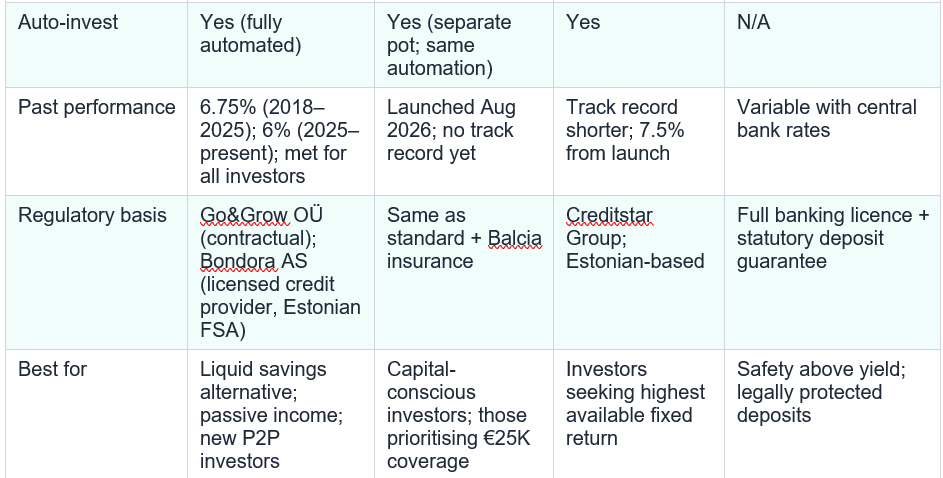
The rethink-p2p.de August 2026 review identifies the two specific investor profiles for which Go & Grow is the strongest fit: ‘In particular, the combination of simplicity and high liquidity makes Go & Grow a good option for two types of investors: first, for new and more inexperienced investors who want to start investing in P2P loans quickly and easily; and second, for investors with a strong need for liquidity who want to invest their money short-term at an attractive interest rate.’More specifically, Go & Grow suits investors who:
- Want a better return than a bank savings account without any active management. At 6% versus the ECB base rate of 2%, the risk-adjusted return proposition is attractive for money that would otherwise sit in cash.
- Maintain a cash buffer or emergency fund and want that buffer to earn a competitive return while remaining accessible. The daily accrual and 1–3 day withdrawal speed make it genuinely functional as a liquid savings tool.
- Are new to P2P investing and want to understand the asset class without selecting individual loans or navigating complex auto-invest settings.
- Want to park a portion of a broader investment portfolio in a relatively liquid, fixed-rate instrument that is uncorrelated with equity markets.
How Go & Grow Compares: A Side-by-Side Table
14. Pros and Cons: The Honest Assessment
- Pro: 18-year track record. Bondora has been operating since 2008 through multiple market cycles including the 2008–2009 global financial crisis, the 2020 pandemic, and the 2022–2023 rate cycle. No other active European P2P platform has a longer uninterrupted operational history.
- Pro: Target return delivered consistently. The 6% (formerly 6.75%) target return has been met for all investors across the platform’s history, with independent tracker data of 441 portfolios confirming a 6.0% average over the last 12 months (Crowdinform, August 2026).
- Pro: Genuine liquidity. With the exception of the three-month COVID restriction in 2020, Go & Grow has maintained daily liquidity since 2018. For a P2P investment product, this is genuinely unusual and genuinely valuable.
- Pro: Zero investor fees. No management, no setup, no platform fee. Only a flat €1 withdrawal charge, making it one of the lowest-cost investment products available at any return level.
- Pro: Minimum €1 investment. The €1 minimum is one of the lowest in the sector, making the platform accessible to investors at all wealth levels, including those building savings from scratch.
- Pro: Strong 2025 financials. Revenue of €62.7 million (+19%), net profit €9.5 million, no interest-bearing liabilities, and €20.4 million in cash (Bondora Group 2025, audited KPMG). The financial buffer behind the platform is substantive.
- Con: No deposit protection. Go & Grow is not covered by any statutory deposit guarantee scheme. If the platform fails, investors have no automatic safety net. This is the most important caveat for any investor treating Go & Grow as a savings account equivalent.
- Con: Return can be reduced at any time. The April 2025 reduction from 6.75% to 6% was the first in seven years but demonstrates that the rate is not locked. Future reductions are possible with no contractual notice requirement.
- Con: Liquidity rationing clause remains. The contractual right to slow withdrawals exists and was used in 2020. Under stress conditions, investors may not be able to access their funds immediately despite the ‘daily liquidity’ marketing language.
- Con: Limited transparency on underlying loan performance. Bondora does not publish euro-value loss figures for investors. The reports section has been described as under reconstruction since August 2024. Independent estimates suggest approximately 27% of the outstanding loan book is in arrears or written off (Crowdinform), but this is not confirmed by the platform.
- Con: Regulatory fine and Slovenian branch withdrawal. The €200,000 FSA fine in April 2025 (for consumer loans without required borrower checks) and the withdrawal of Slovenian operating permission in April 2026 indicate regulatory tensions. Two regulatory enforcement actions in 12 months is a flag worth noting.
- Con: Rate lower than competitors. At 6%, Go & Grow currently offers a lower return than Monefit SmartSaver (7.5% target), TWINO, and other European P2P platforms. The simplicity premium costs approximately 1.5 percentage points in annual return.
Conclusion
Go & Grow is a genuinely useful financial product for a specific purpose: earning a competitive return on liquid savings without active management. Its 18-year track record, daily interest accrual, zero management fees, and consistent delivery of the advertised return across its entire history make it one of the more reliable instruments in the P2P investing landscape.The product’s limitations are equally specific. It is not a bank account. Your capital is at risk. The return can be reduced. Withdrawals can be rationed. There is no deposit protection. The underlying loan book carries the default risk that all consumer lending carries. These limitations do not make Go & Grow a poor investment — they define the conditions under which it is appropriate.
For investors who understand those conditions — and who are using Go & Grow as a liquid, higher-yield alternative to a savings account rather than as a substitute for a guaranteed deposit — the product occupies a genuine and useful role in a diversified personal finance strategy. The new Go & Grow Pocket product (4.89% + €25,000 private insurance) adds a second option for more risk-averse investors who want the platform’s simplicity with a capital protection layer, at the cost of approximately 1.1 percentage points in annual return.
The search volume data provided by the user (90,500 monthly searches, +614% growth since discovery in May 2023) reflects a genuine and growing public interest in accessible, simple investment products that outperform savings rates. Go & Grow answers that interest directly. As with any investment decision, the right response to that interest is informed rather than impulsive engagement. This review aims to provide the complete picture.
Frequently Asked Questions
Is Bondora / Go & Grow safe?Go & Grow is one of the most established P2P investment products in Europe, with an 18-year operating history and a track record of delivering its advertised return to all investors. However, 'safe' in the investment context has an important caveat: your capital is at risk, and Go & Grow is not covered by any statutory deposit protection scheme. If the platform were to fail, you would be an unsecured creditor with no automatic safety net. The 2020 COVID-19 withdrawal rationing episode, the €200,000 Estonian FSA fine in April 2025, and the Slovenian branch withdrawal in April 2026 are all worth noting in a full risk assessment. Go & Grow is relatively safe for a P2P investment product — it is not as safe as a regulated bank deposit.
What is the current interest rate on Go & Grow in 2026?
The current target annual return is 6% per annum, reduced from 6.75% on April 1, 2025. The rate accrues daily and has been at 6% since April 2025. Throughout its entire history, the advertised return has been achieved for all investors. Independent tracking of 441 real investor portfolios confirms a 6.0% average return over the last 12 months (Crowdinform, August 2026). The rate is set by the platform and can be adjusted at any time — there is no contractual lock on the rate. The new Go & Grow Pocket product (launched August 2026) offers 4.89% p.a. with private insurance coverage up to €25,000.
What is the difference between Go & Grow and Go & Grow Pocket?
The standard Go & Grow account offers a 6% per annum target return with daily liquidity, no capital protection, and a €1 withdrawal fee. Go & Grow Pocket, launched in August 2026, is a separate investment pot within the same account. It offers a lower target return of 4.89% per annum in exchange for private insurance coverage of up to €25,000 per investor through Latvian insurer Balcia Insurance SE. This is not a statutory deposit guarantee — it is a private insurance policy subject to the insurer's policy terms, exclusions, and ability to pay. The €25,000 coverage cap means Pocket offers meaningful protection for smaller balances but does not scale to cover larger investments.
Can I withdraw my money from Go & Grow at any time?
Under normal conditions, yes. Withdrawals are processed and typically reach your bank account within 1–3 business days for a flat €1 fee. However, the platform contractually reserves the right to slow withdrawals if too many investors attempt to exit simultaneously — a clause it activated in spring 2020 during the COVID-19 pandemic, resulting in withdrawals being paid in daily instalments for approximately three months. This clause has not been activated since 2020. Withdrawals go only to a previously verified bank account in your own name, for security purposes.
Is Go & Grow regulated?
The regulatory situation has two dimensions. The underlying lender, Bondora AS, is a licensed credit provider regulated by the Estonian Financial Supervisory Authority (Finantsinspektsioon), as well as by the Finnish FSA, Latvijas Banka (Latvia), and with recent approvals in Denmark and Lithuania. The investor-facing entity, Go&Grow OÜ, does not hold a financial services licence and is not regulated as an investment firm — it operates under general Estonian commercial and consumer protection law. There is no deposit protection scheme covering investor funds. Go & Grow is subject to EU regulations including GDPR. The Estonian FSA fined Bondora AS €200,000 in April 2025 for lending without required borrower creditworthiness checks.
How does Go & Grow compare to a savings account?
Go & Grow offers a significantly higher target return than most easy-access savings accounts in 2026. With the ECB base rate at 2% (October 2025), the best easy-access bank savings rates in the eurozone are typically 2–3.5%. Go & Grow's 6% target is 2–4 percentage points above this. However, the comparison carries an important caveat: bank deposits up to €100,000 are covered by the EU statutory deposit guarantee scheme, meaning you cannot lose money held in a bank deposit (up to the limit) even if the bank fails. Go & Grow carries no such protection. The higher return reflects, in part, this higher risk. For many investors, maintaining a portion of liquid savings in Go & Grow (accepting the P2P risk in exchange for a higher return) while keeping the bulk of cash in a guaranteed bank account represents a rational allocation strategy.

0 Comments Comments