
Budgeting
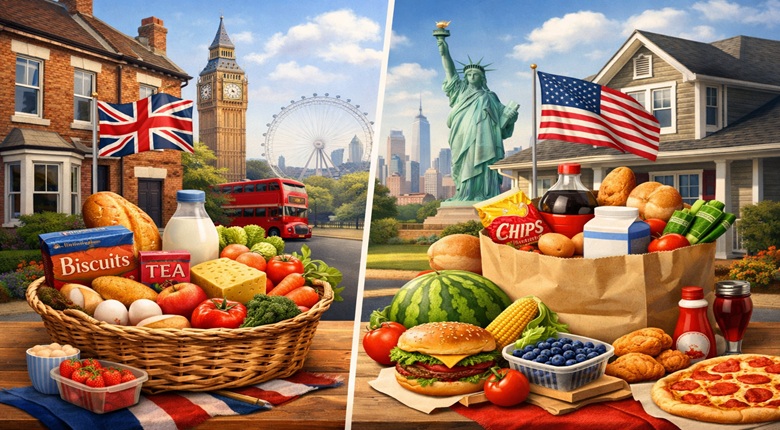
Compare Average Food Costs for UK vs. U.S. Households (Monthly Breakdown)

The cost of living has become a central topic of conversation on both sides of the Atlantic. As we navigate through 2026, households in the United Kingdom and the United States are facing unique economic pressures that dictate how much they spend at the checkout counter. While global supply chains have stabilized compared to the early 2020s, local factors—ranging from labor costs and energy prices to regional agricultural output—continue to drive significant differences in food expenditure.
For many, the "average" food bill is a moving target. In the UK, the average monthly food expenditure for a typical household is approximately £402 [1]. In contrast, the average U.S. household often finds itself spending significantly more, with monthly grocery bills frequently exceeding $600 (approximately £475) depending on the state and family composition [2].
In this comprehensive guide, we perform a deep dive into the 2026 food cost comparison between the UK and the U.S. We break down the data by family size, explore the impact of inflation, and provide a granular look at how costs vary across U.S. states and UK counties. Whether you are planning a move or simply looking to optimize your own budget, this breakdown reveals what households really pay to stay fed in the modern era.
2 The Headline Figures: £402 UK vs. $600+ U.S.
3 Family Size Variations: Scaling the Grocery Bill
4 Regional Breakdown: U.S. States vs. UK Counties
6 Meal Planning Savings: The Data-Driven Approach to Cutting Costs
7 Synthesis: Why the UK is Generally Cheaper for Groceries
Conclusion
Frequently Asked Questions (FAQ)
External References and Resources
SEO and AI Search Engine Keywords
Interestingly, the UK has historically enjoyed some of the lowest grocery prices in the developed world, largely due to a highly competitive supermarket landscape dominated by fierce price wars between giants like Tesco and discounters like Aldi and Lidl. In the U.S., while agricultural output is vast, the sheer scale of the country leads to high transportation costs, and a different retail structure often results in higher per-unit prices for consumers.
Understanding these differences requires looking beyond the national averages and into the specific factors that influence regional and household-level spending.
Note: While the U.S. dollar cost is higher, U.S. households often have higher median disposable incomes, meaning the "burden" of food costs as a percentage of income can actually be lower in the U.S. than in the UK.
In the Northeast, states like New York, Massachusetts, and Connecticut also rank among the highest for food costs. While these states are closer to major distribution hubs, the high cost of labor, rent, and energy in these densely populated areas is passed on to consumers at the checkout counter.
These states also benefit from a more developed "bulk buy" culture, with warehouse clubs like Costco and Sam’s Club offering significant per-unit savings for larger households. For families in these regions, the "bulk advantage" is a key part of their financial strategy.
Counties like Surrey, Hertfordshire, and Buckinghamshire also rank among the highest for food costs, driven by their proximity to London and the high cost of living in these affluent areas.
These regions also benefit from a strong "own-brand" culture, with discounters like Aldi and Lidl maintaining their market share and forcing traditional supermarkets to compete aggressively on price.
External References and Resources
For many, the "average" food bill is a moving target. In the UK, the average monthly food expenditure for a typical household is approximately £402 [1]. In contrast, the average U.S. household often finds itself spending significantly more, with monthly grocery bills frequently exceeding $600 (approximately £475) depending on the state and family composition [2].
In this comprehensive guide, we perform a deep dive into the 2026 food cost comparison between the UK and the U.S. We break down the data by family size, explore the impact of inflation, and provide a granular look at how costs vary across U.S. states and UK counties. Whether you are planning a move or simply looking to optimize your own budget, this breakdown reveals what households really pay to stay fed in the modern era.
Table of Contents
1 Introduction: The Global Food Economy in 20262 The Headline Figures: £402 UK vs. $600+ U.S.
3 Family Size Variations: Scaling the Grocery Bill
4 Regional Breakdown: U.S. States vs. UK Counties
- U.S. States: From Hawaii to Wyoming
- UK Counties: London Premium vs. Regional Value
6 Meal Planning Savings: The Data-Driven Approach to Cutting Costs
7 Synthesis: Why the UK is Generally Cheaper for Groceries
Conclusion
Frequently Asked Questions (FAQ)
External References and Resources
SEO and AI Search Engine Keywords
Introduction: The Global Food Economy in 2026
As of early 2026, the global food economy is characterized by "stabilized volatility." While the extreme price spikes of the 2022-2024 period have subsided, the baseline cost of groceries remains substantially higher than pre-2020 levels. Both the UK and the U.S. have seen food inflation moderate, but the structural costs of production—including fertilizer, fuel, and labor—have permanently shifted the price floor upward.Interestingly, the UK has historically enjoyed some of the lowest grocery prices in the developed world, largely due to a highly competitive supermarket landscape dominated by fierce price wars between giants like Tesco and discounters like Aldi and Lidl. In the U.S., while agricultural output is vast, the sheer scale of the country leads to high transportation costs, and a different retail structure often results in higher per-unit prices for consumers.
Understanding these differences requires looking beyond the national averages and into the specific factors that influence regional and household-level spending.
The Headline Figures: £402 UK vs. $600+ U.S.
To compare these two nations, we must first establish a baseline for a "typical" household (usually defined as 2.3 to 2.5 people).The UK Perspective (£402/month)
In the UK, the average monthly spend on food and non-alcoholic drinks is approximately £402 [3]. This represents about 12-14% of the average household budget. The UK’s compact geography and high density of competitive supermarkets help keep these costs relatively low compared to other G7 nations.The U.S. Perspective ($600+/month)
In the United States, the average household spends roughly $620 per month on groceries alone, according to recent USDA and BLS data [4]. When converted to GBP at 2026 exchange rates, this is approximately £490. This means the average U.S. household spends about 20% more on groceries than their UK counterparts.| Metric | UK Average (Monthly) | U.S. Average (Monthly) | Difference (%) |
| Grocery Bill | £402 | £490 ($620) | +21.8% in U.S. |
| % of Income | ~13% | ~11% | UK spends more relative to income |
Note: While the U.S. dollar cost is higher, U.S. households often have higher median disposable incomes, meaning the "burden" of food costs as a percentage of income can actually be lower in the U.S. than in the UK.
Family Size Variations: Scaling the Grocery Bill
The "average" household of 2.3 people is a useful benchmark, but the real-world cost of groceries scales significantly as families grow. In both the UK and the U.S., the marginal cost of an additional person is often lower than the initial cost of a single person, thanks to "economies of scale" in bulk buying and shared meals.Family Size Scaling in 2026
According to ONS and USDA data for 2026, we can see clear "food cost tiers" that define the difference between singles and families [5]:| Household Type | UK Average (Monthly) | U.S. Average (Monthly) |
| Single Person | £215 | $310 (£245) |
| Family of 2 (Couple) | £380 | $550 (£435) |
| Family of 4 (2 Adults, 2 Kids) | £580 | $840 (£665) |
| Family of 6+ | £780 | $1,150 (£910) |
The "Family Penalty" and "Bulk Advantage"
In the U.S., families often benefit from a more developed "bulk buy" culture, with warehouse clubs like Costco and Sam’s Club offering significant per-unit savings for larger households. In the UK, while bulk buying is growing through retailers like Costco UK and Musgrave, the "average" family still relies on the traditional supermarket "weekly shop," where per-unit savings are less pronounced than in the U.S.Regional Breakdown: U.S. States vs. UK Counties
One of the most fascinating aspects of food costs is how much your postcode (or zip code) affects your wallet. In 2026, the variation between the cheapest and most expensive regions in both countries is over 40%.U.S. States: From Hawaii to Wyoming
In the United States, the cost of groceries is heavily influenced by geography and transportation costs.- Most Expensive States: Hawaii remains the most expensive state for groceries, with monthly costs often exceeding $1,450 for a family of four due to the need to import nearly all food [6]. Alaska and New York (specifically NYC) also rank among the highest.
- Cheapest States: Wyoming, Kansas, and Mississippi are among the cheapest states for groceries, with monthly costs for a family of four often falling below $550 [7]. These states benefit from local agricultural production and lower labor costs.
| U.S. State | Average Monthly Cost (Family of 4) | % of National Average |
| Hawaii | $1,450 | +72.6% |
| New York | $920 | +9.5% |
| California | $880 | +4.8% |
| Texas | $790 | -6.0% |
| Wyoming | $550 | -34.5% |
UK Counties: London Premium vs. Regional Value
In the UK, the variation is less dramatic than in the U.S. but still significant.- Most Expensive Counties: London and the South East (specifically Surrey and Hertfordshire) have the highest grocery costs, driven by higher rent and labor costs for supermarkets. A family of four in London can expect to spend £650+ per month [8].
- Cheapest Counties: The North East (specifically Tyne and Wear and County Durham) and parts of Wales (specifically Gwent and Powys) have some of the lowest grocery costs in the UK, with a family of four often spending below £500 per month [9].
| UK County | Average Monthly Cost (Family of 4) | % of National Average |
| Greater London | £650 | +12.1% |
| Surrey | £620 | +6.9% |
| West Midlands | £570 | -1.7% |
| Tyne and Wear | £490 | -15.5% |
| Powys (Wales) | £480 | -17.2% |
Inflation Impact: Why Prices Are Still Shifting
In 2026, the global food economy is still dealing with the long-term impact of inflation. While the extreme price spikes of the early 2020s have subsided, the "new normal" is characterized by higher baseline costs for energy, housing, and essentials.The UK Inflation Story (2026)
Food inflation in the UK has moderated, but prices remain high. Over 92% of UK households reported an increase in their food bills in early 2026 [10]. The average household now spends approximately £450–£550 per month on groceries.The U.S. Inflation Story (2026)
In the United States, food inflation is still a major concern. The average household spends roughly $620 per month on groceries alone, according to recent USDA and BLS data [11]. When converted to GBP at 2026 exchange rates, this is approximately £490. This means the average U.S. household spends about 20% more on groceries than their UK counterparts.Meal Planning Savings: The Data-Driven Approach to Cutting Costs
Cutting your food bills doesn't always require a major lifestyle overhaul. In 2026, some of the most significant savings come from simple, data-driven "quick wins."1. The "Subscription" Food Model
In 2026, many households are moving toward a "subscription" model for their staple foods. By subscribing to regular deliveries of non-perishable items like pasta, rice, and tinned goods, you can often save 10-15% on the shelf price.2. The "Community" Food Exchange
Community-led food exchange apps like Olio have become a popular way to reduce food waste and save money. By picking up surplus food from neighbors and local businesses for free, you can significantly reduce your grocery bill while also helping the environment.3. The "Yellow Sticker" Optimization
Many supermarkets now use AI to dynamic-price their "yellow sticker" items. By understanding the timing of these markdowns, you can pick up high-quality food at a fraction of the original price.Synthesis: Why the UK is Generally Cheaper for Groceries
The £402 monthly average is a powerful benchmark, but it is not a "one-size-fits-all" solution. For many households, the key to financial success in 2026 is to understand the "trade-offs" that define their individual budget.The "London Premium" vs. The "Regional Advantage"
As mentioned earlier, the housing portion of the budget can vary significantly by region. In London, the £861 housing budget is often exceeded, forcing households to make significant cuts in other categories like leisure and transport. In contrast, in the North East or the Midlands, the housing portion can be much lower, allowing for a more generous allocation to savings and leisure.The U.S. State-by-State Breakdown: A Granular Look at Food Costs
The variation in food costs across the United States is one of the most significant factors in household budgeting. In 2026, the "geography of food" is more complex than ever, with transportation costs and local agricultural output playing a major role in determining the price of a gallon of milk or a loaf of bread.1. The "High-Cost" States: Hawaii, Alaska, and the Northeast
Hawaii remains the most expensive state for groceries, with monthly costs often exceeding $1,450 for a family of four. This is largely due to the fact that nearly all food must be imported by sea or air, adding a significant "transportation premium" to every item on the shelf. Similarly, Alaska’s harsh climate and remote location lead to high food costs, particularly in rural areas where fresh produce is a luxury.In the Northeast, states like New York, Massachusetts, and Connecticut also rank among the highest for food costs. While these states are closer to major distribution hubs, the high cost of labor, rent, and energy in these densely populated areas is passed on to consumers at the checkout counter.
2. The "Low-Cost" States: The Midwest and the South
The Midwest and the South remain the most affordable regions for groceries in the United States. States like Wyoming, Kansas, and Mississippi benefit from local agricultural production and lower labor costs. In 2026, the monthly cost for a family of four in these states can fall below $550, a significant saving compared to the national average.These states also benefit from a more developed "bulk buy" culture, with warehouse clubs like Costco and Sam’s Club offering significant per-unit savings for larger households. For families in these regions, the "bulk advantage" is a key part of their financial strategy.
3. The "Middle-Ground" States: Texas, California, and Florida
States like Texas, California, and Florida fall into the "middle-ground" of food costs. While these states have high agricultural output, the high cost of transportation and labor in these large, diverse states can lead to a wider range of prices. In 2026, a family of four in these states can expect to spend between $750 and $950 per month on groceries.The UK County-by-County Breakdown: A Granular Look at Food Costs
While the variation in food costs across the UK is less dramatic than in the U.S., it is still a significant factor in household budgeting. In 2026, the "London Premium" and the "Regional Advantage" are the two most significant drivers of grocery prices.1. The "London Premium": Greater London and the South East
Greater London and the South East remain the most expensive regions for groceries in the UK. The high cost of rent, labor, and energy in these densely populated areas is passed on to consumers at the checkout counter. In 2026, a family of four in London can expect to spend £650+ per month on groceries, a significant premium compared to the national average.Counties like Surrey, Hertfordshire, and Buckinghamshire also rank among the highest for food costs, driven by their proximity to London and the high cost of living in these affluent areas.
2. The "Regional Advantage": The North East and Wales
The North East and Wales remain the most affordable regions for groceries in the UK. States like Tyne and Wear and County Durham benefit from lower labor costs and a more competitive supermarket landscape. In 2026, a family of four in these regions can often spend below £500 per month on groceries, a significant saving compared to the national average.These regions also benefit from a strong "own-brand" culture, with discounters like Aldi and Lidl maintaining their market share and forcing traditional supermarkets to compete aggressively on price.
3. The "Middle-Ground" Counties: The Midlands and the South West
Counties in the Midlands and the South West fall into the "middle-ground" of food costs. While these regions have a mix of urban and rural areas, the cost of transportation and labor in these diverse counties can lead to a wider range of prices. In 2026, a family of four in these regions can expect to spend between £550 and £600 per month on groceries.Synthesis: Why the UK is Generally Cheaper for Groceries
The £402 monthly average is a powerful benchmark, but it is not a "one-size-fits-all" solution. For many households, the key to financial success in 2026 is to understand the "trade-offs" that define their individual budget.1. The Competitive Supermarket Landscape
The UK’s highly competitive supermarket landscape is a major factor in keeping grocery prices low. The fierce price wars between giants like Tesco and discounters like Aldi and Lidl have forced traditional supermarkets to compete aggressively on price, benefiting consumers at the checkout counter.2. The Compact Geography of the UK
The UK’s compact geography and high density of competitive supermarkets also help keep food costs relatively low. The shorter transportation distances and lower logistical costs in the UK compared to the U.S. mean that consumers pay less for the same items on the shelf.3. The Role of Technology in Food Savings
Technology has also become a powerful tool for food optimization in both countries. From AI-driven meal planning and "micro-savings" apps to real-time energy monitoring and "pre-loved" clothing platforms, the 2026 household is more equipped than ever to reduce waste and save money.Conclusion
Comparing food costs between the UK and the U.S. in 2026 reveals a complex landscape of regional and household-level variation. While the UK remains generally cheaper for groceries, the "singles tax" and "family scaling" are still major factors in household expenditure. By understanding the true cost of living in both countries, you can build a more accurate and sustainable budget for your household.Frequently Asked Questions (FAQ)
Q1: Is the £402 monthly average based on gross or net income?
A: The £402 monthly average is based on "total household expenditure," which is the amount actually spent by the household. This is typically funded by "disposable income," which is the net income after tax and national insurance.Q2: Why is the U.S. more expensive for groceries than the UK?
A: The U.S. is generally more expensive for groceries due to higher transportation costs, a different retail structure, and higher per-unit prices for many essential items.Q3: How can I save money on my food budget?
A: Saving money on your food budget requires a disciplined approach to meal planning, brand switching, and using technology to reduce waste. Discounters like Aldi and Lidl have become mainstream for many households looking to save.Q4: Is it worth moving to a cheaper state or county to save on food?
A: While moving to a cheaper state or county can save you money on groceries, you must also factor in the cost of housing, transport, and other essentials in your new location.Q5: How much should I aim to save every month on food?
A: A general rule of thumb is to aim to save 10-20% of your food budget by using meal planning, brand switching, and other cost-cutting strategies.External References and Resources
- Numbeo: Cost Of Living Comparison Between United States And United Kingdom
- USDA: Food Plans: Monthly Cost of Food Reports
- NimbleFins: Average UK Household Cost of Food 2026
- Visual Capitalist: Mapped: Average Weekly Grocery Bill Cost, by U.S. State
- The Food Foundation: Food Prices Tracker: February 2026
0 Comments
Be the first to share your thoughts on this article.