

Financial Literacy
Could You Survive Six Months Without a Paycheck? Do the Math

Bankrate 2026: 46% of Americans can cover three months of expenses; 27% can cover six; about 24% have no emergency savings; 47% could cover a $1,000 emergency; 29% have more credit card debt than emergency savings; 54% are saving less because of inflation. BLS (September 2026): payrolls +29,000; unemployment rate 4.2% (7.1 million unemployed); long-term unemployed (27+ weeks) 1.9 million, 27.1% of the unemployed; average duration of unemployment about 24.8 weeks. Unemployment insurance: only 27% of unemployed workers received benefits in 2024 (NELP/DOL); benefits replace roughly 40% of prior wages; up to 26 weeks in most states, fewer in 13. Illustration: $3,800 a month of essentials = $22,800 for six months; a $60,000 earner on benefits at 40% gets about $12,000 over 26 weeks, leaving a gap of about $10,800. Cash yields: best savings 4.34%–4.50%, 52-week T-bill 4.46% (October 2026); average savings account 0.38%.
It is an uncomfortable question, which is exactly why it is worth asking while nothing is wrong. And in October 2026, the data gives it a sharper edge: the average spell of unemployment in the United States lasts about 24.8 weeks, close to six months. The real question is not whether you could survive a bad week, but a typical jobless spell.
The trend lines are not encouraging. Fifty-four percent of Americans said they are saving less for emergencies because of inflation. Bankrate’s survey found that 8 in 10 people did not contribute anything to emergency savings in 2025, and that those who saved more usually saw their income rise. As Bankrate’s analyst put it, households trying to build savings in 2026 will likely succeed by raising income rather than hunting for more expenses to cut.
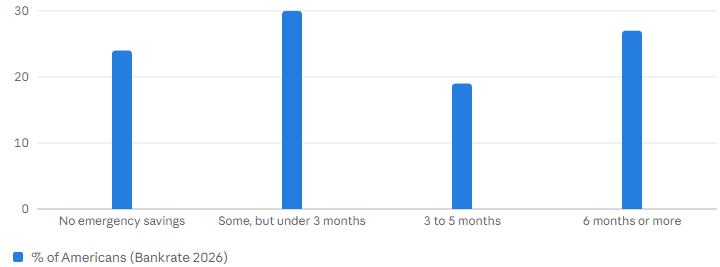
Bankrate 2026: 46% can cover 3 months of expenses; 27% can cover 6 months; 47% could cover a $1,000 emergency; 54% are saving less because of inflation; about 8 in 10 contributed nothing to emergency savings in 2025.
That last number matters most here: more than one in four unemployed workers has been out of work for over six months. Meanwhile, living costs are rising. Consumer prices were up 3.7% over the year in September, and real hourly earnings are down 0.7%, so a fixed cushion buys less than it did a year ago. None of this predicts a recession. It simply means the safety net in your own account matters.
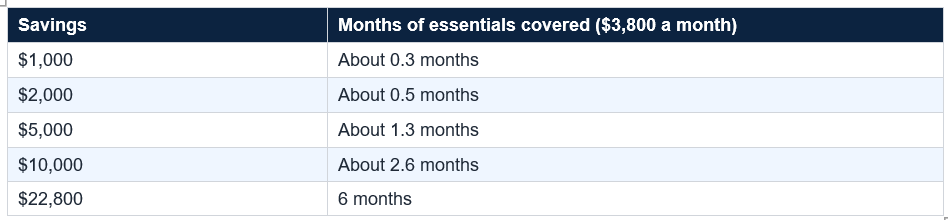
Here is a made-up example. A household has $1,800 in rent, $700 for groceries, $300 for utilities and phone, $400 for transportation, $600 for health insurance and medical costs, and $400 in minimum debt payments. That is $4,200 a month, but suppose a stripped-down survival budget trims it to $3,800. Six months of that is $22,800, and three months is $11,400. Your own figures will differ, but the method is the same, and writing the number down makes the target concrete.
Then there is access. NELP, citing Department of Labor data, reported that in 2024 only 27% of unemployed workers received UI benefits, ranging from about 9% in Kentucky to nearly 59% in Minnesota. Many are ineligible, for example because they quit, have short work histories or work as independent contractors. Do not count on benefits until you know you qualify, and file as soon as you lose your job.
Here is how it might look for a made-up worker earning $60,000 a year, about $1,154 a week. At a 40% replacement rate, benefits would be roughly $462 a week, or about $12,000 over 26 weeks. Against $22,800 of essential expenses over six months, that leaves a gap of about $10,800, assuming the worker qualifies, lives in a state paying a full 26 weeks and has no other income. Without benefits, the full $22,800 must come from savings or other sources.

Inflation adds another twist. With prices rising 3.7% a year, the same six-month budget costs more than it did last year. That is a reason to revisit your number every year and adjust it for your actual costs, not a reason to panic.
To see what each pace takes, divide the goal by the months. Building $22,800 in 36 months takes about $633 a month. In 24 months, about $950. In 18 months, about $1,267. In 12 months, about $1,900. These figures ignore interest, which helps a little. Automate the transfer on payday so the decision is made once. If your income allows, direct raises, tax refunds and windfalls to the fund, since Bankrate’s survey suggests that rising income is what makes saving possible.

Confirm that the account is FDIC- or NCUA-insured, and keep the fund in its own account so it does not blend into spending. Do not chase the very last fraction of a percent at the cost of access, since you may need the money quickly. Rates can change, so check every few months. And remember that this money is for emergencies, not for investing; longer-term goals belong elsewhere.
Then sequence your options. Use cash first, cut discretionary spending, claim benefits if eligible, add temporary income through gig or part-time work and consider selling things you do not need. Lower-cost borrowing comes before high-interest credit cards, and retirement accounts come last. Do not wait to ask for help. Most problems are smaller when addressed early.
But the number you need is calculable, and the path to it is mostly arithmetic and automation. Know your essentials, set milestones of $1,000, one month, three months and six, move the money automatically into an insured account that pays something real, and review once a year. You do not have to get there overnight. You only have to be further along next month than you are today. This is general education, not personalized advice, and a financial professional can help tailor it to your situation.
The common guideline is three to six months of essential expenses. Many planners suggest more, up to nine or twelve months, for people with variable income, such as freelancers, single-income households or workers in volatile industries. Bankrate found that only 46% of Americans could cover three months and 27% could cover six.
How long does unemployment usually last?
The BLS reported in September 2026 that the average duration of unemployment was about 24.8 weeks, close to six months, and that 27.1% of unemployed people, about 1.9 million, had been jobless for 27 weeks or more. Individual experiences vary widely by industry, location and skills.
Will unemployment insurance cover my bills?
Probably not fully. Benefits generally replace roughly 40% of prior wages, are capped by state formulas and typically last up to 26 weeks, though 13 states offer fewer. In 2024, only 27% of unemployed workers received benefits. Treat them as a partial cushion, and file as soon as you lose your job.
Where should I keep my emergency fund?
In an insured, easily accessible account kept separate from everyday spending. In mid-October 2026, top savings accounts paid about 4.34% to 4.50% and a 52-week Treasury bill about 4.46%, versus 0.38% for the average savings account. Rates change, so check before you move money.
What if I cannot save six months of expenses?
Start smaller. A first goal of $1,000, then one month of essentials, then three months is realistic and still protects you. Any cushion reduces the need for high-interest debt. If you do lose income, contact lenders and utilities early and file for benefits right away.
Table of Contents
- 1. The Monday Morning Question
- 2. The Short Answer
- 3. What the Surveys Say About Our Cushions
- 4. Why the Question Matters Right Now
- 5. Find Your Six-Month Number
- 6. What Unemployment Benefits Really Cover
- 7. How Long Your Savings Would Last
- 8. The Hidden Costs of Losing a Paycheck
- 9. How to Build the Cushion, Step by Step
- 10. Where to Keep the Money
- 11. If You Are Short: A Survival Plan
- 12. Conclusion
- 13. Frequently Asked Questions
How many months of expenses could Americans cover from savings? (%)
% of adults by Source: Bankrate 2026 Annual Emergency Savings Report
How long savings last at $3,800 a month of essentials (months)
Months covered by Savings balance (illustrative household)
The Monday Morning Question
Picture it. It is Monday morning, and a meeting invite lands on your calendar with no agenda. By noon you have a box of your things and a letter about severance. The shock fades quickly and the arithmetic takes over: rent is due in two weeks, the car payment comes out on the first and the insurance auto-pays on the fifth. The question stops being theoretical. How long could you keep going?It is an uncomfortable question, which is exactly why it is worth asking while nothing is wrong. And in October 2026, the data gives it a sharper edge: the average spell of unemployment in the United States lasts about 24.8 weeks, close to six months. The real question is not whether you could survive a bad week, but a typical jobless spell.
The Short Answer
For most people, probably not without help. Bankrate’s 2026 survey found that only 46% of Americans could cover three months of expenses from savings, and just 27% could cover six months. Unemployment insurance helps, but it replaces only about 40% of wages for a limited time, and most unemployed workers do not receive it. The good news is that the number you need is calculable, and a few steady steps can close the gap.What the Surveys Say About Our Cushions
Bankrate has polled Americans on emergency savings since 2011, and its 2026 report is sobering. Only 47% of Americans have enough liquidity to cover a $1,000 emergency expense. About 46% could cover three months of expenses: 19% could cover three to five months, and 27% could cover six or more. Another 30% have some savings but less than three months, and nearly a quarter have none. At the same time, 29% have more credit card debt than emergency savings, versus 44% who have more savings than card debt.The trend lines are not encouraging. Fifty-four percent of Americans said they are saving less for emergencies because of inflation. Bankrate’s survey found that 8 in 10 people did not contribute anything to emergency savings in 2025, and that those who saved more usually saw their income rise. As Bankrate’s analyst put it, households trying to build savings in 2026 will likely succeed by raising income rather than hunting for more expenses to cut.
Bankrate 2026: 46% can cover 3 months of expenses; 27% can cover 6 months; 47% could cover a $1,000 emergency; 54% are saving less because of inflation; about 8 in 10 contributed nothing to emergency savings in 2025.
Why the Question Matters Right Now
The job market has cooled. The Bureau of Labor Statistics reported that employers added just 29,000 jobs in September, below the roughly 90,000 economists expected, and that the unemployment rate rose to 4.2%, with 7.1 million people unemployed. July’s figure was revised to a loss of 10,000 jobs, and the three-month average is about 51,000 jobs a month. Long-term unemployment, meaning jobless for 27 weeks or more, stood at about 1.9 million people, or 27.1% of all unemployed.That last number matters most here: more than one in four unemployed workers has been out of work for over six months. Meanwhile, living costs are rising. Consumer prices were up 3.7% over the year in September, and real hourly earnings are down 0.7%, so a fixed cushion buys less than it did a year ago. None of this predicts a recession. It simply means the safety net in your own account matters.
Find Your Six-Month Number
Skip the vague advice and calculate. List your essential monthly expenses, the ones you could not skip: housing, utilities, groceries, transportation, insurance, minimum debt payments and any childcare or medical costs. Leave out dining out, subscriptions, travel and shopping, since you would cut those first. Multiply the total by three, then by six. That is your range.Here is a made-up example. A household has $1,800 in rent, $700 for groceries, $300 for utilities and phone, $400 for transportation, $600 for health insurance and medical costs, and $400 in minimum debt payments. That is $4,200 a month, but suppose a stripped-down survival budget trims it to $3,800. Six months of that is $22,800, and three months is $11,400. Your own figures will differ, but the method is the same, and writing the number down makes the target concrete.
What Unemployment Benefits Really Cover
Unemployment insurance is real help, but smaller than most people assume. Studies put the average replacement rate around 40% of prior wages. Brookings’ Gary Burtless found an average of about 41%, and the Niskanen Center describes it as roughly 40% and not enough to remain secure between jobs. Benefits are capped by state formulas, and most states pay up to 26 weeks, though the National Employment Law Project notes that 13 states provide fewer than 26 weeks.Then there is access. NELP, citing Department of Labor data, reported that in 2024 only 27% of unemployed workers received UI benefits, ranging from about 9% in Kentucky to nearly 59% in Minnesota. Many are ineligible, for example because they quit, have short work histories or work as independent contractors. Do not count on benefits until you know you qualify, and file as soon as you lose your job.
Here is how it might look for a made-up worker earning $60,000 a year, about $1,154 a week. At a 40% replacement rate, benefits would be roughly $462 a week, or about $12,000 over 26 weeks. Against $22,800 of essential expenses over six months, that leaves a gap of about $10,800, assuming the worker qualifies, lives in a state paying a full 26 weeks and has no other income. Without benefits, the full $22,800 must come from savings or other sources.
How Long Your Savings Would Last
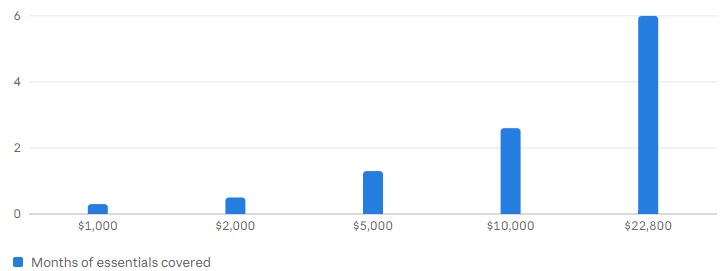
The runway formula is simple: savings divided by monthly essentials. With $3,800 a month of essentials, $2,000 in the bank lasts about half a month. Ten thousand dollars lasts about 2.6 months. It takes the full $22,800 to last six. Notice that the average jobless spell of 24.8 weeks is about 5.7 months, so the six-month target is not arbitrary. It is roughly what the typical spell requires.
The Hidden Costs of Losing a Paycheck
The monthly essentials number understates the true cost, because a layoff creates new expenses. Health insurance often changes: continuing employer coverage through COBRA generally means paying the full premium plus a small administrative fee, and losing coverage can open a special enrollment period for marketplace plans. Job searching costs money for travel, certifications and sometimes relocation. Credit card balances, if you use them to bridge the gap, carry high interest. And withdrawing from retirement accounts before 59½ usually brings taxes and a penalty, which is why those accounts are a last resort.Inflation adds another twist. With prices rising 3.7% a year, the same six-month budget costs more than it did last year. That is a reason to revisit your number every year and adjust it for your actual costs, not a reason to panic.
How to Build the Cushion, Step by Step
Think in milestones rather than one daunting target. First, aim for a starter fund of $1,000, which covers many minor emergencies and keeps you off credit cards. Second, build one month of essentials, about $3,800 in the example. Third, reach three months, about $11,400, the level that 46% of Americans have. Fourth, move toward six months. Each milestone is a real improvement in your safety.To see what each pace takes, divide the goal by the months. Building $22,800 in 36 months takes about $633 a month. In 24 months, about $950. In 18 months, about $1,267. In 12 months, about $1,900. These figures ignore interest, which helps a little. Automate the transfer on payday so the decision is made once. If your income allows, direct raises, tax refunds and windfalls to the fund, since Bankrate’s survey suggests that rising income is what makes saving possible.
Where to Keep the Money
An emergency fund should be safe, accessible and separate from your daily spending. In MyMoneyBlog’s October 12 survey, the best savings accounts paid 4.34% to 4.50% and a 52-week Treasury bill about 4.46%, compared with 0.38% for the average savings account, according to Experian’s FDIC-based figures. On $22,800 at 4.34%, the interest would be roughly $990 a year, which offsets part of the inflation drag.Confirm that the account is FDIC- or NCUA-insured, and keep the fund in its own account so it does not blend into spending. Do not chase the very last fraction of a percent at the cost of access, since you may need the money quickly. Rates can change, so check every few months. And remember that this money is for emergencies, not for investing; longer-term goals belong elsewhere.
If You Are Short: A Survival Plan
If you are reading this with a thin cushion, do not despair. Start with what you can control. Build a stripped-down survival budget and know the number. If you lose income, file for unemployment benefits immediately, since delays can cost weeks of payments. Call your landlord or lender, your utilities and your credit card issuers early, as many offer hardship programs for people who ask before they miss a payment.Then sequence your options. Use cash first, cut discretionary spending, claim benefits if eligible, add temporary income through gig or part-time work and consider selling things you do not need. Lower-cost borrowing comes before high-interest credit cards, and retirement accounts come last. Do not wait to ask for help. Most problems are smaller when addressed early.
Conclusion
Could you survive six months without a paycheck? The honest answer for most Americans is not comfortably. Only 46% could cover three months and 27% six. Unemployment benefits cover about 40% of wages for a limited period, and only 27% of unemployed workers received them in 2024. Meanwhile the average jobless spell lasts about 24.8 weeks, and 27.1% of the unemployed have been out of work for more than six months.But the number you need is calculable, and the path to it is mostly arithmetic and automation. Know your essentials, set milestones of $1,000, one month, three months and six, move the money automatically into an insured account that pays something real, and review once a year. You do not have to get there overnight. You only have to be further along next month than you are today. This is general education, not personalized advice, and a financial professional can help tailor it to your situation.
Frequently Asked Questions
How many months of expenses should I save?The common guideline is three to six months of essential expenses. Many planners suggest more, up to nine or twelve months, for people with variable income, such as freelancers, single-income households or workers in volatile industries. Bankrate found that only 46% of Americans could cover three months and 27% could cover six.
How long does unemployment usually last?
The BLS reported in September 2026 that the average duration of unemployment was about 24.8 weeks, close to six months, and that 27.1% of unemployed people, about 1.9 million, had been jobless for 27 weeks or more. Individual experiences vary widely by industry, location and skills.
Will unemployment insurance cover my bills?
Probably not fully. Benefits generally replace roughly 40% of prior wages, are capped by state formulas and typically last up to 26 weeks, though 13 states offer fewer. In 2024, only 27% of unemployed workers received benefits. Treat them as a partial cushion, and file as soon as you lose your job.
Where should I keep my emergency fund?
In an insured, easily accessible account kept separate from everyday spending. In mid-October 2026, top savings accounts paid about 4.34% to 4.50% and a 52-week Treasury bill about 4.46%, versus 0.38% for the average savings account. Rates change, so check before you move money.
What if I cannot save six months of expenses?
Start smaller. A first goal of $1,000, then one month of essentials, then three months is realistic and still protects you. Any cushion reduces the need for high-interest debt. If you do lose income, contact lenders and utilities early and file for benefits right away.
0 Comments
Be the first to share your thoughts on this article.