

Making Money
Florida Minimum Wage 2026: $14/$15 Complete Guide


Table of Contents
- Current Rate, Upcoming Change, and the Full Schedule
- How Tipped Employee Wages Work in Florida
- Who Is Covered — and the Key Exemptions
- Florida vs Federal and Other States: The Context
- What Happens After $15: The Inflation-Adjustment Era
- Employer Compliance: Requirements and Penalties
- Workers' Rights: What To Do If You Are Being Paid Less Than Minimum Wage
- Conclusion
- Frequently Asked Questions (FAQ)
- External References & Further Reading
Florida's minimum wage is $14.00 per hour through September 29, 2026 — and it rises to $15.00 per hour on September 30, 2026, completing a five-year journey that voters began when they approved Amendment 2 to the Florida Constitution in November 2020. That amendment, passed with 60.8% of the vote, set out a clear schedule of $1.00 annual increases starting in 2021, bringing the state from $8.65 per hour up to the $15.00 milestone now just weeks away.
For workers, this means understanding exactly which rate applies to the hours you have already worked and the hours you will work after September 30. For employers, it means updating payroll systems, displaying the correct wage poster, and ensuring that tipped employees — who operate under a separate, lower direct-cash-wage structure — are being paid correctly given both the current rate and the upcoming change. For everyone asking the simple question 'what is the minimum wage in Florida right now' — the answer depends on whether you are checking before or after that late-September date.
This guide walks through every dimension of Florida's minimum wage in 2026: the full historical schedule, how tipped employee wages work, who is covered and who is not, how Florida compares to the federal minimum and to other states, what happens after $15 is reached, the penalties for non-compliance, and how workers can enforce their rights if they believe they are being paid incorrectly.
Current Rate, Upcoming Change, and the Full Schedule
The table below shows the complete Florida minimum wage schedule from 2021 through the post-$15 inflation-adjustment era, including both the standard rate and the tipped employee cash wage for each period: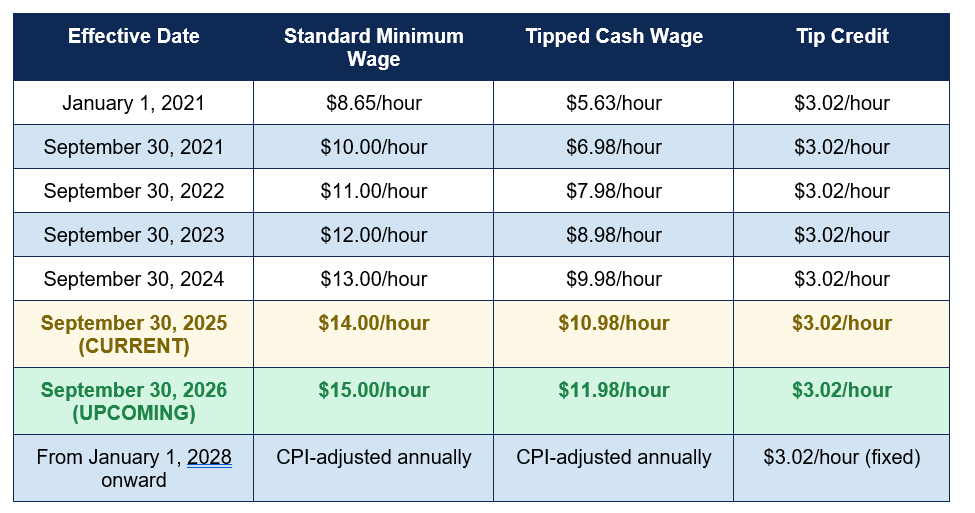
The September 30, 2026 increase in context: $14.00 → $15.00 — the final mandated $1.00 increase under Amendment 2, bringing Florida's minimum wage to $7.75 above the federal rate of $7.25 — a gap that has been widening steadily since 2021 (Florida Department of Commerce, 2026)
Important detail for employers and workers: the September 30 effective date is the start of Florida's state fiscal year, and all new rates must be in place for any hours worked from that date onward. There is no grace period, and the requirement to display the updated minimum wage poster takes effect simultaneously. The poster must be displayed in a conspicuous location accessible to all employees, in English, Spanish, and Creole, and the Florida Department of Commerce publishes updated versions each December for the following year's rate.
How Tipped Employee Wages Work in Florida
Tipped employees in Florida — servers, bartenders, bellhops, valets, hairstylists, and others who regularly receive more than $30 per month in tips — operate under a separate wage structure that often generates confusion both for workers who do not understand their rights and for employers who misapply the rules.The structure works as follows: Florida law allows employers to take a 'tip credit' of $3.02 per hour, a fixed amount that has not changed since 2003 when it was set based on the then-applicable federal FLSA tip credit. This means the direct cash wage an employer must pay a tipped employee is calculated by subtracting $3.02 from the current standard minimum wage. Through September 29, 2026, that works out to $14.00 minus $3.02, giving a minimum direct cash wage of $10.98 per hour. From September 30, 2026, the calculation becomes $15.00 minus $3.02, giving a minimum direct cash wage of $11.98 per hour.
The critical rule that protects workers: the combined total of the direct cash wage and actual tips received must equal or exceed the full state minimum wage for every hour worked. If a tipped employee's tips are low enough during any pay period that the combined total falls below $14.00 per hour (or $15.00 from September 30), the employer is legally required to make up the difference. Employers cannot pocket the tip credit and pay only $10.98 if tips were insufficient to bring the worker to the full minimum — this is one of the most common minimum wage violations in the restaurant and hospitality industry.
Who Is Covered — and the Key Exemptions
Florida's minimum wage law, established under Article X, Section 24 of the Florida Constitution and Florida Statute Section 448.110, covers the vast majority of employees working in the state. Florida's rate applies whenever it exceeds the federal rate — which it currently does by a significant margin — meaning almost all non-exempt Florida workers are entitled to the state rate, not the lower federal $7.25.The key exemptions worth knowing are:
- Youth wage (under 20 years old): Under the federal Fair Labor Standards Act (FLSA), employers may pay a training wage of $4.25 per hour to employees under 20 years old for the first 90 consecutive calendar days of their employment. After 90 days, or when the employee turns 20, whichever comes first, the full state minimum wage applies.
- Student learners: Workers enrolled in certain vocational education programs may be paid a special minimum wage of $4.25 per hour under specific certification conditions supervised by the US Department of Labor.
- Small businesses (under $110,000 annual gross): Businesses that make less than $110,000 annually and are not engaged in interstate commerce may be eligible to pay a lower rate of $4.00 per hour under a narrow federal exemption. Most Florida businesses do not qualify, as the interstate commerce threshold is broad in practice.
- Agricultural workers: Agricultural and seasonal workers are covered by federal FLSA standards rather than the state minimum wage, currently $7.25 per hour at the federal level.
- Executive, administrative, and professional employees: Salaried employees who meet both the salary threshold and duties tests under the FLSA may be classified as exempt from minimum wage and overtime requirements. The specific duties and salary criteria are set by federal regulation and have changed periodically.
An important Florida-specific rule: unlike many states, Florida law explicitly preempts local jurisdictions from enacting their own higher minimum wages. There is no Miami minimum wage, no Orlando minimum wage, no Jacksonville minimum wage that differs from the statewide rate. If you are searching for the minimum wage in any specific Florida city, the statewide Florida rate is the applicable figure.
Florida vs Federal and Other States: The Context
Understanding where Florida's minimum wage sits relative to the federal rate and to comparable states provides important context for both workers and businesses operating across multiple states: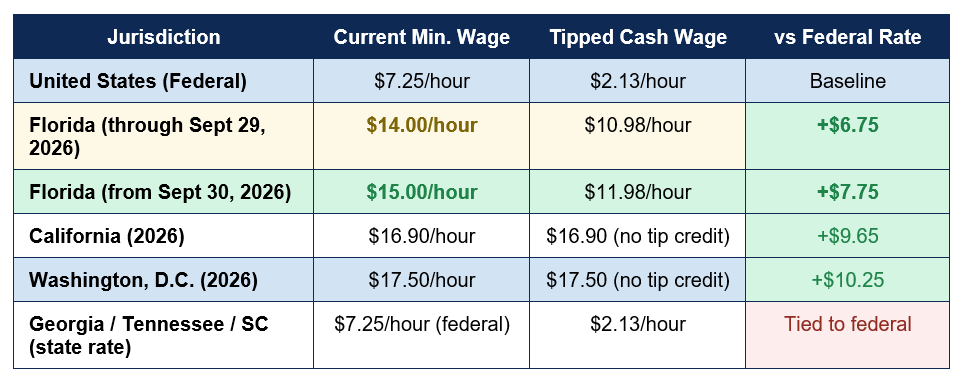
The gap between Florida's upcoming $15.00 rate and the federal minimum of $7.25 — unchanged since 2009 — is particularly striking at $7.75 per hour, representing a more than doubling of the federal floor. States that have not enacted their own minimum wage laws, or that have set their rate at or below the federal minimum (including Florida's immediate neighbours Georgia and South Carolina), still use the federal $7.25, meaning a worker performing the same job in Georgia can legally be paid less than half what the same worker earns in Florida.
Within the higher-wage state landscape, Florida's $15.00 rate will be competitive upon implementation but sits below both California ($16.90) and Washington, D.C. ($17.50). Notably, Florida retains the tip credit system — meaning tipped employees can legally be paid a direct cash wage below the standard minimum — while states like California have abolished the tip credit entirely, requiring all employees including tipped workers to be paid the full minimum wage before any tips they receive.
What Happens After $15: The Inflation-Adjustment Era
The September 30, 2026 increase to $15.00 per hour represents the last of the fixed, scheduled $1.00 increments mandated by Amendment 2. After this point, Florida's minimum wage enters a new phase in which it adjusts annually based on the Consumer Price Index, following a similar approach to the inflation-adjustment system Florida used from 2005 to 2020 before the Amendment 2 increases took over.The mechanics of this transition are specific: beginning January 1, 2028 (note the calendar year change from the previous September 30 effective dates), the Florida Department of Commerce will calculate any adjustment based on the CPI, publish the new rate by October 15 of the preceding year, and notify all employers registered in the reemployment assistance database by November 15. This means employers will have approximately six weeks of advance notice before each January 1 adjustment takes effect.
The practical effect of this shift to CPI-linking is that Florida's minimum wage will no longer lag inflation in the way it did in the decade between 2008 and 2021, when no increases were made at all. However, it also means that in periods of low inflation, the minimum wage may increase very little or not at all — the CPI-linked system delivers stability rather than guaranteed purchasing-power growth.
Employer Compliance: Requirements and Penalties
Florida employers have several specific legal obligations under the state minimum wage law, and the penalties for non-compliance are significant enough to warrant careful attention, particularly as the September 30, 2026 rate change approaches:- Display the updated minimum wage poster: Employers must display the official Florida minimum wage poster, produced by the Florida Department of Commerce, in a conspicuous location accessible to all employees. The poster must be updated to reflect the $15.00 rate no later than September 30, 2026. Posters are available in English, Spanish, and Creole.
- Update payroll systems before September 30: Any employee currently paid at or near the $14.00 minimum whose rate has not been updated to $15.00 by September 30 may constitute a wage violation for every hour worked on or after that date at the lower rate.
- Recalculate tipped employee wages: Employers using the tip credit must update the direct cash wage floor from $10.98 to $11.98 per hour from September 30 and continue to ensure that the combined cash wage and tips total at least the new $15.00 minimum for every pay period.
Florida does not have a dedicated state wage enforcement agency; the federal Department of Labor's Wage and Hour Division (WHD) handles enforcement, and workers can file a complaint directly with the WHD at no cost.
Workers' Rights: What To Do If You Are Being Paid Less Than Minimum Wage
If you are a Florida worker and believe you are being paid less than the applicable minimum wage, the following steps represent the most effective path to resolution:- Document everything: Collect pay stubs, time records, and any written records of your hourly rate. Note the exact dates of work and the rate actually paid. If you are a tipped employee, maintain records of tips received each shift to be able to demonstrate whether the combined total met the minimum wage threshold.
- Compare your rate to the correct applicable rate: The minimum wage that should have applied depends on the specific dates worked — the rate before September 30, 2026 was $14.00; the rate on or after September 30, 2026 is $15.00. If your employer used the tip credit, verify that your combined wages and tips actually reached the full minimum for each pay period.
- Contact your employer directly first: Many minimum wage violations are the result of administrative error rather than deliberate non-payment, and raising the issue directly with your employer or HR department frequently resolves it promptly. Document this conversation.
- File a complaint with the Department of Labor: The federal DOL's Wage and Hour Division accepts complaints online at dol.gov or by phone. There is no fee, and retaliation against an employee for filing a minimum wage complaint is itself a legal violation.
- Consult an employment attorney: Many employment attorneys in Florida offer free initial consultations for wage claims. Because the law requires the employer to pay attorney fees in a successful case, there is often no out-of-pocket cost to the worker for legal representation in a minimum wage dispute.
Conclusion
Florida's minimum wage in 2026 is $14.00 per hour through September 29, rising to $15.00 on September 30 — completing the five-year journey set in motion by the constitutional amendment voters approved in November 2020. That milestone represents a 73% increase from the $8.65 rate in place at the start of 2021 and, from October 2026, places Florida's minimum wage at $7.75 above the federal rate, which has not changed since 2009.For workers, the approaching $15.00 milestone is significant both practically and symbolically: practically, because it means a full-time minimum wage worker in Florida will be earning roughly $31,200 annually from October 2026, compared to approximately $15,080 on the unchanged federal minimum; symbolically, because the achievement came not from legislative compromise but from a direct voter mandate with no city-specific exceptions or carve-outs. For tipped employees, understanding the combined wage structure — and specifically the employer's obligation to make up the difference when tips are insufficient — remains the most important single piece of workers' rights knowledge in Florida's wage landscape.
After September 2026, the next chapter of Florida's minimum wage will be written by inflation data rather than a constitutional schedule — which makes the CPI a number worth watching every autumn for anyone whose income is tied to the state minimum wage floor.
Frequently Asked Questions (FAQ)
What is the minimum wage in Florida right now?
As of July 1, 2026, Florida's minimum wage is $14.00 per hour for standard non-tipped employees. This rate has been in effect since September 30, 2025. It increases to $15.00 per hour on September 30, 2026. For tipped employees, the minimum direct cash wage is currently $10.98 per hour, increasing to $11.98 per hour on September 30, 2026.When does Florida's minimum wage go up to $15?
Florida's minimum wage increases to $15.00 per hour on September 30, 2026 — the start of the state's fiscal year and the effective date for all Amendment 2 increases. Hours worked through September 29, 2026 are covered at the $14.00 rate; hours worked on September 30 and after are covered at $15.00. After this increase, future adjustments will be tied to the Consumer Price Index and will take effect January 1 each year beginning in 2028.Does Florida have a different minimum wage for Miami, Orlando, or other cities?
No. Florida law explicitly preempts local municipalities and counties from setting their own minimum wage ordinances. There is no separate city minimum wage for Miami, Orlando, Jacksonville, Tampa, Pensacola, Sarasota, or any other Florida city. The statewide Florida minimum wage — currently $14.00, rising to $15.00 on September 30, 2026 — is the only applicable rate across the entire state.I am a tipped worker. Is my employer allowed to pay me less than $14 an hour?
Yes, but only within specific rules. Florida allows a tip credit of $3.02 per hour, meaning your employer can pay you a direct cash wage of $10.98 per hour (or $11.98 from September 30, 2026), provided that your tips bring your total compensation to at least the full minimum wage of $14.00 per hour (or $15.00 from September 30). If your tips in any pay period are not sufficient to reach that total, your employer is legally required to make up the difference. If your employer is taking the tip credit without your tips actually bringing you to the full minimum, that is a wage violation.How do I report a minimum wage violation in Florida?
Florida does not have its own dedicated state wage enforcement agency. Minimum wage complaints in Florida are handled by the federal Department of Labor's Wage and Hour Division (WHD). You can file a complaint online at dol.gov, by phone, or in person at a local WHD office. The process is free, and employers are legally prohibited from retaliating against workers who file a complaint. You can also pursue a private civil action through the courts, either alone or together with other affected workers. Many Florida employment attorneys offer free initial consultations for wage claims, and if your case is successful the employer is required to pay your attorney fees.
External References
The following authoritative sources were used in researching this article and are recommended for further reading:1. Florida Department of Commerce - Minimum Wage Poster and Official Notices
https://www.floridajobs.org/business-growth-and-partnerships/for-employers/display-and-tax-posters
2. RemoteLaws.com - Florida Minimum Wage Law 2026 (Compiled from Official Sources)
https://remotelaws.com/minimum-wage/florida/
3. Factorial HR - Florida Minimum Wage Guide 2026
https://factorialhr.com/blog/florida-minimum-wage/
4. Wenzel Fenton Cabassa P.A. - A Guide to Florida Minimum Wage in 2026
https://www.wenzelfenton.com/blog/2026/05/25/a-guide-to-florida-minimum-wage/
5. AllGeo - Complete Guide to Florida Minimum Wage 2026 (For Employers)
https://blog.allgeo.com/guide-to-minimum-wage-in-florida
6. US Department of Labor - Wage and Hour Division: File a Complaint
https://www.dol.gov/agencies/whd/contact/complaints
7. US Department of Labor - Fair Labor Standards Act (FLSA) Overview
https://www.dol.gov/agencies/whd/flsa
8. Florida Senate - Amendment 2 (2020): Raising Florida's Minimum Wage
https://www.flsenate.gov/Laws/Constitution#A10S24
0 Comments
Be the first to share your thoughts on this article.