

Real Estate
How Homeowners Can Access Home Equity Without Selling

Americans hold $17.6 trillion in accessible home equity — a record high. Most homeowners don’t want to sell or refinance at higher rates. Here are five ways to turn that equity into cash without touching your existing mortgage.
For millions of American homeowners, the years since 2020 have created an unusual financial situation: they are sitting on record levels of equity, holding mortgages at historically low rates, and watching the housing market remain expensive enough that selling and buying something else makes limited sense. Americans entered Q3 2025 with $17.6 trillion in total accessible home equity, according to ICE Mortgage Technology — a record high. But the same low rates that made homeownership affordable have also created a trap: a cash-out refinance in 2026 means replacing a 3-4% mortgage with a 6-7% rate on the entire loan balance. The payment shock is real. The good news is that a cash-out refinance is not the only way to access equity. There are five distinct methods — each with different mechanics, different costs, different risks, and different qualifying requirements — that allow homeowners to access what their property is worth without selling it and without necessarily touching the existing mortgage. This article covers all five, with the data behind each one, the advantages and disadvantages, and who each is best suited for.
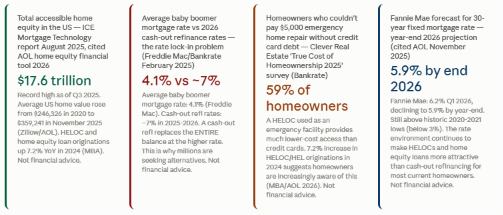
Americans: $17.6 trillion accessible home equity, record high (ICE Mortgage Technology August 2025). Average US home: $246,326 (2020) → $359,241 (November 2025, Zillow). HELOC/HEL originations +7.2% YoY 2024 (MBA). Average baby boomer mortgage rate: 4.1% (Freddie Mac/Bankrate) vs 2026 cash-out rates ~7%.
Quick equity calculation: (home value − mortgage balance) ÷ home value × 100 = equity %. Most lenders require 15-20% remaining equity after any loan. Accessible equity = 80-85% of home value − current mortgage balance. Check with a mortgage broker for an accurate current figur.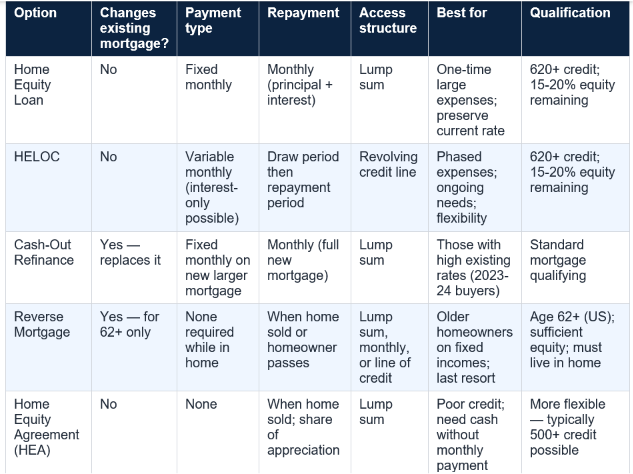
Fixed rate and fixed monthly payment — predictable cost. Does not change your existing first mortgage. Lump sum available immediately. Interest may be tax-deductible if used for home improvements (check with a tax adviser — not tax advice). Often lower rate than personal loans or credit cards.
Secured against your home — failure to repay risks foreclosure. Monthly payment added on top of existing mortgage. Requires sufficient equity and qualifying credit. Fixed amount — cannot draw more if needs change. Closing costs apply.
One-time large expenses: home renovation, debt consolidation, major medical costs, or education funding where you need a fixed sum at a known rate. Particularly valuable in 2026 for homeowners who want to preserve their existing low-rate first mortgage.
UK equivalent: a further advance from your existing lender (usually easiest) or a second charge mortgage from a specialist lender. Both add debt secured against your home without changing your first mortgage. Check with your existing mortgage lender first.
Revolving credit — only borrow what you need, when you need it. Only pay interest on what you draw. Does not change your existing first mortgage. Flexible for phased or variable expenses. Interest-only payment option during draw period can ease cash flow.
Variable rate in most cases — payment increases if rates rise. Draw period followed by repayment period creates a payment step-change. Secured against your home. Lender may reduce or freeze the line during market downturns. Requires qualifying equity and credit.
Phased or unpredictable expenses: home renovation in stages, multi-year education costs, emergency fund access. Valuable when you need a credit facility rather than a fixed lump sum. Best for homeowners who will not over-draw in the draw period.
UK equivalent: flexible further advance or offset mortgage with an overdraft feature. Some UK mortgage products offer a flexible drawdown facility. Less common than in the US. A second charge flexible mortgage may also provide similar access.
Single monthly payment (replaces, not adds to, the existing mortgage). Potentially lower rate if current rates are below your existing rate. Access to a large lump sum. Longer repayment period than a home equity loan in some cases.
Replaces your entire existing mortgage — you lose a low historic rate if you have one. Rate applies to the full balance, not just the cash-out portion. Closing costs are higher (percentage of full loan). Not advantageous for most 2020-2021 buyers in 2026.
Homeowners who locked in at a high rate (2023-2024 purchases) and could benefit from refinancing regardless, making the cash-out component essentially free in rate terms. Or those with very large equity needs and limited other options. Not recommended for most 2020-2021 buyers in 2026.
UK equivalent: remortgaging to a higher loan amount with the same or a new lender — the most common form of equity release in the UK. Works similarly to a US cash-out refinance. Check whether your current deal has early repayment charges before remortgaging.
No monthly repayments required while living in the home. Tax-free proceeds (US HECM — not income). Does not require selling. Can receive as lump sum, monthly payments, or line of credit. Available to those with limited income who could not qualify for conventional products.
Interest accrues and compounds — loan balance grows over time. Loan ends if homeowner moves out for 12+ months (limits care home flexibility). Reduces estate value for heirs. Risk of foreclosure if property taxes/insurance not maintained. Last-resort tool per Bankrate (Krieger). UK lifetime mortgages carry similar risks.
Homeowners 62+ (US) or 55+ (UK equity release) with significant equity who need to supplement retirement income and have no other viable access route. Last resort only per specialist advice. Not suitable as a primary planning tool. Always seek specialist independent advice. Not financial or mortgage advice.
UK equivalent: equity release via a lifetime mortgage (most common) or home reversion plan. Regulated by the FCA. Equity Release Council standards provide consumer protections including a no-negative-equity guarantee. Always seek specialist, FCA-regulated advice before proceeding.
No monthly debt payments. No interest rate risk. Qualification criteria typically more flexible than loans. Preserves cash flow. No impact on existing mortgage. Option for lower credit score homeowners.
You share future appreciation — if the home value rises significantly, the cost is high. Less transparent than traditional lending. Fewer consumer protections than regulated mortgage products. Can complicate future sale or refinancing. Relatively new and less understood product.
Homeowners who cannot qualify for conventional equity products, who need cash without monthly payment obligations, or who want to access equity without adding any debt. Important to read terms carefully — the future cost depends on home value appreciation. Seek independent advice.
UK equivalent: home reversion plans (a form of equity release where the homeowner sells a share of the property to a provider). Also some newer shared ownership schemes. Regulated by FCA. Less common than lifetime mortgages.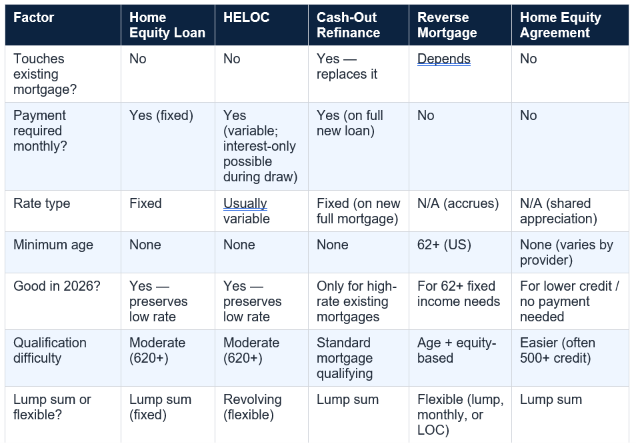
A home equity loan provides a fixed lump sum at a fixed interest rate with fixed monthly repayments — similar to a personal loan but secured against your home. A HELOC (Home Equity Line of Credit) is a revolving credit facility, like a credit card backed by your home's equity, where you draw as needed during a draw period (typically 10 years) and repay over a longer repayment period. The key difference is the access structure and rate type: a home equity loan gives you a fixed amount at a fixed rate; a HELOC gives you flexible access up to a limit at a usually variable rate. Neither changes your existing first mortgage, making both particularly valuable in 2026 when cash-out refinancing would mean replacing a low-rate existing mortgage with a higher one. The UCBI March 2026 guide recommends: 'If you prefer/need flexibility, choose a HELOC. If you want a fixed lump sum, choose the home equity loan.
Is a cash-out refinance a good idea in 2026?
For most homeowners who bought between 2019 and 2022, a cash-out refinance is not the optimal choice in 2026. The reason is straightforward: Bankrate's February 2025 analysis reports that the average baby boomer has a mortgage rate of 4.1% (Freddie Mac data), while cash-out refinance rates in 2025-2026 are closer to 7%. Fannie Mae projected the 30-year fixed rate at 6.2% for Q1 2026 declining to 5.9% by year-end. A cash-out refinance replaces your entire existing mortgage balance at the higher rate — not just the cash-out portion. X2 Mortgage's 2026 guide identifies this as the primary reason millions of homeowners are skipping the cash-out refinance. The exception: homeowners who bought at higher rates in 2022-2024 (when rates peaked above 7%) who could refinance to a lower current rate and access cash simultaneously. For them, combining refinancing with cash-out may be cost-effective. Sources: Bankrate February 2025; X2 Mortgage 2026; AOL 2026.
Who qualifies for a reverse mortgage?
In the US, the most common reverse mortgage is the Home Equity Conversion Mortgage (HECM), insured by the FHA. Eligibility requirements: age 62 or older (some proprietary reverse mortgages allow 55+); the home must be the primary residence; the homeowner must maintain the property and pay property taxes and insurance; and the homeowner must complete a HUD-approved housing counselling session. The loan ends when the home is sold, the homeowner passes away, or the homeowner moves out for 12 or more consecutive months. Bankrate's Rose Krieger notes that reverse mortgages should be considered a last resort, and the Finance of America 2026 education resource recommends them specifically for older homeowners who want equity access without monthly payment obligations. In the UK, the equivalent is an equity release product (lifetime mortgage or home reversion), regulated by the FCA, available from age 55. Always seek specialist independent advice before proceeding.
What is a home equity agreement and how does it work?
A Home Equity Agreement (HEA), also called a home equity sharing agreement or home equity investment, is a relatively new product in which an investor provides the homeowner with a lump sum of cash in exchange for a percentage share of the home's future appreciation. There are no monthly payments and no interest rate. The agreement is settled when the home is sold or at a defined future date, at which point the investor receives their agreed share of the property's value. Unlock.com's guide identifies HEAs as having more accommodating qualification requirements than home equity loans or cash-out refinances, making them accessible to homeowners with lower credit scores. The primary cost is the future appreciation shared — if the property rises significantly in value, the total cost to the homeowner can exceed what a conventional loan would have cost. Finance of America's 2026 education resource lists HEAs among the options for accessing equity without selling.
Can I access home equity if I have a low credit score?
Yes — some options remain available with lower credit scores, though the product range narrows. A home equity agreement (HEA) typically has the most flexible qualification criteria — some providers will work with credit scores of 500+ where a conventional home equity loan or HELOC would typically require 620+. A reverse mortgage is age and equity-based rather than credit-dependent, making it accessible for older homeowners regardless of credit score (subject to basic financial assessment). A home equity loan or HELOC will generally require a credit score of at least 620, though higher is preferable for better rates. A cash-out refinance requires standard mortgage qualifying, which is credit-sensitive. Bankrate's financial emergency guide notes that options narrow with lower credit but do not disappear entirely. X2 Mortgage's 2026 guide confirms that a home equity loan, HELOC, and HEA can all provide equity access while keeping the existing mortgage intact. This is not financial or mortgage advice. Consult a qualified mortgage broker for your specific situation.
For millions of American homeowners, the years since 2020 have created an unusual financial situation: they are sitting on record levels of equity, holding mortgages at historically low rates, and watching the housing market remain expensive enough that selling and buying something else makes limited sense. Americans entered Q3 2025 with $17.6 trillion in total accessible home equity, according to ICE Mortgage Technology — a record high. But the same low rates that made homeownership affordable have also created a trap: a cash-out refinance in 2026 means replacing a 3-4% mortgage with a 6-7% rate on the entire loan balance. The payment shock is real. The good news is that a cash-out refinance is not the only way to access equity. There are five distinct methods — each with different mechanics, different costs, different risks, and different qualifying requirements — that allow homeowners to access what their property is worth without selling it and without necessarily touching the existing mortgage. This article covers all five, with the data behind each one, the advantages and disadvantages, and who each is best suited for.
Table of Contents
- Why So Many Homeowners Are Looking for Alternatives in 2026
- Your Home Equity: How Much Do You Have?
- The Five Options at a Glance
- Home Equity Loan (HEL)
- HELOC (Home Equity Line of Credit)
- Cash-Out Refinance
- Reverse Mortgage (HECM)
- Home Equity Agreement (HEA) / Shared Equity
- Side-by-Side Comparison Table
- Choosing the Right Option for Your Situation
- Conclusion: $17.6 Trillion Is Sitting There — Here’s How to Access It Wisely
- Frequently Asked Questions
Why So Many Homeowners Are Looking for Alternatives in 2026
Two forces collided in the American housing market between 2020 and 2024, and the collision created the situation most homeowners now find themselves in. The first was historically low mortgage rates — averaging well below 3% during 2020-2021 — that locked millions of homeowners into the cheapest long-term debt many of them will ever carry. The second was rapid home value appreciation that turned those locked-in properties into significant equity assets. The result: homeowners are sitting on record equity but are financially disincentivised to touch their existing mortgages. ICE Mortgage Technology reported that Americans entered Q3 2025 with $17.6 trillion in accessible home equity, a record high (cited in AOL’s home equity 2026 guide). The average US home value rose from $246,326 in early 2020 to $359,241 in November 2025 (Zillow, cited AOL). But the average baby boomer mortgage rate is 4.1% (Freddie Mac data cited by Bankrate) while cash-out refinance rates sit closer to 7% (Bankrate February 2025). Replacing a 4.1% mortgage with a 7% one on a $300,000 balance would add hundreds of dollars to the monthly payment — what Bankrate describes as ‘payment shock.’ X2 Mortgage’s 2026 guide is direct: this is why millions of homeowners are skipping the cash-out refinance and seeking other options.Americans: $17.6 trillion accessible home equity, record high (ICE Mortgage Technology August 2025). Average US home: $246,326 (2020) → $359,241 (November 2025, Zillow). HELOC/HEL originations +7.2% YoY 2024 (MBA). Average baby boomer mortgage rate: 4.1% (Freddie Mac/Bankrate) vs 2026 cash-out rates ~7%.
Your Home Equity: How Much Do You Have?
Home equity is simple to calculate: current market value of your home minus the outstanding mortgage balance. If your home is worth $400,000 and you owe $250,000 on the mortgage, you have $150,000 in equity. The percentage is calculated as: (home value − mortgage balance) ÷ home value × 100. On $400,000 with $250,000 owed, that is ($150,000 ÷ $400,000) × 100 = 37.5% equity. Most lenders will not allow you to access your full equity: typically, they require you to maintain at least 15-20% equity in the property after any loan, meaning the accessible equity is the amount above that threshold. On the same example: the accessible equity at a 20% retained threshold is $400,000 × 80% − $250,000 = $320,000 − $250,000 = $70,000. Your accessible equity is what determines which options are available and for how much.Quick equity calculation: (home value − mortgage balance) ÷ home value × 100 = equity %. Most lenders require 15-20% remaining equity after any loan. Accessible equity = 80-85% of home value − current mortgage balance. Check with a mortgage broker for an accurate current figur.
The Five Options at a Glance
Home Equity Loan (HEL)
A home equity loan is the most straightforward of the equity access options: you borrow a fixed lump sum against the equity you have built in your home, at a fixed interest rate, with fixed monthly repayments over a set term. Critically, it does not touch your existing first mortgage. Your current rate stays exactly as it is. The home equity loan sits alongside your existing mortgage as a second mortgage — a separate, parallel debt with its own rate and term. This is the key feature that makes home equity loans particularly attractive in 2026, when the average cash-out refinance rate is around 7% (Bankrate February 2025) while millions of homeowners are sitting on existing mortgages at 3-4%. A home equity loan lets you access the equity in your property without replacing a 3% mortgage with a 7% one. The AOL home equity article (2026) identifies the home equity loan as one of the primary traditional methods through which homeowners have historically accessed equity, alongside HELOCs and cash-out refinancing. The Mortgage Bankers Association reported that HELOC and home equity loan originations increased 7.2% year over year in 2024 — a clear signal that more homeowners are moving toward these products as the rate lock-in effect makes cash-out refinancing less attractive. Typical requirements include maintaining at least 15-20% equity in the property after the loan, a good credit score (generally 620+), and a debt-to-income ratio within the lender’s guidelines.Fixed rate and fixed monthly payment — predictable cost. Does not change your existing first mortgage. Lump sum available immediately. Interest may be tax-deductible if used for home improvements (check with a tax adviser — not tax advice). Often lower rate than personal loans or credit cards.
Secured against your home — failure to repay risks foreclosure. Monthly payment added on top of existing mortgage. Requires sufficient equity and qualifying credit. Fixed amount — cannot draw more if needs change. Closing costs apply.
One-time large expenses: home renovation, debt consolidation, major medical costs, or education funding where you need a fixed sum at a known rate. Particularly valuable in 2026 for homeowners who want to preserve their existing low-rate first mortgage.
UK equivalent: a further advance from your existing lender (usually easiest) or a second charge mortgage from a specialist lender. Both add debt secured against your home without changing your first mortgage. Check with your existing mortgage lender first.
HELOC (Home Equity Line of Credit)
A HELOC functions like a credit card that is secured against the equity in your home. Instead of receiving a lump sum, you are approved for a credit limit and can draw from it as needed during the draw period — typically ten years. During the draw period, you may make interest-only payments. Once the draw period ends, the repayment period begins (typically twenty years), during which you repay both principal and interest. Like a home equity loan, a HELOC does not replace your existing first mortgage. Your current rate and balance remain unchanged. The X2 Mortgage 2026 guide specifically positions this as the key advantage in the current rate environment: HELOCs, home equity loans, and home equity agreements ‘allow you to pull cash from your home while keeping your existing mortgage completely unchanged.’ The UCBI bank’s March 2026 learning centre describes the HELOC as ‘a great option for goals like renovating your home, funding higher education, or covering unexpected expenses.’ Its revolving nature makes it particularly well-suited to expenses that arrive in phases or are unpredictable in timing and amount — a renovation that takes 18 months and involves multiple contractors, or education costs spread over four academic years. The key risk of a HELOC compared to a home equity loan is that most HELOCs carry a variable interest rate. The rate moves with market rates, which means your payment can increase when rates rise.Revolving credit — only borrow what you need, when you need it. Only pay interest on what you draw. Does not change your existing first mortgage. Flexible for phased or variable expenses. Interest-only payment option during draw period can ease cash flow.
Variable rate in most cases — payment increases if rates rise. Draw period followed by repayment period creates a payment step-change. Secured against your home. Lender may reduce or freeze the line during market downturns. Requires qualifying equity and credit.
Phased or unpredictable expenses: home renovation in stages, multi-year education costs, emergency fund access. Valuable when you need a credit facility rather than a fixed lump sum. Best for homeowners who will not over-draw in the draw period.
UK equivalent: flexible further advance or offset mortgage with an overdraft feature. Some UK mortgage products offer a flexible drawdown facility. Less common than in the US. A second charge flexible mortgage may also provide similar access.
Cash-Out Refinance
A cash-out refinance replaces your entire existing mortgage with a new, larger loan. You receive the difference between the new loan amount and your existing mortgage balance as cash. The UCBI learning centre gives a clear example (March 2026): original mortgage owed $180,000; new mortgage $200,000; cash out $20,000 (minus closing expenses). A cash-out refinance is the only option on this list that completely replaces your current mortgage — which is the source of both its potential advantage and its primary drawback in 2026. The advantage: if current rates are lower than your existing rate, a cash-out refinance can simultaneously lower your monthly payment and release equity. The drawback: in 2026, with Fannie Mae projecting the 30-year fixed rate at 6.2% in Q1 and declining to 5.9% by year-end (AOL November 2025), and with Bankrate reporting that the average baby boomer has a mortgage rate of 4.1% (Freddie Mac data), a cash-out refinance would require replacing a 4.1% rate with a 6-7% rate on the ENTIRE mortgage balance. X2 Mortgage’s 2026 guide is direct: this is why millions of homeowners are skipping the cash-out refinance and seeking alternatives. The Bankrate February 2025 analysis concurs: ‘So, unless you bought a home very recently — at a high rate — a cash-out refinance likely is not the best option to tap your equity.’ The exception is homeowners who purchased at high rates in 2023-2024 and would benefit from refinancing regardless — for them, adding cash-out is a cost-effective way to combine rate improvement with equity access.Single monthly payment (replaces, not adds to, the existing mortgage). Potentially lower rate if current rates are below your existing rate. Access to a large lump sum. Longer repayment period than a home equity loan in some cases.
Replaces your entire existing mortgage — you lose a low historic rate if you have one. Rate applies to the full balance, not just the cash-out portion. Closing costs are higher (percentage of full loan). Not advantageous for most 2020-2021 buyers in 2026.
Homeowners who locked in at a high rate (2023-2024 purchases) and could benefit from refinancing regardless, making the cash-out component essentially free in rate terms. Or those with very large equity needs and limited other options. Not recommended for most 2020-2021 buyers in 2026.
UK equivalent: remortgaging to a higher loan amount with the same or a new lender — the most common form of equity release in the UK. Works similarly to a US cash-out refinance. Check whether your current deal has early repayment charges before remortgaging.
Reverse Mortgage (HECM)
A reverse mortgage is specifically designed for homeowners aged 62 or older (some products allow 55+) who want to access their home equity without making monthly mortgage repayments. Instead of paying the lender, the lender pays you — as a lump sum, as monthly payments, or as a line of credit — and the loan is repaid when the home is sold, when the homeowner passes away, or if the homeowner moves out for a year or more. Bankrate’s February 2025 analysis quotes Rose Krieger, senior home loan specialist at Churchill Mortgage: ‘What I like about the reverse mortgage is it’s not taking away from the fixed income of our clients.’ The absence of monthly repayments is the defining feature for retirees on fixed incomes where any additional monthly obligation would be genuinely unworkable. The most common reverse mortgage in the US is the Home Equity Conversion Mortgage (HECM), insured by the FHA. Proceeds are tax-free (not considered income). The Finance of America education resource (2026) notes that a reverse mortgage ‘may be a good fit for older homeowners who want to access equity without taking on a monthly mortgage payment and while continuing to live in their home.’ However, the risks are significant. Krieger specifically states that a reverse mortgage ‘should only be used as a last resort.’ Interest accrues on the outstanding balance. The loan balance grows over time. If the homeowner needs to move to a care facility for more than twelve months, the loan becomes due. This can eliminate the option of downsizing when health requires it.No monthly repayments required while living in the home. Tax-free proceeds (US HECM — not income). Does not require selling. Can receive as lump sum, monthly payments, or line of credit. Available to those with limited income who could not qualify for conventional products.
Interest accrues and compounds — loan balance grows over time. Loan ends if homeowner moves out for 12+ months (limits care home flexibility). Reduces estate value for heirs. Risk of foreclosure if property taxes/insurance not maintained. Last-resort tool per Bankrate (Krieger). UK lifetime mortgages carry similar risks.
Homeowners 62+ (US) or 55+ (UK equity release) with significant equity who need to supplement retirement income and have no other viable access route. Last resort only per specialist advice. Not suitable as a primary planning tool. Always seek specialist independent advice. Not financial or mortgage advice.
UK equivalent: equity release via a lifetime mortgage (most common) or home reversion plan. Regulated by the FCA. Equity Release Council standards provide consumer protections including a no-negative-equity guarantee. Always seek specialist, FCA-regulated advice before proceeding.
Home Equity Agreement (HEA) / Shared Equity
A Home Equity Agreement — also called a home equity sharing agreement or home equity investment agreement — is the newest and least traditional of the home equity access options. In an HEA, an investor (typically a financial company) provides the homeowner with a lump sum of cash today, in exchange for a share of the home’s future appreciation when it is eventually sold. There are no monthly payments. The agreement is resolved when the home is sold or at a set future date, at which point the investor receives their agreed share of the property’s value (both their original investment and their agreed appreciation share). The Unlock.com guide identifies HEAs as offering ‘qualification requirements typically more accommodating than those associated with a home equity loan or cash-out refinance,’ making them accessible to homeowners with lower credit scores or less standard financial profiles who might not qualify for conventional products. The Finance of America education resource (2026) includes HEAs in its list of options for accessing equity without selling. The primary trade-off: if the property value rises significantly, the homeowner shares that appreciation with the investor. The homeowner benefits from the immediate cash access but gives up some of the future upside of ownership. This makes HEAs particularly relevant for homeowners who need access to equity now but do not want to take on additional debt, are unable to qualify for conventional credit products, or believe their property value may not rise significantly in the near term.No monthly debt payments. No interest rate risk. Qualification criteria typically more flexible than loans. Preserves cash flow. No impact on existing mortgage. Option for lower credit score homeowners.
You share future appreciation — if the home value rises significantly, the cost is high. Less transparent than traditional lending. Fewer consumer protections than regulated mortgage products. Can complicate future sale or refinancing. Relatively new and less understood product.
Homeowners who cannot qualify for conventional equity products, who need cash without monthly payment obligations, or who want to access equity without adding any debt. Important to read terms carefully — the future cost depends on home value appreciation. Seek independent advice.
UK equivalent: home reversion plans (a form of equity release where the homeowner sells a share of the property to a provider). Also some newer shared ownership schemes. Regulated by FCA. Less common than lifetime mortgages.
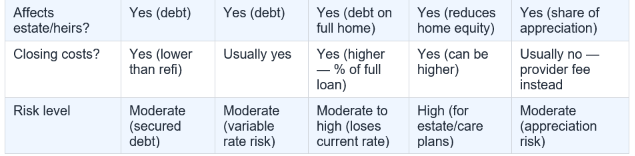
Side-by-Side Comparison Table
Choosing the Right Option for Your Situation
The right equity access option depends on four primary factors: your existing mortgage rate, your need for a lump sum or flexible access, your age, and your credit and income profile. For the majority of 2020-2021 buyers who locked in at sub-3% rates, the decision is between a home equity loan (lump sum, fixed rate, preserves existing mortgage) and a HELOC (flexible revolving access, variable rate, preserves existing mortgage). A cash-out refinance makes sense primarily for those who purchased at higher rates in 2022-2024 and would benefit from refinancing regardless. For homeowners aged 62+ in the US (55+ in the UK) who are on fixed incomes and cannot absorb additional monthly payments, a reverse mortgage or lifetime mortgage deserves careful consideration with specialist advice — but Bankrate’s Rose Krieger caution about ‘last resort’ usage applies. For those with lower credit scores or non-standard financial profiles, a home equity agreement may be the only practical option, though the long-term cost in appreciated value needs careful evaluation. Bankrate’s financial emergency guide found that 59% of homeowners could not pay a $5,000 emergency home repair without going into credit card debt (Clever Real Estate 2025). For those homeowners, a HELOC used as an emergency facility — a line of credit drawn only when needed — offers a much lower-cost alternative to credit card debt.Conclusion
The scale of available home equity in the US — $17.6 trillion as of Q3 2025 — reflects a generation of home value appreciation that has left many homeowners asset-rich in ways they may not have planned for. The challenge is accessing that wealth without incurring unnecessary cost, without abandoning the low mortgage rates that made homeownership affordable, and without taking on risks that are disproportionate to the need. The HELOC and home equity loan are the right tools for the largest proportion of current homeowners in 2026 — precisely because they do not touch the existing mortgage. The cash-out refinance is the right tool for a narrower group. The reverse mortgage and home equity agreement each serve specific situations that the other products cannot reach. The MBA’s 7.2% year-over-year increase in HELOC and home equity loan originations in 2024 suggests that the market has already begun to realise this. This is not financial, mortgage, or tax advice. For guidance specific to your circumstances, consult a qualified, regulated financial adviser or mortgage broker.12. Frequently Asked Questions
What is the difference between a home equity loan and a HELOC?A home equity loan provides a fixed lump sum at a fixed interest rate with fixed monthly repayments — similar to a personal loan but secured against your home. A HELOC (Home Equity Line of Credit) is a revolving credit facility, like a credit card backed by your home's equity, where you draw as needed during a draw period (typically 10 years) and repay over a longer repayment period. The key difference is the access structure and rate type: a home equity loan gives you a fixed amount at a fixed rate; a HELOC gives you flexible access up to a limit at a usually variable rate. Neither changes your existing first mortgage, making both particularly valuable in 2026 when cash-out refinancing would mean replacing a low-rate existing mortgage with a higher one. The UCBI March 2026 guide recommends: 'If you prefer/need flexibility, choose a HELOC. If you want a fixed lump sum, choose the home equity loan.
Is a cash-out refinance a good idea in 2026?
For most homeowners who bought between 2019 and 2022, a cash-out refinance is not the optimal choice in 2026. The reason is straightforward: Bankrate's February 2025 analysis reports that the average baby boomer has a mortgage rate of 4.1% (Freddie Mac data), while cash-out refinance rates in 2025-2026 are closer to 7%. Fannie Mae projected the 30-year fixed rate at 6.2% for Q1 2026 declining to 5.9% by year-end. A cash-out refinance replaces your entire existing mortgage balance at the higher rate — not just the cash-out portion. X2 Mortgage's 2026 guide identifies this as the primary reason millions of homeowners are skipping the cash-out refinance. The exception: homeowners who bought at higher rates in 2022-2024 (when rates peaked above 7%) who could refinance to a lower current rate and access cash simultaneously. For them, combining refinancing with cash-out may be cost-effective. Sources: Bankrate February 2025; X2 Mortgage 2026; AOL 2026.
Who qualifies for a reverse mortgage?
In the US, the most common reverse mortgage is the Home Equity Conversion Mortgage (HECM), insured by the FHA. Eligibility requirements: age 62 or older (some proprietary reverse mortgages allow 55+); the home must be the primary residence; the homeowner must maintain the property and pay property taxes and insurance; and the homeowner must complete a HUD-approved housing counselling session. The loan ends when the home is sold, the homeowner passes away, or the homeowner moves out for 12 or more consecutive months. Bankrate's Rose Krieger notes that reverse mortgages should be considered a last resort, and the Finance of America 2026 education resource recommends them specifically for older homeowners who want equity access without monthly payment obligations. In the UK, the equivalent is an equity release product (lifetime mortgage or home reversion), regulated by the FCA, available from age 55. Always seek specialist independent advice before proceeding.
What is a home equity agreement and how does it work?
A Home Equity Agreement (HEA), also called a home equity sharing agreement or home equity investment, is a relatively new product in which an investor provides the homeowner with a lump sum of cash in exchange for a percentage share of the home's future appreciation. There are no monthly payments and no interest rate. The agreement is settled when the home is sold or at a defined future date, at which point the investor receives their agreed share of the property's value. Unlock.com's guide identifies HEAs as having more accommodating qualification requirements than home equity loans or cash-out refinances, making them accessible to homeowners with lower credit scores. The primary cost is the future appreciation shared — if the property rises significantly in value, the total cost to the homeowner can exceed what a conventional loan would have cost. Finance of America's 2026 education resource lists HEAs among the options for accessing equity without selling.
Can I access home equity if I have a low credit score?
Yes — some options remain available with lower credit scores, though the product range narrows. A home equity agreement (HEA) typically has the most flexible qualification criteria — some providers will work with credit scores of 500+ where a conventional home equity loan or HELOC would typically require 620+. A reverse mortgage is age and equity-based rather than credit-dependent, making it accessible for older homeowners regardless of credit score (subject to basic financial assessment). A home equity loan or HELOC will generally require a credit score of at least 620, though higher is preferable for better rates. A cash-out refinance requires standard mortgage qualifying, which is credit-sensitive. Bankrate's financial emergency guide notes that options narrow with lower credit but do not disappear entirely. X2 Mortgage's 2026 guide confirms that a home equity loan, HELOC, and HEA can all provide equity access while keeping the existing mortgage intact. This is not financial or mortgage advice. Consult a qualified mortgage broker for your specific situation.
0 Comments
Be the first to share your thoughts on this article.