

Business
How Leadership & Culture Drive Business Outcomes

Global employee engagement fell to 20% in 2025 — its lowest since the pandemic. Disengagement now costs the global economy an estimated $10 trillion a year. Managers account for 70% of the variance in team engagement. Organisations with healthy cultures see 18% higher productivity and up to 85% more revenue. Toxic cultures cost US businesses $1 trillion per year in turnover alone. The evidence is unambiguous: leadership and culture are not soft factors — they are the most powerful determinants of business performance available to any organisation.

Global employee engagement fell to 20% in 2025, its lowest level since the pandemic, according to Gallup’s 2026 State of the Global Workplace report. The cost of that disengagement is estimated at $10 trillion in lost productivity annually (EvalFlow, 2026, citing Gallup). That is not a human resources figure. It is a macroeconomic one. At the organisational level, the translation is equally stark: companies with healthy cultures outperform those without by measurable margins on profitability, revenue growth, customer satisfaction, innovation, and talent retention.
The mechanism is not mysterious. People perform at their best when they work under leaders who communicate clearly, build trust, recognise contribution, create psychological safety, and model the values the organisation claims to hold. When they do not, people disengage. They stay physically while leaving psychologically. They stop contributing discretionary effort, stop sharing ideas, and eventually stop showing up altogether. The financial consequences of that trajectory are now quantified, replicated across studies, and visible in the operating results of organisations that get the leadership equation wrong.
Global engagement: 20% in 2025 (lowest since COVID; Gallup 2026 report). Disengagement cost: ~$10 trillion/yr globally (Gallup, cited EvalFlow 2026). Managers explain 70% of team-level engagement variance (Gallup). Healthy culture: +18% productivity, up to +85% revenue (Gallup; speakwiseapp May 2026). Toxic culture: $1 trillion/yr cost in US turnover alone (Gallup, cited speakwiseapp April 2026). Replacing one employee: 50–200% of annual salary.
The trend is moving in the wrong direction. Global engagement was 23% in 2023, fell to 21% in 2024 (the lowest since COVID, costing the global economy $438 billion in that year alone per Gallup’s State of the Global Workplace 2025 Report), and declined further to 20% in 2025 (shaanrais.com, July 2026). Trust in immediate managers dropped from 46% to 29% in just two years, from 2022 to 2024 (DDI research, cited shaanrais.com July 2026). These are not fluctuations. They are a structural deterioration in the relationship between workers and their organisations that is accelerating rather than reversing.
The consequences play out at every level of business performance. Gallup’s longitudinal research across thousands of business units consistently finds that highly engaged teams outperform less engaged teams on every measurable business outcome — profitability, productivity, absenteeism, turnover, safety incidents, and customer satisfaction. The gap between top-quartile and bottom-quartile engagement is not incremental. It is transformational.
The most important contextual fact: only 36% of employees feel engaged and just 24% feel psychologically safe at work, according to a 2025 report from Achievers Workforce (yourthoughtpartner.com). Psychological safety — the belief that one can speak up, take risks, and raise concerns without fear of reprisal — is widely recognised in organisational research as the foundation of high performance. That only a quarter of workers experience it is a leadership failure of systemic proportions.
Effectory’s Global Employee Engagement Index (2025) quantifies the specific impact of leadership on key business metrics. When leadership is identified as a critical engagement driver, it increases: alignment by 22.5%; employee retention by 20.6%; customer focus by 19.9%; productivity by 19.3%. When leadership plays an active, critical role, all of these metrics increase by approximately 24% (cerkl.com, March 2026). These are not marginal effects. A 20% increase in retention, generated by leadership quality alone, represents a massive reduction in recruitment, onboarding, and productivity-ramp costs for any organisation at scale.
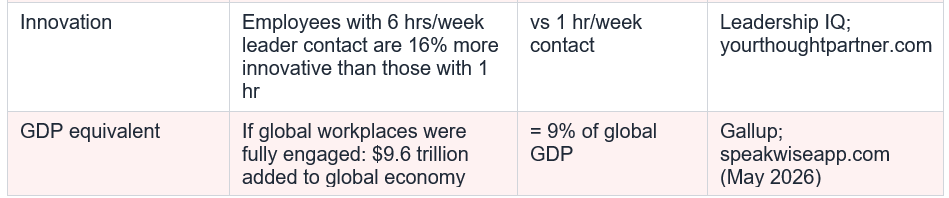
The time dimension of leadership also matters in ways that many organisations have not systematically measured. Leadership IQ research, based on a survey of 32,410 executives, managers, and employees in the US and Canada, found that employees who spend 6 hours per week interacting with their leader are 29% more inspired, 30% more engaged, and 16% more innovative than those who have only 1 hour of weekly leader contact (yourthoughtpartner.com). Leadership contact time is not a luxury. It is a performance input with measurable, compounding effects.
The 70% statistic — that managers account for 70% of the variance in team engagement — means that most engagement surveys, culture programmes, and employee experience initiatives are solving the wrong problem. The answer to low engagement is almost never 'better perks' or 'more office plants.' It is better managers. Specifically: managers who communicate clearly, build trust, provide recognition, give meaningful feedback, and create the conditions for psychological safety. Until that is the target of the organisation's investment, the engagement problem does not get solved.
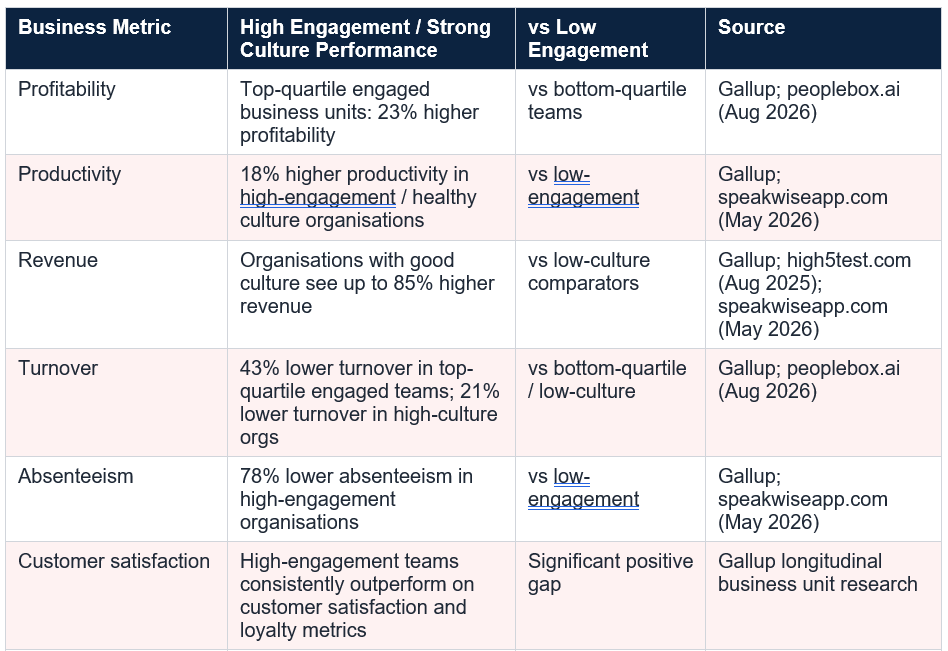
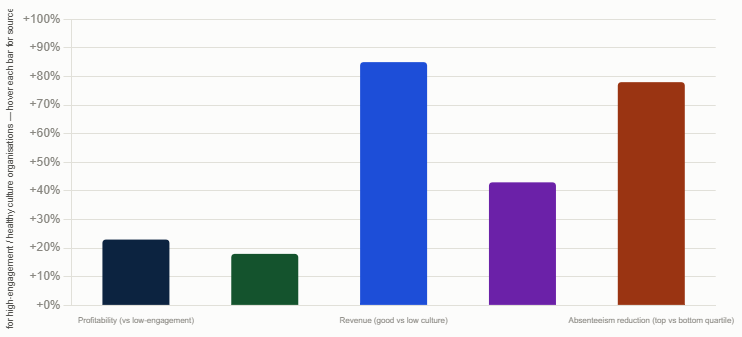
These are not projections or aspirational targets. They are empirically measured differences between organisations in the top and bottom quartiles of engagement, recorded consistently across Gallup’s decades of business unit research. The 23% profitability gap and the 85% revenue gap represent the financial distance between organisations that invest in people leadership and those that treat it as a secondary concern.
Trust is not a soft organisational virtue. It is the mechanism through which all other leadership effectiveness flows. When employees trust their managers, they communicate problems honestly, bring forward innovative ideas, accept direction without needing to constantly second-guess motives, and commit discretionary effort to organisational goals. When trust is absent, every one of those behaviours disappears. People shift energy from contribution to self-protection.
The CEO Magazine’s 2026 analysis of toxic leadership is particularly direct: ‘When leadership goes wrong, people stop collaborating. They stop learning. They stop telling you the truth.’ The senior executive HR Think Tank quoted in Senior Executive (June 2026) makes the operational case: ‘When one leader is allowed to violate the standards others are expected to live by, trust erodes, accountability weakens and people shift energy away from contribution and toward self-protection.’
In the UK, 40.1 million working days were lost to work-related ill health in 2024–2025. Of those, 22.1 million were due to stress, depression, or anxiety (CEO Magazine, 2026 toxic leadership article). These are not wellness statistics. They are capacity statistics — missed deliveries, delayed projects, fragile teams, and a leadership failure that eventually shows up in operating results. The connection from poor leadership to individual stress to organisational performance disruption is direct and documented.
The scale of the problem is wider than most organisations acknowledge. iHire’s 2025 Toxic Workplace Trends Report surveyed 1,781 employees and found that nearly 75% had worked for an employer with a toxic workplace at some point in their career. Poor leadership was the most frequently cited cause of that toxicity. McKinsey Health Institute research has found that one in four employees globally experiences toxic behaviour at work.
The financial costs attach to specific, measurable outcomes:
The primary mechanism: leadership quality → employee engagement → discretionary effort → productivity, customer experience, and innovation → revenue and profitability. Each step in this chain is empirically supported:
Emotional intelligence in a leadership context encompasses five core competencies: self-awareness (understanding one’s own emotional states and how they affect others), self-regulation (managing emotional reactions, particularly under pressure), motivation (internal drive beyond external incentives), empathy (understanding others’ emotional states and responding appropriately), and social skill (building and maintaining effective relationships). Of these, empathy has received specific attention in the engagement data. In toxic cultures, 47% of employees cite the lack of empathetic leadership as a reason for leaving (high5test.com, August 2025).
The practical implication is that the leaders most valued by their organisations in 2026 are not those who are hardest on their teams but those who are most effectively connected to them. The CEO Magazine analysis of toxic leadership makes the distinction precisely: ‘High expectations are clear, fair and consistent. Toxic leadership mistakes aggression, humiliation, or unpredictability for drive.’ The research on burnout reinforces this: 64% of employees feel burnt out at least once a week (McKinsey, 2025), and the biggest causes are unrealistic expectations, always-on work cultures, and weak support systems — all of which are leader-driven variables.
Emotional intelligence is measurable, trainable, and directly linked to the engagement and retention outcomes that drive business performance. Organisations that assess EQ in leadership selection, develop it through coaching and feedback, and measure it as a performance metric are building the specific capability that the research identifies as the primary driver of team-level engagement. Organisations that continue to select and promote purely on technical performance are systematically creating the conditions for the engagement, burnout, and turnover costs that define the bottom half of Gallup's business unit distribution.
Recognition: regular recognition increases engagement by 23%, according to Forbes research (cited peoplebox.ai, August 2026). Only 21% of employees strongly agree that their manager explains how culture impacts their role — a specific communication failure that signals a leadership gap (high5test.com, August 2025). Recognition is not a personality trait or a cultural nicety. It is a leadership practice with a documented 23% effect on the metric most correlated with organisational performance.
Communication frequency: the Leadership IQ survey of 32,410 American and Canadian executives, managers, and employees found that the quantity of leader-employee contact time is directly correlated with engagement, inspiration, and innovation:
Three high-ROI leadership practices supported by the 2025–2026 research: (1) Implement structured recognition — specific, timely, and regular acknowledgement of contribution. The 23% engagement uplift from recognition costs nothing but attention and discipline. (2) Increase contact hours — move toward meaningful, regular one-to-one and team interactions. The Leadership IQ data shows the difference between 1 and 6 hours per week is 30% in engagement. (3) Explain the 'why' of culture to every direct report — only 21% of employees currently receive this. Leaders who connect individual work to organisational purpose close one of the most consistently identified engagement gaps.
The financial consequences of burnout are specific and large. Companies with high burnout rates see 23% more absenteeism and nearly three times higher healthcare costs (McKinsey, 2025; getculturebot.com, August 2025). The UK data illustrates the operational scale: 40.1 million working days were lost to work-related ill health in 2024–2025, with 22.1 million of those attributable to stress, depression, or anxiety (CEO Magazine, 2026). Those are not wellness statistics. They are delivery capacity statistics, project risk statistics, and ultimately financial performance statistics.
Burnout also accelerates the engagement-to-exit pipeline. Disengaged employees are 56% more likely to seek new jobs (Gallup, 2025). The burnout-to-disengagement-to-attrition sequence is the most expensive people cycle in any organisation, and it is one of the most predictable. High burnout rates in a team or function are a leading indicator, not a lagging one, of the turnover costs that will follow.
The average worker now experiences 10 planned enterprise changes per year — including organisational restructuring, culture transformation, and technology initiatives — up from 2 in 2016 (Deloitte 2025 Global Human Capital Trends Report; gable.to, November 2025). With 75% of workers hoping for stability, the pace of change itself is a burnout accelerant that leaders must actively manage through communication, support, and realistic expectation-setting.
Inclusion matters to culture not as a separate programme but as a dimension of the basic cultural conditions that drive performance. Inclusive cultures show 12% higher engagement rates (McKinsey, 2024, cited peoplebox.ai, August 2026). Diversity and inclusion are now a priority for 63% of US employees when choosing a company, rising to 73% of Gen Z employees and 68% of Millennials (high5test.com, August 2025). For organisations competing for talent in the youngest two generational cohorts — who will constitute an increasing majority of the workforce over the next decade — inclusive culture is not an optional value statement. It is a talent acquisition and retention strategy with measurable financial implications.
The culture-innovation link is particularly important in a business environment characterised by technological change. In 2026, 47% of employees fear AI will replace their jobs within five years (Gartner, 2025; getculturebot.com). Leaders who create inclusive, psychologically safe cultures are the ones who can redirect that anxiety toward productive engagement with new technology. Leaders who do not are creating environments where 70% of employees are less likely to upskill and 45% more likely to disengage (Gartner, 2025) — precisely when their organisations most need them to adapt.
Global engagement at 20% is not a human resources concern. It is a strategic emergency that manifests as $10 trillion in annual lost productivity, $1 trillion per year in US turnover costs, $223 billion in five-year losses for US businesses from toxic culture, 22.1 million working days lost to stress-related illness in the UK alone, and the accumulated attrition of talent, institutional knowledge, and competitive capability that follows when leaders create environments where people disengage and leave.
The positive case is equally clear. Organisations in the top quartile of engagement outperform those in the bottom quartile by 23% on profitability, 18% on productivity, and up to 85% on revenue. Those differences compound over time. They are driven primarily by leadership quality — the 70% of engagement variance that is attributable to manager behaviour. They are built through specific, evidence-based practices: developing emotional intelligence, creating psychological safety, implementing structured recognition, increasing contact hours, tolerating no toxic actors regardless of individual performance, and explaining to every person in the organisation why the work they do matters.
The organisations that will outperform over the next decade are not those with the most sophisticated strategy documents. They are those whose leaders show up every day and make the people around them feel valued, supported, and genuinely part of something worth contributing to. That is the culture-performance equation. The data says so, unambiguously.
Leadership style determines the conditions under which employees work — and those conditions are the primary driver of employee engagement. Gallup's longitudinal research across thousands of business units finds that managers account for 70% of the variance in team-level employee engagement. Since engagement is directly correlated with profitability (+23%), productivity (+18%), turnover (-43%), and absenteeism (-78%) compared to low-engagement units, the mathematical path from leadership style to business outcome is short and direct. Effectory's Global Employee Engagement Index (2025) quantifies it specifically: when leadership is a critical engagement driver, it increases alignment by 22.5%, employee retention by 20.6%, customer focus by 19.9%, and productivity by 19.3%. Leadership style is not a cultural soft factor. It is a business performance variable with measurable financial effects.
What is the cost of toxic workplace culture?
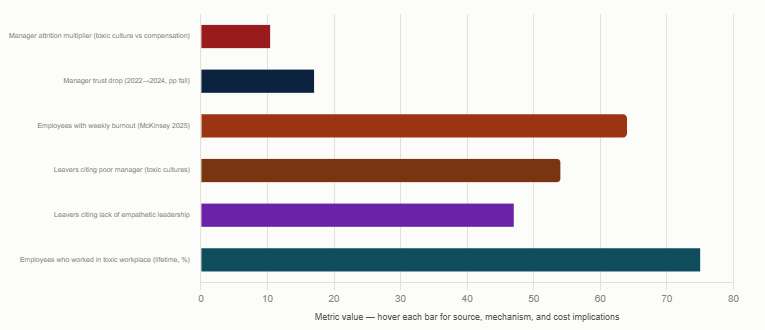
The documented costs of toxic culture operate at multiple levels. At the US national level: toxic culture costs businesses $1 trillion per year in employee turnover costs (Gallup, cited speakwiseapp.com, April 2026). Over five years, a SHRM survey found toxic workplace culture costs US companies approximately $223 billion due to turnover and absenteeism. At the individual level: a single toxic employee costs approximately $12,489 in turnover costs alone (Harvard Business School, Housman and Minor, 50,000 employee study). Workers are 10.4 times more likely to leave due to toxic culture than due to any other factor, including compensation (MIT Sloan analysis). Replacing a departing employee costs 50–200% of their annual salary. At the individual decision level: 54% of employees in toxic cultures cite poor managers as a reason for leaving; 47% cite lack of empathetic leadership.
Why is employee engagement so low globally?
Gallup's 2026 report finds global employee engagement at 20%, its lowest since the pandemic. The primary identified driver is manager quality — and trust in managers has collapsed. DDI research shows trust in immediate managers fell from 46% to 29% between 2022 and 2024. Additional factors identified in the 2025–2026 research literature include: accelerating rates of organisational change (10 planned changes per year per average worker, up from 2 in 2016, per Deloitte 2025); burnout from unrealistic expectations and always-on cultures (64% of employees report weekly burnout, up from 48% in 2023, per McKinsey 2025); anxiety about AI and job security (47% fear job replacement, per Gartner 2025); and declining psychological safety (only 24% of employees feel psychologically safe at work, per Achievers Workforce 2025). These are all, ultimately, leadership and culture problems: they are conditions that effective leadership can address and ineffective leadership exacerbates.
What is the relationship between company culture and revenue?
Organisations with healthy cultures see an 18% increase in productivity and up to an 85% increase in revenue compared to low-culture organisations (Gallup research; high5test.com, August 2025; speakwiseapp.com, May 2026). The mechanism runs from culture through engagement through discretionary effort through customer experience and innovation through financial performance. Culture determines whether people bring their full capability to work or a fraction of it. When they bring the full version — because they feel valued, trusted, safe, and connected to purpose — the business outcomes reflect it. When they do not, the productivity cost is measurable and the financial drag is real. Gallup estimates that if global workplaces were fully engaged, $9.6 trillion could be added to the global economy — equivalent to 9% of global GDP.
What does emotional intelligence have to do with leadership effectiveness?
Emotional intelligence (EQ) — the ability to perceive, understand, manage, and use emotions effectively — has been identified as the #1 most in-demand leadership skill in 2026, according to LEADx's benchmark research (shaanrais.com, July 2026). The World Economic Forum's 2025 report classifies EQ as a 'power skill' for leaders rather than a soft skill. The connection to business outcomes is through engagement: 47% of employees in toxic cultures cite lack of empathetic leadership as a reason for leaving (high5test.com). Empathy is a core component of EQ. Leaders with high EQ create the conditions for psychological safety — the foundation of team performance. They also manage the burnout risk more effectively: the three primary causes of burnout identified in McKinsey's 2025 research (unrealistic expectations, always-on culture, weak support systems) are all controllable by a leader with strong emotional intelligence.
How can organisations build a high-performance culture?
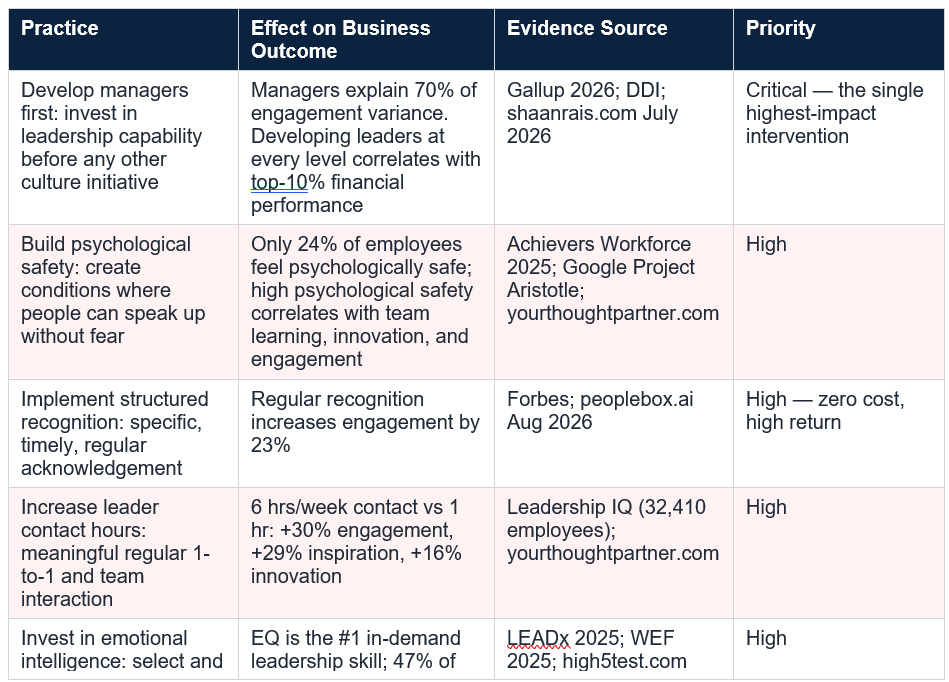
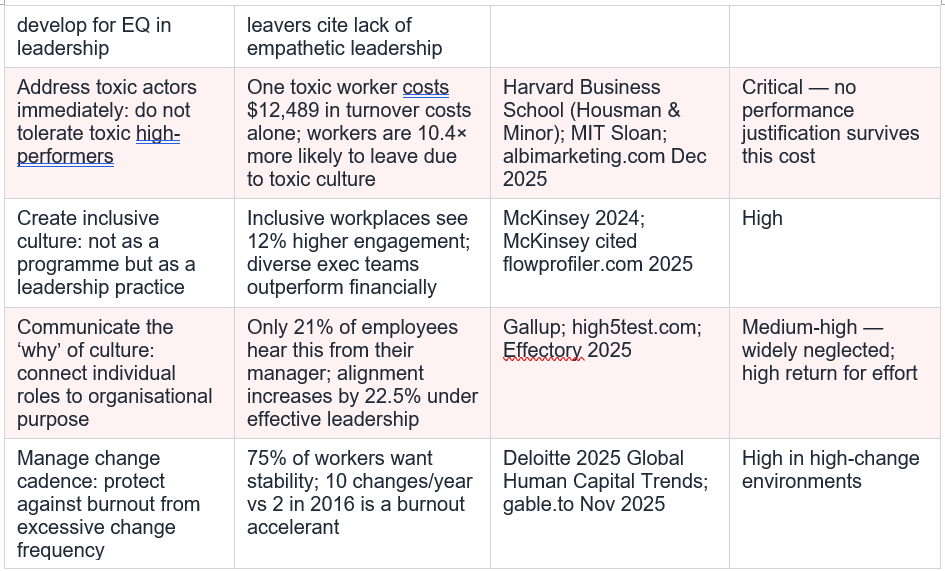
The 2025–2026 research converges on a specific, prioritised set of actions. In order of impact: (1) Develop managers first — since managers explain 70% of engagement variance, leadership development is the single highest-return cultural investment; (2) Build psychological safety — only 24% of employees feel safe speaking up; creating conditions for this requires consistent leadership behaviour, not culture posters; (3) Implement structured recognition — a 23% engagement uplift at zero cost; (4) Increase meaningful leader contact hours — the difference between 1 hour and 6 hours of weekly leader interaction is 30% in engagement; (5) Develop emotional intelligence — select and develop leaders for EQ, not just technical performance; (6) Address toxic actors immediately — no individual performance justification survives the $12,489 minimum turnover cost of a single toxic worker, plus the team morale and innovation drag; (7) Create inclusive environments — 12% higher engagement in inclusive workplaces, with compounding talent and innovation effects.
Table of Contents
- Culture Is the Strategy
- The Global Engagement Crisis: Where We Are in 2026
- The Manager Multiplier: Why Leadership Is the Primary Variable
- The Financial Case: What Strong Culture Delivers in Numbers
- The Trust Collapse: Why Manager Trust Is Falling and What It Costs
- The High Cost of Toxic Leadership and Culture
- The Culture-Revenue Connection: From Engagement to the Bottom Line
- Emotional Intelligence: The #1 Leadership Skill in 2026
- Recognition, Communication, and the Engagement Levers
- Burnout: The Hidden Tax on Organisational Performance
- Diversity, Inclusion, and the Culture-Innovation Link
- Building High-Performance Culture: What the Evidence Actually Supports
- Conclusion: The ROI of Getting Leadership Right
- Frequently Asked Questions
Culture vs Performance: The Evidence Gap
The Cost of Toxic Leadership and Culture
The Leadership Levers: What Drives Engagement
Culture Is the Strategy
In 2026, the most consequential strategic conversation in any boardroom is not about product roadmap, market positioning, or capital allocation. It is about people — and more specifically, about the quality of leadership those people experience and the culture those leaders build. The evidence accumulated over decades of organisational research, and crystallised in a series of landmark reports published in 2024 through 2026, now makes this case in purely financial terms.Global employee engagement fell to 20% in 2025, its lowest level since the pandemic, according to Gallup’s 2026 State of the Global Workplace report. The cost of that disengagement is estimated at $10 trillion in lost productivity annually (EvalFlow, 2026, citing Gallup). That is not a human resources figure. It is a macroeconomic one. At the organisational level, the translation is equally stark: companies with healthy cultures outperform those without by measurable margins on profitability, revenue growth, customer satisfaction, innovation, and talent retention.
The mechanism is not mysterious. People perform at their best when they work under leaders who communicate clearly, build trust, recognise contribution, create psychological safety, and model the values the organisation claims to hold. When they do not, people disengage. They stay physically while leaving psychologically. They stop contributing discretionary effort, stop sharing ideas, and eventually stop showing up altogether. The financial consequences of that trajectory are now quantified, replicated across studies, and visible in the operating results of organisations that get the leadership equation wrong.
Global engagement: 20% in 2025 (lowest since COVID; Gallup 2026 report). Disengagement cost: ~$10 trillion/yr globally (Gallup, cited EvalFlow 2026). Managers explain 70% of team-level engagement variance (Gallup). Healthy culture: +18% productivity, up to +85% revenue (Gallup; speakwiseapp May 2026). Toxic culture: $1 trillion/yr cost in US turnover alone (Gallup, cited speakwiseapp April 2026). Replacing one employee: 50–200% of annual salary.
The Global Engagement Crisis: Where We Are in 2026
The scale of the engagement problem in 2026 is not a marginal concern. It is a structural failure of enormous proportions. Gallup’s 2026 global report records that only 20% of the world’s workforce is engaged at work — meaning that eight in ten workers are either not engaged (going through the motions) or actively disengaged (working against their organisation’s interests). US engagement, while higher, stands at 31% in the first half of 2026 (Gallup, cited EvalFlow 2026) — still meaning that nearly seven in ten American workers are not fully engaged.The trend is moving in the wrong direction. Global engagement was 23% in 2023, fell to 21% in 2024 (the lowest since COVID, costing the global economy $438 billion in that year alone per Gallup’s State of the Global Workplace 2025 Report), and declined further to 20% in 2025 (shaanrais.com, July 2026). Trust in immediate managers dropped from 46% to 29% in just two years, from 2022 to 2024 (DDI research, cited shaanrais.com July 2026). These are not fluctuations. They are a structural deterioration in the relationship between workers and their organisations that is accelerating rather than reversing.
The consequences play out at every level of business performance. Gallup’s longitudinal research across thousands of business units consistently finds that highly engaged teams outperform less engaged teams on every measurable business outcome — profitability, productivity, absenteeism, turnover, safety incidents, and customer satisfaction. The gap between top-quartile and bottom-quartile engagement is not incremental. It is transformational.
The most important contextual fact: only 36% of employees feel engaged and just 24% feel psychologically safe at work, according to a 2025 report from Achievers Workforce (yourthoughtpartner.com). Psychological safety — the belief that one can speak up, take risks, and raise concerns without fear of reprisal — is widely recognised in organisational research as the foundation of high performance. That only a quarter of workers experience it is a leadership failure of systemic proportions.
The Manager Multiplier: Why Leadership Is the Primary Variable
Of all the variables that influence employee engagement, leadership quality is the most powerful. Gallup’s research is unambiguous on this point: managers account for 70% of the variance in team-level employee engagement (cited shaanrais.com, July 2026). This single finding reframes the entire employee engagement conversation. Compensation, benefits, office design, flexible working policies, and culture initiatives all matter — but none of them approaches the magnitude of the manager’s contribution to whether the people in their team are engaged or not.Effectory’s Global Employee Engagement Index (2025) quantifies the specific impact of leadership on key business metrics. When leadership is identified as a critical engagement driver, it increases: alignment by 22.5%; employee retention by 20.6%; customer focus by 19.9%; productivity by 19.3%. When leadership plays an active, critical role, all of these metrics increase by approximately 24% (cerkl.com, March 2026). These are not marginal effects. A 20% increase in retention, generated by leadership quality alone, represents a massive reduction in recruitment, onboarding, and productivity-ramp costs for any organisation at scale.
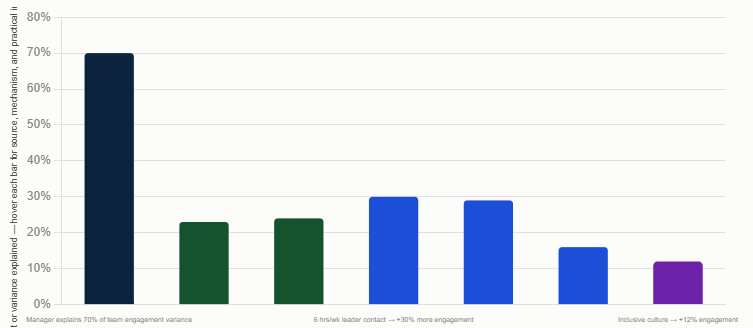
The time dimension of leadership also matters in ways that many organisations have not systematically measured. Leadership IQ research, based on a survey of 32,410 executives, managers, and employees in the US and Canada, found that employees who spend 6 hours per week interacting with their leader are 29% more inspired, 30% more engaged, and 16% more innovative than those who have only 1 hour of weekly leader contact (yourthoughtpartner.com). Leadership contact time is not a luxury. It is a performance input with measurable, compounding effects.
The 70% statistic — that managers account for 70% of the variance in team engagement — means that most engagement surveys, culture programmes, and employee experience initiatives are solving the wrong problem. The answer to low engagement is almost never 'better perks' or 'more office plants.' It is better managers. Specifically: managers who communicate clearly, build trust, provide recognition, give meaningful feedback, and create the conditions for psychological safety. Until that is the target of the organisation's investment, the engagement problem does not get solved.
The Financial Case: What Strong Culture Delivers in Numbers
The business case for investing in leadership quality and organisational culture is no longer a matter of intuition or HR advocacy. It is now documented in peer-reviewed research, large-scale employee surveys, and Gallup’s longitudinal business unit data covering hundreds of thousands of employees across industries and geographies. The financial returns are measurable and large.These are not projections or aspirational targets. They are empirically measured differences between organisations in the top and bottom quartiles of engagement, recorded consistently across Gallup’s decades of business unit research. The 23% profitability gap and the 85% revenue gap represent the financial distance between organisations that invest in people leadership and those that treat it as a secondary concern.
The Trust Collapse: Why Manager Trust Is Falling and What It Costs
One of the most alarming findings in the 2025–2026 leadership research landscape is the collapse of trust in managers. Trust in immediate managers fell from 46% to 29% between 2022 and 2024 — a 17 percentage point drop in two years (DDI research, cited shaanrais.com, July 2026). The American Psychological Association’s 2025 Work in America report documents rising workplace stress alongside declining employee trust in organisational leadership. Workers increasingly report feeling undervalued, overworked, and unsupported.Trust is not a soft organisational virtue. It is the mechanism through which all other leadership effectiveness flows. When employees trust their managers, they communicate problems honestly, bring forward innovative ideas, accept direction without needing to constantly second-guess motives, and commit discretionary effort to organisational goals. When trust is absent, every one of those behaviours disappears. People shift energy from contribution to self-protection.
The CEO Magazine’s 2026 analysis of toxic leadership is particularly direct: ‘When leadership goes wrong, people stop collaborating. They stop learning. They stop telling you the truth.’ The senior executive HR Think Tank quoted in Senior Executive (June 2026) makes the operational case: ‘When one leader is allowed to violate the standards others are expected to live by, trust erodes, accountability weakens and people shift energy away from contribution and toward self-protection.’
In the UK, 40.1 million working days were lost to work-related ill health in 2024–2025. Of those, 22.1 million were due to stress, depression, or anxiety (CEO Magazine, 2026 toxic leadership article). These are not wellness statistics. They are capacity statistics — missed deliveries, delayed projects, fragile teams, and a leadership failure that eventually shows up in operating results. The connection from poor leadership to individual stress to organisational performance disruption is direct and documented.
The High Cost of Toxic Leadership and Culture
Toxic culture and toxic leadership have historically been framed as ethical concerns — important, but separate from the business conversation. The 2025–2026 research dismantles that distinction entirely. Toxic culture and toxic leadership are now quantified business risks with measurable financial consequences that can be modelled, tracked, and reported.The scale of the problem is wider than most organisations acknowledge. iHire’s 2025 Toxic Workplace Trends Report surveyed 1,781 employees and found that nearly 75% had worked for an employer with a toxic workplace at some point in their career. Poor leadership was the most frequently cited cause of that toxicity. McKinsey Health Institute research has found that one in four employees globally experiences toxic behaviour at work.
The financial costs attach to specific, measurable outcomes:
- Turnover: toxic culture costs US businesses $1 trillion per year in employee turnover-related costs (Gallup, cited speakwiseapp.com, April 2026). Replacing a single employee costs 50–200% of their annual salary when recruitment, onboarding, training, and lost productivity are factored in.
- Individual toxic actors: Harvard Business School research by Housman and Minor, based on 50,000 employees, found that a single toxic worker costs the firm approximately $12,489 in turnover costs alone — excluding productivity drag, team morale cost, and customer impact (albimarketing.com, December 2025).
- SHRM survey findings: toxic workplace culture costs US companies an estimated $223 billion over five years due to high turnover and absenteeism (innovativeconnectionsinc.com, April 2025, citing SHRM survey).
- Exit decisions: in toxic cultures, 54% of employees cite a ‘poor manager’ or ‘unfair treatment’ as a reason for leaving; 47% point to lack of empathetic leadership or care (high5test.com, August 2025).
- Toxicity as the #1 attrition driver: workers are 10.4 times more likely to leave their jobs due to toxic corporate culture than due to compensation — the primary driver identified in MIT Sloan Management Review research (cited edhat.com, July 2026).
The Culture-Revenue Connection: From Engagement to the Bottom Line
The link between culture and financial performance is not indirect or correlational in a weak sense. It operates through specific, traceable mechanisms that connect leadership behaviour to business outcomes via discrete chains of causation.The primary mechanism: leadership quality → employee engagement → discretionary effort → productivity, customer experience, and innovation → revenue and profitability. Each step in this chain is empirically supported:
- Leadership quality determines engagement: 70% of engagement variance is explained by manager quality (Gallup).
- Engagement determines effort: disengaged employees are 56% more likely to seek new jobs and cost companies 34% of their annual salary in lost productivity (Gallup, 2025; cited getculturebot.com, August 2025).
- Effort determines customer experience: engaged employees provide better customer service, which enhances customer satisfaction and loyalty (Gallup; peoplebox.ai, August 2026). The customer satisfaction scores of high-engagement teams consistently outperform those of low-engagement teams in Gallup’s longitudinal research.
- Culture determines innovation: 74% of millennial employees believe an inclusive culture makes a company more innovative (high5test.com, August 2025). McKinsey research finds that companies with highly diverse executive teams are substantially more likely to outperform financially.
- Culture determines talent retention, which determines institutional knowledge, which determines operational effectiveness.
Emotional Intelligence: The #1 Leadership Skill in 2026
For most of the twentieth century, leadership theory emphasised technical competence, strategic acumen, and decisiveness. The research of the last decade — and the quantified engagement data of 2024–2026 in particular — has produced a different answer to the question of what makes a leader effective. Emotional intelligence (EQ) is now the #1 most in-demand leadership skill, according to LEADx’s 2025 benchmark (shaanrais.com, July 2026). The World Economic Forum’s 2025 report categorises EQ not as a ‘soft skill’ but as a ‘power skill’ for leaders (flowprofiler.com, October 2025).Emotional intelligence in a leadership context encompasses five core competencies: self-awareness (understanding one’s own emotional states and how they affect others), self-regulation (managing emotional reactions, particularly under pressure), motivation (internal drive beyond external incentives), empathy (understanding others’ emotional states and responding appropriately), and social skill (building and maintaining effective relationships). Of these, empathy has received specific attention in the engagement data. In toxic cultures, 47% of employees cite the lack of empathetic leadership as a reason for leaving (high5test.com, August 2025).
The practical implication is that the leaders most valued by their organisations in 2026 are not those who are hardest on their teams but those who are most effectively connected to them. The CEO Magazine analysis of toxic leadership makes the distinction precisely: ‘High expectations are clear, fair and consistent. Toxic leadership mistakes aggression, humiliation, or unpredictability for drive.’ The research on burnout reinforces this: 64% of employees feel burnt out at least once a week (McKinsey, 2025), and the biggest causes are unrealistic expectations, always-on work cultures, and weak support systems — all of which are leader-driven variables.
Emotional intelligence is measurable, trainable, and directly linked to the engagement and retention outcomes that drive business performance. Organisations that assess EQ in leadership selection, develop it through coaching and feedback, and measure it as a performance metric are building the specific capability that the research identifies as the primary driver of team-level engagement. Organisations that continue to select and promote purely on technical performance are systematically creating the conditions for the engagement, burnout, and turnover costs that define the bottom half of Gallup's business unit distribution.
Recognition, Communication, and the Engagement Levers
Beyond EQ, the research identifies specific, actionable leadership behaviours with documented effects on engagement. Two stand out with particularly strong quantitative evidence: recognition and communication frequency.Recognition: regular recognition increases engagement by 23%, according to Forbes research (cited peoplebox.ai, August 2026). Only 21% of employees strongly agree that their manager explains how culture impacts their role — a specific communication failure that signals a leadership gap (high5test.com, August 2025). Recognition is not a personality trait or a cultural nicety. It is a leadership practice with a documented 23% effect on the metric most correlated with organisational performance.
Communication frequency: the Leadership IQ survey of 32,410 American and Canadian executives, managers, and employees found that the quantity of leader-employee contact time is directly correlated with engagement, inspiration, and innovation:
- Employees with 6 hours of leader communication per week are 29% more inspired than those with 1 hour.
- Employees with 6 hours of leader contact are 30% more engaged than those with 1 hour.
- Employees who spend 6 hours per week interacting with a leader are 16% more innovative than those with 1 hour.
Three high-ROI leadership practices supported by the 2025–2026 research: (1) Implement structured recognition — specific, timely, and regular acknowledgement of contribution. The 23% engagement uplift from recognition costs nothing but attention and discipline. (2) Increase contact hours — move toward meaningful, regular one-to-one and team interactions. The Leadership IQ data shows the difference between 1 and 6 hours per week is 30% in engagement. (3) Explain the 'why' of culture to every direct report — only 21% of employees currently receive this. Leaders who connect individual work to organisational purpose close one of the most consistently identified engagement gaps.
Burnout: The Hidden Tax on Organisational Performance
Burnout is one of the most significant and systematically undercosted consequences of poor leadership culture. McKinsey’s 2025 research found that 64% of employees report feeling burnt out at least once a week — up from 48% in 2023 (getculturebot.com, August 2025). The root causes are leadership-determined: unrealistic expectations, always-on work cultures, and weak support systems. All three are within a leader’s direct control.The financial consequences of burnout are specific and large. Companies with high burnout rates see 23% more absenteeism and nearly three times higher healthcare costs (McKinsey, 2025; getculturebot.com, August 2025). The UK data illustrates the operational scale: 40.1 million working days were lost to work-related ill health in 2024–2025, with 22.1 million of those attributable to stress, depression, or anxiety (CEO Magazine, 2026). Those are not wellness statistics. They are delivery capacity statistics, project risk statistics, and ultimately financial performance statistics.
Burnout also accelerates the engagement-to-exit pipeline. Disengaged employees are 56% more likely to seek new jobs (Gallup, 2025). The burnout-to-disengagement-to-attrition sequence is the most expensive people cycle in any organisation, and it is one of the most predictable. High burnout rates in a team or function are a leading indicator, not a lagging one, of the turnover costs that will follow.
The average worker now experiences 10 planned enterprise changes per year — including organisational restructuring, culture transformation, and technology initiatives — up from 2 in 2016 (Deloitte 2025 Global Human Capital Trends Report; gable.to, November 2025). With 75% of workers hoping for stability, the pace of change itself is a burnout accelerant that leaders must actively manage through communication, support, and realistic expectation-setting.
Diversity, Inclusion, and the Culture-Innovation Link
The research connection between inclusive culture and business performance has strengthened significantly in recent years. McKinsey research finds that companies with highly diverse executive teams are substantially more likely to outperform their peers financially (flowprofiler.com, October 2025). 74% of millennial employees believe an inclusive culture makes a company more innovative — a belief that reflects a real and documented relationship (high5test.com, August 2025).Inclusion matters to culture not as a separate programme but as a dimension of the basic cultural conditions that drive performance. Inclusive cultures show 12% higher engagement rates (McKinsey, 2024, cited peoplebox.ai, August 2026). Diversity and inclusion are now a priority for 63% of US employees when choosing a company, rising to 73% of Gen Z employees and 68% of Millennials (high5test.com, August 2025). For organisations competing for talent in the youngest two generational cohorts — who will constitute an increasing majority of the workforce over the next decade — inclusive culture is not an optional value statement. It is a talent acquisition and retention strategy with measurable financial implications.
The culture-innovation link is particularly important in a business environment characterised by technological change. In 2026, 47% of employees fear AI will replace their jobs within five years (Gartner, 2025; getculturebot.com). Leaders who create inclusive, psychologically safe cultures are the ones who can redirect that anxiety toward productive engagement with new technology. Leaders who do not are creating environments where 70% of employees are less likely to upskill and 45% more likely to disengage (Gartner, 2025) — precisely when their organisations most need them to adapt.
Building High-Performance Culture: What the Evidence Actually Supports
The research of 2024–2026 identifies specific, evidence-based practices that distinguish high-culture, high-performance organisations from their peers. These are not aspirational values or brand statements. They are leadership behaviours and organisational practices with documented effects on engagement, retention, and financial performance:
Conclusion
The evidence assembled in this article constitutes a comprehensive, multi-source answer to one of the oldest management questions: does culture matter to business performance? The answer, in 2026, is unambiguous. Culture does not merely influence business performance. For most organisations, it is the primary determinant of it.Global engagement at 20% is not a human resources concern. It is a strategic emergency that manifests as $10 trillion in annual lost productivity, $1 trillion per year in US turnover costs, $223 billion in five-year losses for US businesses from toxic culture, 22.1 million working days lost to stress-related illness in the UK alone, and the accumulated attrition of talent, institutional knowledge, and competitive capability that follows when leaders create environments where people disengage and leave.
The positive case is equally clear. Organisations in the top quartile of engagement outperform those in the bottom quartile by 23% on profitability, 18% on productivity, and up to 85% on revenue. Those differences compound over time. They are driven primarily by leadership quality — the 70% of engagement variance that is attributable to manager behaviour. They are built through specific, evidence-based practices: developing emotional intelligence, creating psychological safety, implementing structured recognition, increasing contact hours, tolerating no toxic actors regardless of individual performance, and explaining to every person in the organisation why the work they do matters.
The organisations that will outperform over the next decade are not those with the most sophisticated strategy documents. They are those whose leaders show up every day and make the people around them feel valued, supported, and genuinely part of something worth contributing to. That is the culture-performance equation. The data says so, unambiguously.
Frequently Asked Questions
How does leadership style directly affect business outcomes?Leadership style determines the conditions under which employees work — and those conditions are the primary driver of employee engagement. Gallup's longitudinal research across thousands of business units finds that managers account for 70% of the variance in team-level employee engagement. Since engagement is directly correlated with profitability (+23%), productivity (+18%), turnover (-43%), and absenteeism (-78%) compared to low-engagement units, the mathematical path from leadership style to business outcome is short and direct. Effectory's Global Employee Engagement Index (2025) quantifies it specifically: when leadership is a critical engagement driver, it increases alignment by 22.5%, employee retention by 20.6%, customer focus by 19.9%, and productivity by 19.3%. Leadership style is not a cultural soft factor. It is a business performance variable with measurable financial effects.
What is the cost of toxic workplace culture?
The documented costs of toxic culture operate at multiple levels. At the US national level: toxic culture costs businesses $1 trillion per year in employee turnover costs (Gallup, cited speakwiseapp.com, April 2026). Over five years, a SHRM survey found toxic workplace culture costs US companies approximately $223 billion due to turnover and absenteeism. At the individual level: a single toxic employee costs approximately $12,489 in turnover costs alone (Harvard Business School, Housman and Minor, 50,000 employee study). Workers are 10.4 times more likely to leave due to toxic culture than due to any other factor, including compensation (MIT Sloan analysis). Replacing a departing employee costs 50–200% of their annual salary. At the individual decision level: 54% of employees in toxic cultures cite poor managers as a reason for leaving; 47% cite lack of empathetic leadership.
Why is employee engagement so low globally?
Gallup's 2026 report finds global employee engagement at 20%, its lowest since the pandemic. The primary identified driver is manager quality — and trust in managers has collapsed. DDI research shows trust in immediate managers fell from 46% to 29% between 2022 and 2024. Additional factors identified in the 2025–2026 research literature include: accelerating rates of organisational change (10 planned changes per year per average worker, up from 2 in 2016, per Deloitte 2025); burnout from unrealistic expectations and always-on cultures (64% of employees report weekly burnout, up from 48% in 2023, per McKinsey 2025); anxiety about AI and job security (47% fear job replacement, per Gartner 2025); and declining psychological safety (only 24% of employees feel psychologically safe at work, per Achievers Workforce 2025). These are all, ultimately, leadership and culture problems: they are conditions that effective leadership can address and ineffective leadership exacerbates.
What is the relationship between company culture and revenue?
Organisations with healthy cultures see an 18% increase in productivity and up to an 85% increase in revenue compared to low-culture organisations (Gallup research; high5test.com, August 2025; speakwiseapp.com, May 2026). The mechanism runs from culture through engagement through discretionary effort through customer experience and innovation through financial performance. Culture determines whether people bring their full capability to work or a fraction of it. When they bring the full version — because they feel valued, trusted, safe, and connected to purpose — the business outcomes reflect it. When they do not, the productivity cost is measurable and the financial drag is real. Gallup estimates that if global workplaces were fully engaged, $9.6 trillion could be added to the global economy — equivalent to 9% of global GDP.
What does emotional intelligence have to do with leadership effectiveness?
Emotional intelligence (EQ) — the ability to perceive, understand, manage, and use emotions effectively — has been identified as the #1 most in-demand leadership skill in 2026, according to LEADx's benchmark research (shaanrais.com, July 2026). The World Economic Forum's 2025 report classifies EQ as a 'power skill' for leaders rather than a soft skill. The connection to business outcomes is through engagement: 47% of employees in toxic cultures cite lack of empathetic leadership as a reason for leaving (high5test.com). Empathy is a core component of EQ. Leaders with high EQ create the conditions for psychological safety — the foundation of team performance. They also manage the burnout risk more effectively: the three primary causes of burnout identified in McKinsey's 2025 research (unrealistic expectations, always-on culture, weak support systems) are all controllable by a leader with strong emotional intelligence.
How can organisations build a high-performance culture?
The 2025–2026 research converges on a specific, prioritised set of actions. In order of impact: (1) Develop managers first — since managers explain 70% of engagement variance, leadership development is the single highest-return cultural investment; (2) Build psychological safety — only 24% of employees feel safe speaking up; creating conditions for this requires consistent leadership behaviour, not culture posters; (3) Implement structured recognition — a 23% engagement uplift at zero cost; (4) Increase meaningful leader contact hours — the difference between 1 hour and 6 hours of weekly leader interaction is 30% in engagement; (5) Develop emotional intelligence — select and develop leaders for EQ, not just technical performance; (6) Address toxic actors immediately — no individual performance justification survives the $12,489 minimum turnover cost of a single toxic worker, plus the team morale and innovation drag; (7) Create inclusive environments — 12% higher engagement in inclusive workplaces, with compounding talent and innovation effects.
0 Comments
Be the first to share your thoughts on this article.