

Investing
How Market Swings Can Help You Save on Taxes
The S&P 500 dropped around 4% in the first quarter of 2026. Tech-sector rotations are reshaping portfolios. Eighty-six percent of financial advisers ramp up tax strategy during volatile periods — not at year-end. The reason: market swings create losses, and losses cancel out taxable gains. Used correctly, every dip in your portfolio is a potential tax bill reduction. This guide explains exactly how — with the 2026 rules, real numbers, and the mistakes that cost investors the deduction entirely.

When markets fall, most investors feel one of two things: anxiety about their portfolio, or numbness from checking it too often. What most investors do not feel — but should — is opportunity. Specifically, the opportunity to convert a paper loss into a real tax reduction.
The strategy is called tax-loss harvesting. It is the practice of selling investments that have fallen below their purchase price to realise a capital loss, then using that loss to offset capital gains elsewhere in the portfolio — or to reduce ordinary income by up to $3,000 per year. The IRS does not care whether your portfolio is up or down; it only cares about what is realised. Unrealised losses are invisible on a tax return. Realised losses are tax deductions.
The 2026 market context makes this strategy particularly relevant right now. Kiplinger's August 2026 analysis notes that the year 'is breaking the rules with tech-sector rotations and unexpected volatility,' and that putting investments on autopilot in this environment 'could be a costly mistake.' The S&P 500 was down approximately 4% in the first quarter of 2026 before recovering — the kind of swing that creates temporary losses in individual positions even in broadly rising portfolios. Eighty-six percent of financial advisers ramp up tax management strategies during volatile periods rather than waiting for year-end, according to the same Kiplinger analysis.
This guide explains the complete mechanics, the 2026 rules, the numbers at multiple income levels, the wash-sale rule that disqualifies the deduction when triggered, and the specific scenarios where market volatility creates the most valuable harvesting windows.
86% of financial advisers ramp up tax management during volatile periods rather than year-end (Kiplinger August 1, 2026). Tax savings from tax-loss harvesting: $1,000–$5,000/year for moderate investors; much more for high-income taxpayers (TakeHomeTax April 2026). High-net-worth example: client saved $48,000 on $9,500 advisory cost — ~5x return (Uncle Kam 2026). Capital losses offset gains dollar-for-dollar; excess deducts up to $3,000 ordinary income per year; unused losses carry forward indefinitely. 2026 LTCG rates: 0%/$49,450 single; 15% up to $545,500; 20% above. NIIT 3.8% applies above $200,000 single / $250,000 MFJ MAGI. Maximum combined federal rate: 23.8%. Short-term gains taxed as ordinary income: up to 40.8% combined.
The mechanics work through Schedule D of the US federal tax return. Capital gains and losses from all sales during the year are netted against each other. Long-term gains (assets held more than one year) and long-term losses are first netted together. Short-term gains (assets held one year or less) and short-term losses are first netted together. Then, if one category has a net gain and the other a net loss, they are crossed against each other. The result is either a net capital gain (which is taxable) or a net capital loss (which can offset income).
The key feature that makes this strategy powerful is the tax rate differential. A capital loss realised from a portfolio holding that has dropped 20% is deducted at the full value of the loss. But the gains it offsets may be taxed at 15% or 20% for long-term positions, or up to 37% for short-term gains. Harvesting a long-term loss to offset a short-term gain is particularly valuable: the loss deduction value exceeds the simple LTCG offset because the gain it cancels would have been taxed at a much higher ordinary income rate.
Tax-loss harvesting does not eliminate tax — it defers and repositions it. When the replacement security is eventually sold at a gain, the lower cost basis (because the original position was sold at a loss) will produce a larger gain. The strategy works because a dollar of tax saved today, invested for ten years, is worth more than a dollar of extra tax paid in ten years on the larger gain. The present value of the deferral is the real benefit — amplified when the harvested losses are used to offset high-rate short-term gains rather than lower-rate long-term gains.
For long-term capital gains (assets held more than one year), the federal rates are 0%, 15%, and 20%, applied to taxable income thresholds that were modestly inflation-adjusted for 2026. Single filers pay 0% on long-term gains within a taxable income of $49,450; 15% from $49,451 to $545,500; and 20% above that. For married filing jointly, the 0% threshold is $98,900; the 15% range extends to $613,700; 20% applies above. These thresholds are slightly higher than 2025 (0% ceiling rose from $48,350 to $49,450 for single filers) reflecting the ~2.8% inflation adjustment under IRS Rev. Proc. 2025-32.
Short-term capital gains — from assets held one year or less — receive no preferential treatment. They are added to ordinary income and taxed at the standard brackets: 10%, 12%, 22%, 24%, 32%, 35%, or 37%. For a single filer in the 32% bracket with a $50,000 short-term gain, the tax bill on that gain alone is $16,000. The same gain held one additional year and converted to a long-term gain at 15% would cost $7,500 — a $8,500 tax difference from patience alone.
On top of the standard rates, high earners face the Net Investment Income Tax (NIIT) — an additional 3.8% on the lesser of net investment income or the amount by which MAGI exceeds $200,000 for single filers or $250,000 for married filing jointly. This surtax, introduced in 2013, has never been inflation-indexed. As a result, more taxpayers are caught by it each year simply because wages and asset values have risen while the thresholds have not. In 2026, the maximum combined federal rate on long-term gains is 23.8% (20% + 3.8% NIIT) and on short-term gains up to 40.8% (37% + 3.8% NIIT).
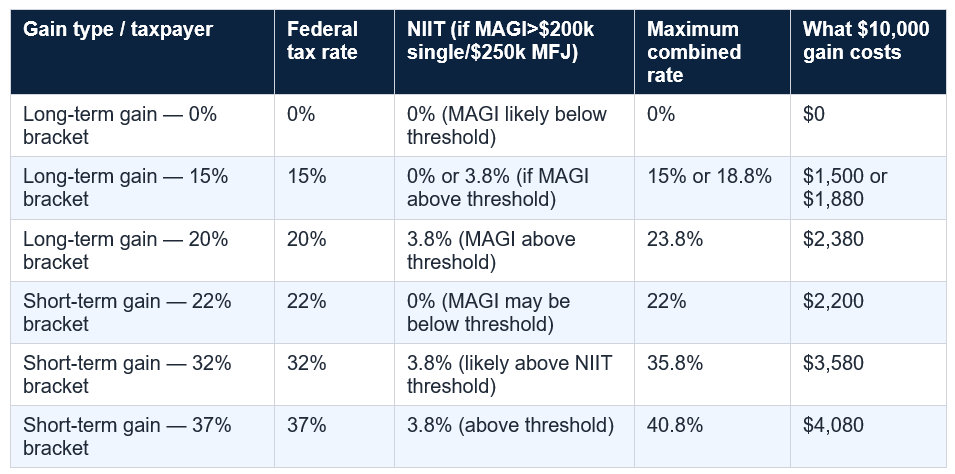
Sources: IRS Rev. Proc. 2025-32 (multiple citations); ustax.tools August 2026; calculover.com July 2026; freefincalc.net. Not tax advice — individual tax liability depends on filing status, state taxes, deductions, and other income.
Example 1 — Moderate investor, 15% bracket: $20,000 long-term gains realised from a rebalancing trade. Portfolio also has $15,000 unrealised loss in a tech ETF affected by 2026 rotation. Without harvesting: tax on $20,000 LTCG at 15% = $3,000. With harvesting: net gain = $20,000 – $15,000 = $5,000. Tax at 15% = $750. Saving: $2,250 (TakeHomeTax April 2026 framework). The harvested loss also comes with a replacement fund purchase that maintains market exposure for the 31-day wash-sale window.
Example 2 — Short-term gain offset: investor sold a stock held 8 months for a $25,000 gain (short-term, taxed at 22% ordinary rate). Portfolio has $7,000 unrealised loss in a sector ETF. Without harvesting: $25,000 at 22% = $5,500. With harvesting: $25,000 – $7,000 = $18,000 at 22% = $3,960. Saving: $1,540. Additionally: had the investor held the $25,000 gain position one extra month past the 1-year mark before selling, the tax rate would have dropped from 22% to 15%, saving roughly $1,750 on the gain alone (freefincalc.net). Patience and loss harvesting are complementary strategies.
Example 3 — High earner with NIIT exposure: single filer, $190,000 ordinary income, $60,000 long-term gain from selling appreciated stock. MAGI = $250,000. LTCG tax at 20%: $12,000. NIIT (3.8% on $60,000): $2,280. Total gain tax: $14,280. If $20,000 in harvested losses offset $20,000 of the gain: net LTCG = $40,000. LTCG tax at 20%: $8,000. NIIT: $1,520. Total: $9,520. Saving: $4,760. The NIIT saving alone ($760) adds meaningfully to the 20% rate saving (freefincalc.net scenario structure; mytaxcalcs.com June 2026 NIIT illustration).
Example 4 — Loss in excess of gains (ordinary income deduction): investor has $5,000 in capital gains and harvests $20,000 in losses. Net: $15,000 excess loss. The $5,000 gains are fully offset ($0 tax). The first $3,000 of excess loss deducts from ordinary income — at a 24% bracket, that saves $720 in additional tax. The remaining $12,000 carries forward to 2027 and future years with no expiration (DaCalc April 2026; TakeHomeTax April 2026).
The Maths: Summary of tax savings across scenarios. Scenario 1 ($15k loss vs $20k LTCG, 15% rate): saves $2,250. Scenario 2 ($7k loss vs $25k ST gain, 22% rate): saves $1,540. Scenario 3 ($20k loss vs $60k LTCG + NIIT, 20%+3.8%): saves $4,760. Scenario 4 (excess losses, $3k ordinary income deduction at 24%): saves $720 per year plus carry-forward. Range for moderate investors: $1,000–$5,000/year (TakeHomeTax April 2026). High-net-worth example (Uncle Kam 2026): $48,000 saved on $9,500 advisory investment = ~5x return. All figures illustrative. Not tax advice.
The practical danger is that 'substantially identical' is broader than most investors assume. It clearly covers the same stock or bond. It clearly covers options on the same security. The Kiplinger August 2026 guide gives a concrete example of what does not work: selling the Vanguard S&P 500 ETF (VOO) at a loss and immediately buying the SPDR S&P 500 ETF Trust (SPY) is likely to be considered substantially identical — both track the same index, hold the same underlying securities, and move in lockstep. What does work: selling VOO and buying iShares Core S&P 500 ETF (IVV) or Schwab S&P 500 Index Fund (SFLNX) — the same broad exposure through a different issuer and different fund.
The TakeHomeTax April 2026 guide highlights a critical extension of the rule that many investors miss: the wash-sale rule applies across all accounts controlled by the same taxpayer, including the taxpayer's IRA accounts and spousal accounts. Selling a stock at a loss in a taxable brokerage account and immediately buying the same stock in a Roth IRA triggers the wash-sale rule and disallows the loss. Only the individual, their spouse, and their controlled corporations are in scope — an unrelated account owned by an adult child is not.
The three most common wash-sale violations in practice (TakeHomeTax April 2026; SwitchWize May 2026). First: selling a fund at a loss and forgetting that a DRIP (dividend reinvestment plan) on the same fund automatically repurchased shares within 30 days — the automatic repurchase triggers a wash sale. Stop DRIP reinvestment on the position before harvesting. Second: selling a position at a loss and buying a 'substantially identical' ETF from the same index family. The IRS has not published a definitive list of what constitutes 'substantially identical' for funds — conservative practice is to switch index families, not just fund issuers. Third: selling at a loss in a taxable account and buying the same security in an IRA 'to not miss the recovery' — the IRA purchase disallows the taxable account loss.
Choosing the right swap pair is the most important practical skill in tax-loss harvesting. The guiding principle is that the replacement fund must provide similar economic exposure (same asset class, similar sector weights, similar geographic coverage) while being issued by a different provider and tracking a different — though correlated — index. The SwitchWize May 2026 guide notes that the best swap pairs involve indices with different construction methodologies or provider names, even when the practical investment outcome is nearly identical.
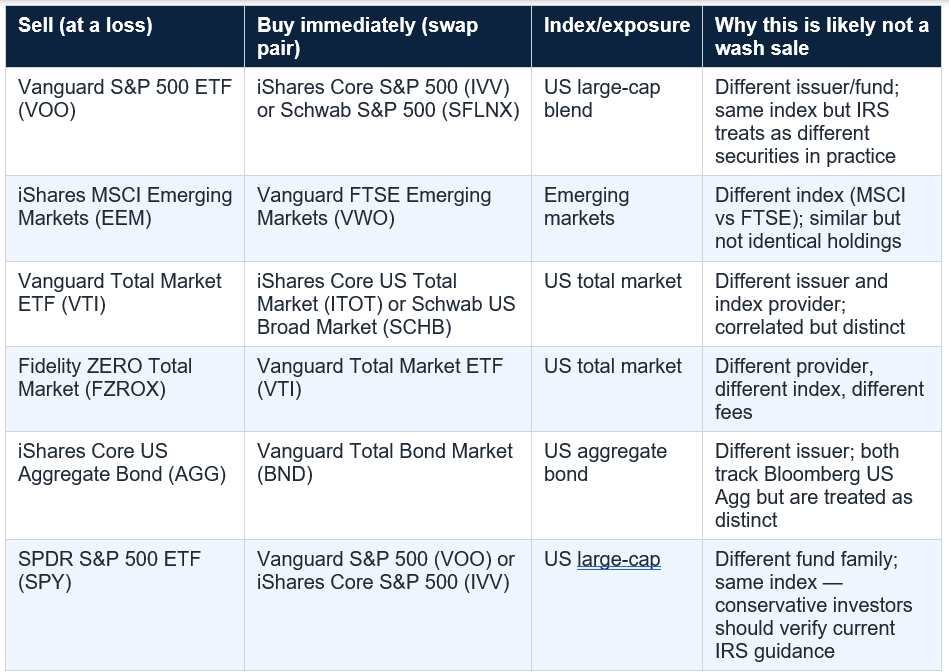
Note: the IRS has not issued definitive guidance on which ETF pairs are 'substantially identical.' The above pairs represent common practice in the tax planning community as of 2026. Conservative investors confirm with a qualified tax professional before executing any swap. Never swap within the same index family (e.g., VOO for VFIAX — both Vanguard S&P 500 funds — is almost certainly a wash sale). Source: SwitchWize May 2026; TakeHomeTax April 2026; Kiplinger August 2026.
The $3,000 limit was set decades ago and has never been inflation-adjusted. Many tax reform observers note that in real terms, $3,000 of ordinary income deduction in 2026 dollars is worth a fraction of what it was when the limit was established. But the carry-forward feature compensates substantially. Unused capital losses — any amount beyond the $3,000 deducted in the current year — carry forward indefinitely, retaining their short-term or long-term character, and can be applied against future capital gains or ordinary income in any future year until fully absorbed.
The carry-forward creates what the Uncle Kam 2026 guide calls a 'loss bank' — a stockpile of prior-year losses that future gains can draw against. An investor who harvests $50,000 in losses in 2026 but only realises $10,000 in gains that year deducts $3,000 against ordinary income and carries forward $37,000 to future years. If a large capital gain event occurs in 2027 or 2028 — a business sale, property sale, concentrated stock liquidation — the carry-forward loss absorbs it entirely or partially. The strategy works not just in the current year but as a long-term tax asset.
Carry-forward example. Year 2026: $50,000 harvested losses; $10,000 capital gains. Net loss after offset: $40,000. Deduct $3,000 against ordinary income (saves $720 at 24% bracket). Carry forward: $37,000 into 2027. Year 2027: $37,000 in carried-forward losses. New capital gain event: $40,000 from sale of appreciated real estate (above the home sale exclusion). The $37,000 carry-forward fully offsets $37,000 of the $40,000 gain. Tax payable on $3,000 net gain at 15% LTCG = $450. Without the carry-forward: $40,000 × 15% = $6,000. Total multi-year saving from the 2026 harvesting: $720 (ordinary income 2026) + $5,550 (gain offset 2027) = $6,270 in total additional tax savings over two years. All figures illustrative. Not tax advice.
Market volatility — the kind that 2026 has delivered through tech-sector rotations and geopolitical uncertainty — is precisely the environment that creates the most harvesting opportunities. When broad indices are up but specific sectors or individual positions are down, a portfolio often contains simultaneous gains (from diversified positions and prior-year winners) and losses (from sector-specific or company-specific declines). This combination is ideal: there are gains to offset and losses available to harvest.
The instead.com 2026 guide makes a timing argument that pushes against the conventional wisdom of December harvesting: 'Starting in April lets you act on market dips as they happen rather than forcing sales in the last two weeks of December when everyone else is doing the same thing.' Year-round harvesting captures losses at the moment they are deepest — during an actual market dip — rather than waiting for year-end when prices may have partially recovered. The quarterly estimated tax payment calendar provides natural checkpoints: each June 15 (Q2), September 15 (Q3), and January 15 (Q4) estimated payment deadline is a good moment to scan for harvesting opportunities.
Year-round harvesting workflow (instead.com 2026 framework; Kiplinger August 2026 checklist). Step 1: audit year-to-date capital gains each quarter. Step 2: scan taxable accounts for positions below cost basis. Step 3: identify ETF swap pairs before executing any sale. Step 4: check the 61-day wash-sale window — any purchases of the same security in the last 30 days? Step 5: stop DRIP reinvestment on the position being harvested. Step 6: sell the losing position and immediately buy the swap pair. Step 7: document the trade date, cost basis, loss amount, and replacement security. Step 8: set a calendar reminder 31 days after the harvest to repurchase the original position if preferred. Step 9: verify with a tax professional before any large or complex harvest. Trade date (not settlement) controls the tax year — complete trades by December 31, 2026 for 2026 deduction (Uncle Kam 2026).
The NIIT applies to the lesser of net investment income or the amount of MAGI above the threshold. Tax-loss harvesting directly reduces net investment income by adding losses to the calculation — every dollar of harvested loss that offsets a capital gain reduces net investment income by the same dollar, saving 3.8 cents in NIIT per dollar, on top of the regular capital gains tax saving. For filers hovering near the NIIT threshold, harvested losses can pull MAGI below the $200,000/$250,000 line entirely, eliminating the surtax rather than just reducing it.
This NIIT interaction also connects to IRMAA — the Medicare premium surcharge for higher-income beneficiaries. IRMAA for 2026 is based on 2024 MAGI; IRMAA for 2027 will be based on 2025 MAGI (Fidelity July 2026). Investors near IRMAA thresholds ($109,000 single / $218,000 joint for 2026) who harvest losses to reduce MAGI may simultaneously avoid NIIT and prevent IRMAA surcharges from applying two years later. The cascading benefit of MAGI management through tax-loss harvesting can significantly exceed the face value of the harvested losses.
The NIIT threshold has been frozen at $200,000/$250,000 since 2013. In real purchasing-power terms, these thresholds have declined by approximately 40% over that period. What was originally designed as a 'high earner' provision increasingly applies to dual-income professional households earning well under $300,000. The freefincalc.net 2026 guide notes: 'The $200,000/$250,000 thresholds have remained frozen since 2013, pushing more middle-income taxpayers above the line each year due to wage growth and asset price inflation.' For these filers, tax-loss harvesting is not just a capital gains strategy — it is a MAGI management tool with Medicare premium implications.
The home sale exclusion allows up to $250,000 (single) or $500,000 (married filing jointly) of capital gain from a primary residence to be excluded from income. But with home prices having appreciated dramatically in recent years, many sellers in 2026 face gains that exceed the exclusion. The instead.com 2026 guide explicitly flags this: 'Capital losses can offset gains from selling your home, even if they exceed the exclusion amount. If you sold a home in 2025 or plan to sell one in 2026 and expect a gain above the exclusion amount, harvesting investment losses to offset that gain could save you thousands.'
Concentrated stock positions — where a single employer stock, IPO holding, or long-held winner represents a disproportionate share of the portfolio — are both a financial risk and a tax problem. Selling the concentrated position to diversify generates a capital gain. Harvesting losses from other positions directly offsets that gain, enabling the diversification at a lower tax cost. In volatile markets, positions in non-favoured sectors may be temporarily depressed — creating harvesting opportunities specifically because of the volatility that also justifies diversifying out of the concentrated winner.
Portfolio rebalancing — systematically selling positions that have grown beyond their target allocation and buying underweighted positions — inherently generates gains from the winners being trimmed. Tax-loss harvesting turns the underperforming positions that are simultaneously present in most diversified portfolios into fuel for the rebalancing trade. Rather than selling winners and paying tax to fund rebalancing, the investor harvests losers to offset the gain from selling winners — achieving the same rebalancing outcome with a significantly lower tax cost.
The instead.com 2026 guide makes the operational case: 'Starting in April lets you act on market dips as they happen rather than forcing sales in the last two weeks of December when everyone else is doing the same thing.' This is especially relevant in 2026, where the January–April market rotation created loss opportunities in tech and growth names that partially recovered by summer. Investors who waited for December missed the deepest harvesting window of the year.
The practical workflow integrates harvesting with the quarterly estimated tax payment schedule. Each estimated payment date — April 15, June 15, September 15, and January 15 — requires a calculation of year-to-date gains and estimated future gains. This calculation is the natural trigger for a portfolio scan: if realised gains are materialising, is there anything in the taxable portfolio that is currently below cost basis and eligible to offset them? If yes, and a clean swap pair is available, the harvest should happen at that moment — not three months later at year-end.
The Uncle Kam 2026 guide adds the critical operational note: the trade date controls the tax year, not the settlement date. All trades for the 2026 tax year must be executed by December 31, 2026 — not December 31 plus two settlement days. For anyone who has not yet scanned their portfolio for 2026 harvesting opportunities and has realised gains to offset, September is the ideal window: enough time has passed to identify the year's clear underperformers, and sufficient time remains before year-end to execute trades and complete the 31-day swap window before December 31.
September 2026 tax-loss harvesting action checklist. 1) Pull your year-to-date realised gains from your brokerage account (available in the Gains and Losses section). 2) Identify all positions in taxable accounts currently below your cost basis. 3) For each loss position, calculate the size of the unrealised loss and determine whether it exceeds your minimum harvesting threshold (typically $1,000+). 4) Confirm that you have not purchased the same security within the last 30 days (that would already be a wash-sale violation). 5) Identify your ETF swap pair from the table in Section 6 or from your adviser. 6) Disable DRIP reinvestment on the position being sold. 7) Execute the sale and immediately buy the replacement. 8) Document everything: trade date, sale price, cost basis, loss amount, replacement security, and the date 31 days after the harvest when the original position can be repurchased. 9) Consult a tax professional for any harvest above $5,000 or involving complex positions (options, crypto, foreign securities). Not tax advice.
In 2026, with tech-sector rotations, Iran War commodity effects on energy portfolios, and the S&P's volatile path following its strong 2025, there are more harvesting opportunities in individual portfolios than in a quietly trending year. Eighty-six percent of financial advisers are acting on this — not waiting for December, but scanning quarterly and harvesting at the depth of each dip. The mechanics are straightforward. The wash-sale rule is navigable with the right ETF swap pairs. The savings — $1,000 to $5,000 per year for moderate investors, substantially more for high earners — are real and repeatable.
The only thing that converts a paper loss into a tax saving is the decision to realise it. Every unrealised loss sitting in a taxable portfolio is a tax deduction waiting to be collected — and it is available now, regardless of the calendar date.
Tax-loss harvesting is the practice of selling investments that are currently worth less than their purchase price to realise a capital loss, then using that loss to offset capital gains or ordinary income on your tax return. Capital losses offset capital gains dollar-for-dollar — if you have $15,000 in gains and harvest $10,000 in losses, you owe tax on only $5,000 of gains. If losses exceed gains, up to $3,000 of excess losses can deduct from ordinary income (wages, salary) per year, with unused losses carrying forward indefinitely to future tax years. In 2026, the strategy is particularly relevant given tech-sector rotation and market volatility — Kiplinger (August 1, 2026) reports that 86% of financial advisers ramp up tax management strategies during volatile periods. Moderate investors typically save $1,000–$5,000 per year; high-income taxpayers can save substantially more (TakeHomeTax April 2026; Uncle Kam 2026).
What are the 2026 capital gains tax rates and thresholds?
For 2026, long-term capital gains (assets held more than one year) are taxed at three federal rates, per IRS Rev. Proc. 2025-32. For single filers: 0% on taxable income up to $49,450; 15% from $49,451 to $545,500; 20% above $545,500. For married filing jointly: 0% up to $98,900; 15% to $613,700; 20% above. Short-term gains (assets held one year or less) are taxed as ordinary income — up to 37% for the highest bracket. In addition, high earners may owe the 3.8% Net Investment Income Tax (NIIT) on the lesser of net investment income or MAGI above $200,000 (single) or $250,000 (MFJ). The NIIT thresholds have never been inflation-adjusted since 2013, meaning more upper-middle-income filers are caught each year. The maximum combined federal rate on long-term gains is 23.8%; on short-term gains up to 40.8%. Tax-loss harvesting reduces the taxable gain that these rates are applied to.
What is the wash-sale rule and how do I avoid it?
The wash-sale rule (IRC Section 1091) disallows a capital loss deduction if you purchase a 'substantially identical' security within 30 days before or after the loss sale — a 61-day window total. If triggered, the loss is added to the cost basis of the replacement shares (deferred, not permanently lost), but the current-year tax deduction is destroyed. The rule applies across all accounts controlled by the same taxpayer, including spousal accounts and IRA accounts. To avoid it: sell the losing position and immediately buy a different but economically similar security — an ETF swap. For example, sell Vanguard S&P 500 ETF (VOO) and buy iShares Core S&P 500 (IVV) — similar exposure, different issuer. Also: stop DRIP reinvestment on the position before harvesting, as automatic reinvestments within 30 days trigger the rule. Never buy the same security in an IRA on the same day you sell it at a loss in a taxable account.
How much can I actually save from tax-loss harvesting?
The savings depend on the size of the loss, the tax rate on the gains being offset, and whether the NIIT applies. At the 15% LTCG rate: a $15,000 harvested loss offsetting a $20,000 gain saves $2,250 compared to no harvesting. At the 20% rate plus 3.8% NIIT (23.8% combined): $20,000 of harvested losses from a $60,000 gain scenario saves approximately $4,760 (freefincalc.net; mytaxcalcs.com June 2026). For short-term gains taxed at 22–37% ordinary rates: harvesting is even more valuable per dollar of loss because the rate differential is larger. Moderate investors typically save $1,000–$5,000 per year (TakeHomeTax April 2026). A real-world high-net-worth example: a client saved $48,000 in taxes on a $9,500 professional advisory investment — approximately a 5x return on the advisory cost (Uncle Kam 2026). The ordinary income deduction saves an additional $720 per year at the 24% bracket from the $3,000 annual limit, plus unlimited carry-forward for future gain events.
When is the best time to harvest tax losses — only at year-end?
No — and waiting until December is widely described as leaving money on the table. The instead.com 2026 guide recommends starting as early as April, after the prior-year tax return is filed and with a full view of the year's starting position. Kiplinger (August 2026) confirms that 86% of advisers harvest throughout the year during volatile periods, not at year-end. The optimal moment to harvest is when losses are deepest — during an actual market dip — not in late December when prices may have already partially recovered. In 2026, the January-to-April market rotation created loss opportunities in tech and growth names that partially rebounded by summer; investors who harvested during the dip captured larger deductions. The practical workflow: review your taxable accounts whenever you calculate quarterly estimated tax payments (April 15, June 15, September 15) and act whenever a loss exceeds your threshold and a clean swap pair is available. All trades must be executed by December 31, 2026 (trade date, not settlement) for the 2026 tax year.
Should I harvest losses even if I have no capital gains to offset?
Yes, with important qualifications. Even with no capital gains in the current year, harvested losses can: (1) deduct up to $3,000 against ordinary income per year, saving real tax dollars at your marginal income rate; and (2) carry forward indefinitely to future years when gains do materialise. A harvested loss with no immediate offset is a tax asset held for future use — a 'loss bank' that absorbs the next large capital gain event (business sale, property sale, concentrated stock liquidation, large rebalancing trade). The Uncle Kam 2026 guide describes this explicitly: 'Banking a big loss now protects future gains. This makes harvesting a long-term tool, not just a year-end trick.' The exception: if you are certain you will never realise another capital gain and your ordinary income is zero, there is no benefit. But for most investors, carry-forward losses created in volatile markets are a valuable multi-year asset.
Table of Contents
- Why Market Drops Are Actually Tax Opportunities
- What Is Tax-Loss Harvesting? The Core Mechanic Explained
- 2026 Capital Gains Tax Rates: What You're Actually Trying to Offset
- The Dollar Maths: What Different Loss Scenarios Actually Save
- The Wash-Sale Rule: The One Mistake That Wipes Out the Deduction
- ETF Swap Pairs: How to Stay Invested While Harvesting
- The $3,000 Ordinary Income Deduction — and the Carry-Forward Weapon
- When Market Volatility Makes Harvesting Most Valuable
- The NIIT Connection: How Harvesting Cuts the Hidden 3.8% Surtax
- Special Scenarios: Home Sales, Concentrated Positions, Rebalancing
- When Tax-Loss Harvesting Does NOT Make Sense
- The Year-Round Workflow: Don't Wait Until December
- Conclusion: The Tax Move the Market Does For You
- Frequently Asked Questions
Why Market Drops Are Actually Tax Opportunities
When markets fall, most investors feel one of two things: anxiety about their portfolio, or numbness from checking it too often. What most investors do not feel — but should — is opportunity. Specifically, the opportunity to convert a paper loss into a real tax reduction.The strategy is called tax-loss harvesting. It is the practice of selling investments that have fallen below their purchase price to realise a capital loss, then using that loss to offset capital gains elsewhere in the portfolio — or to reduce ordinary income by up to $3,000 per year. The IRS does not care whether your portfolio is up or down; it only cares about what is realised. Unrealised losses are invisible on a tax return. Realised losses are tax deductions.
The 2026 market context makes this strategy particularly relevant right now. Kiplinger's August 2026 analysis notes that the year 'is breaking the rules with tech-sector rotations and unexpected volatility,' and that putting investments on autopilot in this environment 'could be a costly mistake.' The S&P 500 was down approximately 4% in the first quarter of 2026 before recovering — the kind of swing that creates temporary losses in individual positions even in broadly rising portfolios. Eighty-six percent of financial advisers ramp up tax management strategies during volatile periods rather than waiting for year-end, according to the same Kiplinger analysis.
This guide explains the complete mechanics, the 2026 rules, the numbers at multiple income levels, the wash-sale rule that disqualifies the deduction when triggered, and the specific scenarios where market volatility creates the most valuable harvesting windows.
86% of financial advisers ramp up tax management during volatile periods rather than year-end (Kiplinger August 1, 2026). Tax savings from tax-loss harvesting: $1,000–$5,000/year for moderate investors; much more for high-income taxpayers (TakeHomeTax April 2026). High-net-worth example: client saved $48,000 on $9,500 advisory cost — ~5x return (Uncle Kam 2026). Capital losses offset gains dollar-for-dollar; excess deducts up to $3,000 ordinary income per year; unused losses carry forward indefinitely. 2026 LTCG rates: 0%/$49,450 single; 15% up to $545,500; 20% above. NIIT 3.8% applies above $200,000 single / $250,000 MFJ MAGI. Maximum combined federal rate: 23.8%. Short-term gains taxed as ordinary income: up to 40.8% combined.
What Is Tax-Loss Harvesting? The Core Mechanic Explained
Tax-loss harvesting is straightforward in concept: sell an investment that is currently worth less than you paid for it, realise the capital loss, and use that loss to reduce your tax liability. The investment does not have to be a permanent failure — you can immediately replace it with a similar (but not identical) investment to maintain your market exposure. The tax benefit is captured; the portfolio position is effectively maintained.The mechanics work through Schedule D of the US federal tax return. Capital gains and losses from all sales during the year are netted against each other. Long-term gains (assets held more than one year) and long-term losses are first netted together. Short-term gains (assets held one year or less) and short-term losses are first netted together. Then, if one category has a net gain and the other a net loss, they are crossed against each other. The result is either a net capital gain (which is taxable) or a net capital loss (which can offset income).
The key feature that makes this strategy powerful is the tax rate differential. A capital loss realised from a portfolio holding that has dropped 20% is deducted at the full value of the loss. But the gains it offsets may be taxed at 15% or 20% for long-term positions, or up to 37% for short-term gains. Harvesting a long-term loss to offset a short-term gain is particularly valuable: the loss deduction value exceeds the simple LTCG offset because the gain it cancels would have been taxed at a much higher ordinary income rate.
Tax-loss harvesting does not eliminate tax — it defers and repositions it. When the replacement security is eventually sold at a gain, the lower cost basis (because the original position was sold at a loss) will produce a larger gain. The strategy works because a dollar of tax saved today, invested for ten years, is worth more than a dollar of extra tax paid in ten years on the larger gain. The present value of the deferral is the real benefit — amplified when the harvested losses are used to offset high-rate short-term gains rather than lower-rate long-term gains.
2026 Capital Gains Tax Rates: What You're Actually Trying to Offset
Understanding what you are offsetting is essential to quantifying the value of any harvested loss. The 2026 capital gains tax rates, confirmed by multiple sources citing IRS Rev. Proc. 2025-32, are as follows:For long-term capital gains (assets held more than one year), the federal rates are 0%, 15%, and 20%, applied to taxable income thresholds that were modestly inflation-adjusted for 2026. Single filers pay 0% on long-term gains within a taxable income of $49,450; 15% from $49,451 to $545,500; and 20% above that. For married filing jointly, the 0% threshold is $98,900; the 15% range extends to $613,700; 20% applies above. These thresholds are slightly higher than 2025 (0% ceiling rose from $48,350 to $49,450 for single filers) reflecting the ~2.8% inflation adjustment under IRS Rev. Proc. 2025-32.
Short-term capital gains — from assets held one year or less — receive no preferential treatment. They are added to ordinary income and taxed at the standard brackets: 10%, 12%, 22%, 24%, 32%, 35%, or 37%. For a single filer in the 32% bracket with a $50,000 short-term gain, the tax bill on that gain alone is $16,000. The same gain held one additional year and converted to a long-term gain at 15% would cost $7,500 — a $8,500 tax difference from patience alone.
On top of the standard rates, high earners face the Net Investment Income Tax (NIIT) — an additional 3.8% on the lesser of net investment income or the amount by which MAGI exceeds $200,000 for single filers or $250,000 for married filing jointly. This surtax, introduced in 2013, has never been inflation-indexed. As a result, more taxpayers are caught by it each year simply because wages and asset values have risen while the thresholds have not. In 2026, the maximum combined federal rate on long-term gains is 23.8% (20% + 3.8% NIIT) and on short-term gains up to 40.8% (37% + 3.8% NIIT).
Sources: IRS Rev. Proc. 2025-32 (multiple citations); ustax.tools August 2026; calculover.com July 2026; freefincalc.net. Not tax advice — individual tax liability depends on filing status, state taxes, deductions, and other income.
The Dollar Maths: What Different Loss Scenarios Actually Save
Abstract percentages matter less than concrete dollar savings. The following examples illustrate what harvested losses actually save at different income levels in 2026, based on published calculations from TakeHomeTax (April 2026), freefincalc.net, mytaxcalcs.com (June 2026), and other sources.Example 1 — Moderate investor, 15% bracket: $20,000 long-term gains realised from a rebalancing trade. Portfolio also has $15,000 unrealised loss in a tech ETF affected by 2026 rotation. Without harvesting: tax on $20,000 LTCG at 15% = $3,000. With harvesting: net gain = $20,000 – $15,000 = $5,000. Tax at 15% = $750. Saving: $2,250 (TakeHomeTax April 2026 framework). The harvested loss also comes with a replacement fund purchase that maintains market exposure for the 31-day wash-sale window.
Example 2 — Short-term gain offset: investor sold a stock held 8 months for a $25,000 gain (short-term, taxed at 22% ordinary rate). Portfolio has $7,000 unrealised loss in a sector ETF. Without harvesting: $25,000 at 22% = $5,500. With harvesting: $25,000 – $7,000 = $18,000 at 22% = $3,960. Saving: $1,540. Additionally: had the investor held the $25,000 gain position one extra month past the 1-year mark before selling, the tax rate would have dropped from 22% to 15%, saving roughly $1,750 on the gain alone (freefincalc.net). Patience and loss harvesting are complementary strategies.
Example 3 — High earner with NIIT exposure: single filer, $190,000 ordinary income, $60,000 long-term gain from selling appreciated stock. MAGI = $250,000. LTCG tax at 20%: $12,000. NIIT (3.8% on $60,000): $2,280. Total gain tax: $14,280. If $20,000 in harvested losses offset $20,000 of the gain: net LTCG = $40,000. LTCG tax at 20%: $8,000. NIIT: $1,520. Total: $9,520. Saving: $4,760. The NIIT saving alone ($760) adds meaningfully to the 20% rate saving (freefincalc.net scenario structure; mytaxcalcs.com June 2026 NIIT illustration).
Example 4 — Loss in excess of gains (ordinary income deduction): investor has $5,000 in capital gains and harvests $20,000 in losses. Net: $15,000 excess loss. The $5,000 gains are fully offset ($0 tax). The first $3,000 of excess loss deducts from ordinary income — at a 24% bracket, that saves $720 in additional tax. The remaining $12,000 carries forward to 2027 and future years with no expiration (DaCalc April 2026; TakeHomeTax April 2026).
The Maths: Summary of tax savings across scenarios. Scenario 1 ($15k loss vs $20k LTCG, 15% rate): saves $2,250. Scenario 2 ($7k loss vs $25k ST gain, 22% rate): saves $1,540. Scenario 3 ($20k loss vs $60k LTCG + NIIT, 20%+3.8%): saves $4,760. Scenario 4 (excess losses, $3k ordinary income deduction at 24%): saves $720 per year plus carry-forward. Range for moderate investors: $1,000–$5,000/year (TakeHomeTax April 2026). High-net-worth example (Uncle Kam 2026): $48,000 saved on $9,500 advisory investment = ~5x return. All figures illustrative. Not tax advice.
The Wash-Sale Rule: The One Mistake That Wipes Out the Deduction
Tax-loss harvesting's most dangerous trap has a precise name: the wash-sale rule, codified in IRC Section 1091. The rule disallows a capital loss deduction if the taxpayer purchases a 'substantially identical' security within a 61-day window — the 30 days before the loss sale, the day of the sale itself, and the 30 days after. If this window is violated, the loss is disallowed. The good news is that it is not permanently lost — it is added to the cost basis of the replacement shares, deferring rather than eliminating the benefit. The bad news is that the timing benefit is destroyed: the loss cannot be used in the current tax year.The practical danger is that 'substantially identical' is broader than most investors assume. It clearly covers the same stock or bond. It clearly covers options on the same security. The Kiplinger August 2026 guide gives a concrete example of what does not work: selling the Vanguard S&P 500 ETF (VOO) at a loss and immediately buying the SPDR S&P 500 ETF Trust (SPY) is likely to be considered substantially identical — both track the same index, hold the same underlying securities, and move in lockstep. What does work: selling VOO and buying iShares Core S&P 500 ETF (IVV) or Schwab S&P 500 Index Fund (SFLNX) — the same broad exposure through a different issuer and different fund.
The TakeHomeTax April 2026 guide highlights a critical extension of the rule that many investors miss: the wash-sale rule applies across all accounts controlled by the same taxpayer, including the taxpayer's IRA accounts and spousal accounts. Selling a stock at a loss in a taxable brokerage account and immediately buying the same stock in a Roth IRA triggers the wash-sale rule and disallows the loss. Only the individual, their spouse, and their controlled corporations are in scope — an unrelated account owned by an adult child is not.
The three most common wash-sale violations in practice (TakeHomeTax April 2026; SwitchWize May 2026). First: selling a fund at a loss and forgetting that a DRIP (dividend reinvestment plan) on the same fund automatically repurchased shares within 30 days — the automatic repurchase triggers a wash sale. Stop DRIP reinvestment on the position before harvesting. Second: selling a position at a loss and buying a 'substantially identical' ETF from the same index family. The IRS has not published a definitive list of what constitutes 'substantially identical' for funds — conservative practice is to switch index families, not just fund issuers. Third: selling at a loss in a taxable account and buying the same security in an IRA 'to not miss the recovery' — the IRA purchase disallows the taxable account loss.
ETF Swap Pairs: How to Stay Invested While Harvesting
The solution to the wash-sale constraint is an ETF swap: selling one fund at a loss and immediately buying a different but economically similar fund that tracks the same market but is not substantially identical. This keeps the investor fully invested — capturing any market recovery — while the harvested loss is preserved for the tax return.Choosing the right swap pair is the most important practical skill in tax-loss harvesting. The guiding principle is that the replacement fund must provide similar economic exposure (same asset class, similar sector weights, similar geographic coverage) while being issued by a different provider and tracking a different — though correlated — index. The SwitchWize May 2026 guide notes that the best swap pairs involve indices with different construction methodologies or provider names, even when the practical investment outcome is nearly identical.
Note: the IRS has not issued definitive guidance on which ETF pairs are 'substantially identical.' The above pairs represent common practice in the tax planning community as of 2026. Conservative investors confirm with a qualified tax professional before executing any swap. Never swap within the same index family (e.g., VOO for VFIAX — both Vanguard S&P 500 funds — is almost certainly a wash sale). Source: SwitchWize May 2026; TakeHomeTax April 2026; Kiplinger August 2026.
The $3,000 Ordinary Income Deduction — and the Carry-Forward Weapon
One of the most underappreciated features of capital loss treatment is the ordinary income deduction. When capital losses exceed capital gains — after all netting — the excess can deduct up to $3,000 per year from ordinary income: wages, salary, self-employment income, rental income. For a taxpayer in the 24% bracket, $3,000 of ordinary income deducted produces $720 in additional tax savings per year, on top of any capital gain offsets.The $3,000 limit was set decades ago and has never been inflation-adjusted. Many tax reform observers note that in real terms, $3,000 of ordinary income deduction in 2026 dollars is worth a fraction of what it was when the limit was established. But the carry-forward feature compensates substantially. Unused capital losses — any amount beyond the $3,000 deducted in the current year — carry forward indefinitely, retaining their short-term or long-term character, and can be applied against future capital gains or ordinary income in any future year until fully absorbed.
The carry-forward creates what the Uncle Kam 2026 guide calls a 'loss bank' — a stockpile of prior-year losses that future gains can draw against. An investor who harvests $50,000 in losses in 2026 but only realises $10,000 in gains that year deducts $3,000 against ordinary income and carries forward $37,000 to future years. If a large capital gain event occurs in 2027 or 2028 — a business sale, property sale, concentrated stock liquidation — the carry-forward loss absorbs it entirely or partially. The strategy works not just in the current year but as a long-term tax asset.
Carry-forward example. Year 2026: $50,000 harvested losses; $10,000 capital gains. Net loss after offset: $40,000. Deduct $3,000 against ordinary income (saves $720 at 24% bracket). Carry forward: $37,000 into 2027. Year 2027: $37,000 in carried-forward losses. New capital gain event: $40,000 from sale of appreciated real estate (above the home sale exclusion). The $37,000 carry-forward fully offsets $37,000 of the $40,000 gain. Tax payable on $3,000 net gain at 15% LTCG = $450. Without the carry-forward: $40,000 × 15% = $6,000. Total multi-year saving from the 2026 harvesting: $720 (ordinary income 2026) + $5,550 (gain offset 2027) = $6,270 in total additional tax savings over two years. All figures illustrative. Not tax advice.
When Market Volatility Makes Harvesting Most Valuable
Tax-loss harvesting is most valuable when three conditions align: the investor has realised capital gains in the current year (or large gains anticipated); unrealised losses are present in the taxable portfolio; and the losses are large enough to justify the transaction costs and the 30-day reinvestment constraint.Market volatility — the kind that 2026 has delivered through tech-sector rotations and geopolitical uncertainty — is precisely the environment that creates the most harvesting opportunities. When broad indices are up but specific sectors or individual positions are down, a portfolio often contains simultaneous gains (from diversified positions and prior-year winners) and losses (from sector-specific or company-specific declines). This combination is ideal: there are gains to offset and losses available to harvest.
The instead.com 2026 guide makes a timing argument that pushes against the conventional wisdom of December harvesting: 'Starting in April lets you act on market dips as they happen rather than forcing sales in the last two weeks of December when everyone else is doing the same thing.' Year-round harvesting captures losses at the moment they are deepest — during an actual market dip — rather than waiting for year-end when prices may have partially recovered. The quarterly estimated tax payment calendar provides natural checkpoints: each June 15 (Q2), September 15 (Q3), and January 15 (Q4) estimated payment deadline is a good moment to scan for harvesting opportunities.
Year-round harvesting workflow (instead.com 2026 framework; Kiplinger August 2026 checklist). Step 1: audit year-to-date capital gains each quarter. Step 2: scan taxable accounts for positions below cost basis. Step 3: identify ETF swap pairs before executing any sale. Step 4: check the 61-day wash-sale window — any purchases of the same security in the last 30 days? Step 5: stop DRIP reinvestment on the position being harvested. Step 6: sell the losing position and immediately buy the swap pair. Step 7: document the trade date, cost basis, loss amount, and replacement security. Step 8: set a calendar reminder 31 days after the harvest to repurchase the original position if preferred. Step 9: verify with a tax professional before any large or complex harvest. Trade date (not settlement) controls the tax year — complete trades by December 31, 2026 for 2026 deduction (Uncle Kam 2026).
The NIIT Connection: How Harvesting Cuts the Hidden 3.8% Surtax
The Net Investment Income Tax — 3.8% on net investment income for filers above $200,000 (single) or $250,000 (MFJ) in MAGI — is one of the least understood components of the US tax code among individual investors. Because it was introduced as a provision of the Affordable Care Act in 2013 and has never been indexed to inflation, it increasingly affects upper-middle-income filers who do not consider themselves high earners.The NIIT applies to the lesser of net investment income or the amount of MAGI above the threshold. Tax-loss harvesting directly reduces net investment income by adding losses to the calculation — every dollar of harvested loss that offsets a capital gain reduces net investment income by the same dollar, saving 3.8 cents in NIIT per dollar, on top of the regular capital gains tax saving. For filers hovering near the NIIT threshold, harvested losses can pull MAGI below the $200,000/$250,000 line entirely, eliminating the surtax rather than just reducing it.
This NIIT interaction also connects to IRMAA — the Medicare premium surcharge for higher-income beneficiaries. IRMAA for 2026 is based on 2024 MAGI; IRMAA for 2027 will be based on 2025 MAGI (Fidelity July 2026). Investors near IRMAA thresholds ($109,000 single / $218,000 joint for 2026) who harvest losses to reduce MAGI may simultaneously avoid NIIT and prevent IRMAA surcharges from applying two years later. The cascading benefit of MAGI management through tax-loss harvesting can significantly exceed the face value of the harvested losses.
The NIIT threshold has been frozen at $200,000/$250,000 since 2013. In real purchasing-power terms, these thresholds have declined by approximately 40% over that period. What was originally designed as a 'high earner' provision increasingly applies to dual-income professional households earning well under $300,000. The freefincalc.net 2026 guide notes: 'The $200,000/$250,000 thresholds have remained frozen since 2013, pushing more middle-income taxpayers above the line each year due to wage growth and asset price inflation.' For these filers, tax-loss harvesting is not just a capital gains strategy — it is a MAGI management tool with Medicare premium implications.
Special Scenarios: Home Sales, Concentrated Positions, Rebalancing
Tax-loss harvesting extends well beyond ordinary portfolio management. Three specific scenarios make it especially powerful in 2026: offsetting home sale gains above the exclusion, diversifying concentrated stock positions, and funding portfolio rebalancing without triggering taxable gains.The home sale exclusion allows up to $250,000 (single) or $500,000 (married filing jointly) of capital gain from a primary residence to be excluded from income. But with home prices having appreciated dramatically in recent years, many sellers in 2026 face gains that exceed the exclusion. The instead.com 2026 guide explicitly flags this: 'Capital losses can offset gains from selling your home, even if they exceed the exclusion amount. If you sold a home in 2025 or plan to sell one in 2026 and expect a gain above the exclusion amount, harvesting investment losses to offset that gain could save you thousands.'
Concentrated stock positions — where a single employer stock, IPO holding, or long-held winner represents a disproportionate share of the portfolio — are both a financial risk and a tax problem. Selling the concentrated position to diversify generates a capital gain. Harvesting losses from other positions directly offsets that gain, enabling the diversification at a lower tax cost. In volatile markets, positions in non-favoured sectors may be temporarily depressed — creating harvesting opportunities specifically because of the volatility that also justifies diversifying out of the concentrated winner.
Portfolio rebalancing — systematically selling positions that have grown beyond their target allocation and buying underweighted positions — inherently generates gains from the winners being trimmed. Tax-loss harvesting turns the underperforming positions that are simultaneously present in most diversified portfolios into fuel for the rebalancing trade. Rather than selling winners and paying tax to fund rebalancing, the investor harvests losers to offset the gain from selling winners — achieving the same rebalancing outcome with a significantly lower tax cost.
When Tax-Loss Harvesting Does NOT Make Sense
Tax-loss harvesting is a powerful strategy — but not in every situation. Understanding when it does not apply saves both the effort of executing it and the risk of triggering a wash-sale violation unnecessarily.- You are in the 0% LTCG bracket: if your taxable income is below $49,450 (single) or $98,900 (MFJ) in 2026, long-term capital gains are already taxed at 0%. Harvesting losses to offset 0%-rate gains produces zero tax saving. In this bracket, the better strategy is tax-gain harvesting — deliberately realising long-term gains to reset cost basis at 0% tax.
- The investment is inside a tax-advantaged account: losses inside a 401(k), IRA, Roth IRA, or HSA do not generate deductible capital losses. The IRS does not allow tax-loss harvesting in tax-sheltered accounts. Harvesting is only for taxable brokerage accounts.
- The loss is very small relative to transaction costs: a $200 unrealised loss that requires a trade costing $7 in fees and exposes you to 30 days of tracking the wash-sale window is unlikely to be worth the administrative burden. As a rough guide, positions with losses below $1,000 are generally not worth harvesting unless they are part of a larger systematic portfolio review.
- You plan to leave the assets to heirs: for assets held until death, the cost basis is stepped up to the date-of-death value under current law. A step-up eliminates all accrued unrealised gains — meaning the tax deferral created by harvesting and carry-forward is worth less for investors who are unlikely to ever sell the replacement asset. (Note: the One Big Beautiful Bill Act July 2025 maintained the step-up in basis — estate planning strategies should be verified with a tax attorney.)
- State tax does not recognise the federal treatment: most states follow federal capital gains treatment, but a few have different rules. Always verify state capital gains tax treatment before assuming the federal saving translates 1:1 to total tax saving.
The Year-Round Workflow: Don't Wait Until December
The conventional wisdom — that tax-loss harvesting is a December activity — is incorrect and leaves significant value on the table. Kiplinger's August 2026 report on volatile market tax strategies confirms what experienced tax advisers have practiced for years: the best time to harvest is when losses are deepest, which occurs during market dips throughout the year, not on December 29th when recovery may have already started.The instead.com 2026 guide makes the operational case: 'Starting in April lets you act on market dips as they happen rather than forcing sales in the last two weeks of December when everyone else is doing the same thing.' This is especially relevant in 2026, where the January–April market rotation created loss opportunities in tech and growth names that partially recovered by summer. Investors who waited for December missed the deepest harvesting window of the year.
The practical workflow integrates harvesting with the quarterly estimated tax payment schedule. Each estimated payment date — April 15, June 15, September 15, and January 15 — requires a calculation of year-to-date gains and estimated future gains. This calculation is the natural trigger for a portfolio scan: if realised gains are materialising, is there anything in the taxable portfolio that is currently below cost basis and eligible to offset them? If yes, and a clean swap pair is available, the harvest should happen at that moment — not three months later at year-end.
The Uncle Kam 2026 guide adds the critical operational note: the trade date controls the tax year, not the settlement date. All trades for the 2026 tax year must be executed by December 31, 2026 — not December 31 plus two settlement days. For anyone who has not yet scanned their portfolio for 2026 harvesting opportunities and has realised gains to offset, September is the ideal window: enough time has passed to identify the year's clear underperformers, and sufficient time remains before year-end to execute trades and complete the 31-day swap window before December 31.
September 2026 tax-loss harvesting action checklist. 1) Pull your year-to-date realised gains from your brokerage account (available in the Gains and Losses section). 2) Identify all positions in taxable accounts currently below your cost basis. 3) For each loss position, calculate the size of the unrealised loss and determine whether it exceeds your minimum harvesting threshold (typically $1,000+). 4) Confirm that you have not purchased the same security within the last 30 days (that would already be a wash-sale violation). 5) Identify your ETF swap pair from the table in Section 6 or from your adviser. 6) Disable DRIP reinvestment on the position being sold. 7) Execute the sale and immediately buy the replacement. 8) Document everything: trade date, sale price, cost basis, loss amount, replacement security, and the date 31 days after the harvest when the original position can be repurchased. 9) Consult a tax professional for any harvest above $5,000 or involving complex positions (options, crypto, foreign securities). Not tax advice.
Conclusion
Market swings are typically framed as a problem — something to endure, hedge against, or wait out. The tax code offers a different perspective: every decline in a taxable portfolio creates a potential asset, in the form of a harvestable loss that can offset gains, reduce ordinary income by up to $3,000, and carry forward indefinitely to future years.In 2026, with tech-sector rotations, Iran War commodity effects on energy portfolios, and the S&P's volatile path following its strong 2025, there are more harvesting opportunities in individual portfolios than in a quietly trending year. Eighty-six percent of financial advisers are acting on this — not waiting for December, but scanning quarterly and harvesting at the depth of each dip. The mechanics are straightforward. The wash-sale rule is navigable with the right ETF swap pairs. The savings — $1,000 to $5,000 per year for moderate investors, substantially more for high earners — are real and repeatable.
The only thing that converts a paper loss into a tax saving is the decision to realise it. Every unrealised loss sitting in a taxable portfolio is a tax deduction waiting to be collected — and it is available now, regardless of the calendar date.
Frequently Asked Questions
What is tax-loss harvesting and how does it work in 2026?Tax-loss harvesting is the practice of selling investments that are currently worth less than their purchase price to realise a capital loss, then using that loss to offset capital gains or ordinary income on your tax return. Capital losses offset capital gains dollar-for-dollar — if you have $15,000 in gains and harvest $10,000 in losses, you owe tax on only $5,000 of gains. If losses exceed gains, up to $3,000 of excess losses can deduct from ordinary income (wages, salary) per year, with unused losses carrying forward indefinitely to future tax years. In 2026, the strategy is particularly relevant given tech-sector rotation and market volatility — Kiplinger (August 1, 2026) reports that 86% of financial advisers ramp up tax management strategies during volatile periods. Moderate investors typically save $1,000–$5,000 per year; high-income taxpayers can save substantially more (TakeHomeTax April 2026; Uncle Kam 2026).
What are the 2026 capital gains tax rates and thresholds?
For 2026, long-term capital gains (assets held more than one year) are taxed at three federal rates, per IRS Rev. Proc. 2025-32. For single filers: 0% on taxable income up to $49,450; 15% from $49,451 to $545,500; 20% above $545,500. For married filing jointly: 0% up to $98,900; 15% to $613,700; 20% above. Short-term gains (assets held one year or less) are taxed as ordinary income — up to 37% for the highest bracket. In addition, high earners may owe the 3.8% Net Investment Income Tax (NIIT) on the lesser of net investment income or MAGI above $200,000 (single) or $250,000 (MFJ). The NIIT thresholds have never been inflation-adjusted since 2013, meaning more upper-middle-income filers are caught each year. The maximum combined federal rate on long-term gains is 23.8%; on short-term gains up to 40.8%. Tax-loss harvesting reduces the taxable gain that these rates are applied to.
What is the wash-sale rule and how do I avoid it?
The wash-sale rule (IRC Section 1091) disallows a capital loss deduction if you purchase a 'substantially identical' security within 30 days before or after the loss sale — a 61-day window total. If triggered, the loss is added to the cost basis of the replacement shares (deferred, not permanently lost), but the current-year tax deduction is destroyed. The rule applies across all accounts controlled by the same taxpayer, including spousal accounts and IRA accounts. To avoid it: sell the losing position and immediately buy a different but economically similar security — an ETF swap. For example, sell Vanguard S&P 500 ETF (VOO) and buy iShares Core S&P 500 (IVV) — similar exposure, different issuer. Also: stop DRIP reinvestment on the position before harvesting, as automatic reinvestments within 30 days trigger the rule. Never buy the same security in an IRA on the same day you sell it at a loss in a taxable account.
How much can I actually save from tax-loss harvesting?
The savings depend on the size of the loss, the tax rate on the gains being offset, and whether the NIIT applies. At the 15% LTCG rate: a $15,000 harvested loss offsetting a $20,000 gain saves $2,250 compared to no harvesting. At the 20% rate plus 3.8% NIIT (23.8% combined): $20,000 of harvested losses from a $60,000 gain scenario saves approximately $4,760 (freefincalc.net; mytaxcalcs.com June 2026). For short-term gains taxed at 22–37% ordinary rates: harvesting is even more valuable per dollar of loss because the rate differential is larger. Moderate investors typically save $1,000–$5,000 per year (TakeHomeTax April 2026). A real-world high-net-worth example: a client saved $48,000 in taxes on a $9,500 professional advisory investment — approximately a 5x return on the advisory cost (Uncle Kam 2026). The ordinary income deduction saves an additional $720 per year at the 24% bracket from the $3,000 annual limit, plus unlimited carry-forward for future gain events.
When is the best time to harvest tax losses — only at year-end?
No — and waiting until December is widely described as leaving money on the table. The instead.com 2026 guide recommends starting as early as April, after the prior-year tax return is filed and with a full view of the year's starting position. Kiplinger (August 2026) confirms that 86% of advisers harvest throughout the year during volatile periods, not at year-end. The optimal moment to harvest is when losses are deepest — during an actual market dip — not in late December when prices may have already partially recovered. In 2026, the January-to-April market rotation created loss opportunities in tech and growth names that partially rebounded by summer; investors who harvested during the dip captured larger deductions. The practical workflow: review your taxable accounts whenever you calculate quarterly estimated tax payments (April 15, June 15, September 15) and act whenever a loss exceeds your threshold and a clean swap pair is available. All trades must be executed by December 31, 2026 (trade date, not settlement) for the 2026 tax year.
Should I harvest losses even if I have no capital gains to offset?
Yes, with important qualifications. Even with no capital gains in the current year, harvested losses can: (1) deduct up to $3,000 against ordinary income per year, saving real tax dollars at your marginal income rate; and (2) carry forward indefinitely to future years when gains do materialise. A harvested loss with no immediate offset is a tax asset held for future use — a 'loss bank' that absorbs the next large capital gain event (business sale, property sale, concentrated stock liquidation, large rebalancing trade). The Uncle Kam 2026 guide describes this explicitly: 'Banking a big loss now protects future gains. This makes harvesting a long-term tool, not just a year-end trick.' The exception: if you are certain you will never realise another capital gain and your ordinary income is zero, there is no benefit. But for most investors, carry-forward losses created in volatile markets are a valuable multi-year asset.

0 Comments Comments