

Insurance
How Medigap Insurance Is Affected by Preexisting Conditions
Medigap — Medicare Supplement insurance — fills the gaps that original Medicare leaves open: deductibles, copayments, and coinsurance that can otherwise add up to thousands of dollars. But the ability to buy it depends heavily on WHEN you apply. During a six-month federally protected open enrollment window, no insurer can deny you coverage or charge you more because of a preexisting condition. After that window closes, most of those protections disappear. Understanding the timing is the most important piece of Medigap planning.
Medigap — Medicare Supplement insurance — is the private insurance product that fills these gaps, paying for the cost-sharing that Medicare leaves to the beneficiary. Approximately 14.4 million Americans have a Medigap policy, representing about 46% of traditional Medicare beneficiaries aged 65 and older (MedPAC 2024; NAIC data). But the ability to obtain Medigap coverage when you have a preexisting health condition — which describes most people entering Medicare at 65 — is governed by a specific set of timing rules that create very different outcomes depending on when you apply.
The central rule is this: during a six-month federally protected open enrollment window that opens when you turn 65 and enroll in Medicare Part B, no Medigap insurer can deny your application, charge you more, or apply a waiting period because of any preexisting health condition. After that window closes, most of those protections are gone. Outside of a limited set of qualifying events that trigger ‘guaranteed issue rights,’ Medigap insurers in most states can decline your application, charge you higher premiums, or impose waiting periods before covering preexisting conditions. The timing of your application is not an administrative detail. It is the determinative factor in whether you can obtain comprehensive Medigap coverage at all.
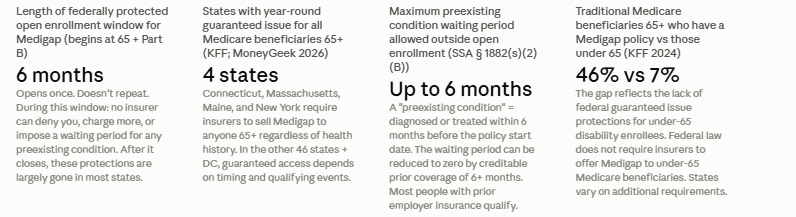
67 million Americans covered by Medicare (KFF 2024). 14.4 million Medigap policyholders (MedPAC 2024/NAIC 2023). 46% of traditional Medicare beneficiaries 65+ have Medigap vs only 7% of under-65 disability enrollees (KFF 2024). 22% of older adults face medical debt concerns (KFF 2024). Medigap enrollment by state: 9% (Hawaii) to 67% (Iowa). Plan G (most comprehensive for new enrollees): 39% of 2023 policyholders (~5.3 million). Plan F: 41% (legacy, closed to new enrollment January 1, 2020). Open enrollment: 6-month federally protected window beginning month of 65th birthday AND Part B enrollment. 4 states require year-round guaranteed issue: CT, MA, ME, NY. Waiting period for preexisting conditions outside OEP: up to 6 months. Preexisting condition definition: diagnosed or treated within 6 months before policy start date.
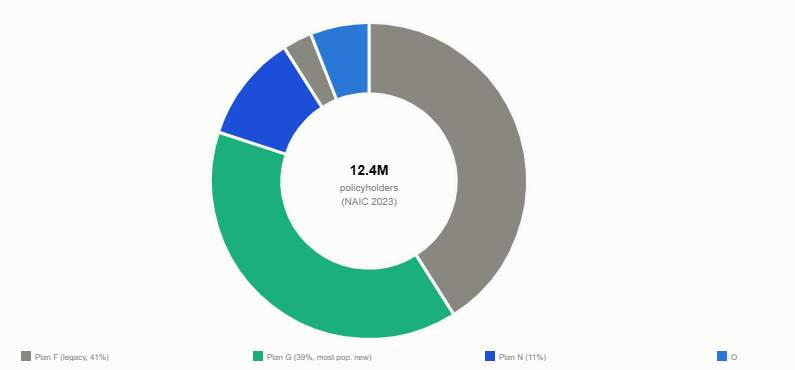
The plans available to new enrollees are standardised at the federal level: each plan letter (A, B, D, G, K, L, M, N) offers an identical set of benefits regardless of which insurer sells it. Plan G is now the most comprehensive option available to new beneficiaries — Plan F, which was historically the most popular, was closed to new enrollment on January 1, 2020 (though those who enrolled before that date can keep it). In 2023, Plan G accounted for approximately 39% of all Medigap policyholders (approximately 5.3 million people), while Plan F still held 41% as a legacy block (MedPAC 2024; NAIC data). Because the benefits within a plan letter are identical, the only variables when comparing plans of the same letter type are price, the insurer’s financial strength, and the insurer’s premium rate increase history.
For people with chronic or serious health conditions, Medigap’s financial protection is particularly critical. Traditional Medicare’s lack of an out-of-pocket maximum means that a beneficiary with diabetes, heart disease, cancer, or any condition requiring frequent care is exposed to potentially unlimited annual costs under Medicare alone. The 22% of older adults who face medical debt concerns are disproportionately those without supplemental coverage. Medigap converts that unlimited exposure into a predictable monthly premium, enabling people with significant health conditions to budget for healthcare costs without fear of catastrophic expenses. Whether they can obtain that protection at the standard rate, at a higher premium, or at all, however, depends entirely on timing.
This window is not announced or applied for. It opens automatically when the two eligibility conditions (age 65 and Part B enrollment) are met. It is not the same as the Medicare Annual Enrollment Period (October 15 to December 7), which applies to Medicare Advantage and Part D drug plans. The Medigap open enrollment period is a separate, one-time event that exists purely within the Medigap context.
The most common source of confusion, noted by MoneyGeek’s 2026 Medicare Supplement guide, involves beneficiaries who delay Part B enrollment because they have employer-sponsored health coverage. Employer coverage is a legitimate reason to delay Part B enrollment without penalty — but it also delays the start of the Medigap open enrollment window. The window does not start at age 65 for these beneficiaries; it starts when Part B begins. A 65-year-old who stays on employer coverage until 68 and then retires will have their six-month Medigap open enrollment window begin at 68 — not at 65. This is advantageous in some ways (it allows the open enrollment window to align with actual need), but it means the window does not exist as a standing option throughout the years between 65 and retirement.
The governing federal law for the Medigap open enrollment period is the Social Security Act Section 1882(s)(2). It establishes: (1) the six-month window beginning at first-month-of-65-and-Part-B; (2) the prohibition on medical underwriting, application denial, and premium surcharges based on health history during this window; and (3) the creditable coverage rule for reducing or eliminating waiting periods within the window. Source: ssa.gov; CMS/NAIC 2025 Medigap Guide (medicare.gov/publications/02110).
The federal definition of a preexisting condition for Medigap purposes is a condition that was diagnosed or treated within the six months before the new Medigap policy's start date (Social Security Act Section 1882(s)(2)(B); brevy.com 2026). This is a backward-looking window: only conditions that were actively diagnosed or treated in the six months immediately preceding the policy start are subject to the waiting period. A condition diagnosed ten years ago that has not required treatment in the past six months does not fall within this definition.
During the waiting period, the policy remains active and covers all other Medicare cost-sharing. The insurer is not permitted to extend the waiting period beyond six months, regardless of the severity of the condition or the expected cost of care. After the six-month waiting period expires, the policy provides full coverage for the previously excluded preexisting conditions going forward.
The waiting period applies to the COST-SHARING for preexisting conditions, not to Medicare coverage itself. Medicare Parts A and B continue to pay their share of costs for all conditions throughout the waiting period. The Medigap waiting period only affects whether the Medigap policy picks up the portion Medicare does not cover (the deductibles, copayments, and coinsurance). A beneficiary with a heart condition who buys Medigap outside their open enrollment window may face a six-month period during which Medicare covers 80% of their cardiology costs but the Medigap policy does not pick up the remaining 20%. Not insurance advice.
Most forms of prior health coverage qualify as creditable coverage: employer-sponsored health insurance, coverage under COBRA, individual market health plans, Medicare Advantage plans, Medicaid (with some exceptions), and most other forms of continuous comprehensive health coverage. The key requirement is continuity — a significant gap in coverage (typically more than 63 days) can reset the creditable coverage clock.
The practical outcome is powerful: a beneficiary who comes to their Medigap open enrollment window (or to an outside-enrollment purchase) with six or more months of uninterrupted creditable coverage before their Medigap policy start date has the preexisting condition waiting period reduced to zero. Most people enrolling at 65 who had employer-sponsored coverage before retirement meet this threshold easily. MedicareInteractive.org explains the rule directly: ‘During this protected period [open enrollment], Medigap policies must shorten any preexisting condition waiting period by the number of months you had prior creditable coverage. Most forms of health coverage count as creditable.’
The creditable coverage rule means that for most people using their open enrollment window who had any form of continuous health coverage before Medicare — which describes the vast majority of Americans who were insured through their employer — neither the six-month waiting period nor the preexisting condition definition is practically relevant. The waiting period is reduced to zero, and preexisting conditions are covered from day one.
Guaranteed issue rights are narrower than open enrollment in two important ways. First, they are triggered only by specific qualifying events — they do not reopen general access to Medigap. Second, guaranteed issue rights at the federal level typically provide access only to specific plan letters (Plans A, B, C, F, K, or L, depending on the triggering event), not to the full range of plan types the insurer may offer. Some states provide broader guaranteed issue access than the federal minimum.
MedicareSupplement.com’s 2026 guide summarises the guaranteed issue right clearly: ‘If you have a guaranteed issue right, an insurance company must sell you a Medigap policy, must cover all preexisting conditions, and cannot charge you more because of your preexisting condition.’ The coverage and non-discrimination protections are identical to those in open enrollment; the difference is that they can only be accessed through the specific qualifying events, and they provide access only for the plan letters specified in federal law for each event.
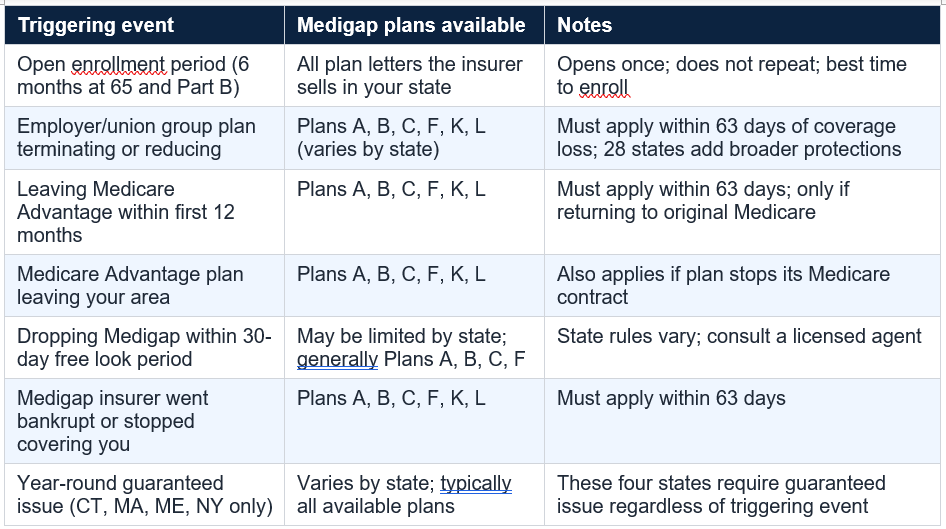
Four states have enacted legislation that provides broader guaranteed issue protections: Connecticut, Massachusetts, Maine, and New York. In these states, Medigap insurers are required to accept applications from Medicare beneficiaries ages 65 and older regardless of health status — effectively providing year-round guaranteed issue rights. In these four states, a beneficiary with any preexisting condition can purchase Medigap at any time, subject to applicable premium rules, without facing medical underwriting or application denial (KFF; MoneyGeek 2026; Healthline; brevy.com 2026).
Massachusetts, Maine, and Minnesota also operate under unique standardised Medigap plan structures that differ from the federal lettered plan system used in other states. Massachusetts, for example, has its own Core and Supplement 1 plan definitions. Beneficiaries in these states should consult state-specific resources rather than applying federal plan letter descriptions directly.
MoneyGeek’s 2026 Medicare Supplement guide notes: ‘Only a small number of states, including Connecticut, Massachusetts, Maine, New York and Washington, require year-round guaranteed issue.’ The reference to Washington (state) is consistent with additional state-specific protections in some contexts, though the KFF and broader policy literature primarily identifies the four states listed above as having the most comprehensive year-round requirements.
If you live in Connecticut, Massachusetts, Maine, or New York: your guaranteed issue rights for Medigap are significantly broader than in other states. You can apply for Medigap coverage outside of open enrollment and outside of qualifying events. You should still carefully compare plans and premiums, as insurers in these states may be permitted to vary premiums by age, gender, and tobacco use even while they cannot deny coverage. Contact your state’s SHIP (State Health Insurance Assistance Program) or a licensed insurance agent for guidance specific to your state’s rules. Not insurance advice.
This is a fundamental feature of how the Medigap market operates outside protected windows. The federal consumer protections are time-bound and event-bound. They do not provide a general right to purchase Medigap at any time regardless of health. The protected windows exist precisely because without them, the private insurance market would make Medigap unaffordable or inaccessible for most people with preexisting conditions — which is to say, most people entering Medicare.
What can a beneficiary with a preexisting condition do if they find themselves outside open enrollment with no qualifying event? MoneyGeek’s 2026 guide describes the realistic options: a healthy beneficiary who missed the window will likely find at least some insurers willing to accept their application, possibly with a higher premium, though the range of plans available and the pricing will vary. A beneficiary with significant chronic conditions who missed the window faces a much more restricted market. In most states, they may be declined by multiple insurers and may find that the only option is to wait for a qualifying event to occur.
The strategic implication is significant: missing the Medigap open enrollment window is not recoverable by simply applying again later. The window does not reopen. For people who enter Medicare and do not enrol in Medigap during the open enrollment window, the consequences can be permanent — restricted or denied access to Medigap for the remainder of their life in most states, unless a qualifying event occurs.
For someone with any preexisting health conditions — diabetes, heart disease, cancer history, kidney disease, COPD, or any condition requiring ongoing treatment — the Medigap open enrollment period is not an optional window to consider. It is the only circumstance in which they are guaranteed the right to purchase Medigap at standard rates. Missing it means facing a market that may refuse them entirely. Not insurance advice. Contact Medicare.gov or call 1-800-MEDICARE for personalised assistance.
Federal law does not require Medigap insurers to offer any Medigap policies to Medicare beneficiaries under age 65. This creates a default in which under-65 beneficiaries may have no right to purchase Medigap at all. Some states have enacted laws requiring insurers to offer at least some Medigap options to under-65 beneficiaries, but the scope of these requirements varies widely by state. KFF’s 2024 analysis of Medigap enrollment finds that only 7% of traditional Medicare beneficiaries under age 65 have a Medigap policy, compared to 46% of those 65 and older — in large part due to this lack of federal guaranteed issue protection.
When an under-65 disability enrollee eventually reaches age 65, they receive a new, fresh six-month open enrollment period based on their age-65 Part B enrollment, providing a reset of the full guaranteed issue protection. This is the most important long-term planning point for under-65 Medicare beneficiaries: the age-65 open enrollment period is when their full Medigap access rights are established, regardless of what they experienced before age 65. Wisconsin’s BOALTC Medicare supplement page confirms: ‘If an individual is under age 65 and in Medicare due to disability or end stage renal disease, the beneficiary will be entitled to a second six-month open enrollment period upon reaching age 65.’
For new beneficiaries, Plan G is the most comprehensive plan available and the current market leader in new enrollment (39% of policyholders in 2023; approximately 5.3 million people). Plan G covers everything Plan F covered except the Medicare Part B annual deductible ($240 in 2024; check CMS for the current year’s figure). Because Plan G is not among the plans available under most federal guaranteed issue triggers, a beneficiary who experiences a qualifying event after their open enrollment window has closed may find that the most comprehensive plan available to them under guaranteed issue is not Plan G.
Plan N is the third most popular plan at 11% of policyholders. It is also not typically available under federal guaranteed issue triggers. Beneficiaries evaluating guaranteed issue options should confirm with a licensed insurance agent which specific plan letters are available under the guaranteed issue trigger applicable to their situation and in their state.
MoneyGeek’s 2026 guide on switching Medigap plans with preexisting conditions explains: ‘Federal law creates two windows during which Medigap insurers cannot apply medical underwriting, cannot deny an application based on health status and cannot charge a premium surcharge based on pre-existing conditions. These windows are the Medigap open enrollment period and guaranteed issue rights.’ Outside these windows, switching plans is subject to the same potential for denial and premium surcharge as any new application.
In practice, a beneficiary who purchases a Medigap plan during their open enrollment period and keeps it can maintain that coverage regardless of subsequent changes to their health. Insurers cannot cancel or reprice an active Medigap policy based on the policyholder’s health status. The underwriting challenge arises only when the beneficiary wants to change plans or insurers — the new application triggers the outside-open-enrollment rules. This is why the initial plan choice at open enrollment is so important: it may be the only opportunity to choose the most comprehensive plan without underwriting.
The system creates a strong incentive to enrol in Medigap during open enrollment rather than waiting. The best time to enrol in Medigap is during the open enrollment period — regardless of current health, regardless of current cost-sharing exposure, and regardless of the appeal of Medicare Advantage as an alternative. Choosing Medicare Advantage instead of Medigap during open enrollment is a legitimate decision, but it should be made with clear understanding that returning to Medigap later — if Medicare Advantage does not meet needs — will require navigating medical underwriting in most states.
The four states with year-round guaranteed issue (Connecticut, Massachusetts, Maine, and New York) provide a safety net that most states do not. Under-65 disability beneficiaries face the most restricted access, with an important reset at age 65 when a fresh open enrollment window opens. And throughout the system, creditable prior coverage is the tool that eliminates the preexisting condition waiting period for those who come to their enrollment window with continuous prior health coverage. Not insurance advice. Contact Medicare.gov, call 1-800-MEDICARE, or reach your state SHIP for personalised assistance.
What is the Medigap preexisting condition waiting period?
Federal law (Social Security Act Section 1882(s)(2)(B)) permits Medigap insurers to impose a waiting period of up to six months before covering costs related to preexisting conditions, when a policy is purchased outside the open enrollment period or outside a guaranteed issue right. During this waiting period, the policy is still in force and covers all other Medicare cost-sharing, but the insurer can decline to pay the Medigap share of costs specifically related to preexisting conditions. A preexisting condition is defined as a condition that was diagnosed or treated within the six months before the new policy’s start date. The waiting period can be reduced or eliminated entirely by creditable coverage: if you had at least six months of continuous prior health coverage (employer insurance, COBRA, individual market plans, etc.) before the Medigap policy started, the waiting period is reduced month-for-month. Most people who had employer-sponsored insurance before Medicare will have their waiting period reduced to zero. Not insurance advice.
What are guaranteed issue rights for Medigap?
Guaranteed issue rights are federally protected rights to purchase Medigap outside the open enrollment period without underwriting, denial, or premium surcharge based on health status. They are triggered by specific qualifying events: (1) your employer group health plan is terminating or reducing coverage; (2) you are returning to original Medicare from a Medicare Advantage plan within 12 months of first joining; (3) your Medicare Advantage plan is being discontinued or withdrawing from Medicare in your area; (4) you are dropping a Medigap policy within the first 30 days; or (5) your Medigap insurer went bankrupt or stopped covering you. When a guaranteed issue right is triggered, you have a limited window (typically 63 days from the triggering event) to purchase a Medigap plan. During this window, insurers must accept your application, must cover all preexisting conditions with no waiting period, and cannot charge higher premiums because of your health. The plan letters available under federal guaranteed issue rights are generally Plans A, B, C, F, K, and L. Note that Plans C and F are no longer available to new enrollees after January 1, 2020. State rules may expand these protections. Not insurance advice.
What states have year-round guaranteed issue for Medigap?
As of 2026, four states require Medigap insurers to provide guaranteed issue protections to Medicare beneficiaries ages 65 and older continuously or on an annual basis, regardless of health history: Connecticut, Massachusetts, Maine, and New York (KFF; MoneyGeek 2026; Healthline). In these states, Medigap insurers cannot deny an application or charge higher premiums based on preexisting conditions, giving residents the equivalent of open enrollment access at any time. Massachusetts, Maine, and Minnesota operate under unique standardised Medigap plan structures that differ from the federal lettered plan system. Beneficiaries in these states should consult state-specific resources. Additionally, 28 states extend guaranteed issue rights beyond the federal minimum for specific situations, such as employer retiree coverage changes (KFF). Always verify current state-specific rules with your state’s SHIP or a licensed insurance agent, as state laws change. Not insurance advice.
What happens if I miss the Medigap open enrollment period?
If you miss the six-month Medigap open enrollment period without a guaranteed issue right applying, your options for obtaining Medigap coverage become significantly more limited and depend on your state and your health status. In most states, Medigap insurers can require you to complete a health questionnaire, can deny your application based on health conditions, can charge higher premiums, or can impose up to a six-month waiting period on preexisting conditions. A healthy beneficiary who missed the window may find some insurers willing to accept their application at somewhat higher rates. A beneficiary with significant chronic conditions may be declined by multiple insurers. The four states with year-round guaranteed issue (CT, MA, ME, NY) are exceptions where continued access is protected. Qualifying events (see Section 8) can reopen access, but only when those specific events occur. The strategic advice from multiple Medicare guidance sources (Medicare.gov, MedicareInteractive.org, MoneyGeek) is consistent: the best time to enrol in Medigap is during your open enrollment period, before health conditions can affect your eligibility. Contact 1-800-MEDICARE or your state SHIP for assistance. Not insurance advice.
Table of Contents
- The Timing Question That Defines Your Medigap Access
- What Medigap Is and Why It Matters for People With Health Conditions
- The Open Enrollment Period: Your Six-Month Window of Full Protection
- What Happens During Open Enrollment: Four Guaranteed Protections
- The Preexisting Condition Waiting Period: How It Works Outside Open Enrollment
- Creditable Coverage: The Key to Shortening or Eliminating the Waiting Period
- Guaranteed Issue Rights: When the Window Reopens After It Has Closed
- The Five Federal Guaranteed Issue Triggering Events
- The Four States With Year-Round Guaranteed Issue
- Can Medigap Insurers Deny You After Open Enrollment? The Honest Answer
- Under-65 Medicare Beneficiaries: A Separate and More Difficult Situation
- The Most Popular Plans and Which Are Available Under Guaranteed Issue
- Switching Medigap Plans With a Preexisting Condition
- Conclusion: The Six-Month Window Is Everything — Do Not Miss It
- Frequently Asked Questions
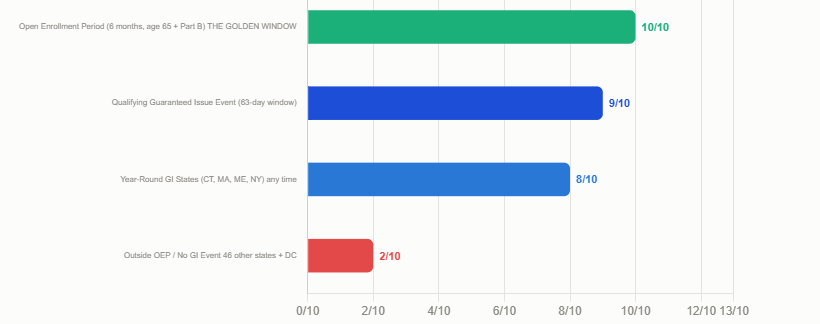
The open enrollment timeline and preexisting condition protections
Medigap plan popularity and what guaranteed issue covers
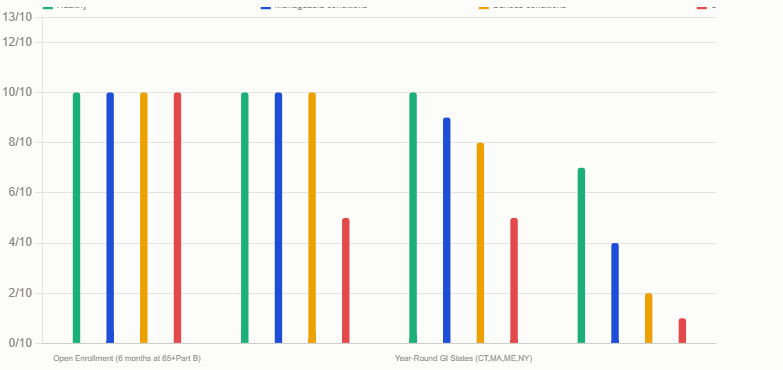
Access rights by situation: who gets in, who doesn't
The Timing Question That Defines Your Medigap Access
Traditional Medicare — Parts A and B — is comprehensive enough to cover the majority of medical care for America’s 67 million Medicare beneficiaries. But it leaves significant financial gaps. Medicare has no annual out-of-pocket spending limit, a structural feature that makes it unlike virtually every other health insurance product in America. A beneficiary who needs intensive hospital care, repeated specialist visits, or prolonged outpatient treatment can face tens of thousands of dollars in out-of-pocket costs — all within a single year — with no ceiling. Medical debt is a concern for more than one in five (22%) older adults (KFF 2024).Medigap — Medicare Supplement insurance — is the private insurance product that fills these gaps, paying for the cost-sharing that Medicare leaves to the beneficiary. Approximately 14.4 million Americans have a Medigap policy, representing about 46% of traditional Medicare beneficiaries aged 65 and older (MedPAC 2024; NAIC data). But the ability to obtain Medigap coverage when you have a preexisting health condition — which describes most people entering Medicare at 65 — is governed by a specific set of timing rules that create very different outcomes depending on when you apply.
The central rule is this: during a six-month federally protected open enrollment window that opens when you turn 65 and enroll in Medicare Part B, no Medigap insurer can deny your application, charge you more, or apply a waiting period because of any preexisting health condition. After that window closes, most of those protections are gone. Outside of a limited set of qualifying events that trigger ‘guaranteed issue rights,’ Medigap insurers in most states can decline your application, charge you higher premiums, or impose waiting periods before covering preexisting conditions. The timing of your application is not an administrative detail. It is the determinative factor in whether you can obtain comprehensive Medigap coverage at all.
67 million Americans covered by Medicare (KFF 2024). 14.4 million Medigap policyholders (MedPAC 2024/NAIC 2023). 46% of traditional Medicare beneficiaries 65+ have Medigap vs only 7% of under-65 disability enrollees (KFF 2024). 22% of older adults face medical debt concerns (KFF 2024). Medigap enrollment by state: 9% (Hawaii) to 67% (Iowa). Plan G (most comprehensive for new enrollees): 39% of 2023 policyholders (~5.3 million). Plan F: 41% (legacy, closed to new enrollment January 1, 2020). Open enrollment: 6-month federally protected window beginning month of 65th birthday AND Part B enrollment. 4 states require year-round guaranteed issue: CT, MA, ME, NY. Waiting period for preexisting conditions outside OEP: up to 6 months. Preexisting condition definition: diagnosed or treated within 6 months before policy start date.
What Medigap Is and Why It Matters for People With Health Conditions
Medigap, also called Medicare Supplement insurance, is private health insurance sold by state-licensed insurance companies to fill the cost-sharing gaps in original Medicare. It does not replace Medicare — it supplements it. A Medigap policy pays for all or part of the deductibles, copayments, and coinsurance that original Medicare requires the beneficiary to pay out of pocket.The plans available to new enrollees are standardised at the federal level: each plan letter (A, B, D, G, K, L, M, N) offers an identical set of benefits regardless of which insurer sells it. Plan G is now the most comprehensive option available to new beneficiaries — Plan F, which was historically the most popular, was closed to new enrollment on January 1, 2020 (though those who enrolled before that date can keep it). In 2023, Plan G accounted for approximately 39% of all Medigap policyholders (approximately 5.3 million people), while Plan F still held 41% as a legacy block (MedPAC 2024; NAIC data). Because the benefits within a plan letter are identical, the only variables when comparing plans of the same letter type are price, the insurer’s financial strength, and the insurer’s premium rate increase history.
For people with chronic or serious health conditions, Medigap’s financial protection is particularly critical. Traditional Medicare’s lack of an out-of-pocket maximum means that a beneficiary with diabetes, heart disease, cancer, or any condition requiring frequent care is exposed to potentially unlimited annual costs under Medicare alone. The 22% of older adults who face medical debt concerns are disproportionately those without supplemental coverage. Medigap converts that unlimited exposure into a predictable monthly premium, enabling people with significant health conditions to budget for healthcare costs without fear of catastrophic expenses. Whether they can obtain that protection at the standard rate, at a higher premium, or at all, however, depends entirely on timing.
The Open Enrollment Period: Your Six-Month Window of Full Protection
The Medigap open enrollment period is a federally protected window that begins on the first day of the month in which a beneficiary is both age 65 or older AND enrolled in Medicare Part B. It lasts exactly six months. During this window, every Medigap insurer selling plans in a state must accept any eligible applicant and must provide coverage for preexisting conditions from day one — without medical underwriting, without premium surcharges, and without any waiting periods.This window is not announced or applied for. It opens automatically when the two eligibility conditions (age 65 and Part B enrollment) are met. It is not the same as the Medicare Annual Enrollment Period (October 15 to December 7), which applies to Medicare Advantage and Part D drug plans. The Medigap open enrollment period is a separate, one-time event that exists purely within the Medigap context.
The most common source of confusion, noted by MoneyGeek’s 2026 Medicare Supplement guide, involves beneficiaries who delay Part B enrollment because they have employer-sponsored health coverage. Employer coverage is a legitimate reason to delay Part B enrollment without penalty — but it also delays the start of the Medigap open enrollment window. The window does not start at age 65 for these beneficiaries; it starts when Part B begins. A 65-year-old who stays on employer coverage until 68 and then retires will have their six-month Medigap open enrollment window begin at 68 — not at 65. This is advantageous in some ways (it allows the open enrollment window to align with actual need), but it means the window does not exist as a standing option throughout the years between 65 and retirement.
The governing federal law for the Medigap open enrollment period is the Social Security Act Section 1882(s)(2). It establishes: (1) the six-month window beginning at first-month-of-65-and-Part-B; (2) the prohibition on medical underwriting, application denial, and premium surcharges based on health history during this window; and (3) the creditable coverage rule for reducing or eliminating waiting periods within the window. Source: ssa.gov; CMS/NAIC 2025 Medigap Guide (medicare.gov/publications/02110).
What Happens During Open Enrollment: Four Guaranteed Protections
MoneyGeek’s 2026 Medicare Supplement open enrollment guide identifies four specific protections that exist during open enrollment and that are not automatically available again after the window closes:- No medical underwriting: the insurer cannot ask you to complete a health questionnaire, cannot review your medical records for pricing purposes, and cannot use any aspect of your health history to evaluate your application.
- Coverage for preexisting conditions from day one: as long as you have qualifying creditable prior coverage (see Section 6), no waiting period applies to conditions you already had when your policy began. The policy covers preexisting condition costs from the first day it is in force.
- Access to any plan letter the insurer sells: during open enrollment, you can purchase any plan letter (A, B, D, G, K, L, M, N) that the insurer offers in your state. Outside open enrollment, even if an insurer is willing to sell you a plan, they may restrict which plan letters they make available to applicants with health conditions.
- The right to choose any insurer in your state based on price alone: because every insurer must accept you and cannot surcharge based on health, the only meaningful variable is the premium. Price comparison is possible in a way it is not outside open enrollment. Outside the window, the insurer’s willingness to accept you at all becomes the first filter — price becomes secondary.
The Preexisting Condition Waiting Period: How It Works Outside Open Enrollment
When a Medigap policy is purchased outside the open enrollment period (and outside a guaranteed issue event), federal law permits the insurer to impose a waiting period of up to six months before the policy covers costs related to preexisting conditions. This is not a denial of coverage — it is a temporary exclusion of coverage for specific preexisting conditions while coverage for everything else begins immediately.The federal definition of a preexisting condition for Medigap purposes is a condition that was diagnosed or treated within the six months before the new Medigap policy's start date (Social Security Act Section 1882(s)(2)(B); brevy.com 2026). This is a backward-looking window: only conditions that were actively diagnosed or treated in the six months immediately preceding the policy start are subject to the waiting period. A condition diagnosed ten years ago that has not required treatment in the past six months does not fall within this definition.
During the waiting period, the policy remains active and covers all other Medicare cost-sharing. The insurer is not permitted to extend the waiting period beyond six months, regardless of the severity of the condition or the expected cost of care. After the six-month waiting period expires, the policy provides full coverage for the previously excluded preexisting conditions going forward.
The waiting period applies to the COST-SHARING for preexisting conditions, not to Medicare coverage itself. Medicare Parts A and B continue to pay their share of costs for all conditions throughout the waiting period. The Medigap waiting period only affects whether the Medigap policy picks up the portion Medicare does not cover (the deductibles, copayments, and coinsurance). A beneficiary with a heart condition who buys Medigap outside their open enrollment window may face a six-month period during which Medicare covers 80% of their cardiology costs but the Medigap policy does not pick up the remaining 20%. Not insurance advice.
Creditable Coverage: The Key to Shortening or Eliminating the Waiting Period
The six-month preexisting condition waiting period is not immovable. Federal law provides a specific mechanism for reducing or eliminating it: creditable coverage. If a beneficiary had prior health coverage for a continuous period before enrolling in Medigap, the waiting period is reduced month-for-month by the number of months of creditable coverage they bring to the new Medigap policy.Most forms of prior health coverage qualify as creditable coverage: employer-sponsored health insurance, coverage under COBRA, individual market health plans, Medicare Advantage plans, Medicaid (with some exceptions), and most other forms of continuous comprehensive health coverage. The key requirement is continuity — a significant gap in coverage (typically more than 63 days) can reset the creditable coverage clock.
The practical outcome is powerful: a beneficiary who comes to their Medigap open enrollment window (or to an outside-enrollment purchase) with six or more months of uninterrupted creditable coverage before their Medigap policy start date has the preexisting condition waiting period reduced to zero. Most people enrolling at 65 who had employer-sponsored coverage before retirement meet this threshold easily. MedicareInteractive.org explains the rule directly: ‘During this protected period [open enrollment], Medigap policies must shorten any preexisting condition waiting period by the number of months you had prior creditable coverage. Most forms of health coverage count as creditable.’
The creditable coverage rule means that for most people using their open enrollment window who had any form of continuous health coverage before Medicare — which describes the vast majority of Americans who were insured through their employer — neither the six-month waiting period nor the preexisting condition definition is practically relevant. The waiting period is reduced to zero, and preexisting conditions are covered from day one.
Guaranteed Issue Rights: When the Window Reopens After It Has Closed
The Medigap open enrollment period opens once and does not repeat. But federal law creates a second category of protection — guaranteed issue rights — that can be triggered by specific qualifying events throughout a beneficiary’s life. When a qualifying event occurs, the beneficiary has a limited window (typically 63 days) during which Medigap insurers must accept their application, must provide coverage for preexisting conditions immediately with no waiting period, and cannot charge higher premiums because of health status.Guaranteed issue rights are narrower than open enrollment in two important ways. First, they are triggered only by specific qualifying events — they do not reopen general access to Medigap. Second, guaranteed issue rights at the federal level typically provide access only to specific plan letters (Plans A, B, C, F, K, or L, depending on the triggering event), not to the full range of plan types the insurer may offer. Some states provide broader guaranteed issue access than the federal minimum.
MedicareSupplement.com’s 2026 guide summarises the guaranteed issue right clearly: ‘If you have a guaranteed issue right, an insurance company must sell you a Medigap policy, must cover all preexisting conditions, and cannot charge you more because of your preexisting condition.’ The coverage and non-discrimination protections are identical to those in open enrollment; the difference is that they can only be accessed through the specific qualifying events, and they provide access only for the plan letters specified in federal law for each event.
The Five Federal Guaranteed Issue Triggering Events
Federal law specifies the qualifying events that trigger guaranteed issue rights for Medigap outside the open enrollment period. The following list reflects the primary federally established triggers, as described by Medicare.gov, MedicareSupplement.com, and MedicareInteractive.org:- Event 1 — Employer or union group health plan is terminating or reducing coverage: if you have retiree group health coverage through an employer or union that is ending or being significantly reduced, and that coverage was supplementing your Medicare, you have a guaranteed issue right to purchase a Medigap policy. This is one of the most commonly triggered events as employers adjust or eliminate retiree health benefits.
- Event 2 — You enrolled in a Medicare Advantage plan when you first became eligible for Medicare and want to return to original Medicare: if you joined a Medicare Advantage plan when you first became eligible for Part A and Part B, and you want to switch back to original Medicare within 12 months of first joining the Advantage plan, you have a guaranteed issue right to purchase a Medigap policy.
- Event 3 — Your Medicare Advantage plan is leaving your area or stopping its Medicare contract: if your Medicare Advantage plan is being discontinued in your service area, or if the plan is withdrawing from the Medicare programme entirely, you have a guaranteed issue right to purchase a Medigap policy. You also have this right if your Medicare Advantage plan reduces benefits to the point where it no longer qualifies as Medicare coverage.
- Event 4 — You are dropping Medigap within the first 30 days of purchase: a ‘free look period’ right applies when you buy a Medigap policy for the first time and decide to drop it within 30 days. If you drop the Medigap policy during this period and want to buy a different Medigap plan, you may have a guaranteed issue right.
- Event 5 — Your Medigap insurer went bankrupt or stopped covering you: if your Medigap insurance company becomes insolvent, goes out of business, or otherwise terminates your coverage through no fault of your own, you have a guaranteed issue right to purchase a replacement Medigap policy.
The Four States With Year-Round Guaranteed Issue
In the vast majority of states, the open enrollment period and the five federal qualifying events are the only circumstances in which guaranteed issue rights apply to Medigap. Once the open enrollment window closes and no qualifying event applies, insurers in most states can decline applications, apply health-based underwriting, or charge higher premiums based on a beneficiary’s health history.Four states have enacted legislation that provides broader guaranteed issue protections: Connecticut, Massachusetts, Maine, and New York. In these states, Medigap insurers are required to accept applications from Medicare beneficiaries ages 65 and older regardless of health status — effectively providing year-round guaranteed issue rights. In these four states, a beneficiary with any preexisting condition can purchase Medigap at any time, subject to applicable premium rules, without facing medical underwriting or application denial (KFF; MoneyGeek 2026; Healthline; brevy.com 2026).
Massachusetts, Maine, and Minnesota also operate under unique standardised Medigap plan structures that differ from the federal lettered plan system used in other states. Massachusetts, for example, has its own Core and Supplement 1 plan definitions. Beneficiaries in these states should consult state-specific resources rather than applying federal plan letter descriptions directly.
MoneyGeek’s 2026 Medicare Supplement guide notes: ‘Only a small number of states, including Connecticut, Massachusetts, Maine, New York and Washington, require year-round guaranteed issue.’ The reference to Washington (state) is consistent with additional state-specific protections in some contexts, though the KFF and broader policy literature primarily identifies the four states listed above as having the most comprehensive year-round requirements.
If you live in Connecticut, Massachusetts, Maine, or New York: your guaranteed issue rights for Medigap are significantly broader than in other states. You can apply for Medigap coverage outside of open enrollment and outside of qualifying events. You should still carefully compare plans and premiums, as insurers in these states may be permitted to vary premiums by age, gender, and tobacco use even while they cannot deny coverage. Contact your state’s SHIP (State Health Insurance Assistance Program) or a licensed insurance agent for guidance specific to your state’s rules. Not insurance advice.
Can Medigap Insurers Deny You After Open Enrollment? The Honest Answer
Outside the open enrollment period and outside of qualifying guaranteed issue events, Medigap insurers in most US states can and routinely do deny applications based on health status. The honest answer to whether an insurer can deny you is: yes, in 46 states plus Washington, D.C., an insurer can decline your Medigap application after your open enrollment window has closed and no guaranteed issue event applies.This is a fundamental feature of how the Medigap market operates outside protected windows. The federal consumer protections are time-bound and event-bound. They do not provide a general right to purchase Medigap at any time regardless of health. The protected windows exist precisely because without them, the private insurance market would make Medigap unaffordable or inaccessible for most people with preexisting conditions — which is to say, most people entering Medicare.
What can a beneficiary with a preexisting condition do if they find themselves outside open enrollment with no qualifying event? MoneyGeek’s 2026 guide describes the realistic options: a healthy beneficiary who missed the window will likely find at least some insurers willing to accept their application, possibly with a higher premium, though the range of plans available and the pricing will vary. A beneficiary with significant chronic conditions who missed the window faces a much more restricted market. In most states, they may be declined by multiple insurers and may find that the only option is to wait for a qualifying event to occur.
The strategic implication is significant: missing the Medigap open enrollment window is not recoverable by simply applying again later. The window does not reopen. For people who enter Medicare and do not enrol in Medigap during the open enrollment window, the consequences can be permanent — restricted or denied access to Medigap for the remainder of their life in most states, unless a qualifying event occurs.
For someone with any preexisting health conditions — diabetes, heart disease, cancer history, kidney disease, COPD, or any condition requiring ongoing treatment — the Medigap open enrollment period is not an optional window to consider. It is the only circumstance in which they are guaranteed the right to purchase Medigap at standard rates. Missing it means facing a market that may refuse them entirely. Not insurance advice. Contact Medicare.gov or call 1-800-MEDICARE for personalised assistance.
Under-65 Medicare Beneficiaries: A Separate and More Difficult Situation
Medicare is available to people under age 65 who have been receiving Social Security disability benefits for 24 consecutive months, or who have End-Stage Renal Disease (ESRD) or ALS (Lou Gehrig’s disease). For these under-65 beneficiaries, the Medigap situation is significantly more difficult than for those who enter Medicare at 65.Federal law does not require Medigap insurers to offer any Medigap policies to Medicare beneficiaries under age 65. This creates a default in which under-65 beneficiaries may have no right to purchase Medigap at all. Some states have enacted laws requiring insurers to offer at least some Medigap options to under-65 beneficiaries, but the scope of these requirements varies widely by state. KFF’s 2024 analysis of Medigap enrollment finds that only 7% of traditional Medicare beneficiaries under age 65 have a Medigap policy, compared to 46% of those 65 and older — in large part due to this lack of federal guaranteed issue protection.
When an under-65 disability enrollee eventually reaches age 65, they receive a new, fresh six-month open enrollment period based on their age-65 Part B enrollment, providing a reset of the full guaranteed issue protection. This is the most important long-term planning point for under-65 Medicare beneficiaries: the age-65 open enrollment period is when their full Medigap access rights are established, regardless of what they experienced before age 65. Wisconsin’s BOALTC Medicare supplement page confirms: ‘If an individual is under age 65 and in Medicare due to disability or end stage renal disease, the beneficiary will be entitled to a second six-month open enrollment period upon reaching age 65.’
The Most Popular Plans and Which Are Available Under Guaranteed Issue
Understanding which Medigap plan letters are available under guaranteed issue rights is important for beneficiaries whose open enrollment window has passed and who experience a qualifying event. Federal law limits the plan letters available under most guaranteed issue triggers to Plans A, B, C, F, K, and L. However, beneficiaries who turned 65 on or after January 1, 2020 cannot enrol in Plan C or Plan F as new policyholders even under guaranteed issue, because those plans were closed to new enrollment on that date.For new beneficiaries, Plan G is the most comprehensive plan available and the current market leader in new enrollment (39% of policyholders in 2023; approximately 5.3 million people). Plan G covers everything Plan F covered except the Medicare Part B annual deductible ($240 in 2024; check CMS for the current year’s figure). Because Plan G is not among the plans available under most federal guaranteed issue triggers, a beneficiary who experiences a qualifying event after their open enrollment window has closed may find that the most comprehensive plan available to them under guaranteed issue is not Plan G.
Plan N is the third most popular plan at 11% of policyholders. It is also not typically available under federal guaranteed issue triggers. Beneficiaries evaluating guaranteed issue options should confirm with a licensed insurance agent which specific plan letters are available under the guaranteed issue trigger applicable to their situation and in their state.
Switching Medigap Plans With a Preexisting Condition
Switching from one Medigap plan to a different Medigap plan — either to a different plan letter or to a different insurer offering the same letter — is subject to the same medical underwriting rules as any other outside-open-enrollment purchase in most states. A beneficiary who wants to switch from Plan N to Plan G, or from one insurer’s Plan G to a competitor’s Plan G, typically must go through medical underwriting outside their open enrollment period unless a guaranteed issue right applies.MoneyGeek’s 2026 guide on switching Medigap plans with preexisting conditions explains: ‘Federal law creates two windows during which Medigap insurers cannot apply medical underwriting, cannot deny an application based on health status and cannot charge a premium surcharge based on pre-existing conditions. These windows are the Medigap open enrollment period and guaranteed issue rights.’ Outside these windows, switching plans is subject to the same potential for denial and premium surcharge as any new application.
In practice, a beneficiary who purchases a Medigap plan during their open enrollment period and keeps it can maintain that coverage regardless of subsequent changes to their health. Insurers cannot cancel or reprice an active Medigap policy based on the policyholder’s health status. The underwriting challenge arises only when the beneficiary wants to change plans or insurers — the new application triggers the outside-open-enrollment rules. This is why the initial plan choice at open enrollment is so important: it may be the only opportunity to choose the most comprehensive plan without underwriting.
Conclusion
Medigap’s relationship with preexisting conditions follows a single governing logic: during the six-month open enrollment window that opens when you turn 65 and enroll in Medicare Part B, you are fully protected. No insurer can deny you, surcharge you, or impose a waiting period based on any preexisting health condition. Outside that window, the protection shrinks to a limited set of qualifying events, and in most states, a beneficiary with significant health conditions may find that they cannot obtain Medigap coverage at all.The system creates a strong incentive to enrol in Medigap during open enrollment rather than waiting. The best time to enrol in Medigap is during the open enrollment period — regardless of current health, regardless of current cost-sharing exposure, and regardless of the appeal of Medicare Advantage as an alternative. Choosing Medicare Advantage instead of Medigap during open enrollment is a legitimate decision, but it should be made with clear understanding that returning to Medigap later — if Medicare Advantage does not meet needs — will require navigating medical underwriting in most states.
The four states with year-round guaranteed issue (Connecticut, Massachusetts, Maine, and New York) provide a safety net that most states do not. Under-65 disability beneficiaries face the most restricted access, with an important reset at age 65 when a fresh open enrollment window opens. And throughout the system, creditable prior coverage is the tool that eliminates the preexisting condition waiting period for those who come to their enrollment window with continuous prior health coverage. Not insurance advice. Contact Medicare.gov, call 1-800-MEDICARE, or reach your state SHIP for personalised assistance.
Frequently Asked Questions
Can I get Medigap with a preexisting condition?
Yes, but the timing determines your rights. During your six-month Medigap open enrollment period (which begins the month you turn 65 and are enrolled in Medicare Part B), insurers must accept your application, cannot charge you more, and cannot impose a waiting period for preexisting conditions. This protection applies regardless of your health history. If you have had continuous creditable prior coverage of six or more months, there is no waiting period at all. After the open enrollment period closes, the rules change significantly. Insurers in most states can deny your application, charge higher premiums, or impose up to a six-month waiting period on preexisting conditions. Only Connecticut, Massachusetts, Maine, and New York require year-round guaranteed issue for all Medicare beneficiaries 65 and older. In all other states, if you miss the open enrollment window and do not have a qualifying guaranteed issue right, you may find it very difficult to obtain Medigap coverage with significant health conditions. Not insurance advice.What is the Medigap preexisting condition waiting period?
Federal law (Social Security Act Section 1882(s)(2)(B)) permits Medigap insurers to impose a waiting period of up to six months before covering costs related to preexisting conditions, when a policy is purchased outside the open enrollment period or outside a guaranteed issue right. During this waiting period, the policy is still in force and covers all other Medicare cost-sharing, but the insurer can decline to pay the Medigap share of costs specifically related to preexisting conditions. A preexisting condition is defined as a condition that was diagnosed or treated within the six months before the new policy’s start date. The waiting period can be reduced or eliminated entirely by creditable coverage: if you had at least six months of continuous prior health coverage (employer insurance, COBRA, individual market plans, etc.) before the Medigap policy started, the waiting period is reduced month-for-month. Most people who had employer-sponsored insurance before Medicare will have their waiting period reduced to zero. Not insurance advice.
What are guaranteed issue rights for Medigap?
Guaranteed issue rights are federally protected rights to purchase Medigap outside the open enrollment period without underwriting, denial, or premium surcharge based on health status. They are triggered by specific qualifying events: (1) your employer group health plan is terminating or reducing coverage; (2) you are returning to original Medicare from a Medicare Advantage plan within 12 months of first joining; (3) your Medicare Advantage plan is being discontinued or withdrawing from Medicare in your area; (4) you are dropping a Medigap policy within the first 30 days; or (5) your Medigap insurer went bankrupt or stopped covering you. When a guaranteed issue right is triggered, you have a limited window (typically 63 days from the triggering event) to purchase a Medigap plan. During this window, insurers must accept your application, must cover all preexisting conditions with no waiting period, and cannot charge higher premiums because of your health. The plan letters available under federal guaranteed issue rights are generally Plans A, B, C, F, K, and L. Note that Plans C and F are no longer available to new enrollees after January 1, 2020. State rules may expand these protections. Not insurance advice.
What states have year-round guaranteed issue for Medigap?
As of 2026, four states require Medigap insurers to provide guaranteed issue protections to Medicare beneficiaries ages 65 and older continuously or on an annual basis, regardless of health history: Connecticut, Massachusetts, Maine, and New York (KFF; MoneyGeek 2026; Healthline). In these states, Medigap insurers cannot deny an application or charge higher premiums based on preexisting conditions, giving residents the equivalent of open enrollment access at any time. Massachusetts, Maine, and Minnesota operate under unique standardised Medigap plan structures that differ from the federal lettered plan system. Beneficiaries in these states should consult state-specific resources. Additionally, 28 states extend guaranteed issue rights beyond the federal minimum for specific situations, such as employer retiree coverage changes (KFF). Always verify current state-specific rules with your state’s SHIP or a licensed insurance agent, as state laws change. Not insurance advice.
What happens if I miss the Medigap open enrollment period?
If you miss the six-month Medigap open enrollment period without a guaranteed issue right applying, your options for obtaining Medigap coverage become significantly more limited and depend on your state and your health status. In most states, Medigap insurers can require you to complete a health questionnaire, can deny your application based on health conditions, can charge higher premiums, or can impose up to a six-month waiting period on preexisting conditions. A healthy beneficiary who missed the window may find some insurers willing to accept their application at somewhat higher rates. A beneficiary with significant chronic conditions may be declined by multiple insurers. The four states with year-round guaranteed issue (CT, MA, ME, NY) are exceptions where continued access is protected. Qualifying events (see Section 8) can reopen access, but only when those specific events occur. The strategic advice from multiple Medicare guidance sources (Medicare.gov, MedicareInteractive.org, MoneyGeek) is consistent: the best time to enrol in Medigap is during your open enrollment period, before health conditions can affect your eligibility. Contact 1-800-MEDICARE or your state SHIP for assistance. Not insurance advice.

0 Comments Comments