
Professional & Career Development
How to Attend University Without a Student Loan

Table of Contents
- Understanding the Real Cost of a University Degree
- Scholarships and Grants: Free Money You Should Not Leave Behind
- Types of Scholarships
- Employer Tuition Assistance: Getting Your Employer to Pay
- Strategic Academic Pathways to Reduce Tuition Costs
- Start at a Community College
- Earn Credits Before You Arrive
- Choose In-State or Lower-Cost Universities
- Funding Sources at a Glance
- Working Your Way Through University
- Cutting Living Costs Without Cutting Corners
- Conclusion
- Frequently Asked Questions (FAQ)
- External References & Further Reading
Student loan debt has become one of the defining financial crises of our generation. In the United States alone, borrowers collectively owe more than $1.7 trillion in student loan debt — a figure that surpasses credit card and auto loan debt combined. In the United Kingdom, graduates leave university owing an average of over £45,000. For millions of students, the prospect of spending a decade or more repaying loans before building any real wealth is a serious deterrent to higher education.
But here is the truth that many prospective students never hear: a university degree does not have to come with a mountain of debt. Hundreds of thousands of students graduate each year debt-free — not because they are exceptionally lucky or exceptionally wealthy, but because they were strategic. They understood the system, sought out available funding, made smart academic choices, and approached their education as a financial project as much as an intellectual one.
This guide breaks down every practical strategy available to prospective and current university students who want to earn their degree without taking on student loans. Whether you are a school leaver planning ahead, a mature student returning to education, or a parent helping a child navigate the system, the roadmap ahead will show you exactly how it can be done.
Understanding the Real Cost of a University Degree
Before you can avoid student debt, you need to understand what you are actually paying for. University costs fall into two broad categories: tuition fees and living costs. In the US, annual tuition at a public university averages around $10,950 for in-state students and $28,240 for out-of-state students, according to the College Board. Private universities average $39,400 per year. Add accommodation, food, books, and transport, and the total cost of attendance at many institutions exceeds $50,000 per year.In the UK, tuition fees for home students are currently capped at £9,250 per year, but living costs in cities like London can add another £12,000 to £18,000 annually. Over a three-year degree, total costs can easily reach £80,000 or more.
Understanding these numbers is essential because debt-free strategies work by systematically reducing or eliminating each cost component — tuition, accommodation, and living expenses — rather than assuming a single magic solution exists. The most successful debt-free students typically combine several strategies simultaneously.
Scholarships and Grants: Free Money You Should Not Leave Behind
Scholarships and grants are the most direct routes to a debt-free degree. Unlike loans, they never need to be repaid. The challenge is that many students simply do not apply for enough of them.Types of Scholarships
- Merit-based scholarships — awarded for academic, athletic, or artistic achievement
- Need-based scholarships — awarded based on family income and financial circumstances
- Subject-specific scholarships — available for students pursuing certain disciplines such as STEM, nursing, or education
- Demographic scholarships — available to first-generation students, underrepresented minorities, students with disabilities, and other groups
- Employer and community scholarships — offered by local businesses, rotary clubs, faith organisations, and professional associations
The FAFSA (Free Application for Federal Student Aid) in the US is the gateway to federal grants including the Pell Grant, which provides up to $7,395 per year for eligible low-income students. This single form also unlocks state grants, institutional aid, and work-study eligibility. Not completing the FAFSA is one of the most costly mistakes a student can make — even students who think they earn too much to qualify are often surprised by the aid available.
Scholarship search platforms such as Scholarships.com, Fastweb, and the College Board's BigFuture database contain hundreds of thousands of awards. Students who dedicate several hours each week to applying throughout Year 12 or their senior year of high school can realistically accumulate enough funding to cover a significant portion — or all — of their tuition.
Employer Tuition Assistance: Getting Your Employer to Pay
One of the most underutilised routes to a debt-free degree is employer-sponsored education. Many large employers — including Amazon, Starbucks, Walmart, McDonald's, and UPS in the US, as well as major UK employers such as Lloyds Banking Group, Deloitte, and the NHS — offer partial or full tuition reimbursement programmes for employees pursuing relevant qualifications.In the United States, the IRS allows employers to provide up to $5,250 per year in tax-free educational assistance under Section 127 of the tax code. This is not a loan — it is a tax-free benefit that reduces your out-of-pocket tuition cost substantially.
Degree apprenticeships in the UK represent perhaps the most powerful version of this model. Offered by universities in partnership with employers, these programmes allow students to earn a full bachelor's or master's degree while working and being paid a salary — with all tuition fees covered by the employer and the government. Programmes are available in fields ranging from accountancy and engineering to nursing and digital technology.
The key requirement for employer tuition assistance is that the degree programme typically needs to be relevant to your role. Choosing an employer who offers this benefit — and planning your academic pathway around it — can entirely eliminate tuition costs.
Strategic Academic Pathways to Reduce Tuition Costs
Start at a Community College
In the US, beginning your degree at a community college and transferring to a four-year university after two years is one of the most powerful cost-reduction strategies available. Community college tuition averages just $3,860 per year — a fraction of university costs. Completing your general education requirements (core modules) at community college level and then transferring to complete your bachelor's degree saves tens of thousands of dollars.Many state universities have guaranteed transfer agreements with community colleges, meaning your credits are fully accepted and your degree is identical to that of a student who completed all four years at the university. Employers and graduate schools do not differentiate.
Earn Credits Before You Arrive
Advanced Placement (AP) exams in the US and A-Level equivalents internationally allow students to earn university-level credit while still in secondary school. A strong AP exam score (typically 4 or 5 out of 5) earns college credit at most US universities, potentially eliminating an entire semester of study — and its associated costs.The College-Level Examination Programme (CLEP) allows students to test out of university courses at any age. At a cost of just $89 per exam, a student who passes several CLEP tests can shave a semester or even a full year off their degree, saving thousands in tuition. UK students can similarly use A-Levels and the Extended Project Qualification (EPQ) to demonstrate advanced readiness and potentially compress their degree timeline.
Choose In-State or Lower-Cost Universities
Where you study has a dramatic effect on total cost. Attending an in-state public university rather than a private or out-of-state institution can save $50,000 to $100,000 over four years. For many careers, the reputational difference between a well-regarded state university and a prestigious private university is negligible, while the financial difference is enormous. Researching universities with the strongest institutional grant programmes — many top universities, including Harvard, MIT, and Oxford, offer free tuition for families earning below a certain income threshold — is essential planning.Funding Sources at a Glance
The table below summarises the main debt-free funding routes, their potential value, and the effort required to access them: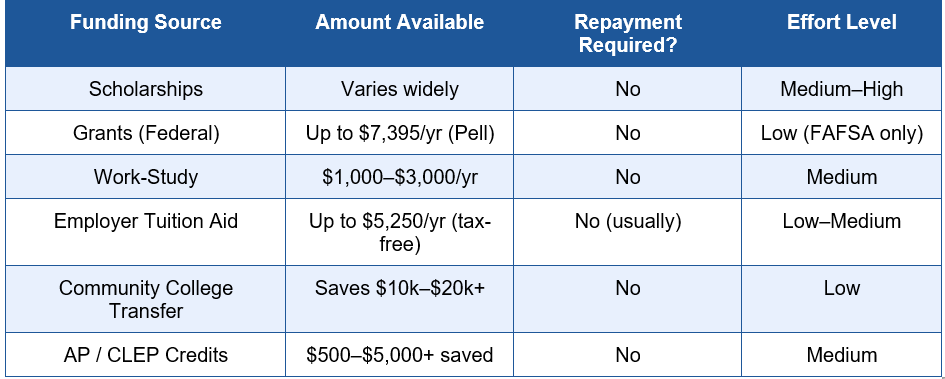
Working Your Way Through University
Part-time and term-time work is a well-established component of debt-free university strategies, but it requires careful balance. Research from the National Centre for Education Statistics shows that students working 10-15 hours per week maintain academic performance comparable to non-working peers, while those working more than 20 hours per week show declines in grades and graduation rates.The Federal Work-Study programme in the US provides part-time employment opportunities — often on-campus — for students with financial need, funded partly by the government. Work-study jobs are arranged around class schedules and provide between $1,000 and $3,000 per year on average.
Beyond formal work-study, students can supplement income through campus employment, tutoring, freelance work, resident advisor roles (which often include free accommodation), and online income streams. The key is treating work as one component of a larger strategy rather than the sole means of funding — and protecting enough time for academic success, which is what makes the degree valuable in the first place.
Cutting Living Costs Without Cutting Corners
Tuition is only part of the equation. Living costs — accommodation, food, transport, and books — can equal or exceed tuition at many institutions. Reducing these costs is just as important as funding tuition.- Live at home or with relatives — where geographically feasible, this eliminates accommodation costs entirely and can save $8,000 to $15,000 per year.
- Apply for resident advisor (RA) positions — RAs typically receive free or heavily subsidised accommodation in exchange for supporting fellow students, representing a significant saving.
- Use the library and open educational resources — textbooks can cost $1,000 or more per year. Borrowing from the library, using OpenStax free textbooks, and accessing PDF versions through institutional subscriptions eliminates this cost almost entirely.
- Cook at home and use student discount schemes — meal plans at universities are often more expensive than self-catering. UK students should use TOTUM (formerly NUS Extra) and US students should leverage their university ID for the extensive student discounts available at supermarkets, transport providers, and software vendors.
- Choose universities in lower cost-of-living areas — a degree from a highly regarded university in a mid-sized city can cost half as much in living expenses as the same quality institution in London, New York, or San Francisco.
Conclusion
The idea that university automatically means debt is a myth — and an expensive one. Hundreds of thousands of students every year graduate with their degrees and their financial futures intact by combining scholarships, grants, employer support, strategic academic choices, and disciplined cost management.None of these strategies require extraordinary intelligence, wealth, or luck. They require planning, research, and the willingness to treat your education as a financial investment that deserves the same careful thought you would give to any major purchase. The earlier you start — ideally in the final years of secondary school — the more options are available to you.
A debt-free degree is not just possible; for many students it is entirely achievable. Start with the FAFSA or your country's equivalent aid application, search scholarship databases consistently, explore employer tuition programmes, and map a cost-efficient academic pathway. Your future self — unburdened by loan repayments and free to save, invest, and build wealth from day one — will thank you for it.
Frequently Asked Questions (FAQ)
Is it really possible to attend university completely debt-free?
Yes, though it typically requires combining multiple strategies rather than relying on a single source of funding. Students who aggressively pursue scholarships, complete FAFSA early, begin at community college, take AP or CLEP exams, and work part-time on campus are most likely to graduate without debt. Degree apprenticeships in the UK make this even more accessible.When should I start applying for scholarships?
As early as possible — ideally in Year 11 or the equivalent of US 10th or 11th grade. Many scholarships have deadlines in the autumn or winter before university entry. Building a scholarship application habit of a few hours per week throughout your final secondary school years significantly increases total award amounts.Does completing FAFSA affect whether I can get scholarships?
No — completing the FAFSA actually increases your eligibility for aid, including grants, work-study, and institutional scholarships. Many private scholarships also require a completed FAFSA to assess financial need. There is no downside to submitting it, and it should be completed as early as possible after October 1st of the application year.Can international students access these debt-free strategies?
International students have fewer federal aid options in the US but can still access institutional scholarships, private awards, home-country government sponsorships, and employer tuition programmes. The UK's degree apprenticeship route is available to students with settled status. Many universities also offer specific international merit scholarships — researching each institution's financial aid page directly is essential.What if I have already taken out loans — is it too late to reduce my debt?
It is never too late. Students already in university can still apply for scholarships (many target current students specifically), switch to a community college for remaining general education credits, seek employer tuition assistance, apply to become a resident advisor for free accommodation, or accelerate graduation by taking a heavier course load and finishing in three years rather than four. Every semester of debt avoided is a meaningful financial improvement.External References & Further Reading
The following authoritative sources were used in researching this article and are recommended for further guidance:1. College Board — Trends in College Pricing and Student Aid 2023
https://research.collegeboard.org/trends/college-pricing
2. Federal Student Aid (FAFSA) — Official Application Portal
https://studentaid.gov/h/apply-for-aid/fafsa
3. Scholarships.com — Free Scholarship Search Database
https://www.scholarships.com/
4. CLEP — College-Level Examination Programme
https://clep.collegeboard.org/
5. UK Government — Degree Apprenticeships Guide
https://www.gov.uk/degree-apprenticeships
6. IRS — Section 127 Employer Educational Assistance
https://www.irs.gov/newsroom/employer-provided-educational-assistance
7. OpenStax — Free Peer-Reviewed University Textbooks
https://openstax.org/
8. NerdWallet — How to Pay for College Without Student Loans
https://www.nerdwallet.com/article/loans/student-loans/how-to-pay-for-college-without-loans
0 Comments
Be the first to share your thoughts on this article.