

Real Estate
How to Compare Thousands of UK Mortgage Deals

The UK mortgage market entered 2026 at its most competitive level in 18 years. There are 7,158 mortgage products currently available — the highest number since October 2007 — with rates falling, lender competition intensifying, and 1.8 million fixed-rate deals due to expire this year alone. If you have a mortgage deal ending in 2026, or are buying a home for the first time, you have more choice than at almost any point since before the financial crisis. The challenge is not the shortage of options. It is the sheer volume. Comparing 7,000 mortgage products manually would take weeks. Comparison sites filter thousands down to dozens. Whole-of-market brokers access deals that never appear on those sites. The combination of the right tools, the right criteria, and an understanding of what the headline rate is not telling you is what turns mortgage comparison from an overwhelming task into a 90-minute exercise that could save you thousands over your deal term. This article gives you that framework, step by step, from understanding what drives rates to locking in a deal six months early. This is Not mortgage, financial, or property advice but general information and educationl purpose only.
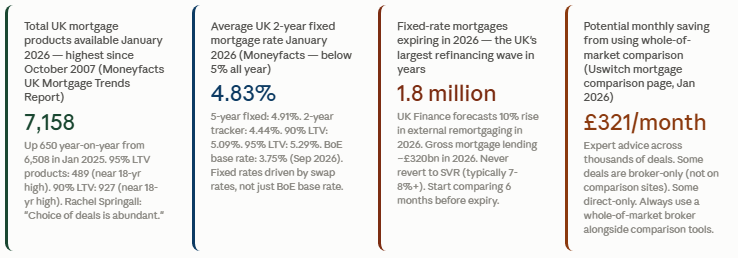
Two specific forces make 2026 the most consequential mortgage year in a generation. First, 1.8 million fixed-rate mortgage deals are due to expire this year (Moneyfacts; Coreco), creating what the industry is calling a ‘refinancing wave.’ Every one of those 1.8 million households needs to compare the market and secure a new deal before they revert to their lender’s Standard Variable Rate — which typically runs 7-8%+ in the current environment, a dramatic and costly leap from their existing fixed rate. Second, Rachel Springall, finance expert at Moneyfacts, described borrower and lender sentiment heading into 2026 as ‘optimism,’ with ‘mortgage rates lower year-on-year, and the choice of deals abundant.’ That abundance is both the opportunity and the challenge: more deals than at any point in 18 years, and no single borrower has the time or framework to evaluate them all without a structured approach. Not mortgage advice.
UK mortgage market 2026: 7,158 products available (highest since Oct 2007; Moneyfacts January 2026). Average 2yr fixed: 4.83%; 5yr fixed: 4.91% (Moneyfacts January 2026). 95% LTV products: 489 (up from 366 year-on-year). 90% LTV: 927 products. 1.8 million fixed-rate deals expiring in 2026. UK Finance: 10% rise in external remortgaging. BoE base rate: 3.75% (September 2026). Rachel Springall, Moneyfacts: 'Expectations are high for a booming market in 2026.' Sources cited. Not mortgage advice.
Mortgage rates are driven by two distinct forces. Tracker and variable rates follow the Bank of England base rate — currently at 3.75% as of September 2026 (oportfolio.co.uk September 2026). Fixed rates are driven by swap rates in the money markets, which reflect expectations of where the base rate is heading, not where it is now. This is why fixed rates can and do move independently of the Bank of England’s decisions — sometimes rising when the base rate is held steady, sometimes falling in anticipation of future base rate cuts. The Coreco January 2026 outlook noted that most forecasters expect the base rate to settle between 3% and 3.75% during 2026, with some suggesting two-year fixed rates could dip below 3.5% before end of year. However, by September 2026, rising swap rates had caused some lenders to increase selected fixed rates despite the base rate remaining unchanged — demonstrating that mortgage rate movements are never entirely predictable. Not mortgage advice.
The critical limitation: some mortgage deals are broker-only, and some are direct-only. A comparison site that searches 60 lenders may not see the full product range of those lenders — only what lenders make visible on that platform. Post Office and CompareTheMarket note explicitly that ‘some deals are available direct from the lender, while others are only available through a mortgage broker.’ This means a comparison site search is a first filter, not a comprehensive market survey. The rates shown are correct at the time of update but can be pulled the same day — Be Clever With Your Cash notes that ‘mortgage rates change all the time, so the rate given one day could be pulled the next.’ Use comparison sites to establish a benchmark and understand the range; then use a broker to verify and access the full market. Not mortgage advice.
The comparison site gap: no single comparison site shows all 7,158 available mortgage deals. Broker-only deals — which represent a significant portion of the market — are not visible on direct comparison tables. Some lenders do not appear on any comparison site. Always use a whole-of-market broker alongside comparison tools, not instead of them. Sources: Post Office/CompareTheMarket 2026; Be Clever With Your Cash 2026; MoneySuperMarket 2026. Not mortgage advice.
Broker types in the UK: tied advisers, who recommend only products from a single lender or panel; multi-tied advisers, who compare a panel of lenders; and whole-of-market independent brokers, who can access the full product range. For genuine market comparison, a whole-of-market broker is the appropriate choice. Fee structure varies: some brokers charge a flat fee (typically £300-£500), some charge a percentage of the mortgage (typically 0.3-1%), and some are fee-free, receiving a proc fee from the lender. MoneyToTheMasses notes fee-free brokers are available — though any broker charge should be verified upfront. Be Clever With Your Cash’s Tembo partner offers a free rate-rechecking service: if you lock in a deal six months early and rates drop before completion, the broker reapplies at no additional cost. That specific feature — rate monitoring post-lock-in — is something comparison sites cannot provide. Not mortgage advice.
Rachel Springall, finance expert at Moneyfacts (January 2026): 'Expectations are high for a booming market in 2026. Mortgage rates are lower year-on-year, and the choice of deals is abundant. As we have seen over the past few months, fixed rate cuts have been in abundance.' MoneyToTheMasses: 'For most borrowers, a mortgage broker is the most effective option because they provide a comprehensive view of the market and understand which loans suit specific types of individuals.' Sources: Moneyfacts/Mortgage Solutions January 2026; MoneyToTheMasses 2026. Not mortgage advice.
First: the arrangement or product fee. Most competitive rates come with fees ranging from zero to £1,999 or more. A rate of 4.70% with a £999 arrangement fee may be more expensive over the deal period than a rate of 4.80% with no fee, depending on the mortgage size. The calculation: take the monthly payment difference and multiply by the deal length in months, then compare to the fee. On a £150,000 mortgage, the monthly saving from a 0.10% rate difference is approximately £14, which over 24 months is £336 — less than the £999 fee. On a £400,000 mortgage, the same 0.10% saves approximately £34/month, or £816 over 24 months — still less than a £999 fee. Always model fee vs rate across the full deal term. Not mortgage advice.
APRC (Annual Percentage Rate of Charge): the legally required true cost metric for UK mortgages. It includes the headline rate plus all fees, expressed as a single annual percentage over the full mortgage term. The APRC is the fairest single-number comparison across deals with different rates and fees. Always read the APRC alongside the headline rate. A lower headline rate with a high fee often produces a higher APRC. Source: FCA regulations; taxfly.co.uk 2026. Not mortgage advice.
Second: early repayment charges (ERCs). Most fixed-rate mortgages charge ERCs of 1-5% of the outstanding balance if you repay or switch during the initial deal period. These charges can be substantial: a 3% ERC on a £300,000 mortgage is £9,000. If you plan to move property, overpay significantly, or might need to access equity during the deal, ERCs are a critical comparison metric. Third: the revert rate or SVR. Every fixed deal ends and reverts to the lender’s SVR unless you remortgage. In 2026, SVRs typically run 7-8%+. A borrower who fails to remortgage when their deal ends can face a dramatic payment increase. Fourth: overpayment allowance. Most deals allow 10% of the outstanding balance to be overpaid each year without triggering ERCs. If you plan to overpay regularly, confirm this allowance before committing. Not mortgage advice.
The LTV brackets that define UK mortgage pricing: 60% LTV or below gives access to the best available rates across the market. 75% LTV is a key threshold where rates step up noticeably. 85% LTV sees another step. 90% LTV — which means a 10% deposit — has 927 products available in January 2026 at near 18-year highs, with an average 2-year fixed at 5.09%. 95% LTV — a 5% deposit — has 489 products at near 18-year highs, average 5.29%. For borrowers close to an LTV threshold, it is worth calculating whether using a slightly larger deposit (or a gift contribution from family) to cross into the next bracket would produce savings that outweigh the upfront cost. A £2,000 additional deposit that moves an 85% LTV borrower to 80% LTV could save hundreds per year in interest — often far exceeding the deposit top-up within two years. Not mortgage advice.
The logic: if you lock in a deal six months before expiry and rates subsequently fall, you are still protected by asking the broker to reapply for a better rate — Be Clever With Your Cash’s Tembo partner offers exactly this as a free rate-checking service. If rates rise after you lock in, you benefit from the rate you secured. If you wait until your deal actually expires, you lose six months of rate security and risk reverting to SVR while the market moves against you. The September 2026 mortgage market update from oportfolio.co.uk noted that rising swap rates had caused several lenders to increase selected fixed rates — precisely the kind of unexpected movement that makes early locking valuable. Not mortgage advice.
The six-month rule: if your current fixed-rate deal expires in the next six months, start comparing now. Lock in a new rate before rates move adversely. If rates fall before your deal starts, ask your broker or lender to switch to the lower rate — many allow this. Starting six months early: protects against rate rises; provides time for proper comparison; avoids the SVR gap if you leave comparison to the last minute. Sources: Uswitch August 2026; CompareTheMarket 2026; Be Clever With Your Cash 2026. Not mortgage advice.
For borrowers who fixed at below 2% in 2021, the payment increase will be substantial regardless of which new deal they choose — the comparison exercise is about minimising that increase rather than avoiding it. For those who fixed at 4-5% in 2023-2024, the 2026 market may offer equivalent or lower rates on renewal, representing a genuine saving opportunity. The September 2026 mortgage market update (oportfolio.co.uk) noted that remortgage approvals had risen slightly in July 2026, reflecting the start of the remortgage wave. The most important action for any borrower whose deal expires in the next six months is to begin the comparison process immediately — do not wait for the expiry date. Not mortgage advice.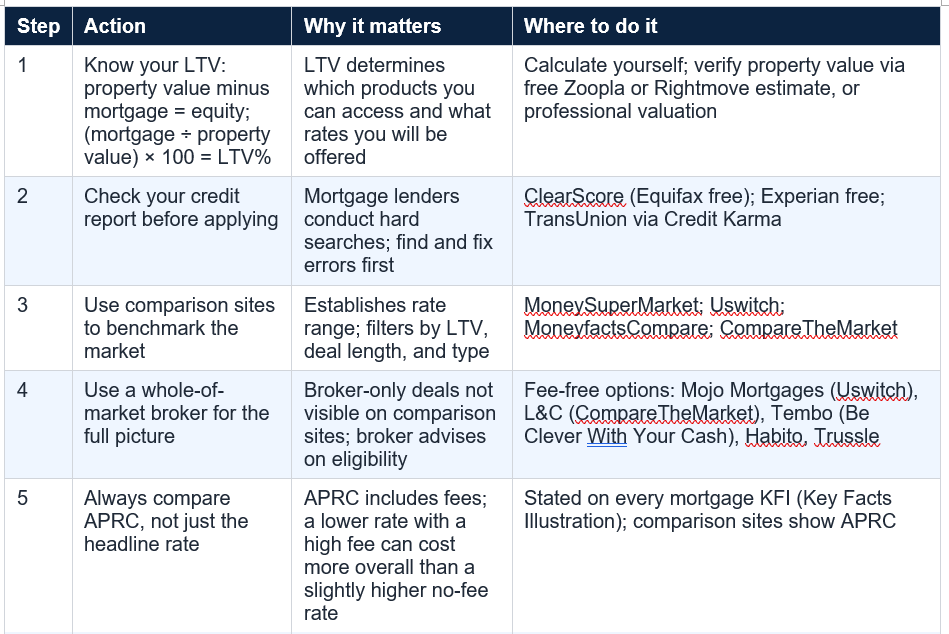
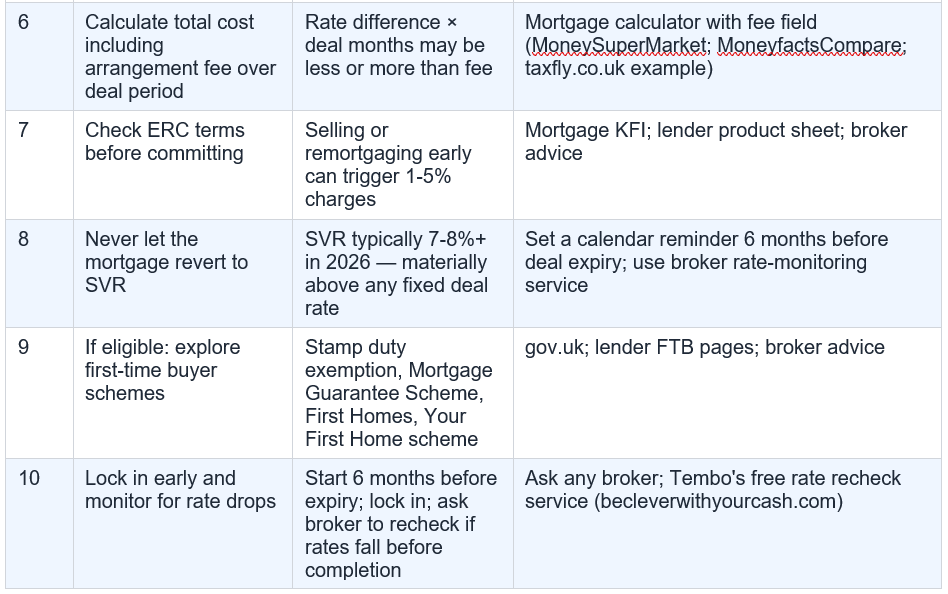
Compare using the APRC, not just the percentage. Always calculate whether a low-rate, high-fee deal costs more or less than a higher-rate, no-fee alternative over your specific deal period. Check the ERC terms before committing. If remortgaging, start six months before your deal expires and lock in a rate even if you think rates might fall further — the cost of getting this timing wrong is reverting to SVR. In 2026, with 7,158 products, 18-year-record low-deposit availability, and 1.8 million deals expiring, the comparison tools and the advice infrastructure exist to navigate this market effectively. The framework above is all most borrowers need to use them well. Not mortgage, financial, or property advice. Your home may be repossessed if you do not keep up repayments. Consult an FCA-regulated mortgage broker.
As of January 2026, there were 7,158 mortgage products available in the UK — an increase of 650 year-on-year from 6,508 in January 2025, and the highest number since October 2007, according to Moneyfacts' UK Mortgage Trends Treasury Report (cited Mortgage Solutions January 12, 2026; MoneyfactsCompare; MoneyToTheMasses). The number of products at 95% LTV (5% deposit) has risen from 366 to 489 in one year, and 90% LTV products stand at 927 — both near 18-year highs. Average rates in January 2026: 2-year fixed 4.83%, 5-year fixed 4.91%, 2-year tracker 4.44%. The Bank of England base rate stands at 3.75% as of September 2026. Fixed mortgage rates do not directly follow the base rate — they are driven by swap rates in the money markets. Source: Moneyfacts January 2026; oportfolio.co.uk September 2026. Not mortgage advice. Rates change daily.
What is the difference between using a comparison site and using a mortgage broker?
Comparison sites (MoneySuperMarket, Uswitch, CompareTheMarket, MoneyfactsCompare) search the products lenders have made visible on those platforms — typically deals from 60-100+ lenders. They are a fast and free first filter that gives you a benchmark for the market. Their limitation: some mortgage deals are broker-only (not available on comparison sites) and some are direct-only (only available if you approach the lender directly). A whole-of-market mortgage broker can access the full product range including broker-only deals, advise on lender eligibility criteria (which can differ significantly even for borrowers with similar profiles), and manage the application process. For most borrowers, MoneyToTheMasses says 'a mortgage broker is the most effective option.' Fee-free whole-of-market brokers include Mojo Mortgages (via Uswitch), L&C (via CompareTheMarket), and Tembo (via Be Clever With Your Cash). Sources: MoneyToTheMasses 2026; Post Office/CompareTheMarket 2026; Uswitch August 2026. Not mortgage advice.
What is APRC and why does it matter for mortgage comparison?
APRC stands for Annual Percentage Rate of Charge. It is the legally required true cost metric for UK mortgages, expressing the total cost of the deal — including the interest rate plus all fees — as a single annual percentage over the full mortgage term. The APRC allows fair comparison between deals with different rates and fee structures. A mortgage with a 4.70% rate and a £999 arrangement fee will have a higher APRC than one with a 4.80% rate and no fee if the fee exceeds the saving from the lower rate over the deal period. On smaller mortgages, fees have more impact on APRC; on larger mortgages, the rate difference dominates. Every mortgage Key Facts Illustration (KFI) must state the APRC. Always read the APRC alongside the headline rate — never use the headline rate alone to compare deals. Source: FCA regulations; taxfly.co.uk 2026. Not mortgage advice.
How soon before my mortgage deal expires should I start comparing?
Six months is the standard guidance, and most major comparison sources (Uswitch, CompareTheMarket, Be Clever With Your Cash) explicitly recommend starting the process at the six-month mark. Most UK mortgage lenders allow you to lock in a new deal up to six months before your current one expires, so you can secure a rate now even if the new deal doesn't start for months. This matters because rates can move significantly in either direction. If you lock in and rates subsequently fall before your deal starts, ask your broker or lender to reapply at the lower rate — Be Clever With Your Cash's partner Tembo offers a free rate-recheck service for exactly this scenario. If you wait until your deal expires and rates have risen, you may be forced to accept a worse rate or temporarily revert to your lender's Standard Variable Rate (SVR), which typically runs 7-8%+ in 2026. With 1.8 million deals expiring in 2026, starting early also avoids the processing delays that can occur when large numbers of borrowers remortgage simultaneously. Sources: Uswitch August 2026; CompareTheMarket 2026; Be Clever With Your Cash 2026. Not mortgage advice.
Are there specific mortgage deals for first-time buyers in 2026?
First-time buyer status does not create an entirely separate mortgage market — most standard deals are available to all buyers. But there are specific advantages for first-time buyers in 2026. Stamp Duty Land Tax exemption (England): since 1 April 2025, first-time buyers are exempt from stamp duty on the first £300,000 of properties costing up to £500,000, saving up to £5,000 vs non-FTB buyers. Scotland: first-time buyers are exempt from LBTT on the first £175,000. The Government Mortgage Guarantee Scheme supports 91-95% LTV mortgages, expanding access for those with 5-9% deposits. The growing availability of 95% LTV products (489 deals in January 2026, near 18-year high) means a 5% deposit is now viable for most eligible borrowers. The First Homes scheme in England offers eligible first-time buyers 30-50% discounts on properties in specific developments. Your First Home scheme (referenced in Lloyds September 2026 HPI) is an additional support mechanism. First-time buyers defined by lenders as having never owned property anywhere globally — including inherited property. For joint applications, all applicants must meet this definition (Uswitch 2026). Source: CompareTheMarket/Post Office 2026; MoneySuperMarket 2026; Uswitch 2026. Not mortgage or legal advice. Verify scheme eligibility at gov.uk.
Table of Contents
- Why 2026 Is the Most Important Year to Compare Your Mortgage
- Understanding the UK Mortgage Market in 2026
- Step 1: Know Your Numbers Before You Start
- Step 2: Understand the Mortgage Types Available
- Step 3: Use Comparison Sites — But Know Their Limits
- Step 4: Use a Whole-of-Market Broker
- Step 5: Compare the True Cost, Not Just the Headline Rate
- Step 6: Understand LTV and How It Affects Your Deals
- Step 7: The Six-Month Early Lock-In Rule
- First-Time Buyers: The Specific Deals and Schemes Available
- Remortgaging: The 1.8 Million Deals Expiring in 2026
- The Complete Mortgage Comparison Checklist
- Conclusion: The Comparison Framework That Actually Works
- Frequently Asked Questions
Why 2026 Is the Most Important Year to Compare Your Mortgage
The UK mortgage market entered 2026 in a condition that most borrowers have not seen in nearly two decades. The total number of available mortgage products reached 7,158 in January 2026 — an increase of 650 products year-on-year and the highest count since October 2007, according to Moneyfacts’ UK Mortgage Trends Treasury Report. Rates have been falling: the average two-year fixed rate sits at 4.83%, the five-year at 4.91%, both below 5% — a threshold that Moneyfacts noted fixed rates have maintained throughout 2026. Low-deposit deals have expanded dramatically: 95% LTV products have risen from 366 to 489 in one year, and 90% LTV products stand at 927 — both near 18-year highs.Two specific forces make 2026 the most consequential mortgage year in a generation. First, 1.8 million fixed-rate mortgage deals are due to expire this year (Moneyfacts; Coreco), creating what the industry is calling a ‘refinancing wave.’ Every one of those 1.8 million households needs to compare the market and secure a new deal before they revert to their lender’s Standard Variable Rate — which typically runs 7-8%+ in the current environment, a dramatic and costly leap from their existing fixed rate. Second, Rachel Springall, finance expert at Moneyfacts, described borrower and lender sentiment heading into 2026 as ‘optimism,’ with ‘mortgage rates lower year-on-year, and the choice of deals abundant.’ That abundance is both the opportunity and the challenge: more deals than at any point in 18 years, and no single borrower has the time or framework to evaluate them all without a structured approach. Not mortgage advice.
UK mortgage market 2026: 7,158 products available (highest since Oct 2007; Moneyfacts January 2026). Average 2yr fixed: 4.83%; 5yr fixed: 4.91% (Moneyfacts January 2026). 95% LTV products: 489 (up from 366 year-on-year). 90% LTV: 927 products. 1.8 million fixed-rate deals expiring in 2026. UK Finance: 10% rise in external remortgaging. BoE base rate: 3.75% (September 2026). Rachel Springall, Moneyfacts: 'Expectations are high for a booming market in 2026.' Sources cited. Not mortgage advice.
Understanding the UK Mortgage Market in 2026
A UK mortgage is a secured loan against a property, repaid over a term (typically 25-35 years) at an interest rate that is either fixed or variable. What most people encounter in practice is a short initial deal — typically two or five years — during which the rate is fixed or tracked against the Bank of England base rate, followed by reversion to the lender’s Standard Variable Rate (SVR). The comparison exercise almost always focuses on the initial deal period, because the SVR is almost always materially worse than any available product — which is why never letting a mortgage drift onto SVR is the single most financially important rule in mortgage management.Mortgage rates are driven by two distinct forces. Tracker and variable rates follow the Bank of England base rate — currently at 3.75% as of September 2026 (oportfolio.co.uk September 2026). Fixed rates are driven by swap rates in the money markets, which reflect expectations of where the base rate is heading, not where it is now. This is why fixed rates can and do move independently of the Bank of England’s decisions — sometimes rising when the base rate is held steady, sometimes falling in anticipation of future base rate cuts. The Coreco January 2026 outlook noted that most forecasters expect the base rate to settle between 3% and 3.75% during 2026, with some suggesting two-year fixed rates could dip below 3.5% before end of year. However, by September 2026, rising swap rates had caused some lenders to increase selected fixed rates despite the base rate remaining unchanged — demonstrating that mortgage rate movements are never entirely predictable. Not mortgage advice.
Step 1: Know Your Numbers Before You Start
Effective mortgage comparison begins with a clear view of your own position. Lenders and comparison tools need specific numbers to filter 7,000+ products down to the deals you are actually eligible for. Before approaching a comparison site, broker, or lender directly, gather the following:- Your property value (for purchases: the agreed or estimated purchase price; for remortgages: your current property valuation).
- The mortgage amount you need (for purchases: purchase price minus deposit; for remortgages: remaining mortgage balance or the amount you want to borrow).
- Your deposit size or current equity percentage — this determines your LTV, which is one of the most significant determinants of available rates.
- Your income — gross annual salary for employed borrowers; last two to three years’ accounts for self-employed. Lenders typically offer 4-4.5x income, though some go to 5-5.5x in specific circumstances.
- Your credit history — obtain a free credit report from Equifax (via ClearScore), Experian, or TransUnion before applying. Mortgage lenders conduct hard credit searches; knowing your report first avoids surprises.
- Any existing financial commitments: car finance, personal loans, credit card balances. These reduce the income multiple lenders will offer.
Step 2: Understand the Mortgage Types Available
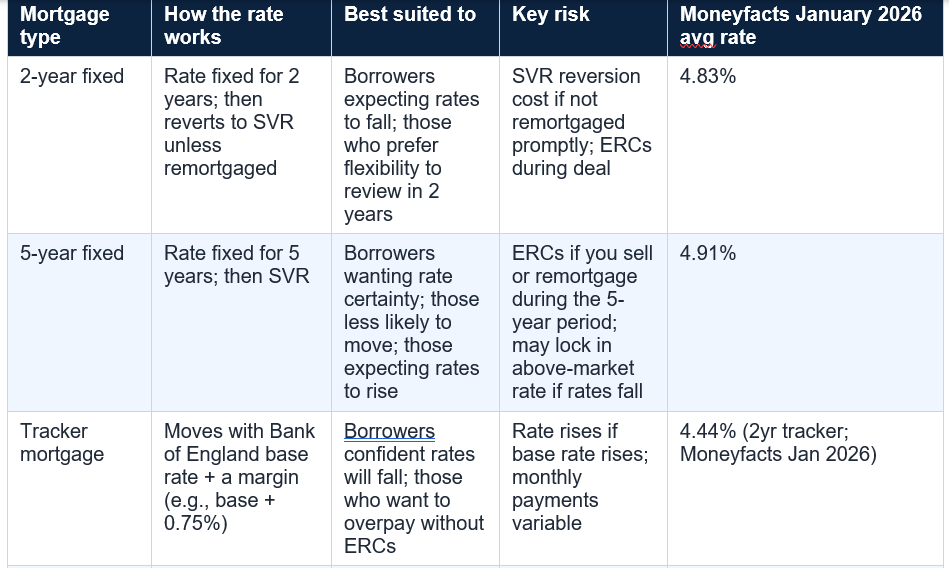
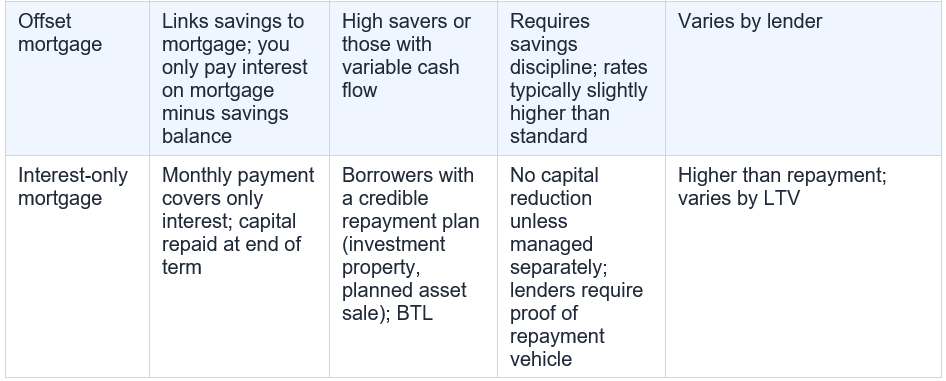
The 7,158 UK mortgage products available in 2026 fall into a manageable number of structural categories. Understanding these categories is what makes comparison meaningful — you are not comparing apples with apples if you evaluate a two-year fixed against a five-year fixed without understanding how they serve different needs. Not mortgage advice.
Step 3: Use Comparison Sites — But Know Their Limits
UK mortgage comparison sites are the starting point for most borrowers, and they are genuinely useful — but they have specific limitations that are important to understand before relying on them as the only source of comparison. The major sites and what they cover: MoneySuperMarket compares 1,000s of mortgage deals across the whole market; Uswitch compares deals from over 60 leading UK lenders and partners with Mojo Mortgages; CompareTheMarket provides rate data from L&C Mortgages updated in real time; MoneyfactsCompare provides live rate tables updated daily; Be Clever With Your Cash partners with Tembo (4x British Bank Award winner, 2022-2025) to surface rates from over 200,000 deals and 100+ lenders.The critical limitation: some mortgage deals are broker-only, and some are direct-only. A comparison site that searches 60 lenders may not see the full product range of those lenders — only what lenders make visible on that platform. Post Office and CompareTheMarket note explicitly that ‘some deals are available direct from the lender, while others are only available through a mortgage broker.’ This means a comparison site search is a first filter, not a comprehensive market survey. The rates shown are correct at the time of update but can be pulled the same day — Be Clever With Your Cash notes that ‘mortgage rates change all the time, so the rate given one day could be pulled the next.’ Use comparison sites to establish a benchmark and understand the range; then use a broker to verify and access the full market. Not mortgage advice.
The comparison site gap: no single comparison site shows all 7,158 available mortgage deals. Broker-only deals — which represent a significant portion of the market — are not visible on direct comparison tables. Some lenders do not appear on any comparison site. Always use a whole-of-market broker alongside comparison tools, not instead of them. Sources: Post Office/CompareTheMarket 2026; Be Clever With Your Cash 2026; MoneySuperMarket 2026. Not mortgage advice.
Step 4: Use a Whole-of-Market Broker
For most borrowers, a whole-of-market mortgage broker is the most effective single tool for comparing UK mortgage deals. MoneyToTheMasses states it directly: ‘For most borrowers, a mortgage broker is the most effective option because they provide a comprehensive view of the market and understand which loans suit specific types of individuals.’ A whole-of-market broker can search across all available products — including broker-only deals that never appear on comparison sites — can advise on lender criteria and eligibility, and can manage the application process.Broker types in the UK: tied advisers, who recommend only products from a single lender or panel; multi-tied advisers, who compare a panel of lenders; and whole-of-market independent brokers, who can access the full product range. For genuine market comparison, a whole-of-market broker is the appropriate choice. Fee structure varies: some brokers charge a flat fee (typically £300-£500), some charge a percentage of the mortgage (typically 0.3-1%), and some are fee-free, receiving a proc fee from the lender. MoneyToTheMasses notes fee-free brokers are available — though any broker charge should be verified upfront. Be Clever With Your Cash’s Tembo partner offers a free rate-rechecking service: if you lock in a deal six months early and rates drop before completion, the broker reapplies at no additional cost. That specific feature — rate monitoring post-lock-in — is something comparison sites cannot provide. Not mortgage advice.
Rachel Springall, finance expert at Moneyfacts (January 2026): 'Expectations are high for a booming market in 2026. Mortgage rates are lower year-on-year, and the choice of deals is abundant. As we have seen over the past few months, fixed rate cuts have been in abundance.' MoneyToTheMasses: 'For most borrowers, a mortgage broker is the most effective option because they provide a comprehensive view of the market and understand which loans suit specific types of individuals.' Sources: Moneyfacts/Mortgage Solutions January 2026; MoneyToTheMasses 2026. Not mortgage advice.
Step 5: Compare the True Cost, Not Just the Headline Rate
The headline rate — the percentage shown in the large font on every comparison table — is not the true cost of a mortgage. There are four additional components that determine the total cost of a deal, and ignoring any of them can result in choosing a product that appears cheap but costs significantly more in practice.First: the arrangement or product fee. Most competitive rates come with fees ranging from zero to £1,999 or more. A rate of 4.70% with a £999 arrangement fee may be more expensive over the deal period than a rate of 4.80% with no fee, depending on the mortgage size. The calculation: take the monthly payment difference and multiply by the deal length in months, then compare to the fee. On a £150,000 mortgage, the monthly saving from a 0.10% rate difference is approximately £14, which over 24 months is £336 — less than the £999 fee. On a £400,000 mortgage, the same 0.10% saves approximately £34/month, or £816 over 24 months — still less than a £999 fee. Always model fee vs rate across the full deal term. Not mortgage advice.
APRC (Annual Percentage Rate of Charge): the legally required true cost metric for UK mortgages. It includes the headline rate plus all fees, expressed as a single annual percentage over the full mortgage term. The APRC is the fairest single-number comparison across deals with different rates and fees. Always read the APRC alongside the headline rate. A lower headline rate with a high fee often produces a higher APRC. Source: FCA regulations; taxfly.co.uk 2026. Not mortgage advice.
Second: early repayment charges (ERCs). Most fixed-rate mortgages charge ERCs of 1-5% of the outstanding balance if you repay or switch during the initial deal period. These charges can be substantial: a 3% ERC on a £300,000 mortgage is £9,000. If you plan to move property, overpay significantly, or might need to access equity during the deal, ERCs are a critical comparison metric. Third: the revert rate or SVR. Every fixed deal ends and reverts to the lender’s SVR unless you remortgage. In 2026, SVRs typically run 7-8%+. A borrower who fails to remortgage when their deal ends can face a dramatic payment increase. Fourth: overpayment allowance. Most deals allow 10% of the outstanding balance to be overpaid each year without triggering ERCs. If you plan to overpay regularly, confirm this allowance before committing. Not mortgage advice.
Step 6: Understand LTV and How It Affects Your Deals
Loan to value (LTV) is the ratio of the mortgage amount to the property value, expressed as a percentage. A property worth £250,000 with a £50,000 deposit has a mortgage of £200,000, giving an LTV of 80%. LTV is one of the most significant determinants of both available products and available rates: lower LTV unlocks more deals and better rates, because the lender’s security improves as the borrower’s equity grows.The LTV brackets that define UK mortgage pricing: 60% LTV or below gives access to the best available rates across the market. 75% LTV is a key threshold where rates step up noticeably. 85% LTV sees another step. 90% LTV — which means a 10% deposit — has 927 products available in January 2026 at near 18-year highs, with an average 2-year fixed at 5.09%. 95% LTV — a 5% deposit — has 489 products at near 18-year highs, average 5.29%. For borrowers close to an LTV threshold, it is worth calculating whether using a slightly larger deposit (or a gift contribution from family) to cross into the next bracket would produce savings that outweigh the upfront cost. A £2,000 additional deposit that moves an 85% LTV borrower to 80% LTV could save hundreds per year in interest — often far exceeding the deposit top-up within two years. Not mortgage advice.
Step 7: The Six-Month Early Lock-In Rule
One of the most consistently underused mortgage comparison tactics is beginning the process six months before the current deal expires. Most UK mortgage lenders allow borrowers to lock in a new rate up to six months before the current deal ends. This matters enormously in a falling rate environment — and in a volatile rate environment where rates can move either way. Uswitch, CompareTheMarket, and Be Clever With Your Cash all explicitly recommend starting the remortgage comparison six months early.The logic: if you lock in a deal six months before expiry and rates subsequently fall, you are still protected by asking the broker to reapply for a better rate — Be Clever With Your Cash’s Tembo partner offers exactly this as a free rate-checking service. If rates rise after you lock in, you benefit from the rate you secured. If you wait until your deal actually expires, you lose six months of rate security and risk reverting to SVR while the market moves against you. The September 2026 mortgage market update from oportfolio.co.uk noted that rising swap rates had caused several lenders to increase selected fixed rates — precisely the kind of unexpected movement that makes early locking valuable. Not mortgage advice.
The six-month rule: if your current fixed-rate deal expires in the next six months, start comparing now. Lock in a new rate before rates move adversely. If rates fall before your deal starts, ask your broker or lender to switch to the lower rate — many allow this. Starting six months early: protects against rate rises; provides time for proper comparison; avoids the SVR gap if you leave comparison to the last minute. Sources: Uswitch August 2026; CompareTheMarket 2026; Be Clever With Your Cash 2026. Not mortgage advice.
First-Time Buyers: The Specific Deals and Schemes Available
First-time buyers in 2026 have access to a specific set of products and government schemes that are worth understanding before beginning the comparison process. A first-time buyer is defined by mortgage lenders as someone who has never owned a property anywhere in the world — this includes inherited properties even if no mortgage was involved. For joint applications, all applicants must meet this definition (Uswitch 2026).- Stamp Duty Land Tax exemption: since 1 April 2025, first-time buyers in England are exempt from stamp duty on the first £300,000 of properties costing up to £500,000. This is a meaningful saving — up to £5,000 on a £300,000 purchase. In Scotland, first-time buyers are exempt from Land and Buildings Transaction Tax (LBTT) on the first £175,000. There is no equivalent first-time buyer relief in Wales (CompareTheMarket/Post Office 2026).
- Government Mortgage Guarantee Scheme: supports 91-95% LTV mortgages for first-time buyers and home movers, with participating lenders including major high-street names (MoneySuperMarket 2026). This scheme underpins the growing availability of 5% deposit mortgages.
- First Homes scheme (England): allows eligible first-time buyers to purchase homes at a 30-50% discount in specific areas. Eligibility criteria apply; verify at gov.uk.
- Your First Home scheme: referenced in Lloyds’ September 2026 House Price Index as a specific support mechanism for first-time buyers alongside low-deposit mortgage products.
- Low-deposit products: the 489 products available at 95% LTV (near 18-year high) are the starting point for most first-time buyers with a 5% deposit. The average rate at 95% LTV was 5.29% in January 2026, with some lenders offering competitive rates below this.
Remortgaging: The 1.8 Million Deals Expiring in 2026
The single largest group of mortgage borrowers in 2026 is not first-time buyers — it is the 1.8 million households whose fixed-rate deals are expiring this year (Moneyfacts; Coreco). UK Finance forecasts a 10% rise in external remortgaging in 2026 as a direct consequence. For these borrowers, the mortgage comparison exercise is both urgent and consequential. Anyone whose deal expires in 2026 is moving from a rate fixed in 2021-2024 (when rates ranged from under 2% to approximately 5%+) into a market where average 2-year fixed rates are 4.83% and average 5-year fixed rates are 4.91%.For borrowers who fixed at below 2% in 2021, the payment increase will be substantial regardless of which new deal they choose — the comparison exercise is about minimising that increase rather than avoiding it. For those who fixed at 4-5% in 2023-2024, the 2026 market may offer equivalent or lower rates on renewal, representing a genuine saving opportunity. The September 2026 mortgage market update (oportfolio.co.uk) noted that remortgage approvals had risen slightly in July 2026, reflecting the start of the remortgage wave. The most important action for any borrower whose deal expires in the next six months is to begin the comparison process immediately — do not wait for the expiry date. Not mortgage advice.
The Complete Mortgage Comparison Checklist
Conclusion
The question ‘how do I compare thousands of mortgage deals?’ has a practical answer that most borrowers can act on in a single afternoon. Know your LTV and income. Check your credit report. Use two or three comparison sites to establish the rate range and understand which deal types suit your circumstances. Then use a whole-of-market broker to access the deals the comparison sites cannot show — including broker-only products, lender-specific criteria advantages, and full advice on whether the headline rate is genuinely the cheapest deal when fees are accounted for.Compare using the APRC, not just the percentage. Always calculate whether a low-rate, high-fee deal costs more or less than a higher-rate, no-fee alternative over your specific deal period. Check the ERC terms before committing. If remortgaging, start six months before your deal expires and lock in a rate even if you think rates might fall further — the cost of getting this timing wrong is reverting to SVR. In 2026, with 7,158 products, 18-year-record low-deposit availability, and 1.8 million deals expiring, the comparison tools and the advice infrastructure exist to navigate this market effectively. The framework above is all most borrowers need to use them well. Not mortgage, financial, or property advice. Your home may be repossessed if you do not keep up repayments. Consult an FCA-regulated mortgage broker.
Frequently Asked Questions
How many mortgage deals are currently available in the UK?As of January 2026, there were 7,158 mortgage products available in the UK — an increase of 650 year-on-year from 6,508 in January 2025, and the highest number since October 2007, according to Moneyfacts' UK Mortgage Trends Treasury Report (cited Mortgage Solutions January 12, 2026; MoneyfactsCompare; MoneyToTheMasses). The number of products at 95% LTV (5% deposit) has risen from 366 to 489 in one year, and 90% LTV products stand at 927 — both near 18-year highs. Average rates in January 2026: 2-year fixed 4.83%, 5-year fixed 4.91%, 2-year tracker 4.44%. The Bank of England base rate stands at 3.75% as of September 2026. Fixed mortgage rates do not directly follow the base rate — they are driven by swap rates in the money markets. Source: Moneyfacts January 2026; oportfolio.co.uk September 2026. Not mortgage advice. Rates change daily.
What is the difference between using a comparison site and using a mortgage broker?
Comparison sites (MoneySuperMarket, Uswitch, CompareTheMarket, MoneyfactsCompare) search the products lenders have made visible on those platforms — typically deals from 60-100+ lenders. They are a fast and free first filter that gives you a benchmark for the market. Their limitation: some mortgage deals are broker-only (not available on comparison sites) and some are direct-only (only available if you approach the lender directly). A whole-of-market mortgage broker can access the full product range including broker-only deals, advise on lender eligibility criteria (which can differ significantly even for borrowers with similar profiles), and manage the application process. For most borrowers, MoneyToTheMasses says 'a mortgage broker is the most effective option.' Fee-free whole-of-market brokers include Mojo Mortgages (via Uswitch), L&C (via CompareTheMarket), and Tembo (via Be Clever With Your Cash). Sources: MoneyToTheMasses 2026; Post Office/CompareTheMarket 2026; Uswitch August 2026. Not mortgage advice.
What is APRC and why does it matter for mortgage comparison?
APRC stands for Annual Percentage Rate of Charge. It is the legally required true cost metric for UK mortgages, expressing the total cost of the deal — including the interest rate plus all fees — as a single annual percentage over the full mortgage term. The APRC allows fair comparison between deals with different rates and fee structures. A mortgage with a 4.70% rate and a £999 arrangement fee will have a higher APRC than one with a 4.80% rate and no fee if the fee exceeds the saving from the lower rate over the deal period. On smaller mortgages, fees have more impact on APRC; on larger mortgages, the rate difference dominates. Every mortgage Key Facts Illustration (KFI) must state the APRC. Always read the APRC alongside the headline rate — never use the headline rate alone to compare deals. Source: FCA regulations; taxfly.co.uk 2026. Not mortgage advice.
How soon before my mortgage deal expires should I start comparing?
Six months is the standard guidance, and most major comparison sources (Uswitch, CompareTheMarket, Be Clever With Your Cash) explicitly recommend starting the process at the six-month mark. Most UK mortgage lenders allow you to lock in a new deal up to six months before your current one expires, so you can secure a rate now even if the new deal doesn't start for months. This matters because rates can move significantly in either direction. If you lock in and rates subsequently fall before your deal starts, ask your broker or lender to reapply at the lower rate — Be Clever With Your Cash's partner Tembo offers a free rate-recheck service for exactly this scenario. If you wait until your deal expires and rates have risen, you may be forced to accept a worse rate or temporarily revert to your lender's Standard Variable Rate (SVR), which typically runs 7-8%+ in 2026. With 1.8 million deals expiring in 2026, starting early also avoids the processing delays that can occur when large numbers of borrowers remortgage simultaneously. Sources: Uswitch August 2026; CompareTheMarket 2026; Be Clever With Your Cash 2026. Not mortgage advice.
Are there specific mortgage deals for first-time buyers in 2026?
First-time buyer status does not create an entirely separate mortgage market — most standard deals are available to all buyers. But there are specific advantages for first-time buyers in 2026. Stamp Duty Land Tax exemption (England): since 1 April 2025, first-time buyers are exempt from stamp duty on the first £300,000 of properties costing up to £500,000, saving up to £5,000 vs non-FTB buyers. Scotland: first-time buyers are exempt from LBTT on the first £175,000. The Government Mortgage Guarantee Scheme supports 91-95% LTV mortgages, expanding access for those with 5-9% deposits. The growing availability of 95% LTV products (489 deals in January 2026, near 18-year high) means a 5% deposit is now viable for most eligible borrowers. The First Homes scheme in England offers eligible first-time buyers 30-50% discounts on properties in specific developments. Your First Home scheme (referenced in Lloyds September 2026 HPI) is an additional support mechanism. First-time buyers defined by lenders as having never owned property anywhere globally — including inherited property. For joint applications, all applicants must meet this definition (Uswitch 2026). Source: CompareTheMarket/Post Office 2026; MoneySuperMarket 2026; Uswitch 2026. Not mortgage or legal advice. Verify scheme eligibility at gov.uk.
0 Comments
Be the first to share your thoughts on this article.