

Financial Literacy
How to Drive Down Costs in Your Finances: Complete Guide

A practical 2026 guide to cutting expenses across every major category — without sacrificing your standard of living

The good news is structural: Broadview Federal Credit Union’s August 2026 analysis found that many households can cut 15 to 20 percent from their monthly budgets by addressing recurring payments and daily spending patterns. Not by fundamentally changing their lifestyle. Not by making dramatic sacrifices. By finding the money that is already leaving and redirecting it to something better.
This guide provides ten specific strategies for driving down costs across every major expense category in 2026 — with realistic saving estimates, specific tactics, and the data behind each approach. The goal is not a budget that feels like punishment. It is a budget that reflects actual choices.
The Numbers: 69% of Americans live paycheck to paycheck (Debt.com 2025). 37% cannot cover a $400 emergency without borrowing (Federal Reserve SHED). US credit card debt: record $1.233 trillion (New York Fed, 2025). Average household debt: $104,215 (Debt.org).
What the 30-day tracking exercise reliably reveals:
Quick Win: Use your bank’s free spending categorisation tool or a free budgeting app (YNAB, Empower, Monarch Money) for the tracking exercise. Manual tracking is also effective — the act of recording every expenditure changes spending behaviour even before any specific cut is made.
Broadview FCU’s August 2026 guide specifically identifies unused gym memberships and premium cable packages as the most common candidates for immediate elimination. Wealthrisen’s July 2026 analysis describes the opportunity plainly: unused gym memberships (cancel and use free workout apps or YouTube fitness channels), premium cable packages (cord-cut to streaming services), magazine and news subscriptions, and multiple overlapping streaming services are the highest-value targets.
The subscription audit process:
The highest-impact food cost strategies in 2026:
Specific tactics that deliver consistent savings:
Two primary debt-reduction strategies:
List all debts by interest rate, highest first. Make minimum payments on all debts and direct every available extra dollar to the highest-rate debt. When it is paid off, redirect all of its payment to the next-highest-rate debt. This method minimises total interest paid and is optimal for any household with high-rate credit card debt.
Additional debt cost reduction tactics:
The practical automation setup:
Additional fee categories worth eliminating: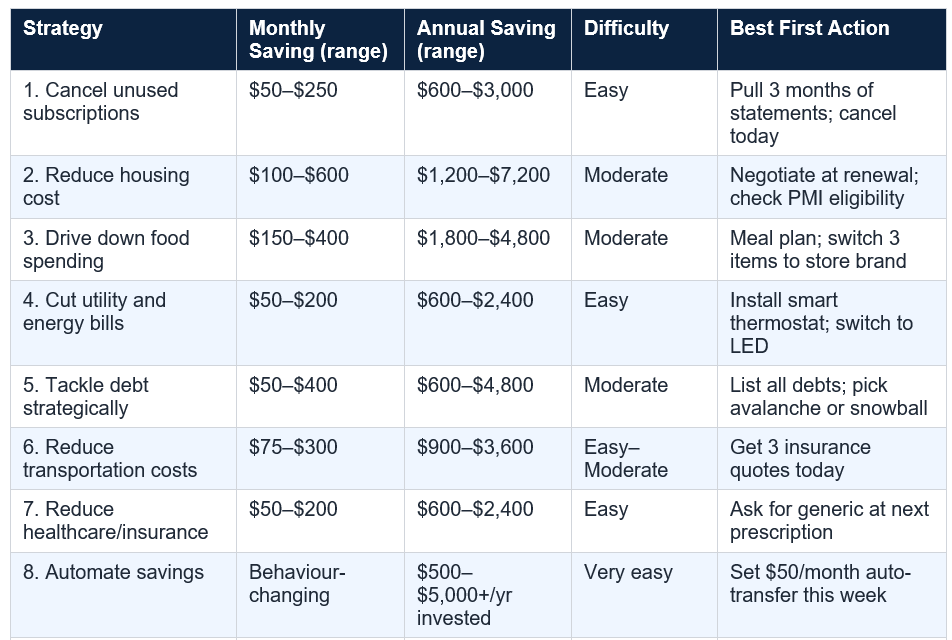
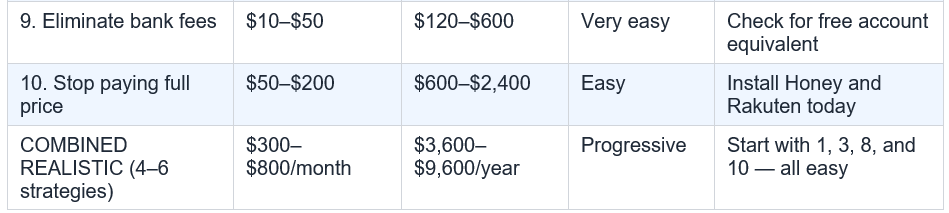
All figures are estimates based on publicly available 2025–2026 research. Individual results vary by income, location, current spending patterns, and consistency of strategy application. The combined row represents a household that implements four to six strategies consistently over three to six months.
None of them require dramatic lifestyle changes. Cancelling an unused subscription takes three minutes. Switching three groceries to store brands takes a single shopping trip. Setting up an automatic savings transfer takes ten minutes. Installing a browser cashback extension takes two minutes. The difficulty is not the actions themselves. It is the habit of doing them deliberately and consistently, month after month, until cost consciousness becomes the default mode rather than an emergency response.
A household that implements four to six of these strategies realistically saves $300 to $800 per month — $3,600 to $9,600 per year. Invested consistently at market-average returns, that money compounds into a financial buffer, then a debt-free balance sheet, then long-term wealth. Costs come down one decision at a time. The first decision is to make a decision — to stop letting the default choices be made for you and start making them yourself.
According to Debt.com’s annual survey, 69% of Americans lived paycheck to paycheck in 2025. 86% of that group claimed to have a budget, indicating that the problem is not the absence of budgeting but the gap between a budget on paper and active, consistent financial decision-making. The Federal Reserve’s SHED found that 37% of US adults could not cover a $400 emergency expense without borrowing or selling something.
What is the 50/30/20 rule and does it still work in 2026?
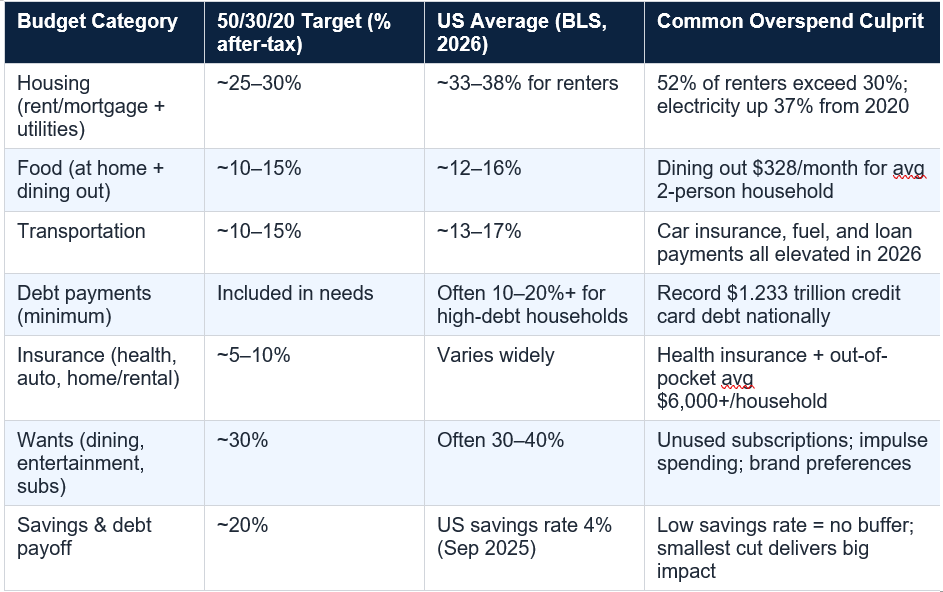
The 50/30/20 rule allocates 50% of after-tax income to needs (housing, food, utilities, transportation, minimum debt payments), 30% to wants, and 20% to savings and additional debt repayment. It remains a useful benchmark in 2026 but is difficult to achieve in high-cost areas: 52% of US renters already spend more than 30% of income on housing alone (Harvard/US Census Bureau). The rule is best used as a diagnostic tool rather than a rigid target — if your needs exceed 50%, the priority is identifying which specific cost-cutting strategies can bring that figure down.
What is the fastest way to reduce monthly expenses?
The fastest high-impact moves are: (1) cancel unused subscriptions (pull three months of statements and cancel anything not actively used — potential saving $50–$250/month); (2) switch to store-brand groceries for pantry staples (potential saving $30–$80/month); (3) install free cashback browser extensions (Honey, Rakuten, Capital One Shopping) on every future online purchase; and (4) set up a $50 automatic savings transfer. These four actions can be completed in under an hour and produce immediate results.
How do I reduce credit card debt in 2026?
Two primary methods: the avalanche (highest interest rate first) is mathematically optimal and saves the most total interest; the snowball (smallest balance first) provides faster visible progress and tends to sustain motivation better for those with multiple debts. Additional tactics include calling the issuer to request a rate reduction, transferring high-rate balances to 0% APR promotional cards (if eligible), and making at least one extra payment above the minimum each month. NerdWallet’s 2026 report found that 30% of Americans planned to pay off one or more debts in full in 2026 — those who succeed free up that minimum payment each month for savings or other priorities.
How do I cut utility bills when energy prices keep rising?
The US EIA reports national average residential electricity at 18 cents/kWh in 2026 — up approximately 37% from 2020. The highest-return actions: install a programmable thermostat (10–15% reduction in HVAC costs), switch to LED lighting throughout the home (75% less energy than incandescent bulbs), unplug standby electronics (phantom loads can account for 5–10% of electricity use), and compare energy providers in deregulated markets. Fidelity’s guide also notes federal and state incentives available for home energy efficiency upgrades.
How much can the average household realistically cut from monthly expenses?
Broadview Federal Credit Union’s August 2026 analysis found that many households can cut 15 to 20 percent from monthly budgets by addressing recurring payments and daily spending patterns. For a household spending $4,000 per month, this is $600 to $800 in potential monthly savings. Realistically, implementing four to six of the strategies in this guide generates $300 to $800 per month in reduced expenses without significant lifestyle changes. Individual results depend on current spending levels, housing market, household size, and how consistently strategies are applied.
Table of Contents
- Most Budgets Have 15–20% Hidden Slack
- Start Here: Track Everything for 30 Days
- Use the 50/30/20 Rule as Your Benchmark
- Strategy 1: Audit and Cancel Subscriptions
- Strategy 2: Cut Housing Costs
- Strategy 3: Drive Down Food Spending
- Strategy 4: Reduce Utility and Energy Bills
- Strategy 5: Tackle Debt Strategically
- Strategy 6: Cut Transportation Costs
- Strategy 7: Reduce Healthcare and Insurance Costs
- Strategy 8: Automate Savings — Pay Yourself First
- Strategy 9: Eliminate Bank Fees and Hidden Charges
- Strategy 10: Stop Paying Full Price on Everyday Purchases
- The Full Cost-Cutting Summary Table
- Conclusion: Costs Come Down One Decision at a Time
- Frequently Asked Questions
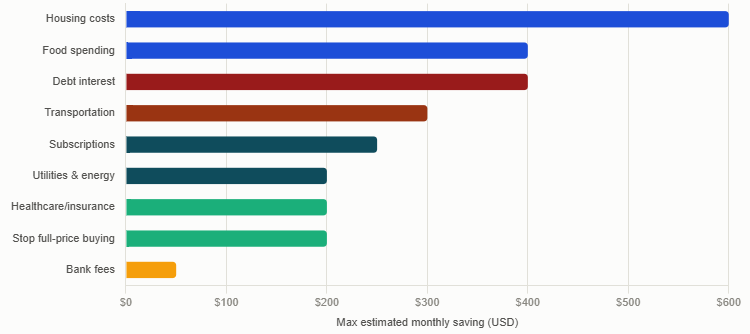
Monthly Average Savings By Category
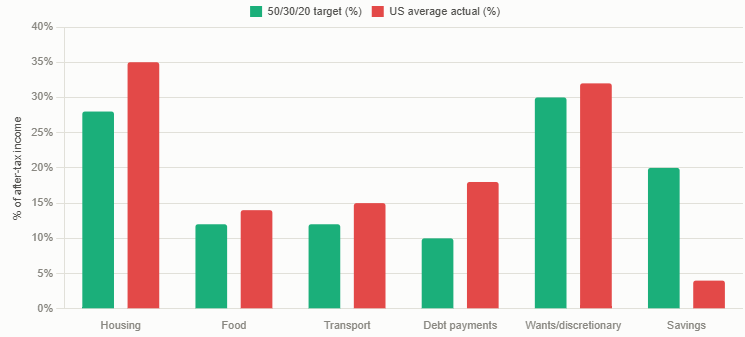
50/30/20 vs Actual Spending
Most Budgets Have 15–20% Hidden Slack
Sixty-nine percent of Americans lived paycheck to paycheck in 2025, according to Debt.com’s annual survey. What makes this figure striking is the one that sits alongside it: 86 percent of the same group claim to have a budget. The problem is not the absence of a budget. The problem is that most budgets are built around spending that has never been actively chosen — subscriptions that were set up and forgotten, utility rates that were never renegotiated, debt interest that compounds quietly in the background, and food spending that drifts upward without anyone deciding to spend more.The good news is structural: Broadview Federal Credit Union’s August 2026 analysis found that many households can cut 15 to 20 percent from their monthly budgets by addressing recurring payments and daily spending patterns. Not by fundamentally changing their lifestyle. Not by making dramatic sacrifices. By finding the money that is already leaving and redirecting it to something better.
This guide provides ten specific strategies for driving down costs across every major expense category in 2026 — with realistic saving estimates, specific tactics, and the data behind each approach. The goal is not a budget that feels like punishment. It is a budget that reflects actual choices.
The Numbers: 69% of Americans live paycheck to paycheck (Debt.com 2025). 37% cannot cover a $400 emergency without borrowing (Federal Reserve SHED). US credit card debt: record $1.233 trillion (New York Fed, 2025). Average household debt: $104,215 (Debt.org).
Start Here: Track Everything for 30 Days
Before any strategy can be applied, there must be a baseline. InCharge’s June 2026 guide states the principle plainly: those who do not know where money is going will find it nearly impossible to know what to cut. Broadview FCU’s August 2026 analysis concurs: download three months of bank and credit card statements, categorise every transaction, and identify which categories consume the most.What the 30-day tracking exercise reliably reveals:
- Forgotten or underused subscriptions that have been auto-renewing for months or years.
- The gap between estimated food spending and actual food spending — which for most households is significantly wider than expected.
- Small recurring charges ($5 to $15) across multiple services that collectively add up to $100 or more per month.
- Irregular spending patterns (coffee, convenience store purchases, impulse online orders) that do not feel significant in the moment but are substantial over a month.
Quick Win: Use your bank’s free spending categorisation tool or a free budgeting app (YNAB, Empower, Monarch Money) for the tracking exercise. Manual tracking is also effective — the act of recording every expenditure changes spending behaviour even before any specific cut is made.
Use the 50/30/20 Rule as Your Benchmark
Once you know where your money is going, you need a framework for evaluating whether the allocation is reasonable. The 50/30/20 rule, cited by NerdWallet’s January 2026 guidance and widely adopted across personal finance literature, provides the most accessible starting benchmark:- 50% of after-tax income to needs: housing, utilities, food, transportation, minimum debt payments, insurance.
- 30% of after-tax income to wants: dining out, entertainment, subscriptions, non-essential clothing, hobbies.
- 20% of after-tax income to savings and debt repayment: emergency fund, retirement contributions, accelerated debt payoff.
Strategy 1: Audit and Cancel Subscriptions
Subscriptions are the stealth expense of the modern budget. Most households have accumulated streaming services, news sites, software subscriptions, gym memberships, delivery services, cloud storage, and app subscriptions that were set up at different times for different reasons and have continued renewing without any ongoing decision to keep them.Broadview FCU’s August 2026 guide specifically identifies unused gym memberships and premium cable packages as the most common candidates for immediate elimination. Wealthrisen’s July 2026 analysis describes the opportunity plainly: unused gym memberships (cancel and use free workout apps or YouTube fitness channels), premium cable packages (cord-cut to streaming services), magazine and news subscriptions, and multiple overlapping streaming services are the highest-value targets.
The subscription audit process:
- Pull the last three months of bank and credit card statements and highlight every recurring charge. Include annual subscriptions that may not have appeared in a single month of reviewing.
- For each subscription, ask: Have I used this in the last 30 days? If I had to sign up for this today knowing what I know now, would I? The answer to both is required to justify keeping it.
- Call or cancel online immediately for any service that does not pass both questions. Many services offer a retention discount when you contact them to cancel — accept it if the service is genuinely used, decline it if it is not.
Strategy 2: Cut Housing Costs
Housing is the largest single line item in most household budgets, and the one where change is most consequential. Financial advisers consistently recommend keeping total housing costs below 30 percent of gross income. Debt.org’s April 2026 analysis noted that 52 percent of renters currently exceed this threshold. The strategies for reducing housing costs differ depending on whether you rent or own:For renters
- Negotiate the renewal price: in markets where real-time rents have been flat or declining (many metros in 2026), landlords prefer retaining a reliable tenant over vacancy. Presenting comparable listings at lower rents is a legitimate and frequently effective tactic at renewal time.
- Get a roommate: sharing a two-bedroom apartment typically halves the effective housing cost per person. This is the single highest-impact housing cost reduction available to single-occupancy renters.
- Consider relocation: if remote or hybrid work allows flexibility, moving to a lower-cost neighbourhood or metro area is the most dramatic cost reduction available — and one that compounds across every other expense category that is priced by location.
For homeowners
- Remove PMI: if you bought your home with less than a 20 percent down payment and have since paid down 20 percent of the original loan value (or if home values have appreciated), request PMI removal from your lender. PMI typically costs 0.5 to 1.5 percent of the loan amount annually.
- Refinance: check whether current mortgage rates offer a meaningful saving relative to your existing rate. Even a 0.5 percent rate reduction on a $300,000 mortgage saves approximately $1,500 per year.
Strategy 3: Drive Down Food Spending
The average two-person US household spends approximately $800 per month on food — $504 at home and $328 dining out — according to BLS Consumer Expenditure Survey data cited by Wealthrisen in July 2026. This is the category where daily decisions compound most visibly into monthly totals, and where the savings potential is substantial without requiring any reduction in the quality or enjoyment of eating.The highest-impact food cost strategies in 2026:
- Meal plan before shopping: planning the week’s meals before writing the shopping list prevents impulse purchases and ensures every ingredient has a purpose. GOBankingRates’ March 2026 analysis cited USDA data: meal planning is one of the best ways to save money on food.
- Reduce dining out frequency: food-away-from-home prices rose 3.9 percent in 2025, faster than grocery prices. Replacing two restaurant meals per week with home-cooked equivalents saves approximately $50 to $100 per week for a household that typically spends $20 to $50 per person dining out.
- Switch to store brands: generic groceries are approximately 40 percent cheaper than name-brand equivalents, according to a CNET study cited by AARP in April 2026. University of Tennessee Extension confirmed that store brands are often manufactured by the same companies as national brands.
- Cut food waste: the average family of four loses approximately $1,500 per year to uneaten food (USDA). Checking the refrigerator before shopping, using FIFO storage habits, and freezing before the spoil point each reduce waste and lower the effective food cost per meal.
7. Strategy 4: Reduce Utility and Energy Bills
US residential electricity prices have reached 18 cents per kilowatt hour on average in 2026 — approximately 37 percent higher than in 2020, according to the US Energy Information Administration cited by Wealthrisen. Household energy arrearages (overdue bills) rose 31 percent between December 2023 and June 2025, reflecting how significantly electricity costs have increased relative to household incomes.Specific tactics that deliver consistent savings:
- Install a programmable or smart thermostat: Fidelity’s guide identifies this as one of the highest-return single investments in energy cost reduction. Reducing heating and cooling when the house is unoccupied or during sleeping hours can reduce HVAC costs by 10 to 15 percent.
- Switch to LED lighting: LED bulbs use approximately 75 percent less energy than incandescent bulbs and last 15 to 25 times longer. The one-time cost of switching is recovered within months through lower electricity bills.
- Unplug unused electronics: devices left on standby (‘phantom loads’) can account for 5 to 10 percent of total electricity use. Plugging devices into power strips and switching them off when not in use eliminates this cost.
- Seal air leaks: caulking window frames and door gaps is a low-cost, high-return energy efficiency measure. Even moderate air sealing in an average home can reduce heating and cooling costs by 5 to 10 percent annually.
- Review utility providers: in deregulated energy markets, comparing alternative electricity and gas suppliers annually can yield savings of 5 to 15 percent versus the default utility rate.
Strategy 5: Tackle Debt Strategically
US credit card debt reached a record $1.233 trillion in 2025, according to the New York Federal Reserve. Over 40 percent of US adults carry credit card debt, with Generation X carrying the highest average balance at $9,600 (Experian). Debt interest is one of the most expensive ongoing costs in any household budget — and one of the most directly reducible.Two primary debt-reduction strategies:
The avalanche method (mathematically optimal)
List all debts by interest rate, highest first. Make minimum payments on all debts and direct every available extra dollar to the highest-rate debt. When it is paid off, redirect all of its payment to the next-highest-rate debt. This method minimises total interest paid and is optimal for any household with high-rate credit card debt.
The snowball method (behaviourally effective)
List all debts by balance, smallest first. Make minimum payments on all and direct every extra dollar to the smallest balance. When it is paid off, redirect its payment to the next smallest. This produces quicker visible wins, which research suggests improves long-term completion rates for people who struggle with motivation during long debt payoff periods.Additional debt cost reduction tactics:
- Balance transfer to a 0% APR promotional card: for credit card debt, transferring to a card with a 0% introductory APR period (typically 12 to 21 months) eliminates interest during the promotional period if the balance is paid in full within the window. The transfer fee (typically 3 to 5 percent) is usually less than one or two months of interest on high-rate debt.
- Call and negotiate the interest rate: credit card holders with good payment history can call the issuer and request a rate reduction. This takes five minutes and succeeds more often than most people expect.
- NerdWallet’s July 2026 report: 30 percent of Americans plan to pay off one or more debts in full in 2026. Those who succeed free up monthly cash flow equal to the minimum payment, which can then be redirected to savings or additional debt payoff.
9. Strategy 6: Cut Transportation Costs
Transportation is typically the second or third largest household expense category. The 2026 cost environment for transportation is elevated across multiple dimensions: car insurance premiums rose 20 to 30 percent in 2023 to 2024, gas prices remain above historical averages, and car prices (both new and used) remain above pre-pandemic levels.- Review and renegotiate car insurance annually: car insurance is one of the most competitive insurance markets. Annual comparison shopping using aggregator sites typically identifies savings of 10 to 25 percent from switching to a competing insurer for the same coverage. Many insurers also offer low-mileage discounts for drivers who now work from home more than before the pandemic.
- Maintain your vehicle: proper tyre inflation improves fuel economy by up to 3 percent (US Department of Energy). Regular oil changes and tune-ups prevent the significantly larger costs of mechanical breakdown. The cost of maintenance is consistently lower than the cost of neglect.
- Consolidate trips and use route planning apps: reducing the number of separate errands trips and combining them efficiently reduces fuel consumption without reducing any actual activity.
- Consider whether a second vehicle is necessary: for dual-car households where one vehicle is used primarily for short, local trips, a shift to ride-share or public transit for those trips can eliminate one vehicle’s insurance, registration, maintenance, and depreciation costs — typically $5,000 to $10,000 per year.
10. Strategy 7: Reduce Healthcare and Insurance Costs
Healthcare is a major financial stress for American families, with the average household spending over $6,000 per year on insurance and out-of-pocket costs, according to Financer’s 2026 analysis. Three specific tactics deliver the most consistent savings:- Switch to generics: generic drugs work identically to brand-name versions and cost 30 to 80 percent less (Financer, 2026). Always ask the pharmacist whether a generic equivalent is available when a brand-name medication is prescribed. GoodRx and RxSaver compare pharmacy prices in real time and frequently identify savings of 50 to 80 percent on the same generic medication between nearby pharmacies.
- Maximise HSA contributions: if enrolled in a high-deductible health plan, the Health Savings Account is one of the most tax-advantaged tools available. The 2026 HSA contribution limits are $4,300 for individuals and $8,550 for families. Contributions are tax-deductible, growth is tax-free, and withdrawals for qualified medical expenses are tax-free. This triple tax advantage makes HSA contributions among the highest-return financial actions available to qualifying households.
- Review insurance coverage annually: insurance needs change as assets, debts, and family situations change. Over-insured households pay premiums for coverage they do not need. Annual review of auto, home or rental, life, and disability insurance against current needs typically identifies opportunities to adjust coverage or switch providers for equivalent coverage at lower cost.
Strategy 8: Automate Savings — Pay Yourself First
Automation is the most consistently recommended tactic across every major personal finance source in 2026. The reason is behavioural: willpower is unreliable and decision fatigue is real. DivvyUpp’s July 2026 analysis noted that consolidating to three accounts and automating transfers on payday cuts monthly financial decisions by 80 to 90 percent. Experian’s guidance states: automating savings transfers stands out as a highly effective tactic. Setting up automatic moves from checking to savings right after payday, even as little as $10 or $20 per paycheck, helps ‘pay yourself first’ without relying on willpower.The practical automation setup:
- Set an automatic transfer from checking to a high-yield savings account (HYSA) on the same day as your paycheck arrives. The current HYSA environment offers 3.5 to 4.5 percent interest — meaningfully above zero and above most traditional savings accounts.
- Increase your 401(k) or retirement contribution by 1 percent immediately. NerdWallet’s simplify finances guide suggests taking 10 minutes to explore increasing your 401(k) contribution or opening an IRA. The earlier the increase, the longer the compounding period.
- Automate bill payments for fixed expenses: water, electricity, internet, phone, insurance. This eliminates late fees (which can be $15 to $40 per incident) and reduces the number of active decisions required each month.
Strategy 9: Eliminate Bank Fees and Hidden Charges
Bank fees are one of the most overlooked sources of household financial leakage. Account maintenance fees of $5 to $15 per month — which can add up to $60 to $180 per year — are charged by many traditional banks for accounts that could be replaced by no-fee equivalents at online banks or credit unions. KESQ/Finder’s July 2026 analysis identified this as an immediate, low-effort saving: if you rarely use your account for anything beyond everyday spending and transfers, a no-fee bank account eliminates this cost entirely. Many banks waive monthly fees if a direct deposit or minimum balance requirement is met — conditions that most employed adults already satisfy.Additional fee categories worth eliminating:
- Late fees: paying bills on time eliminates a cost that is entirely avoidable. Automating bill payments (Strategy 8) removes the risk of late fees from forgotten payments.
- ATM fees: using your bank’s own ATMs or choosing a bank that reimburses ATM fees eliminates the $2.50 to $5 per-transaction cost of using out-of-network ATMs.
- Overdraft fees: most banks charge $25 to $35 per overdraft incident. Opting out of overdraft ‘protection’ (which is a fee product, not a protection) or linking a savings account as overdraft backup eliminates this risk.
13. Strategy 10: Stop Paying Full Price on Everyday Purchases
Beyond the major categories, everyday purchasing habits determine a significant slice of monthly spending. Truist’s personal finance guidance and AARP’s April 2026 everyday expense guide both identify brand-name preferences and impulse purchasing as two of the most consistent budget-draining behaviours across all income levels.- Buy generics across all applicable categories: 40 percent saving on groceries (CNET study); 30 to 80 percent on medications; 20 to 40 percent on cleaning products, personal care, and paper goods. The quality difference is negligible in regulated or commodity categories.
- Use cashback and discount tools on every eligible purchase: Rakuten, Ibotta, and store loyalty apps deliver consistent rebates on purchases already planned. Capital One Shopping automatically applies coupon codes at checkout. These tools are free and operate with minimal effort once installed.
- Buy second-hand for clothing, furniture, and electronics: thrift stores, Facebook Marketplace, Poshmark, and eBay provide access to perfectly functional items at 50 to 90 percent below retail. For items where brand and newness do not matter functionally, second-hand is the rational choice.
- Implement a 24-hour rule on non-essential purchases over $50: adding an item to a digital cart and returning to it 24 hours later eliminates a significant proportion of impulse purchases that felt essential in the moment and unnecessary the next day.
The Full Cost-Cutting Summary Table
All figures are estimates based on publicly available 2025–2026 research. Individual results vary by income, location, current spending patterns, and consistency of strategy application. The combined row represents a household that implements four to six strategies consistently over three to six months.
Conclusion
Sixty-nine percent of Americans live paycheck to paycheck. Eighty-six percent of them have a budget. The gap between having a budget and having control of your finances is the gap between knowing where your money is going and actively deciding where it should go. The ten strategies in this guide are the tools for crossing that gap.None of them require dramatic lifestyle changes. Cancelling an unused subscription takes three minutes. Switching three groceries to store brands takes a single shopping trip. Setting up an automatic savings transfer takes ten minutes. Installing a browser cashback extension takes two minutes. The difficulty is not the actions themselves. It is the habit of doing them deliberately and consistently, month after month, until cost consciousness becomes the default mode rather than an emergency response.
A household that implements four to six of these strategies realistically saves $300 to $800 per month — $3,600 to $9,600 per year. Invested consistently at market-average returns, that money compounds into a financial buffer, then a debt-free balance sheet, then long-term wealth. Costs come down one decision at a time. The first decision is to make a decision — to stop letting the default choices be made for you and start making them yourself.
1Frequently Asked Questions
What percentage of Americans are living paycheck to paycheck in 2026?According to Debt.com’s annual survey, 69% of Americans lived paycheck to paycheck in 2025. 86% of that group claimed to have a budget, indicating that the problem is not the absence of budgeting but the gap between a budget on paper and active, consistent financial decision-making. The Federal Reserve’s SHED found that 37% of US adults could not cover a $400 emergency expense without borrowing or selling something.
What is the 50/30/20 rule and does it still work in 2026?
The 50/30/20 rule allocates 50% of after-tax income to needs (housing, food, utilities, transportation, minimum debt payments), 30% to wants, and 20% to savings and additional debt repayment. It remains a useful benchmark in 2026 but is difficult to achieve in high-cost areas: 52% of US renters already spend more than 30% of income on housing alone (Harvard/US Census Bureau). The rule is best used as a diagnostic tool rather than a rigid target — if your needs exceed 50%, the priority is identifying which specific cost-cutting strategies can bring that figure down.
What is the fastest way to reduce monthly expenses?
The fastest high-impact moves are: (1) cancel unused subscriptions (pull three months of statements and cancel anything not actively used — potential saving $50–$250/month); (2) switch to store-brand groceries for pantry staples (potential saving $30–$80/month); (3) install free cashback browser extensions (Honey, Rakuten, Capital One Shopping) on every future online purchase; and (4) set up a $50 automatic savings transfer. These four actions can be completed in under an hour and produce immediate results.
How do I reduce credit card debt in 2026?
Two primary methods: the avalanche (highest interest rate first) is mathematically optimal and saves the most total interest; the snowball (smallest balance first) provides faster visible progress and tends to sustain motivation better for those with multiple debts. Additional tactics include calling the issuer to request a rate reduction, transferring high-rate balances to 0% APR promotional cards (if eligible), and making at least one extra payment above the minimum each month. NerdWallet’s 2026 report found that 30% of Americans planned to pay off one or more debts in full in 2026 — those who succeed free up that minimum payment each month for savings or other priorities.
How do I cut utility bills when energy prices keep rising?
The US EIA reports national average residential electricity at 18 cents/kWh in 2026 — up approximately 37% from 2020. The highest-return actions: install a programmable thermostat (10–15% reduction in HVAC costs), switch to LED lighting throughout the home (75% less energy than incandescent bulbs), unplug standby electronics (phantom loads can account for 5–10% of electricity use), and compare energy providers in deregulated markets. Fidelity’s guide also notes federal and state incentives available for home energy efficiency upgrades.
How much can the average household realistically cut from monthly expenses?
Broadview Federal Credit Union’s August 2026 analysis found that many households can cut 15 to 20 percent from monthly budgets by addressing recurring payments and daily spending patterns. For a household spending $4,000 per month, this is $600 to $800 in potential monthly savings. Realistically, implementing four to six of the strategies in this guide generates $300 to $800 per month in reduced expenses without significant lifestyle changes. Individual results depend on current spending levels, housing market, household size, and how consistently strategies are applied.
0 Comments
Be the first to share your thoughts on this article.