
Real Estate
How to Get an FHA Loan in Texas: Complete Guide

3.5% down. Credit scores from 580. Loan limits up to $649,750 in Travis County. Down payment assistance from TDHCA. Here is the complete step-by-step guide to getting an FHA loan in Texas in 2026.
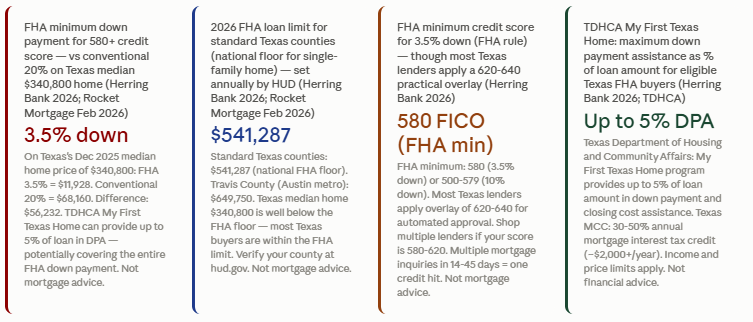
Texas is the second-largest state in the US, and its housing market runs the full spectrum: from modest rural counties where the FHA floor of $541,287 covers nearly everything, to competitive metros like Austin, Dallas, and Houston where prices have climbed significantly. For buyers who have a steady income but a moderate credit score or limited savings for a down payment, the FHA loan — backed by the Federal Housing Administration — is often the most accessible path to homeownership in the Lone Star State. The median Texas home price in December 2025 was $340,800, according to Redfin data cited by Rocket Mortgage. An FHA loan with 3.5% down on that price requires approximately $11,928 — a fraction of the $68,160 a 20% conventional down payment would demand. This guide covers every step from checking your credit score to collecting your keys, with the 2026 FHA requirements, Texas-specific loan limits, and TDHCA down payment assistance programs that make the process work for Texas buyers specifically. Not financial or mortgage advice.
An FHA loan is a mortgage insured by the Federal Housing Administration, a division of the US Department of Housing and Urban Development (HUD). Because the FHA insures the loan against borrower default, lenders can offer more flexible terms than they would for conventional loans: lower credit score requirements, smaller down payments, and more generous debt-to-income ratio guidelines. The lender takes on less risk because the government backs the loan — and the borrower benefits from terms that conventional lenders would not otherwise offer. JVM Lending’s guide to FHA loans summarises the core advantage: ‘The FHA offers home loans that are attractive due to their lower down payment requirements, low interest rates compared to other loans, and less stringent credit requirements, making it easier to qualify.’
Texas is one of the most active FHA loan markets in the US. With a median home price of $340,800 in December 2025 (Redfin, cited by Rocket Mortgage), a 3.5% FHA down payment of approximately $11,928 is a realistic savings target for many first-time buyers — compared to $68,160 at 20% conventional down payment. The state’s size means that FHA limits vary considerably across counties, and TDHCA provides down payment assistance programs that pair directly with FHA financing. For buyers with moderate credit scores, limited savings, or higher debt-to-income ratios, the FHA loan is typically the most accessible route to homeownership in Texas.
Texas median home price December 2025: $340,800 (Redfin/Rocket Mortgage). FHA 3.5% down on median price: $11,928. Conventional 20% down: $68,160. 2026 FHA limits: $541,287 (standard Texas counties) to $649,750 (Travis County). FHA UFMIP: 1.75% of loan amount. Sources cited.
2026 FHA minimum: 580 credit score for 3.5% down; 500-579 with 10% down. Most Texas lenders practically require 620-640. Check credit 90+ days before applying so any fixes have time to take effect. Sources: Herring Bank 2026; Lower.com 2026; Rocket Mortgage February 2026.
Use a soft credit inquiry tool like Credit Karma first — these do not affect your score. Only allow a hard pull when you are ready to apply formally to a lender. Multiple mortgage hard pulls within a 14-45 day window count as a single inquiry under FICO scoring rules.
2026 FHA loan limits in Texas: $541,287 (standard counties, single-family) to $649,750 (Travis County/Austin). Check your specific county at HUD's loan limit lookup tool (hud.gov). Texas median home price December 2025: $340,800 (Redfin/Rocket Mortgage).
FHA minimum down payment: 3.5% (580+ credit score) or 10% (500-579 credit score). On $340,800 Texas median: $11,928 minimum. Closing costs: typically 2-5% additional. TDHCA My First Texas Home: up to 5% of loan in DPA. FHA allows gift funds for entire down payment. Sources: Herring Bank 2026; Rocket Mortgage; x2mortgage.com 2025.
Required documents: two years W-2s (or tax returns for self-employed), recent pay stubs, 2-3 months bank statements, government photo ID, Social Security number, all debt statements. Self-employed: two years tax returns required; net income used. Sources: DSLD Mortgage; x2mortgage.com 2025; Herring Bank 2026.
Create a digital folder (Google Drive or Dropbox) for all mortgage documents from day one. Your lender will request the same documents in multiple stages. Having them organised and immediately accessible prevents delays — especially critical once you are under contract with a closing deadline.
FHA pre-approval required for serious homebuying. Shop three to five lenders within a 14-45 day window (counts as one credit inquiry). Compare: interest rate, APR, lender fees, minimum credit score overlay, MIP structure. HUD-approved lenders in Texas listed at hud.gov. Sources: Herring Bank 2026; JVM Lending; DSLD Mortgage.
When comparing pre-approval offers, focus on the Annual Percentage Rate (APR) — not just the interest rate. APR includes lender fees and gives you an accurate comparison across lenders. A lender offering a lower interest rate but higher fees may cost more in total than one with a slightly higher rate and lower fees.
FHA property requirements: primary residence only; must meet HUD Minimum Property Standards; functional roof, systems, no safety hazards; no significant structural damage. Manufactured homes must meet HUD installation standards. Condos must be on FHA-approved condominium list. Sources: Herring Bank 2026; Rocket Mortgage February 2026; DSLD Mortgage.
Ask your real estate agent to confirm whether a condo community is on the FHA-approved condominium list before making an offer — FHA condo approval requires the whole complex to be approved, not just the individual unit. Check the FHA condo approval list at HUD.gov.
FHA appraisal is mandatory and combines market value assessment with HUD minimum property standards review. Assigned independently through HUD system. If property conditions are flagged, seller typically must remedy before closing or price is renegotiated. Appraisal cost: typically $400-$600 in Texas. Sources: Herring Bank 2026; Rocket Mortgage; DSLD Mortgage.
Always hire a separate licensed home inspector in addition to the FHA appraisal. The FHA appraisal is not a comprehensive home inspection — it checks for major visible defects but will not catch everything a licensed inspector would. In Texas, look for TREC-licensed inspectors (Texas Real Estate Commission).
Underwriting reviews complete loan file against FHA guidelines. Expect 'conditions' requiring additional documentation — respond immediately. Do NOT: open new credit, change employment, make large untracked deposits, or increase debt during underwriting. Timeline: underwriting typically 5-15 business days. Sources: x2mortgage.com 2025; Herring Bank 2026; DSLD Mortgage.
Create a dedicated email folder for all lender communications from the moment you are under contract. Respond to all condition requests within 24 hours if possible. Every day of delay in responding to a condition is a day added to the closing timeline — and in a competitive Texas market, contract deadline extensions are not always guaranteed.
Closing in Texas: at title company. Review Closing Disclosure three business days before closing. Pay remaining closing costs (2-5% minus DPA credits). Sign promissory note, deed of trust, FHA disclosures. UFMIP (1.75% of loan) typically rolled into loan. Keys delivered upon recording. Sources: Herring Bank 2026; Rocket Mortgage; JVM Lending.
Bring a cashier's check or arrange a wire transfer for closing costs — personal checks are typically not accepted at Texas title company closings. Confirm the exact amount and payment method with your lender and title company at least three days before your closing date.
The nine steps in this guide move from credit check to closing in the order a Texas buyer will encounter them. Start with Step 1 — an honest assessment of your credit score and financial readiness — and work through the process systematically. The documentation, the pre-approval, the property search, the appraisal, and the underwriting each have their own requirements, but none of them is insurmountable for a well-prepared buyer. Please be aware that this is not financial or mortgage advice. For guidance specific to your circumstances, contact a HUD-approved housing counsellor (find one at hud.gov/find/counseling) or a qualified Texas mortgage professional.
The FHA's own minimum credit score is 580 for a 3.5% down payment, and 500-579 for a 10% down payment. However, Herring Bank's 2026 Texas FHA guide notes that most Texas lenders apply an overlay of 620-640 for automated approval — meaning the FHA minimum and the practical lender minimum are different. If your score is between 580 and 620, you can still qualify for an FHA loan in Texas, but you may need to shop more lenders to find one that works with your profile. If your score is between 500 and 579, you can potentially qualify with a 10% down payment but will need specific lender approval. Sources: Herring Bank 2026; Lower.com 2026; Rocket Mortgage February 2026.
What are the 2026 FHA loan limits in Texas?
For 2026, FHA loan limits in Texas range from $541,287 in standard-cost counties (the national FHA floor for a single-family home) to $649,750 in Travis County (Austin metro), according to Herring Bank's 2026 Texas FHA guide. Rocket Mortgage's February 2026 guide cites a higher potential ceiling in some Texas counties (up to $1,249,125 in the highest-cost counties nationally, though most Texas counties fall at or near the floor). The Texas median home price in December 2025 was $340,800 (Redfin, cited by Rocket Mortgage), which is well below the FHA floor of $541,287 — meaning most Texas buyers are within the FHA limit for their properties. FHA limits are set annually by HUD and vary by county. Check your specific county at HUD's loan limit lookup tool. Sources: Herring Bank 2026; Rocket Mortgage February 2026.
Does Texas have down payment assistance for FHA loans?
Yes — Texas has active state-funded down payment assistance programs through TDHCA (Texas Department of Housing and Community Affairs). The My First Texas Home program provides up to 5% of the loan amount in down payment and closing cost assistance to eligible first-time buyers and veterans, paired with FHA financing. The Texas Mortgage Credit Certificate (MCC) allows qualified buyers to claim a federal tax credit of 30-50% of annual mortgage interest paid. The My Choice Texas Home program is available to both first-time and repeat buyers. Many Texas cities and counties also offer additional local programs. Income limits and property price limits apply to TDHCA programs. Sources: Herring Bank 2026; TDHCA (tdhca.state.tx.us). Check current program eligibility directly with TDHCA or a participating lender.
How long does it take to get an FHA loan in Texas?
The typical timeline from pre-approval to closing for an FHA loan in Texas is 30-60 days, though it can be faster or slower depending on how quickly documentation is provided, whether the appraisal identifies property condition issues, and how responsive all parties (buyer, seller, lender, title company) are. Key timeline milestones: pre-approval can be completed in 1-3 days with complete documentation; appraisal scheduling and report: 1-2 weeks after accepted offer; underwriting: typically 5-15 business days after complete file submission; closing: 3 business days after final Closing Disclosure delivery. The timeline can extend if there are underwriting conditions that take time to satisfy, appraisal issues requiring seller remediation, or title complications. X2 Mortgage's 2025 guide notes that the process can move quickly when documentation is complete and clean.
Can I use an FHA loan for a rental property or second home in Texas?
No. FHA loans are strictly for primary residences only. You must intend to live in the property as your primary home. Investment properties and second homes are ineligible for FHA financing. This requirement is verified at closing and the FHA requires borrowers to occupy the property within 60 days of closing. If you need financing for an investment property, you would need to use a conventional loan, portfolio loan, or other non-FHA financing type. However, FHA does allow multi-unit properties (2-4 units) where the borrower occupies one unit as their primary residence — which is one way to use FHA financing for a property that also generates rental income. Sources: Herring Bank 2026; Rocket Mortgage February 2026; DSLD Mortgage. This is not mortgage or legal advice.
Texas is the second-largest state in the US, and its housing market runs the full spectrum: from modest rural counties where the FHA floor of $541,287 covers nearly everything, to competitive metros like Austin, Dallas, and Houston where prices have climbed significantly. For buyers who have a steady income but a moderate credit score or limited savings for a down payment, the FHA loan — backed by the Federal Housing Administration — is often the most accessible path to homeownership in the Lone Star State. The median Texas home price in December 2025 was $340,800, according to Redfin data cited by Rocket Mortgage. An FHA loan with 3.5% down on that price requires approximately $11,928 — a fraction of the $68,160 a 20% conventional down payment would demand. This guide covers every step from checking your credit score to collecting your keys, with the 2026 FHA requirements, Texas-specific loan limits, and TDHCA down payment assistance programs that make the process work for Texas buyers specifically. Not financial or mortgage advice.
Table of Contents
- What Is an FHA Loan and Why It Works Well in Texas
- 2026 FHA Loan Requirements at a Glance
- Step 1 Check Your Credit Score and Financial Readiness
- Step 2 Understand Texas FHA Loan Limits for Your County
- Step 3 Save for Down Payment and Closing Costs
- Step 4 Gather Your Documentation
- Step 5 Get Pre-Approved and Shop Multiple FHA Lenders
- Step 6 Find a Property That Meets FHA Requirements
- Step 7 Order the FHA Appraisal
- Step 8 Complete Underwriting and Respond to Conditions
- Step 9 Close on Your Texas Home
- Texas FHA Loan vs Conventional Loan: Which Is Right for You?
- Texas Down Payment Assistance Programs
- Conclusion: Texas Homeownership Is Within Reach
- Frequently Asked Questions
What Is an FHA Loan and Why It Works Well in Texas
An FHA loan is a mortgage insured by the Federal Housing Administration, a division of the US Department of Housing and Urban Development (HUD). Because the FHA insures the loan against borrower default, lenders can offer more flexible terms than they would for conventional loans: lower credit score requirements, smaller down payments, and more generous debt-to-income ratio guidelines. The lender takes on less risk because the government backs the loan — and the borrower benefits from terms that conventional lenders would not otherwise offer. JVM Lending’s guide to FHA loans summarises the core advantage: ‘The FHA offers home loans that are attractive due to their lower down payment requirements, low interest rates compared to other loans, and less stringent credit requirements, making it easier to qualify.’Texas is one of the most active FHA loan markets in the US. With a median home price of $340,800 in December 2025 (Redfin, cited by Rocket Mortgage), a 3.5% FHA down payment of approximately $11,928 is a realistic savings target for many first-time buyers — compared to $68,160 at 20% conventional down payment. The state’s size means that FHA limits vary considerably across counties, and TDHCA provides down payment assistance programs that pair directly with FHA financing. For buyers with moderate credit scores, limited savings, or higher debt-to-income ratios, the FHA loan is typically the most accessible route to homeownership in Texas.
Texas median home price December 2025: $340,800 (Redfin/Rocket Mortgage). FHA 3.5% down on median price: $11,928. Conventional 20% down: $68,160. 2026 FHA limits: $541,287 (standard Texas counties) to $649,750 (Travis County). FHA UFMIP: 1.75% of loan amount. Sources cited.
2026 FHA Loan Requirements at a Glance
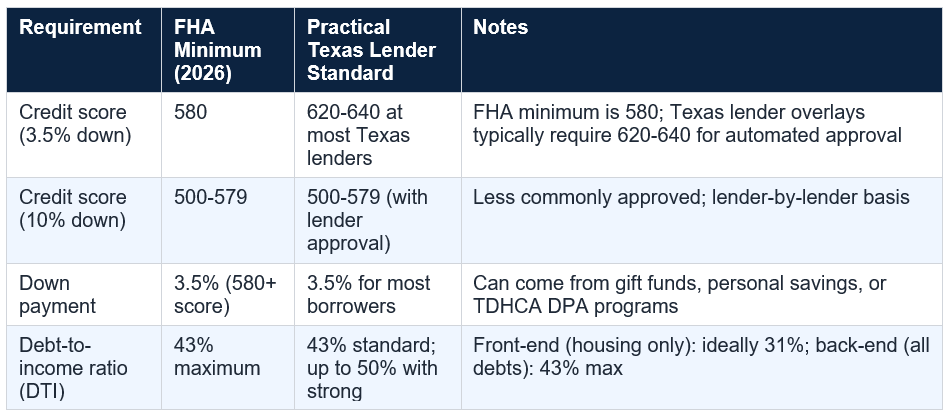
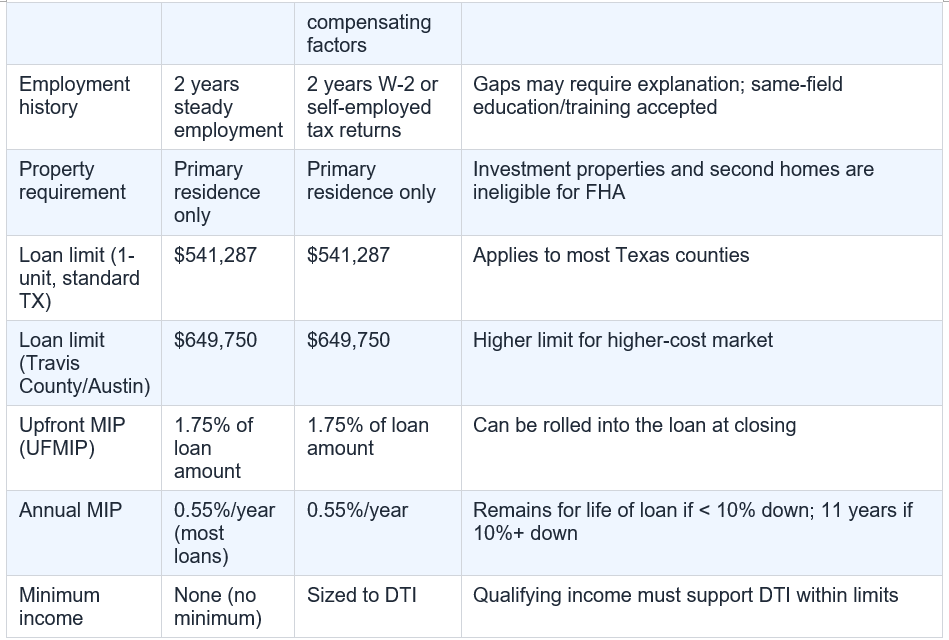
Before the nine-step process, here is the complete 2026 FHA requirement set for Texas borrowers. These are the baseline criteria every application will be assessed against:
Step 1 Check Your Credit Score and Financial Readiness
The FHA loan process in Texas begins before you talk to any lender. It begins with an honest assessment of your credit score and overall financial picture. The FHA minimum credit score is 580 for a 3.5% down payment, or 500-579 for 10% down. But Herring Bank’s 2026 Texas FHA guide notes an important practical point: most Texas lenders apply an overlay of 620-640 for automated approval. This means the FHA’s own minimum is not necessarily what a specific Texas lender will accept. If your score is currently between 580 and 620, you can still find FHA lenders who will work with you — but you may need to shop more deliberately. If your score is below 580, improving it before applying will expand your lender options and your interest rate. Three free credit check tools — AnnualCreditReport.com (the federally mandated free report), Credit Karma, and Experian’s free tier — give you a current picture. When you check, look not just at the score but at what is driving it: outstanding collections, high card utilisation, or late payments are each fixable in different timeframes. Dispute any errors you find before applying.2026 FHA minimum: 580 credit score for 3.5% down; 500-579 with 10% down. Most Texas lenders practically require 620-640. Check credit 90+ days before applying so any fixes have time to take effect. Sources: Herring Bank 2026; Lower.com 2026; Rocket Mortgage February 2026.
Use a soft credit inquiry tool like Credit Karma first — these do not affect your score. Only allow a hard pull when you are ready to apply formally to a lender. Multiple mortgage hard pulls within a 14-45 day window count as a single inquiry under FICO scoring rules.
Step 2 Understand Texas FHA Loan Limits for Your County
FHA loan limits in Texas vary county by county and are set annually by HUD based on local housing prices. For 2026, the FHA loan limits for a one-unit home range from $541,287 in standard-cost Texas counties to $649,750 in Travis County (the Austin metro area), according to Herring Bank’s 2026 Texas FHA guide. Rocket Mortgage’s February 2026 guide notes that the national FHA ceiling for high-cost counties can reach $1,249,125 — though most Texas counties fall at the floor or in the standard range. This matters because it tells you the maximum you can borrow using FHA financing in your specific county. If the home you are buying costs more than the FHA limit for your county, you will either need to cover the difference with a larger down payment (bringing the loan amount to or below the limit), choose a different property, or consider an alternative loan type. The median Texas home price in December 2025 was $340,800 (Redfin, cited by Rocket Mortgage), well below the FHA floor of $541,287 — meaning most Texas buyers are well within the FHA limit range for the properties they are targeting. In higher-cost markets like Austin, the county-specific limit of $649,750 covers a substantial range of properties.2026 FHA loan limits in Texas: $541,287 (standard counties, single-family) to $649,750 (Travis County/Austin). Check your specific county at HUD's loan limit lookup tool (hud.gov). Texas median home price December 2025: $340,800 (Redfin/Rocket Mortgage).
Step 3 Save for Down Payment and Closing Costs
The FHA down payment minimum is 3.5% of the purchase price for borrowers with a 580+ credit score. On Texas’s December 2025 median home price of $340,800, that is approximately $11,928. This is significantly lower than the 20% conventionally required to avoid private mortgage insurance on a conventional loan ($68,160 on the same home price). But the down payment is not the only upfront cost. Closing costs on an FHA loan in Texas typically range from 2-5% of the loan amount — covering lender fees, title insurance, appraisal, prepaid property taxes and insurance, and the FHA upfront mortgage insurance premium (UFMIP) of 1.75% of the base loan amount (which can be rolled into the loan rather than paid at closing). The good news for Texas buyers: TDHCA’s down payment assistance programs can cover some or all of this. The My First Texas Home program provides up to 5% of the loan amount in down payment and closing cost assistance (Herring Bank 2026). Additionally, FHA allows 100% of the down payment to come from gift funds — a family member, employer, or eligible charitable organisation can gift the entire down payment with no repayment requirement, as long as proper gift letter documentation is provided.FHA minimum down payment: 3.5% (580+ credit score) or 10% (500-579 credit score). On $340,800 Texas median: $11,928 minimum. Closing costs: typically 2-5% additional. TDHCA My First Texas Home: up to 5% of loan in DPA. FHA allows gift funds for entire down payment. Sources: Herring Bank 2026; Rocket Mortgage; x2mortgage.com 2025.
Step 4 Gather Your Documentation
FHA loans have specific documentation requirements that Texas buyers should prepare for in advance. Pulling these together before you start talking to lenders saves time and prevents delays once you are under contract. The FHA documentation list covers four main areas: identity, income, assets, and debts. For identity: government-issued photo ID and Social Security number. For income: your two most recent W-2s (or two years of tax returns if self-employed), your two most recent pay stubs, and documentation of any additional income sources (rental income, alimony, child support, part-time work). For assets: two to three months of bank statements showing the source of your down payment and reserves. For debts: current statements for all open accounts (student loans, car loans, credit cards, any existing mortgages). X2 Mortgage’s 2025 guide for Texas FHA buyers notes that self-employed borrowers need two years of tax returns with the net income used for qualification — not gross revenue. If you are self-employed, it is important to understand that the income your lender uses may differ significantly from your business’s gross income.Required documents: two years W-2s (or tax returns for self-employed), recent pay stubs, 2-3 months bank statements, government photo ID, Social Security number, all debt statements. Self-employed: two years tax returns required; net income used. Sources: DSLD Mortgage; x2mortgage.com 2025; Herring Bank 2026.
Create a digital folder (Google Drive or Dropbox) for all mortgage documents from day one. Your lender will request the same documents in multiple stages. Having them organised and immediately accessible prevents delays — especially critical once you are under contract with a closing deadline.
Step 5 Get Pre-Approved and Shop Multiple FHA Lenders
FHA pre-approval is the document that makes sellers take your offer seriously. It tells you precisely how much you can borrow, confirms your interest rate range, and demonstrates that a lender has reviewed your financial situation and found you eligible. Importantly, there is more than one way to get pre-approved, and there is more than one FHA lender in Texas — which matters more than most first-time buyers realise. Interest rates, lender fees, and the practical minimum credit score overlays vary by lender. Herring Bank’s 2026 Texas FHA guide makes the point about overlays specifically: while FHA’s minimum is 580, most Texas lenders require 620-640 in practice. This means shopping lenders is not just about finding the lowest rate — it is about finding a lender whose specific overlay and fee structure works for your profile. FICO’s mortgage shopping rule helps: multiple mortgage credit inquiries within a 14-45 day window count as a single hard inquiry. So get pre-approvals from three to five FHA lenders within a short window to compare. For Texas buyers, lenders to consider include banks, credit unions, and FHA-approved mortgage companies. Some HUD-approved housing counselling agencies in Texas can also provide lender referrals at no cost.FHA pre-approval required for serious homebuying. Shop three to five lenders within a 14-45 day window (counts as one credit inquiry). Compare: interest rate, APR, lender fees, minimum credit score overlay, MIP structure. HUD-approved lenders in Texas listed at hud.gov. Sources: Herring Bank 2026; JVM Lending; DSLD Mortgage.
When comparing pre-approval offers, focus on the Annual Percentage Rate (APR) — not just the interest rate. APR includes lender fees and gives you an accurate comparison across lenders. A lender offering a lower interest rate but higher fees may cost more in total than one with a slightly higher rate and lower fees.
Step 6 Find a Property That Meets FHA Requirements
FHA loans come with property requirements that go beyond what a conventional loan requires, because the FHA is insuring the loan and has a standard to protect its investment. In Texas, the property must be the borrower’s primary residence — FHA loans cannot be used for investment properties or second homes. The property must also meet HUD’s Minimum Property Standards (MPS), which cover structural integrity, safety systems, and basic habitability. In practice, the FHA property requirements mean: the home must have a functional roof, working heating and cooling systems, no significant structural damage, no lead-based paint hazards (in homes built before 1978), functional electrical and plumbing systems, and no safety hazards such as exposed wiring. Properties in Texas that commonly encounter FHA property issues include: homes with old or failing roofs, homes with foundation issues (relevant in areas with expansive clay soils), homes with deferred maintenance, and manufactured homes that do not meet HUD installation standards. An FHA appraisal (Step 7) will flag property condition issues, but buyers who work with a real estate agent familiar with FHA requirements can screen for obvious issues before making an offer.FHA property requirements: primary residence only; must meet HUD Minimum Property Standards; functional roof, systems, no safety hazards; no significant structural damage. Manufactured homes must meet HUD installation standards. Condos must be on FHA-approved condominium list. Sources: Herring Bank 2026; Rocket Mortgage February 2026; DSLD Mortgage.
Ask your real estate agent to confirm whether a condo community is on the FHA-approved condominium list before making an offer — FHA condo approval requires the whole complex to be approved, not just the individual unit. Check the FHA condo approval list at HUD.gov.
Step 7 Order the FHA Appraisal
Once you have an accepted offer, your lender will order an FHA appraisal. This is different from a standard home inspection, though it fulfils a dual role: it simultaneously establishes the market value of the property (to ensure the lender is not lending more than the home is worth) and assesses whether the property meets HUD’s Minimum Property Standards. An FHA appraisal is assigned through an automated system and cannot be assigned by the lender or the borrower — it is selected from a pool of FHA-approved appraisers to ensure independence. If the appraisal comes in below the agreed purchase price, you have several options: negotiate the price down to the appraised value, cover the difference between the appraised value and purchase price with additional cash, challenge the appraisal with additional comparable sales evidence (a reconsideration of value), or walk away. In Texas, appraisers are familiar with the FHA dual-function requirements, but in fast-moving markets, appraisal timing can create complications. If the FHA appraisal identifies property condition issues, the seller is typically asked to remedy them before closing — or you can negotiate a price reduction to cover the repairs. Note: the FHA appraisal does not replace an independent home inspection. Always also hire a licensed home inspector.FHA appraisal is mandatory and combines market value assessment with HUD minimum property standards review. Assigned independently through HUD system. If property conditions are flagged, seller typically must remedy before closing or price is renegotiated. Appraisal cost: typically $400-$600 in Texas. Sources: Herring Bank 2026; Rocket Mortgage; DSLD Mortgage.
Always hire a separate licensed home inspector in addition to the FHA appraisal. The FHA appraisal is not a comprehensive home inspection — it checks for major visible defects but will not catch everything a licensed inspector would. In Texas, look for TREC-licensed inspectors (Texas Real Estate Commission).
Step 8 Complete Underwriting and Respond to Conditions
After the appraisal comes back clean and you have a fully executed purchase contract, your file moves to underwriting. The FHA underwriter reviews the complete loan file — your credit, income, assets, the appraisal, title, and property insurance — to confirm the loan meets FHA guidelines. Most FHA loan files come back with ‘conditions’ rather than an immediate clear-to-close — this is normal and expected. A condition is simply a request for additional documentation or clarification. Common conditions include: a letter of explanation for a credit inquiry or employment gap, additional bank statements to source a large deposit, proof of homeowners insurance bound for the property, or title search results. Respond to every condition as quickly and completely as possible. Delays in responding extend the time to closing and can risk a purchase contract deadline. X2 Mortgage’s 2025 guide for Texas FHA buyers notes that the process can move quickly when documentation is complete and clean. Keep your financial situation stable during underwriting: do not open new credit accounts, do not change jobs, do not make large untracked deposits, and do not increase your debt. The underwriter may run a final verification just before closing.Underwriting reviews complete loan file against FHA guidelines. Expect 'conditions' requiring additional documentation — respond immediately. Do NOT: open new credit, change employment, make large untracked deposits, or increase debt during underwriting. Timeline: underwriting typically 5-15 business days. Sources: x2mortgage.com 2025; Herring Bank 2026; DSLD Mortgage.
Create a dedicated email folder for all lender communications from the moment you are under contract. Respond to all condition requests within 24 hours if possible. Every day of delay in responding to a condition is a day added to the closing timeline — and in a competitive Texas market, contract deadline extensions are not always guaranteed.
Step 9 Close on Your Texas Home
The final step is the closing appointment, typically at a title company in Texas. At closing, you will sign the loan documents, pay your remaining closing costs (minus any credits or DPA you have received), and receive your keys. Texas uses title companies for closings rather than attorneys (as some other states do), and the closing process is typically efficient. Before closing, you will receive a Closing Disclosure — a standardised document that details all final loan terms, monthly payment, and closing costs. You have three business days to review it before closing. Review it carefully against your loan estimate and flag any discrepancies to your lender immediately. At the closing table, you will sign the promissory note (your promise to repay), the deed of trust (the security instrument that gives the lender a lien on the property), and various FHA-specific disclosures. In Texas, the FHA upfront mortgage insurance premium (UFMIP) of 1.75% of the loan amount is typically rolled into the loan rather than paid out-of-pocket at closing. After signing, the lender funds the loan, the title company records the deed, and the transaction is complete. Congratulations — you are a Texas homeowner.Closing in Texas: at title company. Review Closing Disclosure three business days before closing. Pay remaining closing costs (2-5% minus DPA credits). Sign promissory note, deed of trust, FHA disclosures. UFMIP (1.75% of loan) typically rolled into loan. Keys delivered upon recording. Sources: Herring Bank 2026; Rocket Mortgage; JVM Lending.
Bring a cashier's check or arrange a wire transfer for closing costs — personal checks are typically not accepted at Texas title company closings. Confirm the exact amount and payment method with your lender and title company at least three days before your closing date.
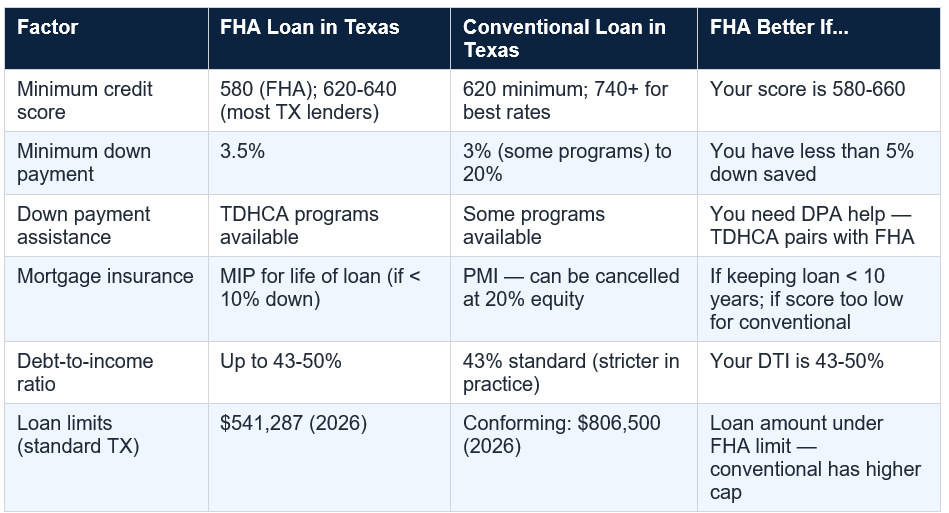
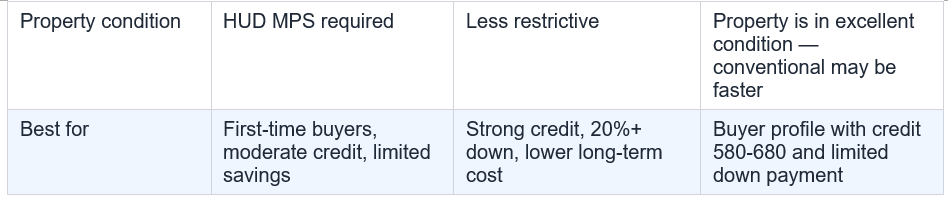
Texas FHA Loan vs Conventional Loan: Which Is Right for You?
The choice between FHA and conventional financing depends primarily on your credit score, down payment savings, and long-term mortgage insurance cost tolerance. X2 Mortgage’s 2025 guide offers the clearest summary: ‘If you have poor credit score, less reserve funds towards down payment, or higher debt, an FHA Home Loan Texas will probably be your best bet. Conventional home loans take more credit and more down payment, but less long-term mortgage insurance cost if you qualify.
Texas Down Payment Assistance Programs
Texas is well-served by down payment assistance programs that pair directly with FHA financing. Herring Bank’s 2026 Texas FHA guide identifies TDHCA programs as a key tool for Texas FHA buyers: the state’s housing agency specifically pairs FHA financing with down payment assistance to cover the upfront cost hurdle for eligible buyers.- My First Texas Home (TDHCA): Available to first-time buyers and veterans. Provides up to 5% of the loan amount in down payment and closing cost assistance (Herring Bank 2026). Paired with a competitive FHA or conventional loan rate. Income limits apply.
- Texas Mortgage Credit Certificate (MCC): A federal tax credit worth 30-50% of annual mortgage interest paid each year (up to $2,000 per year). Reduces net federal tax liability. Available through TDHCA for qualified buyers.
- My Choice Texas Home (TDHCA): Available to both first-time and repeat buyers. Provides up to 5% DPA. Slightly different income and purchase price limits from My First Texas Home.
- City and county programs: Houston, Dallas, San Antonio, Austin, and many other Texas municipalities offer additional homebuyer assistance programs — sometimes in the form of forgivable grants. Check with your city’s housing department for local programs.
- National programs: Nationwide DPA programs including those from the National Homebuyers Fund (NHF) and similar organisations may also be available to Texas buyers alongside FHA financing.
Conclusion
The FHA loan remains the most accessible mortgage programme for Texas buyers who are working with moderate credit scores, limited down payment savings, or higher debt-to-income ratios. In 2026, the combination of a $541,287 FHA floor limit that covers the vast majority of Texas properties at the state’s $340,800 median home price, a 3.5% minimum down payment, and TDHCA down payment assistance programs that can cover that 3.5% entirely for eligible buyers, creates a realistic path to homeownership for a wide range of Texas buyers. X2 Mortgage’s conclusion holds: ‘For most first-time and repeat homebuyers in Texas, FHA remains the easiest path to homeownership.’The nine steps in this guide move from credit check to closing in the order a Texas buyer will encounter them. Start with Step 1 — an honest assessment of your credit score and financial readiness — and work through the process systematically. The documentation, the pre-approval, the property search, the appraisal, and the underwriting each have their own requirements, but none of them is insurmountable for a well-prepared buyer. Please be aware that this is not financial or mortgage advice. For guidance specific to your circumstances, contact a HUD-approved housing counsellor (find one at hud.gov/find/counseling) or a qualified Texas mortgage professional.
Frequently Asked Questions
What is the minimum credit score for an FHA loan in Texas in 2026?The FHA's own minimum credit score is 580 for a 3.5% down payment, and 500-579 for a 10% down payment. However, Herring Bank's 2026 Texas FHA guide notes that most Texas lenders apply an overlay of 620-640 for automated approval — meaning the FHA minimum and the practical lender minimum are different. If your score is between 580 and 620, you can still qualify for an FHA loan in Texas, but you may need to shop more lenders to find one that works with your profile. If your score is between 500 and 579, you can potentially qualify with a 10% down payment but will need specific lender approval. Sources: Herring Bank 2026; Lower.com 2026; Rocket Mortgage February 2026.
What are the 2026 FHA loan limits in Texas?
For 2026, FHA loan limits in Texas range from $541,287 in standard-cost counties (the national FHA floor for a single-family home) to $649,750 in Travis County (Austin metro), according to Herring Bank's 2026 Texas FHA guide. Rocket Mortgage's February 2026 guide cites a higher potential ceiling in some Texas counties (up to $1,249,125 in the highest-cost counties nationally, though most Texas counties fall at or near the floor). The Texas median home price in December 2025 was $340,800 (Redfin, cited by Rocket Mortgage), which is well below the FHA floor of $541,287 — meaning most Texas buyers are within the FHA limit for their properties. FHA limits are set annually by HUD and vary by county. Check your specific county at HUD's loan limit lookup tool. Sources: Herring Bank 2026; Rocket Mortgage February 2026.
Does Texas have down payment assistance for FHA loans?
Yes — Texas has active state-funded down payment assistance programs through TDHCA (Texas Department of Housing and Community Affairs). The My First Texas Home program provides up to 5% of the loan amount in down payment and closing cost assistance to eligible first-time buyers and veterans, paired with FHA financing. The Texas Mortgage Credit Certificate (MCC) allows qualified buyers to claim a federal tax credit of 30-50% of annual mortgage interest paid. The My Choice Texas Home program is available to both first-time and repeat buyers. Many Texas cities and counties also offer additional local programs. Income limits and property price limits apply to TDHCA programs. Sources: Herring Bank 2026; TDHCA (tdhca.state.tx.us). Check current program eligibility directly with TDHCA or a participating lender.
How long does it take to get an FHA loan in Texas?
The typical timeline from pre-approval to closing for an FHA loan in Texas is 30-60 days, though it can be faster or slower depending on how quickly documentation is provided, whether the appraisal identifies property condition issues, and how responsive all parties (buyer, seller, lender, title company) are. Key timeline milestones: pre-approval can be completed in 1-3 days with complete documentation; appraisal scheduling and report: 1-2 weeks after accepted offer; underwriting: typically 5-15 business days after complete file submission; closing: 3 business days after final Closing Disclosure delivery. The timeline can extend if there are underwriting conditions that take time to satisfy, appraisal issues requiring seller remediation, or title complications. X2 Mortgage's 2025 guide notes that the process can move quickly when documentation is complete and clean.
Can I use an FHA loan for a rental property or second home in Texas?
No. FHA loans are strictly for primary residences only. You must intend to live in the property as your primary home. Investment properties and second homes are ineligible for FHA financing. This requirement is verified at closing and the FHA requires borrowers to occupy the property within 60 days of closing. If you need financing for an investment property, you would need to use a conventional loan, portfolio loan, or other non-FHA financing type. However, FHA does allow multi-unit properties (2-4 units) where the borrower occupies one unit as their primary residence — which is one way to use FHA financing for a property that also generates rental income. Sources: Herring Bank 2026; Rocket Mortgage February 2026; DSLD Mortgage. This is not mortgage or legal advice.
0 Comments
Be the first to share your thoughts on this article.