
Financial Literacy
How to Get Help Paying Your Bills: Accountant Explains


Table of Contents
- You Are Not Alone — And There Is More Help Than You Think
- Step One: The First Actions to Take If You Cannot Pay a Bill
- UK Bill Help: Every Major Scheme for 2025-2026
- UK Energy Bills: Detailed Support Guidance
- Talk to Your Energy Supplier First
- Universal Credit and Energy Bills
- UK Help With Other Bills: Rent, Water, Council Tax, and More
- Rent and Housing
- Water Bills
- Broadband and Phone Bills
- US Bill Help: Federal and Local Programmes for 2025-2026
- US Bill Help: Detailed Guidance by Bill Type
- Energy Bills
- Rent and Housing
- Medical Bills
- How to Negotiate Directly With Your Supplier or Creditor
- Additional Sources of Help: Charities, Food Banks, and Community Support
- United Kingdom
- United States
- Conclusion
- Frequently Asked Questions (FAQ)
You Are Not Alone — And There Is More Help Than You Think
Struggling to pay a bill is one of the most stressful experiences in everyday life. Whether it is an energy bill that has spiked, a rent payment that is out of reach this month, a water bill that feels impossible to meet, or a combination of costs that have simply added up beyond what income can cover — the weight of financial pressure is real, and the anxiety it creates can be overwhelming. But there is something critically important that most people in this situation do not know: there is a significant amount of help available, and most of it goes unclaimed because people either do not know it exists or do not believe they qualify.In the United States, Bankrate's 2025 Annual Emergency Savings Report found that more than one in three Americans — 37% — needed to tap their emergency savings in the past year. In the UK, the cost-of-living crisis of 2022-2024 pushed millions of households into fuel poverty and bill distress, prompting the government to introduce a range of support measures that remain available or are being renewed for 2025-2026. When the California wildfires struck in early 2025, the Red Cross disbursed more than $51 million in emergency assistance to over 13,000 households within weeks — demonstrating both the scale of financial distress and the scale of the support infrastructure that exists to respond to it.
This guide is a comprehensive, practical, and current resource covering every major source of bill help available in the UK and US in 2026: government energy and heating schemes, utility hardship programmes, rent and housing assistance, food support, phone and internet help, local council funds, the most important helplines and referral services, the steps to take before help arrives, and how to negotiate directly with creditors and suppliers to reduce or defer payments. If you are struggling with bills — or simply want to know what support exists before you need it — this guide has you covered.
Step One: The First Actions to Take If You Cannot Pay a Bill
Before exploring specific programmes and schemes, there are four immediate actions that can make a significant difference to anyone facing bill difficulties — regardless of which country they are in or which bills are causing the problem. These steps do not require any government programme, application, or waiting period:- Contact your supplier or creditor immediately: The single most important step most people delay taking. Whether it is an energy company, a landlord, a mortgage lender, a water company, or a phone provider, almost every major bill provider has a hardship process or payment plan available — but you have to ask for it. Calling before you miss a payment gives you more options than calling after. Explain your situation honestly and ask specifically: 'Do you have a hardship programme or payment plan I can apply for?' Most utility companies in the UK are required by Ofgem regulations to offer payment plans. In the US, most utilities have shut-off protections and budget billing options.
- Check what benefits and schemes you are entitled to: A significant proportion of people eligible for government support do not claim it — either because they do not know it exists, they think they will not qualify, or the application process feels daunting. In the UK, Citizens Advice estimates that billions of pounds in benefits go unclaimed every year. Use an online benefits calculator (EntitledTo.co.uk or Turn2us.org.uk in the UK; benefits.gov in the US) to get a personalised estimate of what you can claim. You may be entitled to significantly more than you think.
- Prioritise your bills correctly: Not all bills are equal. Falling behind on different bills has very different consequences. The priority hierarchy: housing (rent or mortgage) first — loss of housing is the most serious consequence; energy (gas and electricity) second — disconnection is dangerous and affects health; council tax (UK) or other legally enforceable debts third; then consumer debts (credit cards, personal loans, buy-now-pay-later) which have more flexibility. Never let rent or mortgage lapse to pay a credit card — the consequences are opposite in severity.
- Get free debt or money advice: In the UK, Citizens Advice (0800 144 8848), StepChange (0800 138 1111), National Debtline (0808 808 4000), and MoneyHelper (0800 138 7777) all provide free, confidential money and debt advice. In the US, CFPB-recommended resources include 211 and HUD-approved housing counselling agencies (800-569-4287). A trained adviser can assess your full situation, identify every scheme you qualify for, and help you negotiate with creditors — often achieving outcomes far better than individual negotiation alone.
The scale of financial pressure in 2025-2026: 37% of Americans needed to tap emergency savings in 2025. Red Cross disbursed $51M+ to 13,000+ households after 2025 California wildfires. — GoFundMe Emergency Financial Assistance Guide (April 20, 2026): 'According to Bankrate's 2025 Annual Emergency Savings Report, more than one in three (37%) Americans needed to tap into their emergency savings in the past year, and many are finding their emergency funds dwindling with the rising cost of living.' California wildfires 2025: 'The Red Cross disbursed more than $51 million of assistance to over 13,000 households.' UK context: Citizens Advice helps over 2.6 million people per year with debt, benefits, and bills — the majority of whom find support they did not know existed before seeking help
UK Bill Help: Every Major Scheme for 2025-2026
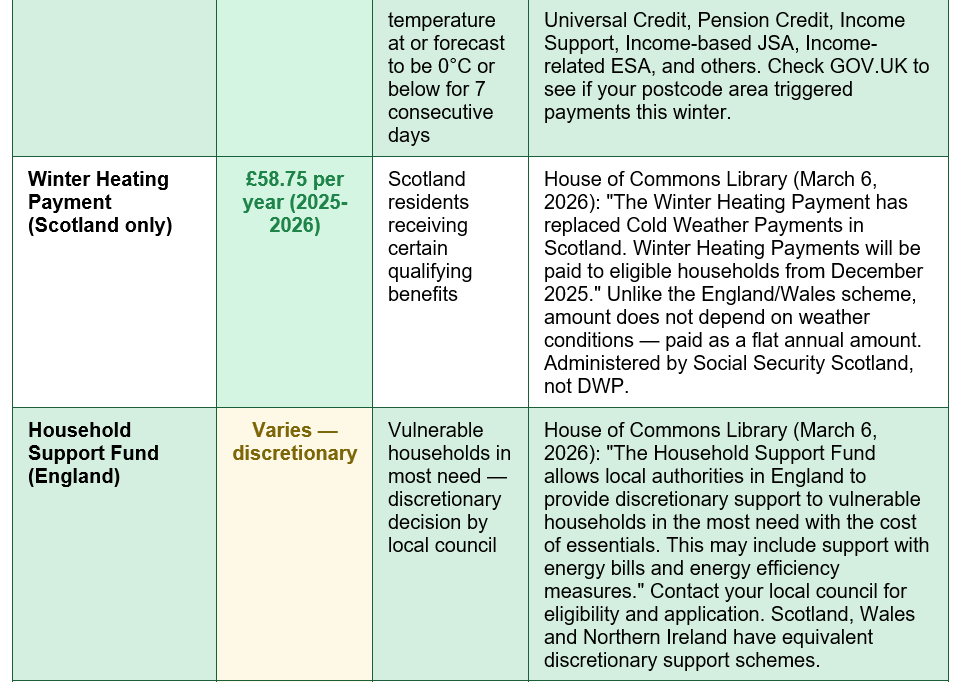
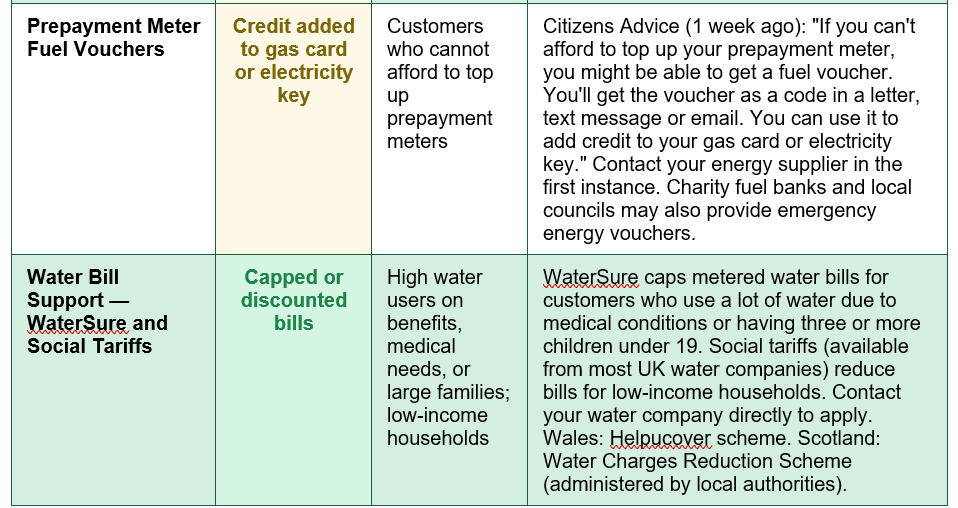
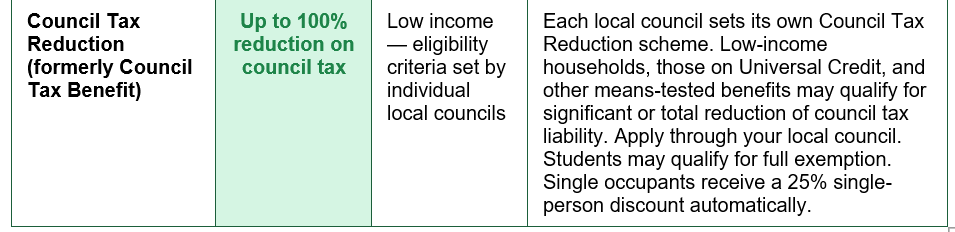
The UK government and energy regulator Ofgem have a range of support schemes for households struggling with bills. The table below maps every major scheme with current 2025-2026 details — amounts, eligibility, and exactly how to claim: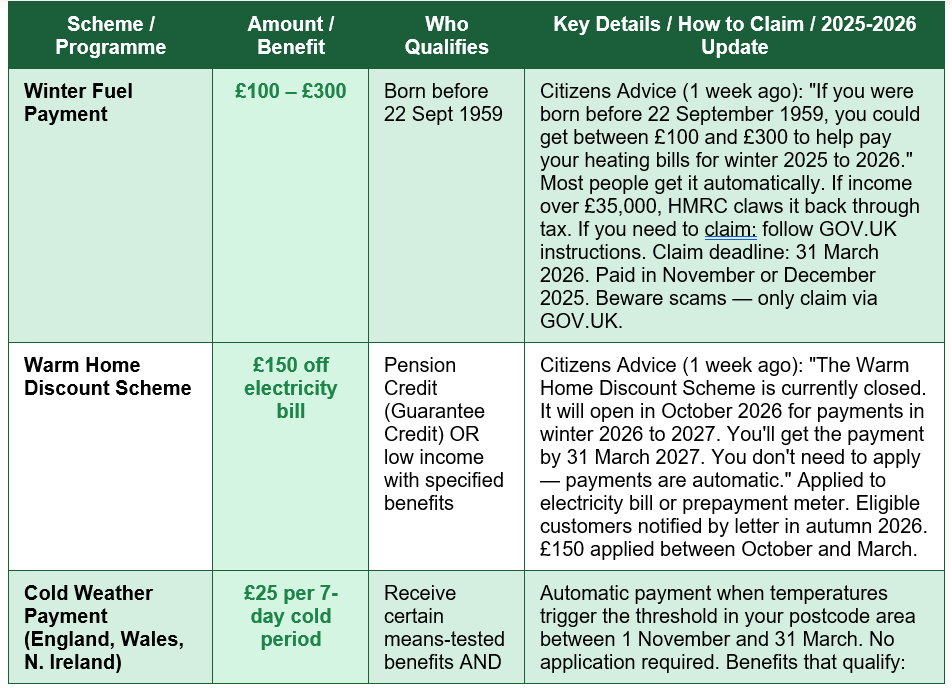
UK Energy Bills: Detailed Support Guidance
Talk to Your Energy Supplier First
Every major UK energy supplier is required by Ofgem to offer support to customers in financial difficulty. The specific support available includes: payment plans spread over 12-24 months, payment breaks or reductions for short-term difficulties, access to the supplier's own hardship fund (British Gas Energy Trust, E.ON Next Energy Fund, Octopus Energy's Octo Assist Fund, etc.), fuel vouchers for prepayment customers, and referral to debt advisers. Call the number on your energy bill and ask to speak to the 'financial support' or 'hardship' team specifically — not general customer services.Universal Credit and Energy Bills
If you receive Universal Credit, you may be entitled to additional energy support. The Cold Weather Payment is automatically triggered for Universal Credit recipients when temperatures fall. The Warm Home Discount requires you to have your name on the electricity bill and meet the qualifying income criteria. Council Tax Reduction can significantly reduce council tax for UC recipients. Some local councils also offer direct bill grants to Universal Credit claimants through the Household Support Fund — contact your council directly.The most important thing to know about UK energy bills: you cannot be disconnected for debt if you have a prepayment meter, if you have communicated with your supplier that you are in difficulty, or during winter months if you are vulnerable. Ofgem's Standards of Conduct require suppliers to treat customers fairly, offer debt repayment plans, and provide emergency credit on prepayment meters. If your supplier refuses to help or threatens disconnection unfairly, contact Citizens Advice Energy (0808 223 1133) — they can advocate on your behalf and the supplier is legally required to cooperate.
UK Help With Other Bills: Rent, Water, Council Tax, and More
Rent and Housing
If you are struggling to pay rent, act immediately — rent arrears can escalate quickly to eviction proceedings. Key resources: Discretionary Housing Payments (DHPs) — available from your local council if Housing Benefit or the housing element of Universal Credit does not cover your full rent. DHPs are not automatically granted and are discretionary — apply through your council explaining your circumstances. Local housing associations may have their own hardship funds. Shelter's housing helpline (0808 800 4444) provides free advice. If you are a homeowner, the Support for Mortgage Interest (SMI) scheme — a government loan that covers mortgage interest for qualifying Universal Credit or Pension Credit recipients — may be available.Water Bills
Every water company in England and Wales is required to have a social tariff for low-income customers. Contact your water company and ask specifically about their 'social tariff' or 'hardship scheme'. WaterSure is a national scheme that caps water bills for metered customers who use a lot of water due to medical conditions or having three or more children under 19. Water companies also have their own charitable trust funds — Yorkshire Water's WaterCare, Thames Water's Restart scheme, and others — that can provide grants or direct assistance to customers in genuine hardship. You will not know what is available unless you ask.Broadband and Phone Bills
Several UK broadband providers offer social tariffs for Universal Credit recipients: BT Home Essentials, Sky's Broadband Basics, Virgin Media O2's Essential Broadband, and Vodafone's Broadband Lite are all available at significantly reduced prices. These typically provide speeds sufficient for streaming and working from home at around £15-£25 per month — a significant saving on standard tariffs. Phone providers also offer reduced tariffs for benefits recipients. MoneyHelper (moneyhelper.org.uk) maintains an updated list of social tariff providers.US Bill Help: Federal and Local Programmes for 2025-2026
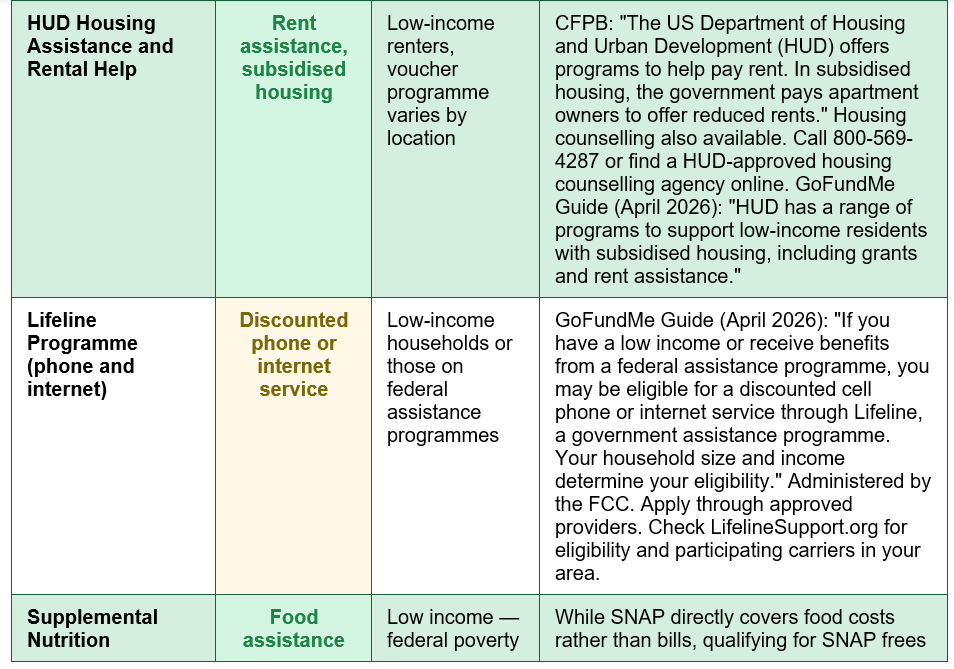
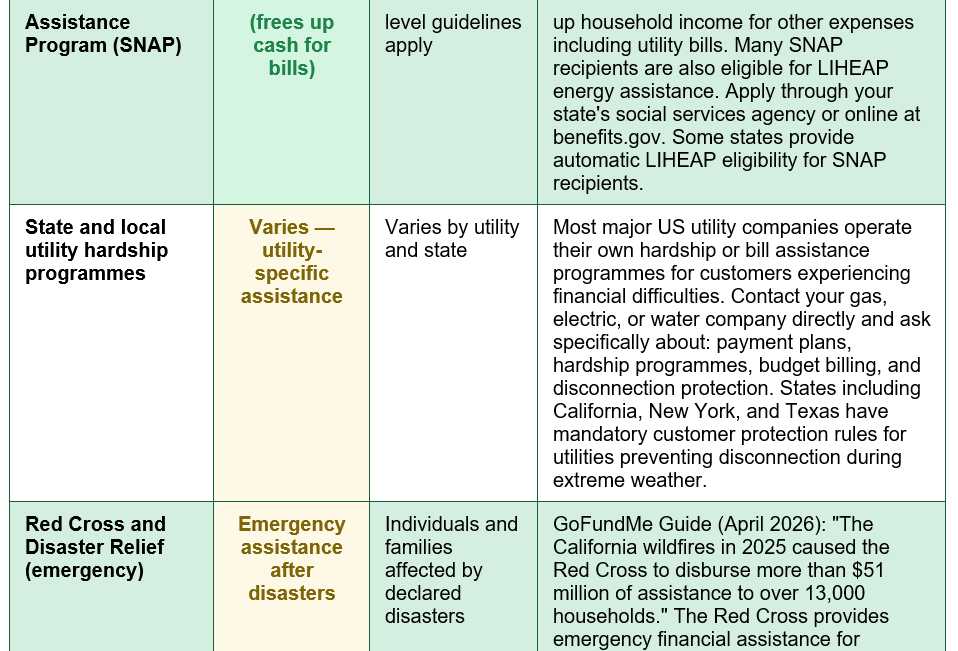
The United States has a comprehensive network of federal, state, and local assistance programmes for households struggling with bills. The table below maps the most important resources — with the critical contact information to access each one: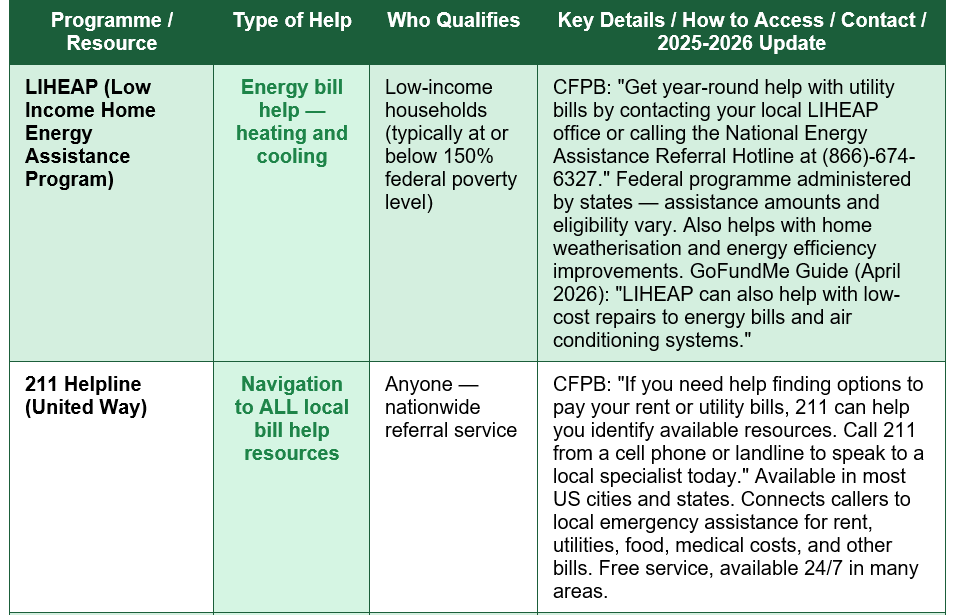

US Bill Help: Detailed Guidance by Bill Type
Energy Bills
LIHEAP is the cornerstone of US energy bill assistance — a federal programme that provides heating and cooling assistance, home weatherisation, and energy efficiency improvements to income-qualifying households. Eligibility and benefit amounts vary significantly by state. The National Energy Assistance Referral Hotline (866-674-6327) connects callers directly to their local LIHEAP office. Beyond LIHEAP, most major utilities operate their own assistance programmes — contact your specific utility company and ask about 'bill assistance', 'hardship programmes', or 'payment plans'. State public utility commissions also regulate disconnection and mandate certain customer protections in most states.Rent and Housing
The CFPB recommends 211 as the first call for rent assistance — the service connects callers to local rental assistance resources including state-funded Emergency Rental Assistance programmes, HUD-subsidised housing, and local charity assistance. HUD-approved housing counsellors are available at 800-569-4287 and can provide free or low-cost guidance on rental assistance, eviction prevention, and long-term housing stability. Section 8 Housing Choice Vouchers (administered by local Public Housing Authorities) provide longer-term rental assistance for qualifying households, though waitlists can be long in many areas.Medical Bills
Medical bills are the leading cause of personal bankruptcy in the United States. Key resources: hospitals and healthcare systems are required to have financial assistance (charity care) programmes for uninsured or underinsured patients — ask the billing department specifically about their 'financial assistance policy' or 'charity care programme'. The patient advocacy charity RIP Medical Debt acquires and erases medical debt portfolios for families in need. Medicaid provides free or very low-cost healthcare for qualifying low-income individuals — eligibility expanded significantly under the Affordable Care Act and varies by state.THE MOST IMPORTANT CONTACTS FOR IMMEDIATE HELP — UK AND US: UK — FREE HELP WITH ALL BILLS: Citizens Advice: 0800 144 8848 (free, confidential, covers all bill types). StepChange Debt Charity: 0800 138 1111 (free debt and bill advice). MoneyHelper: 0800 138 7777 (government-backed money and debt guidance). Turn2Us: turn2us.org.uk (benefits calculator and grant search). National Debtline: 0808 808 4000 (specialist debt advice). Shelter Housing Helpline: 0808 800 4444 (housing and rent issues). Ofgem Energy Advice: citizensadvice.org.uk/consumer/energy (energy bill disputes). UK — GOVERNMENT WEBSITES: GOV.UK/Benefits — for Winter Fuel Payment, Universal Credit, Council Tax Reduction applications. Entitledto.co.uk — free online benefits calculator. US — FREE HELP WITH ALL BILLS: 211 Helpline: Dial 211 from any phone for local emergency assistance referrals (available in most states). LIHEAP Energy Help: 1-866-674-6327 (National Energy Assistance Referral Hotline). HUD Housing Counselling: 1-800-569-4287. CFPB Consumer Help: consumerfinance.gov. Benefits.gov: federal benefits finder tool. DisasterAssistance.gov: disaster relief applications.
How to Negotiate Directly With Your Supplier or Creditor
If government programmes and schemes do not fully cover your needs, direct negotiation with your supplier or creditor is often more effective than people expect. Suppliers and creditors — from energy companies to landlords to mortgage lenders — generally prefer to negotiate a payment solution over the alternative of non-payment, legal action, and the associated costs and reputational damage. Here is how to approach these conversations effectively:- Be specific and honest: Call the company and ask to speak to the accounts management, collections, or hardship team. Explain your specific situation: 'I am currently unable to pay the full amount because [reason]. I can afford to pay £X per month. Can we set up a payment plan?' A specific, credible offer is more likely to be accepted than a vague request for 'more time'. Bring documentation of your income and outgoings to support your position.
- Request a payment holiday: Many creditors, including energy companies, mobile phone providers, and banks, will offer a short-term payment holiday (typically 1-3 months) for customers experiencing temporary financial difficulty. This defers payments rather than reducing them — interest may continue to accrue on debts during a payment holiday — but it provides breathing space. Ask explicitly: 'Can I apply for a payment holiday?'
- Ask about breathing space protections (UK): The UK Breathing Space scheme (Debt Respite Scheme) provides up to 60 days of legal protection from most creditors while you seek debt advice. During breathing space, creditors cannot take enforcement action, add interest or charges, or contact you directly about the debt. Apply through a registered debt adviser such as Citizens Advice, StepChange, or National Debtline.
- Get all agreements in writing: Any payment arrangement agreed over the phone should be confirmed in writing before you make the first payment. Ask the representative to send you written confirmation of the arrangement by email or post. A written agreement protects you if the company later claims the arrangement was not agreed or applies further charges.
- Challenge unfair charges and penalties: Creditors and suppliers cannot charge excessive default fees in the UK (the Financial Conduct Authority caps default charges at £15 for credit-regulated products). Energy companies cannot disconnect you for debt in ways that breach Ofgem regulations. If you believe you have been charged unfairly or treated in breach of regulatory rules, contact the relevant ombudsman — the Energy Ombudsman (UK) for energy bills, the Financial Ombudsman Service (FOS) for financial products.
Additional Sources of Help: Charities, Food Banks, and Community Support
Beyond government schemes and direct supplier negotiation, a significant network of charitable and community support exists in both countries for people struggling with bills and basic costs of living:United Kingdom
- Trussell Trust food banks: Over 1,200 food bank centres across the UK, providing emergency food parcels and often money advice referrals. Find your local food bank at trusselltrust.org or call 01722 580180.
- British Gas Energy Trust: Provides grants to help British Gas and non-British Gas customers in energy debt, regardless of supplier. Apply at britishgasenergytrust.org.uk.
- E.ON Next Energy Fund: Grants for E.ON and non-E.ON customers experiencing energy hardship. Available at eon.co.uk/energy-fund.
- Turn2Us: Free online tool at turn2us.org.uk to search for charitable grants and funds available in your area and based on your circumstances. Searches thousands of grant programmes simultaneously.
- Local welfare assistance schemes: Most UK local councils have a local welfare assistance scheme providing grants or vouchers for essential costs including food, energy, and household goods. Search '[your council name] welfare assistance' to find your local scheme.
United States
- Feeding America food banks: Network of 200+ food banks across the US. Find your nearest at feedingamerica.org or call 1-800-771-2303.
- Salvation Army: Provides utility assistance, rent assistance, and other emergency help. Contact your local Salvation Army office or visit salvationarmyusa.org.
- Community Action Agencies: Local agencies funded under the Community Services Block Grant providing emergency assistance, job training, and financial literacy. Find your agency at communityactionpartnership.com.
- 211.org: The comprehensive US referral portal — search by location for food banks, utility assistance, rent help, childcare, and virtually any other community resource.
- Modest Needs: Provides small emergency grants to working adults not yet in poverty who have a temporary financial shortfall. Apply at modestneeds.org.
SCAM WARNING — PROTECT YOURSELF WHEN SEEKING BILL HELP: When you are financially vulnerable and searching for help, you become a target for scammers who pose as government agencies, grant providers, or energy companies. Key warning signs: any legitimate scheme will NEVER ask for an upfront payment to release a grant or benefit; Citizens Advice (UK), LIHEAP (US), and all government programmes do not charge fees for their services. Be suspicious of unsolicited calls, texts, or social media messages claiming you are owed energy money or offering government grants in exchange for personal or banking information. Citizens Advice (1 week ago) specifically warns about Winter Fuel Payment scams: 'If you are asked to claim in any other way [than GOV.UK], it is probably a scam.' In the US, LIHEAP referrals come only from government offices or approved non-profit agencies — never from private companies charging 'processing fees'. If in doubt, call 211 (US) or Citizens Advice (UK: 0800 144 8848) directly using the number from the official website, not a number from an incoming message.
Conclusion
Struggling to pay bills is not a failure — it is a circumstance faced by millions of people in the UK and US every year, and the gap between the help that exists and the help that is claimed remains enormous. The four most important things to do if you cannot pay a bill are: contact your supplier immediately and ask about hardship programmes and payment plans; check what government benefits and schemes you are entitled to using a benefits calculator; call 211 (US) or Citizens Advice (UK: 0800 144 8848) for free navigation of every resource in your area; and prioritise your bills correctly — housing and energy first, consumer debts last.In the UK, the 2025-2026 suite of government support includes the Winter Fuel Payment (£100-£300 for those born before September 22, 1959), the Warm Home Discount (£150 off electricity, reopening October 2026), Cold Weather Payments (£25 per 7-day cold period for benefit recipients), the Household Support Fund (administered by local councils), and numerous supplier-specific hardship funds and charitable grants. In the US, LIHEAP provides year-round energy assistance, 211 connects callers to every local resource for every type of bill, HUD and state housing agencies provide rental assistance, and the Lifeline programme offers discounted phone and internet for low-income households.
The most effective single action any person in financial difficulty can take is to make contact — with a supplier, with a government programme, or with a free advice service — before the situation escalates. Payment plans, breathing space protections, fuel vouchers, hardship grants, and benefit entitlements are available, but they require you to reach out to access them. Every week of delay makes the financial hole deeper and the available options narrower. This guide exists to make that first contact easier, better informed, and more likely to result in the help you are entitled to.
0 Comments
Be the first to share your thoughts on this article.