
Credits
How to Improve a Poor Credit Score Fast

The average FICO score hit a record 715 in late 2025. But approximately 20% of Americans still have a score below 600 — and around 20% of credit reports contain errors that lower scores unnecessarily. Here is the complete, step-by-step 2026 guide to rebuilding from poor credit.

If you are in the 20 percent with a score below 600, the most important thing to understand is that your current score is not a permanent condition. It is a snapshot of your financial behaviour and your credit file as they exist today. Both can be changed. Some strategies produce measurable score improvement within a single billing cycle (30 to 45 days). Others require months or years of consistent behaviour. This guide organises every credible 2026 credit improvement strategy by speed of impact and explains exactly how much each one can move the needle.
The Numbers: Average US FICO score: 715 in late 2025 (record high, Experian). ~20% of Americans have a score below 600. ~20% of credit reports contain errors that lower scores (creditscoresandmore.com 2026). One missed payment: 50–100 point drop. Average US credit card debt 2026: $6,360. Average utilization: 35.5% vs recommended under 30% (ideal under 10%).

You cannot fix what you have not found. The first step is always a full review of all three credit reports from all three bureaus — Equifax, Experian, and TransUnion. Free weekly access to all three reports continues through 2026 at AnnualCreditReport.com (ScoreVera, April 2026). This is not the same as paying for a score or a credit monitoring service; it is a free, federally mandated right under the Fair Credit Reporting Act.
What to look for on each report:
The dispute process:
Avoid This: Do not pay a third-party credit repair company to do what you can legally do yourself for free. The dispute process under the FCRA is available directly to consumers. Third-party credit repair companies cannot do anything for you that you cannot do yourself, and many charge significant fees for filing the same dispute letters you could send for the cost of postage.
The utilization thresholds matter:
The most reliable protection against a future missed payment is autopay: setting the minimum payment to auto-draft from your bank account on the due date for every account. This does not prevent you from paying more; it prevents the catastrophic scenario where a forgotten due date generates a 30-day late payment notation that stays on your file for seven years. Credit.com’s April 2026 guide makes the mechanism explicit: ‘simply go to your credit card company’s website and set up automatic payments for the minimum each month. This way, you never have to worry about forgetting your payment.’
For existing late payments: time and consistent on-time behaviour are the primary remedies. There is no legitimate way to remove an accurately reported late payment from your credit file before its natural expiration. However, some creditors will remove a single late payment as a courtesy (known as a ‘goodwill deletion’) if you write a respectful letter citing your otherwise positive payment history and asking for consideration. Success rates are inconsistent but the process costs only time.
Action: Log in to every credit card and loan account today. Set up autopay for the minimum payment on each. Then set a separate calendar reminder two days before each statement closing date to make any additional payment above the minimum. The autopay protects your payment history; the reminder gives you the opportunity to pay more.
ScoreNerds’ March 2026 guide to 2025–2026 credit score changes identifies the authorised user strategy as the one exception to the general rule that you cannot accelerate the ‘length of credit history’ factor (15 percent of FICO score). Consumers with the highest scores have an average credit history exceeding 11 years (FICO). By becoming an authorised user on an account that has been open for 10 years with a perfect payment record, you can effectively inherit some of that account age for scoring purposes.
Important conditions:
The rules for maximum benefit: use the card for one small recurring charge (such as a streaming subscription) and pay the full balance every month. Keep utilization on the secured card under 10 percent of the limit. Never carry a large balance on a secured card.
If you have medical collections currently on your report that you believe should have been removed under the 2023 voluntary bureau changes, pull your reports from AnnualCreditReport.com and verify. If a qualifying medical collection is still appearing, file a dispute with the relevant bureau citing the 2023 voluntary policy. The bureau bears the burden of justifying keeping the item on the report.
The impact is most significant for thin-file consumers — those with few credit accounts. If you have been paying your electric bill, phone bill, and Netflix subscription on time for years but have no credit cards or loans, those payments have been contributing nothing to your credit score. Experian Boost converts that payment history into positive credit file data. The average reported boost is modest (a few points for most users), but for consumers with thin files or specific score thresholds they are trying to reach, even a few points can make the difference.
Important limitations: Experian Boost only affects your Experian credit report and Experian-based credit scores. It does not affect your Equifax or TransUnion files. Additionally, the payments added are only the ones that appear positive — the service only adds beneficial history. And if you have missed utility or phone payments, those are not added; only consistent on-time payments contribute.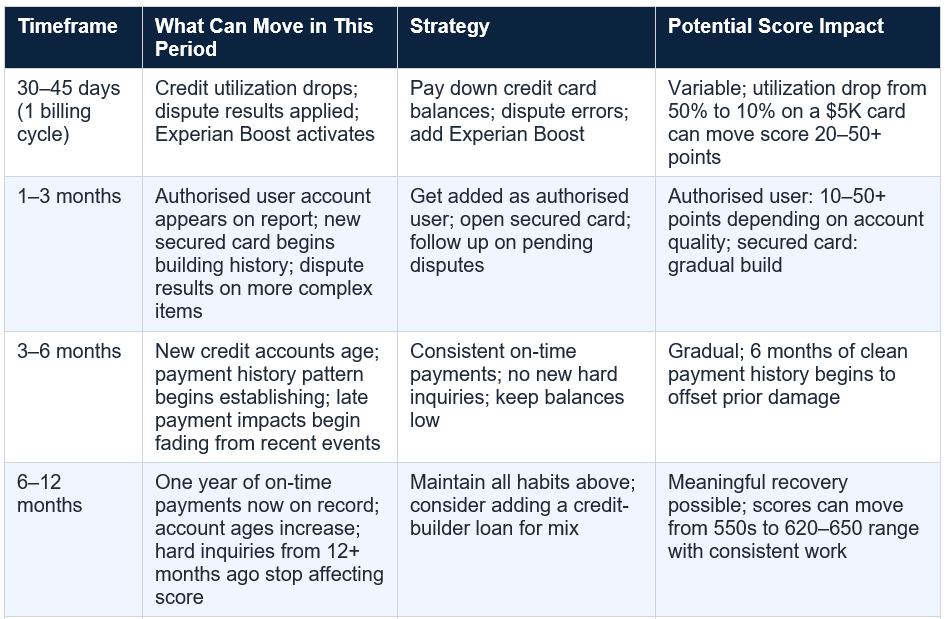
Good credit drivers pay up to 25 percent less in insurance compared to bad credit drivers (credit-repair.com October 2025). The cumulative financial cost of a poor credit score over a lifetime of borrowing — mortgages, auto loans, personal loans, higher insurance premiums, apartment deposits — can reach hundreds of thousands of dollars. Improving a credit score is one of the highest-return financial activities available.
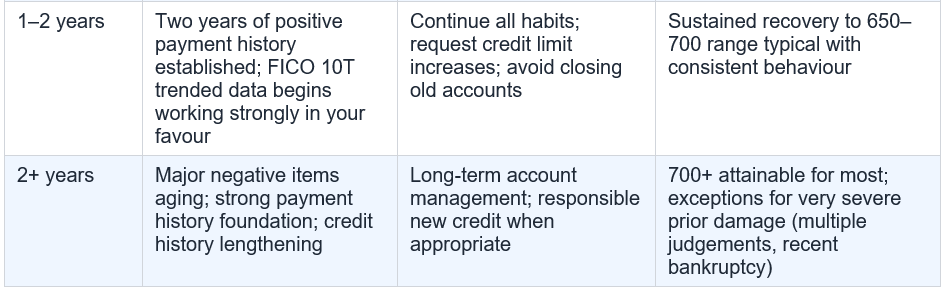
The eight steps in this guide produce results on different timescales. Disputing an error, reducing credit utilization, and getting added as an authorised user can each produce meaningful score movement within a single month. Building the payment history foundation that the 35 percent payment factor rewards requires months and years of consistent on-time payments. The two timescales are not in conflict: the fastest strategies produce immediate improvement while the slower strategies build the durable foundation that sustains it.
Start today. Pull your credit reports from AnnualCreditReport.com, identify every negative item and every error, and begin the dispute process for any inaccuracy. Then set up autopay on every account, pay down the highest-utilization card, and check whether any medical debt collections on your report should already have been removed under the 2023 voluntary bureau changes. The most expensive hour of credit neglect is the next one.
It depends on the strategy and the severity of the damage. Some improvements can happen within a single billing cycle (30–45 days): disputing and removing an error, paying down a high credit card balance to below 30% utilization, or getting added as an authorised user on a well-managed account can all produce noticeable score improvement within 30–45 days of the change being reported to the bureaus (Firstcard, April 2026). However, rebuilding a score from below 600 to above 700 typically takes 12 to 24 months of consistent positive behaviour — primarily on-time payments and low utilization maintained over time. The new FICO 10T model launched in early 2026 tracks 24 months of trended behaviour, which means consistent improvement over two years is now structurally rewarded more than in prior scoring models.
What is the fastest way to raise a credit score?
Three strategies produce the fastest results: (1) Reduce credit utilization — paying down credit card balances below 30% (ideally below 10%) of your credit limit can improve your score in one billing cycle (30–45 days). This is the fastest-moving factor because it is recalculated every month when balances are reported. (2) Dispute errors — approximately 20% of credit reports contain errors (creditscoresandmore.com 2026). Removing an incorrect collection, a misreported late payment, or a duplicate account can produce significant score improvement within 30–60 days of the dispute being resolved. (3) Get added as an authorised user — being added to a family member's or trusted friend's well-managed account (long history, low utilization, no late payments) can begin appearing on your report within one to two billing cycles, potentially improving average account age and payment history simultaneously.
Does paying off a collection account improve your credit score?
It depends on the type of collection and the scoring model being used. Under older FICO models (still used by some lenders), a paid collection still appears on your credit report and may only modestly improve your score. Under newer models like FICO 9 and FICO 10, paid collections are ignored, meaning paying a collection in full can produce meaningful score improvement. For medical collections specifically: under the 2023 voluntary bureau changes (still in effect in 2026), paid medical collections are removed from credit reports entirely, regardless of amount. This removal can produce noticeable score improvement for consumers who had medical collections dragging their scores down by 20–40 points each (ScoreVera, April 2026). For non-medical collections: the primary benefit of paying is to stop the item aging and to position yourself for goodwill deletion requests or dispute leverage in future.
How much does one late payment hurt your credit score?
Significantly. One late payment can drop a credit score by 50 to 100 points (credit-repair.com October 2025; credit.com April 2026), depending on the score before the late payment and how late it was (30 days vs 60 days vs 90+ days are progressively more damaging). The higher your score before the late payment, the more it drops — this is because a late payment is more statistically anomalous for someone with a 750 score than someone with a 600 score. Late payments remain on your credit report for 7 years, but their impact diminishes over time. A late payment from 3+ years ago has significantly less impact than one from the last 6 months (Firstcard, April 2026). The best strategy for an isolated old late payment is to set up autopay immediately (to prevent future occurrences) and, if it was an isolated incident, write a goodwill deletion letter to the creditor.
What is credit utilization and how does it affect my score?
Credit utilization is the ratio of your credit card balances to your total credit limits, expressed as a percentage. If you have a $10,000 total credit limit across all cards and carry $3,500 in total balances, your utilization is 35%. Credit utilization accounts for 30% of your FICO score — the second-largest factor. The recommended maximum is 30%, but consumers with the highest credit scores typically maintain utilization under 10%, according to Experian data cited by creditscoresandmore.com in 2026. The average American's utilization was approximately 35.5% in 2025 (credit-repair.com) — already above the recommended level. Utilization is calculated both overall (across all cards combined) and per card (each individual card). A single card at 90% utilization hurts even if your overall rate is low. Utilization is recalculated every month when your balances are reported, making it the fastest-moving credit score factor available.
What medical debt is still on credit reports in 2026?
The situation in 2026: the CFPB's rule banning medical debt from all credit reports was vacated by a federal court and is no longer enforceable as of April 2026 (Firstcard, May 2026). However, the voluntary actions taken by the three major credit bureaus (Equifax, Experian, TransUnion) in 2023 remain fully in effect: (1) Paid medical collections are removed from credit reports regardless of amount. (2) Medical collections under $500 are removed. (3) A 365-day waiting period applies before any medical collection can appear on a credit report. Medical debt within the past year should not be on your report. Roughly 70% of medical debt tradelines have been removed by 2026 (Health Bill Central, March 2026). If a qualifying medical collection is still on your report, dispute it directly with the bureau. The average medical collection was dragging scores down by 20–40 points; multiple collections could account for a 50–100+ point drag (ScoreVera, April 2026).
Table of Contents
- Where Americans Stand on Credit in 2026
- How Your FICO Score Is Built: The Five Factors
- Step #1: Get Your Free Credit Reports and Find Every Error
- Step #2: Dispute Every Error — Your FCRA Rights in 2026
- Step #3: Attack Credit Utilization First (It Moves Fastest)
- Step #4: Never Miss Another Payment — Set Up Autopay Today
- Step #5: Become an Authorised User on a Well-Managed Account
- Step #6: Open a Secured Credit Card or Credit-Builder Loan
- Step #7: Check Your Medical Debt Status Under 2026 Rules
- Step #8: Add Alternative Payment Data with Experian Boost
- What the New 2026 Scoring Models Mean for You
- The Credit Score Improvement Timeline: What to Expect and When
- Five Habits That Destroy Credit Scores (And How to Stop Them)
- The Real Cost of a Poor Credit Score
- Conclusion: Credit Repair Is a Marathon, Not a Sprint — But Some Laps Are Fast
- Frequently Asked Questions
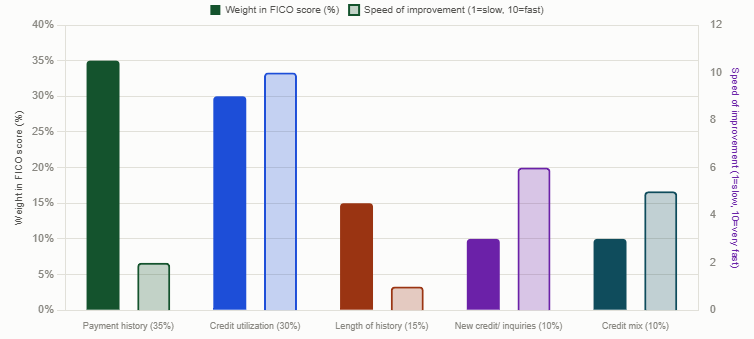
FICO Factor Weights And Speed
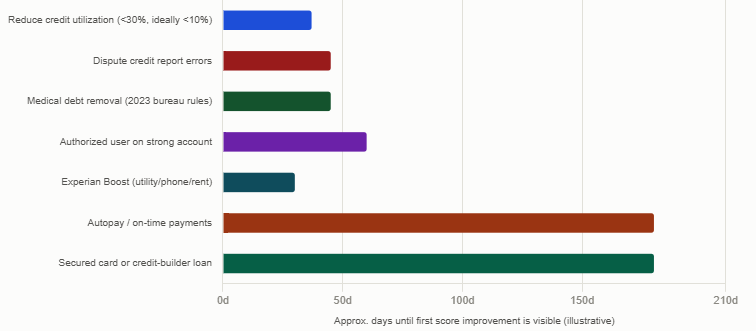
Imrovement Timeline By Strategy
Where Americans Stand on Credit in 2026
The average FICO score hit 715 in late 2025 — the highest national average ever recorded, according to Experian’s Annual Consumer Credit Review, cited by ScoreNerds in March 2026. About 23 percent of Americans have exceptional credit (800 or above). These are the encouraging headlines. The less encouraging data: approximately 20 percent of Americans still carry a FICO score below 600, where lenders either decline applications outright or offer rates that make borrowing genuinely punishing. And approximately 20 percent of credit reports contain errors that are currently lowering scores below what they should be.If you are in the 20 percent with a score below 600, the most important thing to understand is that your current score is not a permanent condition. It is a snapshot of your financial behaviour and your credit file as they exist today. Both can be changed. Some strategies produce measurable score improvement within a single billing cycle (30 to 45 days). Others require months or years of consistent behaviour. This guide organises every credible 2026 credit improvement strategy by speed of impact and explains exactly how much each one can move the needle.
The Numbers: Average US FICO score: 715 in late 2025 (record high, Experian). ~20% of Americans have a score below 600. ~20% of credit reports contain errors that lower scores (creditscoresandmore.com 2026). One missed payment: 50–100 point drop. Average US credit card debt 2026: $6,360. Average utilization: 35.5% vs recommended under 30% (ideal under 10%).
How Your FICO Score Is Built: The Five Factors
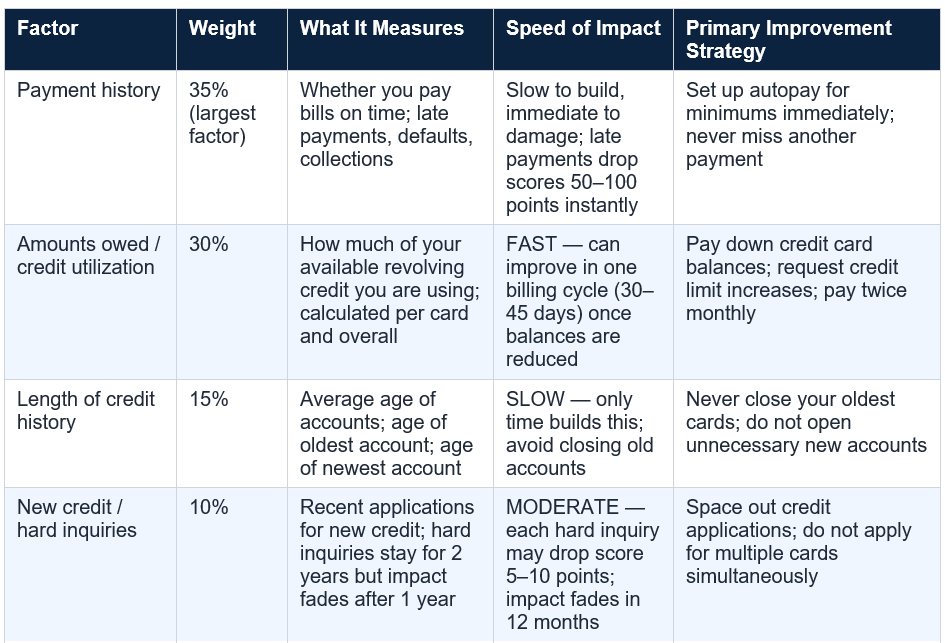
Before attacking your credit score, understand what it is made of. FICO scores (used by approximately 90 percent of top lenders) are built from five categories, each weighted differently. The weights determine which strategies produce the fastest results:
Step #1: Get Your Free Credit Reports and Find Every Error
Step #1: Get All Three Free Credit Reports and Read Every Line
Approximately 20 percent of credit reports contain errors that lower scores, according to creditscoresandmore.com’s 2026 analysis. These errors are not rare anomalies — they include duplicate accounts, accounts belonging to someone with a similar name, correctly paid debts reported as unpaid, debts discharged in bankruptcy still showing balances, and accounts that have passed the legally permitted reporting period but remain on the file.You cannot fix what you have not found. The first step is always a full review of all three credit reports from all three bureaus — Equifax, Experian, and TransUnion. Free weekly access to all three reports continues through 2026 at AnnualCreditReport.com (ScoreVera, April 2026). This is not the same as paying for a score or a credit monitoring service; it is a free, federally mandated right under the Fair Credit Reporting Act.
What to look for on each report:
- Accounts that are not yours: these may indicate identity theft or a mixed file (your file contains information from someone with a similar name).
- Late payments marked incorrectly: payments reported as late that you can document were made on time.
- Debt that has been paid but is still listed as unpaid or in collections.
- Debts discharged in bankruptcy still showing balances owed.
- Duplicate accounts: the same debt reported twice.
- Accounts past the reporting period: most negative items must be removed after 7 years (some bankruptcies after 10 years).
- Medical debt that should have been removed: paid medical collections and collections under $500 are removed under the 2023 voluntary bureau changes (confirmed as still in effect in 2026 per Firstcard May 2026).
Step #2: Dispute Every Error — Your FCRA Rights in 2026
Step #2: Dispute Every Inaccurate Item Through the Correct Process
Under the Fair Credit Reporting Act (FCRA), credit bureaus have 30 days to investigate a dispute and respond (National Credit Repair Authority; Pinnacle Credit Repair). If the item is confirmed inaccurate or unverifiable, it must be deleted or corrected. If errors are identified and removed, Pinnacle Credit Repair’s August 2025 guide notes that many people see score movement within 30 to 60 days. ScoreNerds’ March 2026 guide to 2025–2026 credit score changes cites 2026 FCRA amendments as providing stronger dispute protections.The dispute process:
- File directly with each bureau: disputes can be filed online (Equifax, Experian, and TransUnion all have online dispute portals), by mail (with certified receipt), or by phone. Mail with certified mail is the strongest evidentiary record.
- Dispute with the furnisher as well: alongside the bureau dispute, send a dispute letter directly to the creditor or collection agency that reported the error. Under FCRA, furnishers must investigate disputes and cannot continue reporting information they know to be inaccurate.
- Document everything: keep copies of all dispute letters, certified mail receipts, and bureau responses. This documentation is essential if escalation becomes necessary.
- Escalate if needed: if the dispute is denied and you believe the item is genuinely inaccurate, escalate by filing a complaint with the CFPB at ConsumerFinance.gov. The CFPB complaint process has produced results in cases where direct bureau disputes did not.
Avoid This: Do not pay a third-party credit repair company to do what you can legally do yourself for free. The dispute process under the FCRA is available directly to consumers. Third-party credit repair companies cannot do anything for you that you cannot do yourself, and many charge significant fees for filing the same dispute letters you could send for the cost of postage.
Step #3: Attack Credit Utilization First (It Moves Fastest)
Step #3: Reduce Credit Utilization Below 30% — and Ideally Below 10%
Credit utilization — the ratio of your credit card balances to your credit limits — accounts for 30 percent of your FICO score and is the fastest-moving factor available to most people. Paying down credit card debt can improve your score in as little as one billing cycle (30 to 45 days) once the lower balance is reported to the bureaus (Firstcard, April 2026).The utilization thresholds matter:
- Below 30%: the widely cited maximum threshold. The average American carries 35.5 percent utilization (credit-repair.com), which means most people are already above the recommended level.
- Below 10%: the level maintained by consumers with the highest credit scores, per Experian data cited by creditscoresandmore.com 2026. Moving from 35 percent to under 10 percent on a $10,000 credit limit means bringing a balance from $3,500 to under $1,000.
- Per-card and overall: utilization is calculated both for each individual card and across all cards combined. A single card at 90 percent utilization hurts even if the overall utilization across all cards is 20 percent. Distribute balances and pay down the highest-utilization card first.
- Request a credit limit increase: if your credit limit increases from $5,000 to $7,500 and your balance stays at $1,500, utilization drops from 30 percent to 20 percent without paying down a dollar. Many issuers allow online credit limit increase requests without a hard inquiry.
- Pay twice per month: credit card balances are reported on the statement closing date, not the payment due date. Paying down balances before the statement closes reduces the balance that is reported to the bureaus.
- Open a new card (carefully): opening a new credit card increases your total available credit, reducing the utilization ratio — but at the cost of a hard inquiry and a new account (which temporarily reduces average account age). This trade-off is worth analysing in context.
Step #4: Never Miss Another Payment — Set Up Autopay Today
Step #4: Make On-Time Payment a Certainty With Autopay
Payment history is 35 percent of your FICO score — the single largest factor. One missed payment can drop a score by 50 to 100 points, according to credit-repair.com and credit.com. Late payments remain on your credit report for up to seven years, though their impact on your score diminishes as time passes (Firstcard, April 2026). A late payment from three or more years ago has significantly less impact than one from the last six months.The most reliable protection against a future missed payment is autopay: setting the minimum payment to auto-draft from your bank account on the due date for every account. This does not prevent you from paying more; it prevents the catastrophic scenario where a forgotten due date generates a 30-day late payment notation that stays on your file for seven years. Credit.com’s April 2026 guide makes the mechanism explicit: ‘simply go to your credit card company’s website and set up automatic payments for the minimum each month. This way, you never have to worry about forgetting your payment.’
For existing late payments: time and consistent on-time behaviour are the primary remedies. There is no legitimate way to remove an accurately reported late payment from your credit file before its natural expiration. However, some creditors will remove a single late payment as a courtesy (known as a ‘goodwill deletion’) if you write a respectful letter citing your otherwise positive payment history and asking for consideration. Success rates are inconsistent but the process costs only time.
Action: Log in to every credit card and loan account today. Set up autopay for the minimum payment on each. Then set a separate calendar reminder two days before each statement closing date to make any additional payment above the minimum. The autopay protects your payment history; the reminder gives you the opportunity to pay more.
Step #5: Become an Authorised User on a Well-Managed Account
Step #5: Get Added as an Authorised User on a Trusted, Well-Managed Account
The authorised user strategy is one of the fastest credit score improvements available, particularly for thin-file consumers (those with few or no credit accounts) and those recovering from past damage. When a family member or trusted friend adds you as an authorised user on their credit card — ideally one with a long history, low utilization, and a perfect payment record — their positive account history can begin appearing on your credit report within one to two billing cycles (Firstcard, April 2026).ScoreNerds’ March 2026 guide to 2025–2026 credit score changes identifies the authorised user strategy as the one exception to the general rule that you cannot accelerate the ‘length of credit history’ factor (15 percent of FICO score). Consumers with the highest scores have an average credit history exceeding 11 years (FICO). By becoming an authorised user on an account that has been open for 10 years with a perfect payment record, you can effectively inherit some of that account age for scoring purposes.
Important conditions:
- The primary account holder must have a strong payment history, low utilization, and a long account age. A poorly managed account you are added to as an authorised user hurts your score.
- You do not need to use the card or even receive the card. Simply being added is sufficient to inherit the history.
- The card issuer must report authorised user accounts to the credit bureaus (most major issuers do, but confirm before being added).
Step #6: Open a Secured Credit Card or Credit-Builder Loan
Step #6: Build New Positive History With a Secured Card or Credit-Builder Loan
If your credit file is thin (few accounts) or your existing accounts are damaged, the long-term solution is adding new accounts with positive payment history. Two products designed specifically for this:Secured Credit Card
A secured credit card requires a cash deposit (typically $200 to $500) that becomes the credit limit. It functions exactly like a regular credit card: you charge purchases, receive a monthly statement, and pay the balance. The card issuer reports your payment history to the bureaus. Disciplined use — keeping balances low, paying the statement balance in full each month — builds a positive payment history record. Many secured card issuers automatically review accounts for upgrade to an unsecured card after 6 to 12 months of responsible use, returning the deposit.The rules for maximum benefit: use the card for one small recurring charge (such as a streaming subscription) and pay the full balance every month. Keep utilization on the secured card under 10 percent of the limit. Never carry a large balance on a secured card.
Credit-Builder Loan
A credit-builder loan works in reverse: you make monthly loan payments, and the funds are held in a savings account. At the end of the loan term, you receive the accumulated savings. The loan payments are reported to the bureaus throughout the term, building payment history without requiring any upfront credit qualification. Credit unions and community banks offer these products specifically for consumers rebuilding credit.Step #7: Check Your Medical Debt Status Under 2026 Rules
Step #7: Verify Whether Medical Debt Collections Should Already Be Off Your Report
Medical debt is one of the most significant and most frequently misunderstood credit file issues. The situation as of 2026 is nuanced: the CFPB’s rule banning all medical debt from credit reports nationally was vacated by a federal court in 2025. As of April 2026, that specific federal rule is no longer enforceable (Firstcard, May 2026). However, the voluntary actions taken by Equifax, Experian, and TransUnion in 2023 remain fully in effect and are still removing medical debt from credit reports:- Paid medical collections: removed from credit reports regardless of amount.
- Medical collections under $500: removed from credit reports.
- Medical debt within the first 365 days: a one-year waiting period before any medical collection can appear on a credit report.
If you have medical collections currently on your report that you believe should have been removed under the 2023 voluntary bureau changes, pull your reports from AnnualCreditReport.com and verify. If a qualifying medical collection is still appearing, file a dispute with the relevant bureau citing the 2023 voluntary policy. The bureau bears the burden of justifying keeping the item on the report.
Step #8: Add Alternative Payment Data with Experian Boost
Step #8: Use Experian Boost to Add Utility, Phone, Streaming, and Rent Payments
Experian Boost is a free service offered by Experian that allows consumers to add payment history from bills not traditionally included in credit reports — specifically utilities, mobile phone, video streaming services, and rent payments. When you enrol and connect your bank account, Experian scans for these payments and, with your authorisation, adds them to your Experian credit file.The impact is most significant for thin-file consumers — those with few credit accounts. If you have been paying your electric bill, phone bill, and Netflix subscription on time for years but have no credit cards or loans, those payments have been contributing nothing to your credit score. Experian Boost converts that payment history into positive credit file data. The average reported boost is modest (a few points for most users), but for consumers with thin files or specific score thresholds they are trying to reach, even a few points can make the difference.
Important limitations: Experian Boost only affects your Experian credit report and Experian-based credit scores. It does not affect your Equifax or TransUnion files. Additionally, the payments added are only the ones that appear positive — the service only adds beneficial history. And if you have missed utility or phone payments, those are not added; only consistent on-time payments contribute.
What the New 2026 Scoring Models Mean for You
Several significant changes to credit scoring models are affecting how scores are calculated in 2026:- FICO 10T (launched early 2026): tracks 24 months of credit behaviour — trended data — rather than a single snapshot. If you have been consistently paying down balances over the past two years, FICO 10T will reward that pattern more than the snapshot models. If you have been consistently carrying growing balances, it will penalise that pattern more. Consistent improvement is now structurally more rewarding.
- FICO Score 10 BNPL / FICO Score 10T BNPL (launched late 2025): Buy Now, Pay Later (BNPL) payments now appear on credit reports under these models. On-time BNPL payments can build credit history, especially for thin-file consumers. Missed BNPL payments hurt scores like any other delinquency. Treat every BNPL payment as seriously as a credit card payment.
- VantageScore 4.0: already available to Fannie Mae and Freddie Mac; tracks 24 months of data similar to FICO 10T.
- Fannie Mae eliminated minimum credit score requirements for mortgages on November 15, 2025 (getoutofdebt.org January 2026): using broader risk assessment. This does not mean bad credit is ignored, but that the threshold approach has been replaced by a more holistic model.
The Credit Score Improvement Timeline: What to Expect and When
Five Habits That Destroy Credit Scores (And How to Stop Them)
Understanding what damages credit is as important as understanding what builds it. The five most common credit score killers:- Missing payments: one 30-day late payment can drop a score 50 to 100 points instantly. Solution: autopay for minimums on every account, every month.
- High credit utilization: carrying balances above 30 percent of credit limits is one of the most common reasons for scores stuck below 700. Solution: pay toward the highest-utilization card first, even before the highest-rate card.
- Closing old credit cards: closing an old card reduces your total available credit (raising utilization) and can reduce your average account age (reducing the length of credit history factor). Solution: keep old cards open, even if you rarely use them. A small recurring charge and monthly payoff maintains the account.
- Applying for multiple cards simultaneously: each hard inquiry reduces the score by approximately 5 to 10 points and multiple applications signal financial stress to lenders. Solution: space credit applications at least six to twelve months apart.
- Maxing out a single card: a single card at 90 percent utilization significantly damages the per-card utilization calculation, even if overall utilization is low. Solution: distribute balances across cards and prioritise keeping any single card below 30 percent.
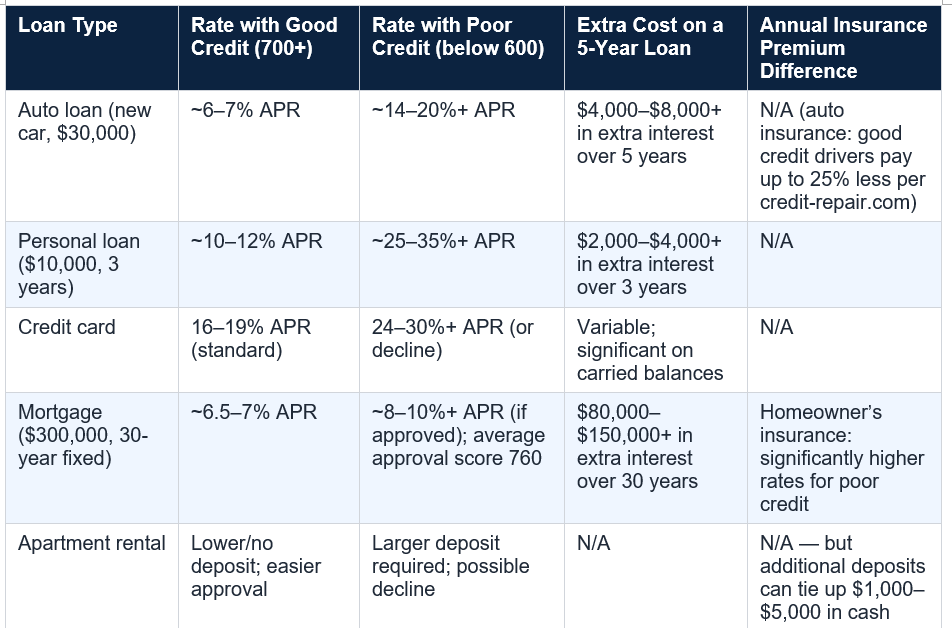
The Real Cost of a Poor Credit Score
A poor credit score is not just a financial inconvenience. It is a tax on everything you borrow:Good credit drivers pay up to 25 percent less in insurance compared to bad credit drivers (credit-repair.com October 2025). The cumulative financial cost of a poor credit score over a lifetime of borrowing — mortgages, auto loans, personal loans, higher insurance premiums, apartment deposits — can reach hundreds of thousands of dollars. Improving a credit score is one of the highest-return financial activities available.
Conclusion
The average FICO score of 715 is a national headline. Behind it are millions of Americans with scores below 600 who are paying more for everything they borrow, being denied apartments they want to rent, and facing barriers to financial goals that good credit would open. The gap between a score of 580 and 720 represents tens of thousands of dollars in interest costs over a lifetime of borrowing.The eight steps in this guide produce results on different timescales. Disputing an error, reducing credit utilization, and getting added as an authorised user can each produce meaningful score movement within a single month. Building the payment history foundation that the 35 percent payment factor rewards requires months and years of consistent on-time payments. The two timescales are not in conflict: the fastest strategies produce immediate improvement while the slower strategies build the durable foundation that sustains it.
Start today. Pull your credit reports from AnnualCreditReport.com, identify every negative item and every error, and begin the dispute process for any inaccuracy. Then set up autopay on every account, pay down the highest-utilization card, and check whether any medical debt collections on your report should already have been removed under the 2023 voluntary bureau changes. The most expensive hour of credit neglect is the next one.
Frequently Asked Questions
How long does it take to improve a poor credit score?It depends on the strategy and the severity of the damage. Some improvements can happen within a single billing cycle (30–45 days): disputing and removing an error, paying down a high credit card balance to below 30% utilization, or getting added as an authorised user on a well-managed account can all produce noticeable score improvement within 30–45 days of the change being reported to the bureaus (Firstcard, April 2026). However, rebuilding a score from below 600 to above 700 typically takes 12 to 24 months of consistent positive behaviour — primarily on-time payments and low utilization maintained over time. The new FICO 10T model launched in early 2026 tracks 24 months of trended behaviour, which means consistent improvement over two years is now structurally rewarded more than in prior scoring models.
What is the fastest way to raise a credit score?
Three strategies produce the fastest results: (1) Reduce credit utilization — paying down credit card balances below 30% (ideally below 10%) of your credit limit can improve your score in one billing cycle (30–45 days). This is the fastest-moving factor because it is recalculated every month when balances are reported. (2) Dispute errors — approximately 20% of credit reports contain errors (creditscoresandmore.com 2026). Removing an incorrect collection, a misreported late payment, or a duplicate account can produce significant score improvement within 30–60 days of the dispute being resolved. (3) Get added as an authorised user — being added to a family member's or trusted friend's well-managed account (long history, low utilization, no late payments) can begin appearing on your report within one to two billing cycles, potentially improving average account age and payment history simultaneously.
Does paying off a collection account improve your credit score?
It depends on the type of collection and the scoring model being used. Under older FICO models (still used by some lenders), a paid collection still appears on your credit report and may only modestly improve your score. Under newer models like FICO 9 and FICO 10, paid collections are ignored, meaning paying a collection in full can produce meaningful score improvement. For medical collections specifically: under the 2023 voluntary bureau changes (still in effect in 2026), paid medical collections are removed from credit reports entirely, regardless of amount. This removal can produce noticeable score improvement for consumers who had medical collections dragging their scores down by 20–40 points each (ScoreVera, April 2026). For non-medical collections: the primary benefit of paying is to stop the item aging and to position yourself for goodwill deletion requests or dispute leverage in future.
How much does one late payment hurt your credit score?
Significantly. One late payment can drop a credit score by 50 to 100 points (credit-repair.com October 2025; credit.com April 2026), depending on the score before the late payment and how late it was (30 days vs 60 days vs 90+ days are progressively more damaging). The higher your score before the late payment, the more it drops — this is because a late payment is more statistically anomalous for someone with a 750 score than someone with a 600 score. Late payments remain on your credit report for 7 years, but their impact diminishes over time. A late payment from 3+ years ago has significantly less impact than one from the last 6 months (Firstcard, April 2026). The best strategy for an isolated old late payment is to set up autopay immediately (to prevent future occurrences) and, if it was an isolated incident, write a goodwill deletion letter to the creditor.
What is credit utilization and how does it affect my score?
Credit utilization is the ratio of your credit card balances to your total credit limits, expressed as a percentage. If you have a $10,000 total credit limit across all cards and carry $3,500 in total balances, your utilization is 35%. Credit utilization accounts for 30% of your FICO score — the second-largest factor. The recommended maximum is 30%, but consumers with the highest credit scores typically maintain utilization under 10%, according to Experian data cited by creditscoresandmore.com in 2026. The average American's utilization was approximately 35.5% in 2025 (credit-repair.com) — already above the recommended level. Utilization is calculated both overall (across all cards combined) and per card (each individual card). A single card at 90% utilization hurts even if your overall rate is low. Utilization is recalculated every month when your balances are reported, making it the fastest-moving credit score factor available.
What medical debt is still on credit reports in 2026?
The situation in 2026: the CFPB's rule banning medical debt from all credit reports was vacated by a federal court and is no longer enforceable as of April 2026 (Firstcard, May 2026). However, the voluntary actions taken by the three major credit bureaus (Equifax, Experian, TransUnion) in 2023 remain fully in effect: (1) Paid medical collections are removed from credit reports regardless of amount. (2) Medical collections under $500 are removed. (3) A 365-day waiting period applies before any medical collection can appear on a credit report. Medical debt within the past year should not be on your report. Roughly 70% of medical debt tradelines have been removed by 2026 (Health Bill Central, March 2026). If a qualifying medical collection is still on your report, dispute it directly with the bureau. The average medical collection was dragging scores down by 20–40 points; multiple collections could account for a 50–100+ point drag (ScoreVera, April 2026).
0 Comments
Be the first to share your thoughts on this article.