

Real Estate
How to Invest in Real Estate With No Capital
Table of Contents
- Why Real Estate Remains One of the Best Wealth-Building Vehicles
- 7 Strategies at a Glance
- Strategy 1: Real Estate Investment Trusts (REITs)
- Strategy 2: Real Estate Crowdfunding Platforms
- Strategy 3: Real Estate Wholesaling
- Strategy 4: House Hacking
- Strategy 5: Lease Options (Rent-to-Own)
- Strategy 6: Subject-To Real Estate Acquisitions
- Strategy 7: Real Estate Partnerships and Joint Ventures
- Key Risks to Understand Before You Start
- Conclusion
- Frequently Asked Questions (FAQ)
- External References & Further Reading
Real estate has long been considered one of the most reliable paths to building lasting wealth. Historically, property investment has delivered consistent returns through rental income, capital appreciation, and tax advantages that few other asset classes can match. But for many aspiring investors, a single obstacle seems to block the entire journey: the lack of starting capital.
The assumption that you need a large deposit or significant savings to invest in real estate is one of the most persistent and costly myths in personal finance. The reality is more nuanced — and considerably more accessible. Thousands of investors around the world enter the property market every year without a traditional down payment, using creative strategies, leveraging other people's money, pooling resources, or using their skills and time as currency instead of cash.
This guide covers seven legitimate, well-established strategies for investing in real estate with little to no capital. Each approach has its own risk profile, effort requirements, and income potential. Whether you are looking for a fully passive entry point or willing to invest significant time and energy in exchange for equity and profit, there is a path here that matches your situation. The most important step is understanding your options clearly — and then taking action.
Why Real Estate Remains One of the Best Wealth-Building Vehicles
Before exploring no-capital strategies, it is worth understanding why real estate is worth pursuing in the first place. Unlike stocks or bonds, property investment offers a unique combination of advantages that compound over time.- Leverage: Real estate allows investors to control a large asset with a comparatively small initial investment. For example, in the UK a property worth £200,000 can be acquired with a £20,000 deposit — a 10:1 leverage ratio that amplifies returns on the invested capital.
- Passive income: Rental properties generate monthly cash flow that can cover mortgage payments and produce ongoing income, creating financial independence over time.
- Capital appreciation: UK house prices have increased by an average of approximately 6% per year over the past 25 years, according to the Nationwide House Price Index. US property has shown similar long-term trends.
- Inflation hedge: Property values and rents tend to rise with inflation, protecting purchasing power in a way that cash savings do not.
- Tax advantages: From mortgage interest deductions to depreciation allowances and capital gains exemptions, real estate offers substantial tax efficiency in both the UK and US.
These advantages explain why real estate consistently features in the portfolios of the world's wealthiest individuals — and why finding a way to participate, even without upfront capital, is worth considerable effort.
7 Strategies at a Glance
The table below summarises all seven strategies covered in this guide, including the capital required, income potential, and relative difficulty: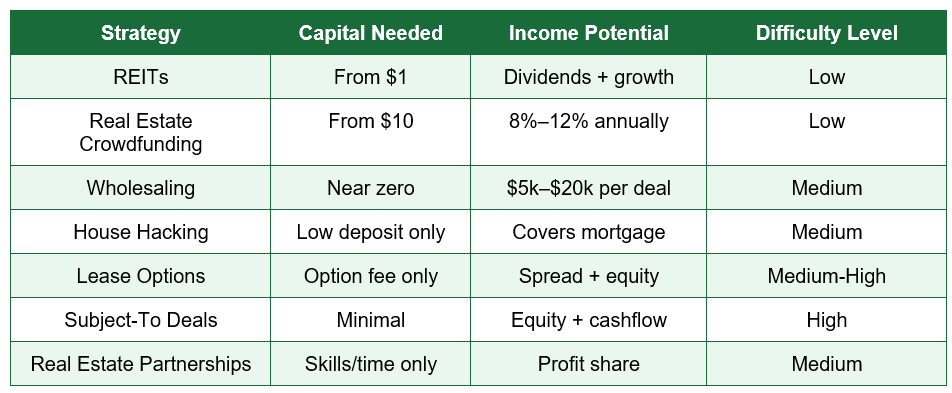
Strategy 1: Real Estate Investment Trusts (REITs)
A Real Estate Investment Trust (REIT) is a company that owns, operates, or finances income-producing real estate across a range of property sectors — including commercial offices, residential apartments, retail spaces, industrial warehouses, and healthcare facilities. REITs are publicly traded on stock exchanges, meaning you can buy shares through any standard investment or brokerage account with as little as a few pounds or dollars.By law in both the US and UK, REITs must distribute at least 90% of their taxable income to shareholders as dividends. This makes them one of the most reliable sources of passive income in the investment universe. Major REITs such as Segro, Land Securities, and British Land (UK) or Realty Income, American Tower, and Prologis (US) offer well-diversified exposure to the property market with the liquidity of a stock.
REITs are ideal for investors with minimal capital who want true exposure to real estate returns without the management responsibilities of physical property. They can be held within an ISA (UK) or IRA (US) for tax efficiency. The trade-off is that you do not benefit from direct leverage, and returns depend on market conditions and management quality rather than your own effort.
For the absolute beginner, investing as little as £50 per month into a REIT-focused index fund through platforms such as Vanguard, Hargreaves Lansdown, or Fidelity represents an accessible and low-risk entry point into real estate investing.
Strategy 2: Real Estate Crowdfunding Platforms
Real estate crowdfunding platforms pool together small investments from many individuals to fund the purchase or development of specific properties. In return, investors receive a proportional share of rental income and any capital gains when the property is sold. Platforms such as Fundrise, RealtyMogul, and CrowdStreet (US) or Property Partner, Assetz Capital, and Bricklane (UK) allow participation with as little as $10 to $100.Crowdfunding bridges the gap between the accessibility of REITs and the tangibility of direct property ownership. Many platforms allow you to choose specific projects — a residential development in Manchester, a commercial property in Austin, a build-to-rent block in Birmingham — giving investors more control over the type and location of their real estate exposure.
Returns on established platforms have historically ranged between 8% and 12% annually, though these are not guaranteed and platform risk — the risk that the platform itself faces financial difficulties — should be factored into any decision. Always invest only through FCA-regulated platforms in the UK or SEC-registered platforms in the US, and diversify across multiple projects to reduce concentration risk.
Strategy 3: Real Estate Wholesaling
Wholesaling is one of the most powerful no-capital real estate strategies for those willing to invest time, research, and negotiation skills. The process works as follows: a wholesaler identifies a distressed or undervalued property, negotiates a purchase contract with the seller at a below-market price, and then assigns that contract to an end buyer (typically a property investor or developer) for a fee — without ever purchasing the property themselves.The wholesaler's profit comes from the assignment fee, which typically ranges from $5,000 to $20,000 per deal in the US and from £3,000 to £15,000 in the UK, depending on the property value and the size of the discount secured. Because the wholesaler never takes title to the property, no mortgage or deposit is required. The primary investment is time: finding motivated sellers, analysing property values, building a buyers list, and executing the contract correctly.
Success in wholesaling requires a solid understanding of local property values, strong negotiation skills, a reliable network of cash buyers, and attention to legal detail — particularly ensuring that the assignment of contracts is conducted in a legally compliant manner in your jurisdiction. For those willing to learn these skills, wholesaling offers a legitimate path to generating significant income from real estate without any starting capital.
Strategy 4: House Hacking
House hacking is the strategy of purchasing a residential property — which you also live in — and renting out part of it to tenants whose rent covers your mortgage payment and ideally generates surplus income. Common approaches include renting out spare bedrooms to housemates, purchasing a small block of flats and living in one unit while renting the others, or renting a room on Airbnb or SpareRoom.The genius of house hacking is that it converts a personal living expense into an income-generating asset. In many cases, the rental income from tenants reduces the investor's effective housing cost to near zero — or eliminates it entirely. In the US, government-backed FHA loans allow owner-occupiers to purchase a property with as little as 3.5% down, dramatically reducing the barrier to entry. In the UK, Help to Buy and shared ownership schemes perform a similar function for first-time buyers.
House hacking requires a willingness to share your living space and manage tenant relationships, but it is one of the most capital-efficient strategies available, particularly for younger investors who are at the stage of life where flexibility about living arrangements is possible. Many seasoned property investors credit house hacking as the foundation of their portfolio.
Strategy 5: Lease Options (Rent-to-Own)
A lease option is a contractual arrangement in which an investor leases a property from a seller with the right — but not the obligation — to purchase it at a pre-agreed price at a future date. The investor can then sub-let the property to tenants at a higher rent than they are paying the owner, keeping the difference as monthly cashflow, while also building equity toward an eventual purchase.Lease options require minimal upfront capital — typically only a modest option fee paid to the seller to secure the right to purchase. In exchange, the seller benefits from a reliable tenant who maintains the property and commits to a long-term arrangement. This structure is particularly attractive for sellers who want monthly income without the hassle of landlord responsibilities, or who need time to release equity gradually.
The strategy requires careful legal structuring to ensure all parties' interests are protected. In the UK, lease option agreements should always be drafted or reviewed by a solicitor experienced in property law. In the US, rent-to-own arrangements are regulated differently by state, so local legal advice is essential. When structured correctly, lease options allow investors to control, profit from, and ultimately own property with minimal initial capital outlay.
Strategy 6: Subject-To Real Estate Acquisitions
A subject-to acquisition involves purchasing a property subject to the existing mortgage — meaning the investor takes over ownership and control of the property while the original seller's mortgage remains in their name. The investor makes the mortgage payments going forward and benefits from any equity growth and rental income, while the seller is relieved of their financial obligation.This strategy requires very little capital because no new mortgage is obtained. The investor simply needs enough to cover any equity the seller holds above the mortgage balance, closing costs, and initial property management expenses. Subject-to deals are most commonly found when sellers are facing financial distress — foreclosure, divorce, job relocation, or an inherited property they cannot maintain — and need a quick exit.
Subject-to acquisitions are complex and carry specific legal and ethical considerations. The seller's mortgage typically contains a due-on-sale clause, meaning the lender could theoretically call the loan due upon transfer of ownership. This risk must be understood and mitigated. Working with an experienced real estate attorney and mentor is strongly recommended before attempting a subject-to transaction. For experienced investors, however, it is one of the most powerful tools for acquiring property with minimal capital.
Strategy 7: Real Estate Partnerships and Joint Ventures
Perhaps the most straightforward no-capital strategy is to partner with someone who has money but lacks time, knowledge, or deal-finding ability. In a real estate joint venture, one partner provides the capital — the deposit, the finance, or the purchase price — while the other partner provides the deal sourcing, management, and expertise. Profits are split according to the agreed terms of the partnership.This approach works because real estate is inherently a relationship business, and capital is not the scarcest resource in the market. Motivated, knowledgeable, and trustworthy deal-finders are often harder to come by than money. Private investors, high-net-worth individuals, and property investment clubs are frequently seeking credible partners who can source quality deals and manage them effectively.
Building the skills required to be a valuable partner — market analysis, deal evaluation, negotiation, project management — takes time but no money. Starting with education (books, online courses, property investment forums) and networking (local property meetups, online communities, professional associations) is the first step. Once you can demonstrate credibility and deal flow, finding a capital partner becomes considerably easier.
Key Risks to Understand Before You Start
Investing in real estate with no capital is genuinely possible — but it is not risk-free. Understanding the primary risks ensures you approach each strategy with appropriate caution:- Market risk: Property values can fall as well as rise. Strategies that rely on capital appreciation require a long-term horizon to smooth out market cycles.
- Liquidity risk: Unlike stocks, real estate — and most no-capital strategies — cannot be exited quickly. Ensure you have financial reserves separate from any investment.
- Legal and compliance risk: Wholesaling, lease options, and subject-to deals have specific legal requirements that vary by jurisdiction. Always seek qualified legal advice before entering contracts.
- Platform risk: Crowdfunding platforms can fail. Only use regulated platforms and diversify across multiple projects.
- Counterparty risk: Joint ventures and partnerships depend on trust and alignment of interests. Always formalise agreements in writing with a solicitor-reviewed contract.
Conclusion
The belief that real estate investing requires substantial capital is a barrier that exists primarily in the mind, not in the market. From REITs that allow participation for the price of a cup of coffee, to wholesaling strategies that generate five-figure profits using nothing but knowledge and hustle, the property market offers entry points at every level of capital availability.The key is matching the right strategy to your current situation: your time availability, risk tolerance, skills, network, and long-term goals. A time-rich, capital-poor investor might excel at wholesaling or building partnership deal flow. A capital-poor but income-steady investor might start with monthly REIT contributions and move into crowdfunding. Someone with a stable income and willingness to share their home might begin with house hacking.
Whatever path you choose, the most important decision is to begin. Real estate investing rewards those who stay the course, continue learning, and reinvest gains into the next opportunity. Start with one strategy, master it, and build from there. The property wealth you envision is more accessible than you think — it simply requires a different kind of starting point than you may have assumed.
Frequently Asked Questions (FAQ)
Is it really possible to invest in real estate with no money at all?
Yes, several strategies genuinely require little to no starting capital. REITs can be started with under £10, wholesaling requires no purchase capital (only time and knowledge), and joint ventures allow you to invest using skills rather than cash. That said, all real estate strategies require some investment — whether in time, education, legal costs, or relationship building. There is no entirely effortless path.Which no-capital strategy is best for a complete beginner?
REITs and real estate crowdfunding are the most accessible starting points for beginners. They require no real estate knowledge to begin, are managed by professionals, and allow you to learn about the market while earning returns. As you build knowledge and confidence, you can explore more active strategies such as wholesaling or partnerships.How do I find motivated sellers for wholesaling or lease options?
Motivated sellers are found through a range of channels: driving for dollars (identifying visibly distressed properties), direct mail campaigns, online platforms such as Rightmove (UK) or Zillow (US) for properties with long days on market, probate listings, and relationships with estate agents who work distressed sales. Consistency and volume in outreach are key — most leads do not convert immediately.What credit score do I need to invest in real estate with no capital?
Strategies such as REITs, crowdfunding, wholesaling, and joint ventures do not require a credit check because no mortgage is being obtained. If you are pursuing house hacking with a government-backed low-deposit loan, lenders typically require a minimum credit score of 580 (FHA) in the US or a satisfactory credit history in the UK. Building and maintaining good credit opens significantly more doors as your investing career progresses.Do I need a solicitor or attorney for these strategies?
For passive strategies like REITs and crowdfunding, legal advice is not required. For all contract-based strategies — wholesaling, lease options, subject-to acquisitions, and joint ventures — professional legal advice is strongly recommended. The cost of a solicitor reviewing a contract is modest compared to the cost of a poorly structured deal. Never rely solely on template agreements downloaded from the internet for significant property transactions.External References
The following authoritative sources informed this article and are recommended for further research:1. Nationwide House Price Index — UK Long-Term Property Data
https://www.nationwide.co.uk/about/house-price-index/
2. Investopedia — Complete Guide to Real Estate Investment Trusts (REITs)
https://www.investopedia.com/terms/r/reit.asp
3. Fundrise — US Real Estate Crowdfunding Platform
https://fundrise.com/
4. Property Partner (UK) — Real Estate Crowdfunding
https://www.propertypartner.co/
5. BiggerPockets — The Ultimate Beginner's Guide to Real Estate Investing
https://www.biggerpockets.com/guides/real-estate-investing
6. US Department of Housing and Urban Development — FHA Loan Guide
https://www.hud.gov/buying/loans
7. UK Government — Help to Buy and Shared Ownership Schemes
https://www.gov.uk/affordable-home-ownership-schemes
8. National Association of Realtors (US) — Real Estate Market Data
https://www.nar.realtor/research-and-statistics

0 Comments Comments