

Making Money
How to Make Money as a Blogger in 2026: Full Guide


Table of Contents
- Blogging Is Not Dead — But It Has Changed
- The Real Numbers: What Bloggers Actually Earn in 2026
- Every Monetisation Method: The 2026 Landscape
- 1. Affiliate Marketing: The Highest-Ceiling Method
- 2. Digital Products: The Highest RPM Method
- 3. Display Advertising: The Passive Foundation
- 4. Sponsored Posts and Brand Deals
- 5. Email Newsletters and Memberships
- 6. Selling Your Blog: The Most Overlooked Exit Strategy
- What the Data Says Actually Works: The Key Success Factors
- Conclusion
- Frequently Asked Questions (FAQ)
- External References & Further Reading
Blogging Is Not Dead — But It Has Changed
'Blogging is dead.' It is a claim made periodically for the last fifteen years, and it has been wrong every time. In 2026, there are over 600 million blogs worldwide. Content marketing as an industry is projected to reach $107.5 billion in value. The 2026 Blogging Income Survey — the most comprehensive annual data set on blogger earnings, published by Productive Blogging in May 2026 — shows veteran bloggers averaging $5,624 per month. Seven out of ten bloggers who earn a meaningful income use affiliate marketing. And 28% of bloggers who stick with it reach full-time income levels within two years.What has changed is the difficulty. Google's Helpful Content updates E-E-A-T ( Experience, Expertise, Authoritativness and Trusthworthiness) have significantly penalised thin, AI-generated, and low-effort content. The flood of AI-produced posts has raised the bar for what 'good enough to rank' actually means. The 2026 Blogging Income Survey confirms that you now need 100 or more quality blog posts to consistently earn $1,000 per month — compared to 50-99 posts that could achieve similar results in earlier years. Blogging still works. But it works for people who treat it like a business rather than a hobby, who understand keyword research, who build multiple revenue streams, and who are patient enough to compound their way to meaningful traffic over 12 to 24 months of consistent publishing.
This guide covers the real income data — with honest numbers at each stage of a blog's growth — and every proven monetisation method available in 2026, from affiliate marketing and display ads to digital products, sponsorships, email newsletters, consulting, and the often-overlooked strategy of selling a blog for a significant lump sum. Whether you are starting from zero or trying to grow an existing blog past its current ceiling, this is the data-grounded picture you need.
The Real Numbers: What Bloggers Actually Earn in 2026
The following table draws on the 2026 Blogging Income Survey, Shopify's research, BloggersPassion's statistics compilation, and RyRob's income analysis — the most credible and comprehensive data available on actual blogger earnings: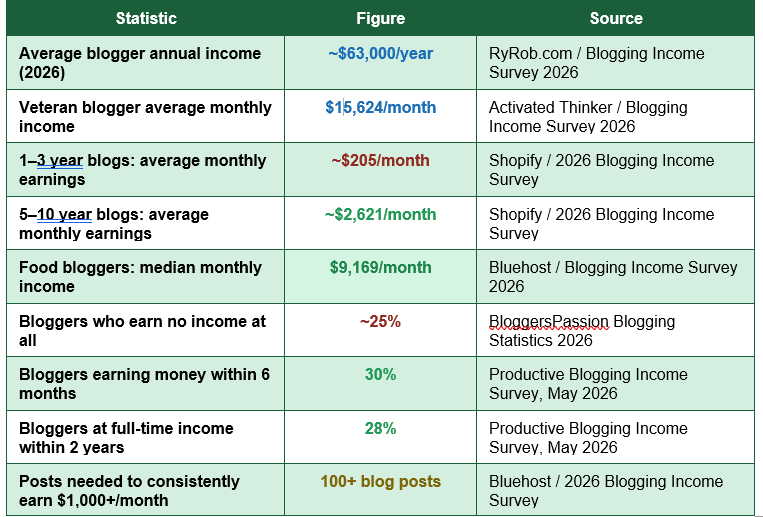
The honest income arc: $205/month at year 1-3, $2,621/month at year 5-10 — blogging income compounds dramatically with time — but only for those who persist and diversify beyond ads into higher-RPM methods like digital products and affiliate marketing (Shopify / 2026 Blogging Income Survey)
Why 25% of bloggers earn nothing — and how to avoid being one of them: The 2026 data consistently shows that bloggers who rely on a single monetisation method, fail to do keyword research before publishing, or publish inconsistently are the ones who fall into the zero-income group. 'There is a very strong correlation between earnings and the number of posts on a blog,' the Productive Blogging Income Survey states directly. The 2026 survey also confirmed that bloggers who monetise via digital products consistently earn more than equivalent bloggers relying on display ads and affiliate links alone.
Every Monetisation Method: The 2026 Landscape
The table below maps every major monetisation method against the traffic level required, realistic monthly income range, whether the income is passive, and which niches it suits best: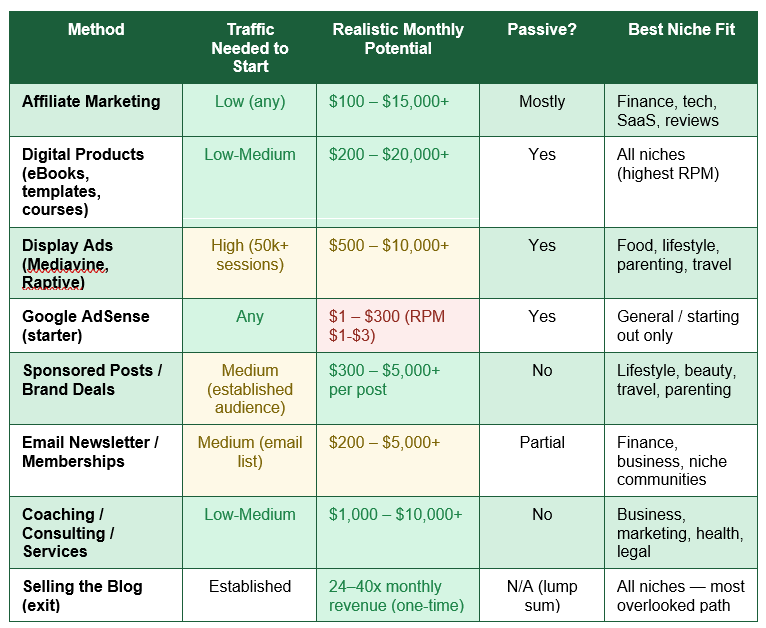
1. Affiliate Marketing: The Highest-Ceiling Method
Affiliate marketing — writing content that recommends products and services, then earning a commission when readers click your link and make a purchase — is the most consistently cited primary income source among high-earning bloggers. Its appeal is structural: you create the content once, and it can generate commissions indefinitely without further work as long as it continues to rank. Seven out of ten bloggers who earn meaningful income use affiliate marketing, according to BloggersPassion's 2026 statistics.Commission rates vary dramatically by niche. Finance and SaaS are consistently the highest-value affiliate niches: credit card programmes, investment platforms, and software tools regularly pay $50 to $300 per referred customer, with some programmes paying $500 or more. A finance blog generating ten successful referrals per month could earn $500 to $5,000 monthly from a single programme. The InsightPress analysis confirms that finance bloggers with strong SEO and affiliate strategy can realistically generate $5,000 to $15,000 per month at scale.
The key affiliate marketing principle that separates high earners from low earners: write content for readers who are ready to make a decision, not just readers who are browsing. A post titled 'Best credit cards for cashback in 2026' has far higher commercial intent than 'What is a credit card' — the former reader is ready to apply, the latter is not. Aligning your content with buyer intent is the single most impactful strategic shift available to affiliate bloggers at any traffic level.
2. Digital Products: The Highest RPM Method
The 2026 Blogging Income Survey identifies digital products — eBooks, templates, spreadsheets, mini-courses, toolkits, printables, and Notion or Canva templates — as the highest-RPM (revenue per thousand pageviews) monetisation method available, consistently outperforming display ads and outperforming affiliate marketing for bloggers at moderate traffic levels. 'Bloggers who monetised via digital products typically earned more than bloggers who monetised with ads and affiliates,' the Productive Blogging survey states directly.The economics make the advantage clear. A display ad might earn £5 per 1,000 views. A well-positioned eBook at £25 converting 0.5% of readers earns £125 per 1,000 views — 25 times the RPM. A £97 mini-course at 0.2% conversion earns £194 per 1,000 views. Digital products require upfront creation time but have zero cost of goods, unlimited scalability, and no inventory. For any blogger with established authority in their niche, creating even one well-targeted digital product is the single most impactful monetisation upgrade available.
Gumroad, Teachable, Podia, and Payhip are the most commonly used platforms for selling digital products directly. Etsy is effective for printables and templates in visual niches. For courses, Thinkific and Kajabi offer more features at higher price points.
3. Display Advertising: The Passive Foundation
Display advertising — placing ad network code on your site and earning revenue based on page views — is the most widely misunderstood monetisation method in blogging. New bloggers frequently start with Google AdSense and conclude that blogging cannot pay, because AdSense RPMs of $1 to $3 per 1,000 views generate negligible income at low traffic levels. This is a tool-selection problem rather than an evidence of blogging's limits.The transformation happens at scale with premium ad networks. Mediavine requires a minimum of 50,000 sessions per month; Raptive (formerly AdThrive) requires 100,000 monthly page views. Both networks use sophisticated ad auction technology that dramatically increases the value of each ad impression compared with AdSense. Mediavine typically starts around $10 RPM and reaches $15 to $35 RPM or more depending on niche and traffic quality. Peak RPMs in food and lifestyle niches during the pre-Christmas period can reach $50 or more. The 2026 Blogging Income Survey found no statistically significant difference between Mediavine and Raptive payouts — the data showed only a $0.49 per 1,000 views difference, which the survey describes as within the margin of statistical noise.
Seventy-two percent of bloggers earning $2,000 or more per month rely on Mediavine or Raptive for their ad management, according to BloggersPassion's 2026 statistics. The practical implication: if you are currently on AdSense with growing traffic, qualifying for Mediavine is the single highest-impact traffic monetisation upgrade available.
4. Sponsored Posts and Brand Deals
Sponsored content — where a brand pays you to write a post, review, or feature placement — is the oldest form of blogger monetisation and still one of the most lucrative per piece of content produced. Finance bloggers with strong domain authority can charge $500 to $5,000 or more per sponsored post, according to InsightPress's 2026 earnings analysis. Lifestyle, beauty, travel, and parenting bloggers are among the most active in this space, driven by brand demand for authentic, audience-trusted content that performs better than traditional advertising.The key to sponsored content is charging appropriately for your audience's value rather than your raw traffic number. An audience of 20,000 highly engaged parents is worth more to a baby products brand than 200,000 casual recipe browsers. Build a media kit — a one or two-page document showing your audience demographics, engagement rates, and past brand work — and use it to pitch brands directly rather than waiting for inbound enquiries. Outreach to brands directly, approaching their marketing teams with specific, tailored proposals, typically produces better results and higher rates than working through influencer platforms.
5. Email Newsletters and Memberships
An email list is the single most valuable asset a blogger can build that is not controlled by Google or any other platform. When your search rankings change — and they will change, repeatedly — your email list provides direct, algorithm-independent access to your most engaged readers. For monetisation, an email list supports affiliate promotions (subscribers convert at higher rates than cold search traffic), digital product launches, exclusive paid newsletter subscriptions, and sponsored newsletter placements.Platforms like Beehiiv and Substack have made paid newsletter subscriptions increasingly accessible, with direct subscription revenue possible even at modest list sizes. A blogger with 5,000 engaged subscribers offering a £5/month paid tier and converting 5% would generate £1,250 per month from this single source alone. For finance, business, and specialist knowledge niches, newsletter subscriptions represent one of the most underutilised income streams available.
6. Selling Your Blog: The Most Overlooked Exit Strategy
One of the most underappreciated facts about profitable blogging is that the blog itself — as a revenue-generating online business — is a sellable asset. Marketplaces like Flippa and Empire Flippers list blogs with established traffic and income for sale, typically valued at 24 to 40 times their monthly net profit. A blog earning $2,000 per month net might sell for $63,000 to $80,000 — a significant lump sum that represents years of future income received upfront.Shopify's analysis notes that 'it's not just monthly revenue that bloggers can earn. Marketplaces like Flippa list blog-based websites for sale, many of which come with hefty price tags.' For bloggers who have built a profitable site but are ready for a new project, selling the blog is a legitimate and often highly financially rewarding final step in the blogging business cycle. Building with a sale in mind — clean financials, documented systems, diversified traffic sources — from early on maximises exit value.
What the Data Says Actually Works: The Key Success Factors
Across the full dataset of the 2026 Blogging Income Survey and supporting research, several factors consistently separate bloggers who earn meaningful income from those who do not:- Treat it like a business from day one: The 2026 survey confirms that bloggers who approach their blog as a business — with a content strategy, editorial calendar, keyword research for every post, and regular performance analysis — reach monetisation milestones significantly faster than those treating it as a creative outlet.
- Diversify beyond a single income stream: Bloggers with three or more revenue streams consistently earn more than those with one or two, according to Productive Blogging's survey data. The combination of affiliate marketing and digital products consistently outperforms either method alone, and adding premium display ads at higher traffic levels further compounds income.
- Prioritise niche selection for monetisation potential: The 2026 data shows personal finance and online business niches averaging four to five times higher earnings than lifestyle or travel niches. This does not mean you must write about finance — but it does mean your niche should have identifiable commercial intent: products people buy, services people pay for, and affiliate programmes with meaningful commission rates.
- Quality and depth beat volume: A strong correlation exists between the number of posts and income — but the correlation levels off and actually reverses after 1,000 posts in the 2026 survey data, suggesting that at high volumes, quality deteriorates and thin content dilutes overall authority. Two well-researched, SEO-optimised posts per week consistently outperforms seven thin ones, as InsightPress's analysis confirms.
- SEO is still the primary traffic driver: Despite the rise of social media, short-form video, and AI-generated discovery, search engine traffic remains the dominant source of consistent blog income in 2026. ComputerSluggish's analysis of the data states directly: 'Most blogging income still comes from SEO.' If your content ranks, you get consistent traffic. If it does not, you do not earn. Keyword research before writing is not optional.
Conclusion
Making money as a blogger in 2026 is harder than it was in 2018, but the income potential for those who persist and treat it strategically has never been higher. Veteran bloggers average $5,624 per month. Food bloggers median $9,169 per month. Thirty percent of new bloggers start earning within six months, and 28% reach full-time income within two years. The content marketing industry is growing toward $107.5 billion. There is money in blogging — but it flows reliably only to the bloggers who approach it as a long-term business rather than a quick monetisation opportunity.The honest income picture is a slow start followed by compounding growth. Blogs in their first one to three years average $205 per month — respectable side income, but not life-changing. Five to ten year blogs average $2,621 per month — genuinely significant. The strategy that bridges these stages most efficiently is the combination of affiliate marketing (starts earning early, no traffic minimum), digital products (highest RPM of any method), and premium display ads once traffic qualifies for Mediavine or Raptive. Building an email list throughout this journey provides insurance against algorithm changes and enables every other monetisation method to perform better.
The 2026 Blogging Income Survey's most actionable conclusion is also its simplest: more high-quality posts, more revenue streams, more email subscribers, and more patience consistently produce more income. The bloggers who fail are overwhelmingly those who give up before the compounding kicks in, or who write without first understanding whether anyone is searching for what they are writing about. The bloggers who succeed are those who did the keyword research, published consistently, built multiple income streams, and stayed in the game long enough for the results to arrive.
Frequently Asked Questions (FAQ)
How much money can a beginner blogger realistically make in the first year?
Most new bloggers earn very little in their first year — the 2026 Blogging Income Survey data shows 1-3 year old blogs averaging approximately $205 per month, and approximately 25% of bloggers earning nothing at all. However, 30% of bloggers do start earning within six months. The bloggers who monetise earliest tend to combine affiliate marketing (which does not require high traffic) with targeted keyword research that identifies commercial-intent search queries from the beginning. Setting realistic expectations — treat the first year as building the foundation that year two and three will monetise — significantly improves the odds of staying consistent enough to succeed.Which blogging niche makes the most money in 2026?
Food bloggers lead the 2026 data with a median monthly income of $9,169, partly because the niche supports multiple monetisation methods simultaneously (display ads, digital products like recipe books, affiliate links for kitchen equipment, and brand sponsorships). Personal finance and online business niches average four to five times higher earnings than lifestyle or travel, according to Shopify's analysis, primarily because affiliate commissions in finance (credit cards, investment platforms, software) are among the highest available. The most important niche characteristic is whether people in the niche actively buy things — without commercial intent, monetisation is structurally difficult regardless of traffic volume.Is affiliate marketing or display advertising better for new bloggers?
For new bloggers with limited traffic, affiliate marketing is almost always the better starting point. Display advertising with Google AdSense generates RPMs of $1-$3 per 1,000 views — meaning you need substantial traffic to earn meaningful amounts. Affiliate marketing, by contrast, can generate commissions with any traffic level as long as the content targets commercial-intent queries and the reader is ready to make a purchasing decision. Once your blog reaches 50,000 monthly sessions, upgrading from AdSense to Mediavine or Raptive is the most impactful single monetisation upgrade available, combining the passive income of display advertising with the significantly higher RPMs these premium networks deliver.Does blogging still work with AI generating so much content in 2026?
Yes, but the bar for ranking has risen. Google's Helpful Content updates have specifically targeted thin, low-effort, and AI-generated-without-human-expertise content. The InsightPress analysis confirms: 'AI-generated content has flooded search results. Google's algorithm updates have penalized thin, low-effort sites. The barrier to earning has gone up, not down.' Bloggers who treat their blog as a genuine expert resource — adding first-hand experience, original research, unique angles, and genuine depth — are still ranking and earning well. The competitive advantage in 2026 is not writing faster than AI; it is writing with more genuine expertise, experience, and specificity than AI alone can produce.How important is building an email list as a blogger?
Very important — arguably more important in 2026 than at any previous point in blogging history. Google algorithm updates have repeatedly demonstrated that search rankings can change dramatically and quickly, and bloggers who rely exclusively on organic search for traffic are entirely vulnerable to these changes. An email list provides direct, algorithm-independent access to your most engaged readers. It enables higher-converting affiliate promotions, digital product launches, paid newsletter subscriptions, and sponsored newsletter placements. Productive Blogging's survey data confirms that bloggers with larger, engaged email lists consistently earn more across all primary monetisation methods than comparable bloggers without one.External References
The following authoritative sources were used in researching this article and are recommended for further reading:1. Productive Blogging — How Much Do Bloggers Really Earn in 2026? (Blogging Income Survey, May 2026)
https://www.productiveblogging.com/how-much-do-bloggers-earn/
2. Productive Blogging — How Long Does It Take to Make Money Blogging in 2026? (May 2026)
https://www.productiveblogging.com/how-long-does-it-take-to-make-money-blogging/
3. Shopify — How to Make Money Blogging: 11 Proven Methods for 2026
https://www.shopify.com/blog/make-money-blogging
4. RyRob.com — How Much Do Bloggers Make? Blogging Income and Salary 2026
https://www.ryrob.com/how-much-bloggers-make/
5. BloggersPassion — Blogging Statistics 2026: Key Data, Growth and Income Trends
https://bloggerspassion.com/blogging-statistics/
6. InsightPress — How Much Do Bloggers Really Earn in 2026? (April 2026)
https://insightpress.xyz/how-much-do-bloggers-really-earn/
7. Bluehost — How to Make Money Blogging in 2026: 12 Proven Strategies
https://www.bluehost.com/blog/how-to-make-money-blogging/
8. ComputerSluggish — How Much Do Bloggers Really Earn in 2026? (March 2026)
https://computersluggish.com/guides/how-much-do-bloggers-earn/
0 Comments
Be the first to share your thoughts on this article.