

Credits
How to Manage a Home Loan: Complete UK & US Guide

Table of Contents
- Most Homeowners Are Paying More Than They Have To
- Understanding Your Home Loan: The Foundation of Good Management
- The Six Home Loan Management Strategies -- With 2026 Data
- Refinancing and Remortgaging: The Biggest Lever Available
- US Refinancing: When to Act and How to Do It Right
- UK Remortgaging: The Critical 2026 Action
- Overpayments: The Compounding Power of Paying More
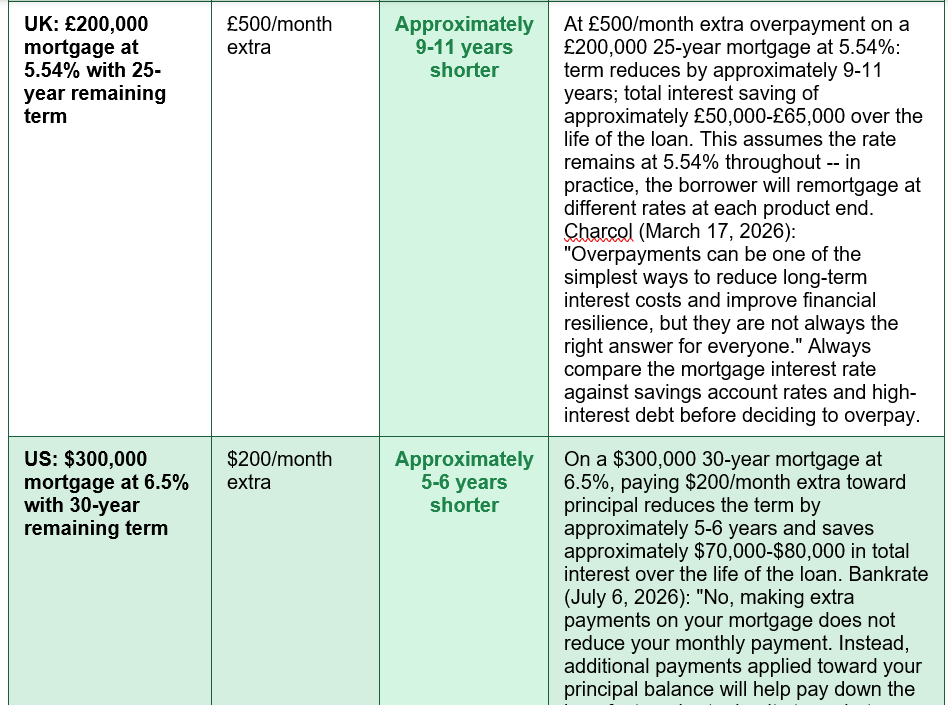
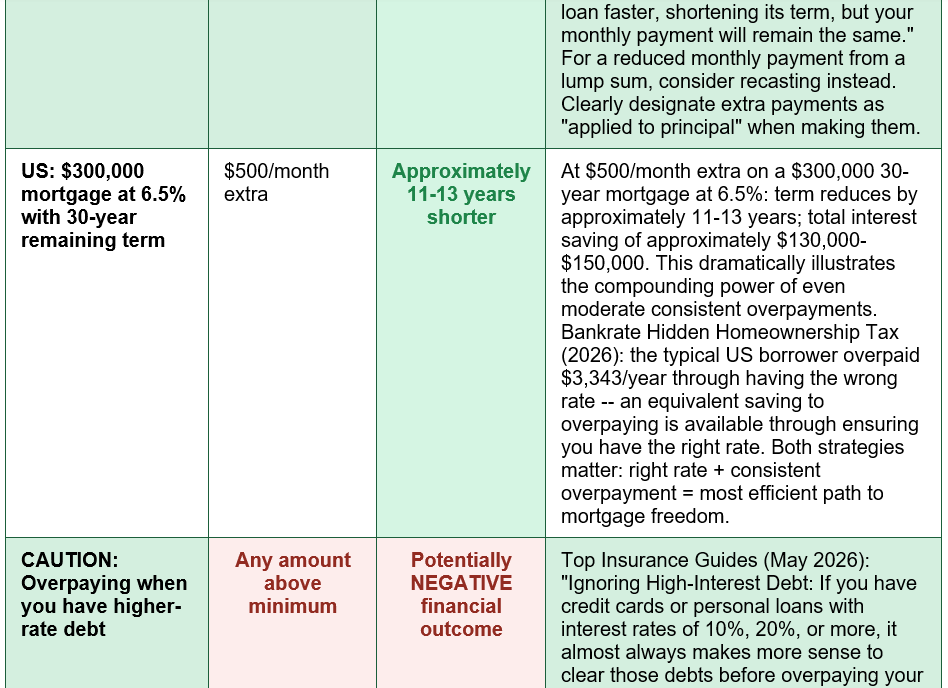
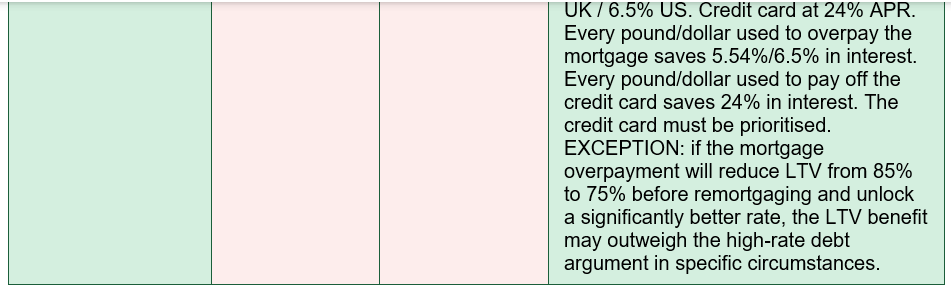
- Overpayment Calculator: What Extra Payments Really Achieve
- Loan-to-Value Ratio (LTV): The Hidden Key to Better Mortgage Rates
- When Mortgage Difficulties Arise: What to Do Before Missing a Payment
- The Annual Mortgage Review: A 30-Minute Check That Can Save Thousands
- Conclusion
- Frequently Asked Questions (FAQ)
Most Homeowners Are Paying More Than They Have To
A mortgage is likely the largest financial commitment most people will ever make -- and most people manage it by setting up a direct debit and trying not to think about it until the deal ends. This passive approach is understandable. Mortgages are complex, the options are numerous, and the financial language around them is designed, intentionally or not, to discourage engagement. But the cost of passivity is substantial and measurable.Bankrate's Hidden Homeownership Tax research (July 6, 2026): 'Most homeowners are paying more for their mortgage than they have to. The typical borrower overpaid by $3,343 a year in 2025 -- $278 a month left on the table, money that could go toward savings, debt payoff or retirement instead.' The same research found that 87% of people who borrowed a mortgage between 2022 and 2025 paid above the most competitive rate available for their profile -- and that over the life of the loan, this overpayment compounds to $78,186 for the average borrower. This is not a marginal rounding error in a complex financial product. It is a significant, recurring cost generated by not actively managing the mortgage.
In the UK, the picture is comparable. HomeOwners Alliance (July 23, 2026 -- updated 1 day ago): 'The average rate on a 5-year fix in July 2026 is 5.54%, which is much higher than the average rate on a 5-year fix in July 2021, which was 2.75%.' Hundreds of thousands of UK homeowners whose cheap fixed-rate deals are ending in 2026 and 2027 face a significant rate increase -- and those who do not remortgage actively will roll onto standard variable rates that are typically even higher than new fixed products. Managing a home loan actively is not complexity for its own sake. It is the difference between leaving thousands of pounds or dollars on the table every year and directing them toward financial goals instead.
Understanding Your Home Loan: The Foundation of Good Management
You cannot manage a mortgage effectively without understanding its key components. Most homeowners know their monthly payment and their interest rate -- but good mortgage management requires knowing the following about your current loan:- Current outstanding balance: The actual amount you owe today, found on your latest mortgage statement or accessible through your lender's online portal. This is the number on which your interest is calculated -- every payment and overpayment you make reduces this balance, which reduces the interest charged in every subsequent period.
- Your interest rate and product type: Whether you are on a fixed rate, a tracker rate, a variable rate, or a standard variable rate (SVR/revert rate); what the rate is; and -- critically -- when the current deal expires. UK: HomeOwners Alliance (July 23, 2026): 'If your cheap fix ends soon, start the remortgage process now.' US: Bankrate (2026): 'Refinancing moves the needle the most if you locked in a high rate between 2022 and 2024.'
- Your remaining term: How many years are left on the mortgage. This determines your current monthly payment and how much total interest you will pay if you make no changes. It also tells you how long you have available for overpayments to compound before the loan ends.
- Your loan-to-value ratio (LTV): Your current outstanding balance as a percentage of your property's current market value. LTV determines your interest rate options at remortgage -- lower LTV means access to better rates. Overpayments reduce the outstanding balance and therefore the LTV; property price growth also reduces LTV. Both matter at remortgage time.
- Your overpayment allowance: UK: Mortgage Knight (3 weeks ago): 'In 2026, most fixed-rate products allow up to 10% overpayment annually without penalty -- but terms vary.' Most UK fixed-rate mortgages carry an Early Repayment Charge (ERC) if overpayments exceed the allowed amount (typically 10% of the outstanding balance per year). US: most conventional loans have no prepayment penalty after 2014 origination, but check your specific loan documents.
- Escrow account contents (US): Many US mortgages collect property taxes and homeowners insurance through an escrow account alongside principal and interest. Understanding what is in your escrow, reviewing whether the insurance and tax components are competitive, and -- where eligible -- eliminating PMI are all legitimate active mortgage management actions.
Home loan management in 2026 -- the cost of inaction: 87% of US 2022-2025 borrowers overpaid the market rate -- $3,343/year avg. UK 5-year fix July 2026: 5.54%. £200/month overpayment can save 5-6 years of mortgage term. — Bankrate Hidden Homeownership Tax (July 6, 2026): '87% of people who borrowed a mortgage between 2022 and 2025 paid above the most competitive rate available for their profile -- costing the typical borrower $3,343 a year or $78,186 over the life of the loan.' HomeOwners Alliance (July 23, 2026 -- 1 day ago): 'The average rate on a 5-year fix in July 2026 is 5.54%.' Mortgage Knight (3 weeks ago): 'Most fixed-rate products allow up to 10% overpayment annually without penalty.' WeCovr (May 2026): overpayment creates snowball effect reducing balance and total interest.
The Six Home Loan Management Strategies -- With 2026 Data
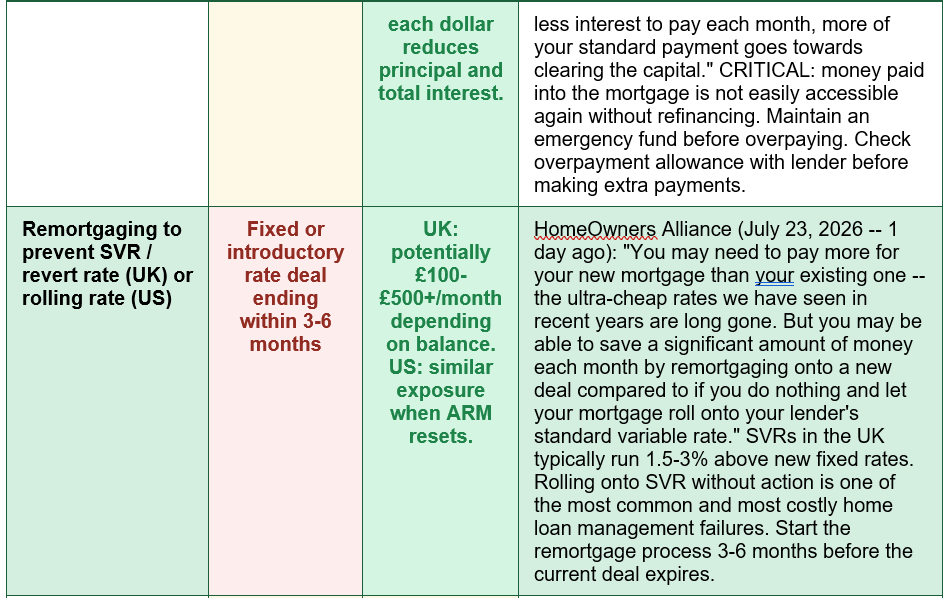
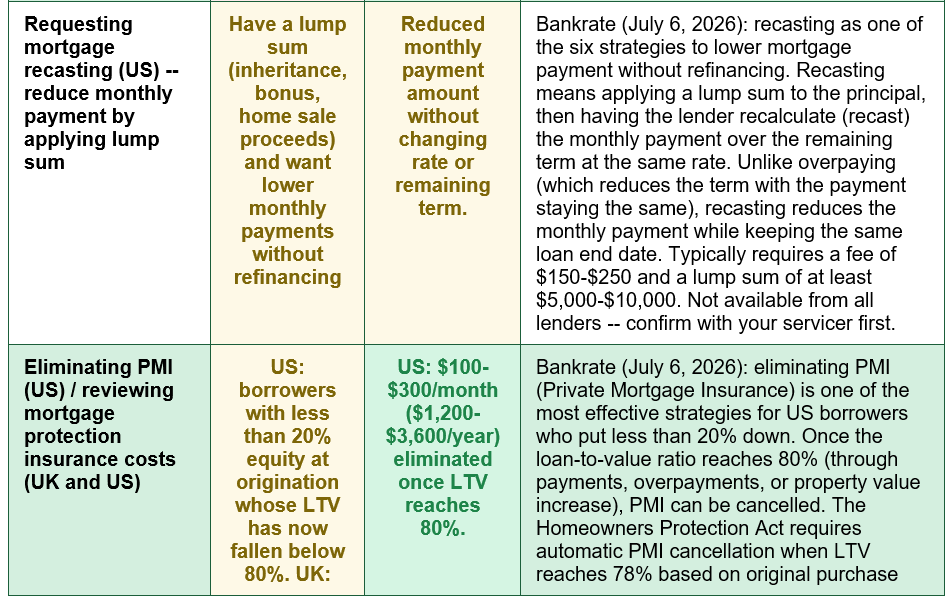
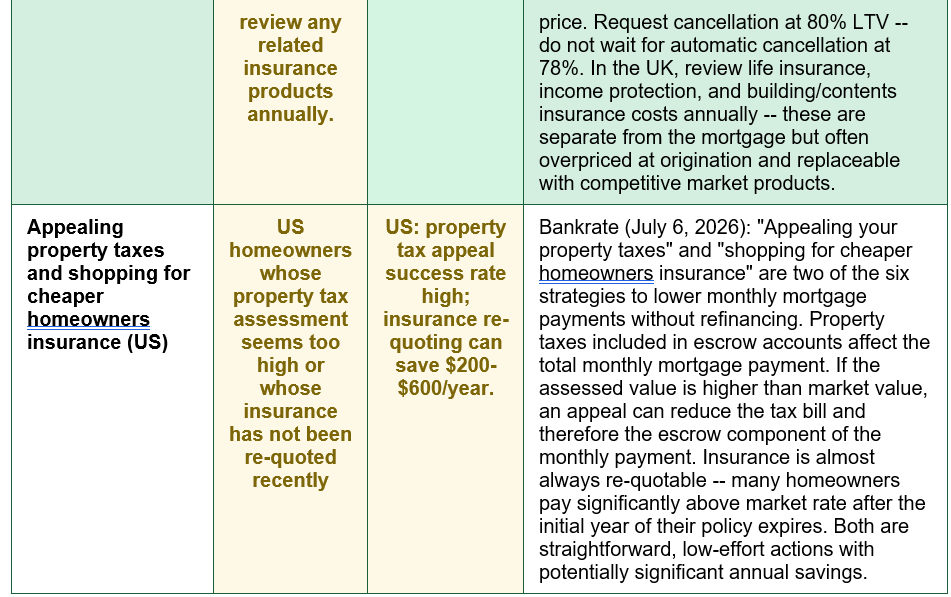
Managing your home loan actively in 2026 means understanding which of the following strategies applies to your current situation, and taking action accordingly. The following table maps every major strategy with the conditions that make it appropriate and the potential financial benefit: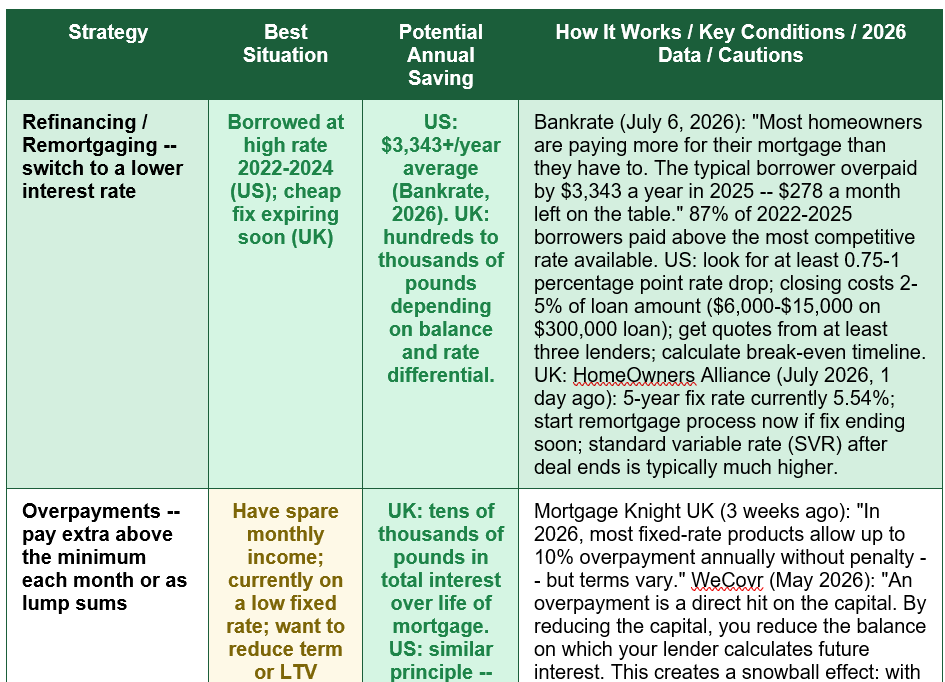
Refinancing and Remortgaging: The Biggest Lever Available
US Refinancing: When to Act and How to Do It Right
Refinancing is replacing your existing mortgage with a new one, typically at a lower interest rate. For the majority of US homeowners who took out mortgages between 2022 and 2024 -- when rates peaked near 8% -- refinancing at 2026 rates may represent a significant opportunity. Bankrate (July 6, 2026): 'Refinancing moves the needle the most if you locked in a high rate between 2022 and 2024.' The current Mortgage Bankers Association Refinance Index (as of 1 week ago) was running at 7% above year-ago levels, with earlier 2026 activity running at double 2025 levels -- suggesting refinance momentum is real but has moderated from its earlier pace.The three rules for US refinancing: (1) Rate threshold: Bankrate: 'Look for a drop of at least 0.75 to 1 percentage point.' Refinancing comes with closing costs of 2-5% of the loan amount ($6,000-$15,000 on a $300,000 loan). The rate drop must be large enough to recover these costs through monthly savings. At a 1% rate drop, the monthly saving is approximately $150-$200 on a $300,000 balance -- the closing costs are recovered in 3-4 years. (2) Break-even timeline: Bankrate: 'If you plan to stay in the home at least two to three years, a refinance will likely reach the break-even point.' If you plan to move in 18 months, the closing costs will not be recovered and refinancing is likely not worth it. (3) Shopping requirement: Bankrate: '79% of refinance borrowers paid above the most competitive rate available in 2025 -- because comparing offers is the step most people skip. Get quotes from at least three lenders before deciding.'
UK Remortgaging: The Critical 2026 Action
In the UK, remortgaging is the equivalent of refinancing -- switching your mortgage to a new deal, either with your existing lender (a product transfer) or with a new lender. HomeOwners Alliance (July 23, 2026 -- 1 day ago): 'The average rate on a 5-year fix in July 2026 is 5.54%, which is much higher than the average rate on a 5-year fix in July 2021, which was 2.75%. So if you are currently on a cheap fix, here is what to do: If your cheap fix ends soon, start the remortgage process now. Speak to a mortgage broker who will find the best mortgage deal for you. You may need to pay more for your new mortgage than your existing one -- but you may be able to save a significant amount of money each month by remortgaging onto a new deal compared to if you do nothing and let your mortgage roll onto your lender's standard variable rate.'The UK standard variable rate (SVR) -- the rate a mortgage reverts to when a fixed deal ends without remortgaging -- is typically set by each lender independently and is usually significantly higher than the rates available on new fixed products. Rolling onto SVR is almost always more expensive than remortgaging. Homeowners Alliance advises starting the remortgage process 3-6 months before the current deal expires, because: many lenders allow mortgage offers to be secured 3-6 months in advance; if rates fall between the offer and completion, you can switch to the lower rate; and there is no pressure to accept a suboptimal product if the process is started early. Mortgage Knight (3 weeks ago): for UK homeowners on cheap older fixes, 'consider taking advantage of the low rate you are currently on and make overpayments if you can' before the fix ends.
The UK 10% overpayment rule: Mortgage Knight (3 weeks ago) confirms that in 2026, most UK fixed-rate mortgage products allow up to 10% of the outstanding balance to be overpaid annually without incurring an Early Repayment Charge (ERC). On a £200,000 mortgage, this means up to £20,000 per year -- or approximately £1,667 per month -- can be overpaid without penalty during a fixed-rate period. Beyond this limit, ERCs apply (typically 1-5% of the overpaid amount, depending on how early in the fixed period the payment is made). ALWAYS check your specific mortgage terms with your lender or mortgage broker before making any overpayment that may approach or exceed 10% of the outstanding balance in any 12-month period. Charcol (March 17, 2026): 'Overpayments can be one of the simplest ways to reduce long-term interest costs and improve financial resilience, but they are not always the right answer for everyone.'
Overpayments: The Compounding Power of Paying More
Making overpayments on a mortgage is one of the most financially powerful actions available to a homeowner -- but it needs to be done in the right circumstances and in the right sequence. WeCovr (May 3, 2026): 'When you make your standard monthly mortgage payment, it is split into two parts: Interest -- a payment to the lender for the privilege of borrowing the money. Capital -- a payment that reduces the actual loan amount you owe. In the early years of your mortgage, a large chunk of your payment goes towards interest. An overpayment is a direct hit on the capital. By reducing the capital, you reduce the balance on which your lender calculates future interest. This creates a snowball effect: with less interest to pay each month, more of your standard payment goes towards clearing the capital, and you become mortgage-free much faster.'Charcol (March 17, 2026): 'Overpayments reduce the mortgage balance faster. That matters because interest is charged on the outstanding balance. Even if you are currently on a low fixed rate, the benefit can become clearer when you think ahead to your next remortgage.' Lowering the outstanding balance also reduces the LTV ratio. A lower LTV at the next remortgage date typically unlocks a lower interest rate band -- making overpayments pay a double dividend: interest saved during the overpayment period, plus a lower rate on the remortgaged balance.
Mortgage Knight (3 weeks ago) provides the important 2026 nuance: 'Overpayments are most effective when they strengthen your position, not reduce your flexibility. Money paid into the mortgage is not easily accessible again without refinancing. Security and flexibility matter as much as debt reduction.' The sequence for overpayment decisions: (1) Maintain an emergency fund (3-6 months of expenses) before overpaying. (2) Clear any higher-rate debt (credit cards, personal loans above your mortgage rate) before overpaying the mortgage. (3) Only then direct surplus income or savings to mortgage overpayments. (4) Check the 10% annual allowance before making any lump-sum payment.
Overpayment Calculator: What Extra Payments Really Achieve
The numbers behind overpayments are more persuasive than any description. The following table maps four specific scenarios -- two UK, two US -- to quantify the real impact of consistent overpayments, alongside the important caution about overpaying when higher-rate debt exists: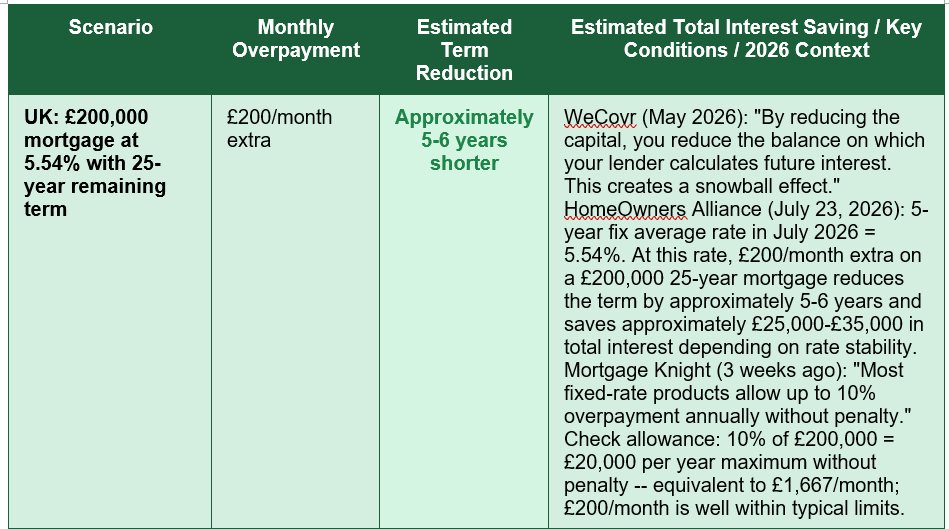
Loan-to-Value Ratio (LTV): The Hidden Key to Better Mortgage Rates
The loan-to-value ratio -- the percentage of the property's value that the outstanding mortgage represents -- is one of the most important numbers in mortgage management, yet most homeowners do not track it. LTV determines which rate band you are in at remortgage time. Most lenders offer significantly better rates at 90%, 85%, 80%, 75%, and 60% LTV thresholds -- each step down typically unlocks a lower rate band. The difference between a 90% and 75% LTV rate can be 0.3-0.8 percentage points, representing potentially hundreds of pounds or dollars per month on a significant mortgage balance.Two factors reduce LTV over time: mortgage payments (which reduce the outstanding balance) and property value increases (which increase the denominator). Overpayments accelerate the LTV reduction through the balance-reduction route. A homeowner who overpays enough to cross a LTV threshold before their remortgage date -- moving from 82% to 79%, for example, crossing the 80% threshold -- could unlock a meaningfully lower rate on their entire balance. Charcol (March 17, 2026): 'Overpayments can reduce your loan-to-value, potentially improving future options.' In the UK, it is worth checking with a mortgage broker 6 months before remortgaging what the LTV thresholds are for the target products -- and whether a targeted overpayment could cross the next threshold before the deal is secured.
In the US, LTV also matters for PMI elimination. Bankrate (July 6, 2026): eliminating PMI is one of the six strategies for lowering mortgage payments without refinancing. Once LTV reaches 80%, a US borrower can request PMI cancellation from their servicer. The Homeowners Protection Act requires automatic cancellation at 78% LTV. PMI typically costs $100-$300 per month -- eliminating it is equivalent to a significant rate reduction and requires no new mortgage application.
When Mortgage Difficulties Arise: What to Do Before Missing a Payment
Home loan management is not only about optimisation when things are going well. A critical aspect of managing a mortgage is knowing what to do when financial difficulties arise -- and the most important action in that scenario is taking it early.- Contact your lender before you miss a payment: UK: FCA mortgage conduct rules (MCOB 13) require lenders to treat borrowers fairly and consider forbearance options before initiating any legal action. UK: most lenders have dedicated arrears support teams. US: federal rules require servicers to make loss mitigation options available and cannot begin foreclosure proceedings until 120 days of missed payments. Contact the lender immediately when payment difficulty is anticipated, not after it has occurred.
- Understand your forbearance options: Both UK and US lenders can offer payment holidays (temporary cessation or reduction of payments), extended loan terms (reducing the monthly payment), interest-only periods, or capitalisation of arrears (adding missed amounts to the loan balance). These are temporary measures that add cost over the loan's life but prevent the catastrophic consequences of foreclosure or repossession.
- Seek free professional advice: UK: MoneyHelper (0800 138 7777), StepChange (0800 138 1111), Citizens Advice (0800 144 8848). US: HUD-approved housing counsellors (1-800-569-4287), CFPB at consumerfinance.gov. These services are free, regulated, and specifically designed to help homeowners in payment difficulty understand their options.
- Review your insurance protection: Mortgage payment protection insurance (MPPI) in the UK and similar products in the US exist specifically to cover mortgage payments in the event of redundancy or serious illness. If you have such a policy, review it immediately and make a claim if eligible. Many people pay for this insurance and do not claim when qualifying events occur.
The Annual Mortgage Review: A 30-Minute Check That Can Save Thousands
The single most impactful habit a homeowner can develop is an annual mortgage review -- a structured check of every aspect of the home loan to identify any action that should be taken. This review takes approximately 30 minutes and should cover the following: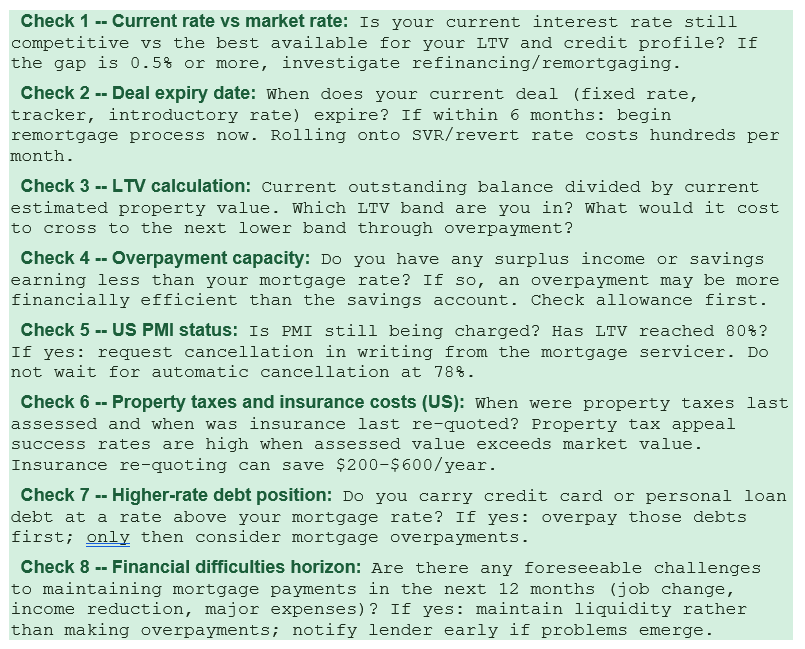
HOME LOAN MANAGEMENT ACTION PLAN -- DO THESE IN ORDER: MOST URGENT (if your fix is ending within 6 months): Contact a mortgage broker or your lender NOW to begin the remortgage/refinance process. HomeOwners Alliance (July 23, 2026): start the remortgage process as soon as possible and do not roll onto SVR. NEXT -- CHECK YOUR RATE: Are you paying above the best available rate for your LTV and profile? Bankrate (2026): 87% of 2022-2025 US borrowers were. Get quotes from at least 3 lenders (US: Bankrate, LendingTree; UK: habito, Trussle, London & Country). THEN -- ASSESS OVERPAYMENTS: Is your emergency fund secure (3-6 months expenses)? Is all higher-rate debt (credit cards, personal loans) cleared? If YES to both: check your 10% overpayment allowance and set up a regular overpayment. Even £100/$100/month makes a material difference over time. UK: Mortgage Knight (3 weeks ago): "Most fixed-rate products allow up to 10% overpayment annually without penalty." US: Bankrate: "Making extra payments reduces term and total interest -- not the monthly payment." ANNUALLY: conduct the 8-point annual mortgage review above. Spend 30 minutes checking rate vs market, deal expiry, LTV position, overpayment capacity, PMI status (US), and high-rate debt position. The 30 minutes will save more per hour than almost anything else you do with your financial time.
FIVE HOME LOAN MANAGEMENT MISTAKES THAT COST THOUSANDS: (1) ROLLING ONTO THE STANDARD VARIABLE RATE (SVR) WITHOUT REMORTGAGING. HomeOwners Alliance (July 23, 2026 -- 1 day ago): you may be able to save a significant amount of money each month by remortgaging onto a new deal compared to letting your mortgage roll onto your lender's SVR. SVRs are typically 1.5-3% above new fixed rates. On a £200,000/$300,000 balance, this costs £250-£500/$375-$750 extra per month. Set a calendar reminder 6 months before your deal expires. (2) NOT SHOPPING AROUND FOR REFINANCING. Bankrate (2026): 79% of US refinance borrowers overpaid on their mortgage in 2025 because they did not compare enough lenders. 'Comparing offers is the single most effective way to lower your rate, and it's the step most borrowers skip.' Get at least three quotes. (3) OVERPAYING THE MORTGAGE WHEN CARRYING HIGH-RATE DEBT. Top Insurance Guides (May 2026): if you have credit cards or personal loans at 10%, 20% or more, it almost always makes more sense to clear those before overpaying the mortgage. Every pound/dollar overpaid on a 5.5% mortgage earns a 5.5% effective return; the same money pays off 24% credit card debt at a 24% effective return. Prioritise in rate order. (4) EXCEEDING THE OVERPAYMENT ALLOWANCE AND TRIGGERING AN ERC. Mortgage Knight (3 weeks ago): 'Imogen overpaid significantly during a fixed period without realising she had exceeded her annual allowance' -- triggering an Early Repayment Charge. In the UK, check the 10% annual allowance with your lender before making any lump-sum payment. (5) MAKING OVERPAYMENTS INSTEAD OF BUILDING AN EMERGENCY FUND. Mortgage Knight: 'Money paid into the mortgage is not easily accessible again without refinancing.' An overpayment that depletes a cash reserve leaves the household vulnerable to any unexpected expense forcing credit card debt at 24% APR -- which is far worse than not overpaying the mortgage.
Conclusion
Managing a home loan actively rather than passively is one of the most financially consequential decisions a homeowner can make. The evidence from 2026 is clear: 87% of US mortgage borrowers from 2022-2025 paid above the best available rate -- costing the average borrower $3,343 per year, or $78,186 over the life of the loan (Bankrate Hidden Homeownership Tax research). In the UK, homeowners whose cheap fixed-rate deals are expiring face the choice between remortgaging actively onto a new product and defaulting passively onto a standard variable rate that is typically significantly more expensive.The strategies available for active home loan management in 2026 cover every stage of the mortgage journey: refinancing or remortgaging to a lower rate at the right moment; making overpayments within the allowed 10% annual limit (UK) or with no prepayment penalty (most US loans post-2014); using lump sums to recast the mortgage (US) and reduce the monthly payment; eliminating PMI once LTV reaches 80% (US); reducing LTV ahead of a remortgage date to cross into a lower rate band; appealing property tax assessments and re-quoting insurance (US); and -- critically -- engaging early with the lender when payment difficulties arise rather than waiting for the problem to escalate.
The 30-minute annual mortgage review is the most time-efficient financial habit a homeowner can develop. Check the rate against the market. Check the deal expiry date. Calculate the current LTV. Assess overpayment capacity and allowance. Review the US PMI and insurance position. Check the high-rate debt position before overpaying. Charcol (March 17, 2026): 'A mortgage is often the largest financial commitment most people will ever take on.' Managing it with the same attention given to the largest financial commitment of your life is not excessive -- it is the minimum appropriate response to its significance.
Frequently Asked Questions (FAQ)
Should I overpay my mortgage or save the money instead?The decision depends on three variables: your mortgage interest rate, your savings rate, and whether you have any higher-rate debt. The general rule: if your mortgage interest rate is higher than the after-tax return you can earn on savings, overpaying the mortgage is the better financial choice. If your savings rate (particularly in a high-interest ISA in the UK or high-yield savings account in the US) is higher than your mortgage rate, saving is mathematically better. Charcol (March 17, 2026): 'In 2026, the decision is more nuanced than it was during the ultra-low rate era. Some borrowers are sitting on older, cheaper fixed rates.' A homeowner on a 2% fixed rate from 2021 who can earn 4-5% in a cash ISA or high-yield savings account is better off saving than overpaying. A homeowner on a new 5.54% fixed rate with savings earning 4%: the mortgage overpayment likely wins. Top Insurance Guides (May 2026): before overpaying the mortgage, clear any credit cards or personal loans at rates of 10%, 20%, or more. And always maintain a 3-6 month emergency fund before directing surplus cash to mortgage overpayments. Mortgage Knight (3 weeks ago): 'Money paid into the mortgage is not easily accessible again without refinancing. Security and flexibility matter as much as debt reduction.'
How much can I overpay my mortgage in the UK without penalty?
In the UK, most fixed-rate mortgage products allow borrowers to overpay up to 10% of the outstanding balance per year without incurring an Early Repayment Charge (ERC). Mortgage Knight (3 weeks ago): 'In 2026, most fixed-rate products allow up to 10% overpayment annually without penalty -- but terms vary.' This means: on a £200,000 outstanding balance, up to £20,000 per year (approximately £1,667 per month) can be overpaid without penalty. On a £150,000 balance, up to £15,000 per year. The 10% allowance is typically calculated per year (though some lenders define the year differently -- check your specific terms). Overpayments beyond the 10% limit during a fixed period trigger ERCs, which are typically 1-5% of the amount overpaid beyond the allowance, depending on how early in the fixed term the overpayment is made. If you want to make a lump-sum overpayment that might approach or exceed 10% of the outstanding balance, call your lender first to confirm the exact allowance figure and any applicable ERC. When on a standard variable rate (SVR) or tracker rate, there is typically no ERC and no overpayment limit.
When should I refinance or remortgage my home loan?
The ideal time to refinance (US) or remortgage (UK) depends on a combination of the current rate vs your existing rate, the costs involved, and your future plans. US: Bankrate (July 6, 2026): 'Refinancing moves the needle the most if you locked in a high rate between 2022 and 2024.' Look for at least a 0.75-1 percentage point rate drop to justify closing costs of 2-5% of the loan amount. If you plan to stay in the home for at least 2-3 years, a refinance will likely recover its upfront costs through monthly savings. Always get quotes from at least three lenders -- Bankrate: '79% of refinance borrowers overpaid in 2025 because comparing offers is the step most people skip.' UK: HomeOwners Alliance (July 23, 2026 -- 1 day ago): 'If your cheap fix ends soon, start the remortgage process now.' Begin the remortgage process 3-6 months before the current deal expires to give time to compare products, secure an offer, and complete before the current deal ends. If you let the mortgage roll onto SVR without remortgaging, you will almost certainly pay significantly more. At remortgage, also consider whether crossing a lower LTV band through overpayments before securing the new deal would unlock a better rate -- this can make a targeted pre-remortgage lump sum overpayment worthwhile even if not justified at other times.
What is mortgage recasting and how does it differ from overpaying?
Mortgage recasting (primarily a US concept) and mortgage overpaying are both ways of applying extra money to the loan, but they produce different outcomes. Overpaying: when you make extra payments above the minimum on a US mortgage, Bankrate (July 6, 2026): 'making extra payments on your mortgage does not reduce your monthly payment. Instead, additional payments applied toward your principal balance will help pay down the loan faster, shortening its term, but your monthly payment will remain the same.' The monthly payment stays fixed; the loan ends sooner. In the UK, overpayments can either reduce the term (the most common default) or be used to reduce the monthly payment -- but this must be specifically requested from the lender. Mortgage recasting (US): you apply a significant lump sum (typically minimum $5,000-$10,000) to the principal, and then ask the lender to recast (recalculate) the monthly payment over the remaining loan term at the same interest rate. The result: the monthly payment is permanently lower, but the loan end date stays the same. The fee is typically $150-$250. Recasting is suitable for borrowers who want a lower monthly payment rather than a shorter term -- for example, after receiving a large sum such as an inheritance, home sale proceeds, or a bonus. Not all lenders offer recasting: confirm availability with your servicer before making the lump-sum payment.
What happens to my mortgage if I cannot make payments?
If you cannot make your mortgage payment, the most important action is to contact your lender immediately -- before you miss a payment if at all possible. In the UK, FCA mortgage conduct rules (MCOB 13) require lenders to treat borrowers in financial difficulty fairly and to consider forbearance options before initiating any possession proceedings. These options include: a temporary payment holiday (suspension of payments, with the missed amounts added to the outstanding balance); reduced payments (interest-only for a period, for example); or a term extension (which reduces the monthly payment by spreading the remaining balance over a longer period). In the US, most mortgage servicers are required to offer loss mitigation options before starting foreclosure proceedings, and federal law generally prohibits servicers from beginning foreclosure until a borrower is more than 120 days delinquent. Free professional advice is available and should be sought immediately: UK: MoneyHelper 0800 138 7777 | StepChange 0800 138 1111 | Shelter 0808 800 4444 | Citizens Advice 0800 144 8848. US: HUD-approved housing counsellors 1-800-569-4287 | CFPB consumerfinance.gov. These are not services of last resort -- they are the right first call the moment you anticipate difficulty, because the more time available, the more options exist.

0 Comments Comments