

Savings
Millennial Retirement Savings: How Much Puts You Ahead in 2026

Table of Contents
- The Most Financially Stressed Generation Faces Retirement
- The Millennial Retirement Benchmark: Age-by-Age Targets
- Where Millennials Actually Stand: The Full Data Picture
- The Peer Comparison Scorecard: Where Your Balance Ranks Among Millennial Peers
- Why the Median is the Right Benchmark -- and What It Tells You
- Why Millennials Face a Harder Retirement Savings Path Than Previous Generations
- What Specifically Puts a Millennial Ahead of Peers in 2026
- Conclusion: The Average Millennial Is Not on Track -- but the Above-Average One Can Be
- Frequently Asked Questions (FAQ)
- What is the average millennial 401(k) balance in 2026?
- How much retirement savings do millennials need by age 40?
- Why do 55% of millennials think they will outlive their retirement savings?
- Is $100,000 in retirement savings good for a millennial in 2026?
- How much do millennials need to retire comfortably -- and by when?
- External References & Further Reading

The Most Financially Stressed Generation Faces Retirement
Millennials -- born between 1981 and 1996 -- are now between the ages of 30 and 45 in 2026. They are the generation that entered the workforce into the dot-com bust, lived through the Great Recession before accumulating any meaningful wealth, carried the heaviest student loan debt of any cohort in American history, and then faced the combined shocks of pandemic disruption and the worst inflation in 40 years precisely when they should have been in their prime savings years. Against this backdrop, asking how much retirement savings puts a millennial ahead of peers is the right question -- and the answer is more achievable than most millennials believe.The most current data: Fidelity Investments, covering 25.6 million participants in 26,800 corporate defined contribution plans as of March 31, 2026, reports that millennials have an average 401(k) balance of $82,600. WalletGrower (2 weeks ago, covering 4.6 million accounts at year-end 2025): the all-ages median 401(k) balance reached $44,115 -- a new record. Kiplinger (April 30, 2026): the average millennial 401(k) is $83,700, compared with $146,400 for all generations and $1.46 million in the 'magic number' that Americans believe they need to retire comfortably, per Northwestern Mutual's 2026 Planning and Progress Study. The gap between the $82,600 current average and the $1.46 million target is the source of the anxiety that 55% of millennials feel -- the belief that they will outlive their savings, according to Northwestern Mutual.
What neither the average nor the anxiety fully captures: how much time millennials still have, and what that time means in compound terms. A 35-year-old millennial with $82,600 in their 401(k), contributing 13% of a $65,000 salary at a 7% average annual return, reaches approximately $1.1 million by age 65. A 40-year-old with the same balance contributing 15% reaches approximately $900,000. The target is not comfortable, but it is not impossible -- and knowing specifically what puts you ahead of peers is the first step to making it concrete.
The Millennial Retirement Benchmark: Age-by-Age Targets
Fidelity's retirement savings benchmarks are the most widely cited age-by-age targets in US financial planning. The following table maps each milestone to specific dollar figures and peer context: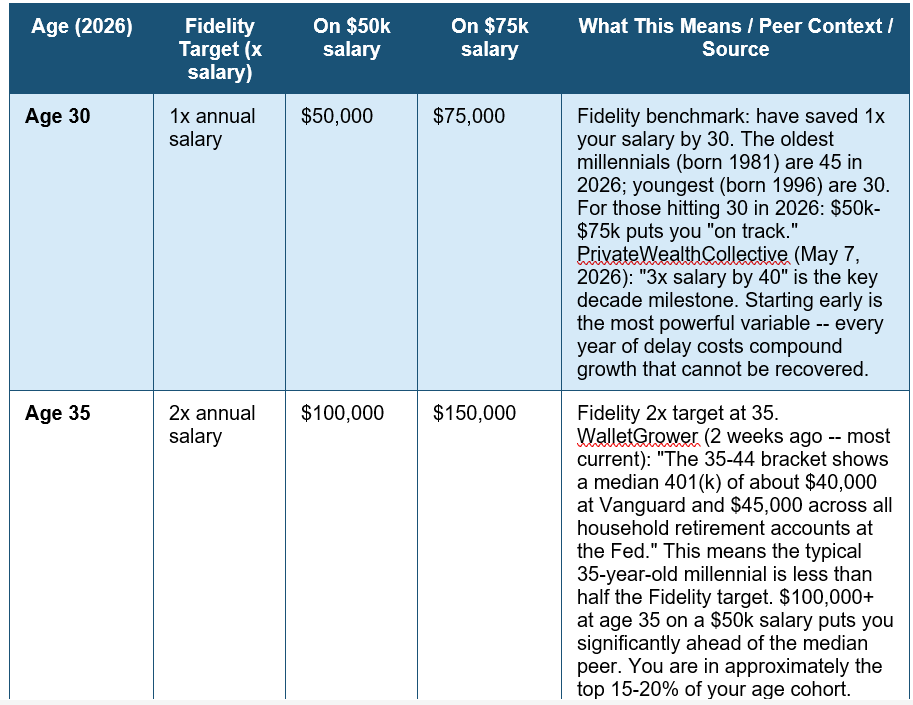
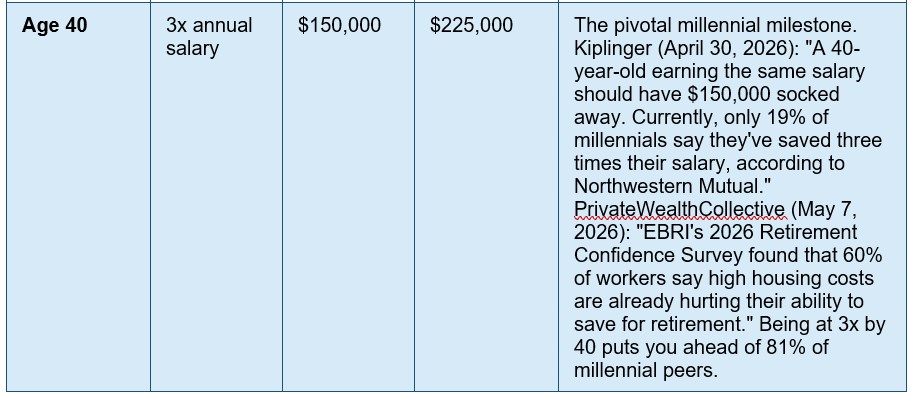
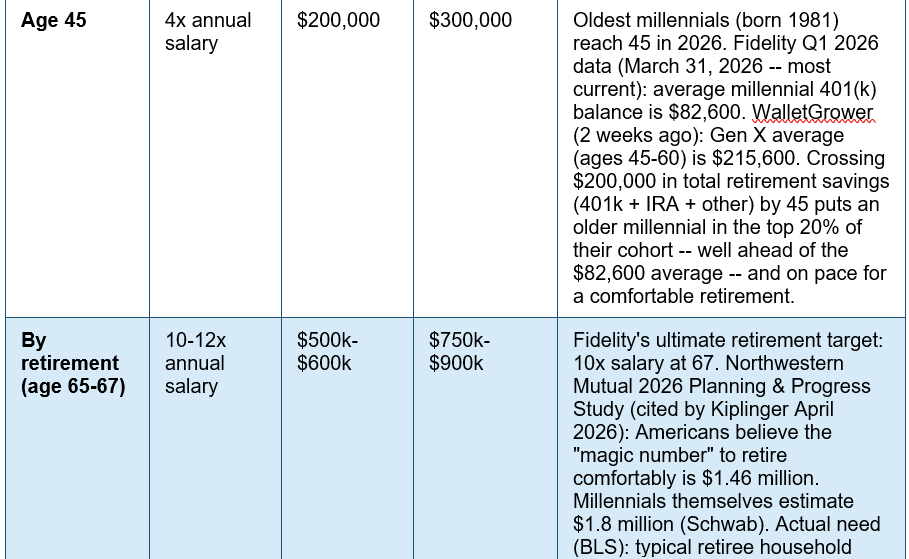

Millennial retirement savings 2026 -- the benchmark numbers: Avg 401(k): $82,600. Median (35-44): ~$40,000. Only 19% at 3x salary. 55% fear outliving savings. Magic number: $1.46M. — Fidelity Q1 2026 (March 31, 2026 -- most current, 25.6M participants): 'Millennial avg 401(k) $82,600.' WalletGrower (2 weeks ago -- most current comprehensive data, 4.6M accounts): 'All-ages median 401(k) $44,115 at year-end 2025 -- new record. Millennial avg $82,600.' Kiplinger (April 30, 2026): 'Only 19% of millennials saved 3x salary. 55% expect to outlive savings.' PrivateWealthCollective (May 7, 2026): '60% say high housing costs hurting retirement saving. 7 in 10 worried housing affects retirement.' Northwestern Mutual 2026: 'Magic number: $1.46 million.'
Where Millennials Actually Stand: The Full Data Picture
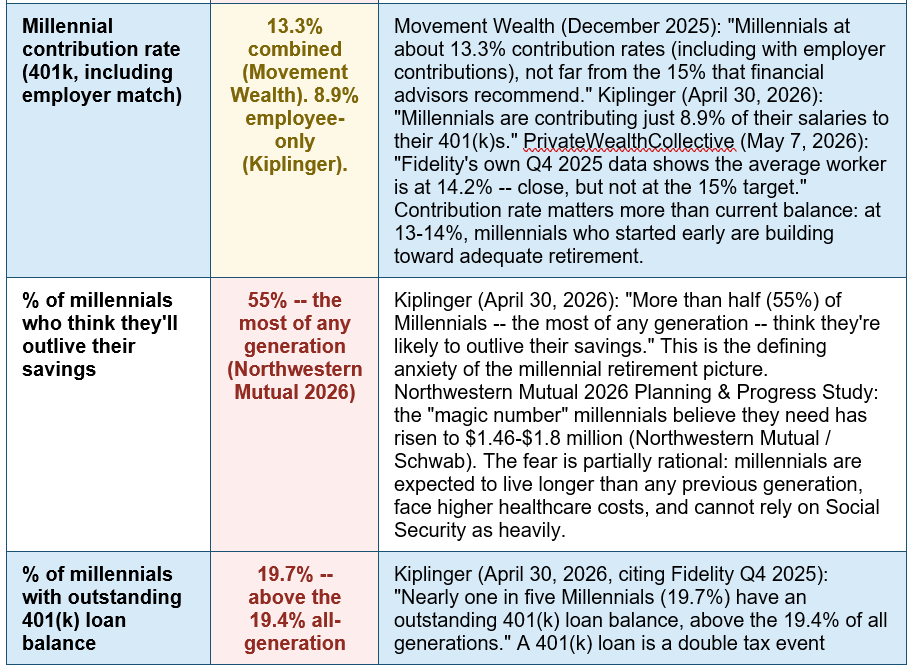
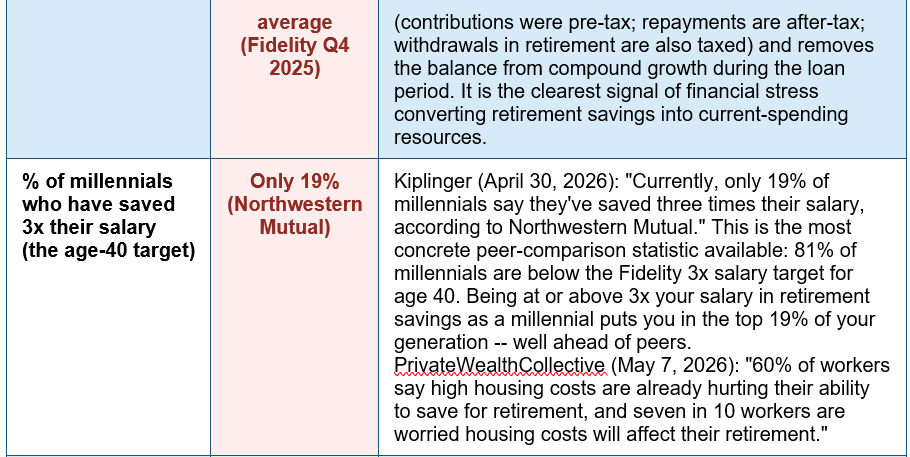
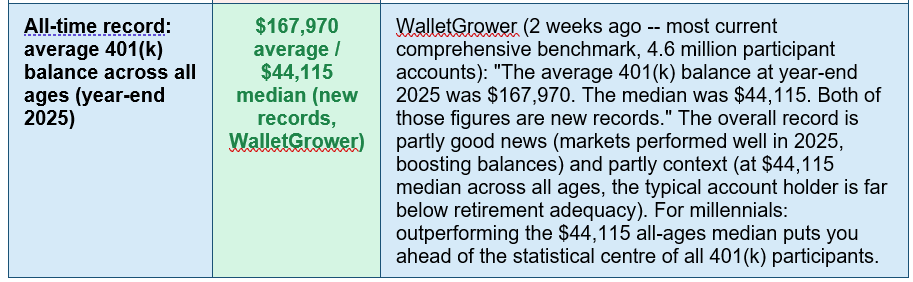
The following table maps every key metric on millennial retirement savings -- average, median, contribution rate, anxiety, and loan data -- to its source and peer context: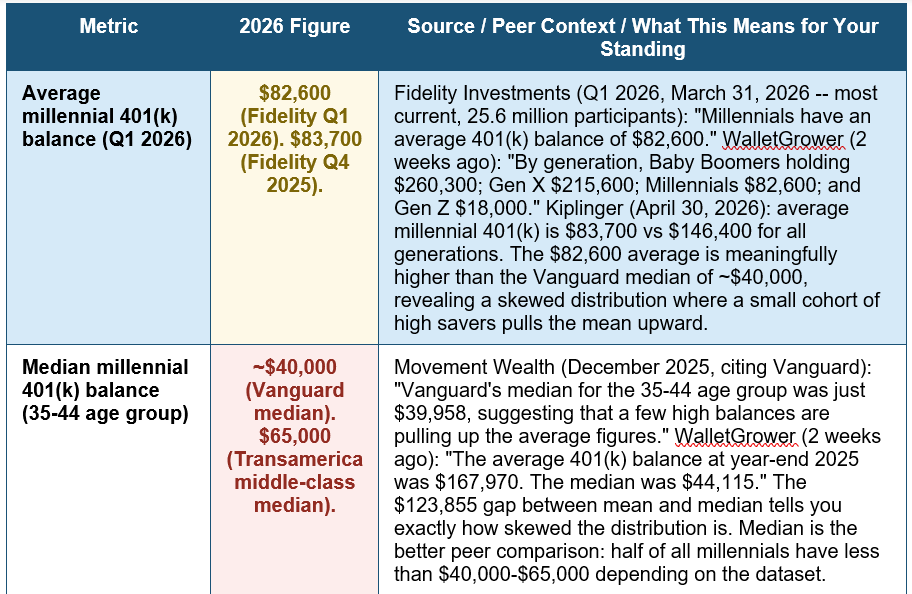
The Peer Comparison Scorecard: Where Your Balance Ranks Among Millennial Peers
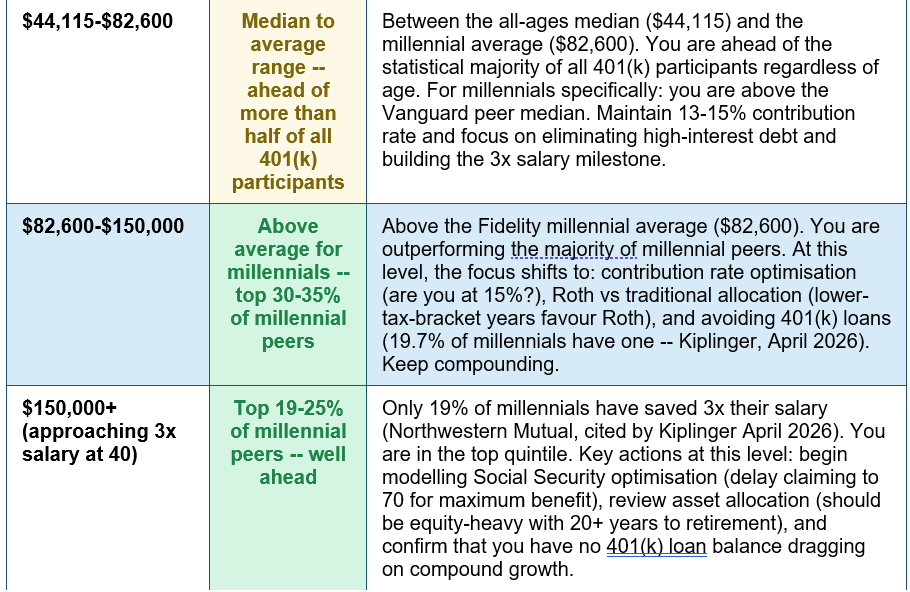
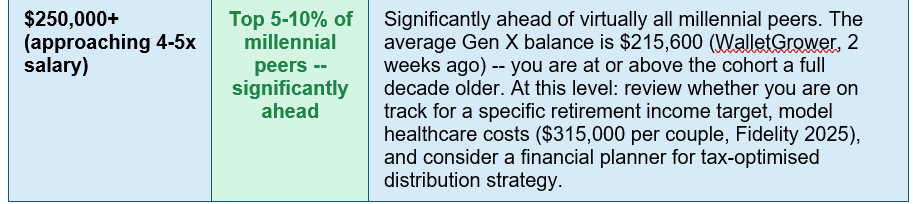
The following table translates specific balance ranges into approximate peer percentiles, using Fidelity Q1 2026, WalletGrower year-end 2025, Vanguard, and Northwestern Mutual 2026 data: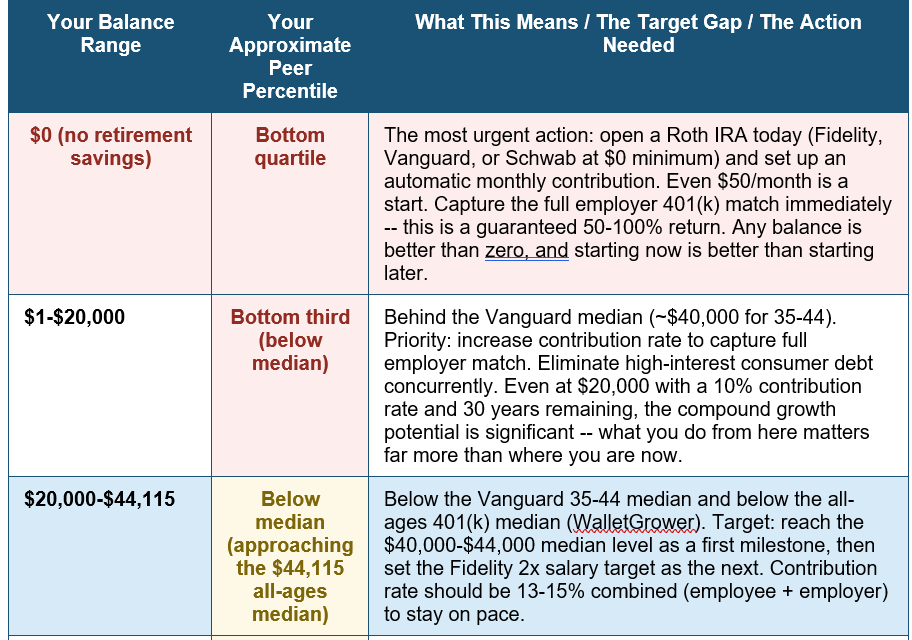
Why the Median is the Right Benchmark -- and What It Tells You
The most important analytical distinction in millennial retirement savings data is the difference between the average ($82,600, Fidelity Q1 2026) and the median (~$40,000, Vanguard for the 35-44 age group). WalletGrower (2 weeks ago -- most current): 'The average 401(k) balance at year-end 2025 was $167,970. The median was $44,115. A difference of $123,855 between mean and median tells you exactly how skewed the distribution is.' The skew means that a small number of high-balance accounts -- millennials who maxed their 401(k) every year from their first job, benefited from employer stock, or inherited windfalls -- pull the mean dramatically upward. The median is less influenced by these outliers and is a more accurate description of where the typical millennial stands.Movement Wealth (December 2025): 'Vanguard's median for the 35-44 age group was just $39,958, suggesting that a few high balances are pulling up the average figures. Transamerica's figures, which focus on middle-class Americans, put the median millennial retirement savings at $65,000 -- meaning half the generation had less than that.' The practical implication: if your retirement savings balance exceeds $40,000, you are ahead of the median millennial peer. If it exceeds $65,000, you are ahead of the median middle-class millennial. If it exceeds $82,600, you are above the Fidelity average. Being above the average -- not just the median -- means you are in approximately the top 25-30% of your generation.
PrivateWealthCollective (May 7, 2026): 'The gap in 2026 is striking. The 35-44 bracket shows a median 401(k) of about $40,000 at Vanguard and $45,000 across all household retirement accounts at the Fed.' The Federal Reserve's household survey data, which captures all retirement accounts (401k, IRA, Roth IRA, pension present value) not just employer plans, puts the 35-44 median at approximately $45,000 -- slightly higher than the Vanguard 401(k)-only data, but confirming the same broad picture.
Why Millennials Face a Harder Retirement Savings Path Than Previous Generations
Understanding why the benchmarks are where they are requires understanding the structural headwinds millennials have faced. Kiplinger (April 30, 2026): 'Millennials came of age during the Great Recession of 2008-2009; they're perhaps best known as the generation mired in so much student debt that they've often delayed key life milestones such as buying a house and getting married.' This is not hyperbole -- the EBRI 2026 Retirement Confidence Survey (cited by PrivateWealthCollective, May 7, 2026) found that '60% of workers say high housing costs are already hurting their ability to save for retirement, and seven in 10 workers are worried housing costs will affect their retirement.' For millennials in particular, high housing costs represent a double blow: the cost of rent and mortgage consumes a higher share of income than for previous generations at the same age, and the barrier to homeownership (which provides long-term housing cost stability) is higher.Movement Wealth (December 2025): 'Older millennials graduated college right in time for not just one, but two recessions. Throw in high levels of student debt, stagnant wages, and raging inflation, and it's a small miracle millennials have retirement savings at all.' The $1.66 trillion in total US student loan debt (Federal Reserve Q1 2026) is disproportionately concentrated among millennials -- representing a debt burden that has delayed retirement savings accumulation for a decade or more for many borrowers. Kiplinger (April 30, 2026): 19.7% of millennials have an outstanding 401(k) loan balance -- above the 19.4% all-generation average. This is the clearest data point showing financial stress actively eroding retirement savings: when a 401(k) is tapped for current expenses, the compounding stops and the loan repayment is doubly taxed.
The structural context does not reduce the urgency of catching up -- it explains why catching up is harder and why the millennial who is on or ahead of the Fidelity benchmarks has achieved something genuinely difficult, not something merely expected.
The compound math that makes the outlook better than the headlines suggest. The anxiety that 55% of millennials feel about outliving savings (Northwestern Mutual, cited by Kiplinger April 2026) is based partly on looking at current balances without fully accounting for what those balances become with continued contributions and compound growth. Let us run the math on the average millennial. At $82,600 in a 401(k) at age 35, contributing 13% of a $65,000 salary ($8,450/year employee contribution plus a 3% employer match of $1,950 = $10,400/year total), at a 7% average annual return: by age 65, this grows to approximately $1.07 million. The same starting balance at 13% contribution rate from age 40 to 65 (25 years): approximately $810,000. Add Social Security income (approximately $20,000-$28,000/year at full retirement age for a median earner) and the retirement income picture improves significantly. At $810,000 at 4% withdrawal, annual income from savings: $32,400. Add $24,000 in Social Security: $56,400/year -- close to the $59,616 average annual retiree household expenditure (BLS 2025). The average millennial, contributing consistently at current rates, is not comfortably on track -- but they are not catastrophically off track either. The headline fear of outliving savings is more justified for those below the median than for those at or above it. PrivateWealthCollective (May 7, 2026): 'Don't get discouraged if you feel behind. What to aim for: 3x salary by 40.' The trajectory is the key variable, not just the current balance.
What Specifically Puts a Millennial Ahead of Peers in 2026
- Based on the 2026 data from Fidelity, Vanguard, Northwestern Mutual, and EBRI, here are the specific thresholds that place a millennial ahead of their generation:
- Ahead of the median: $40,000-$65,000 in total retirement savings (401k + IRA + other accounts). This exceeds the Vanguard 35-44 median ($39,958) and places you ahead of more than half of millennial peers. At this level: contribution rate is the critical next lever.
- Ahead of the Fidelity millennial average: $82,600+ in retirement savings. You are in the top 25-30% of millennial 401(k) participants. Kiplinger (April 30, 2026): the average millennial 401(k) is $83,700 -- exceeding this puts you above the majority of your generation.
- At the Fidelity age-40 benchmark (3x salary): Three times your current annual salary (e.g., $150,000 if earning $50,000/year; $225,000 if earning $75,000/year). Northwestern Mutual: only 19% of millennials have achieved this. Being at this level puts you in the top quintile of your generation by retirement preparedness.
- No 401(k) loan balance: 19.7% of millennials have an outstanding 401(k) loan (Kiplinger April 2026). Having no loan balance -- keeping retirement savings fully compounding -- puts you structurally ahead of nearly 1 in 5 millennial peers who are losing compound growth to loan repayment.
- Contribution rate at 13-15%: Movement Wealth: millennials average 13.3% combined contribution rate (employee + employer). PrivateWealthCollective (May 7, 2026): "Fidelity's own Q4 2025 data shows the average worker is at 14.2% -- close, but not at the 15% target." Being at 15%+ combined puts you in the disciplined minority of consistent maximum-contribution savers.
- No 401(k) withdrawal history: SecureSave (5 days ago): 25% of Americans have reduced, paused, borrowed from, or withdrawn from long-term savings. Maintaining an untouched retirement account through economic cycles and financial pressures -- when many peers have raided theirs -- is itself a competitive advantage.
FIVE RETIREMENT SAVINGS MISTAKES THAT KEEP MILLENNIALS BEHIND: (1) TAKING A 401(k) LOAN. Kiplinger (April 30, 2026): 19.7% of millennials have an outstanding 401(k) loan. A 401(k) loan removes the balance from compound growth, is repaid with after-tax dollars (meaning it is taxed twice -- once in repayment and once at retirement withdrawal), and becomes a full distribution if you change jobs before repayment. The only scenario where a 401(k) loan is the right choice is to prevent foreclosure or eviction. Every other use is almost certainly wrong. (2) CASHING OUT A 401(k) WHEN CHANGING JOBS. The early withdrawal penalty is 10% plus income tax, typically consuming 25-35% of the balance. The other consequence: all future compound growth on that amount is permanently lost. Roll over every 401(k) to an IRA or new employer plan when changing jobs. Every time. (3) INVESTING TOO CONSERVATIVELY DUE TO MARKET ANXIETY. Millennials with 25+ years to retirement and equity allocations below 80% are systematically underperforming the long-run market. At age 35-40, a 90% equity / 10% bond allocation (or a target-date fund for the retirement year) is the standard recommendation. Market downturns at age 35 are buying opportunities, not threats. (4) NOT INCREASING CONTRIBUTIONS AFTER EVERY PAY RISE. The SMarT approach (Save More Tomorrow): pre-commit to directing 50% of every future pay rise to retirement contributions. Most lifestyle inflation occurs when income grows faster than savings. If you increase savings rate by 1-2% annually, you reach 15% contribution from a lower base without any perceived sacrifice. (5) RELYING ON SOCIAL SECURITY TO FILL THE GAP. MoneyTalksNews (May 7, 2026): Social Security replaces only 43% of pre-retirement income for median earners. For a household earning $75,000, that is $32,250/year at full retirement age. The remaining income gap requires personal retirement savings of $600,000-$1,000,000+ at 4% withdrawal. Social Security is a floor, not a plan.
YOUR 2026 MILLENNIAL RETIREMENT CATCH-UP PLAN: STEP 1 -- FIND YOUR NUMBER (10 minutes): Take your current retirement balance (all accounts: 401k, IRA, Roth). Compare to the scorecard above and the Fidelity benchmarks. Are you at 1x salary (age 30), 2x (age 35), or 3x (age 40)? Knowing your percentile is the starting point. STEP 2 -- CAPTURE THE FULL EMPLOYER MATCH (this week): Log into your HR/payroll portal. Find your 401(k) contribution percentage. Find the employer match threshold (typically 3-6% of salary). If you are not contributing enough to capture the full match, increase immediately. This is a guaranteed 50-100% return. STEP 3 -- OPEN A ROTH IRA IF YOU DON'T HAVE ONE (20 minutes): Fidelity, Vanguard, or Schwab. $0 minimum. 2026 limit: $7,000 ($8,000 age 50+). For most millennials in their 30s and early 40s, Roth is the superior vehicle -- you are contributing during the years of highest expected lifetime earning growth, and Roth distributions in retirement are tax-free. STEP 4 -- USE A TARGET-DATE FUND IF YOU HAVEN'T REVIEWED YOUR ALLOCATION: Most 401(k) plans offer a Target Date 2055 or 2060 fund for millennials targeting retirement in their mid-60s. These automatically maintain an age-appropriate equity-heavy allocation and rebalance automatically. The biggest risk for 35-year-olds is being too conservative, not too aggressive. STEP 5 -- SET A CONTRIBUTION RATE ESCALATOR: Set a calendar reminder for each January 1st: increase your contribution rate by 1%. From 10% to 11% to 12% -- in 5 years you will be at 15% without any single decision feeling painful. PROJECTION TOOL: Use Fidelity's Retirement Calculator at fidelity.com/retirement or Vanguard's Retirement Income Calculator at vanguard.com to model your specific balance, contribution rate, and retirement income projection.
Conclusion
The Fidelity Q1 2026 data (March 31, 2026, 25.6 million participants) puts the average millennial 401(k) at $82,600. The Vanguard median for 35-44 year olds is approximately $40,000. Only 19% of millennials have achieved the 3x salary target that Fidelity recommends by age 40. Fifty-five percent fear outliving their savings. EBRI's 2026 Retirement Confidence Survey finds 60% saying high housing costs are actively hurting their retirement saving. These are the facts about the average millennial's retirement position.The above-average millennial -- the one who has captured every employer match, maintained a 13-15% contribution rate through every economic disruption, never taken a 401(k) loan, opened a Roth IRA, and increased contributions after every pay rise -- is not just ahead of peers. They are potentially on track for a comfortable retirement from a median income. The compound math runs in their favour for 25-30 more years. Kiplinger (April 30, 2026): 'It's not all gloom and doom for their futures.' Movement Wealth (December 2025): 'The generation that came of age during economic chaos is gaining ground.'
The specific thresholds: exceeding the $40,000 Vanguard median puts you ahead of more than half of millennial peers. Exceeding $82,600 puts you in the top 25-30%. Reaching 3x salary by 40 puts you in the top 19%. Not having a 401(k) loan puts you structurally ahead of 1 in 5 peers whose savings are not fully compounding. Each of these thresholds is a concrete, achievable target -- and each one, crossed, represents meaningful progress against a generation that has faced more structural financial adversity than any in recent memory.
Frequently Asked Questions (FAQ)
What is the average millennial 401(k) balance in 2026?Fidelity Investments (Q1 2026 data, March 31, 2026 -- most current, based on 26,800 corporate defined contribution plans and 25.6 million participants): the average millennial 401(k) balance is $82,600. WalletGrower (2 weeks ago -- most current comprehensive data, based on 4.6 million participant accounts at year-end 2025): millennials hold $82,600 on average. Kiplinger (April 30, 2026, citing Fidelity Q4 2025 data): the average millennial 401(k) is $83,700, compared with $146,400 for all generations, $215,600 for Gen X, and $260,300 for Baby Boomers. The important caveat: the average is pulled significantly upward by a small number of high-balance accounts. The median -- which better represents the typical millennial -- is approximately $39,958 (Vanguard, for the 35-44 age group) or $65,000 (Transamerica, focused on middle-class Americans). WalletGrower: 'The gap between average and median is already hundreds of thousands of dollars -- that's a reminder that a small cohort of high earners is pulling the mean skyward.' For peer comparison purposes, the median is more meaningful than the average. Exceeding $40,000 in total retirement savings puts a millennial ahead of more than half of their generation. Exceeding $82,600 puts them above the Fidelity average -- in the top 25-30% of millennial retirement savers.
How much retirement savings do millennials need by age 40?
Fidelity's retirement savings benchmark for age 40 is three times your current annual salary. This is the most widely cited milestone in US retirement planning. Kiplinger (April 30, 2026): 'A retirement savings general rule from Fidelity is to have one time your salary saved by age 30 and three times your salary by age 40. A 30-year-old millennial earning $50,000 a year should have a nest egg of $50,000, and a 40-year-old earning the same salary should have $150,000 socked away.' The salary-scaled benchmark is important because it is not a single number -- it scales with income. Three times salary at 40 on a $50,000 income = $150,000 target. Three times on a $75,000 income = $225,000 target. Three times on a $100,000 income = $300,000 target. How many millennials are actually meeting this target? Kiplinger: 'Currently, only 19% of millennials say they've saved three times their salary, according to Northwestern Mutual.' This means 81% are below the Fidelity 3x target for age 40. PrivateWealthCollective (May 7, 2026, EBRI 2026 Retirement Confidence Survey): 60% of workers say high housing costs are hurting their retirement saving, and 7 in 10 are worried housing costs will affect their retirement. These structural barriers explain the gap between the Fidelity target and millennial reality -- but the target remains the right goal.
Why do 55% of millennials think they will outlive their retirement savings?
Kiplinger (April 30, 2026): 'More than half (55%) of Millennials -- the most of any generation -- think they're likely to outlive their savings.' This fear is partly rational, partly the product of anchoring on inadequate current balances without accounting for future contributions and compound growth. The rational elements: millennials are expected to live longer than any previous generation (life expectancy trends continue upward); they face higher lifetime healthcare costs; they cannot rely as heavily on Social Security as their parents could (SS replaces only 43% of pre-retirement income for median earners, per the Federal Reserve SHED 2025); and they do not have defined benefit pensions as a backstop. The anchoring problem: looking at a current balance of $82,600 against a $1.46 million target (Northwestern Mutual 2026 'magic number') and concluding the goal is impossible -- without modelling what $82,600 becomes with 25-30 more years of contributions at 7% average return. A 35-year-old with $82,600 contributing 13% of a $65,000 salary reaches approximately $1.1 million by age 65 at 7% average annual return. That is not comfortable certainty -- but it is close to the target and well above the level that would require accepting severe retirement austerity. The fear is also higher among those at or below the median (below $40,000) than those at or above the average -- which means the 55% figure captures disproportionate anxiety from the most behind members of the generation.
Is $100,000 in retirement savings good for a millennial in 2026?
$100,000 in total retirement savings as a millennial in 2026 is genuinely good -- and significantly better than the position of the majority of your peers, depending on your age. Here is how to assess it: Against the Vanguard median ($39,958 for 35-44 year olds): $100,000 exceeds this -- you are ahead of more than half of millennial peers. Against the Fidelity millennial average ($82,600): $100,000 exceeds this -- you are above average, in approximately the top 25-30% of millennial 401(k) participants. Against the Fidelity age-specific benchmark: at age 30, $100,000 exceeds the 1x salary target for most millennials -- very strong. At age 35, $100,000 is right around the 2x salary target for a $50,000 earner -- on track, ahead of the median. At age 40, $100,000 falls short of the 3x salary target unless your salary is approximately $33,000 -- below the benchmark for middle-income 40-year-olds. Nasdaq data (GOBankingRates survey): '85.6% of younger millennials have less than $100,000 set aside for retirement.' Being above $100,000 puts a millennial in the top 14% by this measure. WalletGrower (2 weeks ago): the all-ages 401(k) median at year-end 2025 was $44,115. Being at $100,000 puts a millennial above the median of all 401(k) participants regardless of age. The most important action at $100,000: do not reduce your contribution rate -- the compound growth on $100,000 over 25-30 years is the most valuable asset on your balance sheet, and the rate at which it grows depends entirely on continued contributions and market exposure.
How much do millennials need to retire comfortably -- and by when?
The answer depends on four variables: your target retirement age, your expected annual retirement spending, your Social Security benefit, and your healthcare costs. Here are the major estimates. Northwestern Mutual 2026 Planning and Progress Study (cited by Kiplinger, April 30, 2026): Americans believe the 'magic number' is $1.46 million -- up 15% since 2023 due to higher inflation. Charles Schwab 401(k) Participant Study (Gen Z/Millennial Focus): the average amount millennials think they need is $1.8 million. Actual retirement spending (BLS Consumer Expenditure Survey 2025, cited by Yahoo Finance, 2 weeks ago): the average retiree household spent $59,616 in 2025 ($4,968/month). At a 4% safe withdrawal rate: to fund $59,616/year from savings requires approximately $1.49 million. Social Security typically covers 28-43% of pre-retirement income for median earners (Federal Reserve SHED 2025), so the portfolio requirement can be lower than $1.49 million if Social Security is factored in. For millennials targeting a 2045-2050 retirement, cost-of-living adjustments to these figures become important: at 3% annual inflation, today's $59,616 annual retirement spending becomes approximately $107,000-$130,000 by 2045-2050. The upper range of millennial retirement need estimates (Wealthcare Financial, GOBankingRates): $3 million to cover $120,000-$150,000/year in retirement spending at a 4% withdrawal rate. The realistic target for a millennial planning now: aim for the Fidelity benchmark trajectory (1x salary by 30, 3x by 40, 6x by 50, 8x by 60, 10x by 67). A $65,000 earner reaching 10x by 67 = $650,000 from savings, plus Social Security = approximately $40,000-$55,000/year in total retirement income. For a higher-income millennial ($100,000 salary, 10x = $1 million), the retirement income picture is considerably more comfortable.
0 Comments
Be the first to share your thoughts on this article.