

Finance
Millennials With $500k Net Worth: Their Financial Habits
MILLENNIAL $500K NET WORTH | Millennial wealth nearly quadrupled since 2019: $3.94T to $15.95T. Millionaire growth: +144% in 5 years. $3.1 trillion in stock holdings (record, up 4.5x since pandemic). Median net worth: $135,600. The $500k+ threshold sits 3.7x above the median. Here are the habits that close that gap.
The $500,000 net worth threshold sits well above the millennial median ($135,600 per RicherNetWorth, June 2026) but below the mean ($345,601-$549,600 depending on the dataset). It is not a lottery outcome or an inheritance story -- it is the level that a significant and growing cohort of millennials are reaching through identifiable, replicable habits that distinguish them from the median member of their generation. Fortune (1 day ago -- most current): millennials and Gen Z now hold a record $3.1 trillion in stock market assets, up 4.5 times since the pandemic alone.
This guide identifies those habits. It draws on IPX1031's 854-person investing survey (August 2025), Wealthfront's millennial millionaire research, Federal Reserve data (Survey of Consumer Finances 2022, the most recent full survey), Fortune's analysis of the millennial wealth split (published within the past two weeks), Self Financial's 1,276-person survey (March 2025), and RicherNetWorth's comprehensive 2026 millennial net worth analysis. The goal is not to describe what happened to lucky millennials -- it is to identify the specific decisions and habits that separated the $500k+ tier from the median, so that anyone can audit their own financial behaviour against them.
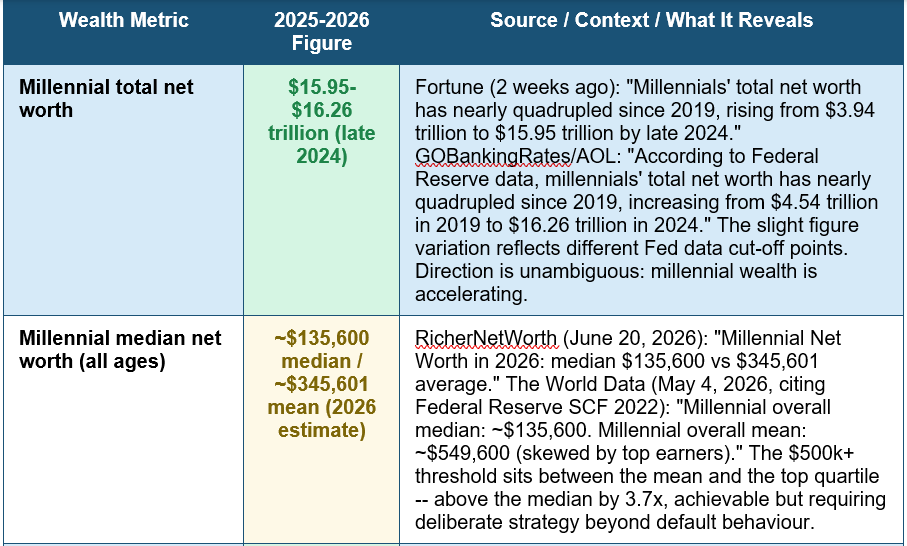
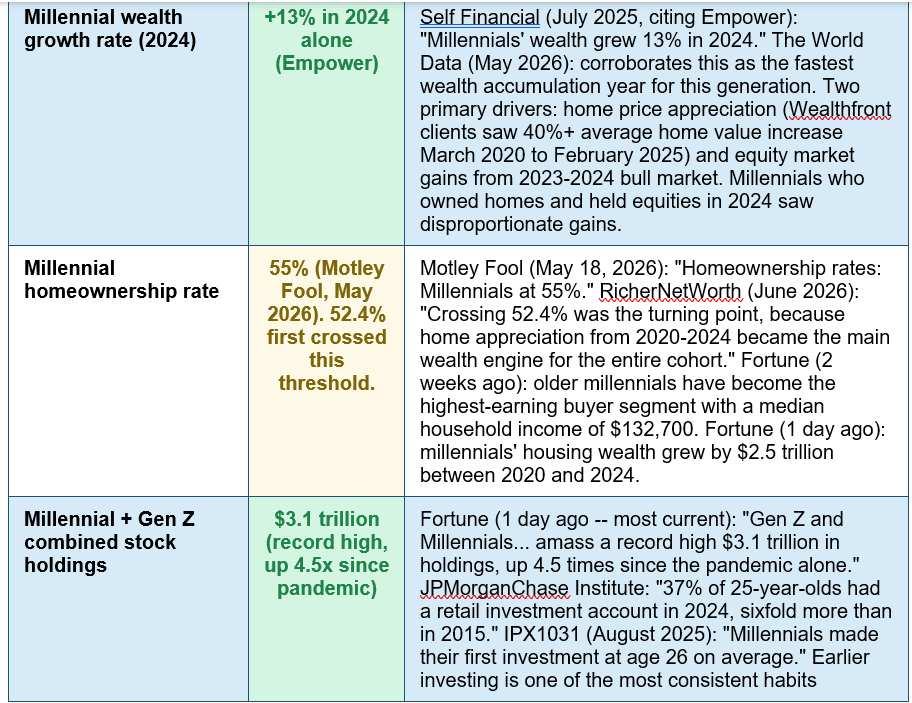
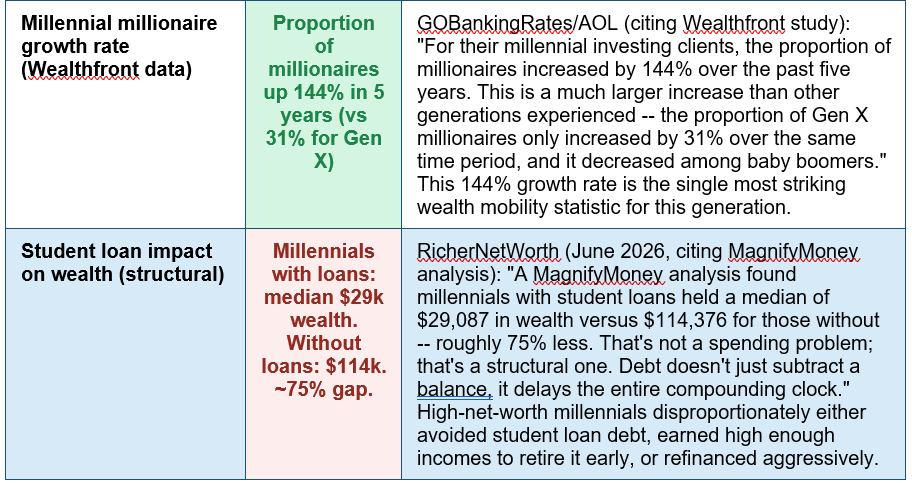
Millennial wealth 2026 -- the defining numbers: Net worth quadrupled to $15.95T. Millionaires up 144% in 5 years. Median: $135k. $3.1T in stocks (record). 55% homeownership. — Fortune (2 weeks ago): 'Millennial total net worth rose from $3.94T to $15.95T.' Wealthfront (GOBankingRates): 'Millionaire proportion up 144% in 5 years vs 31% Gen X.' RicherNetWorth (June 2026): 'Median $135,600 vs mean $345,601.' Fortune (1 day ago, most current): '$3.1 trillion in stock holdings, up 4.5x since pandemic.' Motley Fool (May 2026): '55% homeownership.' Empower (Self Financial, 2025): 'Wealth grew 13% in 2024.'
The $500k+ millennial and the great generational wealth paradox. The same Federal Reserve data that shows millennial total net worth at $15.95 trillion also shows that millennials hold only 10.3% of total US household wealth despite being the largest generational cohort (The World Data, May 2026). Baby Boomers, with a similar headcount, hold 51.4%. The explanation for this paradox is timing. Baby Boomers accumulated wealth across four decades with rising real wages, low housing costs relative to income, defined benefit pensions, and zero student loan debt at the scale millennials carried. The $500k+ millennial is the cohort that managed to transcend those structural disadvantages through a combination of: (1) enough time in the labour market to pay down student debt before compounding could start; (2) homeownership timed before or during the 2020-2024 appreciation cycle; (3) equity market participation through the longest bull market in history (2009-2021) followed by a strong 2023-2024 recovery; and (4) behavioural discipline -- automation, debt elimination priority, multi-income streams -- that produced above-average savings rates despite below-average starting conditions. The $500k threshold is not a story of fortunate timing alone. It is a story of matching the right behaviours to the right opportunities, which is exactly what makes the habits in this guide replicable for the millennial who has not yet reached it.
FIVE BEHAVIOURS THAT KEEP MILLENNIALS BELOW THE $500K THRESHOLD: (1) WAITING TO INVEST UNTIL 'CONDITIONS ARE RIGHT'. IPX1031 (August 2025): 80% of Americans wish they had started investing earlier. The 'conditions' that feel right never arrive -- there is always a geopolitical event, a market correction, a life transition that provides a rationale for delay. Start with $25/month now. (2) RENTING INDEFINITELY IN A MARKET WHERE BUYING IS VIABLE. For millennials in markets where the rent-versus-buy calculation favours buying over a 7+ year horizon: every year of delay is a year without forced equity accumulation and without participation in potential appreciation. Run the actual numbers. (3) TREATING STUDENT LOANS AS A PERMANENT FEATURE RATHER THAN AN EMERGENCY. RicherNetWorth (June 2026): the 75% wealth gap between millennials with and without student loan debt is structural. Treating loans as a normal monthly expense rather than a wealth-destroying emergency means they persist for decades. (4) SPENDING EVERY SALARY INCREASE ON LIFESTYLE. Lifestyle inflation is the most consistent wealth destroyer. Every salary increase absorbed by a bigger apartment, a better car, or expanded subscriptions is compound growth permanently foregone. The $500k+ millennial directed at least 50% of every income increase to savings and investment first. (5) HAVING ONLY ONE INCOME SOURCE. IPX1031: 83% believe multiple income streams are essential. The millennial at $500k+ typically has 2-4. A single income source concentrates risk and caps the investable surplus. Even $5,000/year in side income, invested for 20 years at 7%, adds approximately $196,000 to terminal net worth.
THE $500K BLUEPRINT -- WHAT HIGH-NW MILLENNIALS DID, IN ORDER: (1) EMERGENCY FUND FIRST: $1,000 starter then 3-6 months of expenses in an HYSA at 4.5-5.0% APY. Non-negotiable. (2) EMPLOYER MATCH: 401(k) contribution at least to the match threshold from the first paycheck. Free 50-100% return. (3) DEBT ELIMINATION: Student loans and high-interest consumer debt eliminated before investing beyond the match. The 75% wealth gap is real. (4) ROTH IRA: $7,000/year (2026 limit) in a low-cost total market index fund (FZROX 0%, VTI 0.03%). Tax-free compounding for 30+ years. (5) HOMEOWNERSHIP (where viable): Buy and hold. The $2.5T in millennial housing wealth 2020-2024 was the single largest wealth creator. Run the numbers. (6) ADDITIONAL INCOME: Develop at least one income stream beyond primary employment. 83% of high-NW millennials believe this is essential. (7) AUTOMATION: Every savings and investment action on automatic transfer before spending decisions. (8) MEASUREMENT: Know your net worth quarterly. Track the trajectory. Update the goal. FREE TOOLS: Empower net worth tracker empower.com | Fidelity retirement calculator fidelity.com | studentaid.gov for loan options | SEC compound interest calculator investor.gov.
YOUR $500K NET WORTH AUDIT -- WHERE ARE YOU AND WHAT IS THE GAP? STEP 1 -- CALCULATE YOUR NET WORTH NOW: Assets (bank accounts + investment accounts + home equity + any other assets) minus liabilities (mortgage + student loans + credit cards + car loan + other debt). The result is your net worth. STEP 2 -- IDENTIFY THE GAP: Subtract your current net worth from $500,000. This is your gap. Divide by the number of months until your target date. This is your required monthly net worth growth. STEP 3 -- IDENTIFY YOUR HIGHEST-LEVERAGE ACTION: Of the eight habits above, which is the one you are not doing that would most quickly close the gap? For most millennials: it is either (a) investing more aggressively, (b) attacking student loan debt, or (c) building a second income stream. STEP 4 -- SET ONE AUTOMATION: Whatever the highest-leverage action is: automate the first step this week. 401(k) increase in the HR portal. Roth IRA contribution set up at Fidelity. Extra loan payment set to automatic. One automation. STEP 5 -- TRACK QUARTERLY: Set a calendar reminder for the 1st of January, April, July, and October. Calculate net worth each time. Watch the trajectory. Adjust the action if needed. The $500k threshold is not reached by a single decision -- it is the compounding output of eight habits applied consistently over years.
The habits are replicable: early investing, homeownership where viable, multiple income streams, aggressive debt elimination, maxed tax-advantaged accounts, automated savings, technology-assisted tracking, and positioning on the right side of the generational wealth split. The timing cannot be recovered -- a 35-year-old cannot undo a decade of investing delay. But the compound growth that remains is still substantial. RicherNetWorth (June 2026): 'Improving your own millennial net worth isn't mysterious; it's mechanical. Max tax-advantaged accounts first. Attack high-interest debt before chasing investment returns. If you can buy a home you'll hold for years, the forced equity has historically been this generation's biggest wealth driver. And automate everything.'
The $500k threshold is mechanical, not magical. It is the output of eight habits applied consistently over the decade of your 30s and into your 40s. FactsWings (July 24, 2026): 'Wealth building has less to do with a six-figure salary and more to do with consistent financial habits.' The millennial who starts the first automation this week is already doing what the $500k cohort did at the beginning of their wealth-building journey -- the only difference is the starting date.
The question reframes usefully: rather than asking about a specific person, the useful comparison is where $500k sits within the millennial wealth distribution. RicherNetWorth (June 20, 2026 -- most current): 'Millennial Net Worth in 2026: median $135,600 vs $345,601 average.' The World Data (May 4, 2026, citing Federal Reserve SCF 2022): 'Millennial overall median: ~$135,600. Millennial overall mean: ~$549,600 (skewed by top earners).' A $500k net worth is: 3.7 times the millennial median; above the adjusted mean for most millennial datasets; and comfortably within the top quartile of millennial wealth. For context on what constitutes top-quartile millennial wealth: the Federal Reserve Survey of Consumer Finances 2022 found that millennials at ages 35-39 have a median net worth that is actually higher than Boomers' median at the same age when adjusted for inflation (The World Data, May 2026) -- reflecting the combined effect of home appreciation and equity market gains from 2020-2024. A $500k net worth millennial is significantly ahead of the median peer, at or above the mean depending on the dataset used, and has the compound growth horizon that makes continued acceleration to $1M+ highly achievable with consistent habits.
How did millennials build wealth so quickly between 2019 and 2024?
Millennial net worth grew from approximately $3.94-4.54 trillion in 2019 to $15.95-16.26 trillion by late 2024 -- an approximately 3.5-4x increase in five years. Fortune (2 weeks ago) and GOBankingRates (citing Federal Reserve and Wealthfront data) identify four primary drivers. First, home price appreciation: Fortune (2 weeks ago): 'Roughly $2.5 trillion of that increase came directly from home-price appreciation among millennials who already owned property. Among Wealthfront's millennial clients, the average home value increased by more than 40% between March 2020 and February 2025.' Millennials who owned homes before the 2020-2024 appreciation cycle saw equity gains that would have taken decades of saving to replicate. Second, equity market gains: the 2020-2021 bull market followed by the 2023-2024 recovery (S&P 500 gained approximately 24% in 2023 and 23% in 2024) produced substantial portfolio gains for millennials who had been investing consistently through the 2010s. Fortune (1 day ago): millennials and Gen Z now hold a record $3.1 trillion in stock holdings. Third, career income maturation: the 35-44 bracket -- which includes most of the older millennial cohort by 2024 -- posts a median household income of $86,473 and saw significant income growth from 2020 to 2024 in a tight labour market. Fourth, Wealthfront: the proportion of millennial millionaires grew 144% in five years, partly reflecting that those who had already accumulated substantial wealth saw that wealth compound the fastest as equity and real estate markets performed.
What financial habits separate wealthy millennials from the median?
Research from IPX1031 (August 2025, 854-person survey), Wealthfront millionaire analysis, RicherNetWorth (June 2026), and Federal Reserve data consistently identify the same behavioural differentiators. First, they invested earlier: IPX1031: millennials who are now wealthy made their first investment at 26 on average, versus 28 for Gen X and 31 for Boomers. Fortune (1 day ago): 37% of 25-year-olds had retail investment accounts in 2024 -- six times the rate in 2015. Earlier investing is not just a financial fact -- it is a psychological signal of a different relationship to money and the future. Second, they treated debt as an emergency: RicherNetWorth (June 2026): the 75% wealth gap between millennials with and without student loan debt is the single most structural differentiator. High-net-worth millennials either avoided heavy loan burdens or eliminated them as the first financial priority. Third, they owned homes and held through appreciation: the $2.5T in housing wealth added 2020-2024 went to millennial homeowners. Fourth, they automated savings before spending: FactsWings (July 2026) and every behavioural finance study confirm that automation defeats present bias more effectively than willpower. Fifth, they maximised tax-advantaged accounts: IPX1031 and CapWealth (January 2026) both identify 401(k) match capture and Roth IRA maximisation as the highest-return mechanical financial actions available to working Americans.
Is $500k net worth achievable without homeownership?
Yes -- but the path is longer and requires proportionally higher equity market participation. The $2.5 trillion in housing wealth added to millennial balance sheets between 2020 and 2024 (Fortune, 2 weeks ago) represents a wealth engine that is not available to renters. However, Fortune (1 day ago -- most current) explicitly documents the alternative path: 'Gen Z and Millennials are building wealth in the stock market instead as they reach record high $3.1 trillion in holdings, up 4.5 times since the pandemic alone. Less than half of Gen Z and Millennials can afford to buy a home, and the age of the average first-time homebuyer has jumped from 28 in 1992 to 40 in 2025.' The renter who directs the capital that would have gone toward a down payment and mortgage into a diversified equity portfolio at 7% average annual return is building wealth -- just through a different vehicle. The mathematical comparison: a renter who invests $2,000/month in equities for 15 years at 7% real return accumulates approximately $633,000. A homeowner who bought a $400,000 home in 2020 that appreciated 40% to $560,000 by 2025 has $160,000 in paper equity (assuming a 20% down payment) -- significantly less than the aggressive equity investor's portfolio, but with leverage advantages the equity investor lacks. For urban millennials in high-cost markets where buying is genuinely not financially viable: the stock market path to $500k is well-supported by the current data. Fortune (1 day ago): millennials and Gen Z's $3.1T in stock holdings is direct evidence that this cohort is building wealth through equities when housing is inaccessible.
At what age do most millennials reach $500k net worth?
There is no single data point for the age at which millennials reach $500k net worth, but the Federal Reserve SCF 2022 and related analyses allow a reasonable estimate. RicherNetWorth (June 2026): the millennial median net worth is $135,600 and the mean is $345,601-$549,600 depending on the dataset. The World Data (May 2026, citing Federal Reserve): 'Millennial overall median: ~$135,600.' This distribution is skewed by the top tier -- a meaningful cohort has already crossed $500k and is approaching $1M+, while the median remains well below this figure. The GOBankingRates/Wealthfront data: the proportion of millennial millionaires grew 144% in the past five years, suggesting the crossing of the $500k threshold is happening in the late 30s to early 40s for those on track. Fortune (2 weeks ago): older millennials (born 1981-1988, age 38-45 in 2026) are now functioning as repeat, equity-leveraging home buyers with median household income of $132,700 -- this income and equity-leveraging profile is consistent with the $500k+ net worth tier. Practically: for a millennial who starts at 30 with $50,000 in savings, contributes $1,500/month to investments, and earns 7% average annual return -- they reach $500k in approximately 15 years (age 45). With homeownership and home appreciation factored in, or with higher income and savings rates, this timeline contracts materially. The Business Insider case study (Doreen and Lawrence): $0 to $500k in four years with aggressive expense management and a rental property purchase. The range is genuinely wide -- from 4 years for those who are aggressive and fortunate with timing, to 20+ years for the median-income millennial starting later.
Table of Contents
- The Generation That Was Broke Is Now Building Record Wealth
- The Millennial Wealth Landscape in 2026: Where the $500k Threshold Sits
- The $500k+ Habit Profile: What the Data Shows
- The Eight Habits in Detail: What $500k+ Millennials Do Differently
- Conclusion: The Habits Are Replicable. The Timing Is Not Recoverable.
- Frequently Asked Questions (FAQ)
- What is the average net worth of a millennial with $500k?
- How did millennials build wealth so quickly between 2019 and 2024?
- What financial habits separate wealthy millennials from the median?
- Is $500k net worth achievable without homeownership?
- At what age do most millennials reach $500k net worth?
- External References & Further Reading
The Generation That Was Broke Is Now Building Record Wealth
For most of the past decade, the financial narrative about millennials was defined by what they lacked: entry-level jobs during the Great Recession, student loan balances that delayed every wealth-building milestone, housing costs that priced them out of markets their parents bought into at 28. That narrative is being rewritten by the data. Millennial total net worth has nearly quadrupled since 2019, rising from $3.94 trillion to $15.95 trillion by late 2024 (Fortune, 2 weeks ago). The proportion of millennial millionaires grew by 144% in five years -- more than four times the rate seen in Gen X over the same period (Wealthfront, cited by GOBankingRates).The $500,000 net worth threshold sits well above the millennial median ($135,600 per RicherNetWorth, June 2026) but below the mean ($345,601-$549,600 depending on the dataset). It is not a lottery outcome or an inheritance story -- it is the level that a significant and growing cohort of millennials are reaching through identifiable, replicable habits that distinguish them from the median member of their generation. Fortune (1 day ago -- most current): millennials and Gen Z now hold a record $3.1 trillion in stock market assets, up 4.5 times since the pandemic alone.
This guide identifies those habits. It draws on IPX1031's 854-person investing survey (August 2025), Wealthfront's millennial millionaire research, Federal Reserve data (Survey of Consumer Finances 2022, the most recent full survey), Fortune's analysis of the millennial wealth split (published within the past two weeks), Self Financial's 1,276-person survey (March 2025), and RicherNetWorth's comprehensive 2026 millennial net worth analysis. The goal is not to describe what happened to lucky millennials -- it is to identify the specific decisions and habits that separated the $500k+ tier from the median, so that anyone can audit their own financial behaviour against them.
The Millennial Wealth Landscape in 2026: Where the $500k Threshold Sits
Before examining habits, the context: what does the millennial wealth distribution actually look like, and how far above the median is $500k?Millennial wealth 2026 -- the defining numbers: Net worth quadrupled to $15.95T. Millionaires up 144% in 5 years. Median: $135k. $3.1T in stocks (record). 55% homeownership. — Fortune (2 weeks ago): 'Millennial total net worth rose from $3.94T to $15.95T.' Wealthfront (GOBankingRates): 'Millionaire proportion up 144% in 5 years vs 31% Gen X.' RicherNetWorth (June 2026): 'Median $135,600 vs mean $345,601.' Fortune (1 day ago, most current): '$3.1 trillion in stock holdings, up 4.5x since pandemic.' Motley Fool (May 2026): '55% homeownership.' Empower (Self Financial, 2025): 'Wealth grew 13% in 2024.'
The $500k+ Habit Profile: What the Data Shows
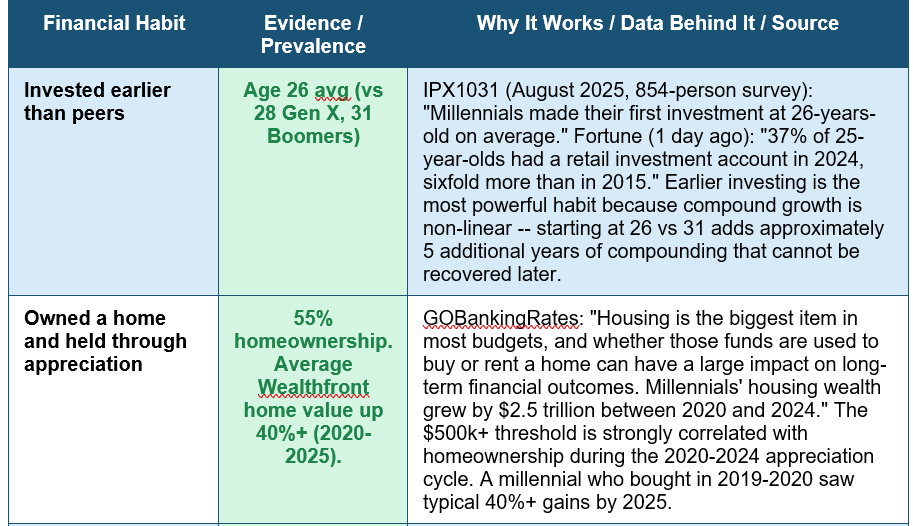
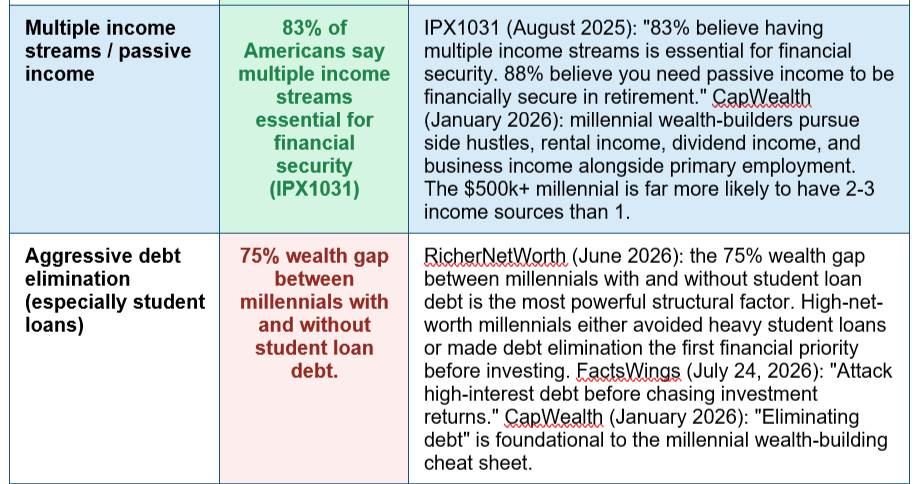
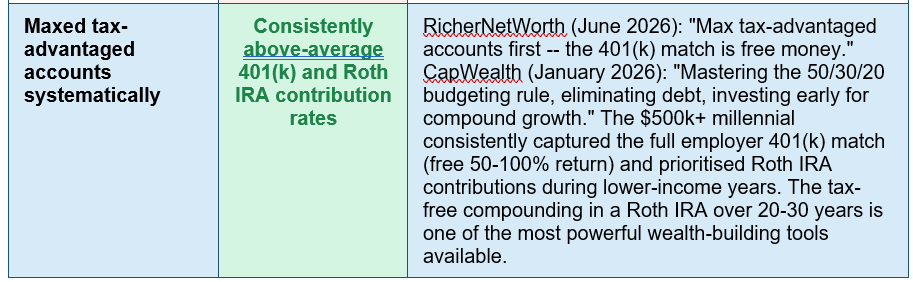
The following table maps the six most consistently documented habits of high-net-worth millennials to the research evidence behind each:
The Eight Habits in Detail: What $500k+ Millennials Do Differently
HABIT 1 THEY INVESTED EARLY AND CONSISTENTLY | Starting at 26 vs 31 adds approximately 5 years of compound growth that cannot be recovered
The most consistent finding across every dataset on high-net-worth millennials is that they invested earlier than their peers. IPX1031 (August 2025, 854-person survey): 'Millennials made their first investment at 26-years-old on average -- earlier than Gen X (28) and Baby Boomers (31).' Fortune (1 day ago -- most current): '37% of 25-year-olds had a retail investment account in 2024, sixfold more than in 2015, just as retail investing flows rose roughly 50% from 2023 to early 2025.' The $500k+ millennial is disproportionately from the cohort that started investing in their mid-to-late 20s rather than waiting for a 'right time' or a salary that felt comfortable enough. The compound arithmetic is unforgiving: $10,000 invested at 26 at 7% real return is worth approximately $74,000 at 56. The same $10,000 invested at 31 is worth approximately $52,000. The 5-year delay costs $22,000 per $10,000 invested -- a 42% reduction in terminal value from a single timing decision. IPX1031 (August 2025): '80% of Americans wish they had started investing earlier in life.' The $500k+ millennial did not wait.HABIT 2 THEY BOUGHT A HOME AND HELD THROUGH APPRECIATION | $2.5 trillion in housing wealth added 2020-2024. Typical Wealthfront home up 40%+.
Homeownership is the single most important structural wealth driver for the $500k+ millennial cohort. The timing advantage of those who bought in 2019-2022 is extraordinary by historical standards. GOBankingRates (citing Wealthfront): 'Millennials' housing wealth grew by $2.5 trillion between 2020 and 2024. Among Wealthfront's millennial clients, the average home value increased by more than 40% between March 2020 and February 2025.' Fortune (2 weeks ago): older millennials have become 'the highest-earning buyer segment in the market, posting a median household income of $132,700 and increasingly functioning as repeat, equity-leveraging buyers rather than first-timers.' RicherNetWorth (June 2026): 'Homeownership: crossing 52.4% was the turning point, because home appreciation from 2020-2024 became the main wealth engine for the entire cohort.' The $500k+ millennial is overwhelmingly likely to be a homeowner who bought before or during the early pandemic period and rode the subsequent appreciation cycle. For those who have not yet bought: Fortune (1 day ago) reports the average age of a first-time homebuyer reached 40 in 2025 -- buying later is still better than not buying. The 55% millennial homeownership rate (Motley Fool, May 2026) means the majority are now participating, though the wealth impact is greatest for those who bought earliest.HABIT 3 THEY BUILT MULTIPLE INCOME STREAMS | 83% say multiple streams essential. $500k+ millennials average 2-4 income sources.
The $500k+ millennial does not rely on a single paycheck. IPX1031 (August 2025): '83% believe having multiple income streams is essential for financial security. 88% believe you need passive income to be financially secure in retirement.' The internet is the number one source of financial advice for Americans -- and what that advice consistently says is that wealth concentrates among those with diversified income. CapWealth (January 2026): millennial wealth-builders pursue side hustles, rental income, dividend income, business income, and online content alongside primary employment. The specific income diversification pattern for the $500k+ cohort: primary W-2 income (the foundation); employer equity or bonus income (technology and finance jobs especially); side business or freelance income (consulting, content, services); passive income from invested assets (dividends, interest, rental income). None of these requires extraordinary income -- the GOBankingRates case study of Doreen and Lawrence Delva-Gonzalez shows that a couple earning modest incomes built $500k in four years by combining disciplined expense control with systematic investment and one rental property. FactsWings (July 24, 2026): 'Wealth building has less to do with a six-figure salary and more to do with consistent financial habits.'HABIT 4 THEY ELIMINATED STUDENT LOAN DEBT AGGRESSIVELY | 75% wealth gap between millennials with and without loans. Debt delays the entire compounding clock.
The student loan crisis is not evenly distributed within the millennial generation -- and the $500k+ tier reflects a disproportionate concentration of those who either avoided heavy loan burdens or paid them off early and systematically. RicherNetWorth (June 2026, citing MagnifyMoney analysis): 'A MagnifyMoney analysis found millennials with student loans held a median of $29,087 in wealth versus $114,376 for those without -- roughly 75% less. That's not a spending problem; that's a structural one. Debt doesn't just subtract a balance, it delays the entire compounding clock.' The pattern of the $500k+ millennial: if they had student loans, they treated them as the single most urgent financial priority ahead of discretionary spending, ahead of investing beyond the employer match, and sometimes ahead of saving for a house. The compounding-delay effect is the key insight: every year that $50,000 in student loan debt remains on the balance sheet at 6-7% interest is a year that $50,000 is working against you rather than for you. FactsWings (July 24, 2026): 'Attack high-interest debt before chasing investment returns.' This is the sequencing discipline that separates wealth builders from wealth accumulators.HABIT 5 THEY MAXED TAX-ADVANTAGED ACCOUNTS FIRST | 401(k) match = guaranteed 50-100% return. Roth IRA = decades of tax-free compounding.
The $500k+ millennial understands and exploits the tax code in a way the median millennial does not. The specific discipline: first, capture the full employer 401(k) match every year from the first year of employment. Second, fund a Roth IRA to the annual maximum during the years when income is low enough to qualify and when the marginal tax rate is likely to be lower than in retirement. Third, increase the 401(k) contribution beyond the match as income grows. RicherNetWorth (June 2026): 'Max tax-advantaged accounts first -- the 401(k) match is free money.' CapWealth (January 2026): 'Investing early for compound growth' within tax-advantaged structures is one of the four pillars of the millennial wealth cheat sheet. The specific compounding advantage of a Roth IRA over a taxable account: a $7,000 annual Roth IRA contribution at 7% average annual return for 30 years grows to approximately $707,000 -- entirely tax-free at withdrawal. The same $7,000 in a taxable account, subject to capital gains tax, produces approximately $534,000 after tax. The difference: $173,000 -- from the same contributions, purely from the tax structure. This is the most legal, most overlooked arbitrage in American personal finance.HABIT 6 THEY AUTOMATED SAVINGS BEFORE SPENDING | Pay yourself first: automation defeats present bias and lifestyle inflation simultaneously.
Every wealth-building study, every case study of high-net-worth millennials, and every behavioural economics researcher agrees on this one: the $500k+ millennial automated their savings before any discretionary spending decision was possible. FactsWings (July 24, 2026): 'Instead of saving what is left after spending, flip it.' The Business Insider case study of Doreen and Lawrence Delva-Gonzalez (the couple who built $500k net worth from zero in four years): they used apps to track every expense, cut discretionary costs aggressively, and directed the freed-up income to investments automatically. The mechanism that makes this work: automation removes the decision. Present bias -- the human tendency to prefer current consumption over future savings -- cannot operate on money that has already been transferred before you see it. A $500 automatic transfer on payday to a Roth IRA and a $200 automatic transfer to an emergency fund happen regardless of what sales are running, what social events come up, or what the month's emotional weather is. IPX1031 (August 2025): '83% believe multiple income streams are essential' -- but the discipline to fund those investment streams requires automation, not willpower.HABIT 7 THEY USED TECHNOLOGY AND DATA TO MAKE FINANCIAL DECISIONS | Internet is the #1 source of financial advice. High-NW millennials track, analyse, and optimise.
IPX1031 (August 2025): 'When it comes to financial advice, the internet is the #1 source for Americans.' But there is a meaningful distinction between passive consumption of financial content and active use of financial technology to track, optimise, and model decisions. The $500k+ millennial is characterised by active use of tools: net worth tracking (Personal Capital/Empower, Copilot, Monarch Money); investment portfolio analysis (Morningstar, M1 Finance, Fidelity's portfolio analysis tools); tax optimisation tools (tax-loss harvesting through robo-advisers like Betterment or Wealthfront); and mortgage calculators and refinancing monitors. FactsWings (July 24, 2026): the Business Insider case study couple 'used apps to assess their financial situation and track their expenses' as the first step in their wealth-building journey. High-net-worth millennials know their net worth figure, their investment return by account, their effective tax rate, and their savings rate -- not because they are obsessed with money, but because measurement is the precondition of optimisation. What gets measured gets managed.HABIT 8 THEY UNDERSTOOD THE GENERATIONAL WEALTH SPLIT -- AND ACTED ON THE WINNING SIDE | Older millennials at $132,700 household income: repeat buyers leveraging equity.
Fortune (2 weeks ago) identified a critical within-generation divide that explains much of the $500k+ phenomenon: 'The National Association of Realtors' latest generational trends report found a widening split within the millennial generation itself. Younger millennials, age 27 to 35, saw their share of first-time buyers plunge from 71% to 60% in a single year. Older millennials, meanwhile, have become the highest-earning buyer segment in the market, posting a median household income of $132,700 and increasingly functioning as repeat, equity-leveraging buyers.' The $500k+ threshold is disproportionately concentrated among older millennials (born 1981-1988) who graduated before 2010, entered the workforce during or after the Great Recession, accumulated savings during the long 2010-2019 expansion, and then rode two simultaneous wealth engines (equity market gains and housing appreciation) from 2020-2024. The World Data (May 2026): 'Millennials at ages 35-39 have a median net worth actually higher than Boomers' median at the same age when adjusted for inflation.' This is the counter-narrative to the broke-millennial story -- the older cohort who survived the structural headwinds and positioned correctly in their mid-to-late 30s are now ahead of where their parents were at the same age.The $500k+ millennial and the great generational wealth paradox. The same Federal Reserve data that shows millennial total net worth at $15.95 trillion also shows that millennials hold only 10.3% of total US household wealth despite being the largest generational cohort (The World Data, May 2026). Baby Boomers, with a similar headcount, hold 51.4%. The explanation for this paradox is timing. Baby Boomers accumulated wealth across four decades with rising real wages, low housing costs relative to income, defined benefit pensions, and zero student loan debt at the scale millennials carried. The $500k+ millennial is the cohort that managed to transcend those structural disadvantages through a combination of: (1) enough time in the labour market to pay down student debt before compounding could start; (2) homeownership timed before or during the 2020-2024 appreciation cycle; (3) equity market participation through the longest bull market in history (2009-2021) followed by a strong 2023-2024 recovery; and (4) behavioural discipline -- automation, debt elimination priority, multi-income streams -- that produced above-average savings rates despite below-average starting conditions. The $500k threshold is not a story of fortunate timing alone. It is a story of matching the right behaviours to the right opportunities, which is exactly what makes the habits in this guide replicable for the millennial who has not yet reached it.
FIVE BEHAVIOURS THAT KEEP MILLENNIALS BELOW THE $500K THRESHOLD: (1) WAITING TO INVEST UNTIL 'CONDITIONS ARE RIGHT'. IPX1031 (August 2025): 80% of Americans wish they had started investing earlier. The 'conditions' that feel right never arrive -- there is always a geopolitical event, a market correction, a life transition that provides a rationale for delay. Start with $25/month now. (2) RENTING INDEFINITELY IN A MARKET WHERE BUYING IS VIABLE. For millennials in markets where the rent-versus-buy calculation favours buying over a 7+ year horizon: every year of delay is a year without forced equity accumulation and without participation in potential appreciation. Run the actual numbers. (3) TREATING STUDENT LOANS AS A PERMANENT FEATURE RATHER THAN AN EMERGENCY. RicherNetWorth (June 2026): the 75% wealth gap between millennials with and without student loan debt is structural. Treating loans as a normal monthly expense rather than a wealth-destroying emergency means they persist for decades. (4) SPENDING EVERY SALARY INCREASE ON LIFESTYLE. Lifestyle inflation is the most consistent wealth destroyer. Every salary increase absorbed by a bigger apartment, a better car, or expanded subscriptions is compound growth permanently foregone. The $500k+ millennial directed at least 50% of every income increase to savings and investment first. (5) HAVING ONLY ONE INCOME SOURCE. IPX1031: 83% believe multiple income streams are essential. The millennial at $500k+ typically has 2-4. A single income source concentrates risk and caps the investable surplus. Even $5,000/year in side income, invested for 20 years at 7%, adds approximately $196,000 to terminal net worth.
THE $500K BLUEPRINT -- WHAT HIGH-NW MILLENNIALS DID, IN ORDER: (1) EMERGENCY FUND FIRST: $1,000 starter then 3-6 months of expenses in an HYSA at 4.5-5.0% APY. Non-negotiable. (2) EMPLOYER MATCH: 401(k) contribution at least to the match threshold from the first paycheck. Free 50-100% return. (3) DEBT ELIMINATION: Student loans and high-interest consumer debt eliminated before investing beyond the match. The 75% wealth gap is real. (4) ROTH IRA: $7,000/year (2026 limit) in a low-cost total market index fund (FZROX 0%, VTI 0.03%). Tax-free compounding for 30+ years. (5) HOMEOWNERSHIP (where viable): Buy and hold. The $2.5T in millennial housing wealth 2020-2024 was the single largest wealth creator. Run the numbers. (6) ADDITIONAL INCOME: Develop at least one income stream beyond primary employment. 83% of high-NW millennials believe this is essential. (7) AUTOMATION: Every savings and investment action on automatic transfer before spending decisions. (8) MEASUREMENT: Know your net worth quarterly. Track the trajectory. Update the goal. FREE TOOLS: Empower net worth tracker empower.com | Fidelity retirement calculator fidelity.com | studentaid.gov for loan options | SEC compound interest calculator investor.gov.
YOUR $500K NET WORTH AUDIT -- WHERE ARE YOU AND WHAT IS THE GAP? STEP 1 -- CALCULATE YOUR NET WORTH NOW: Assets (bank accounts + investment accounts + home equity + any other assets) minus liabilities (mortgage + student loans + credit cards + car loan + other debt). The result is your net worth. STEP 2 -- IDENTIFY THE GAP: Subtract your current net worth from $500,000. This is your gap. Divide by the number of months until your target date. This is your required monthly net worth growth. STEP 3 -- IDENTIFY YOUR HIGHEST-LEVERAGE ACTION: Of the eight habits above, which is the one you are not doing that would most quickly close the gap? For most millennials: it is either (a) investing more aggressively, (b) attacking student loan debt, or (c) building a second income stream. STEP 4 -- SET ONE AUTOMATION: Whatever the highest-leverage action is: automate the first step this week. 401(k) increase in the HR portal. Roth IRA contribution set up at Fidelity. Extra loan payment set to automatic. One automation. STEP 5 -- TRACK QUARTERLY: Set a calendar reminder for the 1st of January, April, July, and October. Calculate net worth each time. Watch the trajectory. Adjust the action if needed. The $500k threshold is not reached by a single decision -- it is the compounding output of eight habits applied consistently over years.
Conclusion
Millennial wealth has nearly quadrupled since 2019 and is now at $15.95 trillion. The proportion of millennial millionaires grew 144% in five years. A record $3.1 trillion in stock holdings -- 4.5 times the pandemic level -- sits in millennial and Gen Z accounts (Fortune, 1 day ago). The $500k net worth threshold, which sits 3.7 times above the millennial median of $135,600, is being reached by a growing cohort of older millennials who combined disciplined habits with fortuitous timing on housing and equity markets.The habits are replicable: early investing, homeownership where viable, multiple income streams, aggressive debt elimination, maxed tax-advantaged accounts, automated savings, technology-assisted tracking, and positioning on the right side of the generational wealth split. The timing cannot be recovered -- a 35-year-old cannot undo a decade of investing delay. But the compound growth that remains is still substantial. RicherNetWorth (June 2026): 'Improving your own millennial net worth isn't mysterious; it's mechanical. Max tax-advantaged accounts first. Attack high-interest debt before chasing investment returns. If you can buy a home you'll hold for years, the forced equity has historically been this generation's biggest wealth driver. And automate everything.'
The $500k threshold is mechanical, not magical. It is the output of eight habits applied consistently over the decade of your 30s and into your 40s. FactsWings (July 24, 2026): 'Wealth building has less to do with a six-figure salary and more to do with consistent financial habits.' The millennial who starts the first automation this week is already doing what the $500k cohort did at the beginning of their wealth-building journey -- the only difference is the starting date.
Frequently Asked Questions (FAQ)
What is the average net worth of a millennial with $500k?The question reframes usefully: rather than asking about a specific person, the useful comparison is where $500k sits within the millennial wealth distribution. RicherNetWorth (June 20, 2026 -- most current): 'Millennial Net Worth in 2026: median $135,600 vs $345,601 average.' The World Data (May 4, 2026, citing Federal Reserve SCF 2022): 'Millennial overall median: ~$135,600. Millennial overall mean: ~$549,600 (skewed by top earners).' A $500k net worth is: 3.7 times the millennial median; above the adjusted mean for most millennial datasets; and comfortably within the top quartile of millennial wealth. For context on what constitutes top-quartile millennial wealth: the Federal Reserve Survey of Consumer Finances 2022 found that millennials at ages 35-39 have a median net worth that is actually higher than Boomers' median at the same age when adjusted for inflation (The World Data, May 2026) -- reflecting the combined effect of home appreciation and equity market gains from 2020-2024. A $500k net worth millennial is significantly ahead of the median peer, at or above the mean depending on the dataset used, and has the compound growth horizon that makes continued acceleration to $1M+ highly achievable with consistent habits.
How did millennials build wealth so quickly between 2019 and 2024?
Millennial net worth grew from approximately $3.94-4.54 trillion in 2019 to $15.95-16.26 trillion by late 2024 -- an approximately 3.5-4x increase in five years. Fortune (2 weeks ago) and GOBankingRates (citing Federal Reserve and Wealthfront data) identify four primary drivers. First, home price appreciation: Fortune (2 weeks ago): 'Roughly $2.5 trillion of that increase came directly from home-price appreciation among millennials who already owned property. Among Wealthfront's millennial clients, the average home value increased by more than 40% between March 2020 and February 2025.' Millennials who owned homes before the 2020-2024 appreciation cycle saw equity gains that would have taken decades of saving to replicate. Second, equity market gains: the 2020-2021 bull market followed by the 2023-2024 recovery (S&P 500 gained approximately 24% in 2023 and 23% in 2024) produced substantial portfolio gains for millennials who had been investing consistently through the 2010s. Fortune (1 day ago): millennials and Gen Z now hold a record $3.1 trillion in stock holdings. Third, career income maturation: the 35-44 bracket -- which includes most of the older millennial cohort by 2024 -- posts a median household income of $86,473 and saw significant income growth from 2020 to 2024 in a tight labour market. Fourth, Wealthfront: the proportion of millennial millionaires grew 144% in five years, partly reflecting that those who had already accumulated substantial wealth saw that wealth compound the fastest as equity and real estate markets performed.
What financial habits separate wealthy millennials from the median?
Research from IPX1031 (August 2025, 854-person survey), Wealthfront millionaire analysis, RicherNetWorth (June 2026), and Federal Reserve data consistently identify the same behavioural differentiators. First, they invested earlier: IPX1031: millennials who are now wealthy made their first investment at 26 on average, versus 28 for Gen X and 31 for Boomers. Fortune (1 day ago): 37% of 25-year-olds had retail investment accounts in 2024 -- six times the rate in 2015. Earlier investing is not just a financial fact -- it is a psychological signal of a different relationship to money and the future. Second, they treated debt as an emergency: RicherNetWorth (June 2026): the 75% wealth gap between millennials with and without student loan debt is the single most structural differentiator. High-net-worth millennials either avoided heavy loan burdens or eliminated them as the first financial priority. Third, they owned homes and held through appreciation: the $2.5T in housing wealth added 2020-2024 went to millennial homeowners. Fourth, they automated savings before spending: FactsWings (July 2026) and every behavioural finance study confirm that automation defeats present bias more effectively than willpower. Fifth, they maximised tax-advantaged accounts: IPX1031 and CapWealth (January 2026) both identify 401(k) match capture and Roth IRA maximisation as the highest-return mechanical financial actions available to working Americans.
Is $500k net worth achievable without homeownership?
Yes -- but the path is longer and requires proportionally higher equity market participation. The $2.5 trillion in housing wealth added to millennial balance sheets between 2020 and 2024 (Fortune, 2 weeks ago) represents a wealth engine that is not available to renters. However, Fortune (1 day ago -- most current) explicitly documents the alternative path: 'Gen Z and Millennials are building wealth in the stock market instead as they reach record high $3.1 trillion in holdings, up 4.5 times since the pandemic alone. Less than half of Gen Z and Millennials can afford to buy a home, and the age of the average first-time homebuyer has jumped from 28 in 1992 to 40 in 2025.' The renter who directs the capital that would have gone toward a down payment and mortgage into a diversified equity portfolio at 7% average annual return is building wealth -- just through a different vehicle. The mathematical comparison: a renter who invests $2,000/month in equities for 15 years at 7% real return accumulates approximately $633,000. A homeowner who bought a $400,000 home in 2020 that appreciated 40% to $560,000 by 2025 has $160,000 in paper equity (assuming a 20% down payment) -- significantly less than the aggressive equity investor's portfolio, but with leverage advantages the equity investor lacks. For urban millennials in high-cost markets where buying is genuinely not financially viable: the stock market path to $500k is well-supported by the current data. Fortune (1 day ago): millennials and Gen Z's $3.1T in stock holdings is direct evidence that this cohort is building wealth through equities when housing is inaccessible.
At what age do most millennials reach $500k net worth?
There is no single data point for the age at which millennials reach $500k net worth, but the Federal Reserve SCF 2022 and related analyses allow a reasonable estimate. RicherNetWorth (June 2026): the millennial median net worth is $135,600 and the mean is $345,601-$549,600 depending on the dataset. The World Data (May 2026, citing Federal Reserve): 'Millennial overall median: ~$135,600.' This distribution is skewed by the top tier -- a meaningful cohort has already crossed $500k and is approaching $1M+, while the median remains well below this figure. The GOBankingRates/Wealthfront data: the proportion of millennial millionaires grew 144% in the past five years, suggesting the crossing of the $500k threshold is happening in the late 30s to early 40s for those on track. Fortune (2 weeks ago): older millennials (born 1981-1988, age 38-45 in 2026) are now functioning as repeat, equity-leveraging home buyers with median household income of $132,700 -- this income and equity-leveraging profile is consistent with the $500k+ net worth tier. Practically: for a millennial who starts at 30 with $50,000 in savings, contributes $1,500/month to investments, and earns 7% average annual return -- they reach $500k in approximately 15 years (age 45). With homeownership and home appreciation factored in, or with higher income and savings rates, this timeline contracts materially. The Business Insider case study (Doreen and Lawrence): $0 to $500k in four years with aggressive expense management and a rental property purchase. The range is genuinely wide -- from 4 years for those who are aggressive and fortunate with timing, to 20+ years for the median-income millennial starting later.

0 Comments Comments