

Taxes
Most Tax-Friendly State for Middle-Class Families
The median US household earns $83,730 per year. About 70% of Americans call themselves middle class. And most of them are leaving thousands of dollars on the table every year simply by living in the wrong state. Kiplinger's 2026 ranking names Nevada as the #1 most tax-friendly state for middle-class families: no income tax, no tax on groceries or medicine, and a median property tax bill $1,000 below the national average. A family of three earning $100,000 in Nevada pays $0 in state income tax. The same family in California pays up to $5,762. Over 18 years, that gap funds two college education accounts. This guide breaks down exactly who qualifies as middle class in 2026, which states help them keep the most money, and what the full cost picture looks like beyond the income tax headline.

This is the tax gap that most middle-class families never fully account for when thinking about their finances. Income tax, property tax, sales tax on groceries and essential items — these are all levers that vary enormously by state, and middle-class families feel the difference more acutely than any other income group. High earners can afford professional tax planning that partially offsets the burden. Low-income households qualify for assistance programmes that cushion state-level tax costs. Middle-class families, by definition, are in neither category. They pay what the state charges, in full, every year.
Kiplinger's 2026 ranking of the most tax-friendly states for middle-class families — updated June 29, 2026 — names Nevada as the top state, based on a methodology that combines state income tax, property tax, and sales tax on essential items (groceries, diapers, and gas) as a percentage of the state's median household income. This guide explains the ranking, profiles each top state in detail, and provides the full 10-state comparison that lets you understand exactly what your family might save by living somewhere different. Not tax or relocation advice — individual outcomes depend on income, household composition, housing costs, and many other factors. Always consult a qualified tax adviser.
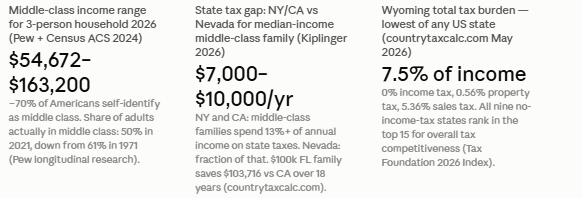
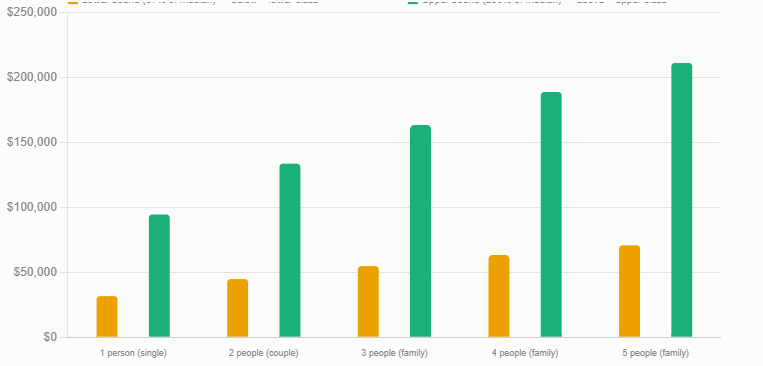
US median household income 2026: $83,730 (Census Bureau 2024 data, released September 2025 — the latest available; CompoundLadder May 2026). Middle-class range for a three-person household: approximately $54,672-$163,200 nationally (Pew Research two-thirds to double formula). About 70% of Americans self-identify as middle class. Nevada median property tax: $2,143/year — ~$1,000 below national average (Kiplinger; Census Bureau). Florida family with $100k income, two kids saves $103,716 over 18 years vs California (countrytaxcalc.com May 2026). New York and California: middle-class families spend more than 13% of annual income on state taxes (Kiplinger 2026). Wyoming total tax burden: 7.5% of personal income — lowest in the US (countrytaxcalc.com May 2026). Share of US adults in middle class: fallen from 61% in 1971 to 50% in 2021 (Pew Research).
Using the Census Bureau's 2024 median household income figure of $83,730 — the latest available in 2026, since the 2025 data does not release until September 2026 — the national Pew middle-class band for a three-person household runs from approximately $54,672 to $163,200. CompoundLadder's May 2026 analysis notes two important practical points about this range: first, it is unusually wide — the upper bound is three times the lower bound — which means a three-person family at $55,000 and a three-person family at $160,000 are both technically middle class by definition but have completely different financial realities. Second, location shifts the band significantly: the effective middle-class range in California (anchored to a higher local median) is different from the range in Mississippi.
The Census Bureau's middle income quintile produces a somewhat tighter range — roughly $60,000 to $95,000 of household income in 2026 — which better captures what most people mean when they say 'middle class.' The Brookings Institution uses the middle three quintiles (the middle 60% of earners, excluding the top 20% and bottom 20%). For this guide, the Pew definition is used as it is the most widely cited in tax analysis and journalism, but any income bracket from approximately $55,000 to $165,000 for a family of three will experience the tax dynamics described here.
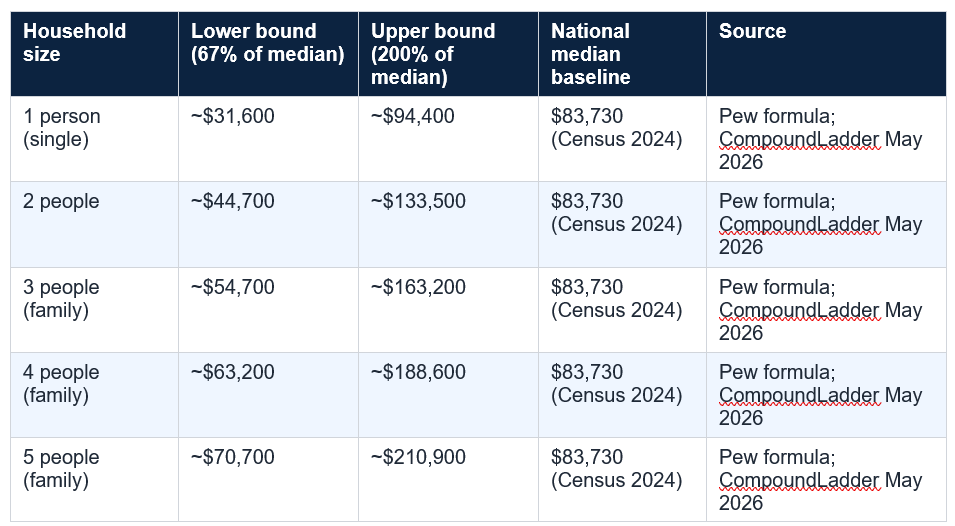
Figures are approximate, based on Pew Research Center's equivalence scale (square root of household size, three-person baseline) applied to Census ACS 2024 median of approximately $81,600-$83,730. Figures rounded. Source: Census Bureau ACS 2024; Pew Research Center methodology; CompoundLadder May 2026. Not financial advice.
Location shifts the middle-class band dramatically. The effective middle-class band in high-cost metropolitan areas can be 30-50% above the national figure. CompoundLadder's May 2026 analysis notes the state median in California is $100,100 versus $59,100 in Mississippi — producing very different middle-class thresholds. A family earning $80,000 is firmly middle class by Mississippi standards, slightly lower-middle by California standards, and practically lower-class by San Francisco Bay Area standards. The definition is national; the experience is local.
Kiplinger's methodology for ranking states by middle-class tax burden covers three main categories: state income tax (calculated against the state's median household income for families with at least one child); property tax (based on the state's median annual property tax bill from Census Bureau data); and sales tax on essential items, specifically groceries, diapers, and gas. This combination captures the taxes that affect middle-class family budgets most directly — the mandatory, recurring costs that cannot be avoided by changing spending habits.
The Tax Foundation's 2026 State Tax Competitiveness Index, published April 3, 2026, adds structural context: all nine no-income-tax states rank in the top 15 states for overall tax competitiveness. Income tax is the largest single component of state tax burden for most working Americans, and its absence shifts the entire burden calculation in a way that property tax and sales tax rarely offset on their own. The pattern is not a coincidence, according to countrytaxcalc.com's May 2026 comprehensive ranking.
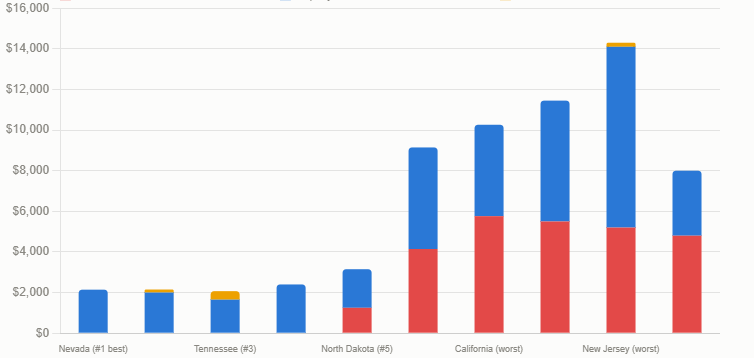
The middle-class income tax gap: what a family earning $100,000 pays in state income tax (approximate 2026 figures). Nevada: $0. Wyoming: $0. Tennessee: $0. Florida: $0. New Hampshire: $0 (fully repealed as of January 1, 2025). North Dakota: approximately $1,000-$1,500 (low flat rates for middle class). Arizona: approximately $1,500-$2,500 (flat 2.5% rate). Ohio: approximately $2,000-$2,500. Virginia: approximately $4,000-$5,000 (5.75% rate). California: approximately $5,000-$6,500 (4.4%-9.3% progressive). New York: approximately $5,500-$7,000 (combined state + city rates can exceed 10%). Illinois: approximately $4,950 (4.95% flat rate). Source: various 2026 state tax guides; Kiplinger; countrytaxcalc.com May 2026. Not tax advice. Individual outcomes depend on deductions, filing status, and specific income composition.
The no-income-tax provision in Nevada is particularly significant because it is constitutionally prohibited — not just a statutory rate that could be changed by a simple legislative vote, but a constitutional bar that requires a supermajority and public referendum to alter. This gives Nevada's zero income tax a structural permanence that some other states' zero-rate policies lack. Among the income types that are fully exempt in Nevada: wages, salary, self-employment income, investment income, capital gains, Social Security benefits, pension income, and IRA or 401(k) distributions, according to Kiplinger's Nevada state tax guide updated July 31, 2026.
On property tax, Nevada's effective rate sits at approximately 0.47% to 0.60% of home value annually — among the lowest 10 states nationally. The median annual property tax bill in Nevada is $2,143, which is approximately $1,000 less than the national average according to Census Bureau data cited by Kiplinger. On the state's median home price of approximately $420,000, that translates to roughly $1,974 per year in property tax at the 0.47% effective rate, per USTaxCalc's 2026 Nevada guide. A 3% annual cap on assessment increases for primary residences provides additional stability.
Nevada's one meaningful tax trade-off for middle-class families is its sales tax. The state sales tax rate is 6.85%, and in Clark County (home to Las Vegas and the largest population centre) the combined rate reaches 8.375% — above the national average of approximately 7%. Critically for middle-class families, however, Nevada does not tax groceries, diapers, or medicine at the state level, which are the essentials that consume a disproportionate share of middle-income budgets. The sales tax burden falls primarily on discretionary spending rather than necessities.
Nevada funds its state government primarily through gaming taxes, which generate a substantial share of state revenue alongside sales taxes and business taxes. This model effectively exports a portion of the tax burden to the state's tens of millions of annual casino visitors, allowing Nevada residents to enjoy comparatively low residential tax burdens. As Nevada Tax Guide 2026 (countrytaxcalc.com) notes: 'Nevada essentially exports its tax burden to tourists and casino visitors, allowing residents to enjoy relatively low tax burdens on income, property, and estates.'
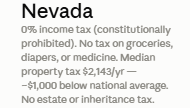
Nevada: #1 most tax-friendly state for middle-class families (Kiplinger 2026; updated June 29, 2026). No income tax (constitutionally prohibited). No tax on groceries, diapers, medicine. No estate or inheritance tax. Median property tax: $2,143/year (~$1,000 below national average; Census Bureau). Effective property tax rate: ~0.47%-0.60%. Property tax assessment capped at 3%/year for primary residences. Sales tax: 6.85% state / 8.375% Clark County (Las Vegas) — higher than average, but essentials exempt. Gaming tax model exports burden to tourists. Best for: middle-class families who want the broadest no-tax profile on income and essentials. Watch out for: Las Vegas cost of living, summer heat, and distance from major Midwest/East Coast family hubs. Source: Kiplinger June 29, 2026; USTaxCalc 2026; countrytaxcalc.com April 2026.
What separates Wyoming from Nevada in Kiplinger's middle-class ranking is a narrower point: Wyoming taxes some essential items, including diapers, while Nevada does not. For middle-class families with young children, this matters — diaper costs are a meaningful recurring expense that is fully exempt from sales tax in Nevada but not in Wyoming. Beyond this distinction, Wyoming's tax profile is arguably the cleanest of any state: no income tax, no estate tax, low property tax, low sales tax, and — unlike Florida and Texas — no high property taxes offsetting the income tax saving.
Wyoming's practical trade-off for middle-class families is quality-of-life and lifestyle rather than financial. The state has a small population, limited urban infrastructure outside of Cheyenne and Casper, harsh winters, and geographic isolation from major economic centres. For families who are comfortable with these trade-offs — particularly those from the Mountain West who already know the lifestyle — Wyoming's tax picture is genuinely exceptional.
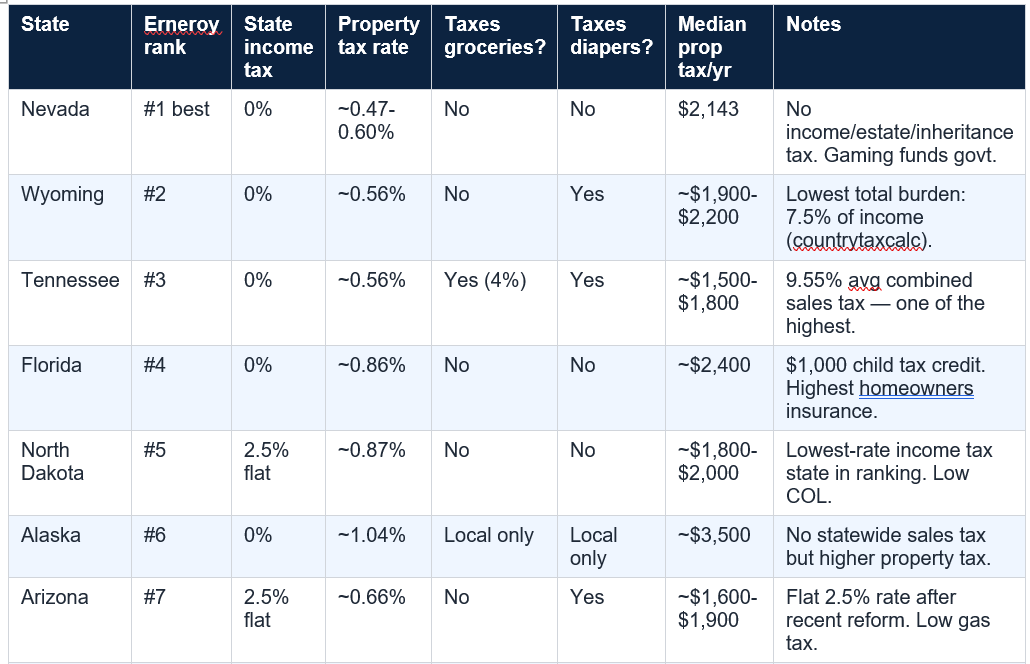
Wyoming: #2 most tax-friendly for middle-class families (Kiplinger 2026); #1 lowest total tax burden at 7.5% of personal income (countrytaxcalc.com May 2026). No income tax; 0.56% property tax; 5.36% sales tax. Taxes diapers (distinction vs Nevada). No estate tax. Best for: middle-class families comfortable with Mountain West lifestyle who want the lowest possible total tax footprint. The financial case is the clearest of any state. Source: Kiplinger June 2026; countrytaxcalc.com May 2026.
Tennessee's effective property tax rate sits at approximately 0.56%, essentially the same as Wyoming's and well below the national average. Nashville's healthcare infrastructure (anchored by Vanderbilt University Medical Center and numerous other major systems), growing employment base, and cultural amenities make it one of the most liveable major cities in the no-income-tax group. Knoxville and Chattanooga offer smaller, lower-cost alternatives with similar tax advantages.
Tennessee's tax trade-offs are concentrated in two areas. First, the state taxes diapers — relevant for families with young children. Second, Tennessee is one of the ten states that still taxes groceries at the state level (at a reduced 4% rate on food), which adds to the effective tax burden on middle-class family budgets compared to Nevada or Wyoming. Third, Tennessee's combined state and local sales tax averages 9.55% — among the highest in the country — which partially offsets the income tax saving for families that spend heavily on taxable goods.
Tennessee: #3 most tax-friendly for middle-class families (Kiplinger 2026). No income tax (Hall Tax fully repealed 2021). Property tax ~0.56%. Taxes groceries (4% reduced rate) and diapers. Sales tax 9.55% avg combined — among highest nationally. Best for: middle-class families who want no income tax plus a warm climate, growing city infrastructure, and Southern lifestyle at below-national-average cost of living. The grocery and diaper tax and high sales tax are the price of the otherwise excellent tax profile. Source: Kiplinger June 2026; countrytaxcalc.com May 2026.
The Florida financial case for a middle-class family of four earning $100,000 with two children is stark: $0 in state income tax versus $5,762 in California for the same income. Countrytaxcalc.com's analysis calculates that over 18 years — the typical childhood period — the $5,762 annual difference compounds to $103,716, which is their estimate of the cost of funding two 529 college savings accounts. That is not a marginal difference; it is a college education.
Florida's specific trade-offs for middle-class families are important to understand before relocating. Homeowners insurance in Florida runs $5,500 to $11,000 per year for $300,000 in coverage — the highest in the country — reflecting hurricane exposure and litigation history. Electricity bills run approximately 50% above the national average. For middle-income families moving from moderate-tax states that already have low income tax, the Florida insurance and utility premium can absorb or exceed the income tax saving, as analysed in the previous blog post in this series on retiring to low-tax states. The most compelling Florida case is for families moving from California, New York, or Illinois where the income tax saving is large enough to clearly exceed the insurance and utility costs.
Florida: #4 most tax-friendly overall for middle-class families (Kiplinger 2026); #1 best for families with children by school quality + tax burden + family credits (countrytaxcalc.com May 2026). 0% income tax. $1,000 child tax credit. 0.86% property tax. B+ public schools avg. Warm climate year-round. But: homeowners insurance $5,500-$11,000/year, electricity 50% above national avg. Best for: families relocating from California, New York, or Illinois where income tax saving clearly exceeds hidden costs. Source: Kiplinger June 2026; countrytaxcalc.com May 2026.
Alaska ranks sixth, with no income tax and no statewide sales tax — a combination that sounds like an obvious winner. The offsetting factor is Alaska's effective property tax rate, which at approximately 1.04% is higher than Nevada, Wyoming, Tennessee, or Florida. Local tax jurisdictions in Alaska may also tax groceries and diapers in ways the state itself does not, reducing the apparent advantage. Alaska's practical trade-offs — climate, geographic isolation, and cost of goods (which are elevated by transportation costs to the remote state) — also factor into the real cost-of-living calculation beyond tax rates.
Arizona ranks seventh with a state income tax (now a flat 2.5% rate following major reforms in recent years), no state tax on groceries, and relatively low property taxes. The state's low gas tax and warm climate make it attractive for cost-of-living reasons beyond the direct tax burden, and the Phoenix and Tucson metropolitan areas offer genuine urban infrastructure at costs well below California or New York. Arizona is the best-performing state with an income tax in Kiplinger's top ten, reflecting the interaction of low flat-rate income tax with other favourable characteristics.
South Dakota rounds out the top eight with no income tax but a significant caveat: the state taxes both groceries and diapers, essential items that Kiplinger's methodology specifically weights in its middle-class comparison. Property taxes are also not particularly low relative to the no-income-tax comparison group. The net result is a state with a strong income tax advantage but a less compelling overall picture for middle-class families with children who spend heavily on taxable essentials.
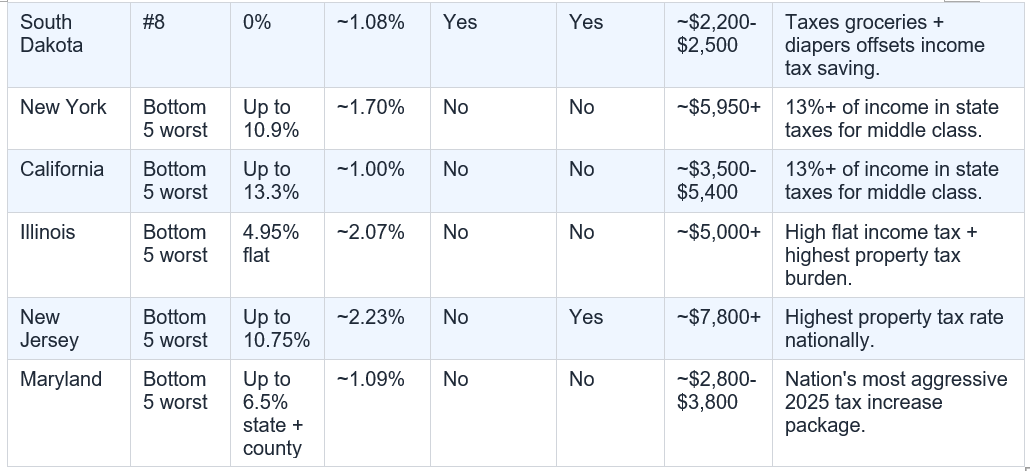
At a household income of $83,730 (the national median), 13% of annual income in state taxes equals $10,885 per year. In Nevada, the equivalent figure is a fraction of that. The gap between the best and worst states for a median-income family is roughly $7,000 to $10,000 per year in state tax burden — real money that could fund retirement contributions, college savings, debt repayment, or simply provide financial breathing room.
Maryland stands out in the 2026 data as a specific warning for middle-class families. The Tax Foundation's 2026 State Tax Competitiveness Index, published April 3, 2026, notes that Maryland adopted the nation's most aggressive package of tax increases in 2025, adding two additional tax brackets on high earners, raising the top marginal individual income tax rate to 6.5%, while also increasing the cap on county income tax rates to 3.3%. Combined county and state income tax rates in some Maryland counties can now reach 9.8% — approaching the rates that have long defined New York and California as worst-in-class for middle-income families. Illinois, meanwhile, combines a 4.95% flat income tax on all earners (with no exemption for the middle class) with some of the highest property taxes in the Midwest.
The worst-state combination for middle-class families in 2026 is a state with a high progressive income tax, high property taxes, and a high cost of living that amplifies both. New York City area residents paying state income tax up to 10.9% plus city income tax up to 3.876% plus federal income tax can see combined marginal rates exceeding 50% for upper-middle-income earners. New Jersey's combination of income tax up to 10.75% and the highest property tax rate in the country (2.23% effective rate) means a middle-class family in a $400,000 home pays approximately $8,920 per year in property tax before any income tax. Source: Kiplinger; Tax Foundation 2026 State Tax Competitiveness Index April 2026. Not tax advice.
Food prices have risen more than 18% since 2022, according to CBS News data. Middle-class families that spend $12,000 per year on groceries are spending $2,160 more per year on the same basket of goods than they did four years ago. Healthcare costs continue to outpace overall inflation. Housing affordability has deteriorated significantly in high-demand states and cities. The Pew Research Center's longitudinal data, compiled by GovFacts in their June 2026 analysis, shows that the share of American adults living in middle-income households has fallen from 61% in 1971 to 50% in 2021 — a five-decade squeeze that shows no sign of reversing.
Against this backdrop, state tax burden is one of the few major financial variables that a middle-class family can actually control through a choice — in this case, the choice of where to live. It requires no change in income, no investment expertise, no timing of financial markets. Moving from California to Nevada on a $100,000 household income produces an immediate, permanent, and predictable $5,762 annual saving in state income tax alone. Adding the property tax differential and the grocery tax exemption makes the total saving larger. Over a decade, the compounding effect of that annual saving into savings, investment, or debt reduction is substantial.
This does not mean relocation is the right decision for every middle-class family. Career opportunities, family proximity, school quality, climate preferences, and lifestyle factors all legitimately outweigh tax considerations for many families. The point is that the tax variable is real, it is large, and it is worth understanding clearly when making any major location decision.
For middle-class families evaluating their state tax burden in 2026: use the Kiplinger state-by-state tax comparison tool and the Pew Research Center's middle-class income calculator to establish your baseline. Compare your current state's total burden (income + property + sales tax on essentials as a percentage of your household income) against the top five states in Section 9's comparison table. Quantify the annual saving and multiply by 10 or 20 to understand the long-term financial impact. Then weigh that number against the non-financial factors that matter to your family. The answer will be different for every household — but making the calculation explicitly, rather than implicitly, usually produces a clearer decision. Not tax or relocation advice. Consult a qualified tax adviser before any relocation decision.
Wyoming offers an arguably even lower total tax burden by percentage of income (7.5%, the lowest in the US) and the same no-income-tax foundation with slightly lower sales taxes but slightly less complete essential item exemptions. Tennessee provides the best lifestyle balance of the no-income-tax group for families who want urban amenities, warm climate, and lower cost of living alongside the tax benefit. Florida is the strongest choice specifically for families with school-age children, combining zero income tax with strong public schools and family-specific credits.
On the other side of the ledger, New York and California — where middle-class families spend more than 13% of annual income on state taxes — represent the steepest burden. Maryland's 2025 tax increase package has moved it into that tier. Illinois and New Jersey combine income tax with property taxes that push the total burden well above the national median.
The middle-class share of American households has been shrinking for five decades. The forces compressing middle-class finances — food inflation, healthcare costs, housing affordability, student debt — are real and largely beyond individual control. The state you live in is not. Geography is not the only financial lever available to middle-class families, but it is one of the most powerful ones that requires no financial expertise to understand and no investment market to navigate. The numbers are public. The comparison is straightforward. And for many families, the savings are large enough to matter.
Nevada is Kiplinger's #1 most tax-friendly state for middle-class families in 2026, based on the combination of no personal income tax (constitutionally prohibited), no state tax on groceries, diapers, or medicine, and a median annual property tax bill of $2,143 — approximately $1,000 below the national average, according to US Census Bureau data. Nevada also has no estate tax and no inheritance tax. The one trade-off is its sales tax rate: 6.85% at the state level and 8.375% in Clark County (Las Vegas), which is above the national average, though essential items are exempt. Wyoming ranks second in Kiplinger's middle-class tax-friendliness ranking with the lowest total tax burden of any state at 7.5% of personal income (countrytaxcalc.com May 2026). Tennessee ranks third, followed by Florida (particularly strong for families with children) and North Dakota (the strongest performer among income-taxing states). Source: Kiplinger June 29, 2026; countrytaxcalc.com May 2026. Not tax advice.
Am I middle class in 2026? What is the income range?
The most widely used definition, from the Pew Research Center, places the middle class at two-thirds to double the national median household income, adjusted for household size. Using the Census Bureau's 2024 median household income of $83,730 (the latest available in 2026), that produces an approximate national middle-class range of $54,672 to $163,200 for a three-person household in 2026 (CompoundLadder May 2026). For a two-person household the range is approximately $44,700 to $133,500; for a four-person family approximately $63,200 to $188,600. About 70% of Americans self-identify as middle class, though many technically fall outside the Pew band. The Census Bureau's middle income quintile produces a tighter range of roughly $60,000 to $95,000 per household. Location significantly shifts the effective band: California's higher state median means its local middle-class range starts and ends higher than Mississippi's. Source: Pew Research Center; Census Bureau ACS 2024; CompoundLadder May 8, 2026.
How much more do middle-class families pay in state taxes in New York or California vs Nevada?
Significantly more. Kiplinger's 2026 analysis reports that middle-class families in New York and California spend more than 13% of their annual income on state taxes. At the national median income of $83,730, 13% equals approximately $10,885 per year in state taxes. In Nevada, a middle-class family pays $0 in state income tax, approximately $2,143 in property tax, and sales tax on non-essential purchases but not on groceries, diapers, or medicine. The total state tax burden for a median Nevada family is a fraction of the New York or California burden. The gap between the best and worst states for a median-income family is roughly $7,000 to $10,000 per year — real money that over a decade represents $70,000 to $100,000 in after-tax income that could have been saved, invested, or used to pay down debt. Source: Kiplinger June 29, 2026. Not tax advice. Individual outcomes depend on income, property value, and spending patterns.
Is Florida or Nevada better for middle-class families with children?
For middle-class families specifically with school-age children, Florida has a strong argument: zero income tax, a $1,000 state child tax credit, public schools averaging a B+ rating nationally, year-round warm climate, and a lower effective property tax rate than many comparable states (approximately 0.86%). Countrytaxcalc.com's May 2026 family-specific ranking places Florida #1 for families balancing tax burden with school quality and family tax credits. Nevada ranks #1 for overall middle-class tax burden but lacks Florida's specific child tax credit and generally has lower-rated public schools than Florida. The practical distinction: if school quality is the primary non-tax factor, Florida wins for families with children. If minimising every category of state tax is the goal, Nevada's profile is more complete (no income tax, no grocery or diaper tax, lower property tax than Florida). Both states have the same income tax (zero) and no estate or inheritance tax. Source: Kiplinger June 2026; countrytaxcalc.com May 2026. Not tax or relocation advice.
What changed about state taxes in 2026 that middle-class families should know?
Several significant changes are worth knowing. Maryland adopted the nation's most aggressive tax increase package in 2025, adding two additional income tax brackets, raising the top marginal rate to 6.5% state plus county income tax up to 3.3% — making Maryland meaningfully more expensive for upper-middle-income families than it was a year ago (Tax Foundation 2026 State Tax Competitiveness Index April 2026). New Hampshire completed its final step in becoming a genuine no-income-tax state: as of January 1, 2025, the state's limited tax on interest and dividend income (which had been 3% in 2024) was fully repealed, bringing New Hampshire to 0% income tax alongside the other eight no-income-tax states (ConsumerAffairs February 2026). Several states including Georgia, Idaho, Louisiana, Nebraska, and Utah lowered individual income tax rates, improving their tax competitiveness rankings (Tax Foundation 2026 Index). The One Big Beautiful Bill Act (OBBBA), signed July 4, 2025, made the federal TCJA individual income tax brackets permanent, keeping the top federal rate at 37% rather than reverting to 39.6% — not a state tax change, but it sets the federal baseline on which state taxes layer.
Table of Contents
- The Tax Gap Nobody Talks About
- Are You Actually Middle Class? The 2026 Definition by Household Size
- Why State Taxes Matter More Than Most Middle-Class Families Realise
- #1 Nevada: The Most Tax-Friendly State for Middle-Class Families
- #2 Wyoming: The Cleanest Tax Picture of Any State
- #3 Tennessee: No Income Tax, Low Property Tax, Warm Climate
- #4 Florida: Best for Families with Children
- States #5-#8: North Dakota, Alaska, Arizona, South Dakota
- The Full 10-State Comparison Table
- The Worst States for Middle-Class Families: What 13% of Income Looks Like
- Beyond the Income Tax: The Four Taxes That Determine the Real Burden
- The Middle-Class Squeeze: Why This Matters More in 2026
- Conclusion: Geography Is One of the Most Powerful Tax Tools You Have
- Frequently Asked Questions
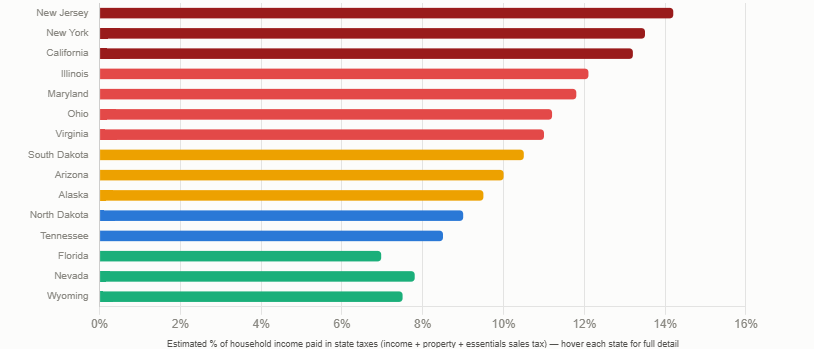
State rankings: total tax burden for middle-class families
Best vs worst: what 13% of income in state taxes looks like
Am I middle class? Income bands by household size 2026
The Tax Gap Nobody Talks About
Two families. Both earning $100,000 per year. Both with two children. Both calling themselves solidly middle class. One lives in Nevada. One lives in California. The Nevada family pays $0 in state income tax. The California family pays approximately $5,762 in state income tax at the same income level. Over 18 years raising those children, that $5,762 annual difference compounds to $103,716 — enough, according to countrytaxcalc.com's May 2026 analysis, to fund two 529 college education accounts. The families made no different investment decisions. They earned the same income. The only variable was the state they chose to live in.This is the tax gap that most middle-class families never fully account for when thinking about their finances. Income tax, property tax, sales tax on groceries and essential items — these are all levers that vary enormously by state, and middle-class families feel the difference more acutely than any other income group. High earners can afford professional tax planning that partially offsets the burden. Low-income households qualify for assistance programmes that cushion state-level tax costs. Middle-class families, by definition, are in neither category. They pay what the state charges, in full, every year.
Kiplinger's 2026 ranking of the most tax-friendly states for middle-class families — updated June 29, 2026 — names Nevada as the top state, based on a methodology that combines state income tax, property tax, and sales tax on essential items (groceries, diapers, and gas) as a percentage of the state's median household income. This guide explains the ranking, profiles each top state in detail, and provides the full 10-state comparison that lets you understand exactly what your family might save by living somewhere different. Not tax or relocation advice — individual outcomes depend on income, household composition, housing costs, and many other factors. Always consult a qualified tax adviser.
US median household income 2026: $83,730 (Census Bureau 2024 data, released September 2025 — the latest available; CompoundLadder May 2026). Middle-class range for a three-person household: approximately $54,672-$163,200 nationally (Pew Research two-thirds to double formula). About 70% of Americans self-identify as middle class. Nevada median property tax: $2,143/year — ~$1,000 below national average (Kiplinger; Census Bureau). Florida family with $100k income, two kids saves $103,716 over 18 years vs California (countrytaxcalc.com May 2026). New York and California: middle-class families spend more than 13% of annual income on state taxes (Kiplinger 2026). Wyoming total tax burden: 7.5% of personal income — lowest in the US (countrytaxcalc.com May 2026). Share of US adults in middle class: fallen from 61% in 1971 to 50% in 2021 (Pew Research).
Are You Actually Middle Class? The 2026 Definition by Household Size
The term 'middle class' is used loosely in American culture — surveys consistently show that about 70% of Americans self-identify as middle class, including many who fall in the bottom or top 20% by income, according to calcinum.com's May 2026 analysis. The most rigorous and widely cited definition comes from the Pew Research Center, which sets the middle-class band at two-thirds to double the national median household income, adjusted for household size.Using the Census Bureau's 2024 median household income figure of $83,730 — the latest available in 2026, since the 2025 data does not release until September 2026 — the national Pew middle-class band for a three-person household runs from approximately $54,672 to $163,200. CompoundLadder's May 2026 analysis notes two important practical points about this range: first, it is unusually wide — the upper bound is three times the lower bound — which means a three-person family at $55,000 and a three-person family at $160,000 are both technically middle class by definition but have completely different financial realities. Second, location shifts the band significantly: the effective middle-class range in California (anchored to a higher local median) is different from the range in Mississippi.
The Census Bureau's middle income quintile produces a somewhat tighter range — roughly $60,000 to $95,000 of household income in 2026 — which better captures what most people mean when they say 'middle class.' The Brookings Institution uses the middle three quintiles (the middle 60% of earners, excluding the top 20% and bottom 20%). For this guide, the Pew definition is used as it is the most widely cited in tax analysis and journalism, but any income bracket from approximately $55,000 to $165,000 for a family of three will experience the tax dynamics described here.
Figures are approximate, based on Pew Research Center's equivalence scale (square root of household size, three-person baseline) applied to Census ACS 2024 median of approximately $81,600-$83,730. Figures rounded. Source: Census Bureau ACS 2024; Pew Research Center methodology; CompoundLadder May 2026. Not financial advice.
Location shifts the middle-class band dramatically. The effective middle-class band in high-cost metropolitan areas can be 30-50% above the national figure. CompoundLadder's May 2026 analysis notes the state median in California is $100,100 versus $59,100 in Mississippi — producing very different middle-class thresholds. A family earning $80,000 is firmly middle class by Mississippi standards, slightly lower-middle by California standards, and practically lower-class by San Francisco Bay Area standards. The definition is national; the experience is local.
Why State Taxes Matter More Than Most Middle-Class Families Realise
Federal income tax gets most of the attention in conversations about the American tax burden. But for middle-class families, state taxes — income tax, property tax, and sales taxes on essentials — represent a second, largely overlooked layer of taxation that varies by as much as $10,000 to $15,000 per year between the best and worst states at the same income level.Kiplinger's methodology for ranking states by middle-class tax burden covers three main categories: state income tax (calculated against the state's median household income for families with at least one child); property tax (based on the state's median annual property tax bill from Census Bureau data); and sales tax on essential items, specifically groceries, diapers, and gas. This combination captures the taxes that affect middle-class family budgets most directly — the mandatory, recurring costs that cannot be avoided by changing spending habits.
The Tax Foundation's 2026 State Tax Competitiveness Index, published April 3, 2026, adds structural context: all nine no-income-tax states rank in the top 15 states for overall tax competitiveness. Income tax is the largest single component of state tax burden for most working Americans, and its absence shifts the entire burden calculation in a way that property tax and sales tax rarely offset on their own. The pattern is not a coincidence, according to countrytaxcalc.com's May 2026 comprehensive ranking.
The middle-class income tax gap: what a family earning $100,000 pays in state income tax (approximate 2026 figures). Nevada: $0. Wyoming: $0. Tennessee: $0. Florida: $0. New Hampshire: $0 (fully repealed as of January 1, 2025). North Dakota: approximately $1,000-$1,500 (low flat rates for middle class). Arizona: approximately $1,500-$2,500 (flat 2.5% rate). Ohio: approximately $2,000-$2,500. Virginia: approximately $4,000-$5,000 (5.75% rate). California: approximately $5,000-$6,500 (4.4%-9.3% progressive). New York: approximately $5,500-$7,000 (combined state + city rates can exceed 10%). Illinois: approximately $4,950 (4.95% flat rate). Source: various 2026 state tax guides; Kiplinger; countrytaxcalc.com May 2026. Not tax advice. Individual outcomes depend on deductions, filing status, and specific income composition.
#1 Nevada: The Most Tax-Friendly State for Middle-Class Families
Nevada holds Kiplinger's top spot for middle-class families in 2026 for a specific combination of reasons that no other state fully replicates: no personal income tax, no tax on groceries, no tax on diapers, no tax on medicine, no estate tax, no inheritance tax, and a median property tax bill approximately $1,000 below the national average. Each of these matters individually. Together, they produce the lowest effective state tax burden for a median-income family of any state in the country by Kiplinger's methodology.The no-income-tax provision in Nevada is particularly significant because it is constitutionally prohibited — not just a statutory rate that could be changed by a simple legislative vote, but a constitutional bar that requires a supermajority and public referendum to alter. This gives Nevada's zero income tax a structural permanence that some other states' zero-rate policies lack. Among the income types that are fully exempt in Nevada: wages, salary, self-employment income, investment income, capital gains, Social Security benefits, pension income, and IRA or 401(k) distributions, according to Kiplinger's Nevada state tax guide updated July 31, 2026.
On property tax, Nevada's effective rate sits at approximately 0.47% to 0.60% of home value annually — among the lowest 10 states nationally. The median annual property tax bill in Nevada is $2,143, which is approximately $1,000 less than the national average according to Census Bureau data cited by Kiplinger. On the state's median home price of approximately $420,000, that translates to roughly $1,974 per year in property tax at the 0.47% effective rate, per USTaxCalc's 2026 Nevada guide. A 3% annual cap on assessment increases for primary residences provides additional stability.
Nevada's one meaningful tax trade-off for middle-class families is its sales tax. The state sales tax rate is 6.85%, and in Clark County (home to Las Vegas and the largest population centre) the combined rate reaches 8.375% — above the national average of approximately 7%. Critically for middle-class families, however, Nevada does not tax groceries, diapers, or medicine at the state level, which are the essentials that consume a disproportionate share of middle-income budgets. The sales tax burden falls primarily on discretionary spending rather than necessities.
Nevada funds its state government primarily through gaming taxes, which generate a substantial share of state revenue alongside sales taxes and business taxes. This model effectively exports a portion of the tax burden to the state's tens of millions of annual casino visitors, allowing Nevada residents to enjoy comparatively low residential tax burdens. As Nevada Tax Guide 2026 (countrytaxcalc.com) notes: 'Nevada essentially exports its tax burden to tourists and casino visitors, allowing residents to enjoy relatively low tax burdens on income, property, and estates.'
Nevada: #1 most tax-friendly state for middle-class families (Kiplinger 2026; updated June 29, 2026). No income tax (constitutionally prohibited). No tax on groceries, diapers, medicine. No estate or inheritance tax. Median property tax: $2,143/year (~$1,000 below national average; Census Bureau). Effective property tax rate: ~0.47%-0.60%. Property tax assessment capped at 3%/year for primary residences. Sales tax: 6.85% state / 8.375% Clark County (Las Vegas) — higher than average, but essentials exempt. Gaming tax model exports burden to tourists. Best for: middle-class families who want the broadest no-tax profile on income and essentials. Watch out for: Las Vegas cost of living, summer heat, and distance from major Midwest/East Coast family hubs. Source: Kiplinger June 29, 2026; USTaxCalc 2026; countrytaxcalc.com April 2026.
#2 Wyoming: The Cleanest Tax Picture of Any State
Wyoming ranks second in Kiplinger's middle-class tax-friendliness ranking and first in the countrytaxcalc.com overall tax burden ranking, with a total tax burden of just 7.5% of personal income — the lowest of any state by that measure. Like Nevada, Wyoming has no personal income tax. Its effective property tax rate is approximately 0.56% — the 11th lowest nationally. Its state sales tax is 5.36%, the lowest of any state that levies a general sales tax, according to countrytaxcalc.com's May 2026 comprehensive ranking.What separates Wyoming from Nevada in Kiplinger's middle-class ranking is a narrower point: Wyoming taxes some essential items, including diapers, while Nevada does not. For middle-class families with young children, this matters — diaper costs are a meaningful recurring expense that is fully exempt from sales tax in Nevada but not in Wyoming. Beyond this distinction, Wyoming's tax profile is arguably the cleanest of any state: no income tax, no estate tax, low property tax, low sales tax, and — unlike Florida and Texas — no high property taxes offsetting the income tax saving.
Wyoming's practical trade-off for middle-class families is quality-of-life and lifestyle rather than financial. The state has a small population, limited urban infrastructure outside of Cheyenne and Casper, harsh winters, and geographic isolation from major economic centres. For families who are comfortable with these trade-offs — particularly those from the Mountain West who already know the lifestyle — Wyoming's tax picture is genuinely exceptional.
Wyoming: #2 most tax-friendly for middle-class families (Kiplinger 2026); #1 lowest total tax burden at 7.5% of personal income (countrytaxcalc.com May 2026). No income tax; 0.56% property tax; 5.36% sales tax. Taxes diapers (distinction vs Nevada). No estate tax. Best for: middle-class families comfortable with Mountain West lifestyle who want the lowest possible total tax footprint. The financial case is the clearest of any state. Source: Kiplinger June 2026; countrytaxcalc.com May 2026.
#3 Tennessee: No Income Tax, Low Property Tax, Warm Climate
Tennessee ranks third in Kiplinger's middle-class tax-friendliness ranking and offers a distinctive combination: no personal income tax (following New Hampshire's full repeal, Tennessee has been a no-income-tax state since eliminating the Hall Tax on investment income in 2021), low property taxes, and a warm Southern climate with a cost of living below the national average. For middle-class families from the Northeast or California who want the financial benefits of a no-income-tax state with more accessible lifestyle infrastructure than Wyoming, Tennessee has become one of the most compelling destinations.Tennessee's effective property tax rate sits at approximately 0.56%, essentially the same as Wyoming's and well below the national average. Nashville's healthcare infrastructure (anchored by Vanderbilt University Medical Center and numerous other major systems), growing employment base, and cultural amenities make it one of the most liveable major cities in the no-income-tax group. Knoxville and Chattanooga offer smaller, lower-cost alternatives with similar tax advantages.
Tennessee's tax trade-offs are concentrated in two areas. First, the state taxes diapers — relevant for families with young children. Second, Tennessee is one of the ten states that still taxes groceries at the state level (at a reduced 4% rate on food), which adds to the effective tax burden on middle-class family budgets compared to Nevada or Wyoming. Third, Tennessee's combined state and local sales tax averages 9.55% — among the highest in the country — which partially offsets the income tax saving for families that spend heavily on taxable goods.
Tennessee: #3 most tax-friendly for middle-class families (Kiplinger 2026). No income tax (Hall Tax fully repealed 2021). Property tax ~0.56%. Taxes groceries (4% reduced rate) and diapers. Sales tax 9.55% avg combined — among highest nationally. Best for: middle-class families who want no income tax plus a warm climate, growing city infrastructure, and Southern lifestyle at below-national-average cost of living. The grocery and diaper tax and high sales tax are the price of the otherwise excellent tax profile. Source: Kiplinger June 2026; countrytaxcalc.com May 2026.
#4 Florida: Best for Families with Children
Florida ranks fourth in Kiplinger's overall middle-class tax-friendliness ranking but first specifically for families with children in countrytaxcalc.com's May 2026 analysis that weighted school quality, family tax credits, and cost of living alongside the tax burden. The combination of zero state income tax, a $1,000 state child tax credit, low property taxes at approximately 0.86% effective rate, strong public schools averaging a B+ rating nationally, and year-round warm climate makes Florida particularly compelling for families in the child-raising years.The Florida financial case for a middle-class family of four earning $100,000 with two children is stark: $0 in state income tax versus $5,762 in California for the same income. Countrytaxcalc.com's analysis calculates that over 18 years — the typical childhood period — the $5,762 annual difference compounds to $103,716, which is their estimate of the cost of funding two 529 college savings accounts. That is not a marginal difference; it is a college education.
Florida's specific trade-offs for middle-class families are important to understand before relocating. Homeowners insurance in Florida runs $5,500 to $11,000 per year for $300,000 in coverage — the highest in the country — reflecting hurricane exposure and litigation history. Electricity bills run approximately 50% above the national average. For middle-income families moving from moderate-tax states that already have low income tax, the Florida insurance and utility premium can absorb or exceed the income tax saving, as analysed in the previous blog post in this series on retiring to low-tax states. The most compelling Florida case is for families moving from California, New York, or Illinois where the income tax saving is large enough to clearly exceed the insurance and utility costs.
Florida: #4 most tax-friendly overall for middle-class families (Kiplinger 2026); #1 best for families with children by school quality + tax burden + family credits (countrytaxcalc.com May 2026). 0% income tax. $1,000 child tax credit. 0.86% property tax. B+ public schools avg. Warm climate year-round. But: homeowners insurance $5,500-$11,000/year, electricity 50% above national avg. Best for: families relocating from California, New York, or Illinois where income tax saving clearly exceeds hidden costs. Source: Kiplinger June 2026; countrytaxcalc.com May 2026.
States #5-#8: North Dakota, Alaska, Arizona, South Dakota
North Dakota ranks fifth in Kiplinger's middle-class ranking despite having a personal income tax. The key distinction is that North Dakota's income tax rates for middle-class households are among the lowest of any state that levies income tax — a flat 2.5% rate phased in following recent reforms — making the effective burden on a $75,000 to $100,000 income very low. Combined with low property taxes and a cost of living significantly below the national average, North Dakota represents the strongest case among income-taxing states for middle-class families.Alaska ranks sixth, with no income tax and no statewide sales tax — a combination that sounds like an obvious winner. The offsetting factor is Alaska's effective property tax rate, which at approximately 1.04% is higher than Nevada, Wyoming, Tennessee, or Florida. Local tax jurisdictions in Alaska may also tax groceries and diapers in ways the state itself does not, reducing the apparent advantage. Alaska's practical trade-offs — climate, geographic isolation, and cost of goods (which are elevated by transportation costs to the remote state) — also factor into the real cost-of-living calculation beyond tax rates.
Arizona ranks seventh with a state income tax (now a flat 2.5% rate following major reforms in recent years), no state tax on groceries, and relatively low property taxes. The state's low gas tax and warm climate make it attractive for cost-of-living reasons beyond the direct tax burden, and the Phoenix and Tucson metropolitan areas offer genuine urban infrastructure at costs well below California or New York. Arizona is the best-performing state with an income tax in Kiplinger's top ten, reflecting the interaction of low flat-rate income tax with other favourable characteristics.
South Dakota rounds out the top eight with no income tax but a significant caveat: the state taxes both groceries and diapers, essential items that Kiplinger's methodology specifically weights in its middle-class comparison. Property taxes are also not particularly low relative to the no-income-tax comparison group. The net result is a state with a strong income tax advantage but a less compelling overall picture for middle-class families with children who spend heavily on taxable essentials.
The Full 10-State Comparison Table
The following table summarises the key tax dimensions for the top and bottom states for middle-class families in 2026, using Kiplinger's methodology supplemented by 2026 data from Tax Foundation, countrytaxcalc.com, and Census Bureau sources. Not tax advice. Individual outcomes depend on income, property value, household composition, and spending patterns. Consult a qualified tax adviser.
The Worst States for Middle-Class Families: What 13% of Income Looks Like
The contrast between the top and bottom states in Kiplinger's 2026 ranking illustrates the scale of the tax burden difference that middle-class families face depending on where they live. In New York and California, Kiplinger reports that middle-class families spend more than 13% of their annual income on state taxes — a combination of income tax, property tax, and sales taxes on essentials.At a household income of $83,730 (the national median), 13% of annual income in state taxes equals $10,885 per year. In Nevada, the equivalent figure is a fraction of that. The gap between the best and worst states for a median-income family is roughly $7,000 to $10,000 per year in state tax burden — real money that could fund retirement contributions, college savings, debt repayment, or simply provide financial breathing room.
Maryland stands out in the 2026 data as a specific warning for middle-class families. The Tax Foundation's 2026 State Tax Competitiveness Index, published April 3, 2026, notes that Maryland adopted the nation's most aggressive package of tax increases in 2025, adding two additional tax brackets on high earners, raising the top marginal individual income tax rate to 6.5%, while also increasing the cap on county income tax rates to 3.3%. Combined county and state income tax rates in some Maryland counties can now reach 9.8% — approaching the rates that have long defined New York and California as worst-in-class for middle-income families. Illinois, meanwhile, combines a 4.95% flat income tax on all earners (with no exemption for the middle class) with some of the highest property taxes in the Midwest.
The worst-state combination for middle-class families in 2026 is a state with a high progressive income tax, high property taxes, and a high cost of living that amplifies both. New York City area residents paying state income tax up to 10.9% plus city income tax up to 3.876% plus federal income tax can see combined marginal rates exceeding 50% for upper-middle-income earners. New Jersey's combination of income tax up to 10.75% and the highest property tax rate in the country (2.23% effective rate) means a middle-class family in a $400,000 home pays approximately $8,920 per year in property tax before any income tax. Source: Kiplinger; Tax Foundation 2026 State Tax Competitiveness Index April 2026. Not tax advice.
Beyond the Income Tax: The Four Taxes That Determine the Real Burden
Income tax is the most visible component of state tax burden, but for middle-class families the full picture requires understanding four tax categories and how they interact.- State income tax: the most straightforward component. Nine states have none. Of those that do, rates range from Arizona's flat 2.5% to California's progressive 13.3% at the top. For a middle-class family earning $80,000 to $120,000, this single item can mean the difference between paying $0 and paying $6,000+ in annual state taxes depending on location. It is also the most controllable through state residency choice.
- Property tax: the tax that does not scale with income. It scales with the value of your home. A family with a $400,000 home in New Jersey pays approximately $8,920 per year (at 2.23% effective rate). The same home in Nevada costs approximately $1,880 per year (at 0.47%). The $7,040 annual difference is larger than most middle-class families' state income tax bill in moderate-tax states. Critically, property tax continues whether you have earned income or not — making it particularly burdensome for families during a period of unemployment, early retirement, or income disruption.
- Sales tax on essentials: Kiplinger's methodology specifically tracks taxes on groceries, diapers, and gas because these are unavoidable expenditures for middle-class families with children. 38 states exempt groceries from the general sales tax. 12 still tax them. For a family spending $10,000 per year on groceries in a state with a 4% food sales tax rate, that is $400 per year in additional tax burden that a family in a non-taxing state does not pay. The cumulative effect across groceries, diapers, and gasoline over a decade of family life is significant.
- Implicit taxes through cost of living: not technically a tax, but effective in the same way. High-cost states produce a higher-cost lifestyle that requires higher income to maintain the same standard of living. The Bureau of Economic Analysis Regional Price Parity index quantifies this: Florida scores approximately 103 (slightly above national average), California scores approximately 113, and New York City area scores approximately 120. A middle-class income stretches further in Tennessee or Wyoming than in California or New York — magnifying the tax savings with a cost-of-living dividend.
The Middle-Class Squeeze: Why This Matters More in 2026
The state tax burden question is more consequential for middle-class families in 2026 than at perhaps any point in recent history. Several forces are compressing middle-class finances simultaneously, making the state tax variable a more significant component of household financial health.Food prices have risen more than 18% since 2022, according to CBS News data. Middle-class families that spend $12,000 per year on groceries are spending $2,160 more per year on the same basket of goods than they did four years ago. Healthcare costs continue to outpace overall inflation. Housing affordability has deteriorated significantly in high-demand states and cities. The Pew Research Center's longitudinal data, compiled by GovFacts in their June 2026 analysis, shows that the share of American adults living in middle-income households has fallen from 61% in 1971 to 50% in 2021 — a five-decade squeeze that shows no sign of reversing.
Against this backdrop, state tax burden is one of the few major financial variables that a middle-class family can actually control through a choice — in this case, the choice of where to live. It requires no change in income, no investment expertise, no timing of financial markets. Moving from California to Nevada on a $100,000 household income produces an immediate, permanent, and predictable $5,762 annual saving in state income tax alone. Adding the property tax differential and the grocery tax exemption makes the total saving larger. Over a decade, the compounding effect of that annual saving into savings, investment, or debt reduction is substantial.
This does not mean relocation is the right decision for every middle-class family. Career opportunities, family proximity, school quality, climate preferences, and lifestyle factors all legitimately outweigh tax considerations for many families. The point is that the tax variable is real, it is large, and it is worth understanding clearly when making any major location decision.
For middle-class families evaluating their state tax burden in 2026: use the Kiplinger state-by-state tax comparison tool and the Pew Research Center's middle-class income calculator to establish your baseline. Compare your current state's total burden (income + property + sales tax on essentials as a percentage of your household income) against the top five states in Section 9's comparison table. Quantify the annual saving and multiply by 10 or 20 to understand the long-term financial impact. Then weigh that number against the non-financial factors that matter to your family. The answer will be different for every household — but making the calculation explicitly, rather than implicitly, usually produces a clearer decision. Not tax or relocation advice. Consult a qualified tax adviser before any relocation decision.
Conclusion
The most tax-friendly state for middle-class families in 2026 is Nevada, according to Kiplinger's comprehensive annual ranking. No income tax. No tax on groceries, diapers, or medicine. A median property tax bill $1,000 below the national average. No estate tax. No inheritance tax. A constitutional prohibition on income tax that provides structural permanence. For the quintessential middle-class family of three or four earning $75,000 to $125,000, Nevada's tax profile is as complete a package as exists in any state.Wyoming offers an arguably even lower total tax burden by percentage of income (7.5%, the lowest in the US) and the same no-income-tax foundation with slightly lower sales taxes but slightly less complete essential item exemptions. Tennessee provides the best lifestyle balance of the no-income-tax group for families who want urban amenities, warm climate, and lower cost of living alongside the tax benefit. Florida is the strongest choice specifically for families with school-age children, combining zero income tax with strong public schools and family-specific credits.
On the other side of the ledger, New York and California — where middle-class families spend more than 13% of annual income on state taxes — represent the steepest burden. Maryland's 2025 tax increase package has moved it into that tier. Illinois and New Jersey combine income tax with property taxes that push the total burden well above the national median.
The middle-class share of American households has been shrinking for five decades. The forces compressing middle-class finances — food inflation, healthcare costs, housing affordability, student debt — are real and largely beyond individual control. The state you live in is not. Geography is not the only financial lever available to middle-class families, but it is one of the most powerful ones that requires no financial expertise to understand and no investment market to navigate. The numbers are public. The comparison is straightforward. And for many families, the savings are large enough to matter.
Frequently Asked Questions
What is the most tax-friendly state for middle-class families in 2026?Nevada is Kiplinger's #1 most tax-friendly state for middle-class families in 2026, based on the combination of no personal income tax (constitutionally prohibited), no state tax on groceries, diapers, or medicine, and a median annual property tax bill of $2,143 — approximately $1,000 below the national average, according to US Census Bureau data. Nevada also has no estate tax and no inheritance tax. The one trade-off is its sales tax rate: 6.85% at the state level and 8.375% in Clark County (Las Vegas), which is above the national average, though essential items are exempt. Wyoming ranks second in Kiplinger's middle-class tax-friendliness ranking with the lowest total tax burden of any state at 7.5% of personal income (countrytaxcalc.com May 2026). Tennessee ranks third, followed by Florida (particularly strong for families with children) and North Dakota (the strongest performer among income-taxing states). Source: Kiplinger June 29, 2026; countrytaxcalc.com May 2026. Not tax advice.
Am I middle class in 2026? What is the income range?
The most widely used definition, from the Pew Research Center, places the middle class at two-thirds to double the national median household income, adjusted for household size. Using the Census Bureau's 2024 median household income of $83,730 (the latest available in 2026), that produces an approximate national middle-class range of $54,672 to $163,200 for a three-person household in 2026 (CompoundLadder May 2026). For a two-person household the range is approximately $44,700 to $133,500; for a four-person family approximately $63,200 to $188,600. About 70% of Americans self-identify as middle class, though many technically fall outside the Pew band. The Census Bureau's middle income quintile produces a tighter range of roughly $60,000 to $95,000 per household. Location significantly shifts the effective band: California's higher state median means its local middle-class range starts and ends higher than Mississippi's. Source: Pew Research Center; Census Bureau ACS 2024; CompoundLadder May 8, 2026.
How much more do middle-class families pay in state taxes in New York or California vs Nevada?
Significantly more. Kiplinger's 2026 analysis reports that middle-class families in New York and California spend more than 13% of their annual income on state taxes. At the national median income of $83,730, 13% equals approximately $10,885 per year in state taxes. In Nevada, a middle-class family pays $0 in state income tax, approximately $2,143 in property tax, and sales tax on non-essential purchases but not on groceries, diapers, or medicine. The total state tax burden for a median Nevada family is a fraction of the New York or California burden. The gap between the best and worst states for a median-income family is roughly $7,000 to $10,000 per year — real money that over a decade represents $70,000 to $100,000 in after-tax income that could have been saved, invested, or used to pay down debt. Source: Kiplinger June 29, 2026. Not tax advice. Individual outcomes depend on income, property value, and spending patterns.
Is Florida or Nevada better for middle-class families with children?
For middle-class families specifically with school-age children, Florida has a strong argument: zero income tax, a $1,000 state child tax credit, public schools averaging a B+ rating nationally, year-round warm climate, and a lower effective property tax rate than many comparable states (approximately 0.86%). Countrytaxcalc.com's May 2026 family-specific ranking places Florida #1 for families balancing tax burden with school quality and family tax credits. Nevada ranks #1 for overall middle-class tax burden but lacks Florida's specific child tax credit and generally has lower-rated public schools than Florida. The practical distinction: if school quality is the primary non-tax factor, Florida wins for families with children. If minimising every category of state tax is the goal, Nevada's profile is more complete (no income tax, no grocery or diaper tax, lower property tax than Florida). Both states have the same income tax (zero) and no estate or inheritance tax. Source: Kiplinger June 2026; countrytaxcalc.com May 2026. Not tax or relocation advice.
What changed about state taxes in 2026 that middle-class families should know?
Several significant changes are worth knowing. Maryland adopted the nation's most aggressive tax increase package in 2025, adding two additional income tax brackets, raising the top marginal rate to 6.5% state plus county income tax up to 3.3% — making Maryland meaningfully more expensive for upper-middle-income families than it was a year ago (Tax Foundation 2026 State Tax Competitiveness Index April 2026). New Hampshire completed its final step in becoming a genuine no-income-tax state: as of January 1, 2025, the state's limited tax on interest and dividend income (which had been 3% in 2024) was fully repealed, bringing New Hampshire to 0% income tax alongside the other eight no-income-tax states (ConsumerAffairs February 2026). Several states including Georgia, Idaho, Louisiana, Nebraska, and Utah lowered individual income tax rates, improving their tax competitiveness rankings (Tax Foundation 2026 Index). The One Big Beautiful Bill Act (OBBBA), signed July 4, 2025, made the federal TCJA individual income tax brackets permanent, keeping the top federal rate at 37% rather than reverting to 39.6% — not a state tax change, but it sets the federal baseline on which state taxes layer.

0 Comments Comments