

Making Money
Passive Income and the New American Dream: The Real Data

Table of Contents
- The Scale of the Trend: Secondary Income in 2026
- Why This Trend Is Accelerating: Wages, Inflation, and Job Security
- The Passive Income Myth vs the Reality
- Who Is Actually Earning What: The Real Income Distribution
- The Hidden Costs: Burnout, Risk, and Time
- What Genuinely Works: Building Realistic Secondary Income
- Conclusion
- Frequently Asked Questions (FAQ)
- Is passive income really replacing traditional jobs for most Americans?
- External References & Further Reading
Scroll through social media for more than a few minutes and you'll encounter the pitch: quit your 9-to-5, build a passive income stream, and earn money while you sleep. The promise of passive income — rent collected without effort, royalties that roll in automatically, dividends that grow your wealth while you do literally anything else — has become one of the defining financial aspirations of the 2020s, increasingly described as the new American Dream in place of the traditional career ladder.
The reality, according to the most current national survey data, is both less dramatic and more genuinely interesting than the 'forget work' headline suggests. Seventy-two percent of American workers now rely on at least one secondary source of income, according to a February 2026 report from MyPerfectResume — but only a small fraction of that group describes their secondary income as genuinely passive. The median side hustler earns just $200 a month. Most people who pursue investment income, rental income, or content-based royalties still describe meaningful, ongoing effort behind the scenes.
This is not a story about passive income failing to deliver. It is a story about what passive income actually is, how it actually performs for typical earners versus the best-case examples used to market it, and how to think about building genuine supplemental income streams without falling for the most common myths. The data, drawn from national surveys conducted through early 2026, paints a picture of an America increasingly dependent on income beyond the traditional paycheck — but one where 'passive' rarely means truly effortless.
The Scale of the Trend: Secondary Income in 2026
The numbers behind the rise of secondary and supplemental income in America are genuinely striking. The table below summarises the most current data: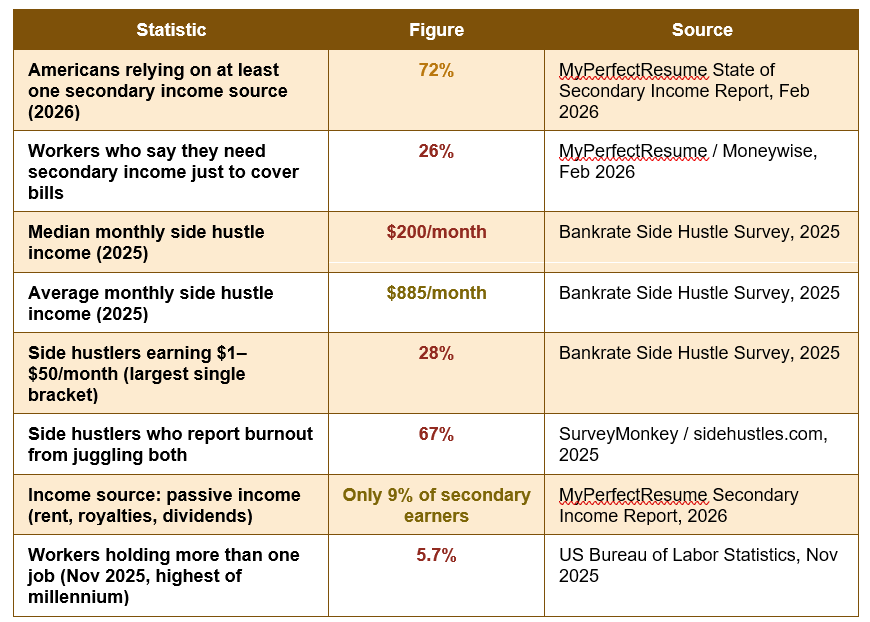
Americans relying on secondary income: 72% in 2026, up from 71% in 2025 — what began, by the survey's own framing, as a short-term pandemic-era response to inflation has become, in the words of one career expert, 'woven into the fabric of American work' (MyPerfectResume, Feb 2026)
- A crucial distinction the headlines often miss: of the workers reporting a secondary income source, the most common categories are freelance or gig work (14%) and investment income (14%), followed by side businesses (9%) and passive income such as rent or royalties (9%) specifically. In other words, genuinely passive income — the kind requiring no ongoing labour — represents only a modest slice of how Americans actually generate secondary income, even as the broader 'secondary income' trend has become close to universal.
Why This Trend Is Accelerating: Wages, Inflation, and Job Security
The growth in secondary income dependence is not primarily a story about ambition or entrepreneurial culture — it is substantially a story about purchasing power. Research cited by MyPerfectResume found that average worker pay rose 18% between 2020 and 2024, while inflation over the same period rose 21%, meaning the typical American worker has measurably less purchasing power today than five years ago, even accounting for nominal wage growth.This erosion in real income helps explain why 26% of workers with a secondary income say they need it simply to cover basic living expenses, not to fund luxuries or accelerate savings goals. As career expert Jasmine Escalera put it, describing the shift: 'You think of people who are just trying to pay rent, to pay for food. This isn't about luxury. This is about necessity.' The framing of passive and secondary income as an aspirational lifestyle choice sits uneasily alongside the reality that, for more than a quarter of those pursuing it, it is functioning as a survival strategy rather than a path to early retirement.
At the same time, it would be inaccurate to describe the trend purely in terms of financial distress. Fifty-two percent of workers with secondary income say it makes them feel more secure, and 68% say it has never interfered with their ambition or performance at their primary job. A meaningful share of the secondary income population — particularly younger workers — describes the behaviour as much in terms of resilience and hedging against uncertainty as outright necessity.
The Passive Income Myth vs the Reality
The marketing language around passive income — build it once, earn forever, money while you sleep — creates expectations that rarely survive contact with how these income streams actually function in practice. The table below sets out the most common claims against what the data and reporting actually show: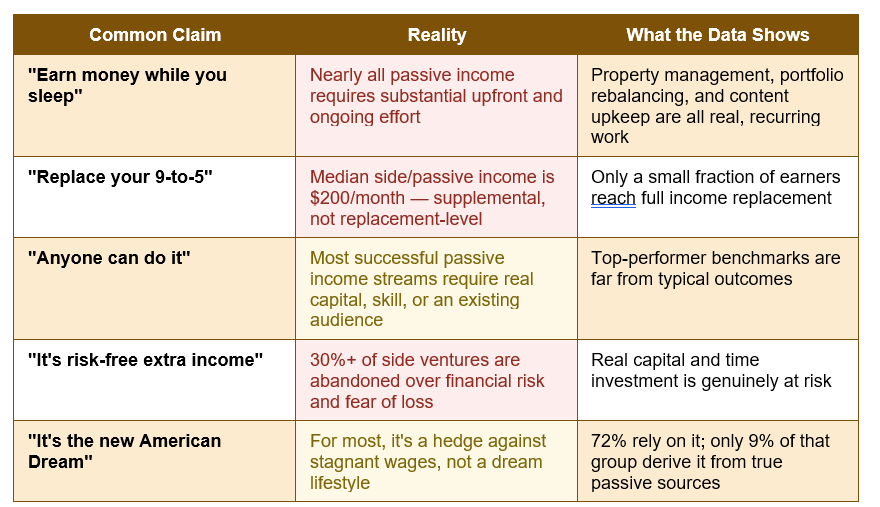
Financial commentators covering this trend have been increasingly explicit on this point. As one Moneywise analysis put it directly: 'If you're depending on passive income or even investments to boost your income, you'll probably discover that they're not truly passive, as most require substantial upfront and ongoing work.' Setting up a successful investment portfolio requires research, monitoring, and periodic rebalancing. Rental property requires acquisition effort, ongoing maintenance, and often direct tenant management — work that is real, recurring, and sometimes substantial, even if it is less hourly-intensive than a traditional job.
Who Is Actually Earning What: The Real Income Distribution
Perhaps the most important corrective to the 'forget work' narrative is the genuine distribution of side and passive income earnings, which is far more skewed than the success stories typically highlighted in passive income marketing content suggest.Bankrate's 2025 Side Hustle Survey found that the single largest earnings bracket — 28% of all side hustlers — earns between just $1 and $50 per month. The median side hustler earns $200 a month, while the average ($885 a month) is pulled significantly higher by a comparatively small group of top earners, a classic statistical pattern in which the average meaningfully overstates the typical experience. Generationally, millennials earn the most on average from side hustles ($1,129 a month), followed by Gen Z ($958), Gen X ($751), and baby boomers ($561) — though even these averages are skewed upward by high performers within each generational group.
Gap between average and median side hustle income: $885 vs $200/month — the average is more than four times the median, meaning a relatively small number of high earners are pulling the headline 'average' figure well above what most people pursuing secondary income actually experience (Bankrate Side Hustle Survey, 2025)
This statistical pattern — a small number of standout performers generating most of the attention and most of the marketing case studies, while the typical participant earns a modest supplemental amount — is one of the most consistent and least discussed features of the passive and side income economy. Content creators, course sellers, and affiliate marketers prominently featured in 'passive income success story' content are, almost by definition, drawn from the high-earning tail of the distribution, not the median experience.
The Hidden Costs: Burnout, Risk, and Time
Beyond the gap between typical and headline earnings, the pursuit of secondary and passive income carries real costs that are frequently underweighted in popular discussion of the trend. Sixty-seven percent of side hustlers report that their additional work leads to burnout, and 52% say the extra workload is only worth it if they earn more than $500 a week — a bar that, per the earnings data above, a clear majority of side hustlers do not clear.Separately, MyPerfectResume's 2026 survey found that sustaining a secondary income has led to a decline in health for 21% of respondents, less time for family and hobbies for 20%, and increased burnout for 15% — though encouragingly, 28% describe their current secondary income workload as 'very sustainable,' suggesting outcomes vary considerably depending on how the secondary income is structured and how much time it actually demands.
- The financial risk dimension matters too: roughly 30% of Americans who start a side hustle or small business abandon it specifically due to financial risk, with over half of that group citing fear of financial loss or debt. About one in four aspiring entrepreneurs cite insufficient financial resources as their main barrier, and a third admit they lack the funds even to get started — a meaningful counterpoint to any framing of passive income pursuits as low-risk or universally accessible.
What Genuinely Works: Building Realistic Secondary Income
None of this means pursuing secondary or passive income is unwise — the data simply argues for realistic expectations and a clear-eyed strategy rather than the 'forget work entirely' framing. The following principles, drawn from how successful secondary earners actually approach the challenge, provide a more grounded starting point:- Distinguish between active side income and genuinely passive income from the outset: Freelance work, gig driving, and content creation are valuable supplemental income sources, but they are forms of active work, not passive income, and should be evaluated on an hourly-return basis like any other job. Genuinely passive sources — dividend income, REIT distributions, royalties from already-published work — typically require significant upfront capital or a body of work built over time before they generate meaningful returns.
- Start with a specific, modest financial goal rather than a vague 'replace my income' ambition: The data shows that the large majority of secondary earners are working toward specific, bounded goals — saving for something specific, covering a particular bill, building an emergency fund — rather than full income replacement. Calibrating your own expectations to this more typical, achievable outcome reduces the risk of discouragement and burnout.
- Treat the median, not the average or the marketed success story, as your realistic baseline: If you are evaluating whether to pursue a specific passive or side income idea, research the median outcome for that specific activity where available, recognising that the prominently marketed success stories are, by their nature, drawn from a small and unrepresentative high-earning tail.
- Calculate the genuine time cost, including maintenance, before assuming any income stream is passive: Rental property, investment portfolios, and content businesses all carry ongoing time and attention requirements. Building this honestly into your expectations from the outset prevents the common experience of burnout that 67% of side hustlers report.
- Recognise when a side income is genuinely accumulating toward financial security versus simply substituting for inadequate primary income: There is an important difference between using secondary income deliberately to accelerate specific goals (48% of side hustlers report this motivation) and relying on it simply to survive month to month (44% report this). The first is a strategy; the second is a symptom of a deeper income adequacy problem that a side hustle alone may not solve.
Conclusion
Passive income has not replaced work in America — but secondary income, in its many active and only occasionally passive forms, has become an almost universal feature of how working Americans manage their finances. Seventy-two percent of workers now rely on some form of income beyond their primary job, a dramatic and rapid normalisation of behaviour that, just a few years ago, would have been considered unusual outside of specific entrepreneurial or investing circles.What the data makes clear is that the popular 'forget work, earn passively' framing significantly oversells both the passivity and the typical scale of these income streams. The median side hustler earns $200 a month, not the life-changing sums showcased in much of the content promoting passive income strategies. Most of what Americans call secondary income is, in practice, additional active work — freelancing, gig driving, content creation — layered on top of an already full-time job, with genuinely passive income from investments, rent, or royalties representing a comparatively small share of the overall trend.
None of this means the underlying instinct is wrong. Building diversified income streams, whether through disciplined investing, a well-chosen side business, or genuinely passive assets accumulated over years, remains one of the soundest long-term financial strategies available. The corrective the data offers is not to abandon the pursuit of secondary income, but to pursue it with realistic expectations: understanding the genuine time commitment involved, calibrating your financial goals to the median rather than the marketed success story, and recognising that for most people, secondary income is best understood as a meaningful supplement and a hedge against uncertainty — not, yet, a replacement for work itself.
Frequently Asked Questions (FAQ)
Is passive income really replacing traditional jobs for most Americans?
No. While 72% of American workers report relying on some form of secondary income, the large majority of this is active work — freelancing, gig work, side businesses — rather than genuinely passive income. Even among those with passive sources such as rental income or dividends, this typically supplements rather than replaces primary employment income. The median secondary earner makes around $200 a month, far below what would be needed to replace a typical full-time salary.What counts as genuinely 'passive' income versus a side hustle?
Genuinely passive income generally requires little to no ongoing time input once established — dividend payments from an investment portfolio, royalties from a book or song already created, or rental income from a professionally managed property are common examples. A side hustle, by contrast, requires ongoing active effort proportional to the income generated — freelance work, gig driving, content creation, or running a small business all fall into this category, even though they are frequently marketed using the language of passive income.Why is the average side hustle income so much higher than the median?
This is a statistical pattern caused by a relatively small number of very high earners pulling the average upward, while the typical (median) participant earns considerably less. Bankrate's 2025 data shows an average of $885 a month against a median of just $200 a month — meaning half of all side hustlers earn less than $200 a month, even though the average figure, often the one quoted in headlines, suggests a much higher typical outcome.Is it worth starting a side hustle or passive income stream given the risk of burnout?
This depends heavily on your specific goals, available time, and financial situation. The data shows real risks — 67% of side hustlers report burnout, and a meaningful share describe negative impacts on health and family time — but also real benefits, including a sense of financial security reported by 52% of secondary earners. The outcomes that tend to work best involve a clear, bounded goal, realistic time budgeting that accounts for the true ongoing effort involved, and an honest assessment of whether the specific income stream you are pursuing is genuinely passive or simply additional active work.What are examples of income sources that are closer to genuinely passive?
Dividend-paying index funds and other diversified investment portfolios are among the closest examples to genuinely passive income, though they still require initial research, ongoing monitoring, and periodic rebalancing. Royalties from previously created intellectual property — books, music, or licensed content — can also become largely passive once the initial creative work is complete, though marketing and occasional updates are often still required to sustain demand. Professionally managed rental property can approach passive income for the owner, though this typically requires either significant upfront capital to hire competent management or considerable initial effort to set up reliable systems.
External References
The following sources informed this article and are recommended for further reading:1. MyPerfectResume — 2026 State of Secondary Income Report
https://www.myperfectresume.com/career-center/careers/secondary-income-sources
2. Moneywise — 72% of US Workers Rely on a Second Income
https://moneywise.com/employment/72-of-us-workers-rely-on-a-second-income-while-26-say-they-need-a-side-job-to-cover-bills
3. Bankrate — Side Hustle Survey 2025: Income, Trends, and Earnings Data
https://www.bankrate.com/loans/small-business/side-hustles-survey/
4. SurveyMonkey — Side Hustle Statistics USA 2025
https://www.surveymonkey.com/curiosity/side-hustle-statistics/
5. US Bureau of Labor Statistics — Multiple Jobholders Data
https://www.bls.gov/cps/multiple-jobholders.htm
6. IndexBox — Secondary Income in 2026: Why 72% of Americans Still Need Side Hustles
https://www.indexbox.io/blog/2026-survey-72-of-americans-rely-on-secondary-income-trend-now-woven-into-work-life/
7. Hostinger — Side Hustle Statistics 2026: Income, Trends & Insights
https://www.hostinger.com/tutorials/side-hustle-statistics
8. Side Hustle Nation — Side Hustle Statistics and Survey Results
https://www.sidehustlenation.com/side-hustle-statistics/
0 Comments
Be the first to share your thoughts on this article.