

Finance
Post-Penny Economy: Rounding & Card Surcharges Explained

On November 12, 2025, the US Mint struck its final penny. The coin that cost 3.69 cents to produce and was worth 1 cent is gone. As pennies fade from circulation, businesses are rounding cash transactions to the nearest nickel. Simultaneously, 48 states now allow merchants to add credit card surcharges of up to 3%. These two quiet shifts — happening simultaneously, at every checkout counter in America — are changing what you actually pay. Here is the full picture.

The second change: credit card surcharges, once a rarity that produced customer outrage when a gas station or restaurant tried to impose one, are now legal in 48 of 50 states and are increasingly common at small merchants. As the CNBC August 26, 2026 report documents, ‘more merchants, the smaller merchants, are imposing surcharges’ — according to Crystal Kaldjob, a partner at Goodwin Procter who works in the law firm’s financial industry group. With US merchants collectively paying an estimated $172 billion in credit card processing fees by end of 2025 — up 20% since 2021 — the pressure to pass those costs to consumers is structural and growing.
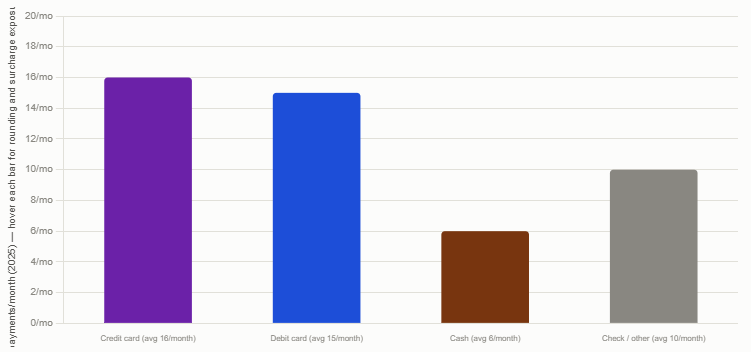
These two shifts are happening simultaneously and reinforcing each other. Cash payments now carry a rounding adjustment; card payments increasingly carry a surcharge. In a consumer economy where the average American made 47 payments per month in 2025 — 16 by credit card, 15 by debit card, and just 6 with cash — the arithmetic adds up across millions of daily transactions. This guide explains both changes in full, including the maths, the rules, and the practical strategies for keeping your costs as low as possible.
US Mint final penny struck: November 12, 2025 (Philadelphia Mint). Treasury final penny blank order: May 2025. Cost to produce a penny: 3.69 cents (2024). Seigniorage loss 2024: $85.3 million (Richmond Fed, July 2025). Estimated rounding tax: ~$6M/year penny alone; up to $56M/year if nickel also eliminated (Richmond Fed EB 25-27). Credit card surcharges legal in 48 states (2026). US merchant card processing fees: $172bn in 2025 (+20% since 2021).
The process of ending penny production involved two steps. In May 2025, the US Treasury placed its final order for penny blanks — the flat metal discs that the US Mint transforms into coins. Following a presidential directive aimed at cutting the mounting costs of coin production, the final penny was struck on November 12, 2025, at the Philadelphia Mint. The New York Times marked the occasion with an obituary: ‘The American penny died on Wednesday in Philadelphia. It was 232.’
Importantly, the end of production does not mean the end of the penny as legal tender. Existing pennies remain legal tender indefinitely. Businesses are not required to accept them, but they can, and individuals can continue to use them. The approximately 114 billion to 250 billion pennies already in circulation will continue to be used until they disappear through loss and attrition. The practical effect is a gradual reduction in penny availability that makes the coin increasingly impractical for everyday use. As pennies become scarcer, businesses that accept cash are left with a pricing problem: what do you do when you cannot make exact change to the penny?
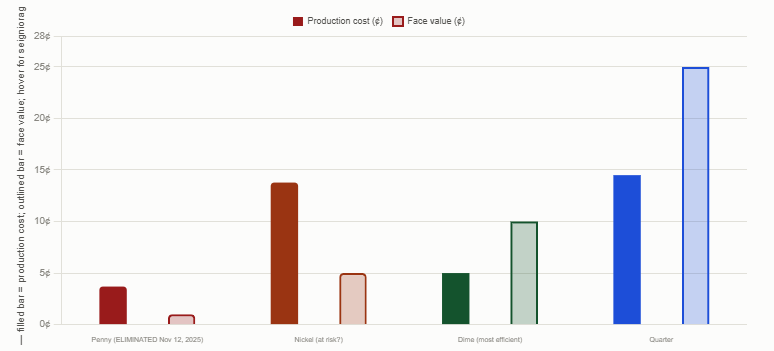
Penny production cost 2024: 3.69 cents per coin (US Mint 2024 Annual Report). Gross cost of pennies produced in 2024: ~$117 million. Face value produced: ~$31.72 million. Seigniorage loss: $85.3 million in 2024. 19 consecutive years more expensive to make than worth. Final penny struck: November 12, 2025, Philadelphia Mint. Pennies in circulation: ~114–250 billion (various estimates; remain legal tender indefinitely). Source: Congress.gov CRS; Richmond Fed EB 25-27; Britannica, July 2026.
The rounding rules:
Note that rounding only applies to the total of a cash transaction, not to individual item prices. Digital prices remain unchanged. Card payments remain unchanged. Only the final total of a cash purchase is rounded, and only when exact change cannot be made.
To avoid the rounding tax entirely: pay with a card (debit or credit) wherever surcharges do not apply, as card transactions are not rounded. Where cash is preferred, try to construct purchases whose totals end in amounts divisible by 5 (or pay with amounts that ensure change in nickels or dimes rather than pennies). In practice, this is difficult to engineer consistently, which is why the Richmond Fed characterises the rounding effect as a 'rounding tax' — it is small, not easily avoidable for habitual cash users, and systematically disadvantages those who rely on cash.
The neutral case: if prices are set independently of the rounding system, and consumers make many purchases whose totals are distributed randomly across the 1–4 cent range, then rounding up and rounding down are equally likely. Over many transactions, the rounding gains and losses cancel. This is the experience of Canada, Australia, Sweden, and other countries that have eliminated their lowest-denomination coin.
The non-neutral case: if merchants systematically set prices at amounts that disproportionately round up, the consumer pays more. For example, a price of $X.98 or $X.99 (after tax) rounds up to the next nickel. Historically, psychological pricing — setting prices at $X.99 to create the impression of a price below a round number — has been one of the most common retail pricing strategies. After tax, a $9.99 item in a jurisdiction with 6.25% sales tax produces a total of $10.61 — which rounds up to $10.65. A $4.99 item at 6% tax produces $5.29 — no rounding needed. The interaction of tax rates with psychological pricing can produce a non-random rounding distribution.
The Richmond Fed study accounts for this by analysing actual transaction data rather than assuming random price distribution. Their $6 million annual estimate is based on observed transaction patterns, not theoretical neutrality. The study is also careful to note that the effect is not uniform: ‘lower-income consumers who rely more heavily on cash may face a disproportionate burden from the rounding tax.’
The 'neutral rounding' claim is approximately correct in aggregate and approximately incorrect for individual consumers who make many small cash transactions in markets with prevalent psychological pricing. For most card-using consumers, the rounding tax is irrelevant — card transactions are not rounded. The policy impact is concentrated among cash users, who in the US tend to be lower-income, unbanked, or privacy-preferring individuals.
The nickel’s production economics are worse than the penny’s on a percentage basis. In 2024, each nickel cost approximately 13.78 cents to produce — a production cost nearly three times the coin’s face value. The annual seigniorage loss on nickel production is approximately $17.7 million. With the penny eliminated, the Treasury expects to ramp up nickel production by 2 to 2.5 million additional coins to meet the demand from rounding, which will increase the nickel’s annual seigniorage loss.
The Richmond Fed’s analysis of what happens if the nickel is also eliminated is stark: if both the penny and the nickel are removed from circulation, the rounding cost to US consumers could reach $56 million per year — nearly ten times the cost of penny-only elimination. This is because the rounding increment would move from the nearest 5 cents to the nearest 10 cents (dime), creating both larger individual rounding adjustments and a greater risk of systematic upward bias.
Nickel production cost per coin: 13.78 cents (2024; face value: 5 cents). Annual nickel seigniorage loss: ~$17.7 million. Treasury expects to increase nickel production by 2–2.5 million additional coins post-penny elimination. If nickel also eliminated: estimated rounding cost jumps from ~$6 million to ~$56 million annually (Richmond Fed EB 25-27). The dime costs less than 6 cents to produce — the most cost-efficient coin. Source: Kiplinger February 2026; Richmond Fed July 2025.
Credit card processing fees are one of the largest operating costs for merchants — and they have been growing. By end of 2025, US merchants collectively paid an estimated $172 billion in credit card processing fees, a figure that has climbed by 20% since 2021 (Strictly Zero, April 2026). Typical merchant processing fees range from 1.5 to 3.5 percent of transaction value, depending on the card type (rewards cards carry the highest interchange fees), the merchant category, and the payment processor. For a small business operating on a 5 to 10 percent profit margin, a 2.5 percent card fee represents 25 to 50 percent of its profit margin on every card transaction.
The legal landscape shifted significantly after a 2013 court ruling that struck down most state surcharge bans as unconstitutional. By April 2023, Visa reduced its maximum allowable surcharge from 4% to 3%, setting the current standard cap. As of 2026, credit card surcharging is legal in 48 states. The CNBC August 26, 2026 report — citing payment behaviour data from the 2026 Diary of Consumer Payment Choice — notes that for the first time in the survey’s history, credit cards overtook debit cards as the most-used payment method: consumers averaged 16 credit card payments, 15 debit card payments, and just 6 cash payments per month in 2025.
The practical result: at any given checkout, consumers may be choosing between a rounded total (if paying cash) and a surcharged total (if paying with a credit card). The question of which is cheaper depends on the specific prices, the rounding outcome, and the surcharge rate.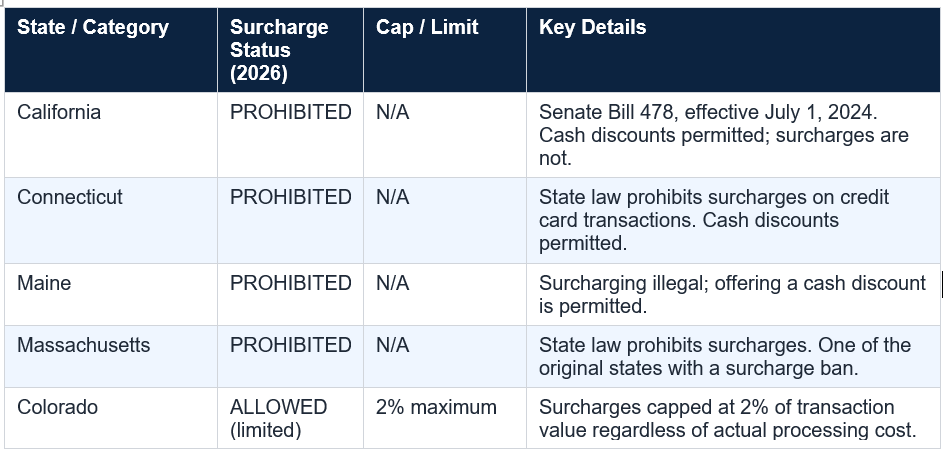

Key universal rules regardless of state: merchants cannot surcharge debit card transactions under any circumstances, even if the customer selects ‘credit’ at the terminal (Durbin Amendment). The surcharge must not exceed the merchant’s actual cost of card acceptance. Merchants must notify Visa or Mastercard at least 30 days before implementing a surcharge programme.
The merchant processing fee system has a notable irony: consumers who earn credit card rewards (points, miles, cashback) are funded by the interchange fees that merchants pay. When a consumer earns 2% cashback on a restaurant purchase, that cashback is effectively subsidised by the restaurant's higher interchange cost — which the restaurant may now pass on as a surcharge. The surcharge trend is, in part, a response to the rewards card system making its funding mechanism visible to merchants for the first time.
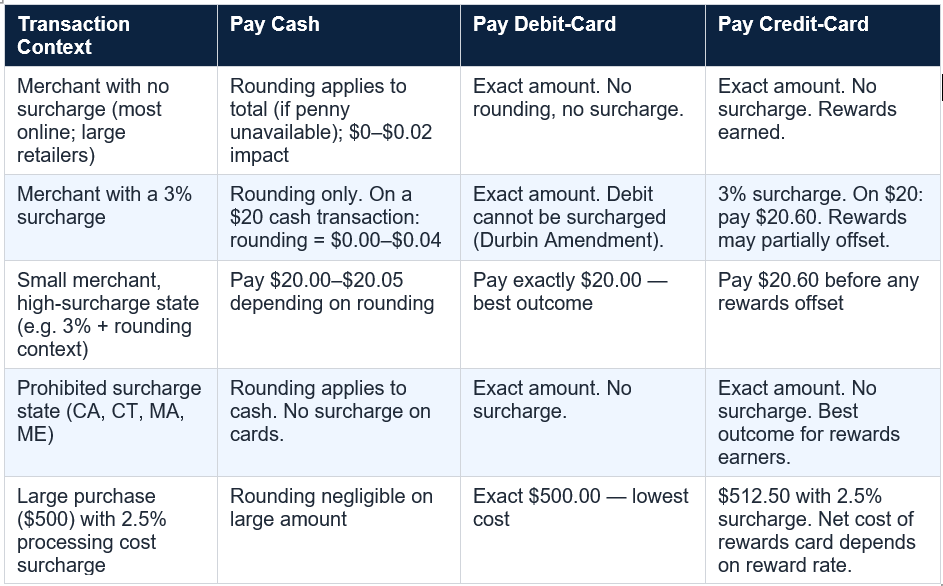
The key insight from this table: debit card payments are the most consistently cost-effective option across most scenarios. Debit cards cannot be surcharged (Durbin Amendment protection), are not subject to rounding, and offer the same exact-amount payment as a credit card without the potential surcharge exposure. The trade-off: no rewards accumulation. For consumers who earn significant rewards on credit cards, the surcharge break-even calculation matters: a 3% surcharge is never offset by a 1% or 1.5% cashback card. Only rewards rates above the surcharge rate produce a net benefit from using a credit card at a surcharging merchant.
Neither change affects every consumer equally. High-income, high-rewards-card users who shop primarily at large retailers and online will experience the post-penny economy as background noise. Lower-income consumers who rely on cash, and small-purchase consumers who frequent local businesses with thin margins, will feel both changes more directly and more frequently.
What the two trends share is a common theme: the invisible cost of how you pay is becoming more visible. The penny’s 3.69-cent production cost was a subsidy that the US government paid for over two decades to maintain a coin whose utility had been hollowed out by inflation and digitisation. The credit card processing fee was a cost that merchants absorbed silently and baked into their prices, subsidising rewards card earners without charging them explicitly. Both systems were unsustainable in their old form. The post-penny economy is the result of those subsidies ending — and the cost being distributed to the moment of purchase, one rounding adjustment and one surcharge at a time.
No. The US Mint struck its final penny on November 12, 2025, and the Treasury placed its final order for penny blanks in May 2025. However, pennies remain legal tender indefinitely. The estimated 114 to 250 billion pennies already in circulation will continue to exist and can be used as long as the holder has them. They will not be recalled or demonetised. What ended is the production of new pennies — the supply being replenished annually by 3+ billion new coins has stopped. As existing pennies disappear through loss, collection, and attrition, their scarcity for making exact change will grow. Businesses are not required to accept them, but they may do so if they choose.
Does rounding apply to card payments?
No. Rounding applies only to cash transactions when exact change cannot be made to the nearest cent. Card payments (credit, debit, or prepaid) are processed electronically for the exact price, and no rounding adjustment applies. This is one of the most practically important distinctions in the post-penny economy: if you pay by card, neither the penny's disappearance nor cash rounding affects what you pay. The only card-related checkout change is the potential for a credit card surcharge at participating merchants.
Is a credit card surcharge legal?
It depends on where you are. As of 2026, credit card surcharges are legal in 48 states and prohibited in California (since July 1, 2024 under Senate Bill 478), Connecticut, Maine, and Massachusetts. Even in states where surcharging is legal, it must comply with card network rules (Visa caps at 3%; Mastercard at 4%), must not exceed the merchant's actual cost of card acceptance, requires advance registration with card networks, and must be clearly disclosed at the point of entry, point of sale, and on the receipt. Debit card surcharges are prohibited in all 50 states under the Durbin Amendment, regardless of whether the customer presses 'credit' or 'debit' at the terminal.
Can I be charged more for using a credit card?
Yes, in most states, if the merchant complies with the disclosure and cap rules described above. The surcharge must be disclosed before you complete the transaction — you should see a notice at the entrance and at the checkout, and the surcharge should appear as a separate line item on your receipt. If you are in California, Connecticut, Maine, or Massachusetts, a credit card surcharge is illegal and you should not be charged one. If you are surcharged in a prohibited state, you can report the merchant to your state's consumer protection office or attorney general's office.
Why do merchants charge a surcharge instead of just raising prices?
Several reasons. First, a surcharge only applies to credit card users — merchants who raise their base price recover the same revenue but also charge it to cash-paying customers who cost them nothing extra in processing fees. A surcharge specifically targets the transaction type that generates the cost. Second, a surcharge makes the cost visible and educational: customers who see a 3% surcharge begin to understand that credit card rewards are not free — they are funded by merchant fees. Third, in the current competitive environment, merchants who surcharge may price their base product lower to attract customers, with the surcharge making the total cost similar to competitors who bake the fee into their price. Fourth, in states where surcharging is permitted and where the discount alternative (reducing the price for cash) requires operational changes to the register system, a surcharge programme implemented through the payment processor is technically simpler.
What is the cheapest way to pay in 2026?
For most consumers in most transactions, the answer is: debit card. Debit card payments cannot be surcharged (Durbin Amendment protection), are not subject to cash rounding, and represent the exact transaction amount with no adjustments. Credit cards earn rewards but may incur surcharges at an increasing number of small merchants — and a 3% surcharge eliminates the benefit of any reward card earning less than 3% back. Cash avoids surcharges but is subject to rounding and faces increasing acceptance issues as merchants' cash handling capacity decreases. The exception: in states where surcharging is prohibited (California, Connecticut, Maine, Massachusetts), credit card rewards are earned at no surcharge cost, making a high-rewards credit card the most financially advantageous payment method.
Table of Contents
- Two Quiet Shifts at the Checkout Counter
- The Death of the Penny: What Actually Happened
- Why Did It Cost 3.69 Cents to Make a 1-Cent Coin?
- The Rounding Tax: What Swedish Rounding Means for Your Wallet
- Is Rounding Up or Down? The Math Behind ‘Neutral’ Rounding
- The Nickel Problem: Will the Next Coin Be Eliminated Too?
- Credit Card Surcharges: The Other Quiet Change at the Register
- The State-by-State Surcharge Map: Where It’s Legal and What’s Capped
- How Much Are Merchants Paying in Processing Fees?
- How Surcharges Must Be Disclosed: The Rules for Merchants
- Cash vs Card: The New Payment Maths
- Strategies to Avoid Both the Rounding Tax and Card Surcharges
- What Businesses Must Know About Surcharge Compliance
- Conclusion: The Post-Penny Economy and What It Costs You
- Frequently Asked Questions
Coin Production Cost vs Face Value: The Case For Abolition
US Payment Methods 2025 & Rounding / Surcharge Impact By Payment Type
Two Quiet Shifts at the Checkout Counter
Something changed at the checkout counter in 2026, and most people did not notice it happening. The first change: the penny disappeared. Not abruptly — there are still an estimated 114 to 250 billion pennies out there, gathering dust in jars and sofa cushions. But on November 12, 2025, the US Mint struck its final penny, and the supply that was once replenished by 3.17 billion new coins per year began draining away. Businesses that deal in cash have quietly started rounding transactions to the nearest nickel.The second change: credit card surcharges, once a rarity that produced customer outrage when a gas station or restaurant tried to impose one, are now legal in 48 of 50 states and are increasingly common at small merchants. As the CNBC August 26, 2026 report documents, ‘more merchants, the smaller merchants, are imposing surcharges’ — according to Crystal Kaldjob, a partner at Goodwin Procter who works in the law firm’s financial industry group. With US merchants collectively paying an estimated $172 billion in credit card processing fees by end of 2025 — up 20% since 2021 — the pressure to pass those costs to consumers is structural and growing.
These two shifts are happening simultaneously and reinforcing each other. Cash payments now carry a rounding adjustment; card payments increasingly carry a surcharge. In a consumer economy where the average American made 47 payments per month in 2025 — 16 by credit card, 15 by debit card, and just 6 with cash — the arithmetic adds up across millions of daily transactions. This guide explains both changes in full, including the maths, the rules, and the practical strategies for keeping your costs as low as possible.
US Mint final penny struck: November 12, 2025 (Philadelphia Mint). Treasury final penny blank order: May 2025. Cost to produce a penny: 3.69 cents (2024). Seigniorage loss 2024: $85.3 million (Richmond Fed, July 2025). Estimated rounding tax: ~$6M/year penny alone; up to $56M/year if nickel also eliminated (Richmond Fed EB 25-27). Credit card surcharges legal in 48 states (2026). US merchant card processing fees: $172bn in 2025 (+20% since 2021).
The Death of the Penny: What Actually Happened
The penny’s death was a policy decision driven by arithmetic. Since 2006 — nineteen consecutive years — it has cost more to produce a penny than the coin is worth. In 2024, the US Mint produced 3,172 million pennies at a production cost of approximately 3.69 cents each, for a total gross cost of approximately $117 million to produce coins with a combined face value of $31.72 million. The Congressional Research Service confirmed this in its June 2025 FAQ: ‘The cost to produce a single penny currently exceeds one cent.’The process of ending penny production involved two steps. In May 2025, the US Treasury placed its final order for penny blanks — the flat metal discs that the US Mint transforms into coins. Following a presidential directive aimed at cutting the mounting costs of coin production, the final penny was struck on November 12, 2025, at the Philadelphia Mint. The New York Times marked the occasion with an obituary: ‘The American penny died on Wednesday in Philadelphia. It was 232.’
Importantly, the end of production does not mean the end of the penny as legal tender. Existing pennies remain legal tender indefinitely. Businesses are not required to accept them, but they can, and individuals can continue to use them. The approximately 114 billion to 250 billion pennies already in circulation will continue to be used until they disappear through loss and attrition. The practical effect is a gradual reduction in penny availability that makes the coin increasingly impractical for everyday use. As pennies become scarcer, businesses that accept cash are left with a pricing problem: what do you do when you cannot make exact change to the penny?
Penny production cost 2024: 3.69 cents per coin (US Mint 2024 Annual Report). Gross cost of pennies produced in 2024: ~$117 million. Face value produced: ~$31.72 million. Seigniorage loss: $85.3 million in 2024. 19 consecutive years more expensive to make than worth. Final penny struck: November 12, 2025, Philadelphia Mint. Pennies in circulation: ~114–250 billion (various estimates; remain legal tender indefinitely). Source: Congress.gov CRS; Richmond Fed EB 25-27; Britannica, July 2026.
Why Did It Cost 3.69 Cents to Make a 1-Cent Coin?
The economics of penny production have been broken for two decades, but the precise reasons are worth understanding — they explain both why it took so long to act and why the decision to stop was ultimately unavoidable.- Material costs: the penny is made of copper-plated zinc. Unlike the nickel (which is a Mint-made blank) and higher-denomination coins, penny blanks are purchased through a federal contract with a private company. The cost of zinc and copper has risen substantially since the penny was redesigned to its current composition in 1982. The penny is not made from a penny’s worth of metal — its material cost alone approaches or exceeds its face value in periods of elevated metal prices.
- Production and distribution: beyond materials, the cost calculation includes manufacturing, equipment, labour, distribution to Federal Reserve banks, and the overhead associated with a facility that produces billions of small coins annually. These fixed and semi-fixed costs spread across a coin worth 1 cent produce an unfavourable unit economics outcome that worsens as the coin’s real purchasing power continues to decline with inflation.
- Handling and friction: the penny imposes costs beyond production. Retailers must handle, count, and deposit pennies. Banks must process and transport them. The US Mint notes that many pennies never circulate effectively at all — they are taken as change, put in a jar, and never returned to circulation. The Leukemia & Lymphoma Society told the New York Times that ‘soliciting donations in the form of roundups and add-ons to credit-card transactions has proved much more lucrative than coin gathering ever did.’
- Comparison: the nickel costs 13.78 cents to produce (face value: 5 cents). The dime costs less than 6 cents and the quarter less than 15 cents — meaning only the penny and the nickel are produced at a loss. The dime, producing the most efficient seigniorage of any coin, is the best-value coin the Mint produces.
The Rounding Tax: What Swedish Rounding Means for Your Wallet
With pennies in short supply and new production stopped, businesses that deal in cash face a practical problem: how do you make change when the smallest coin available is the nickel? The answer, now being adopted by merchants across the US, is a system of rounding that most countries ahead of the US in eliminating low-value coins have already implemented. It is commonly called ‘Swedish rounding’ or ‘cash rounding,’ and the practice is straightforward: cash transaction totals are rounded to the nearest 5 cents (nickel increment).The rounding rules:
- Totals ending in $X.01 or $X.02 round DOWN to $X.00
- Totals ending in $X.03 or $X.04 round UP to $X.05
- Totals ending in $X.06 or $X.07 round DOWN to $X.05
- Totals ending in $X.08 or $X.09 round UP to $X.10
Note that rounding only applies to the total of a cash transaction, not to individual item prices. Digital prices remain unchanged. Card payments remain unchanged. Only the final total of a cash purchase is rounded, and only when exact change cannot be made.
To avoid the rounding tax entirely: pay with a card (debit or credit) wherever surcharges do not apply, as card transactions are not rounded. Where cash is preferred, try to construct purchases whose totals end in amounts divisible by 5 (or pay with amounts that ensure change in nickels or dimes rather than pennies). In practice, this is difficult to engineer consistently, which is why the Richmond Fed characterises the rounding effect as a 'rounding tax' — it is small, not easily avoidable for habitual cash users, and systematically disadvantages those who rely on cash.
Is Rounding Up or Down? The Math Behind ‘Neutral’ Rounding
The claim that Swedish rounding is ‘neutral’ — that consumers gain and lose equally over time — is a theoretical result that holds under specific conditions. Understanding when it holds and when it does not is important for consumers and advocates.The neutral case: if prices are set independently of the rounding system, and consumers make many purchases whose totals are distributed randomly across the 1–4 cent range, then rounding up and rounding down are equally likely. Over many transactions, the rounding gains and losses cancel. This is the experience of Canada, Australia, Sweden, and other countries that have eliminated their lowest-denomination coin.
The non-neutral case: if merchants systematically set prices at amounts that disproportionately round up, the consumer pays more. For example, a price of $X.98 or $X.99 (after tax) rounds up to the next nickel. Historically, psychological pricing — setting prices at $X.99 to create the impression of a price below a round number — has been one of the most common retail pricing strategies. After tax, a $9.99 item in a jurisdiction with 6.25% sales tax produces a total of $10.61 — which rounds up to $10.65. A $4.99 item at 6% tax produces $5.29 — no rounding needed. The interaction of tax rates with psychological pricing can produce a non-random rounding distribution.
The Richmond Fed study accounts for this by analysing actual transaction data rather than assuming random price distribution. Their $6 million annual estimate is based on observed transaction patterns, not theoretical neutrality. The study is also careful to note that the effect is not uniform: ‘lower-income consumers who rely more heavily on cash may face a disproportionate burden from the rounding tax.’
The 'neutral rounding' claim is approximately correct in aggregate and approximately incorrect for individual consumers who make many small cash transactions in markets with prevalent psychological pricing. For most card-using consumers, the rounding tax is irrelevant — card transactions are not rounded. The policy impact is concentrated among cash users, who in the US tend to be lower-income, unbanked, or privacy-preferring individuals.
The Nickel Problem: Will the Next Coin Be Eliminated Too?
The most significant economic ripple effect of the penny’s elimination involves the nickel. Because the penny was the buffer that made ‘rounding to the nearest nickel’ the natural response to penny elimination, the nickel’s own economics now come into sharper focus. The Kiplinger February 2026 analysis poses the question directly: without the penny, is it ‘bye-bye’ to the five-cent piece?The nickel’s production economics are worse than the penny’s on a percentage basis. In 2024, each nickel cost approximately 13.78 cents to produce — a production cost nearly three times the coin’s face value. The annual seigniorage loss on nickel production is approximately $17.7 million. With the penny eliminated, the Treasury expects to ramp up nickel production by 2 to 2.5 million additional coins to meet the demand from rounding, which will increase the nickel’s annual seigniorage loss.
The Richmond Fed’s analysis of what happens if the nickel is also eliminated is stark: if both the penny and the nickel are removed from circulation, the rounding cost to US consumers could reach $56 million per year — nearly ten times the cost of penny-only elimination. This is because the rounding increment would move from the nearest 5 cents to the nearest 10 cents (dime), creating both larger individual rounding adjustments and a greater risk of systematic upward bias.
Nickel production cost per coin: 13.78 cents (2024; face value: 5 cents). Annual nickel seigniorage loss: ~$17.7 million. Treasury expects to increase nickel production by 2–2.5 million additional coins post-penny elimination. If nickel also eliminated: estimated rounding cost jumps from ~$6 million to ~$56 million annually (Richmond Fed EB 25-27). The dime costs less than 6 cents to produce — the most cost-efficient coin. Source: Kiplinger February 2026; Richmond Fed July 2025.
Credit Card Surcharges: The Other Quiet Change at the Register
Simultaneously with the penny’s disappearance, a second pricing shift is occurring at the checkout counter: the proliferation of credit card surcharges. A credit card surcharge is an additional fee that merchants add to the transaction total when a customer pays with a credit card, designed to recover the merchant’s cost of accepting card payments.Credit card processing fees are one of the largest operating costs for merchants — and they have been growing. By end of 2025, US merchants collectively paid an estimated $172 billion in credit card processing fees, a figure that has climbed by 20% since 2021 (Strictly Zero, April 2026). Typical merchant processing fees range from 1.5 to 3.5 percent of transaction value, depending on the card type (rewards cards carry the highest interchange fees), the merchant category, and the payment processor. For a small business operating on a 5 to 10 percent profit margin, a 2.5 percent card fee represents 25 to 50 percent of its profit margin on every card transaction.
The legal landscape shifted significantly after a 2013 court ruling that struck down most state surcharge bans as unconstitutional. By April 2023, Visa reduced its maximum allowable surcharge from 4% to 3%, setting the current standard cap. As of 2026, credit card surcharging is legal in 48 states. The CNBC August 26, 2026 report — citing payment behaviour data from the 2026 Diary of Consumer Payment Choice — notes that for the first time in the survey’s history, credit cards overtook debit cards as the most-used payment method: consumers averaged 16 credit card payments, 15 debit card payments, and just 6 cash payments per month in 2025.
The practical result: at any given checkout, consumers may be choosing between a rounded total (if paying cash) and a surcharged total (if paying with a credit card). The question of which is cheaper depends on the specific prices, the rounding outcome, and the surcharge rate.
The State-by-State Surcharge Map: Where It’s Legal and What’s Capped
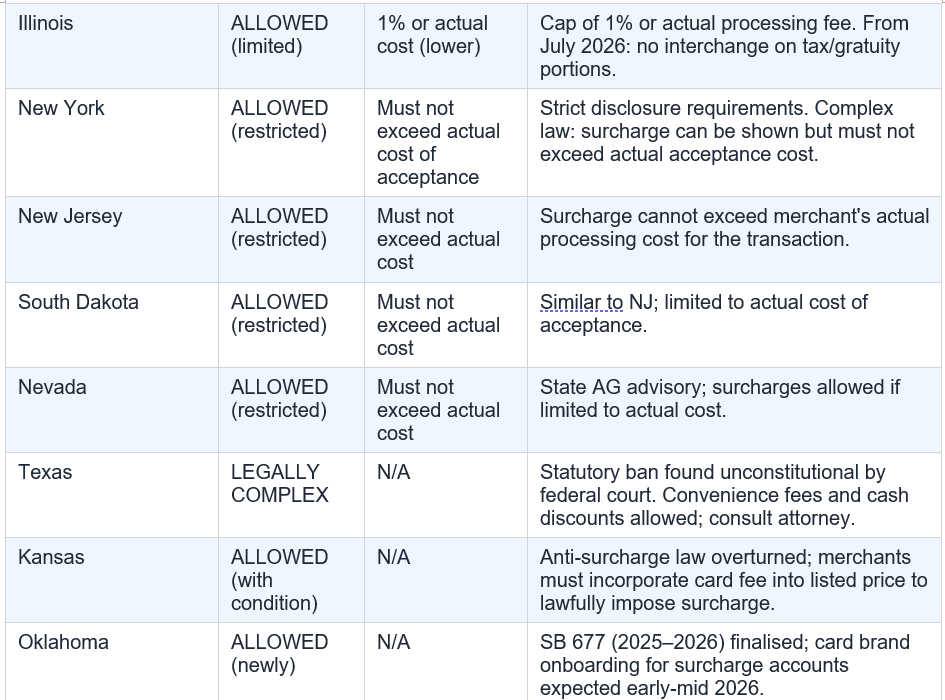
Key universal rules regardless of state: merchants cannot surcharge debit card transactions under any circumstances, even if the customer selects ‘credit’ at the terminal (Durbin Amendment). The surcharge must not exceed the merchant’s actual cost of card acceptance. Merchants must notify Visa or Mastercard at least 30 days before implementing a surcharge programme.
How Much Are Merchants Paying in Processing Fees?
To understand why surcharges are spreading, it helps to understand what merchants are actually paying and why those costs have grown so dramatically. The $172 billion in annual US merchant credit card processing fees breaks down into several components:- Interchange fees: the largest component, paid by the merchant’s bank to the cardholder’s bank. Interchange rates vary by card type — basic debit cards carry the lowest rates (often 0.05% + $0.22 for regulated debit under the Durbin Amendment), while premium rewards cards (the travel and cashback cards that generate points for consumers) carry the highest interchange rates, often 1.5 to 2.5 percent plus a per-transaction fee.
- Assessment fees: paid to the card network (Visa, Mastercard) for use of the network infrastructure. Typically 0.13 to 0.15 percent.
- Payment processor margin: the acquiring bank or processor adds its own margin on top of interchange and assessment fees. This is where rate shopping among payment processors produces the most consumer benefit for merchants.
The merchant processing fee system has a notable irony: consumers who earn credit card rewards (points, miles, cashback) are funded by the interchange fees that merchants pay. When a consumer earns 2% cashback on a restaurant purchase, that cashback is effectively subsidised by the restaurant's higher interchange cost — which the restaurant may now pass on as a surcharge. The surcharge trend is, in part, a response to the rewards card system making its funding mechanism visible to merchants for the first time.
How Surcharges Must Be Disclosed: The Rules for Merchants
Any merchant implementing a credit card surcharge must comply with both card network rules (Visa and Mastercard have independent requirements) and applicable state law. The minimum federal disclosure requirements, applicable across all states where surcharging is permitted, are:- Network notification: merchants must notify their card network (Visa, Mastercard) at least 30 days before implementing a surcharge. This registration creates a formal record and allows the network to ensure compliance.
- Point-of-entry notice: a notice must be posted at the entry point of the business (the door) informing customers that a credit card surcharge applies.
- Point-of-sale notice: the surcharge must be disclosed at the point of sale (the checkout terminal or register) before the transaction is completed. This gives consumers the opportunity to pay by a different method.
- Receipt disclosure: the surcharge must appear as a separate line item on the customer receipt, showing the specific dollar amount or percentage.
- Debit card exception: if a customer swipes a debit card, even selecting ‘credit’ at the terminal, no surcharge may be applied. Modern POS systems are expected to detect card types and suppress surcharges automatically for debit cards.
Cash vs Card: The New Payment Maths
With both rounding (cash) and surcharging (credit cards) now in play, the question ‘how should I pay?’ has become genuinely more complex. The answer depends on several variables at any given checkout:The key insight from this table: debit card payments are the most consistently cost-effective option across most scenarios. Debit cards cannot be surcharged (Durbin Amendment protection), are not subject to rounding, and offer the same exact-amount payment as a credit card without the potential surcharge exposure. The trade-off: no rewards accumulation. For consumers who earn significant rewards on credit cards, the surcharge break-even calculation matters: a 3% surcharge is never offset by a 1% or 1.5% cashback card. Only rewards rates above the surcharge rate produce a net benefit from using a credit card at a surcharging merchant.
Strategies to Avoid Both the Rounding Tax and Card Surcharges
Understanding the new payment landscape allows for specific, practical strategies that minimise costs across different transaction environments. None of these require significant changes in behaviour — they require attention:- Use a debit card as your default payment method in cash-accepting businesses where surcharges apply: debit cards eliminate both the rounding tax (which applies to cash) and the surcharge (which cannot apply to debit). They are the default cost-minimising option in any environment where surcharges and rounding are both possible.
- Use credit cards only at merchants who do not surcharge: most large retailers, most online merchants, and most subscription services do not surcharge. Using a high-rewards credit card at these merchants captures the rewards without the surcharge cost. The credit card’s value is maximised at merchants who bear the interchange cost without passing it on.
- Ask before you tap: in ambiguous situations — small merchants, restaurants, specialty shops — ask whether a surcharge applies before completing the transaction. Merchants are required to disclose before you pay; the disclosure notice should be visible. If you miss it, asking takes five seconds.
- Know your state’s rules: if you live or shop in California, Connecticut, Maine, or Massachusetts, credit card surcharges are illegal. Any merchant who applies one is violating state law. Report violations to your state’s consumer protection office.
- For cash users: be aware of which retailers are rounding. The rounding effect is small per transaction but adds up for high-frequency cash users. If a store regularly rounds your totals upward, slightly adjust your purchase quantity to change the total by a cent or two, or use the smallest possible denomination above the total.
- Consider the surcharge in your rewards calculation: if you carry a card that earns 1.5% cashback and a merchant surcharges 3%, you are net negative by 1.5% on that transaction. Either switch to a no-surcharge payment method at that merchant or, if the surcharge is unavoidable, calculate whether your rewards rate exceeds it.
What Businesses Must Know About Surcharge Compliance
For merchants considering or already implementing surcharges, the compliance landscape requires attention to four simultaneous frameworks: card network rules, state law, federal disclosure requirements, and customer communication best practice.- Check your state’s current law: with ongoing litigation and legislation, the surcharge landscape changes regularly. Illinois’s 1% cap took effect in 2026 with additional restrictions on tax and gratuity interchange from July 2026. Oklahoma’s surcharge framework was only finalised in 2025–2026. Texas’s statutory ban was overturned by federal courts but the law has not been formally repealed. Before implementing any surcharge programme, verify your state’s current status with qualified legal counsel.
- Register with card networks before you start: both Visa and Mastercard require a minimum 30-day advance notification before any surcharge programme begins. Merchants who surcharge without registration can face fines ranging from $50,000 to $1 million (per published card network enforcement guidance, cited 3D Merchant February 2026). The registration process is handled through your acquiring bank or payment processor.
- Never exceed the cap: the Visa cap is 3% (since April 15, 2023). The Mastercard cap is 4%. The surcharge can never exceed the merchant’s actual cost of card acceptance, whichever is lower. Some merchant account providers are marketing ‘free’ accounts with 3.5% or 4% surcharges — both of which violate Visa’s 3% cap. Merchants in these programmes are at risk of network fines and programme termination.
- Never apply surcharges to debit cards: even if a customer selects ‘credit’ at the point of sale, a debit card transaction cannot be surcharged. Modern POS systems should detect card types automatically. Verify this with your processor before activating surcharging.
- Cash discount programmes as an alternative: rather than surcharging credit card users, some merchants prefer to offer a cash discount — a lower price for cash payments. Cash discount programmes are legal in all 50 states and are sometimes perceived more favourably by customers than a surcharge (which feels like an addition) even when the net financial effect is identical. This is the strategy preferred in states where surcharging is prohibited.
Conclusion
The post-penny economy is already here, and its costs are real even if they are small in individual transactions. The rounding tax on cash is estimated at $6 million annually for US consumers, concentrated among lower-income and cash-preferring individuals. The credit card surcharge burden is proportional to card spending in businesses that choose to impose it, and the $172 billion merchants are paying in processing fees provides a structural incentive to keep imposing it.Neither change affects every consumer equally. High-income, high-rewards-card users who shop primarily at large retailers and online will experience the post-penny economy as background noise. Lower-income consumers who rely on cash, and small-purchase consumers who frequent local businesses with thin margins, will feel both changes more directly and more frequently.
What the two trends share is a common theme: the invisible cost of how you pay is becoming more visible. The penny’s 3.69-cent production cost was a subsidy that the US government paid for over two decades to maintain a coin whose utility had been hollowed out by inflation and digitisation. The credit card processing fee was a cost that merchants absorbed silently and baked into their prices, subsidising rewards card earners without charging them explicitly. Both systems were unsustainable in their old form. The post-penny economy is the result of those subsidies ending — and the cost being distributed to the moment of purchase, one rounding adjustment and one surcharge at a time.
Frequently Asked Questions
Is the penny completely gone?No. The US Mint struck its final penny on November 12, 2025, and the Treasury placed its final order for penny blanks in May 2025. However, pennies remain legal tender indefinitely. The estimated 114 to 250 billion pennies already in circulation will continue to exist and can be used as long as the holder has them. They will not be recalled or demonetised. What ended is the production of new pennies — the supply being replenished annually by 3+ billion new coins has stopped. As existing pennies disappear through loss, collection, and attrition, their scarcity for making exact change will grow. Businesses are not required to accept them, but they may do so if they choose.
Does rounding apply to card payments?
No. Rounding applies only to cash transactions when exact change cannot be made to the nearest cent. Card payments (credit, debit, or prepaid) are processed electronically for the exact price, and no rounding adjustment applies. This is one of the most practically important distinctions in the post-penny economy: if you pay by card, neither the penny's disappearance nor cash rounding affects what you pay. The only card-related checkout change is the potential for a credit card surcharge at participating merchants.
Is a credit card surcharge legal?
It depends on where you are. As of 2026, credit card surcharges are legal in 48 states and prohibited in California (since July 1, 2024 under Senate Bill 478), Connecticut, Maine, and Massachusetts. Even in states where surcharging is legal, it must comply with card network rules (Visa caps at 3%; Mastercard at 4%), must not exceed the merchant's actual cost of card acceptance, requires advance registration with card networks, and must be clearly disclosed at the point of entry, point of sale, and on the receipt. Debit card surcharges are prohibited in all 50 states under the Durbin Amendment, regardless of whether the customer presses 'credit' or 'debit' at the terminal.
Can I be charged more for using a credit card?
Yes, in most states, if the merchant complies with the disclosure and cap rules described above. The surcharge must be disclosed before you complete the transaction — you should see a notice at the entrance and at the checkout, and the surcharge should appear as a separate line item on your receipt. If you are in California, Connecticut, Maine, or Massachusetts, a credit card surcharge is illegal and you should not be charged one. If you are surcharged in a prohibited state, you can report the merchant to your state's consumer protection office or attorney general's office.
Why do merchants charge a surcharge instead of just raising prices?
Several reasons. First, a surcharge only applies to credit card users — merchants who raise their base price recover the same revenue but also charge it to cash-paying customers who cost them nothing extra in processing fees. A surcharge specifically targets the transaction type that generates the cost. Second, a surcharge makes the cost visible and educational: customers who see a 3% surcharge begin to understand that credit card rewards are not free — they are funded by merchant fees. Third, in the current competitive environment, merchants who surcharge may price their base product lower to attract customers, with the surcharge making the total cost similar to competitors who bake the fee into their price. Fourth, in states where surcharging is permitted and where the discount alternative (reducing the price for cash) requires operational changes to the register system, a surcharge programme implemented through the payment processor is technically simpler.
What is the cheapest way to pay in 2026?
For most consumers in most transactions, the answer is: debit card. Debit card payments cannot be surcharged (Durbin Amendment protection), are not subject to cash rounding, and represent the exact transaction amount with no adjustments. Credit cards earn rewards but may incur surcharges at an increasing number of small merchants — and a 3% surcharge eliminates the benefit of any reward card earning less than 3% back. Cash avoids surcharges but is subject to rounding and faces increasing acceptance issues as merchants' cash handling capacity decreases. The exception: in states where surcharging is prohibited (California, Connecticut, Maine, Massachusetts), credit card rewards are earned at no surcharge cost, making a high-rewards credit card the most financially advantageous payment method.
0 Comments
Be the first to share your thoughts on this article.