

Business
Rebranding Strategy for Small to Mid-Sized Businesses
40% of rebrands fail to deliver a positive ROI within two years. Failed rebrands can slash sales by more than 22%. Yet a structured 6–12 month rebranding process succeeds 70–85% of the time — and a successful one can increase revenue by up to 23%. For small to mid-sized businesses where every budget decision counts, the difference between a rebrand that works and one that backfires almost entirely comes down to process: strategy before design, research before creativity, and measurement before celebration. This is that process.

The research on why rebrands fail is consistent. A joint PwC and Brand Finance Institute study tracking 614 rebranding campaigns launched between 2022 and 2025 found a failure rate of 38%, with the leading cause identified in 61% of failed campaigns: insufficient pre-launch consumer testing (amraandelma.com, July 2026). The second most common cause: misalignment between the new brand identity and existing customer expectations. The third: underestimated rollout costs that eroded projected ROI within the first 18 months.
Every single one of these failure modes is avoidable with a structured process. A disciplined 6–12 month rebranding approach has a 70–85% success rate; rushed efforts fail 40% of the time (emulousmedia.com, May 2026). For small to mid-sized businesses operating with tighter budgets and less margin for error than large enterprises, the structured approach is not optional — it is the only responsible way to rebrand. This guide provides it, step by step, with the specific research, tools, and decision points that determine whether your rebrand becomes one of the 60% that delivers positive ROI or one of the 40% that does not.
40% of rebrands fail to deliver positive ROI within 2 years (Nielsen 2025; mthd.agency June 2026). 38% failure rate across 614 campaigns 2022–2025 — primary cause: insufficient pre-launch consumer testing (PwC/Brand Finance; amraandelma.com July 2026). Successful rebrands increase revenue by up to 23%. Strong brands have 3× the sales volume of weak brands (Millward Brown). 70–85% success rate for structured 6–12 month process vs 40% failure for rushed efforts (emulousmedia.com May 2026).
Digitalpolo.com’s 2026 brand audit guide describes the sequence: ‘A brand audit is the diagnostic that any refresh or rebrand should be built on.’ The specific step that most SMBs skip, and that most failed rebrands trace back to: ‘A rebrand without an audit is a redesign — visual change without diagnosed reason. The audit answers what specifically isn’t working, which makes the rebrand strategic rather than aesthetic.’
The Brand Audit and Research phase should account for 20–30% of the total rebranding budget and take 2–3 months for a full rebrand (emulousmedia.com May 2026). For an SMB with a $30,000 total rebrand budget, that means $6,000–$9,000 and 8–12 weeks on research and diagnosis before any design work begins. Many SMBs resist this allocation because the audit does not produce a visible deliverable. But skipping it is the fastest way to spend money on a better-looking version of the same problem.
How to conduct a basic brand audit as an SMB: (1) Pull your analytics: branded search volume, direct traffic trend, conversion rate from new vs returning visitors, CTR trend on paid ads. Look for falling metrics as signals of brand fatigue. (2) Survey 10–15 current customers: what do they think you do? How would they describe you to a colleague? What words would they use? (3) Survey 5–10 lost leads or churned customers: where did the positioning or communication fail? (4) Audit your competitors: compare your visual identity, messaging, and positioning to the three to five closest alternatives in your market. (5) Pull up your website on a phone and ask: does it explain what we do, for whom, and why us — within 5 seconds of the homepage loading?
MonkyVision’s February 2026 rebranding guide is direct on the sequence: ‘Design follows strategy. If strategy is unclear, visuals become decoration. Rebranding requires answering fundamental business questions — strategy determines direction.’ The most common SMB rebranding failure mode is inverting this sequence: deciding on the logo, colours, or ‘look’ and then trying to build a brand strategy to justify the design. This approach produces an identity that may look modern but does not communicate clearly, does not differentiate, and does not convert.
For SMBs with limited resources, the strategy phase can be self-led or agency-assisted, but it cannot be skipped. A simple brand strategy document for an SMB might be 4–8 pages covering positioning statement, target audience description, core value proposition, three to five brand attributes, tone of voice description, and key messages for primary audience segments. This document becomes the brief for every design, content, and communications decision that follows.
Starting with the logo is the single most common SMB rebranding mistake. The Pugodesign.com rebranding checklist (2026) is explicit: 'A rebrand that works is not about picking a logo you personally like better. It is a process: know why you are doing it, understand who you actually are and who you need to reach, audit the gap, plan for it, and only then move into design.' Changing the logo without changing the strategy is the most expensive way to stay in the same position.
Audience research does not require a large budget. Structured interviews with 10–20 current customers and 5–10 prospective customers in your target segment will reveal more actionable insight than most formal surveys. The questions that matter: How do you describe your current provider in this category? What words would you use to describe an ideal version of this service or product? What would make you choose someone new? What do you look for first when researching a provider?
Competitive research means building a brand positioning map: plot your top competitors on axes that matter in your market (e.g. premium vs affordable; specialist vs generalist; traditional vs innovative). Identify where the market is crowded and where there is white space. Your new brand identity should occupy white space — a position that is unambiguous, differentiated, and genuinely achievable for your business. Ramotion’s March 2026 rebranding checklist identifies competitive analysis as a required audit output: ‘Understand industry trends, audience shifts and competitor positioning to guide strategic decisions.’
A specific warning for multi-location SMBs: a Moz 2025 study found that 68% of multi-location rebrands lose local search visibility due to inconsistent asset updates across Google Business Profiles (emulousmedia.com, May 2026). Research your digital footprint as part of this phase: check Google Business Profile accuracy, directory citations, and local search rankings that your new brand will need to preserve.
For SMBs, the deliverable from this phase is not just files — it is a brand guidelines document. Digitalpolo.com’s 2026 brand guidelines guide identifies seven sections every brand book needs, even for small businesses: logo, colour, typography, imagery, voice, applications, and a do-not section. Without brand guidelines, the new identity will drift within months as different team members or contractors apply it differently.
The visual identity must work across every platform the business uses. Evaluate each touchpoint: website (desktop and mobile), social media profiles and content, email, physical materials, sales collateral, packaging if applicable, and any advertising channels used. The Veliacar rebranding checklist (December 2025) emphasises mobile-first evaluation: ‘Pull up your website on a phone. Does it explain what you do in plain language? Does the new brand identity render correctly and credibly?’
Before finalising any identity element, test it in context: place the new logo on a mock website homepage, a social profile header, and a business card. Show the design to 5 members of your target audience who were not involved in the development and ask: what do you think this business does? Does this look credible? Would you trust this brand? Their responses tell you more than any internal design review.
The rollout plan should include: (1) Internal launch — brief your team, explain the why behind the rebrand, provide brand guidelines, and equip every team member with the tools they need to apply the new brand consistently. Internal alignment precedes external launch. (2) Asset priority sequence — update your highest-visibility assets first: website homepage, Google Business Profile, social media profiles, email signatures. Then secondary assets: sales decks, proposals, letterhead. Then tertiary: physical materials, signage, packaging.
A specific risk for SMBs that serve local markets: the 68% Google Business Profile visibility loss statistic from Moz 2025 (emulousmedia.com) means that local search ranking can drop immediately if the Google Business Profile, website name, and directory citations do not all update simultaneously and consistently. For any local-market SMB, updating these digital consistency assets on day one of launch is critical.
Communication to existing clients and customers should happen before, not after, the public rebrand launch. A client communication explaining what is changing, why, and what it means for them (the answer: they are getting the same team and service, with a clearer, more professional brand behind it) converts potential confusion into a trust-building moment. Clients who receive no explanation before encountering the new brand often assume something has changed beyond the visuals.
Effective rebrand launch components for SMBs:
The early post-launch metrics to track over a 90-day window (theartistevolution.com, September 2026):
Brand drift — the gradual divergence between the intended brand and how it is actually applied — is the most common post-launch failure for SMBs. It happens when team members or contractors apply old assets, use off-brand messaging, or create materials without following the brand guidelines. A brand guidelines document, stored accessibly and actively shared, is the primary tool for preventing drift. A brief annual brand audit (the same six-dimension review from Step 1) catches drift early and prevents it from compounding.
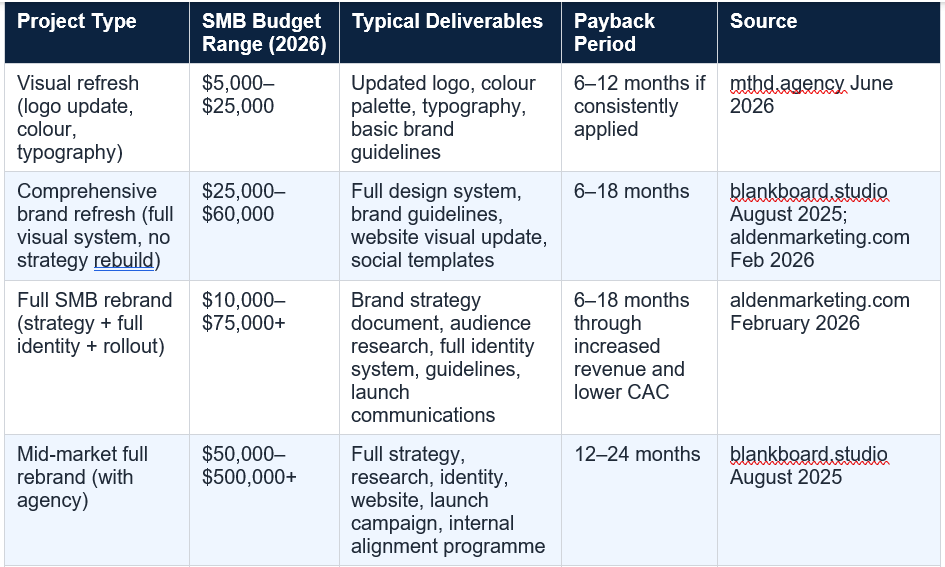
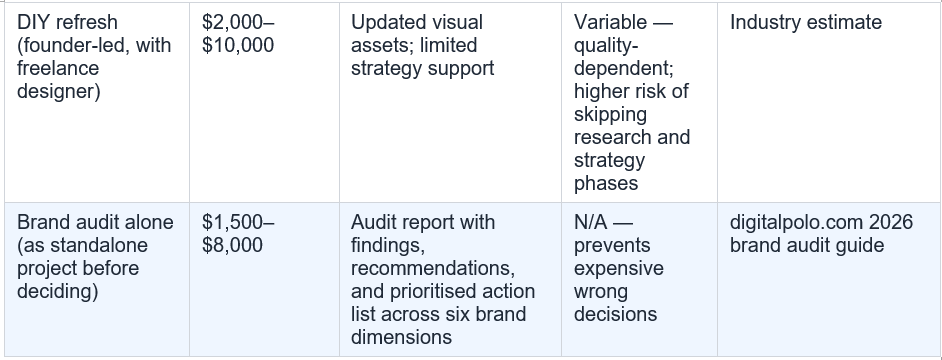
Note: ROI for professional brand strategy and logo design averages 2,000–3,500% over a three-year period (aldenmarketing.com February 2026). On a $30,000 rebrand investment, a 2,000% three-year ROI implies $600,000 in cumulative value creation. This is an industry-cited figure; individual results depend heavily on execution quality, market conditions, and business fundamentals.
The statistics confirm the analogy. Strong brands generate 3× the sales volume of weak brands. Consistent brand application drives 10–20% revenue growth. A successful rebrand produces 23% revenue uplift and reduces customer acquisition costs by 15–25%. 86% of consumers require brand trust before buying. And yet 40% of rebrands fail to deliver positive ROI within two years — not because rebranding is inherently risky, but because it is most often done backwards: design before strategy, creativity before research, speed before structure.
For small to mid-sized businesses operating with limited budgets and genuine market opportunities, the rebranding process in this guide — audit, strategy, research, identity development, rollout planning, launch, and measurement — is not a luxury version of what you can afford. It is the minimum viable version of what works. A $15,000 rebrand done in the right sequence outperforms a $60,000 rebrand done backwards every time. Start with why. Start with who. Start with what is actually broken. And only then decide what the new brand should look like.
Start with a brand audit across six dimensions: strategy, visual identity, brand voice, customer experience, competitive positioning, and internal alignment. A brand refresh is appropriate when your strategy, positioning, and audience are still valid but your visual expression or voice has fallen out of step with where your business is now. A full rebrand is necessary when the strategy itself has changed — new market, new audience, serious reputation issue, post-merger, or a founding brand that was never accurate. The simplest diagnostic: can you articulate clearly what you do, for whom, and why you're different — and does your current brand communicate that? If yes to both, you need a refresh, not a rebrand. If no to either, you need a rebrand. The average SMB rebrand costs $10,000–$75,000 and takes approximately 7 months (Nielsen 2025; mthd.agency June 2026; aldenmarketing.com February 2026).
What does a rebranding strategy include?
A complete rebranding strategy for an SMB includes: (1) A brand audit documenting current performance across strategy, identity, voice, customer experience, competition, and internal alignment; (2) A brand strategy document covering positioning, audience, mission, values, and value proposition; (3) Audience research — interviews and surveys with current customers, lapsed customers, and target prospects; (4) Competitive analysis and a brand positioning map; (5) Brand identity development — logo system, colour palette, typography, visual language, and brand voice guide; (6) Brand guidelines document; (7) A rollout plan covering all touchpoints in priority sequence; (8) A launch communications plan; and (9) Post-launch measurement framework with specific KPIs. The Brand Audit and Research phase alone should account for 20–30% of the total budget (emulousmedia.com May 2026).
How long does a rebrand take for a small business?
A properly structured full rebrand takes approximately 6–12 months for a small to mid-sized business (emulousmedia.com May 2026). Nielsen 2025 brand tracking data puts the average rebrand duration at approximately 7 months (cited mthd.agency June 2026). A focused visual refresh takes 4–12 weeks. The Brand Audit and Research phase alone should take 2–3 months for a full rebrand. Rushed rebrands — those compressed into weeks without proper research and strategy phases — fail 40% of the time. Structured 6–12 month processes succeed 70–85% of the time (emulousmedia.com May 2026). Budget the time appropriately and do not let urgency override the phases that protect the investment.
What is the ROI of rebranding a small business?
A successful rebrand can increase revenue by up to 23%; brand consistency drives 10–20% revenue growth (Lucidpress); strong brands have 3× the sales volume of weak brands (Millward Brown). Alden Marketing (February 2026) cites an average ROI of 2,000–3,500% over three years for professional brand strategy and logo design investment. Customer acquisition costs reduce by 15–25% after a well-executed rebrand (celerart.com January 2026). Established SMBs typically recoup the rebrand investment within 6–18 months (aldenmarketing.com February 2026). The counter-case: 40% of rebrands fail to deliver positive ROI within two years (Nielsen 2025), and failed rebrands average a 22.7% sales decline with $4.2 million average corrective spend required (Nielsen 2026; amraandelma.com July 2026). The structured approach is what distinguishes the 60% that deliver ROI from the 40% that don't.
How do I rebrand without confusing or losing existing customers?
The primary tool for avoiding customer confusion during a rebrand is proactive communication — briefing existing clients on what is changing and why before the public launch. Key messages for that communication: (1) what is changing (the name, visual identity, or positioning); (2) why it changed (growth, evolution, new direction); (3) what it means for them (the same team, the same service, with a clearer or stronger brand behind it). Internal team alignment before external launch ensures no one is caught off guard. A phased rollout that updates the highest-visibility assets first (website, Google Business Profile, social profiles, email signatures) prevents the worst confusion scenario — old and new assets co-existing in the market simultaneously. Consumer testing before launch (which was missing in 61% of failed rebrands per the PwC/Brand Finance study) identifies messaging that confuses before it reaches your audience.
Should I hire an agency to rebrand my small business or do it myself?
It depends on budget, scope, and the strategic complexity of the change. A DIY visual refresh with a freelance designer ($2,000–$10,000) is viable for a simple update and carries lower financial risk but also lacks the strategic and research infrastructure that makes rebrands succeed. A full SMB rebrand ($10,000–$75,000) typically benefits from professional brand strategy input — the 38% failure rate in the PwC/Brand Finance study of 614 campaigns was primarily traced to insufficient research and consumer testing, both of which agency partners are better positioned to deliver than an SMB operating without that expertise. If hiring an agency, evaluate whether they start with a brand audit and strategy brief before any design work — if the first conversation is about logos and colours, find another agency. (Ramotion March 2026: 'Begin with a brand audit. Define measurable objectives before any design work begins.')
Table of Contents
- Why Most Rebrands Fail (and How Yours Won’t)
- Rebrand vs Brand Refresh: The Distinction That Changes Your Budget
- Seven Signals Your Business Needs a Rebrand
- The ROI Case: What a Successful Rebrand Actually Delivers
- Step 1: Conduct a Brand Audit
- Step 2: Define Strategy Before Design
- Step 3: Research Your Audience and Competitors
- Step 4: Develop Your New Brand Identity
- Step 5: Build Your Rollout Plan
- Step 6: Launch and Communicate the Change
- Step 7: Measure, Iterate, and Protect Your New Brand
- What It Costs: Budget Ranges for SMBs in 2026
- The Biggest Rebranding Mistakes SMBs Make
- Conclusion: Your Brand Is Infrastructure, Not Decoration
- Frequently Asked Questions
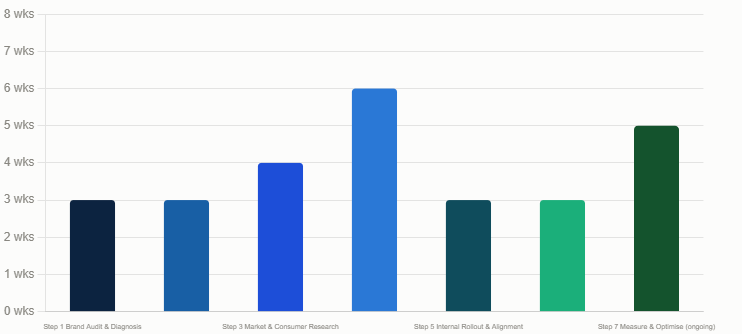
7 Step Regrand Process: Timeline & Effort
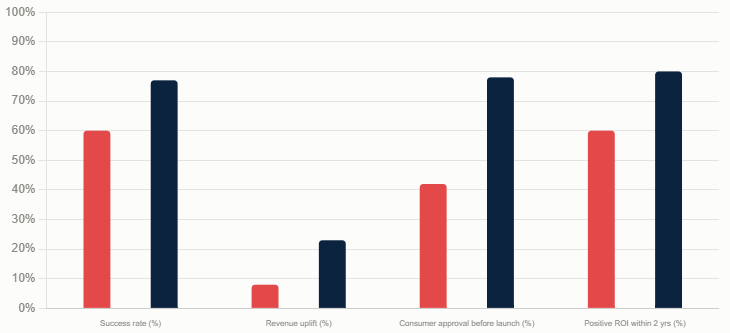
Cost vs Success Rate: Rushed vs Structure Rebrand
Why Most Rebrands Fail (and How Yours Won’t)
Rebranding is one of the highest-stakes decisions a small or mid-sized business can make. Done strategically, it can increase revenue by up to 23%, unlock premium pricing, reduce customer acquisition costs by 15–25%, and reposition a business for the next phase of growth. Done poorly — and 40% of rebrands do not deliver a positive return within two years (Nielsen 2025 brand tracking data, cited mthd.agency June 2026) — it can slash sales by more than 22%, require an average of $4.2 million in corrective spending to recover brand equity, and leave customers confused about who you are and what you do.The research on why rebrands fail is consistent. A joint PwC and Brand Finance Institute study tracking 614 rebranding campaigns launched between 2022 and 2025 found a failure rate of 38%, with the leading cause identified in 61% of failed campaigns: insufficient pre-launch consumer testing (amraandelma.com, July 2026). The second most common cause: misalignment between the new brand identity and existing customer expectations. The third: underestimated rollout costs that eroded projected ROI within the first 18 months.
Every single one of these failure modes is avoidable with a structured process. A disciplined 6–12 month rebranding approach has a 70–85% success rate; rushed efforts fail 40% of the time (emulousmedia.com, May 2026). For small to mid-sized businesses operating with tighter budgets and less margin for error than large enterprises, the structured approach is not optional — it is the only responsible way to rebrand. This guide provides it, step by step, with the specific research, tools, and decision points that determine whether your rebrand becomes one of the 60% that delivers positive ROI or one of the 40% that does not.
40% of rebrands fail to deliver positive ROI within 2 years (Nielsen 2025; mthd.agency June 2026). 38% failure rate across 614 campaigns 2022–2025 — primary cause: insufficient pre-launch consumer testing (PwC/Brand Finance; amraandelma.com July 2026). Successful rebrands increase revenue by up to 23%. Strong brands have 3× the sales volume of weak brands (Millward Brown). 70–85% success rate for structured 6–12 month process vs 40% failure for rushed efforts (emulousmedia.com May 2026).
Rebrand vs Brand Refresh: The Distinction That Changes Your Budget
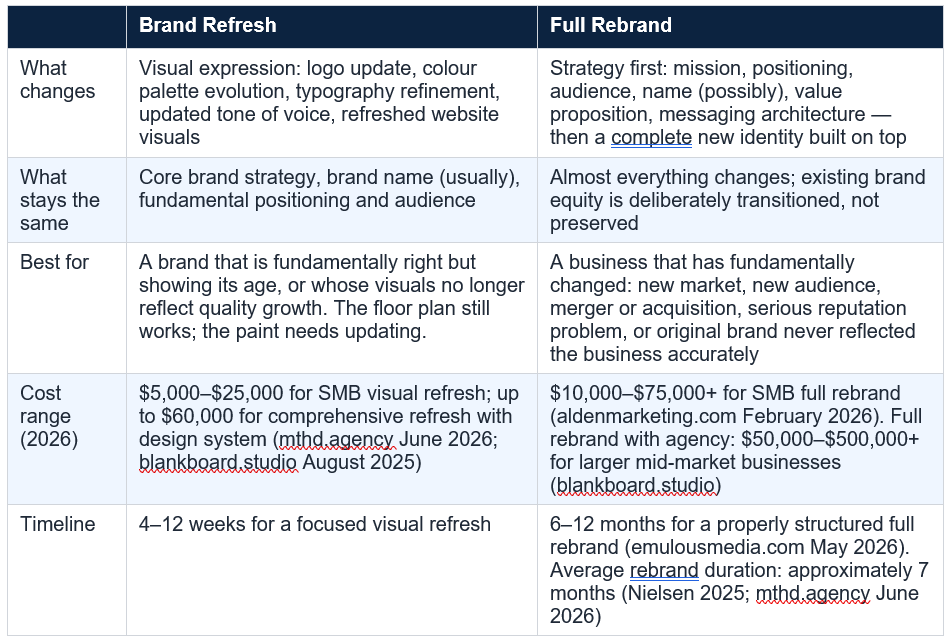
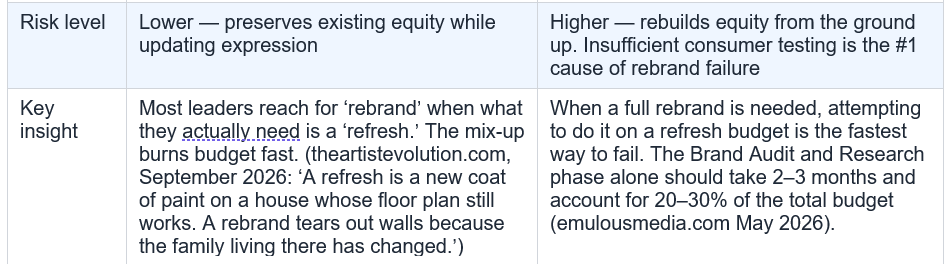
One of the most expensive errors small business owners make is confusing a brand refresh with a full rebrand — or using these terms interchangeably with their designers or agencies. The distinction determines your scope, your timeline, your budget, and your risk exposure.
Seven Signals Your Business Needs a Rebrand
The decision to rebrand should be strategy-led, not aesthetics-led. The following seven signals are empirically validated triggers — they represent conditions under which maintaining the status quo is more expensive than the cost of rebranding:- Signal 1 — Your brand no longer reflects who you are: You built your original brand in your early days for a different market, a different price point, or a different audience. The business has evolved but the brand has not. Pugodesigns.com (2026): ‘Common triggers include outgrowing a brand built in the early days, a shift in audience or positioning, or a brand that simply no longer reflects who the business has become.’
- Signal 2 — Brand awareness is falling below 15% in your target demographic: If prompted awareness of your brand drops below 15% in the audience you serve, you are structurally invisible in your market. This is a measurable trigger, not a subjective one. (Celerart.com, January 2026.)
- Signal 3 — Customer acquisition costs are rising 40%+ year-over-year despite stable ad spend: When CAC rises sharply without a corresponding increase in competition or ad cost, the cause is often brand clarity failure. New customers cannot quickly understand what you do, why it matters, or why you are the right choice.
- Signal 4 — Customers consistently misunderstand your positioning: When the phrase ‘not sure what you do’ or ‘I didn’t know you did that’ appears repeatedly in customer conversations, discovery calls, or reviews, the brand is failing to communicate clearly. (blog.mean.ceo, updated approximately two weeks before publication of this article.)
- Signal 5 — You are entering a new market or customer segment: Expanding into a segment that your current brand was not built to serve often requires a rebrand to reposition the business appropriately. Trying to sell to enterprise clients with a brand built for freelancers, or to premium buyers with a price-competitive brand identity, creates friction at every touchpoint.
- Signal 6 — A merger, acquisition, or major business model change: These events almost always require brand realignment, from naming to positioning. Failing to rebrand after a material business change leaves the market-facing identity misaligned with the operating reality.
- Signal 7 — Your visual brand is actively driving away business: VistaPrint survey data shows 60% of consumers avoid companies with unappealing logo designs even if they have good reviews (cited bynder.com February 2026). If your visual brand is creating first-impression rejection before your value proposition can be heard, it is costing revenue directly.
The ROI Case: What a Successful Rebrand Actually Delivers
For SMB owners who need to justify the investment internally or to stakeholders, the financial case for a well-executed rebrand is well documented in 2025–2026 research:- Revenue growth: a successful rebrand can increase revenue by up to 23% (blankboard.studio August 2025; aldenmarketing.com February 2026). Lucidpress research finds brand consistency drives 10–20% revenue growth; Millward Brown finds strong brands generate 3× the sales volume of weak brands (cited bynder.com February 2026).
- Premium pricing: a stronger brand identity supports higher price points. When customers perceive your brand as more credible, professional, or premium, they are more willing to pay a premium. This is one of the most financially significant benefits of rebranding for SMBs competing in commoditised markets.
- Customer acquisition cost reduction: well-executed rebrands produce 15–25% reductions in customer acquisition costs by improving first-impression conversion, reducing sales cycle length, and increasing referral rates (celerart.com January 2026).
- Return on investment: Alden Marketing (February 2026) cites an average ROI of 2,000–3,500% over a three-year period for professional brand strategy and visual identity investment. This is a three-year compound return, not a first-year figure, and it assumes a structured approach to both strategy and execution.
- Payback period: for established SMBs, the cost of a rebrand is typically recouped within 6–18 months through increased revenue, improved pricing power, and more efficient customer acquisition (aldenmarketing.com February 2026).
Step 1: Conduct a Brand Audit
Step 1: Brand Audit — The Diagnostic That Makes the Rebrand Strategic A brand audit is a structured review of how your brand is currently performing across six dimensions: brand strategy (positioning, mission, values, differentiation), visual identity (logo, colours, typography, design system), brand voice (tone, messaging, content), customer experience (touchpoints, service interactions, purchase journey), competitive positioning (how you compare to alternatives in the market), and internal alignment (whether your team understands and consistently applies the brand). The output is a prioritised list of findings — urgent fixes, system improvements, and strategic shifts. This is not a creative exercise. It is a diagnostic.Digitalpolo.com’s 2026 brand audit guide describes the sequence: ‘A brand audit is the diagnostic that any refresh or rebrand should be built on.’ The specific step that most SMBs skip, and that most failed rebrands trace back to: ‘A rebrand without an audit is a redesign — visual change without diagnosed reason. The audit answers what specifically isn’t working, which makes the rebrand strategic rather than aesthetic.’
The Brand Audit and Research phase should account for 20–30% of the total rebranding budget and take 2–3 months for a full rebrand (emulousmedia.com May 2026). For an SMB with a $30,000 total rebrand budget, that means $6,000–$9,000 and 8–12 weeks on research and diagnosis before any design work begins. Many SMBs resist this allocation because the audit does not produce a visible deliverable. But skipping it is the fastest way to spend money on a better-looking version of the same problem.
How to conduct a basic brand audit as an SMB: (1) Pull your analytics: branded search volume, direct traffic trend, conversion rate from new vs returning visitors, CTR trend on paid ads. Look for falling metrics as signals of brand fatigue. (2) Survey 10–15 current customers: what do they think you do? How would they describe you to a colleague? What words would they use? (3) Survey 5–10 lost leads or churned customers: where did the positioning or communication fail? (4) Audit your competitors: compare your visual identity, messaging, and positioning to the three to five closest alternatives in your market. (5) Pull up your website on a phone and ask: does it explain what we do, for whom, and why us — within 5 seconds of the homepage loading?
Step 2: Define Strategy Before Design
Step 2: Brand Strategy — The Backbone Every Design Decision Depends On Before a designer opens a software file, your brand strategy must be complete. Brand strategy defines: your positioning (what you are and for whom, and specifically how that differs from alternatives); your mission and values (the 'why' that guides decisions); your target audience persona (specific, not generic); your brand archetype (the personality and voice character that guides communication); your unique value proposition (the specific outcome you deliver that others don't); and your messaging architecture (the primary claim, supporting proofs, and objection responses that appear across all channels).MonkyVision’s February 2026 rebranding guide is direct on the sequence: ‘Design follows strategy. If strategy is unclear, visuals become decoration. Rebranding requires answering fundamental business questions — strategy determines direction.’ The most common SMB rebranding failure mode is inverting this sequence: deciding on the logo, colours, or ‘look’ and then trying to build a brand strategy to justify the design. This approach produces an identity that may look modern but does not communicate clearly, does not differentiate, and does not convert.
For SMBs with limited resources, the strategy phase can be self-led or agency-assisted, but it cannot be skipped. A simple brand strategy document for an SMB might be 4–8 pages covering positioning statement, target audience description, core value proposition, three to five brand attributes, tone of voice description, and key messages for primary audience segments. This document becomes the brief for every design, content, and communications decision that follows.
Starting with the logo is the single most common SMB rebranding mistake. The Pugodesign.com rebranding checklist (2026) is explicit: 'A rebrand that works is not about picking a logo you personally like better. It is a process: know why you are doing it, understand who you actually are and who you need to reach, audit the gap, plan for it, and only then move into design.' Changing the logo without changing the strategy is the most expensive way to stay in the same position.
Step 3: Research Your Audience and Competitors
Step 3: Market Research — The Evidence Base That Reduces Risk This is the research failure identified in 61% of failed rebrands in the PwC/Brand Finance study: insufficient pre-launch consumer testing. Market research for a rebrand has two components: audience research (what your target customers believe, feel, and need — and how they currently perceive your brand) and competitive research (where your competitors are positioned, what visual and message territory they own, and where a gap exists for your new brand to occupy).Audience research does not require a large budget. Structured interviews with 10–20 current customers and 5–10 prospective customers in your target segment will reveal more actionable insight than most formal surveys. The questions that matter: How do you describe your current provider in this category? What words would you use to describe an ideal version of this service or product? What would make you choose someone new? What do you look for first when researching a provider?
Competitive research means building a brand positioning map: plot your top competitors on axes that matter in your market (e.g. premium vs affordable; specialist vs generalist; traditional vs innovative). Identify where the market is crowded and where there is white space. Your new brand identity should occupy white space — a position that is unambiguous, differentiated, and genuinely achievable for your business. Ramotion’s March 2026 rebranding checklist identifies competitive analysis as a required audit output: ‘Understand industry trends, audience shifts and competitor positioning to guide strategic decisions.’
A specific warning for multi-location SMBs: a Moz 2025 study found that 68% of multi-location rebrands lose local search visibility due to inconsistent asset updates across Google Business Profiles (emulousmedia.com, May 2026). Research your digital footprint as part of this phase: check Google Business Profile accuracy, directory citations, and local search rankings that your new brand will need to preserve.
Step 4: Develop Your New Brand Identity
Step 4: Brand Identity Development — Strategy Made Visible With strategy defined and audience research complete, the visual and verbal identity development begins. A complete brand identity for an SMB should include: (1) Logo system — primary logo, secondary mark, and wordmark variants for different contexts; (2) Colour palette — primary and secondary colours with exact hex codes and usage rules; (3) Typography system — primary and secondary typefaces with usage hierarchy; (4) Visual language — photography style, illustration approach, graphic elements; (5) Brand voice guide — tone, vocabulary, writing style with examples; (6) Brand in application — how the identity looks on the website, business cards, social profiles, proposals, email signatures, and physical signage if applicable.For SMBs, the deliverable from this phase is not just files — it is a brand guidelines document. Digitalpolo.com’s 2026 brand guidelines guide identifies seven sections every brand book needs, even for small businesses: logo, colour, typography, imagery, voice, applications, and a do-not section. Without brand guidelines, the new identity will drift within months as different team members or contractors apply it differently.
The visual identity must work across every platform the business uses. Evaluate each touchpoint: website (desktop and mobile), social media profiles and content, email, physical materials, sales collateral, packaging if applicable, and any advertising channels used. The Veliacar rebranding checklist (December 2025) emphasises mobile-first evaluation: ‘Pull up your website on a phone. Does it explain what you do in plain language? Does the new brand identity render correctly and credibly?’
Before finalising any identity element, test it in context: place the new logo on a mock website homepage, a social profile header, and a business card. Show the design to 5 members of your target audience who were not involved in the development and ask: what do you think this business does? Does this look credible? Would you trust this brand? Their responses tell you more than any internal design review.
Step 5: Build Your Rollout Plan
Step 5: Rollout Planning — The Phase Most SMBs Underestimate The rollout plan determines how the rebrand moves from internal development to external public launch — and the sequence in which different touchpoints are updated. A rollout without a plan produces the most visible failure mode in SMB rebranding: a business that has half the old brand and half the new brand visible simultaneously in the market, creating confusion and undermining the credibility that the rebrand was designed to build.The rollout plan should include: (1) Internal launch — brief your team, explain the why behind the rebrand, provide brand guidelines, and equip every team member with the tools they need to apply the new brand consistently. Internal alignment precedes external launch. (2) Asset priority sequence — update your highest-visibility assets first: website homepage, Google Business Profile, social media profiles, email signatures. Then secondary assets: sales decks, proposals, letterhead. Then tertiary: physical materials, signage, packaging.
A specific risk for SMBs that serve local markets: the 68% Google Business Profile visibility loss statistic from Moz 2025 (emulousmedia.com) means that local search ranking can drop immediately if the Google Business Profile, website name, and directory citations do not all update simultaneously and consistently. For any local-market SMB, updating these digital consistency assets on day one of launch is critical.
Communication to existing clients and customers should happen before, not after, the public rebrand launch. A client communication explaining what is changing, why, and what it means for them (the answer: they are getting the same team and service, with a clearer, more professional brand behind it) converts potential confusion into a trust-building moment. Clients who receive no explanation before encountering the new brand often assume something has changed beyond the visuals.
Step 6: Launch and Communicate the Change
Step 6: The Public Launch — Announcing the New Brand with Clarity and Confidence The public launch is a communications event, not just a design swap. For SMBs, the rebrand launch should communicate three things clearly: what has changed, why it changed, and what it means for customers. The launch should feel intentional and confident — not apologetic, not over-explained, not buried in small print.Effective rebrand launch components for SMBs:
- Website launch: the new site goes live on launch day. All pages should reflect the new identity. Update the meta title and meta description to reflect new positioning.
- Social media announcement: a post (and story/reel if appropriate) explaining the rebrand with before-and-after visual context, the reason for the change, and what customers can expect.
- Email to existing customer list: a direct communication explaining the rebrand, celebrating the milestone, and reinforcing the value the business provides. Include a link to the new website.
- Google Business Profile and directory updates: name, logo, photos, and description all updated on launch day to maintain search consistency.
- PR if appropriate: for SMBs with local press relationships, a rebrand is a newsworthy business milestone. A press release announcing the rebrand, the reason, and the business’s growth story can generate local visibility.
Step 7: Measure, Iterate, and Protect Your New Brand
Step 7: Measurement and Maintenance — The Work That Protects the Investment A rebrand is not complete at launch. It is complete when the new brand is consistently applied across every customer touchpoint, measurably improving the business metrics it was designed to address, and embedded in a brand management system that prevents drift.The early post-launch metrics to track over a 90-day window (theartistevolution.com, September 2026):
- Branded search volume: is awareness of your brand name increasing in Google Search Console?
- Direct traffic: are more people navigating directly to your website (an indicator of brand recall)?
- Website conversion rate: is the new homepage and messaging converting at a higher rate than the baseline?
- Sales velocity: are deals closing faster, or at higher average values?
- Customer acquisition cost: is it trending down, as expected from a clearer brand message?
Brand drift — the gradual divergence between the intended brand and how it is actually applied — is the most common post-launch failure for SMBs. It happens when team members or contractors apply old assets, use off-brand messaging, or create materials without following the brand guidelines. A brand guidelines document, stored accessibly and actively shared, is the primary tool for preventing drift. A brief annual brand audit (the same six-dimension review from Step 1) catches drift early and prevents it from compounding.
What It Costs: Budget Ranges for SMBs in 2026
The investment in a rebrand spans a wide range depending on scope, the provider type (in-house, freelancer, or agency), and whether strategic services are included alongside visual design. The following table documents current ranges from multiple 2026 sources:Note: ROI for professional brand strategy and logo design averages 2,000–3,500% over a three-year period (aldenmarketing.com February 2026). On a $30,000 rebrand investment, a 2,000% three-year ROI implies $600,000 in cumulative value creation. This is an industry-cited figure; individual results depend heavily on execution quality, market conditions, and business fundamentals.
The Biggest Rebranding Mistakes SMBs Make
The research and practitioner data for 2025–2026 identifies a consistent set of mistakes that account for the majority of SMB rebrand failures:- Starting with the logo: design before strategy is the root cause of most failed rebrands. The visual is the output of the strategy, not the strategy itself.
- Skipping the brand audit: attempting to redesign without diagnosing what is wrong. A brand audit reveals what to keep, what to change, and what cannot survive the transition. Without it, rebrands often rebuild weak messaging into better-looking packaging.
- Insufficient consumer testing before launch: this was identified in 61% of failed rebrands in the PwC/Brand Finance study. Test with real members of your target audience, not colleagues, not family, not the design team.
- Rushing the process: the 40% failure rate for rushed rebrands vs the 70–85% success rate for structured 6–12 month processes is the clearest statistical argument for timeline discipline. Budget enough time.
- Inconsistent rollout: old and new brand assets co-existing in the market, old Google Business Profile not updated, team members still using old email signatures. This undermines credibility and creates customer confusion. The rollout plan must include every touchpoint and a clear completion timeline.
- Changing for the wrong reasons: rebranding because the founder is bored with the current look, or to ‘look more modern’ without a strategic reason. A brand that is working — generating referrals, converting at good rates, recognised in its market — does not need a rebrand. A refresh, perhaps; a full rebrand, no.
- Under-communicating to existing customers: failing to explain the rebrand to current clients before or immediately after launch. Customers who encounter a new brand without context assume something has changed, and not always for the better.
14. Conclusion
Monkyvision’s February 2026 rebranding guide articulates the framing that makes the most sense for any SMB considering this decision: ‘Your brand is not decoration. It is infrastructure. When built strategically, it becomes one of the strongest growth tools a company owns.’The statistics confirm the analogy. Strong brands generate 3× the sales volume of weak brands. Consistent brand application drives 10–20% revenue growth. A successful rebrand produces 23% revenue uplift and reduces customer acquisition costs by 15–25%. 86% of consumers require brand trust before buying. And yet 40% of rebrands fail to deliver positive ROI within two years — not because rebranding is inherently risky, but because it is most often done backwards: design before strategy, creativity before research, speed before structure.
For small to mid-sized businesses operating with limited budgets and genuine market opportunities, the rebranding process in this guide — audit, strategy, research, identity development, rollout planning, launch, and measurement — is not a luxury version of what you can afford. It is the minimum viable version of what works. A $15,000 rebrand done in the right sequence outperforms a $60,000 rebrand done backwards every time. Start with why. Start with who. Start with what is actually broken. And only then decide what the new brand should look like.
Frequently Asked Questions
How do I know if my small business needs a rebrand or just a brand refresh?Start with a brand audit across six dimensions: strategy, visual identity, brand voice, customer experience, competitive positioning, and internal alignment. A brand refresh is appropriate when your strategy, positioning, and audience are still valid but your visual expression or voice has fallen out of step with where your business is now. A full rebrand is necessary when the strategy itself has changed — new market, new audience, serious reputation issue, post-merger, or a founding brand that was never accurate. The simplest diagnostic: can you articulate clearly what you do, for whom, and why you're different — and does your current brand communicate that? If yes to both, you need a refresh, not a rebrand. If no to either, you need a rebrand. The average SMB rebrand costs $10,000–$75,000 and takes approximately 7 months (Nielsen 2025; mthd.agency June 2026; aldenmarketing.com February 2026).
What does a rebranding strategy include?
A complete rebranding strategy for an SMB includes: (1) A brand audit documenting current performance across strategy, identity, voice, customer experience, competition, and internal alignment; (2) A brand strategy document covering positioning, audience, mission, values, and value proposition; (3) Audience research — interviews and surveys with current customers, lapsed customers, and target prospects; (4) Competitive analysis and a brand positioning map; (5) Brand identity development — logo system, colour palette, typography, visual language, and brand voice guide; (6) Brand guidelines document; (7) A rollout plan covering all touchpoints in priority sequence; (8) A launch communications plan; and (9) Post-launch measurement framework with specific KPIs. The Brand Audit and Research phase alone should account for 20–30% of the total budget (emulousmedia.com May 2026).
How long does a rebrand take for a small business?
A properly structured full rebrand takes approximately 6–12 months for a small to mid-sized business (emulousmedia.com May 2026). Nielsen 2025 brand tracking data puts the average rebrand duration at approximately 7 months (cited mthd.agency June 2026). A focused visual refresh takes 4–12 weeks. The Brand Audit and Research phase alone should take 2–3 months for a full rebrand. Rushed rebrands — those compressed into weeks without proper research and strategy phases — fail 40% of the time. Structured 6–12 month processes succeed 70–85% of the time (emulousmedia.com May 2026). Budget the time appropriately and do not let urgency override the phases that protect the investment.
What is the ROI of rebranding a small business?
A successful rebrand can increase revenue by up to 23%; brand consistency drives 10–20% revenue growth (Lucidpress); strong brands have 3× the sales volume of weak brands (Millward Brown). Alden Marketing (February 2026) cites an average ROI of 2,000–3,500% over three years for professional brand strategy and logo design investment. Customer acquisition costs reduce by 15–25% after a well-executed rebrand (celerart.com January 2026). Established SMBs typically recoup the rebrand investment within 6–18 months (aldenmarketing.com February 2026). The counter-case: 40% of rebrands fail to deliver positive ROI within two years (Nielsen 2025), and failed rebrands average a 22.7% sales decline with $4.2 million average corrective spend required (Nielsen 2026; amraandelma.com July 2026). The structured approach is what distinguishes the 60% that deliver ROI from the 40% that don't.
How do I rebrand without confusing or losing existing customers?
The primary tool for avoiding customer confusion during a rebrand is proactive communication — briefing existing clients on what is changing and why before the public launch. Key messages for that communication: (1) what is changing (the name, visual identity, or positioning); (2) why it changed (growth, evolution, new direction); (3) what it means for them (the same team, the same service, with a clearer or stronger brand behind it). Internal team alignment before external launch ensures no one is caught off guard. A phased rollout that updates the highest-visibility assets first (website, Google Business Profile, social profiles, email signatures) prevents the worst confusion scenario — old and new assets co-existing in the market simultaneously. Consumer testing before launch (which was missing in 61% of failed rebrands per the PwC/Brand Finance study) identifies messaging that confuses before it reaches your audience.
Should I hire an agency to rebrand my small business or do it myself?
It depends on budget, scope, and the strategic complexity of the change. A DIY visual refresh with a freelance designer ($2,000–$10,000) is viable for a simple update and carries lower financial risk but also lacks the strategic and research infrastructure that makes rebrands succeed. A full SMB rebrand ($10,000–$75,000) typically benefits from professional brand strategy input — the 38% failure rate in the PwC/Brand Finance study of 614 campaigns was primarily traced to insufficient research and consumer testing, both of which agency partners are better positioned to deliver than an SMB operating without that expertise. If hiring an agency, evaluate whether they start with a brand audit and strategy brief before any design work — if the first conversation is about logos and colours, find another agency. (Ramotion March 2026: 'Begin with a brand audit. Define measurable objectives before any design work begins.')

0 Comments Comments