
Savings
Savings, CD or T-Bills: Where Should Your Cash Go Right Now?

Table of Contents
- Why This Question Suddenly Got Harder
- Savings Accounts: Flexible, but the Rate Is Not a Promise
- CDs: A Fixed Rate in Exchange for Your Freedom
- T-Bills, Money Markets and I Bonds
- How Yields Moved This Year
- Side by Side: Seven Options Compared
- Inflation, Taxes and What You Really Keep
- Lock In or Wait?
- Matching the Money to the Timeline
- Common Mistakes
- Conclusion
- Frequently Asked Questions
Why This Question Suddenly Got Harder
For most of this year the cash question had a comfortable answer. Rates sat around or just below four percent and the main advice was simply to stop leaving money in a bank that pays nothing. Then September arrived. On the 16th the Federal Reserve raised interest rates for the first time since July 2023, lifting its target range by a quarter point to 3.75%–4.00%. The vote was unanimous, 12–0. Chair Kevin Warsh said inflation has been too high for too long, and the committee’s median projection now points to about 4.1% by the end of the year, up from 3.8% in its previous round.That changes the decision. The old question was where to park cash before rates fell. The new one is whether to lock in today’s rate or wait for a better one. This post walks through the mid-October numbers, how savings accounts, CDs and T-bills really differ, and the trade-offs that matter more than the headline rate. The next Fed meeting is October 27–28.
Worth knowing: The October 12 rate survey from MyMoneyBlog opens with a blunt summary: rates are rising across the board, some banks are passing the increases on and others are not.
Savings Accounts: Flexible, but the Rate Is Not a Promise
A high-yield savings account is the simplest option. There is no lock-up and no penalty, and the money is there when life happens. The catch is that the rate can move without asking you. In the October survey the best savings rates were 4.50% APY from a Hyperion Bank money market promotion, which needs $10,000 of new money but carries a rate guarantee through June 30, 2027, and 4.34% from Elevault with no minimum. Further down, SoFi was at 3.30% with direct deposit, and the group of historically competitive banks the survey tracks started at 3.10%. The big megabanks, it says, still pay essentially zero.That spread is the whole story. On $10,000 held for a year, 3.10% earns roughly $310 and 4.50% roughly $450, about $140 apart before compounding, simply for moving money you were not using anyway. The survey adds two cautions: savings rates can drop at any time, and some banks lure customers with a temporary top rate and hope they stay put. It also no longer recommends fintech apps for cash, citing poor record-keeping and a lack of government protection, because the point of cash is absolute safety of principal.
CDs: A Fixed Rate in Exchange for Your Freedom
A certificate of deposit trades flexibility for certainty. You agree to leave the money alone for a set term, and the bank agrees not to change your rate. On October 12 the survey found 12-month CDs at 4.75% from E*Trade Bank (no minimum, 90-day interest penalty) and 4.95% from Tower FCU ($500 minimum, joined via a $35 charity donation, early withdrawal terms not found by the survey). Longer terms paid more: a 5-year CD at 5.00% from Popular Direct ($10,000 minimum), and a non-callable brokered 5-year CD at 5.15% through a bond desk.Three details matter more than the headline number. The first is the penalty. A 90-day penalty is an annoyance, but Popular Direct’s 730 days of interest is two years of earnings, which can swallow most of what the CD paid. The second is the callable trap. Brokerage platforms often show higher rates on callable CDs, and the survey warns that issuers can take them back if rates fall sharply, so you keep the downside while they keep the option. The third is the middle ground: no-penalty CDs, such as a 12-month at 4.15% from Climate First Bank, let you withdraw once without a fee. The rate is lower, but the exit door is real.
T-Bills, Money Markets and I Bonds
Treasury bills are short-term loans to the US government, issued for terms from four weeks to 52 weeks. On October 9, a new 4-week bill worked out to 4.03% annualized and a 52-week bill to 4.46%. Their big structural perk is tax: interest is exempt from state and local income tax, which can lift the effective yield for people in higher-tax states. You can buy directly at TreasuryDirect.gov or through a brokerage with a bond desk, such as Vanguard or Fidelity, and stagger maturities into a ladder.Several cash-like cousins sit nearby. Money market funds are highly regulated but not FDIC-insured. The Vanguard Federal Money Market Fund’s 7-day yield was 3.81%, and its Treasury version 3.85%, mostly exempt from state tax. Short-term Treasury ETFs such as SGOV (3.72% 30-day yield, 0.09% expense ratio) and VBIL (3.73%, 0.06%) hold a rotating basket of bills. All of these sit below the 4.46% on a 52-week bill, probably because trailing yields lag a rising market and fees take a small bite.
I Bonds bought between May and October 2026 pay 4.26% for the first six months, then reset with inflation. They must be held a year, forfeit the last three months of interest if cashed within five years, and are capped at $10,000 a year per person electronically. The survey notes that the next rate estimate becomes clearer once mid-October CPI data arrives.
How Yields Moved This Year
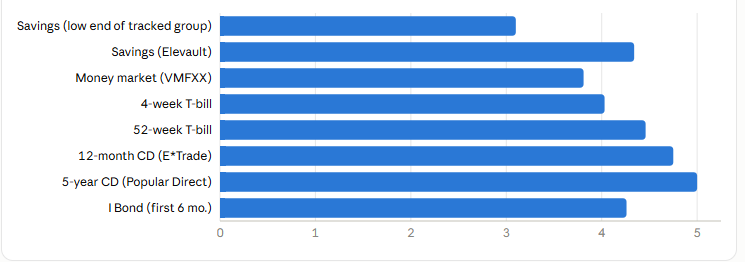
Rates did not jump overnight. The survey series shows a slow climb that sped up after summer. The 52-week T-bill yielded 3.47% on February 11, 3.80% in mid-May, 3.97% in mid-August and 4.46% by October. The 4-week bill barely moved until late summer, from 3.69% in February to 3.63% on July 1 and then up to 4.03%. The top 5-year CD rate went from roughly 4.0% to roughly 5.0%, and the 5-year Treasury reached about 5%. The Vanguard money market yield crept from 3.59% to 3.81%.The best advertised savings rate behaved differently, hovering between about 4.34% and 4.60% all year as the headline offers changed and often came with restrictions. In other words, longer-dated products repriced faster than the top savings rate. The chart above shows the full series.
The data: 52-week T-bill: 3.47% (Feb 11) to 4.46% (Oct 9–12). Top 5-year CD: about 4.0% to about 5.0%. VMFXX 7-day yield: 3.59% to 3.81%. Source: MyMoneyBlog monthly surveys, rates checked Feb 11 through Oct 12, 2026.
Side by Side: Seven Options Compared
The table summarizes the survey’s October 12 figures. Rates are examples from named institutions, not guarantees, and not available to everyone.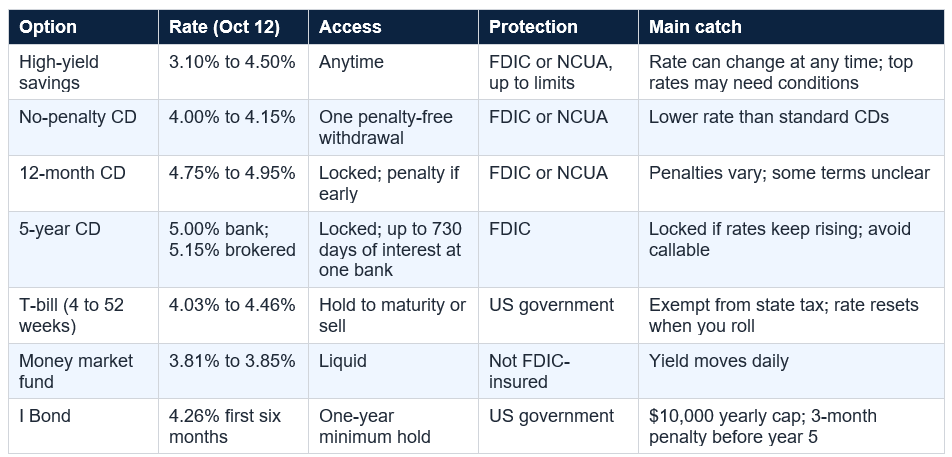
Inflation, Taxes and What You Really Keep
A rate only means something next to inflation. Headline CPI came in at 3.70% for September. A 52-week T-bill at 4.46% therefore beats it by roughly three-quarters of a point, a thin but positive real return. A typical online savings account at 3.10% to 3.30% trails it. Your personal inflation will differ, but cash that earns less than inflation is quietly losing buying power.Tax is the second filter. CD and savings interest is taxable at the federal and state level, while T-bill interest is exempt from state and local tax. Here is a simple illustration, assuming federal tax is identical on both and ignoring everything else. A 4.75% CD stops beating a 4.46% T-bill once your state income tax rate passes about 6.1%, because 4.75% times 0.939 is about 4.46%. Below that rate the CD wins on yield, and above it the T-bill wins. In a state with no income tax, the CD keeps its full edge.
Watch out: This is arithmetic, not tax advice. Your own rates, brackets and state rules decide the outcome, so confirm with a tax professional.
Lock In or Wait?
This is the part nobody can answer with confidence. The case for waiting is straightforward: the Fed has just started raising rates, its projections point higher, and traders are pricing further hikes in the months ahead. If that happens, a CD locked today at 4.75% could look stingy in a year. The case for locking is the mirror image. The hikes are aimed at inflation that is still well above the Fed’s 2% target, and if inflation cools, rates could drift down again. A 5-year CD at 5.00% would then look generous.The practical hedge is not to pick a side but to spread the bet. A ladder of CDs, say one-, two-, three-, four- and five-year terms, means part of your money matures every year while the blended rate stays above a savings account. A T-bill ladder does something similar on a shorter cycle and lets you reinvest at whatever rates prevail. The survey’s author says he treats longer-term instruments with caution because of interest rate risk. Whatever you choose, favour non-callable CDs and know the exit cost first.
Matching the Money to the Timeline
It helps to sort cash by when you will need it. Money for emergencies and surprises belongs where you can reach it any day, which usually points to a savings account or a no-penalty CD. Money earmarked for a known date inside a year, such as a tax bill or a down payment, can sit in a CD or T-bill that matures right before the date. The survey suggests keeping it simple for a big pile you are about to deploy: a flexible short-term CD within FDIC limits if a savings account does not fit. Money you will not touch for years is where laddering comes in. Cash in a brokerage account may earn little, since many firms pay very little on the default sweep.Common Mistakes
The most expensive mistake is inertia: leaving thousands in an account that pays almost nothing while better rates sit a few clicks away. Others include chasing a teaser rate without checking how long it lasts, ignoring penalties until you need the money, buying a callable CD for its headline rate, and forgetting taxes, which can reorder CDs and T-bills.Conclusion
There is no single best home for cash right now, but there is a clearer map than there was in the summer. Savings accounts remain the most flexible, with the best rates around 4.34% to 4.50% and plenty of lazy ones at 3.10% or lower. CDs pay more for commitment, with 12-month rates near 4.75% to 4.95% and five-year rates around 5%. T-bills sit between them at 4.03% to 4.46%, with a state tax advantage that can matter.What decides the winner is not the highest number on the page. It is when you need the money, how much a penalty would hurt, where you live, and how you would feel if rates moved after you locked in. Check the figures again before you act, because this market is moving. A qualified financial adviser or tax professional can help with your specifics.
Frequently Asked Questions
Is my money safe in a savings account, CD or T-bill?Bank savings and CDs are generally protected by FDIC insurance (NCUA at credit unions), up to the standard limit of $250,000 per depositor, per institution, per ownership category. Treasury bills are backed by the US government. Money market funds are regulated but not FDIC-insured. Confirm coverage with the institution before you deposit.
Which pays more right now, a CD or a T-bill?
On the October 12 survey, CDs paid more on headline rate: 4.75% to 4.95% for 12 months versus 4.46% on a 52-week T-bill. But T-bill interest is exempt from state and local income tax, so the gap can shrink or flip depending on where you live. Early withdrawal penalties and minimums matter too.
Should I lock in a CD now or wait for rates to go higher?
Nobody can say for certain. The Fed raised rates in September and its projections point to a median of about 4.1% by year-end, but inflation could cool and rates could fall again. A common way to hedge is a ladder of different maturities, so you are never fully locked in or fully exposed.
What is a callable CD and why does it matter?
A callable CD lets the issuer end it early. Brokerage platforms often list callable CDs at higher rates, and the survey warns that issuers can call them back if rates fall significantly. You get the higher rate only until it stops being convenient for the issuer. A non-callable CD avoids that.
How often should I check rates?
Often, right now. Savings rates can change at any time, and the October survey says rates are rising across the board with some banks passing the increases on and others not. A quick check every month or two, or after a Fed meeting, is a sensible habit.
0 Comments
Be the first to share your thoughts on this article.