
Budgeting
Stretch Your Grocery Budget: 14 Tips for Rising Prices

14 proven strategies to lower your grocery bill in 2026 — without sacrificing nutrition or the meals your family loves

This is the defining frustration of grocery shopping in 2026. Food costs 19.1 percent more than it did four years ago, according to Bureau of Labor Statistics Consumer Price Index data cited by Yahoo Finance in April 2026. The cumulative inflation of the past five years has not reversed. The weekly grocery run that cost $100 in 2020 now costs $119 for the same basket of goods. The family grocery bill that was manageable in 2021 has become one of the largest and most stressful line items in the household budget.
The good news is that grocery spending is one of the most responsive household expenses to intentional strategy. Unlike rent, which is fixed by a lease, or insurance, which changes annually, your grocery bill can be meaningfully reduced every single week through a combination of where you shop, how you shop, what you buy, and how you use what you bring home. This guide presents 14 proven strategies — each grounded in current 2025–2026 research — for stretching your grocery budget without sacrificing nutrition, taste, or the meals your household loves.
Benjamin Lorr, author of The Secret Life of Groceries, made this point directly to AARP in December 2025: ‘Reverse-engineering your meals is a great way to save money.’ The process is straightforward: check your supermarket’s weekly circular before building the meal plan. The sales cycle at most chains rotates every few weeks, meaning proteins, produce, and staples take turns being discounted. Whatever meat, vegetable, or grain is on the deepest discount this week becomes the anchor of this week’s meals.
The Kitchn’s June 2026 survey of 50 families across the US found that meal planning was among the top strategies reported by households successfully managing rising grocery costs. Family Credit’s June 2026 guide estimated that households that meal plan consistently save 15 to 20 percent on grocery spending.
The practical implementation: plan seven dinners for the week before writing any shopping list. Match each dinner to proteins and produce that are discounted this week. Build the shopping list from those meals. The list becomes a constraint that prevents impulse purchases, eliminates duplicative buying, and ensures every item purchased has a purpose.
Jess Rice, Recipe Development Manager, Budget Bytes (AARP, December 2025): Don’t stress perfection. Recipes are meant to be flexible. The goal is to cook something satisfying and affordable, not to stick to exact ingredients.
Saving Potential — Meal planning: 15–20% reduction in grocery spend — approximately $790–$1,053/year for a household spending $438/month
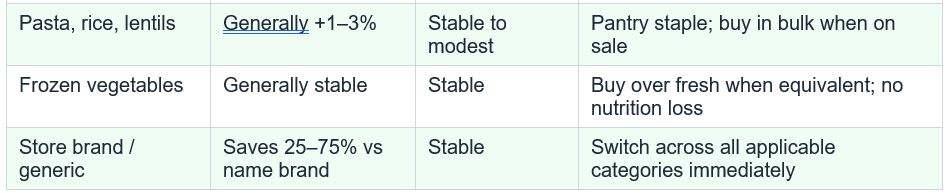
The quality argument against store brands has been largely defeated by evidence. University of Tennessee Extension experts told UT Institute of Agriculture News in January 2026: ‘Generic store brands often are just as high in quality as their name-brand counterparts.’ Many store-brand products are manufactured by the same companies that produce the equivalent national brand, with the same ingredients, in the same facilities, under a different label.
The highest-value store-brand switches with the least quality sacrifice:
The specific protein substitution math makes the case clearly. A pound of 80/20 ground beef costs approximately $6 to $8 in most markets in 2026. A pound of dried lentils costs approximately $1.50 to $2 and, when cooked, yields significantly more servings. Chicken thighs — one of the best-value cuts in the poultry case — typically cost 30 to 50 percent less than boneless skinless chicken breast and are more flavourful when cooked. Eggs, which are forecast to fall 30.7 percent in 2026 as avian flu-affected flocks recover, represent the single best-value protein source available at any grocery store.
Practical substitutions that households are reporting to be satisfying:
The financial case is equally compelling. Fresh lettuce has risen 32.1 percent year-over-year; a bag of frozen spinach — nutritionally comparable for cooking purposes — has remained stable. Fresh tomatoes are up 19.5 percent; canned whole tomatoes are essentially the same price they were two years ago and are the superior choice for any cooked application (soups, sauces, stews, chilli) where the texture of fresh tomatoes is irrelevant.
AARP’s July 2026 grocery tips guide is direct: buying frozen, store-brand, and shelf-stable foods can stretch budgets without sacrificing nutrition. The BECU April 2026 analysis concurs: canned and frozen foods are healthy and can be stored for weeks. Sometimes they are cheaper than fresh. The Kitchn’s June 2026 research found multiple surveyed families reporting permanent shifts to frozen produce as a key component of their grocery cost management.
NBC Philadelphia’s March 2026 coverage of Consumer Reports research found that shoppers are not sticking to one store. Many are making strategic multi-store trips, buying the items cheapest at Aldi or Lidl and supplementing with specialty items at their preferred chain. Consumer Reports spokesperson Torres told NBC: ‘Retailers such as Aldi and Target continue to stand out for savings by offering competitive prices and high-quality products, including good store brands.’
The practical store hierarchy by typical overall price level:
Saving Potential — Store switching from traditional supermarket to Aldi/Lidl for staples: $500–$1,500/year depending on household size and current store choice
The unit price is printed on the shelf label in small type below the retail price at virtually all major US supermarkets. It is expressed in price per ounce, per pound, per unit, or per serving depending on the product category. The specific strategies:
Family Credit’s June 2026 guide on reducing food spending notes that addressing food waste is ‘essentially free savings, since you’ve already paid for the food.’ The strategies that most effectively reduce waste:
The leftover opportunity is equally significant. AARP’s December 2025 guide quoted Budget Bytes’ Jess Rice: ‘Using leftovers to make soups and stews is a win-win for your wallet and your time.’ Almost any cooked ingredient — roast chicken, cooked vegetables, rice, beans, pasta — can be repurposed into soup, stew, fried rice, or grain bowls the following day. A pot of chicken soup that uses the carcass of a roasted chicken, the vegetable offcuts from three days’ cooking, and leftover rice effectively generates a full meal from ingredients that would otherwise be discarded.
The ‘cook once, eat twice’ approach — deliberately cooking larger quantities of protein or grain and using the remainder in a different form the following day — reduces both cooking time and per-meal food cost. A 3-pound pork shoulder roasted on Sunday evening can provide Sunday dinner, Monday lunch sandwiches, and Wednesday pasta with pulled pork.
Saving Potential — Cooking at home + leftover repurposing: $1,500–$3,000/year for a household that currently orders takeout or dines out three or more times per week
The Freedom Debt Relief April 2026 guide was specific about the bulk-buying calculus: an annual warehouse club membership — at $65 for Costco Gold Star membership — pays for itself in per-unit savings on non-perishable bulk purchases if the household consistently buys the right categories in bulk. The critical rule, as the guide noted, is to only bulk-buy items you can use before they expire.
The LSS Minnesota financial counselling guide notes the advantages of seasonal and local buying: farmers markets provide access to fresh produce at prices that can be competitive with supermarkets for peak-season items, particularly during the summer and autumn harvest seasons when supply is highest. Community Supported Agriculture (CSA) programmes allow households to invest in a local farm before the growing season begins and receive weekly boxes of produce throughout the season at prices that are typically 20 to 40 percent below equivalent supermarket produce.
Action: Growing a small herb garden at home is one of the highest-return-per-square-foot investments in the household grocery budget. Fresh herbs cost $3 to $5 per small bunch at a supermarket and are used in quantities small enough that the remainder frequently wilts unused. A pot of basil, rosemary, thyme, or chives on a windowsill costs $3 to $4 to establish and provides free fresh herbs for months.
Saving Potential — Seasonal produce shopping and local sourcing: $100–$300/year for a household that currently buys primarily out-of-season premium produce
The most effective grocery cashback cards in 2026:
Saving Potential — Grocery rewards credit card (3–6% cashback): $158–$315/year on an average household grocery spend (card paid in full monthly)
BECU’s April 2026 analysis identified shrinkflation as an increasingly common practice: ‘Some manufacturers are shrinking package sizes while charging the same. Food brands hope you aren’t paying attention.’ The consumer’s defence is the unit price. Checking the per-ounce, per-pound, or per-serving price on the shelf label every time a regular purchase is made catches shrinkflation immediately: the unit price rises even though the sticker price is unchanged.
Categories where shrinkflation has been most frequently reported in 2025–2026:
Building a small pantry buffer — storing two to four weeks’ supply of regularly used non-perishables purchased at their cycle-low price — means the household is almost never buying staples at full price. This is the strategy that underlies extreme couponing but does not require the time investment of dedicated coupon clipping; it simply requires recognising when a regularly used item is at a price lower than its usual retail.
The Thrifty Apartment’s June 2026 guide described this as ‘stacking pantry savings’: items like paper products, canned goods, pasta, rice, coffee, and cleaning supplies often cost significantly less when purchased in larger quantities during promotions. Buying these staples in bulk when on sale helps lock in lower prices and reduces the number of shopping trips needed each month.
Saving Potential — Pantry buffer strategy (buying non-perishables at cycle-low): $100–$300/year for a household with adequate storage that buys ahead of sale cycles consistently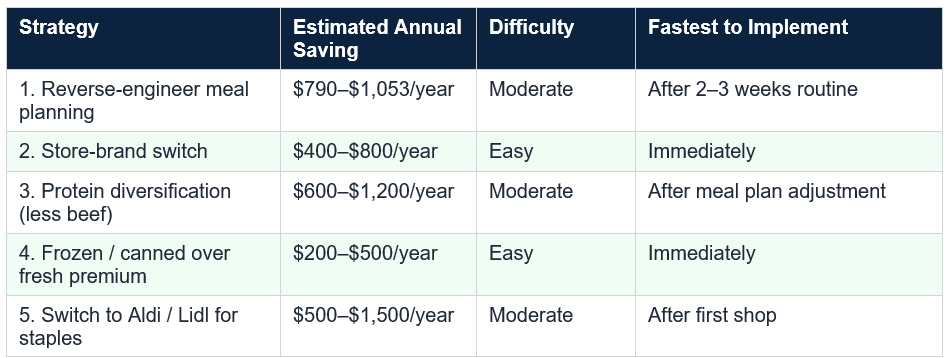
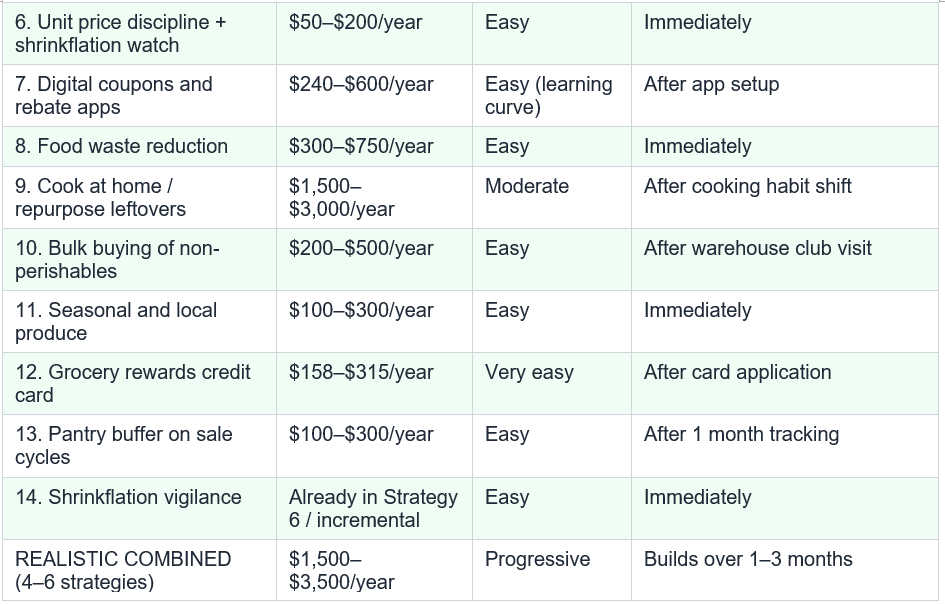
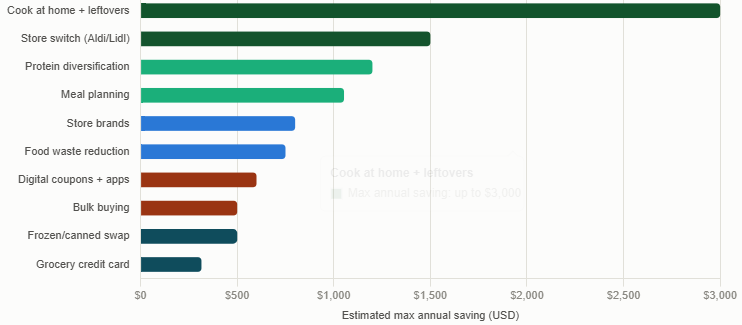
What is within every shopper’s control is the strategy they bring to the grocery store. Where they shop, what brands they choose, which proteins they build meals around, how they use what they buy, and whether they take two minutes to check the unit price before adding something to the cart: these are the variables that add up to $1,500 to $3,500 per year in savings for a household that applies four to six of the fourteen strategies described in this article consistently.
The strategies are not sacrifices. Frozen spinach is nutritionally equivalent to fresh. Store-brand pasta contains the same wheat. Lentil soup is genuinely delicious. And building a meal plan around this week’s sales produces meals that are just as satisfying as meals built around whatever sounded good on a Monday morning. The difference is not in the quality of the food that ends up on the table. The difference is in whether the household is paying the grocery store’s price or their own.
Food costs 19.1% more in 2026 than it did four years ago, according to BLS Consumer Price Index data. The cumulative increase from 2020 to 2024 was approximately 25%. Food-at-home prices (grocery store purchases) rose 2.7% from June 2025 to June 2026 and 3.8% year-over-year in August 2026 (USDA). The average US household now spends approximately $438/month on groceries, and a family of four spends approximately $1,374/month (USDA food plan data).
What is the most effective single change to stretch a grocery budget?
The evidence consistently points to a combination of meal planning and store-brand switching as the two highest-impact strategies. Meal planning is estimated to save 15 to 20 percent of grocery spend (Family Credit, June 2026) by preventing impulse purchases and ensuring every item has a purpose. Switching to store brands saves up to 40% on applicable categories (BECU, April 2026) or up to 75% on specific items (NetCredit study of 171 grocery items, April 2026). Together, these two strategies can reduce monthly grocery spend by $100 to $250 for the average household.
Is it worth switching to Aldi or Lidl to save money on groceries?
Yes, for most households. Consumer Reports price comparison data found that Aldi and Lidl are more than 8% cheaper than Walmart on a comparable basket, and PocketGuard’s 2026 analysis puts Aldi 20% cheaper overall. Aldi gained 19 million new shoppers in 2025. Many households adopt a two-store strategy: buying staples, dairy, frozen goods, and store-brand pantry items at Aldi or Lidl, and supplementing with specialty items at their regular supermarket. This approach captures most of the discount-store savings without a complete lifestyle change.
Are store-brand groceries as good as name brands?
For most staple categories, yes. University of Tennessee Extension experts confirmed in January 2026 that generic store brands are often just as high in quality as name-brand counterparts. Many are made by the same manufacturers. The clearest equivalence is in regulated products (milk, eggs, butter, pasta) where quality standards are consistent regardless of label. There are categories where brand matters for genuine taste or formulation reasons, but these are the exception. The best approach is to trial store brands on a category-by-category basis and switch permanently where the quality difference is imperceptible.
How much food do Americans waste and how can reducing waste save money?
The USDA estimates that the average American wastes approximately $1,500 worth of food per year, and families throw away 30 to 40 percent of the food they buy. Reducing food waste requires three habits: using FIFO (First In, First Out) to ensure older items are used before newer ones; freezing food before it spoils; and planning meals around what is already in the refrigerator before buying more. Family Credit’s June 2026 guide identified food waste reduction as ‘essentially free savings’ because the food has already been purchased.
What grocery apps genuinely save money?
The most consistently recommended are: Ibotta (cashback rebates on hundreds of grocery products; $20 to $50/month for regular users); Checkout 51 (similar receipt-based cashback model); Flipp (aggregates weekly grocery circulars for price comparison before shopping); individual supermarket chain apps (personalised digital coupons and loyalty pricing). A grocery rewards credit card earning 3 to 6% cashback on supermarket spending adds a further $158 to $315/year for the average household (when paid in full monthly).
Table of Contents
- Your Cart Is Fuller of Inflation Than Food
- Why Grocery Prices Keep Rising in 2026
- The Category-by-Category Price Breakdown
- Strategy 1: Reverse-Engineer Your Meal Plan
- Strategy 2: Switch to Store Brands and Generics
- Strategy 3: Rethink Protein — Shift Away from Beef
- Strategy 4: Embrace Frozen and Canned Produce
- Strategy 5: Shop Where the Prices Are Lowest
- Strategy 6: Master the Unit Price, Not the Sticker Price
- Strategy 7: Use Digital Coupons and Rebate Apps
- Strategy 8: Reduce Food Waste — The Hidden Grocery Bill
- Strategy 9: Cook at Home and Repurpose Leftovers
- Strategy 10: Buy in Bulk for Non-Perishable Staples
- Strategy 11: Shop Seasonally and Locally
- Strategy 12: Use a Grocery Rewards Credit Card
- Strategy 13: Watch for Shrinkflation — Always Check Unit Price
- Strategy 14: Build a Pantry Buffer Around Sale Prices
- The Combined Saving Potential: Annual Summary
- Conclusion: You Cannot Control the Price. You Can Control the Strategy.
- Frequently Asked Questions
Your Cart Is Fuller of Inflation Than Food
About seven in ten Americans say they are spending more on groceries compared to a year ago, according to an October 2025 ABC News, Washington Post, and Ipsos survey. More than half describe grocery expenses as a major source of stress in their lives. And yet most are not buying more food. They are buying the same food — or less — and paying significantly more for it.This is the defining frustration of grocery shopping in 2026. Food costs 19.1 percent more than it did four years ago, according to Bureau of Labor Statistics Consumer Price Index data cited by Yahoo Finance in April 2026. The cumulative inflation of the past five years has not reversed. The weekly grocery run that cost $100 in 2020 now costs $119 for the same basket of goods. The family grocery bill that was manageable in 2021 has become one of the largest and most stressful line items in the household budget.
The good news is that grocery spending is one of the most responsive household expenses to intentional strategy. Unlike rent, which is fixed by a lease, or insurance, which changes annually, your grocery bill can be meaningfully reduced every single week through a combination of where you shop, how you shop, what you buy, and how you use what you bring home. This guide presents 14 proven strategies — each grounded in current 2025–2026 research — for stretching your grocery budget without sacrificing nutrition, taste, or the meals your household loves.
Why Grocery Prices Keep Rising in 2026
Understanding the causes of grocery inflation helps identify which strategies are most effective at countering them. David Ortega, a food economist and professor at Michigan State University, told NBC Philadelphia in March 2026: ‘The high cost of food is among the top concerns for Americans across the country. They dominate kitchen table conversations because many households are feeling stretched thin.’ The drivers of 2026’s continued grocery inflation are:- • Energy costs: the ongoing conflict in the Middle East drove energy prices up 23.5 percent year-over-year through May 2026, according to CNBC Select’s analysis. Because food production, processing, refrigeration, and transportation all rely on energy, elevated energy costs flow through the entire food supply chain and appear in the price of almost every item on the shelf.
- • Avian flu and livestock disease: egg prices rose 21.9 percent in 2025 due to avian influenza outbreaks that reduced flock sizes. While eggs are forecast to fall 30.7 percent in 2026 as flock sizes recover, the volatility illustrates how disease events specific to food production translate directly into consumer prices within months.
- • Supply chain disruptions: pandemic-era supply chain disruptions have been compounded by extreme weather events, geopolitical tensions, and rising labour costs throughout the food system. BECU’s April 2026 analysis cited pandemic disruptions, avian flu, energy prices, extreme weather, and global supply issues as the primary drivers of current grocery prices.
- • Tariffs on imported foods: tariff changes affecting imported produce, coffee, and other food commodities have added upward pressure to specific categories in 2026, particularly coffee (up 12.9 percent YoY) and some fresh produce items.
3. The Category-by-Category Price Breakdown
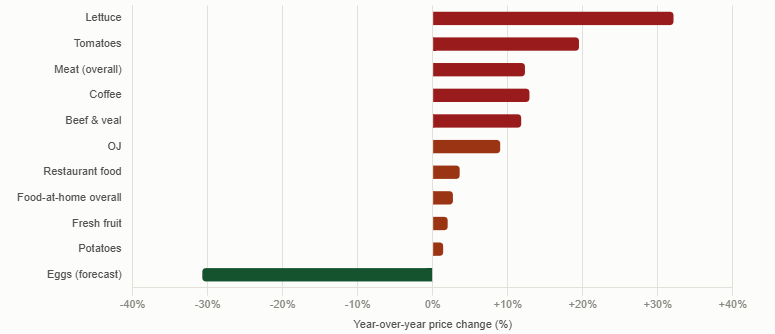
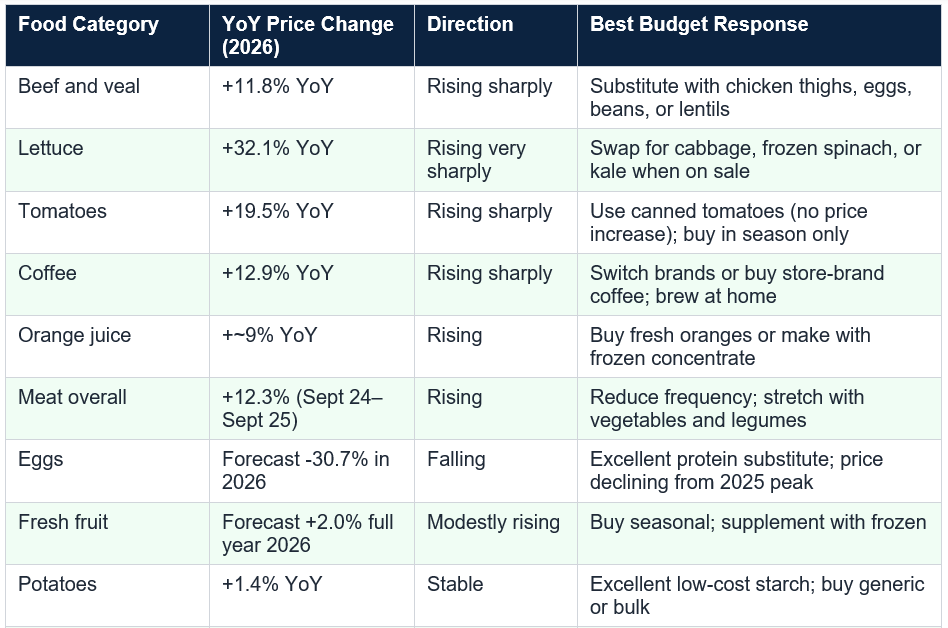
Grocery inflation is not uniform. Some categories have inflated sharply; others remain relatively stable. Understanding which categories are most volatile allows shoppers to make the highest-value substitutions and buy-downs first.
Strategy 1: Reverse-Engineer Your Meal Plan
The most effective single change most households can make to their grocery budget is also one of the most counterintuitive: stop deciding what you want to eat and then shopping for the ingredients. Start with what is cheapest this week and build the meals around those ingredients.Benjamin Lorr, author of The Secret Life of Groceries, made this point directly to AARP in December 2025: ‘Reverse-engineering your meals is a great way to save money.’ The process is straightforward: check your supermarket’s weekly circular before building the meal plan. The sales cycle at most chains rotates every few weeks, meaning proteins, produce, and staples take turns being discounted. Whatever meat, vegetable, or grain is on the deepest discount this week becomes the anchor of this week’s meals.
The Kitchn’s June 2026 survey of 50 families across the US found that meal planning was among the top strategies reported by households successfully managing rising grocery costs. Family Credit’s June 2026 guide estimated that households that meal plan consistently save 15 to 20 percent on grocery spending.
The practical implementation: plan seven dinners for the week before writing any shopping list. Match each dinner to proteins and produce that are discounted this week. Build the shopping list from those meals. The list becomes a constraint that prevents impulse purchases, eliminates duplicative buying, and ensures every item purchased has a purpose.
Jess Rice, Recipe Development Manager, Budget Bytes (AARP, December 2025): Don’t stress perfection. Recipes are meant to be flexible. The goal is to cook something satisfying and affordable, not to stick to exact ingredients.
Saving Potential — Meal planning: 15–20% reduction in grocery spend — approximately $790–$1,053/year for a household spending $438/month
Strategy 2: Switch to Store Brands and Generics
Store brands and generic products are one of the most consistently documented and most immediately accessible sources of grocery savings in 2026. BECU’s April 2026 analysis states the finding plainly: buy store brands to save up to 40 percent on your grocery bill. NetCredit’s April 2026 study comparing 171 grocery store items found that buying the store-brand version at Walmart, Kroger, or Target can save up to 75 percent compared to the equivalent name-brand product.The quality argument against store brands has been largely defeated by evidence. University of Tennessee Extension experts told UT Institute of Agriculture News in January 2026: ‘Generic store brands often are just as high in quality as their name-brand counterparts.’ Many store-brand products are manufactured by the same companies that produce the equivalent national brand, with the same ingredients, in the same facilities, under a different label.
The highest-value store-brand switches with the least quality sacrifice:
- Canned vegetables, beans, and tomatoes: identical nutritional value; the can simply says a different name. Average saving: 30 to 50 percent per unit.
- Pasta, rice, oats, and grains: commodities regulated to consistent quality standards. Store-brand pasta at $0.89 versus national brand at $1.89 is a 53 percent saving on an item purchased weekly in many households.
- Dairy — milk, butter, eggs, and cheese: regulated products with standardised quality. The store-brand version is the same product.
- Frozen vegetables and frozen fruit: identical nutritional value to fresh; store brand adds no quality disadvantage to already-equivalent product.
- Cleaning and household products: while not groceries, the same store-brand principle applies and frees budget for food.
Strategy 3: Rethink Protein — Shift Away from Beef
Beef is the category where 2026’s grocery inflation is most acutely felt and most amenable to meaningful substitution. Beef and veal prices rose 11.8 percent year-over-year, and meat overall rose 12.3 percent from September 2024 to September 2025. AARP’s December 2025 budget guide noted that now is a particularly good time to try plant-based proteins, as meat prices have risen significantly. Alternative protein sources such as lentils, beans, and tofu often cost less while providing essential nutrients.The specific protein substitution math makes the case clearly. A pound of 80/20 ground beef costs approximately $6 to $8 in most markets in 2026. A pound of dried lentils costs approximately $1.50 to $2 and, when cooked, yields significantly more servings. Chicken thighs — one of the best-value cuts in the poultry case — typically cost 30 to 50 percent less than boneless skinless chicken breast and are more flavourful when cooked. Eggs, which are forecast to fall 30.7 percent in 2026 as avian flu-affected flocks recover, represent the single best-value protein source available at any grocery store.
Practical substitutions that households are reporting to be satisfying:
- Tacos and chilli with 50 percent beans and 50 percent ground beef, or entirely with lentils — a meal that most households report as indistinguishable from the all-beef version in texture and flavour.
- Eggs for breakfast, lunch, and lighter dinners: scrambled, fried, baked in frittatas, or made into shakshuka — a $3 to $4 dozen can provide protein for multiple meals.
- Canned tuna, sardines, and mackerel: shelf-stable, high in protein and omega-3 fatty acids, and significantly cheaper per gram of protein than fresh fish or beef.
- Chicken thighs instead of chicken breasts: same protein content; 30 to 50 percent lower cost; often preferred by cooks for moistness.
Strategy 4: Embrace Frozen and Canned Produce
One of the most persistent myths of grocery shopping is that fresh produce is nutritionally superior to frozen or canned. For most vegetables and many fruits, this is simply not true. Frozen vegetables are typically flash-frozen within hours of harvest at peak nutritional density, often before fresh produce has spent its first day in transit.The financial case is equally compelling. Fresh lettuce has risen 32.1 percent year-over-year; a bag of frozen spinach — nutritionally comparable for cooking purposes — has remained stable. Fresh tomatoes are up 19.5 percent; canned whole tomatoes are essentially the same price they were two years ago and are the superior choice for any cooked application (soups, sauces, stews, chilli) where the texture of fresh tomatoes is irrelevant.
AARP’s July 2026 grocery tips guide is direct: buying frozen, store-brand, and shelf-stable foods can stretch budgets without sacrificing nutrition. The BECU April 2026 analysis concurs: canned and frozen foods are healthy and can be stored for weeks. Sometimes they are cheaper than fresh. The Kitchn’s June 2026 research found multiple surveyed families reporting permanent shifts to frozen produce as a key component of their grocery cost management.
- Frozen spinach, broccoli, peas, green beans, and mixed vegetables: flat price trend; available year-round; zero food waste (use exactly what you need).
- Canned tomatoes, black beans, chickpeas, and kidney beans: the original pantry stretchers; nutritionally dense; dramatically cheaper per serving than fresh equivalents.
- Frozen berries for smoothies, oatmeal, and baking: fresh berries can cost $4 to $6 per punnet in summer and significantly more off-season. Frozen blueberries or mixed berries deliver the same nutritional content at $2 to $3 per pound.
8. Strategy 5: Shop Where the Prices Are Lowest
Where you shop has a larger impact on your grocery bill than almost any other single decision. A Consumer Reports basket-of-goods analysis found that Aldi and Lidl were more than 8 percent cheaper than Walmart on a comparable basket. PocketGuard’s 2026 analysis put Aldi at 20 percent cheaper overall. Aldi gained 19 million new shoppers in 2025, according to the company’s own data, reflecting a broad consumer shift toward budget formats.NBC Philadelphia’s March 2026 coverage of Consumer Reports research found that shoppers are not sticking to one store. Many are making strategic multi-store trips, buying the items cheapest at Aldi or Lidl and supplementing with specialty items at their preferred chain. Consumer Reports spokesperson Torres told NBC: ‘Retailers such as Aldi and Target continue to stand out for savings by offering competitive prices and high-quality products, including good store brands.’
The practical store hierarchy by typical overall price level:
- • Aldi and Lidl: consistently 15 to 25 percent below traditional supermarket chains on a comparable basket. Best for staples, frozen goods, dairy, and produce. Limited brand selection by design.
- • Walmart and Walmart Neighbourhood Market: 10 to 15 percent below traditional chains. Broadest selection of categories including national brands alongside competitive store brand pricing.
- • Warehouse clubs (Costco, Sam’s Club, BJ’s): per-unit savings of 20 to 40 percent on non-perishable staples and bulk proteins. Requires storage capacity and predictable consumption.
- • Discount grocery outlets (Grocery Outlet, Save-A-Lot, WinCo): steep per-unit discounts, particularly on close-to-date items and overstock from major brands.
- • Traditional supermarkets with loyalty programmes: use loyalty pricing and weekly specials to compete but remain 15 to 30 percent above Aldi/Lidl on a full basket.
Saving Potential — Store switching from traditional supermarket to Aldi/Lidl for staples: $500–$1,500/year depending on household size and current store choice
Strategy 6: Master the Unit Price, Not the Sticker Price
One of the most reliable ways that grocery stores and manufacturers extract more money from shoppers is by making price comparisons difficult. A 28-oz can of tomatoes and a 14-oz can on the same shelf look like two different products; only the unit price (per ounce) reveals which is actually cheaper per serving. A ‘3 for $5’ promotion sounds like a discount but may be more expensive per unit than the competitor brand at $1.49 each.The unit price is printed on the shelf label in small type below the retail price at virtually all major US supermarkets. It is expressed in price per ounce, per pound, per unit, or per serving depending on the product category. The specific strategies:
- Compare identical products across size variations: larger packages are usually — but not always — cheaper per unit. Occasionally, a mid-size package is on a promotional price that makes it cheaper per unit than both the small and large versions.
- Compare across brands using the unit price line: the store brand and the national brand at different prices are only meaningfully comparable via their per-unit price. A national brand pasta at $2.49 for 16oz versus store brand at $0.89 for 16oz is a 64 percent per-unit saving that the sticker prices reveal instantly once you know to look.
- Beware shrinkflation: BECU’s April 2026 analysis identified this as a specific and growing risk: ‘Some manufacturers are shrinking package sizes while charging the same price. This is called shrinkflation, and food brands hope you aren’t paying attention.’ A bag of chips that was 12oz last year and is now 10oz at the same price has effectively increased in price by 20 percent without changing the sticker.
Strategy 7: Use Digital Coupons and Rebate Apps
The paper coupon clipping of previous decades has been replaced by digital savings tools that are more accessible, easier to use, and increasingly generous in their offers. PocketGuard’s 2026 grocery analysis recommended shooting for $20 to $50 per month in rebates through coupon apps — an annual range of $240 to $600 from tools that cost nothing and take under five minutes per shop to activate.- Ibotta: the most widely used grocery rebate app in the US. Submit a photo of your receipt or link your loyalty account, and Ibotta pays cashback rebates on hundreds of grocery and household products. Users reported $20 to $50 per month in savings consistently. The app also periodically offers bonus-category promotions that can significantly increase earnings during promotional periods.
- Checkout 51: similar model to Ibotta. Upload your receipt each week and earn cashback on qualifying purchases. A useful second app for offers Ibotta does not cover.
- Store loyalty apps: virtually every major US supermarket chain now operates a smartphone app with digital coupon clipping, personalised ‘just for you’ deals based on purchase history, and member-only pricing. Scanning the loyalty card (or app) at checkout ensures all loyalty pricing applies. Failing to scan consistently is one of the most common ways shoppers forfeit savings they were eligible for.
- Flipp: a digital flyer aggregator that collects weekly circulars from all local supermarkets in one app. Checking Flipp before shopping tells you which stores have the best deals this week on items you plan to buy.
Strategy 8: Reduce Food Waste — The Hidden Grocery Bill
The USDA’s data on food waste is one of the most startling in consumer research: the average American wastes approximately $1,500 worth of food per year. Families throw away 30 to 40 percent of the food they buy. Food waste is a hidden grocery bill — money spent on food that was never eaten, which effectively inflates the cost of every meal that was consumed.Family Credit’s June 2026 guide on reducing food spending notes that addressing food waste is ‘essentially free savings, since you’ve already paid for the food.’ The strategies that most effectively reduce waste:
- • FIFO in the refrigerator: First In, First Out — use older items before newer ones. Move older produce, dairy, and leftovers to the front of the refrigerator shelf each time new groceries arrive. This prevents the common scenario where items at the back of the fridge are forgotten until they spoil.
- • Freeze before it spoils: bread, meat, berries, and many vegetables can be frozen before their use-by date and used later. A loaf of bread that is two days from staling is a day away from the freezer, where it will keep for two to three months.
- • Understand best-by vs use-by: most ‘best by’ dates indicate peak quality, not safety. Dairy, bread, and canned goods are frequently still safe and usable past their best-by dates. ‘Use by’ dates are more safety-relevant but still typically indicate a conservative safety margin.
- • The weekly fridge audit: before writing the shopping list, check what is in the refrigerator and what needs to be used this week. Build one or two meals around what is already there before buying more.
Strategy 9: Cook at Home and Repurpose Leftovers
Cooking at home remains one of the most impactful decisions available to any household seeking to reduce food costs. Food-away-from-home prices rose 3.6 percent above April 2025 levels, according to USDA data. Restaurant meals and delivery orders cost 60 to 75 percent more per serving than equivalent home-cooked meals in most market categories. Every restaurant meal replaced by a home-cooked equivalent is a 60 to 75 percent saving on that meal’s cost.The leftover opportunity is equally significant. AARP’s December 2025 guide quoted Budget Bytes’ Jess Rice: ‘Using leftovers to make soups and stews is a win-win for your wallet and your time.’ Almost any cooked ingredient — roast chicken, cooked vegetables, rice, beans, pasta — can be repurposed into soup, stew, fried rice, or grain bowls the following day. A pot of chicken soup that uses the carcass of a roasted chicken, the vegetable offcuts from three days’ cooking, and leftover rice effectively generates a full meal from ingredients that would otherwise be discarded.
The ‘cook once, eat twice’ approach — deliberately cooking larger quantities of protein or grain and using the remainder in a different form the following day — reduces both cooking time and per-meal food cost. A 3-pound pork shoulder roasted on Sunday evening can provide Sunday dinner, Monday lunch sandwiches, and Wednesday pasta with pulled pork.
Saving Potential — Cooking at home + leftover repurposing: $1,500–$3,000/year for a household that currently orders takeout or dines out three or more times per week
13. Strategy 10: Buy in Bulk for Non-Perishable Staples
Bulk buying is one of the oldest and most reliable grocery savings strategies, and it remains highly effective in 2026 for the right categories. The key distinction is between non-perishable staples (where bulk buying is almost always advantageous) and perishable items (where bulk buying only saves money if everything is consumed before it spoils).The Freedom Debt Relief April 2026 guide was specific about the bulk-buying calculus: an annual warehouse club membership — at $65 for Costco Gold Star membership — pays for itself in per-unit savings on non-perishable bulk purchases if the household consistently buys the right categories in bulk. The critical rule, as the guide noted, is to only bulk-buy items you can use before they expire.
- Non-perishable staples that consistently deliver bulk savings: rice, pasta, dried beans and lentils, oats, canned tomatoes, canned fish, paper products, olive oil, nuts, seeds, and coffee.
- Items that should not be bought in bulk: fresh produce (will spoil), bread (goes stale unless frozen), most dairy, and anything in a category where you historically fail to finish before expiry.
- Warehouse clubs for meat: buying family-size packs of chicken, ground beef, or pork and portioning into meal-sized bags for the freezer captures the per-unit cost advantage of bulk buying without the spoilage risk.
Strategy 11: Shop Seasonally and Locally
Fresh produce prices are driven significantly by whether the item is in season locally or being shipped from distant growing regions. Out-of-season fresh tomatoes from Mexico in February are more expensive, less flavourful, and less nutritious than peak-season local tomatoes in August. The seasonal shopping approach aligns grocery spending with the natural price cycle of produce.The LSS Minnesota financial counselling guide notes the advantages of seasonal and local buying: farmers markets provide access to fresh produce at prices that can be competitive with supermarkets for peak-season items, particularly during the summer and autumn harvest seasons when supply is highest. Community Supported Agriculture (CSA) programmes allow households to invest in a local farm before the growing season begins and receive weekly boxes of produce throughout the season at prices that are typically 20 to 40 percent below equivalent supermarket produce.
Action: Growing a small herb garden at home is one of the highest-return-per-square-foot investments in the household grocery budget. Fresh herbs cost $3 to $5 per small bunch at a supermarket and are used in quantities small enough that the remainder frequently wilts unused. A pot of basil, rosemary, thyme, or chives on a windowsill costs $3 to $4 to establish and provides free fresh herbs for months.
Saving Potential — Seasonal produce shopping and local sourcing: $100–$300/year for a household that currently buys primarily out-of-season premium produce
Strategy 12: Use a Grocery Rewards Credit Card
A grocery rewards credit card earns cashback on every dollar spent at the supermarket, effectively reducing the cost of every grocery purchase by 3 to 5 percent. CNBC Select’s August 2026 analysis identified this as one of the most reliable ongoing grocery savings tools available. The savings apply regardless of which store you shop at, which brands you choose, or what the weekly sale cycle is.The most effective grocery cashback cards in 2026:
- • Blue Cash Preferred from American Express: 6% cashback on US supermarket purchases (up to $6,000 per year), then 1%. For a household spending $438/month on groceries ($5,256/year), this generates approximately $315/year in supermarket cashback. $95 annual fee. Net saving after fee: approximately $220/year.
- • Blue Cash Everyday from American Express (no annual fee): 3% cashback at US supermarkets with no cap. Generates approximately $158/year for the average-spend household. No annual fee makes this the better choice for lower-spending households.
- • Bank of America Customized Cash Rewards: 3% on the chosen category (which can include grocery stores) with no annual fee. Up to 5.25% for Preferred Rewards members.
- • Store-specific cards: many supermarket chains offer co-branded credit cards with 5% cashback at their own stores, plus reduced cashback elsewhere. Best for households that do most shopping at a single chain.
Saving Potential — Grocery rewards credit card (3–6% cashback): $158–$315/year on an average household grocery spend (card paid in full monthly)
Strategy 13: Watch for Shrinkflation — Always Check Unit Price
Shrinkflation deserves its own section because it is one of the most insidious forms of hidden grocery price increase — and one that standard budget-tracking approaches do not detect. When a brand reduces the package size from 16oz to 14oz while keeping the retail price at $2.49, the effective price increase is 14 percent. The sticker price has not changed. The household budget does not register a change. But the household is receiving less food for the same money.BECU’s April 2026 analysis identified shrinkflation as an increasingly common practice: ‘Some manufacturers are shrinking package sizes while charging the same. Food brands hope you aren’t paying attention.’ The consumer’s defence is the unit price. Checking the per-ounce, per-pound, or per-serving price on the shelf label every time a regular purchase is made catches shrinkflation immediately: the unit price rises even though the sticker price is unchanged.
Categories where shrinkflation has been most frequently reported in 2025–2026:
- Snack foods, chips, and crackers: packages appear the same size but contain fewer ounces due to increased fill gas and reduced product weight.
- Breakfast cereals: box dimensions unchanged; net weight reduced.
- Coffee: standard can or bag sizes moving from 12oz to 11oz or from 30oz to 28oz.
- Ice cream: half-gallon containers (64oz) reduced to 48oz or 56oz while price remains constant.
- Paper goods: toilet paper and kitchen roll reducing sheet count while maintaining pack count and price.
Strategy 14: Build a Pantry Buffer Around Sale Prices
One of the most effective and overlooked grocery savings strategies is buying more of a non-perishable item when it is at its lowest price in the sale cycle and less of it when it is at full price. Most grocery chains run predictable promotional cycles of four to six weeks on major staple categories: canned goods, pasta, coffee, olive oil, and household supplies all rotate on discount at predictable intervals.Building a small pantry buffer — storing two to four weeks’ supply of regularly used non-perishables purchased at their cycle-low price — means the household is almost never buying staples at full price. This is the strategy that underlies extreme couponing but does not require the time investment of dedicated coupon clipping; it simply requires recognising when a regularly used item is at a price lower than its usual retail.
The Thrifty Apartment’s June 2026 guide described this as ‘stacking pantry savings’: items like paper products, canned goods, pasta, rice, coffee, and cleaning supplies often cost significantly less when purchased in larger quantities during promotions. Buying these staples in bulk when on sale helps lock in lower prices and reduces the number of shopping trips needed each month.
Saving Potential — Pantry buffer strategy (buying non-perishables at cycle-low): $100–$300/year for a household with adequate storage that buys ahead of sale cycles consistently
The Combined Saving Potential: Annual Summary
Conclusion
Food costs 19.1 percent more than it did four years ago. The average US household spends $438 per month on groceries. The drivers — energy prices, avian flu, supply chain disruptions, tariffs, and cumulative inflation — are outside any individual consumer’s control. Seven in ten Americans feel the pinch. Half say it is a major source of stress.What is within every shopper’s control is the strategy they bring to the grocery store. Where they shop, what brands they choose, which proteins they build meals around, how they use what they buy, and whether they take two minutes to check the unit price before adding something to the cart: these are the variables that add up to $1,500 to $3,500 per year in savings for a household that applies four to six of the fourteen strategies described in this article consistently.
The strategies are not sacrifices. Frozen spinach is nutritionally equivalent to fresh. Store-brand pasta contains the same wheat. Lentil soup is genuinely delicious. And building a meal plan around this week’s sales produces meals that are just as satisfying as meals built around whatever sounded good on a Monday morning. The difference is not in the quality of the food that ends up on the table. The difference is in whether the household is paying the grocery store’s price or their own.
Frequently Asked Questions
How much more are Americans paying for groceries in 2026?Food costs 19.1% more in 2026 than it did four years ago, according to BLS Consumer Price Index data. The cumulative increase from 2020 to 2024 was approximately 25%. Food-at-home prices (grocery store purchases) rose 2.7% from June 2025 to June 2026 and 3.8% year-over-year in August 2026 (USDA). The average US household now spends approximately $438/month on groceries, and a family of four spends approximately $1,374/month (USDA food plan data).
What is the most effective single change to stretch a grocery budget?
The evidence consistently points to a combination of meal planning and store-brand switching as the two highest-impact strategies. Meal planning is estimated to save 15 to 20 percent of grocery spend (Family Credit, June 2026) by preventing impulse purchases and ensuring every item has a purpose. Switching to store brands saves up to 40% on applicable categories (BECU, April 2026) or up to 75% on specific items (NetCredit study of 171 grocery items, April 2026). Together, these two strategies can reduce monthly grocery spend by $100 to $250 for the average household.
Is it worth switching to Aldi or Lidl to save money on groceries?
Yes, for most households. Consumer Reports price comparison data found that Aldi and Lidl are more than 8% cheaper than Walmart on a comparable basket, and PocketGuard’s 2026 analysis puts Aldi 20% cheaper overall. Aldi gained 19 million new shoppers in 2025. Many households adopt a two-store strategy: buying staples, dairy, frozen goods, and store-brand pantry items at Aldi or Lidl, and supplementing with specialty items at their regular supermarket. This approach captures most of the discount-store savings without a complete lifestyle change.
Are store-brand groceries as good as name brands?
For most staple categories, yes. University of Tennessee Extension experts confirmed in January 2026 that generic store brands are often just as high in quality as name-brand counterparts. Many are made by the same manufacturers. The clearest equivalence is in regulated products (milk, eggs, butter, pasta) where quality standards are consistent regardless of label. There are categories where brand matters for genuine taste or formulation reasons, but these are the exception. The best approach is to trial store brands on a category-by-category basis and switch permanently where the quality difference is imperceptible.
How much food do Americans waste and how can reducing waste save money?
The USDA estimates that the average American wastes approximately $1,500 worth of food per year, and families throw away 30 to 40 percent of the food they buy. Reducing food waste requires three habits: using FIFO (First In, First Out) to ensure older items are used before newer ones; freezing food before it spoils; and planning meals around what is already in the refrigerator before buying more. Family Credit’s June 2026 guide identified food waste reduction as ‘essentially free savings’ because the food has already been purchased.
What grocery apps genuinely save money?
The most consistently recommended are: Ibotta (cashback rebates on hundreds of grocery products; $20 to $50/month for regular users); Checkout 51 (similar receipt-based cashback model); Flipp (aggregates weekly grocery circulars for price comparison before shopping); individual supermarket chain apps (personalised digital coupons and loyalty pricing). A grocery rewards credit card earning 3 to 6% cashback on supermarket spending adds a further $158 to $315/year for the average household (when paid in full monthly).
0 Comments
Be the first to share your thoughts on this article.