
Savings
Supermarket Tips for Best Deals: UK Full Guide

Table of Contents
- The UK's Grocery Bill Has Changed — and So Have the Savings
- Loyalty Cards in 2026: What Each Scheme Is Actually Worth
- Yellow Sticker Shopping: Timing Reductions for Maximum Savings
- Own Brand vs Branded: Where Switching Saves Most
- Price Comparison Apps and Digital Tools for 2026
- Smarter Shopping Habits That Add Up Over a Year
- Shop with a List — Always
- Aldi and Lidl for Staples, Big Supermarkets for Loyalty Deals
- Multi-Buy Deals: When They Help and When They Don't
- Seasonal and Local Produce: Cheaper and Better
- Bulk Buying: The Costco and Wholesale Option
- Conclusion
- Frequently Asked Questions (FAQ)
- External References

The UK's Grocery Bill Has Changed — and So Have the Savings
The UK grocery market in 2026 looks significantly different from even three years ago. Aldi has been crowned the UK's cheapest supermarket by Which? in June 2026, maintaining dominance it has held for the majority of the past year. Sainsbury's Nectar card has overtaken Tesco's Clubcard in Which?'s monthly basket comparison after a loyalty pricing war that has turned both schemes from modest rewards programmes into genuine weekly money-saving tools. Lidl overhauled its loyalty scheme entirely in May 2026, replacing its Coupon Plus system with a points-based model that brings it into line with the major supermarkets.Against this backdrop, the savings available to UK households who shop strategically have never been more substantial — or more dependent on knowing the current rules. A family of four shopping at Tesco with an active Clubcard and using member prices consistently can save £400 to £780 per year according to Morningfold's 2026 analysis. Those using Sainsbury's Nectar saved an average of 5.17% on their basket in April 2026 according to Which?'s own independent research. And those who understand yellow sticker timing, own-brand switching, price comparison apps, and multi-store shopping can stack savings across every category simultaneously.
This guide brings together every practical tip for saving money at UK supermarkets in 2026, from the loyalty schemes that reward you every week to the yellow sticker windows that can reduce a family meat purchase by 90%, from the own-brand products that consistently match branded quality to the comparison apps that find the cheapest prices without leaving your sofa. Whether you shop at Aldi, Tesco, Sainsbury's, Morrisons, or a combination, this guide has a saving waiting for you.
Loyalty Cards in 2026: What Each Scheme Is Actually Worth
Loyalty schemes have changed significantly since 2022, when Tesco and Sainsbury's shifted from slow point accumulation to member-only shelf pricing. Understanding what each scheme is actually worth to your specific shopping habits is the foundation of maximising your savings. The table below compares every major UK supermarket loyalty programme as of July 2026, including significant scheme changes from the past year: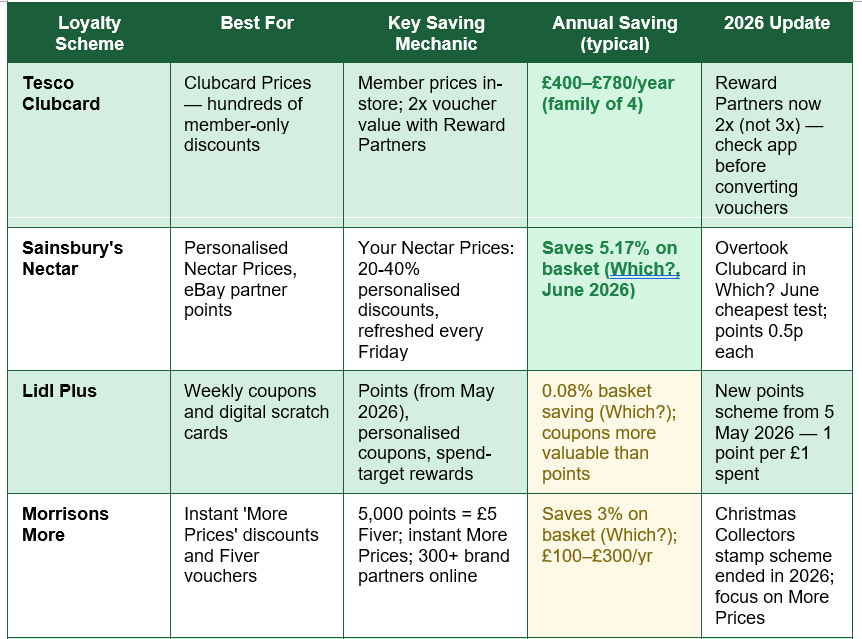
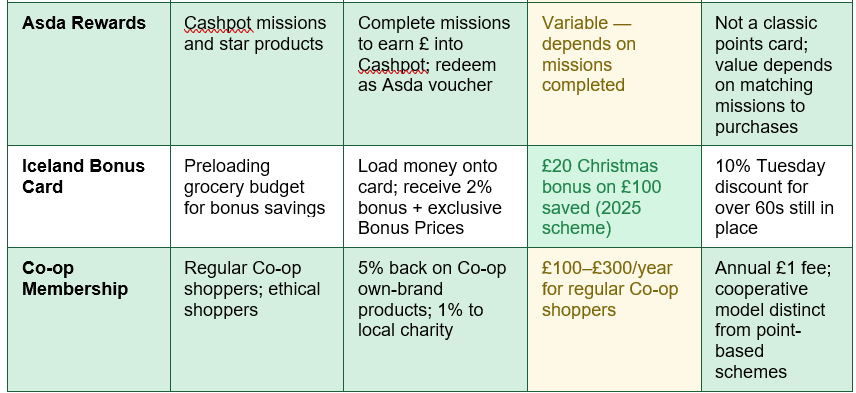
The loyalty card saving most people leave on the table: £400–£780/year for a family of four at Tesco — a family of four with a typical weekly shop including 15-25 Clubcard Price items saves £8-£15 per week — £416-£780 across a year — simply by scanning their card. Nectar saved 5.17% on a basket of 221 items in April 2026 (Which? / Morningfold, April-June 2026).
The Clubcard Reward Partners change you need to know: Older guides and social media tips frequently describe Clubcard vouchers as being worth three times their face value when spent with Reward Partners. As of 2026, this multiplier has been reduced to 2x — still excellent, but not the 3x many shoppers expect. Before converting your accumulated Clubcard vouchers into Reward Partner credit, check the current rate in the Tesco Reward Partners portal in your app. The change means a £10 voucher is worth £20 with a partner, not £30. Still well worth using, but worth double-checking before you commit.
Yellow Sticker Shopping: Timing Reductions for Maximum Savings
Yellow sticker shopping — buying items marked down because they are approaching their use-by or best-before date — is one of the most consistent and reliable savings strategies available to UK shoppers. Discounts of up to 90% on fresh items are genuinely achievable for those who shop at the right time. The timing guide below, drawn from price reduction patterns confirmed across major UK supermarkets, is the foundation of yellow sticker success: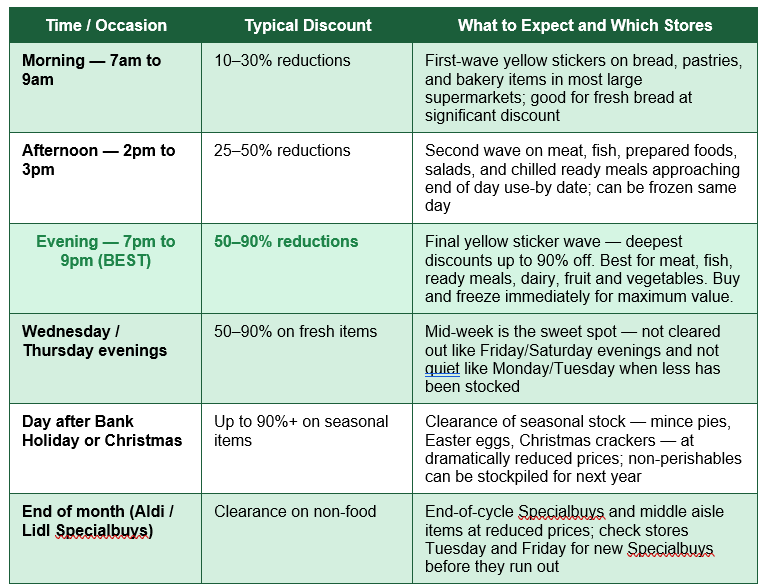
Several practical rules maximise yellow sticker value beyond timing. First, buy and freeze: almost everything with a yellow sticker can be frozen on the day of purchase, converting a one-day deal into a long-term saving. Meat, fish, bread, pastries, prepared meals, and most dairy products freeze well. Second, check the actual use-by date rather than just the yellow sticker label — a 50% discount with four days' use-by remaining is more useful than a 90% discount with today's date on it. Third, develop relationships with store staff if you shop regularly — in smaller stores, staff will often tell regular customers when reductions are coming if asked politely.
The best general principle for yellow sticker shopping is that it rewards regularity and flexibility in equal measure. Regularity — visiting the same store at the same time — means you learn when that specific store does its reductions, which varies more between individual stores than the general timing guides suggest. Flexibility — being willing to eat chicken tonight instead of what you had planned, to use fish this week because it was marked down — is what converts the yellow sticker find into actual money saved rather than a discarded impulse purchase.
Own Brand vs Branded: Where Switching Saves Most
Own-brand products — the supermarket's own-label alternatives to branded goods — represent one of the most consistent and highest-value savings available on any weekly shop. Research consistently finds that own-brand products in many categories are manufactured to the same specification as the branded equivalent, or are made in the same factory, and the difference in price reflects marketing, packaging, and brand premium rather than any meaningful difference in quality or ingredients.The categories where own-brand switching delivers the best combination of savings and quality equivalence are:
- Pantry staples: Flour, sugar, salt, rice, pasta, tinned tomatoes, tinned beans, cooking oil, and dried herbs are among the categories where own-brand quality is essentially identical to branded in blind taste tests. The saving on a weekly shop of these items by switching to own brand can be £5 to £8 per week — over £400 per year.
- Dairy: Own-brand milk, butter, hard cheese, and plain yogurt are generally indistinguishable from branded equivalents in independent taste tests. Cheddar in particular is a category where own-brand consistently outperforms in blind testing.
- Frozen vegetables: Frozen peas, sweetcorn, green beans, and mixed vegetables are virtually identical across branded and own-brand, and often nutritionally superior to fresh equivalents because they are frozen at peak freshness.
- Medication: Supermarket own-brand paracetamol, ibuprofen, antihistamine, and antacids contain the same active ingredients at the same dosages as branded equivalents like Nurofen and Panadol, at a fraction of the price. The saving on a family's annual medication budget from switching to own brand can be £30 to £80.
- Cleaning products: Own-brand washing up liquid, laundry detergent, and surface sprays perform comparably to branded alternatives in independent consumer tests, at 30-60% lower cost.
The categories where premium brands sometimes justify their price are fewer than most people assume: fresh produce (where provenance and seasonality genuinely affect taste), specialist dietary products, and some premium baked goods. For the majority of weekly shop categories, own-brand is the higher-value choice.
Price Comparison Apps and Digital Tools for 2026
The fastest-growing category of supermarket saving tools in 2026 is price comparison and deal-finding apps that eliminate the need for manual price-checking across supermarkets. Several have become genuinely useful parts of the smart shopper's toolkit:- Trolley.co.uk (formerly Supermarket Price Comparison): Compares prices across all major UK supermarkets for specific products in real time, showing you exactly which store is cheapest for each item on your list. Particularly useful before a big shop when you are deciding which store to visit.
- Too Good To Go: The UK's leading food waste reduction app, which allows users to purchase 'magic bags' of surplus food from supermarkets, bakeries, cafes, and restaurants at typically one-third of the retail value. Sainsbury's, Morrisons, Marks and Spencer, and many independent bakers operate via the app. A magic bag typically worth £10-£15 in goods costs £3-£4.99.
- Olio: A community food-sharing app where individuals and businesses (including supermarket staff) post food that is about to be wasted — often same day — for free collection. Not technically a savings app, but a genuinely free food source for those willing to check it regularly.
- Latest Deals and HotUKDeals: Community-driven deal-finding platforms where members post the best current supermarket offers, including unadvertised or short-lived discounts.
- Your supermarket's own app: The single highest-value digital tool for most shoppers is the app for their primary supermarket — Clubcard app, Sainsbury's app, Morrisons More app. These apps surface personalised discounts and activated offers that do not appear on the website or in-store without the app, and activating them before you arrive in store is where significant additional savings come from.
Smarter Shopping Habits That Add Up Over a Year
Shop with a List — Always
Supermarkets are designed by expert marketers to encourage unplanned purchases. The layout, the eye-level positioning of premium products, the end-of-aisle 'deals,' the multi-buy promotions that create a sense of urgency — these are sophisticated psychological tools that consistently produce overspending in shoppers who arrive without a clear list. The research on unplanned purchases consistently shows that shoppers without a list spend 20-40% more than those with one. A specific weekly meal plan that generates a specific shopping list is the highest-single-action savings strategy available.QUICK WIN: Spend 10 minutes each Sunday writing a weekly meal plan and a shopping list from it. Buy only what is on the list. This one habit, consistently applied, saves more per year for most households than any loyalty scheme.
Aldi and Lidl for Staples, Big Supermarkets for Loyalty Deals
The most financially optimal strategy for most UK households in 2026 is a hybrid approach: buy staples, own-brand items, and fresh produce at Aldi or Lidl (both consistently among the cheapest for these categories), and use a loyalty card at a big supermarket for branded items where member prices produce significant discounts. This approach avoids the false choice between 'shop only at discounters' and 'use loyalty cards' — it captures the benefits of both. The Which? cheapest supermarket analysis from June 2026 shows Aldi as the cheapest overall but with no loyalty scheme, while Tesco and Sainsbury's are more expensive on the base price but materially cheaper for loyalty card holders on member-priced items.Multi-Buy Deals: When They Help and When They Don't
Multi-buy promotions — 'three for two,' 'buy two get one free,' 'two for £X' — are designed to increase basket size, and they do. The key question is: would you have bought the extra items anyway, and can you consume them before they go out of date? Multi-buys on non-perishables (pasta, tinned goods, cleaning products, toilet paper) where you will definitely use the extra items represent genuine savings. Multi-buys on fresh items where the extra portion will go to waste represent a price increase disguised as a deal. Before accepting any multi-buy promotion, ask: 'Do I actually need three of these?'Seasonal and Local Produce: Cheaper and Better
Buying fruit and vegetables that are in season and locally grown is consistently cheaper than buying out-of-season equivalents imported from abroad — and usually higher quality. Strawberries in June cost a fraction of what they cost in December. British new potatoes in summer, British apples in autumn, British cauliflower in winter — following seasonal availability is a free saving that also supports British farmers and reduces food miles. Most major supermarkets label seasonal British produce prominently in-store.MONEY SAVER: Check the supermarket's 'weekly specials' or 'fresh deals' section on their website or app before planning your meals for the week. Build your meal plan around what is on offer rather than planning first and shopping second. This reversal of the conventional approach can save £5-£10 per week.
Bulk Buying: The Costco and Wholesale Option
For households with the cash flow to pre-purchase and the storage space to accommodate them, bulk buying non-perishable essentials at wholesale prices — through Costco, Booker, Makro, or online wholesalers — can reduce per-unit costs by 20-40% on items like coffee, laundry detergent, toilet paper, cleaning products, and dried goods. Costco membership costs approximately £33 per year; for families who shop there regularly for staples, the saving on the membership is typically covered within one or two visits.Conclusion
Saving money at UK supermarkets in 2026 is a combination of knowing the current schemes and using them consistently. The loyalty card landscape has genuinely shifted in the past two years — Clubcard Prices and Nectar Prices are real discounts, not just points that accumulate invisibly, and families who scan their cards consistently are saving hundreds of pounds per year compared with those who do not. Sainsbury's Nectar overtook Clubcard in Which?'s June 2026 analysis; Aldi remains the outright cheapest supermarket for those without loyalty scheme access. The optimal approach is to use both.Yellow sticker shopping, if you can shop in the evening and have freezer space, can reduce the cost of fresh protein and produce by 50-90% — genuinely transformative for household food budgets. Own-brand switching across staples, dairy, frozen vegetables, medication, and cleaning products delivers consistent savings with no meaningful quality trade-off. Price comparison apps like Trolley.co.uk eliminate the need to manually check prices across stores. Too Good To Go converts imminent-waste food into savings of 60-70% off retail.
The underlying principle that connects all of these strategies is the same: the supermarket's default settings are designed in the supermarket's financial interest, not yours. Loyalty cards reward engagement over passivity. Yellow stickers reward timing over convenience. Own brands reward openness over brand loyalty. Meal planning rewards intentionality over impulse. Every strategy in this guide is a step away from the supermarket's default and toward your own. The cumulative value, for households who apply even a handful of these tips consistently across a year, runs well into the hundreds of pounds.
Frequently Asked Questions (FAQ)
Which is the cheapest UK supermarket in 2026?
Aldi was crowned the cheapest UK supermarket in Which?'s June 2026 monthly analysis, a position it has held across 10 of the previous 12 months, having only lost to Lidl in July and October 2025. Aldi and Lidl consistently offer the lowest base prices on branded and own-brand groceries, particularly for fresh produce, dairy, and staples. However, they do not offer loyalty schemes, which means shoppers using Tesco Clubcard Prices or Sainsbury's Nectar Prices can close the gap significantly on member-priced items. For loyalty card holders, Sainsbury's with Nectar overtook Tesco with Clubcard in June 2026 according to Which?'s research.What time do supermarkets put out yellow stickers?
Yellow sticker reduction times vary by store but follow broadly consistent patterns across UK supermarkets. The morning wave (7-9am) covers bakery and bread items at 10-30% off. The afternoon wave (2-3pm) reduces meat, fish, and prepared foods at 25-50% off. The evening wave from approximately 7pm onward produces the deepest discounts — often 50-90% off fresh items including meat, fish, ready meals, dairy, fruit, and vegetables. Wednesday and Thursday evenings are the optimal combination of good availability and maximum discounts. Items bought with yellow stickers can be frozen on the day of purchase to extend their use beyond the original use-by date.Is the Tesco Clubcard still worth having in 2026?
Yes — Tesco Clubcard remains one of the most valuable supermarket loyalty schemes in the UK in 2026. A family of four using Clubcard Prices consistently saves an estimated £400 to £780 per year through member-only discounts on hundreds of products. Clubcard vouchers can also be redeemed with Reward Partners at double their face value (note: the multiplier is now 2x, not the 3x cited in older guides — check the current rate in the app before converting). Sainsbury's Nectar slightly edged Clubcard in Which?'s April and June 2026 basket comparisons, but both schemes represent meaningful real savings for regular users.Is it worth buying own-brand supermarket products?
For most product categories, yes. Supermarket own-brand pantry staples (pasta, rice, flour, sugar, tinned goods, cooking oil), dairy (milk, butter, hard cheese), frozen vegetables, and cleaning products are consistently found to match or closely approximate branded equivalents in independent consumer tests — at 20-60% lower prices. The category where own-brand most clearly delivers equivalent quality at lower cost is medication: own-brand paracetamol, ibuprofen, and antihistamines contain identical active ingredients at identical dosages to branded equivalents at a fraction of the price. Switching to own brand across these categories for a family of four typically saves £400-£600 per year.What is Too Good To Go and how does it work?
Too Good To Go is a UK app that partners with supermarkets, bakeries, cafes, and restaurants to sell surplus food that would otherwise be wasted. Users browse available 'magic bags' near them in the app, pay a fixed price (typically £3.09 to £4.99 per bag), and collect the bag during a specified collection window. The contents are a surprise — usually a mix of items approaching their use-by date — but are typically worth £10 to £15 at full retail price. Major UK supermarkets including Sainsbury's, Morrisons, and Marks and Spencer participate. The app is free to download and there is no subscription fee. It is one of the most consistent sources of dramatically discounted fresh food available to UK households in 2026.External References
The following authoritative sources were used in researching this article and are recommended for further reading:1. Which? — Aldi Crowned UK's Cheapest Supermarket in June 2026 (July 2026)
https://www.which.co.uk/news/article/cheapest-supermarket-of-the-month-ag3nQ4J0v6ht
2. Which? — Loyalty Cards Compared: Clubcard vs Nectar and More (May 2026)
https://www.which.co.uk/reviews/supermarkets/article/loyalty-schemes-compared-a4ERY9a5NFJd
3. GetSmartSaver — Best Supermarket Loyalty Schemes UK 2026 Full Comparison (June 2026)
https://getsmartsaver.co.uk/best-supermarket-loyalty-schemes-uk-2026/
4. Morningfold — UK Supermarket Loyalty Cards 2026: What UK Shoppers Actually Save (April 2026)
https://morningfold.co.uk/articles/best-uk-supermarket-loyalty-card-2026/
5. TopCashback — How to Make the Most of Supermarket Loyalty Cards (June 2026)
https://www.topcashback.co.uk/guides/supermarket-loyalty-cards-guide/
6. Too Good To Go — Fight Food Waste and Save Money (Official App)
https://www.toogoodtogo.com/en-gb/
7. Trolley.co.uk — UK Supermarket Price Comparison Tool
https://www.trolley.co.uk/
8. MoneySavingExpert — Supermarket Price Wars: Cheapest Supermarket and Best Deals
https://www.moneysavingexpert.com/shopping/cheapest-supermarket/
0 Comments
Be the first to share your thoughts on this article.