
Financial Literacy
The $10 Decision That May Be Costing You Thousands Over Time

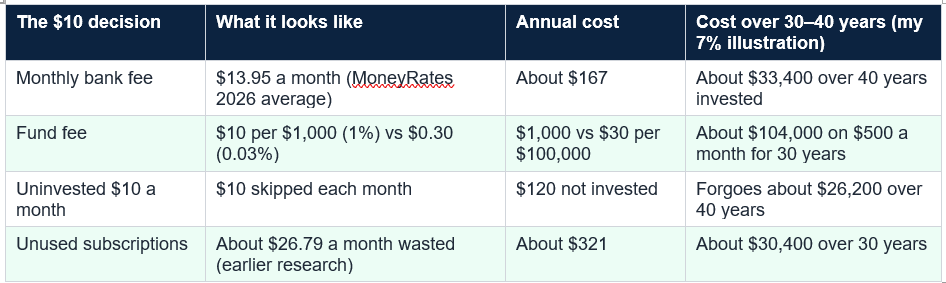
MoneyRates 2026 average monthly maintenance fee $13.95 ($167.40 a year; more than 37% of accounts charge none; 70.7% of online accounts are free vs 32.4% of traditional); Bankrate 2025 average $5.47 on non-interest checking (47% free) and $15.65 on interest checking; overdraft fees $26.77 (Bankrate, 94% of accounts) to $30.82 (MoneyRates). Investing costs: a 1% fund fee is $10 per $1,000 a year, vs about $0.30 for a 0.03% index fund; 79% of active large-cap funds trailed the S&P 500 in 2025; national average savings rate 0.59% vs 4.35% at the top. My arithmetic at 7%: a $13.95 monthly fee costs about $33,400 over 40 years if the money would have been invested; $10 a month invested for 40 years grows to about $26,200 from $4,800; a 1% vs 0.03% fund gap on $500 a month for 30 years is about $104,000; five small leaks totaling about $1,210 a year, invested for 30 years, are worth about $114,000.
In this guide, “the $10 decision” is a shorthand for three versions of the same mistake. The first is paying a monthly bank fee of about $10 to $14. The second is paying $10 for every $1,000 you invest each year, which is what a 1% fund fee costs. The third is leaving $10 a month uninvested. I will use 2026 data where I can find it and my own arithmetic to put dollar signs on each. None of this requires a budget overhaul, only about half an hour.
It also depends where you bank. MoneyRates found 70.7% of online checking accounts have no monthly fee, against 32.4% of traditional ones, and its small-bank average was $10.95 against $16.35 at large banks. Examples of big-bank fees include $12 at Bank of America’s Advantage account, waivable with a $250 direct deposit or a $1,500 balance, and $15 at Chase’s Total Checking. Then there are overdraft fees: $26.77 on average in Bankrate’s survey, charged by 94% of accounts, and $30.82 in MoneyRates’, which can cascade if several transactions hit an overdrawn account.
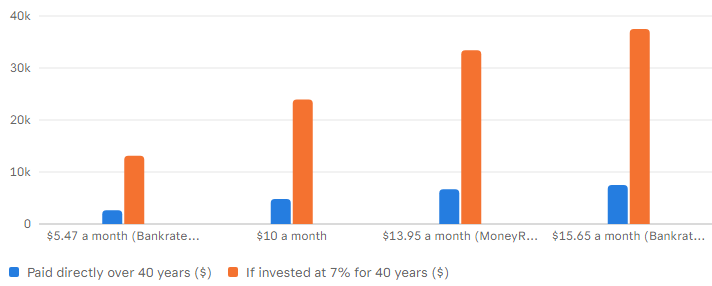
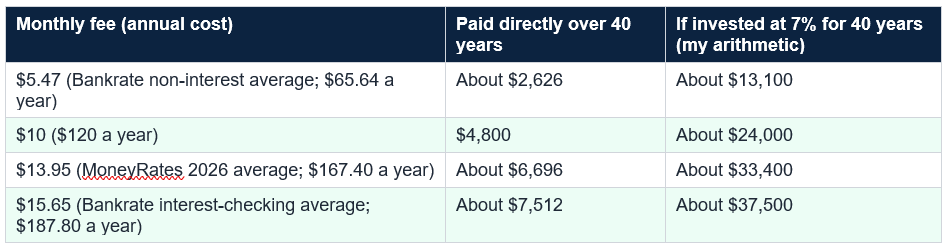
Here is the math, my own. At $13.95 a month, you pay $167.40 a year, or about $6,700 over 40 years. If that money would otherwise have been invested at a constant 7%, the real cost is about $33,400. Even at Bankrate’s lower $5.47 average the figure is about $13,100, and at $15.65 about $37,500. And that is before overdraft fees: one $30.82 fee a quarter adds about $123 a year. A customer who pays the average fee, one overdraft a quarter and weekly out-of-network ATM fees could pay around $425 a year, according to SuperMoney.
MoneyRates 2026: average monthly checking fee $13.95 ($167.40 a year); more than 37% of accounts charge none; 70.7% of online accounts are free vs 32.4% of traditional. Bankrate 2025: $5.47 on non-interest checking (47% free); $15.65 on interest checking; overdraft $26.77 (94% of accounts). A $13.95 fee over 40 years, invested at 7%, costs about $33,400.
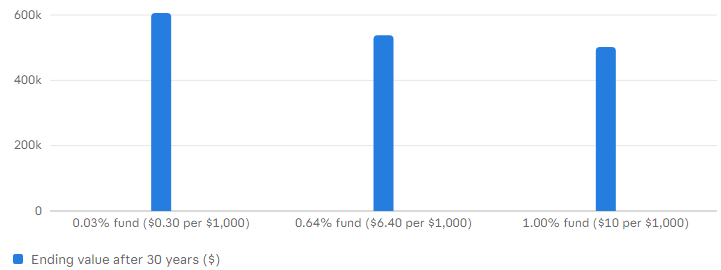
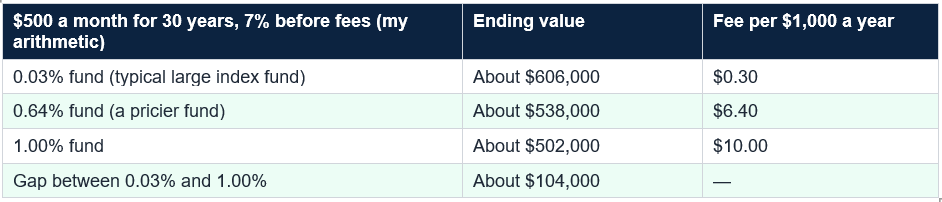
Over time the gap is large. In my illustration, $500 a month for 30 years at 7% before fees grows to about $606,000 at a 0.03% fee, about $538,000 at 0.64% and about $502,000 at 1%. The difference between 1% and 0.03% is roughly $104,000. And higher fees have not reliably bought better results: S&P Dow Jones Indices found 79% of active large-cap funds trailed the S&P 500 in 2025. Check the expense ratio of every fund you own, including those in your 401(k), where the menu may include costly options.
Subscriptions are a close cousin. In earlier research for this series, a Self Financial survey found 59.9% of people had a subscription they no longer use, and a typical wasted amount of about $26.79 a month, which I did not re-retrieve for this article. That is about $321 a year, and if invested for 30 years at 7%, roughly $30,400. You do not need to cancel everything you enjoy. You need to cancel what you do not use, and redirect even half of it. Small automatic investing beats large intentions.

The caveat is that high-yield rates are variable and can change, and after tax they roughly match inflation of 3.7%. But the gap versus 0.59% is real, and since there is no cost to moving an online account, it is one of the easiest leaks to plug. Bankrate found only 46% of Americans could cover three months of expenses, so a cushion in a decent account has value on top of the interest.
That is a hypothetical, and not every household has all five. But it shows the scale: individually these are $10 decisions, and together they are a decent car or a few years of college costs. The point is not to feel guilty about small spending. It is that fixing them takes minutes and pays for decades, which is one of the best returns in personal finance.
In the next ten minutes, check the expense ratio of every fund in your 401(k), IRA and brokerage accounts. Anything above about 0.5% deserves a look, and broad index funds at 0.03% to 0.04% are widely available. In the final ten minutes, list your subscriptions, cancel what you do not use and move your savings to a better account if you earn under 3%. Then set up an automatic transfer of whatever you saved, even $10 or $25 a month, to savings or investments.

Pick one of the three: look up the fee on your checking account, the expense ratio on your biggest fund or the rate on your savings account. Fixing just one this week is worth more than a perfect plan next month.
Also remember that my compounding figures assume a constant 7% return, which real markets do not deliver, and that fees and rates differ by institution. They illustrate scale, not a forecast. The $10 mindset is about attention, not austerity: look at what repeats, ask what it buys you and keep the ones that are worth it.
The good news is that each is quick to fix. Spend half an hour checking your bank statements, your fund fees, your subscriptions and your savings rate, ask your bank to waive what it can and automate whatever you free up. Keep what you value, cancel what you do not and remember that the returns are illustrations, not promises. This is general education, not personalized advice, and a qualified adviser can help you decide what fits.
It is my shorthand for small, repeating money choices that look trivial but compound: paying a $10 to $14 monthly bank fee, paying $10 per $1,000 a year in fund fees (a 1% expense ratio), or leaving $10 a month uninvested. Each is cheap in the moment and expensive over decades, because the money lost would have grown.
How common are monthly checking account fees?
Common but avoidable. MoneyRates’ 2026 survey put the average monthly maintenance fee at $13.95, or about $167 a year, with more than 37% of accounts charging none. Bankrate’s 2025 survey found a $5.47 average on non-interest checking, with 47% of those accounts free, and a $15.65 average on interest-bearing accounts. The surveys differ in scope and date.
How much does a 1% fund fee really cost?
A 1% expense ratio costs $10 for every $1,000 invested each year, or $1,000 a year on $100,000, against about $30 for a 0.03% index fund. In my illustration, $500 a month for 30 years at 7% before fees grows to about $606,000 at 0.03% and about $502,000 at 1%, a gap of roughly $104,000.
Is it worth chasing every small fee?
No. Start with the biggest and most recurring: bank fees you can waive, fund fees above 0.5% and subscriptions you do not use. Do not give up everything small. The goal is to stop paying for things you do not value, not to eliminate all enjoyment. This is general education, not personal advice.
How do I avoid bank fees?
Move to a no-fee account (MoneyRates found 70.7% of online checking accounts charge no monthly fee versus 32.4% of traditional ones), meet waiver requirements such as direct deposit or a minimum balance, opt out of overdraft coverage or set low-balance alerts, and use in-network ATMs. Ask your bank to waive a fee, since many will.
Table of Contents
- Why $10 Is the Most Dangerous Number
- The Short Answer
- The $10 Decision 1: The Monthly Bank Fee
- The $10 Decision 2: $10 Per $1,000 in Fund Fees
- The $10 Decision 3: The $10 You Never Invest
- The Bonus Leak: Savings at 0.59%
- Stacking the Leaks
- A 30-Minute Fix List
- When Not to Sweat the Small Stuff
- Common Mistakes
- Conclusion
- Frequently Asked Questions
The monthly bank fee: what it costs directly vs. what it costs if invested ($)
Dollars over 40 years by Fee averages from Bankrate (2025) and MoneyRates (2026); dollar figures are the author's arithmetic at a constant 7% with annual contributions; not forecasts
$10 per $1,000: what a 1% fund fee costs on $500 a month over 30 years ($)
Ending value ($) by Author's arithmetic: 7% before fees, monthly contributions, no taxes; the gap between 0.03% and 1% is about $104,000; index funds charge 0.015%-0.04% (Bankrate)
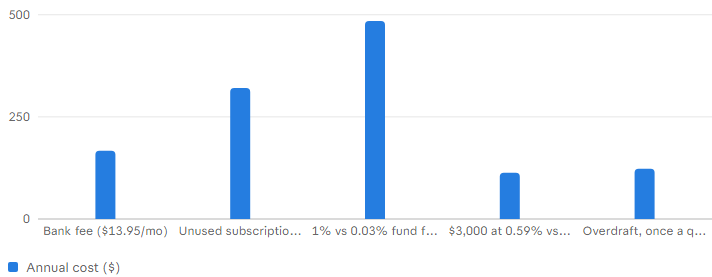
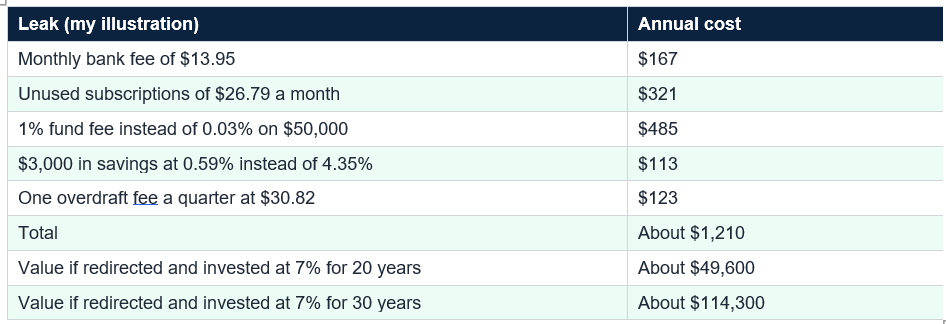
Stacking the leaks: five small costs in a hypothetical household (about $1,210 a year)
Dollars per year by Author's hypothetical illustration; subscription figure from earlier research (not re-retrieved); invested at 7%, the total is worth about $49,600 after 20 years and $114,300 after 30Why $10 Is the Most Dangerous Number
Nobody lies awake worrying about $10. It is under the threshold where we check a statement, argue with a customer service agent or change a habit. That is exactly why it is dangerous. A $10 charge that repeats every month, or a $10 cost hidden in every $1,000 you invest, never feels big enough to deal with, and quietly takes thousands of dollars over a lifetime. The big financial mistakes make headlines. The small, repeating ones just make you poorer.In this guide, “the $10 decision” is a shorthand for three versions of the same mistake. The first is paying a monthly bank fee of about $10 to $14. The second is paying $10 for every $1,000 you invest each year, which is what a 1% fund fee costs. The third is leaving $10 a month uninvested. I will use 2026 data where I can find it and my own arithmetic to put dollar signs on each. None of this requires a budget overhaul, only about half an hour.
The Short Answer
A $10 decision can cost thousands because of two forces: repetition and compounding. A $13.95 monthly fee, the average in one 2026 survey, is about $167 a year, and if that money would have been invested at a constant 7%, it is worth about $33,400 over 40 years. A 1% fund fee instead of 0.03% on $500 a month for 30 years costs roughly $104,000. And $10 a month invested for 40 years grows to about $26,200 from just $4,800 contributed. The fix for each is cheap and fast: switch or waive the fee, choose a low-cost index fund and automate even a small amount.
The $10 Decision 1: The Monthly Bank Fee
Start with the bank fee, because it is the easiest to remove. MoneyRates’ 2026 Checking Account Fee survey puts the average monthly maintenance fee at $13.95, or about $167 a year, with more than 37% of accounts charging nothing. Bankrate’s 2025 survey found a lower average of $5.47 on non-interest checking accounts, with 47% of them free, and a higher $15.65 on interest-bearing accounts, nearly nine in ten of which charge a fee. The numbers differ because the surveys cover different accounts and dates, but the pattern is the same: the fee is common, around $5 to $15, and often avoidable.It also depends where you bank. MoneyRates found 70.7% of online checking accounts have no monthly fee, against 32.4% of traditional ones, and its small-bank average was $10.95 against $16.35 at large banks. Examples of big-bank fees include $12 at Bank of America’s Advantage account, waivable with a $250 direct deposit or a $1,500 balance, and $15 at Chase’s Total Checking. Then there are overdraft fees: $26.77 on average in Bankrate’s survey, charged by 94% of accounts, and $30.82 in MoneyRates’, which can cascade if several transactions hit an overdrawn account.
Here is the math, my own. At $13.95 a month, you pay $167.40 a year, or about $6,700 over 40 years. If that money would otherwise have been invested at a constant 7%, the real cost is about $33,400. Even at Bankrate’s lower $5.47 average the figure is about $13,100, and at $15.65 about $37,500. And that is before overdraft fees: one $30.82 fee a quarter adds about $123 a year. A customer who pays the average fee, one overdraft a quarter and weekly out-of-network ATM fees could pay around $425 a year, according to SuperMoney.
MoneyRates 2026: average monthly checking fee $13.95 ($167.40 a year); more than 37% of accounts charge none; 70.7% of online accounts are free vs 32.4% of traditional. Bankrate 2025: $5.47 on non-interest checking (47% free); $15.65 on interest checking; overdraft $26.77 (94% of accounts). A $13.95 fee over 40 years, invested at 7%, costs about $33,400.
The $10 Decision 2: $10 Per $1,000 in Fund Fees
The second version is hidden in your investments. A fund’s expense ratio is its annual fee as a percentage of your money, and 1% is $10 for every $1,000 you hold, each year. On $100,000 that is $1,000 a year. A low-cost S&P 500 index fund charges 0.015% to 0.04% according to Bankrate, so 0.03% costs about $30 a year on the same $100,000, a difference of $970 a year for owning essentially the same market.Over time the gap is large. In my illustration, $500 a month for 30 years at 7% before fees grows to about $606,000 at a 0.03% fee, about $538,000 at 0.64% and about $502,000 at 1%. The difference between 1% and 0.03% is roughly $104,000. And higher fees have not reliably bought better results: S&P Dow Jones Indices found 79% of active large-cap funds trailed the S&P 500 in 2025. Check the expense ratio of every fund you own, including those in your 401(k), where the menu may include costly options.
The $10 Decision 3: The $10 You Never Invest
The third version is the money you could have invested and did not. It is the cruelest because nothing is charged: the cost is invisible. In my illustration, $10 a month invested for 40 years at a constant 7% grows to about $26,200, from only $4,800 of contributions. For 30 years it reaches about $12,200. It is not retirement money, but it is a free multiple, and the habit it builds, automatic investing, matters more than the amount.Subscriptions are a close cousin. In earlier research for this series, a Self Financial survey found 59.9% of people had a subscription they no longer use, and a typical wasted amount of about $26.79 a month, which I did not re-retrieve for this article. That is about $321 a year, and if invested for 30 years at 7%, roughly $30,400. You do not need to cancel everything you enjoy. You need to cancel what you do not use, and redirect even half of it. Small automatic investing beats large intentions.
The Bonus Leak: Savings at 0.59%
A fourth leak is a savings account paying almost nothing. Bankrate’s survey put the national average savings rate at 0.59% on November 2, while the top high-yield accounts paid about 4.35%, led by Openbank. On $1,000, that is about $5.90 versus $43.50 a year, a gap of about $37.60 per $1,000. On $3,000 it is about $113, which is again a “$10 a month” decision: about $9.40 a month. Moving it is a ten-minute job, and I covered the trade-offs in an earlier guide to high-yield savings.The caveat is that high-yield rates are variable and can change, and after tax they roughly match inflation of 3.7%. But the gap versus 0.59% is real, and since there is no cost to moving an online account, it is one of the easiest leaks to plug. Bankrate found only 46% of Americans could cover three months of expenses, so a cushion in a decent account has value on top of the interest.
Stacking the Leaks
The leaks rarely come alone. Imagine a household with a $13.95 monthly bank fee ($167 a year), $26.79 a month of unused subscriptions ($321), a 1% fund fee on $50,000 instead of 0.03% (about $485 extra), $3,000 in a 0.59% savings account instead of 4.35% (about $113) and one overdraft fee a quarter ($123). In my illustration that totals about $1,210 a year. Redirected and invested at a constant 7%, it is worth about $49,600 after 20 years and about $114,300 after 30.That is a hypothetical, and not every household has all five. But it shows the scale: individually these are $10 decisions, and together they are a decent car or a few years of college costs. The point is not to feel guilty about small spending. It is that fixing them takes minutes and pays for decades, which is one of the best returns in personal finance.
A 30-Minute Fix List
Here is how to plug the leaks in half an hour. In the first ten minutes, open your last two bank statements and look for monthly fees, overdraft charges and ATM fees. If you find a maintenance fee, check how to waive it (a direct deposit or minimum balance) or switch to a no-fee account, since MoneyRates found most online accounts are free. Call or message the bank and ask for the fee to be refunded or waived: it often works. Opt out of overdraft coverage or set low-balance alerts.In the next ten minutes, check the expense ratio of every fund in your 401(k), IRA and brokerage accounts. Anything above about 0.5% deserves a look, and broad index funds at 0.03% to 0.04% are widely available. In the final ten minutes, list your subscriptions, cancel what you do not use and move your savings to a better account if you earn under 3%. Then set up an automatic transfer of whatever you saved, even $10 or $25 a month, to savings or investments.
Pick one of the three: look up the fee on your checking account, the expense ratio on your biggest fund or the rate on your savings account. Fixing just one this week is worth more than a perfect plan next month.
When Not to Sweat the Small Stuff
A word of balance. Chasing every small cost can become its own waste of time, and cutting every treat is not a plan. Some small costs are worth paying: a $10 monthly subscription you use daily, a coffee you love, a bank whose branch you rely on. The aim is to stop paying for things you do not value, especially recurring ones, not to eliminate pleasure. Before you obsess over $10, make sure the big things are in place: an emergency fund, the employer match, high-interest debt and a decent savings rate.Also remember that my compounding figures assume a constant 7% return, which real markets do not deliver, and that fees and rates differ by institution. They illustrate scale, not a forecast. The $10 mindset is about attention, not austerity: look at what repeats, ask what it buys you and keep the ones that are worth it.
Common Mistakes
Common mistakes include assuming a fee is unavoidable without asking, never checking the expense ratio of a 401(k) fund, keeping a savings balance in a 0.59% account out of inertia, ignoring overdraft settings and canceling a useful service while ignoring the big leaks. Another is switching banks for a $50 bonus without checking the monthly fee afterwards. And many people save the money from a fixed fee but then spend it, rather than automating it into savings, which is how the benefit disappears.Conclusion
The $10 decision is not one decision but a type: small, recurring choices that compound. A $13.95 monthly bank fee, the average in MoneyRates’ 2026 survey, costs about $167 a year and about $33,400 over 40 years if invested at 7%. A 1% fund fee instead of 0.03% costs about $104,000 on $500 a month over 30 years, and $10 a month invested for 40 years builds about $26,200 from $4,800. Stacked together, five small leaks of about $1,210 a year are worth about $114,000 over 30 years in my illustration.The good news is that each is quick to fix. Spend half an hour checking your bank statements, your fund fees, your subscriptions and your savings rate, ask your bank to waive what it can and automate whatever you free up. Keep what you value, cancel what you do not and remember that the returns are illustrations, not promises. This is general education, not personalized advice, and a qualified adviser can help you decide what fits.
Frequently Asked Questions
What is the “$10 decision”?It is my shorthand for small, repeating money choices that look trivial but compound: paying a $10 to $14 monthly bank fee, paying $10 per $1,000 a year in fund fees (a 1% expense ratio), or leaving $10 a month uninvested. Each is cheap in the moment and expensive over decades, because the money lost would have grown.
How common are monthly checking account fees?
Common but avoidable. MoneyRates’ 2026 survey put the average monthly maintenance fee at $13.95, or about $167 a year, with more than 37% of accounts charging none. Bankrate’s 2025 survey found a $5.47 average on non-interest checking, with 47% of those accounts free, and a $15.65 average on interest-bearing accounts. The surveys differ in scope and date.
How much does a 1% fund fee really cost?
A 1% expense ratio costs $10 for every $1,000 invested each year, or $1,000 a year on $100,000, against about $30 for a 0.03% index fund. In my illustration, $500 a month for 30 years at 7% before fees grows to about $606,000 at 0.03% and about $502,000 at 1%, a gap of roughly $104,000.
Is it worth chasing every small fee?
No. Start with the biggest and most recurring: bank fees you can waive, fund fees above 0.5% and subscriptions you do not use. Do not give up everything small. The goal is to stop paying for things you do not value, not to eliminate all enjoyment. This is general education, not personal advice.
How do I avoid bank fees?
Move to a no-fee account (MoneyRates found 70.7% of online checking accounts charge no monthly fee versus 32.4% of traditional ones), meet waiver requirements such as direct deposit or a minimum balance, opt out of overdraft coverage or set low-balance alerts, and use in-network ATMs. Ask your bank to waive a fee, since many will.
0 Comments
Be the first to share your thoughts on this article.