

Taxes
The $3,000 IRS Rule That Can Lower Your Taxable Income
Most investors know that selling a losing investment hurts. Fewer know that the loss can be put to work — first to offset capital gains dollar for dollar, and then to reduce ordinary taxable income by up to $3,000 per year. Any remaining loss carries forward indefinitely. This is one of the most underused legal tax reduction tools in the US tax code — and with Kiplinger publishing a detailed guide just four days ago, the 2026 tax year is the moment to act on it.

Kiplinger published a detailed guide to this rule just four days before this article (September 2026), and described the current moment precisely: 'As the final quarter of 2026 approaches, you may be taking a closer look at your investment portfolio, weighing which losses are temporary setbacks and which positions no longer make sense to hold. Thankfully, selling an underperforming investment can not only free up cash to put elsewhere but also offer a tax benefit.'
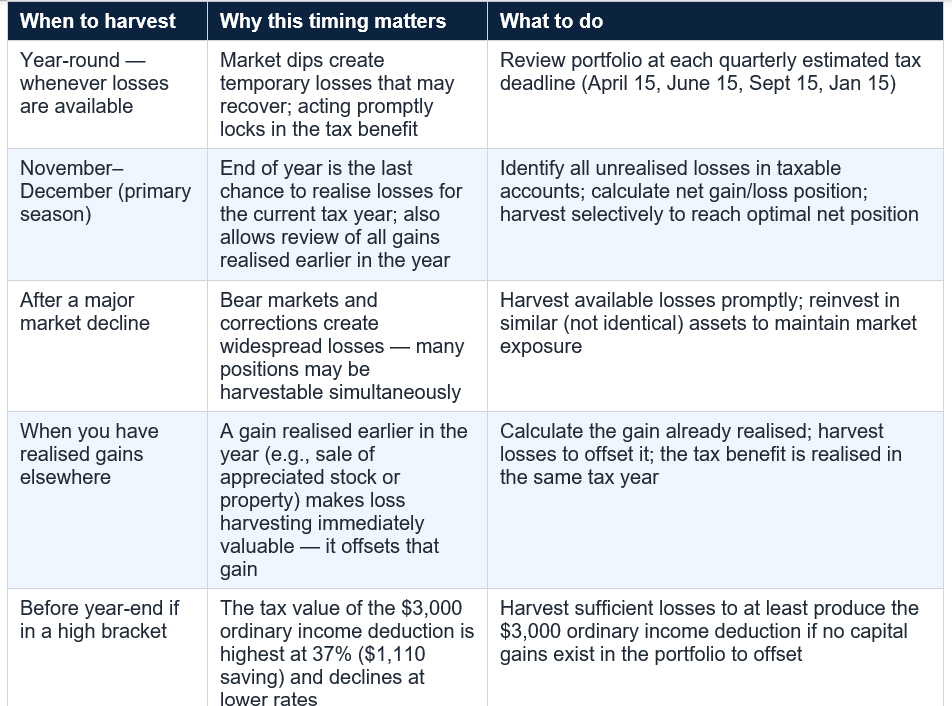
This strategy goes by several names: tax-loss harvesting, capital loss harvesting, or loss realisation for tax purposes. Investment professionals consider November and December the primary season for it — but as Instead.com notes in its 2026 guide, it can and should be reviewed throughout the year, aligned with quarterly estimated tax payment deadlines. The rules themselves haven't changed for 2026 — the $3,000 limit has been fixed by statute since 1978 — but the opportunity to use them is reset fresh with every new tax year.
$3,000: maximum net capital loss deductible against ordinary income per year (IRS Topic 409). $1,500: limit for married filing separately. Fixed by statute since 1978 — never adjusted for inflation. In 1978 purchasing power, $3,000 ≈ $14,000 in 2026 dollars. Capital losses offset gains first: no annual cap on gain offsets. Excess loss: carries forward indefinitely. Wash sale rule: 61-day window (30 days before + sale day + 30 days after). Form 8949 + Schedule D: how losses are reported.
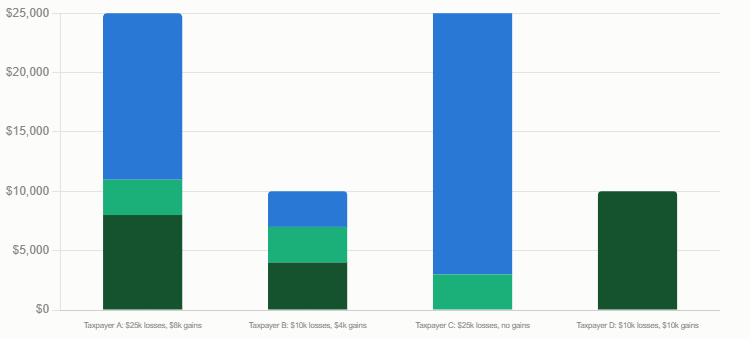
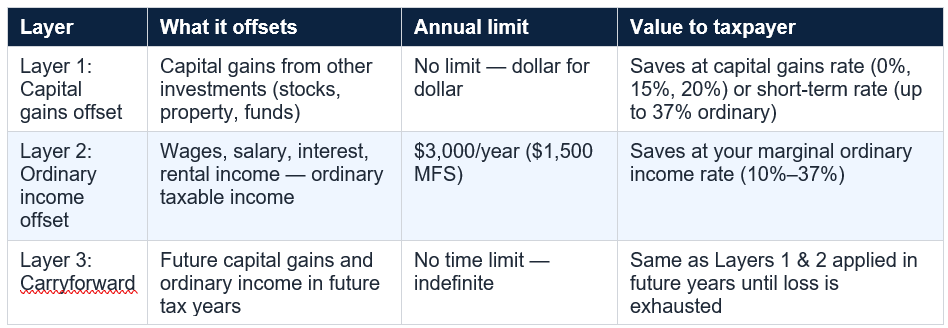
The rule operates in a specific order. First, capital losses offset capital gains dollar for dollar with no annual limit. Second, once all capital gains are offset, any remaining net capital loss can reduce ordinary income by a maximum of $3,000 per year. Third, any loss beyond $3,000 carries forward indefinitely to future tax years, where it can again offset gains (with no cap) and ordinary income (at up to $3,000 per year) until fully utilised.
The $3,000 figure has been set by statute since 1978 and has never once been adjusted for inflation. In 2026 terms, $3,000 in 1978 purchasing power is equivalent to approximately $14,000. This is a significant and widely noted oddity of US tax law — the inflation erosion of the deduction over nearly five decades means the real-terms value of this provision has shrunk considerably. Nevertheless, it remains a valuable and entirely legal tax reduction tool.
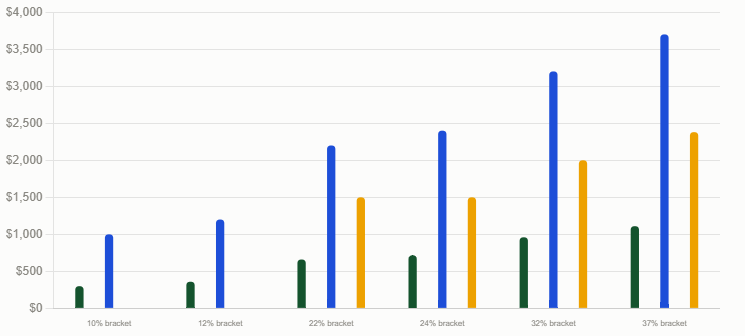
The $3,000 rule is most valuable for taxpayers in the 22%, 24%, 32%, 35%, or 37% ordinary income brackets, because those are the rates at which the $3,000 ordinary income deduction saves tax. At 22%, $3,000 of ordinary income offset saves $660. At 32%, it saves $960. At 37% (the top bracket), it saves $1,110 in federal tax from a single year's deduction. That saving is delivered every year indefinitely if a loss carryforward exists.
Layer 1 — Offset capital gains (no annual limit): the first and most valuable use of a capital loss is to cancel out capital gains from other investments. If you have $20,000 in realised capital gains and harvest $15,000 in losses, your net taxable gain drops to $5,000 (Instead.com, 2026). This is particularly valuable when the gains being offset are short-term (taxed at ordinary income rates up to 37%) — every dollar of short-term gain offset at the 37% bracket saves 37 cents.
Layer 2 — Offset ordinary income (up to $3,000): once capital losses have cancelled all capital gains for the year, any remaining net capital loss can reduce ordinary income by a maximum of $3,000. This deduction applies directly to wages, salary, self-employment income, interest, rental income, and other forms of ordinary income. It reduces adjusted gross income (AGI), which can also reduce exposure to other income-related phase-outs and surcharges.
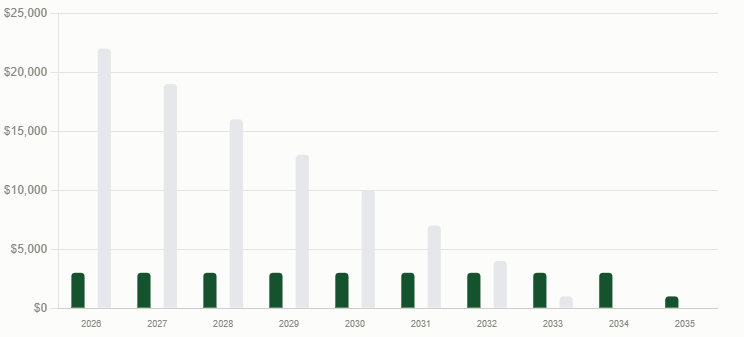
Layer 3 — Carryforward indefinitely: any net capital loss beyond $3,000 after the first two layers carries forward to the next tax year. The carried loss retains its character (short-term or long-term) and can be applied in future years through the same three-layer system. There is no time limit on carryforward — a loss from 2026 can theoretically reduce taxes in 2040 or 2050 if it has not been fully utilised.
Short-term assets: any capital asset held for one year or less. Gains taxed at ordinary income rates (10%–37%). Short-term losses offset short-term gains first.
Long-term assets: any capital asset held for more than one year. Gains taxed at preferential rates (0%, 15%, or 20% depending on taxable income). Long-term losses offset long-term gains first.
Cross-category netting then applies: if short-term losses exceed short-term gains, the excess short-term losses then offset long-term gains. If long-term losses exceed long-term gains, the excess long-term losses offset short-term gains. As OurTaxPartner (July 2026) explains with a 2026 example: a taxpayer with $10,000 in short-term losses, $4,000 in short-term gains, and $5,000 in long-term gains first nets short-term: $10,000 − $4,000 = $6,000 excess short-term loss. That $6,000 then offsets the $5,000 long-term gain entirely, leaving a $1,000 net loss. Then the $3,000 ordinary income deduction applies — but since only $1,000 remains, only $1,000 is deducted against ordinary income.
Harvesting short-term losses (on assets held one year or less) delivers the highest tax benefit per dollar when offsetting short-term gains — because short-term gains are taxed at ordinary rates up to 37%, versus the preferential 15% or 20% on long-term gains. As Instead.com (2026) advises: 'Since short-term gains are taxed at ordinary income rates (up to 37%), harvesting short-term losses first typically delivers the highest tax benefit per dollar of loss.' When planning loss harvesting, prioritise losses that offset your highest-taxed gains first.
Example 1 — Standard gain/loss year (from Kiplinger, September 2026): A taxpayer realises $10,000 of capital gains and $7,000 of capital losses in 2026. The losses offset $7,000 of the gains. Net result: $3,000 net capital gain. All $7,000 of losses are used in Layer 1. No ordinary income deduction applies (net result is a gain, not a loss). Lesson: when losses are smaller than gains, they offset gains first with no further benefit.
Example 2 — Loss exceeds gains (from Kiplinger, September 2026): A taxpayer realises $10,000 of capital losses and $4,000 of capital gains. Net result: $6,000 net capital loss. Layer 1: $4,000 of losses offset the $4,000 of gains. Layer 2: $3,000 of the remaining $2,000... wait — only $2,000 remains, so $2,000 is deducted against ordinary income (the $3,000 cap is a maximum; if the remaining loss is less than $3,000, the actual remaining loss is deducted). Net ordinary income reduction: $2,000. No carryforward.
Example 3 — Large loss, carryforward created (from OurTaxPartner, July 2026 / CountryTaxCalc August 2026): Sarah sells a tech stock and realises a $25,000 long-term capital loss. She has no capital gains for the year. Layer 1: no gains to offset. Layer 2: $3,000 deducted against ordinary income. Her taxable salary falls from $90,000 to $87,000. Layer 3: $22,000 carries forward to 2027. In 2027, she can again offset up to $3,000 of ordinary income — and if she has capital gains in 2027, the $22,000 carryforward will offset those gains dollar for dollar first, with no annual cap. At 22% ordinary rate: $3,000 × 22% = $660 saved in 2026. In 2027, if she realises $22,000 of capital gains: entire $22,000 offset by the carryforward = potentially $3,300 saved (at 15% long-term rate) to $8,140 (at 37% short-term rate) depending on the character of the 2027 gains. Total multi-year value of the 2026 loss: $660 + carryforward value.
Example 4 — Mixed short-term and long-term (CountryTaxCalc, August 2026): A 2026 investor has: $12,000 long-term gain from selling one stock; $9,000 long-term loss from harvesting a different position; $4,000 short-term loss from a third position held less than a year. Step 1: Long-term netting: $12,000 LT gain − $9,000 LT loss = $3,000 net long-term gain. Step 2: Short-term: $4,000 short-term loss, no short-term gains. Step 3: Cross-netting: $4,000 short-term loss offsets the $3,000 net long-term gain, leaving $1,000 net loss. Step 4: Layer 2: $1,000 deducted against ordinary income. No carryforward. Net taxable capital gain: $0. Net ordinary income reduction: $1,000. Tax saved at 22%: $220 from ordinary income; plus the $3,000 long-term gain that was offset would have cost $450 at 15% LTCG rate. Total saving: approximately $670.
SwitchWize (June 2026) identifies the carryforward as one of the primary advantages of loss harvesting: 'Unlimited carryforward: large losses from a bear market can reduce taxes for years or even decades.' FileTax.com (June 2026) confirms the mechanism: 'When capital losses exceed capital gains and the $3,000 ordinary income offset, those losses can be carried forward indefinitely to future tax years until fully utilized. These losses retain their original status as either short-term or long-term.'
The carryforward is particularly powerful when the investor anticipates future capital gains — from a planned property sale, business sale, large stock position liquidation, or inheritance realisation. If a $50,000 loss carryforward is available when $50,000 of capital gains are realised in a future year, the entire gain is sheltered from capital gains tax. At the 20% long-term rate, that represents $10,000 in tax savings from losses that might otherwise have felt like purely bad news.
Track your capital loss carryforward every year. IRS Schedule D (Capital Gains and Losses) carries forward any unused loss, and your tax software or CPA should maintain a running balance. The carryforward does not expire — but it also does not reduce future tax if you forget about it or fail to apply it correctly. If you have a significant carryforward from prior years (from the 2022 bear market, for example), 2026 may be an ideal year to realise capital gains that would otherwise be taxable — using the carryforward to shelter them.
The key insight, articulated by mydcacalc.com (June 2026), is: 'Tax-loss harvesting is one of the few investment strategies where a loss makes you richer. By selling investments that have declined below their purchase price, you realize a capital loss that can offset gains elsewhere in your portfolio — reducing the taxes you owe this year.'
The mechanics of loss harvesting involve: selling the losing position to realise the loss; reinvesting the proceeds into a different investment that maintains similar market exposure (to avoid being out of the market during a potential recovery); and ensuring you do not violate the wash sale rule by buying back the same or substantially identical security within 31 days. The 2026 rules, as mydcacalc.com confirms, 'haven't changed from prior years: losses offset gains dollar-for-dollar with no limit, and up to $3,000 of excess losses can reduce your ordinary income.'
Greenbush Financial Group (June 2026) describes the November-December dynamic: November and December is tax-loss harvesting season — advisers identify investment losses to offset gains realized throughout the year. Instead.com's 2026 guide recommends reviewing throughout the year at quarterly estimated tax payment deadlines. The June 15 Q2 deadline is a natural checkpoint. If the market drops mid-quarter, act when losses are available.
The consequence of a wash sale: the disallowed loss is not permanently lost — it is added to the cost basis of the replacement security. This defers the tax benefit until the replacement security is eventually sold. But the deferral may push the tax benefit into a different tax year or a period when it is less valuable.
The wash sale rule applies across all accounts — not just the account where the sale occurred. If you sell a stock at a loss in your taxable brokerage account and your spouse buys the same stock in their IRA within the 30-day window, the wash sale rule is triggered. Similarly, if you sell a fund at a loss in a taxable account and the same fund is purchased in your 401(k) within the window (through automatic payroll contributions, for example), the wash sale may be triggered. Cross-account wash sale violations are one of the most common accidental tax errors for active investors with multiple accounts.
The solution is straightforward: wait 31 days before buying back the same or substantially identical security. Or better: immediately buy a similar but not identical investment to maintain market exposure without triggering the wash sale. For example: sell an S&P 500 index fund at a loss and immediately buy a total US market fund or a different S&P 500 ETF from a different fund family. The two funds are similar in exposure but not 'substantially identical' in the IRS's interpretation — maintaining your investment exposure while locking in the tax loss.
Instead.com's 2026 guidance identifies the wash sale as the 'single biggest trap in tax-loss harvesting': 'Under IRS rules, if you sell a security at a loss and purchase a substantially identical security within 30 days before or after the sale, the loss is disallowed. The disallowed loss gets added to the cost basis of the replacement security, deferring the tax benefit until you eventually sell the replacement.' The guidance adds: 'When in doubt, wait 31 days and buy the original back.'
Cryptocurrency: as of March 2026, the IRS had not released definitive guidance on whether the wash sale rule applies to cryptocurrency. mydcacalc.com (June 2026) confirms: 'Crypto status: The IRS treats cryptocurrency as property. Crypto losses are deductible as capital losses. As of March 2026, the IRS had not released definitive guidance on whether the wash sale rule applies to crypto — legislation to extend it has been proposed but not passed as of this writing.' This means that as of the 2026 tax year, crypto investors may be able to sell a cryptocurrency at a loss and immediately repurchase it — retaining market exposure while realising the tax loss — without triggering the wash sale rule. However: this interpretation is contested, the IRS could issue retrospective guidance, and pending legislation could change the rule. Consult a tax professional before relying on this treatment.
ETFs and mutual funds: the wash sale rule prohibits buying a 'substantially identical' security. Two funds that track different indices (e.g., an S&P 500 fund and a Total Market fund) are generally considered not substantially identical and the swap is typically safe. Two share classes of the same fund (e.g., Vanguard Admiral and Investor shares of the same fund) are substantially identical and the swap would trigger the wash sale. The practical strategy: maintain a list of 'swap pairs' — similar but not identical ETFs from different fund families covering the same asset class — that can be swapped when a loss harvesting opportunity arises.
AdvisorGuide's 2026 harvesting checklist identifies a further nuance: 'Bonds and bond funds: buying a different bond or bond fund in the same category generally avoids the wash sale rule, since individual bonds are rarely considered substantially identical to each other.' This means bond loss harvesting typically carries less wash sale risk than equity loss harvesting.
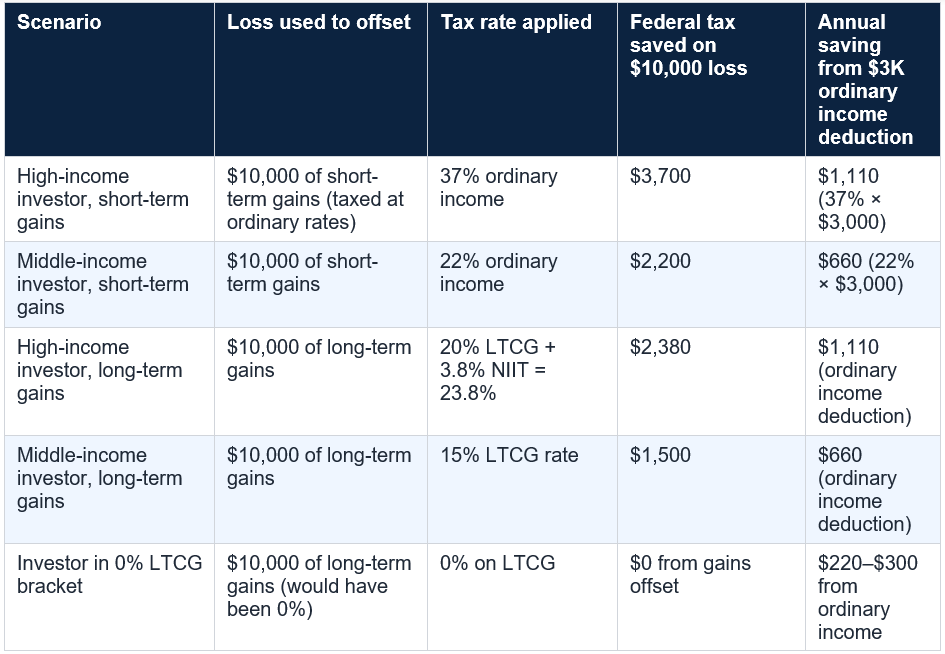

All figures are illustrative estimates for 2026 federal income tax only. State income tax may also be reduced in states that conform to federal capital loss rules. Individual tax situations vary. Not tax advice.
The strategy is not risk-free. The wash sale rule is a genuine trap that requires careful management, particularly for investors with multiple accounts or automatic investment programmes. Cryptocurrency's wash sale status remains unresolved as of September 2026. And the strategy is less valuable at low income levels or in the 0% capital gains bracket. But for taxpayers with capital gains to shelter, a significant loss carryforward, or income in the higher ordinary tax brackets, the $3,000 rule and its associated loss harvesting strategy represent some of the most reliable federal tax reduction available to individual investors.
As Kiplinger put it four days ago: 'Selling an underperforming investment can not only free up cash to put elsewhere but also offer a tax benefit.' The final quarter of 2026 is the last opportunity to act for this tax year. With Q4 now underway, the time to review your portfolio for harvesting opportunities is now.
Under IRS Topic No. 409 and IRS Publication 550, US taxpayers can deduct up to $3,000 of net capital losses against ordinary income (wages, salary, interest, rental income) each tax year after first offsetting all capital gains. If married filing separately, the limit is $1,500. Any remaining net capital loss beyond $3,000 carries forward indefinitely to future tax years, where it can again offset capital gains (with no annual cap) and ordinary income (at up to $3,000 per year). The $3,000 limit has been fixed by statute since 1978 and has never been adjusted for inflation. Losses and gains are reported on IRS Form 8949, with net amounts flowing to Schedule D of your federal tax return.
How does the capital loss carryforward work?
When your net capital losses exceed capital gains plus the $3,000 ordinary income deduction in any year, the remaining loss carries forward to the next tax year. The carried loss retains its original character — short-term or long-term — and can be applied in future years through the same system: first to offset capital gains (with no annual cap), then up to $3,000 against ordinary income. There is no time limit on the carryforward. A $50,000 loss realised in 2026 with no capital gains to offset would produce: $3,000 deducted in 2026, $3,000 in 2027, $3,000 in 2028... and so on for approximately 16 years — or until a year when significant capital gains are realised, at which point the entire remaining carryforward can offset those gains at once. Track your carryforward on Schedule D each year.
What is the wash sale rule and how do I avoid it?
The wash sale rule disqualifies a capital loss if you buy the same or substantially identical security within 30 days before or after the sale. The 61-day 'danger window' is 30 days before the sale + the sale day + 30 days after. If the rule is triggered, the loss is not permanently lost — it is added to the cost basis of the replacement security — but the tax benefit is deferred to when the replacement is eventually sold. To avoid triggering the rule: wait 31 days before repurchasing the same security, or immediately buy a similar (but not identical) investment to maintain market exposure. Example: sell a Vanguard S&P 500 ETF (VOO) at a loss and immediately buy an iShares S&P 500 ETF (IVV) or a total market ETF (VTI) — similar exposure, different fund, not substantially identical. The wash sale rule applies across all accounts, including your spouse's accounts and IRAs, so monitor all accounts simultaneously.
Can I use capital losses to offset ordinary income like my salary?
Yes — but only after first offsetting all capital gains. Once capital losses have cancelled all capital gains for the year, any remaining net capital loss can reduce ordinary income (wages, salary, interest, freelance income, etc.) by up to $3,000 per year. This is the 'Layer 2' application of the rule. The deduction reduces your adjusted gross income (AGI), which may also reduce exposure to other income-based phase-outs. The tax saving from the $3,000 ordinary income deduction depends on your marginal tax bracket: at 10%, it saves $300; at 22%, $660; at 37%, $1,110 per year. The deduction cannot be used in tax-advantaged accounts (IRAs, 401(k)s) — only losses in taxable brokerage accounts qualify.
Does the $3,000 capital loss rule apply to cryptocurrency?
Cryptocurrency is treated as property by the IRS, which means capital loss rules apply — losses from selling crypto at a loss are deductible as capital losses subject to the same three-layer system as stock losses. However, as of March 2026, the IRS had not released definitive guidance on whether the wash sale rule applies to cryptocurrency (mydcacalc.com, June 2026). Legislation to extend the wash sale rule to crypto has been proposed but not enacted as of September 2026. This means crypto investors may currently be able to sell at a loss and immediately repurchase without triggering the wash sale — but this interpretation is contested and pending legislation could change it retrospectively. Consult a qualified tax professional before relying on this treatment.
When should I harvest capital losses — only in December?
No — tax-loss harvesting can and should be done throughout the year. Investment professionals consider November and December the 'primary season,' but Instead.com's 2026 guide recommends checking for harvesting opportunities at each quarterly estimated tax payment deadline: April 15, June 15, September 15, and January 15. If markets decline significantly mid-quarter, do not wait for the scheduled review — act when losses are available. The best time to harvest a loss is when it exists, before a potential market recovery eliminates it. Harvesting early in the year also means any proceeds can be reinvested in a similar position for a longer period, reducing the drag of being out of the market.
Table of Contents
- One of the Most Underused Rules in the Tax Code
- What the $3,000 Rule Actually Is
- How Capital Losses Work: Three-Layer System
- The Netting Rules: Short-Term vs Long-Term
- Step-by-Step Worked Examples
- The Capital Loss Carryforward: Indefinite and Powerful
- Tax-Loss Harvesting: Turning Paper Losses Into Real Tax Savings
- The Wash Sale Rule: The Trap That Disqualifies Your Loss
- Crypto, ETFs, and the Wash Sale Grey Areas
- When the $3,000 Rule Is Less Valuable
- The Tax Savings Calculator: What Your Loss Is Actually Worth
- How to Implement: A Year-Round Checklist
- Conclusion: A Loss That Makes You Richer
- Frequently Asked Questions
Three Layer System: How A Loss Reduces Your Tax
Tax Savings By Bracket: What $3,000 Deduction Is Worth
Carry Forward Power: $25,000 Loss Over 10 years
One of the Most Underused Rules in the Tax Code
Losing money on an investment feels bad. Having that loss reduce your federal tax bill by hundreds or even thousands of dollars feels significantly better. The $3,000 IRS capital loss rule — grounded in IRS Topic No. 409 and Publication 550 — allows US taxpayers to use investment losses not only to cancel out capital gains but, once gains are exhausted, to reduce ordinary taxable income by up to $3,000 per year. And critically, any remaining loss above that $3,000 does not disappear: it carries forward indefinitely to future tax years.Kiplinger published a detailed guide to this rule just four days before this article (September 2026), and described the current moment precisely: 'As the final quarter of 2026 approaches, you may be taking a closer look at your investment portfolio, weighing which losses are temporary setbacks and which positions no longer make sense to hold. Thankfully, selling an underperforming investment can not only free up cash to put elsewhere but also offer a tax benefit.'
This strategy goes by several names: tax-loss harvesting, capital loss harvesting, or loss realisation for tax purposes. Investment professionals consider November and December the primary season for it — but as Instead.com notes in its 2026 guide, it can and should be reviewed throughout the year, aligned with quarterly estimated tax payment deadlines. The rules themselves haven't changed for 2026 — the $3,000 limit has been fixed by statute since 1978 — but the opportunity to use them is reset fresh with every new tax year.
$3,000: maximum net capital loss deductible against ordinary income per year (IRS Topic 409). $1,500: limit for married filing separately. Fixed by statute since 1978 — never adjusted for inflation. In 1978 purchasing power, $3,000 ≈ $14,000 in 2026 dollars. Capital losses offset gains first: no annual cap on gain offsets. Excess loss: carries forward indefinitely. Wash sale rule: 61-day window (30 days before + sale day + 30 days after). Form 8949 + Schedule D: how losses are reported.
What the $3,000 Rule Actually Is
The $3,000 rule is the provision in the US Internal Revenue Code — implemented through IRS Topic No. 409 and Publication 550 — that allows taxpayers with more capital losses than capital gains to deduct up to $3,000 of the excess net loss against their ordinary income. Ordinary income includes wages from employment, salary, freelance income, rental income, and interest income: the income that is typically taxed at higher rates than long-term capital gains.The rule operates in a specific order. First, capital losses offset capital gains dollar for dollar with no annual limit. Second, once all capital gains are offset, any remaining net capital loss can reduce ordinary income by a maximum of $3,000 per year. Third, any loss beyond $3,000 carries forward indefinitely to future tax years, where it can again offset gains (with no cap) and ordinary income (at up to $3,000 per year) until fully utilised.
The $3,000 figure has been set by statute since 1978 and has never once been adjusted for inflation. In 2026 terms, $3,000 in 1978 purchasing power is equivalent to approximately $14,000. This is a significant and widely noted oddity of US tax law — the inflation erosion of the deduction over nearly five decades means the real-terms value of this provision has shrunk considerably. Nevertheless, it remains a valuable and entirely legal tax reduction tool.
The $3,000 rule is most valuable for taxpayers in the 22%, 24%, 32%, 35%, or 37% ordinary income brackets, because those are the rates at which the $3,000 ordinary income deduction saves tax. At 22%, $3,000 of ordinary income offset saves $660. At 32%, it saves $960. At 37% (the top bracket), it saves $1,110 in federal tax from a single year's deduction. That saving is delivered every year indefinitely if a loss carryforward exists.
How Capital Losses Work: Three-Layer System
Capital losses work in three layers, each applying in sequence. Understanding the sequence is essential for calculating how much of a loss will benefit you in any given year.Layer 1 — Offset capital gains (no annual limit): the first and most valuable use of a capital loss is to cancel out capital gains from other investments. If you have $20,000 in realised capital gains and harvest $15,000 in losses, your net taxable gain drops to $5,000 (Instead.com, 2026). This is particularly valuable when the gains being offset are short-term (taxed at ordinary income rates up to 37%) — every dollar of short-term gain offset at the 37% bracket saves 37 cents.
Layer 2 — Offset ordinary income (up to $3,000): once capital losses have cancelled all capital gains for the year, any remaining net capital loss can reduce ordinary income by a maximum of $3,000. This deduction applies directly to wages, salary, self-employment income, interest, rental income, and other forms of ordinary income. It reduces adjusted gross income (AGI), which can also reduce exposure to other income-related phase-outs and surcharges.
Layer 3 — Carryforward indefinitely: any net capital loss beyond $3,000 after the first two layers carries forward to the next tax year. The carried loss retains its character (short-term or long-term) and can be applied in future years through the same three-layer system. There is no time limit on carryforward — a loss from 2026 can theoretically reduce taxes in 2040 or 2050 if it has not been fully utilised.
The Netting Rules: Short-Term vs Long-Term
Before the three-layer system applies, the IRS requires taxpayers to sort capital gains and losses into two categories based on holding period, and net within each category first. This netting rule is critical because short-term and long-term gains are taxed at very different rates — and the order of netting affects both the character of the remaining gain or loss and the ultimate tax saving.Short-term assets: any capital asset held for one year or less. Gains taxed at ordinary income rates (10%–37%). Short-term losses offset short-term gains first.
Long-term assets: any capital asset held for more than one year. Gains taxed at preferential rates (0%, 15%, or 20% depending on taxable income). Long-term losses offset long-term gains first.
Cross-category netting then applies: if short-term losses exceed short-term gains, the excess short-term losses then offset long-term gains. If long-term losses exceed long-term gains, the excess long-term losses offset short-term gains. As OurTaxPartner (July 2026) explains with a 2026 example: a taxpayer with $10,000 in short-term losses, $4,000 in short-term gains, and $5,000 in long-term gains first nets short-term: $10,000 − $4,000 = $6,000 excess short-term loss. That $6,000 then offsets the $5,000 long-term gain entirely, leaving a $1,000 net loss. Then the $3,000 ordinary income deduction applies — but since only $1,000 remains, only $1,000 is deducted against ordinary income.
Harvesting short-term losses (on assets held one year or less) delivers the highest tax benefit per dollar when offsetting short-term gains — because short-term gains are taxed at ordinary rates up to 37%, versus the preferential 15% or 20% on long-term gains. As Instead.com (2026) advises: 'Since short-term gains are taxed at ordinary income rates (up to 37%), harvesting short-term losses first typically delivers the highest tax benefit per dollar of loss.' When planning loss harvesting, prioritise losses that offset your highest-taxed gains first.
Step-by-Step Worked Examples
The following examples illustrate the three-layer system in practice for the 2026 tax year.Example 1 — Standard gain/loss year (from Kiplinger, September 2026): A taxpayer realises $10,000 of capital gains and $7,000 of capital losses in 2026. The losses offset $7,000 of the gains. Net result: $3,000 net capital gain. All $7,000 of losses are used in Layer 1. No ordinary income deduction applies (net result is a gain, not a loss). Lesson: when losses are smaller than gains, they offset gains first with no further benefit.
Example 2 — Loss exceeds gains (from Kiplinger, September 2026): A taxpayer realises $10,000 of capital losses and $4,000 of capital gains. Net result: $6,000 net capital loss. Layer 1: $4,000 of losses offset the $4,000 of gains. Layer 2: $3,000 of the remaining $2,000... wait — only $2,000 remains, so $2,000 is deducted against ordinary income (the $3,000 cap is a maximum; if the remaining loss is less than $3,000, the actual remaining loss is deducted). Net ordinary income reduction: $2,000. No carryforward.
Example 3 — Large loss, carryforward created (from OurTaxPartner, July 2026 / CountryTaxCalc August 2026): Sarah sells a tech stock and realises a $25,000 long-term capital loss. She has no capital gains for the year. Layer 1: no gains to offset. Layer 2: $3,000 deducted against ordinary income. Her taxable salary falls from $90,000 to $87,000. Layer 3: $22,000 carries forward to 2027. In 2027, she can again offset up to $3,000 of ordinary income — and if she has capital gains in 2027, the $22,000 carryforward will offset those gains dollar for dollar first, with no annual cap. At 22% ordinary rate: $3,000 × 22% = $660 saved in 2026. In 2027, if she realises $22,000 of capital gains: entire $22,000 offset by the carryforward = potentially $3,300 saved (at 15% long-term rate) to $8,140 (at 37% short-term rate) depending on the character of the 2027 gains. Total multi-year value of the 2026 loss: $660 + carryforward value.
Example 4 — Mixed short-term and long-term (CountryTaxCalc, August 2026): A 2026 investor has: $12,000 long-term gain from selling one stock; $9,000 long-term loss from harvesting a different position; $4,000 short-term loss from a third position held less than a year. Step 1: Long-term netting: $12,000 LT gain − $9,000 LT loss = $3,000 net long-term gain. Step 2: Short-term: $4,000 short-term loss, no short-term gains. Step 3: Cross-netting: $4,000 short-term loss offsets the $3,000 net long-term gain, leaving $1,000 net loss. Step 4: Layer 2: $1,000 deducted against ordinary income. No carryforward. Net taxable capital gain: $0. Net ordinary income reduction: $1,000. Tax saved at 22%: $220 from ordinary income; plus the $3,000 long-term gain that was offset would have cost $450 at 15% LTCG rate. Total saving: approximately $670.
The Capital Loss Carryforward: Indefinite and Powerful
The indefinite carryforward is one of the most powerful features of the capital loss system. A large loss — from a bear market, a failed investment, or a major position sold at a severe discount — does not disappear. It becomes an asset: a future tax shield that can be deployed against capital gains and ordinary income in perpetuity, year after year, until it is fully consumed.SwitchWize (June 2026) identifies the carryforward as one of the primary advantages of loss harvesting: 'Unlimited carryforward: large losses from a bear market can reduce taxes for years or even decades.' FileTax.com (June 2026) confirms the mechanism: 'When capital losses exceed capital gains and the $3,000 ordinary income offset, those losses can be carried forward indefinitely to future tax years until fully utilized. These losses retain their original status as either short-term or long-term.'
The carryforward is particularly powerful when the investor anticipates future capital gains — from a planned property sale, business sale, large stock position liquidation, or inheritance realisation. If a $50,000 loss carryforward is available when $50,000 of capital gains are realised in a future year, the entire gain is sheltered from capital gains tax. At the 20% long-term rate, that represents $10,000 in tax savings from losses that might otherwise have felt like purely bad news.
Track your capital loss carryforward every year. IRS Schedule D (Capital Gains and Losses) carries forward any unused loss, and your tax software or CPA should maintain a running balance. The carryforward does not expire — but it also does not reduce future tax if you forget about it or fail to apply it correctly. If you have a significant carryforward from prior years (from the 2022 bear market, for example), 2026 may be an ideal year to realise capital gains that would otherwise be taxable — using the carryforward to shelter them.
Tax-Loss Harvesting: Turning Paper Losses Into Real Tax Savings
Tax-loss harvesting is the active strategy of deliberately selling investments that have declined below their purchase price in order to realise a capital loss for tax purposes. The loss is then used through the three-layer system to offset gains, reduce ordinary income by up to $3,000, and create carryforwards for future use.The key insight, articulated by mydcacalc.com (June 2026), is: 'Tax-loss harvesting is one of the few investment strategies where a loss makes you richer. By selling investments that have declined below their purchase price, you realize a capital loss that can offset gains elsewhere in your portfolio — reducing the taxes you owe this year.'
The mechanics of loss harvesting involve: selling the losing position to realise the loss; reinvesting the proceeds into a different investment that maintains similar market exposure (to avoid being out of the market during a potential recovery); and ensuring you do not violate the wash sale rule by buying back the same or substantially identical security within 31 days. The 2026 rules, as mydcacalc.com confirms, 'haven't changed from prior years: losses offset gains dollar-for-dollar with no limit, and up to $3,000 of excess losses can reduce your ordinary income.'
Greenbush Financial Group (June 2026) describes the November-December dynamic: November and December is tax-loss harvesting season — advisers identify investment losses to offset gains realized throughout the year. Instead.com's 2026 guide recommends reviewing throughout the year at quarterly estimated tax payment deadlines. The June 15 Q2 deadline is a natural checkpoint. If the market drops mid-quarter, act when losses are available.
The Wash Sale Rule: The Trap That Disqualifies Your Loss
The wash sale rule is the primary risk in tax-loss harvesting — and the most commonly misunderstood. Under IRS rules, if you sell a security at a loss and buy the same or substantially identical security within 30 days before or after the sale, the loss is disallowed for tax purposes. The 61-day window spans 30 days before the sale, the sale day itself, and 30 days after.The consequence of a wash sale: the disallowed loss is not permanently lost — it is added to the cost basis of the replacement security. This defers the tax benefit until the replacement security is eventually sold. But the deferral may push the tax benefit into a different tax year or a period when it is less valuable.
The wash sale rule applies across all accounts — not just the account where the sale occurred. If you sell a stock at a loss in your taxable brokerage account and your spouse buys the same stock in their IRA within the 30-day window, the wash sale rule is triggered. Similarly, if you sell a fund at a loss in a taxable account and the same fund is purchased in your 401(k) within the window (through automatic payroll contributions, for example), the wash sale may be triggered. Cross-account wash sale violations are one of the most common accidental tax errors for active investors with multiple accounts.
The solution is straightforward: wait 31 days before buying back the same or substantially identical security. Or better: immediately buy a similar but not identical investment to maintain market exposure without triggering the wash sale. For example: sell an S&P 500 index fund at a loss and immediately buy a total US market fund or a different S&P 500 ETF from a different fund family. The two funds are similar in exposure but not 'substantially identical' in the IRS's interpretation — maintaining your investment exposure while locking in the tax loss.
Instead.com's 2026 guidance identifies the wash sale as the 'single biggest trap in tax-loss harvesting': 'Under IRS rules, if you sell a security at a loss and purchase a substantially identical security within 30 days before or after the sale, the loss is disallowed. The disallowed loss gets added to the cost basis of the replacement security, deferring the tax benefit until you eventually sell the replacement.' The guidance adds: 'When in doubt, wait 31 days and buy the original back.'
Crypto, ETFs, and the Wash Sale Grey Areas
The wash sale rule has some important nuances and grey areas that investors in 2026 need to understand, particularly for cryptocurrency and exchange-traded funds.Cryptocurrency: as of March 2026, the IRS had not released definitive guidance on whether the wash sale rule applies to cryptocurrency. mydcacalc.com (June 2026) confirms: 'Crypto status: The IRS treats cryptocurrency as property. Crypto losses are deductible as capital losses. As of March 2026, the IRS had not released definitive guidance on whether the wash sale rule applies to crypto — legislation to extend it has been proposed but not passed as of this writing.' This means that as of the 2026 tax year, crypto investors may be able to sell a cryptocurrency at a loss and immediately repurchase it — retaining market exposure while realising the tax loss — without triggering the wash sale rule. However: this interpretation is contested, the IRS could issue retrospective guidance, and pending legislation could change the rule. Consult a tax professional before relying on this treatment.
ETFs and mutual funds: the wash sale rule prohibits buying a 'substantially identical' security. Two funds that track different indices (e.g., an S&P 500 fund and a Total Market fund) are generally considered not substantially identical and the swap is typically safe. Two share classes of the same fund (e.g., Vanguard Admiral and Investor shares of the same fund) are substantially identical and the swap would trigger the wash sale. The practical strategy: maintain a list of 'swap pairs' — similar but not identical ETFs from different fund families covering the same asset class — that can be swapped when a loss harvesting opportunity arises.
AdvisorGuide's 2026 harvesting checklist identifies a further nuance: 'Bonds and bond funds: buying a different bond or bond fund in the same category generally avoids the wash sale rule, since individual bonds are rarely considered substantially identical to each other.' This means bond loss harvesting typically carries less wash sale risk than equity loss harvesting.
When the $3,000 Rule Is Less Valuable
The $3,000 capital loss deduction is not equally valuable in all situations. There are specific circumstances where its value is reduced or eliminated entirely.- Taxpayers in the 0% long-term capital gains bracket: if your taxable income is below approximately $47,025 (single) or $94,050 (MFJ) in 2026, your long-term capital gains are already taxed at 0%. Offsetting long-term gains in this bracket saves nothing from the capital gains portion. Only the $3,000 ordinary income deduction retains value — saving at your marginal ordinary income rate. SwitchWize (June 2026) identifies this directly: 'if you're in the 0% long-term capital gains bracket... offsetting gains saves nothing; only the $3,000 ordinary income offset matters.'
- Taxpayers with no other investments or gains to shelter: the $3,000 ordinary income deduction has a maximum annual value of $1,110 (at 37%) or as little as $300 (at 10%). If the deduction is the only benefit available (no gains to offset), the dollar value of loss harvesting is modest — though the carryforward creates future value.
- Taxpayers planning to hold the investment long-term anyway: realising a loss now resets the cost basis to the current (lower) price. If the investment subsequently recovers significantly, the future gain will be larger, potentially resulting in more tax owed in future years than was saved by the harvest. This is not a reason to avoid harvesting — the time value of money means tax paid later is worth less than tax paid now — but it is a factor to model.
- Taxpayers near the AMT threshold: the Alternative Minimum Tax may limit or eliminate the benefit of capital loss deductions in some high-income situations. If you are subject to or near the AMT, consult a CPA before harvesting.
- In tax-advantaged accounts: capital losses in traditional IRAs, Roth IRAs, 401(k)s, and other tax-advantaged accounts cannot be deducted. Loss harvesting only works in taxable brokerage accounts. This is why maintaining a taxable investment account alongside retirement accounts is important for access to this strategy.
The Tax Savings Calculator: What Your Loss Is Actually Worth
The dollar value of a capital loss depends on three factors: the size of the loss, the type of gain it offsets (short-term vs long-term), and your marginal tax bracket. The following table shows the federal tax saving from a $10,000 capital loss in 2026 under different scenarios. All figures are federal only; state tax treatment varies.All figures are illustrative estimates for 2026 federal income tax only. State income tax may also be reduced in states that conform to federal capital loss rules. Individual tax situations vary. Not tax advice.
How to Implement: A Year-Round Checklist
Tax-loss harvesting is most effective when treated as an ongoing discipline rather than a December scramble. The following checklist aligns with the quarterly tax calendar:- Q1 (January–March): review the prior year's Schedule D for any loss carryforward from 2025. Note the amount and character (short-term vs long-term). Identify any positions that are currently at a loss following year-end and consider whether they should be held or harvested.
- Q2 review (by June 15, estimated tax deadline): audit the portfolio for unrealised losses. Calculate your current net gain/loss position for the year-to-date. If significant losses exist, evaluate whether harvesting makes sense given your gain position and income bracket.
- Q3 review (by September 15, estimated tax deadline): update the gain/loss calculation. If markets have declined significantly during the quarter, this may be the best harvesting opportunity of the year. Act when losses are available — do not wait for December.
- Q4 (October–December — primary season): final opportunity to realise losses for the current tax year. Calculate total gains realised in 2026 and total losses available. Harvest to produce: (a) enough losses to offset all short-term gains (highest priority); (b) enough remaining losses to offset long-term gains; (c) ideally, a net loss that includes the $3,000 ordinary income deduction. Execute wash-sale-safe swaps for any positions harvested.
- Year-round: maintain a list of ETF swap pairs for each major asset class you hold. Ensure your spouse's accounts and retirement accounts are included in the wash sale monitoring. Track cost basis carefully — tax software or your brokerage's cost basis reporting is essential.
Conclusion
The $3,000 IRS capital loss rule is one of the few features of the tax code that turns bad financial news into a tangible benefit. A losing investment — one that has fallen below the price you paid — can first cancel out capital gains dollar for dollar, then reduce your ordinary taxable income by up to $3,000, and then carry forward indefinitely to shelter future gains and income from tax. The rule has been fixed at $3,000 since 1978 and is available to every US taxpayer with a taxable investment account and realised losses.The strategy is not risk-free. The wash sale rule is a genuine trap that requires careful management, particularly for investors with multiple accounts or automatic investment programmes. Cryptocurrency's wash sale status remains unresolved as of September 2026. And the strategy is less valuable at low income levels or in the 0% capital gains bracket. But for taxpayers with capital gains to shelter, a significant loss carryforward, or income in the higher ordinary tax brackets, the $3,000 rule and its associated loss harvesting strategy represent some of the most reliable federal tax reduction available to individual investors.
As Kiplinger put it four days ago: 'Selling an underperforming investment can not only free up cash to put elsewhere but also offer a tax benefit.' The final quarter of 2026 is the last opportunity to act for this tax year. With Q4 now underway, the time to review your portfolio for harvesting opportunities is now.
Frequently Asked Questions
What exactly is the $3,000 IRS capital loss deduction?Under IRS Topic No. 409 and IRS Publication 550, US taxpayers can deduct up to $3,000 of net capital losses against ordinary income (wages, salary, interest, rental income) each tax year after first offsetting all capital gains. If married filing separately, the limit is $1,500. Any remaining net capital loss beyond $3,000 carries forward indefinitely to future tax years, where it can again offset capital gains (with no annual cap) and ordinary income (at up to $3,000 per year). The $3,000 limit has been fixed by statute since 1978 and has never been adjusted for inflation. Losses and gains are reported on IRS Form 8949, with net amounts flowing to Schedule D of your federal tax return.
How does the capital loss carryforward work?
When your net capital losses exceed capital gains plus the $3,000 ordinary income deduction in any year, the remaining loss carries forward to the next tax year. The carried loss retains its original character — short-term or long-term — and can be applied in future years through the same system: first to offset capital gains (with no annual cap), then up to $3,000 against ordinary income. There is no time limit on the carryforward. A $50,000 loss realised in 2026 with no capital gains to offset would produce: $3,000 deducted in 2026, $3,000 in 2027, $3,000 in 2028... and so on for approximately 16 years — or until a year when significant capital gains are realised, at which point the entire remaining carryforward can offset those gains at once. Track your carryforward on Schedule D each year.
What is the wash sale rule and how do I avoid it?
The wash sale rule disqualifies a capital loss if you buy the same or substantially identical security within 30 days before or after the sale. The 61-day 'danger window' is 30 days before the sale + the sale day + 30 days after. If the rule is triggered, the loss is not permanently lost — it is added to the cost basis of the replacement security — but the tax benefit is deferred to when the replacement is eventually sold. To avoid triggering the rule: wait 31 days before repurchasing the same security, or immediately buy a similar (but not identical) investment to maintain market exposure. Example: sell a Vanguard S&P 500 ETF (VOO) at a loss and immediately buy an iShares S&P 500 ETF (IVV) or a total market ETF (VTI) — similar exposure, different fund, not substantially identical. The wash sale rule applies across all accounts, including your spouse's accounts and IRAs, so monitor all accounts simultaneously.
Can I use capital losses to offset ordinary income like my salary?
Yes — but only after first offsetting all capital gains. Once capital losses have cancelled all capital gains for the year, any remaining net capital loss can reduce ordinary income (wages, salary, interest, freelance income, etc.) by up to $3,000 per year. This is the 'Layer 2' application of the rule. The deduction reduces your adjusted gross income (AGI), which may also reduce exposure to other income-based phase-outs. The tax saving from the $3,000 ordinary income deduction depends on your marginal tax bracket: at 10%, it saves $300; at 22%, $660; at 37%, $1,110 per year. The deduction cannot be used in tax-advantaged accounts (IRAs, 401(k)s) — only losses in taxable brokerage accounts qualify.
Does the $3,000 capital loss rule apply to cryptocurrency?
Cryptocurrency is treated as property by the IRS, which means capital loss rules apply — losses from selling crypto at a loss are deductible as capital losses subject to the same three-layer system as stock losses. However, as of March 2026, the IRS had not released definitive guidance on whether the wash sale rule applies to cryptocurrency (mydcacalc.com, June 2026). Legislation to extend the wash sale rule to crypto has been proposed but not enacted as of September 2026. This means crypto investors may currently be able to sell at a loss and immediately repurchase without triggering the wash sale — but this interpretation is contested and pending legislation could change it retrospectively. Consult a qualified tax professional before relying on this treatment.
When should I harvest capital losses — only in December?
No — tax-loss harvesting can and should be done throughout the year. Investment professionals consider November and December the 'primary season,' but Instead.com's 2026 guide recommends checking for harvesting opportunities at each quarterly estimated tax payment deadline: April 15, June 15, September 15, and January 15. If markets decline significantly mid-quarter, do not wait for the scheduled review — act when losses are available. The best time to harvest a loss is when it exists, before a potential market recovery eliminates it. Harvesting early in the year also means any proceeds can be reinvested in a similar position for a longer period, reducing the drag of being out of the market.

0 Comments Comments