
Investing
The Best Warren Buffett Dividend Stocks: Explained

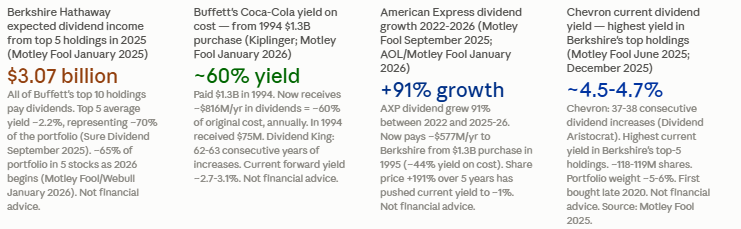
In 1994, Berkshire Hathaway received $75 million in dividends from Coca-Cola. By 2025 that number had grown to $816 million — from the same 400 million shares, bought for $1.3 billion thirty years earlier. Buffett’s yield on cost: approximately 60%. This is what he called ‘the secret sauce’ in his 2022 shareholder letter. Not chasing yield. Not trading in and out. Just buying exceptional businesses with growing dividends, holding them through every economic cycle, and letting time compound the income. Nearly 65% of Berkshire’s portfolio sits in five stocks. All of Buffett’s top 10 holdings pay dividends. Expected dividend income from his top five in 2025: $3.07 billion. This article examines the best of those stocks, what makes each of them a Buffett-style dividend holding, and the principle that ties them all together. Not financial advice.
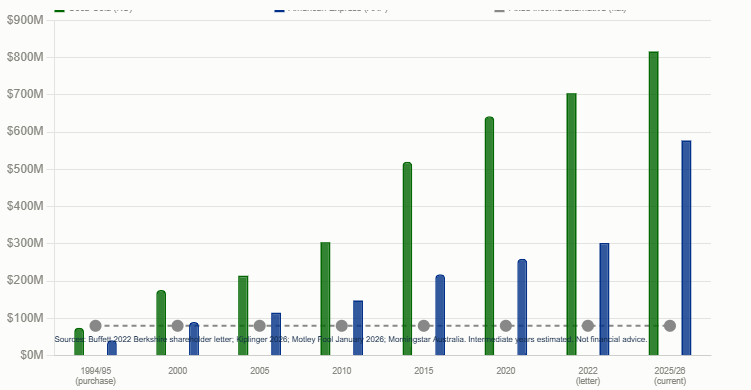
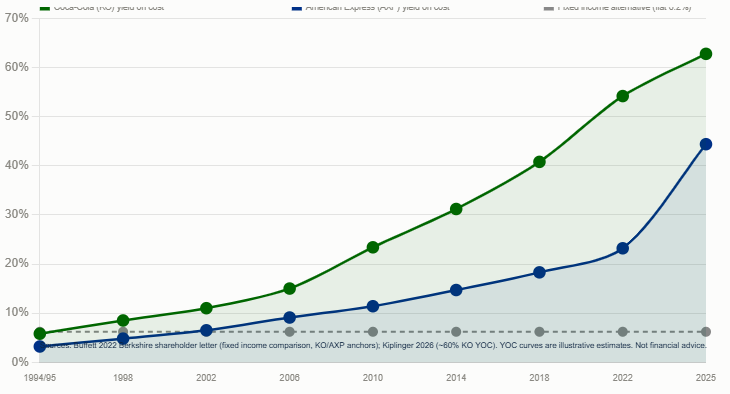
The two examples he used were Coca-Cola and American Express. Berkshire completed its purchase of 400 million Coca-Cola shares in August 1994 for $1.3 billion. In 1994, those shares paid $75 million in dividends. By 2022, the dividend had grown to $704 million — and the original $1.3 billion investment had become a position worth approximately $25 billion. Berkshire had not bought one additional share. It had not done anything except ‘cash Coke’s quarterly dividend checks,’ as Buffett put it. The dividend had grown because the business had grown. That is the secret sauce.
For American Express: purchased for $1.3 billion in 1995. Dividends in 1995: $41 million. By 2022: $302 million. By 2026: approximately $577 million — almost half of Berkshire’s entire original purchase price, arriving annually, indefinitely. This is what distinguishes Buffett’s dividend approach from yield-chasing: he buys businesses with economic moats, waiting for time and compounding to do the work. Not financial advice.
Buffett's 2022 shareholder letter ('The Secret Sauce'): 'In August 1994 — yes, 1994 — Berkshire completed its seven-year purchase of the 400 million shares of Coca-Cola we now own. The total cost was $1.3 billion — then a very meaningful sum at Berkshire. The cash dividend we received from Coke in 1994 was $75 million. By 2022, the dividend had increased to $704 million. All Charlie and I were required to do was cash Coke's quarterly dividend checks.' American Express: 'Berkshire's purchases of Amex were essentially completed in 1995 and, coincidentally, also cost $1.3 billion. Annual dividends received from this investment have grown from $41 million to $302 million.' Kiplinger update: Coca-Cola now pays Berkshire ~$816M/year in dividends (2025). AXP now pays ~$577M/year (2026).
The contrast Buffett draws in his 2022 letter is the alternative: what if, instead of buying Coke and Amex for $1.3 billion each, Berkshire had bought a high-grade 30-year bond? That bond would now represent 0.3% of Berkshire’s net worth, delivering an unchanged $80 million per year in income. No growth. No appreciation. The fixed-income alternative that seemed prudent in 1994 would have been a multi-decade disaster by comparison.
This is the core lesson: a 2% yield on a business that grows its dividend by 6–8% annually will, over 25–30 years, far outperform a 5% yield on a business that does not grow its dividend. The math is straightforward; the discipline to act on it is not. Most investors anchor on the current yield and ignore the dividend growth rate. Buffett anchors on the business quality and the long-run trajectory of earnings, dividend capacity, and compounding. Not financial advice.
Buffett yield-on-cost examples: Coca-Cola: paid $1.3B in 1994; now receives ~$816M/yr in dividends. Yield on cost: approximately 60%. (Kiplinger; Motley Fool January 2026.) American Express: paid $1.3B in 1995; now receives ~$577M/yr in dividends. Yield on cost: approximately 44%. (Motley Fool/AOL January 2026.) Morningstar Australia: AXP dividends grew 7.4x over 27 years (CAGR 7.7%). Buffett's AXP yield on cost: approximately 23-44% depending on calculation method. The comparison: a 30-year bond bought for the same $1.3B in 1994 would now deliver an unchanged $80M/year (Buffett 2022 letter). The growing-dividend business produces 10x+ the income of the fixed-income alternative over 30 years. Not financial advice.
Berkshire’s public equity portfolio stands at approximately $320 billion (Motley Fool July 2025). Alongside it, the conglomerate has accumulated approximately $276.9 billion in cash as of mid-2025 — a cash pile that itself represents a commentary on Buffett’s ongoing struggle to find businesses that meet his standards at reasonable prices. The portfolio’s dividend income is generated passively, with no management overhead, no investment banker fees, and no need to time markets. It is buy-and-hold dividend investing at its most institutional scale.
Note: Greg Abel became Berkshire’s new CEO in 2025 after Warren Buffett stepped down from day-to-day management. The portfolio discussed in this article reflects Buffett’s long-term construction philosophy, now continued under Abel. Not financial advice.
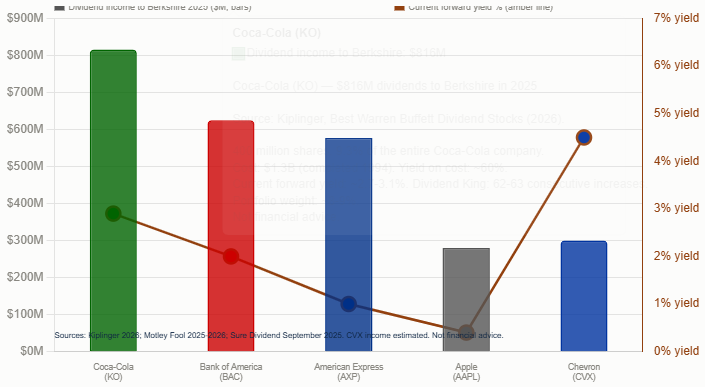
Coca-Cola is a member of the Dividend Kings — an elite group of fewer than 70 companies that have increased their dividends for at least 50 consecutive years. The current forward dividend yield is approximately 2.7–3.1%, depending on the current share price. But as established in Section 2, the current yield misses the point for Buffett: the yield on his original cost basis is approximately 60%.
The business itself remains exceptional. Coca-Cola owns or licenses more than 500 unique non-alcoholic brands and has 30 brands that each generate at least $1 billion in annual sales (Sure Dividend, September 2025). The brand’s international diversification means it is not dependent on any single market. Coca-Cola Zero Sugar grew volume 14% in Q2 2025. Motley Fool (June 2025): ‘If you’re worried that the stock market could be headed for a rough patch in 2026, Coca-Cola could be an especially smart pick.’ Not financial advice.
Coca-Cola (KO) dividend income to Berkshire: 1994: $75M. 2022: $704M (Buffett 2022 letter). 2025: ~$816M (Kiplinger). 2026 (projected): ~$824M+ (Motley Fool/AOL January 2026 — $206M/quarter after expected 64th consecutive increase). Berkshire shares: 400 million (unchanged for decades). Total cost: $1.3 billion. Current portfolio weight: approximately 8-9%. Dividend King: 62-63 consecutive years of increases. Current forward yield: ~2.7-3.1%. Yield on cost: ~60%. Not financial advice. Source: Kiplinger; Motley Fool January 2026; Buffett 2022 shareholder letter.
The current yield on American Express shares is less than 1% — almost certainly the lowest of the major dividend stocks in Berkshire’s portfolio. The reason is that the share price has risen approximately 191% over the last five years, which mathematically compresses the yield on today’s price. But AXP’s dividend has grown 91% between 2022 and 2025–26 (Motley Fool September 2025) — far faster than Coca-Cola. Buffett’s yield on cost is now estimated at approximately 23–44%, depending on the calculation method.
The business fundamentals support continued dividend growth. American Express reported record revenue in its July 2025 earnings report, with earnings rising 17% year over year (excluding a one-time sale) and $57.6 billion in cash on hand (Motley Fool September 2025). The company occupies a unique position as both a payments network and a lender — serving a higher-income, less credit-sensitive customer base than mass-market card issuers. For long-term dividend investors, AXP is the proof of concept that a low current yield can disguise a rapidly compounding income stream. Not financial advice.
American Express (AXP) dividend growth and yield on cost: 1995 dividend to Berkshire: $41M. 2022: $302M (7.4x growth, CAGR 7.7%; Morningstar Australia). 2026: ~$577M (Motley Fool/AOL January 2026). Yield on original $1.3B cost: ~$577M/$1.3B = ~44%. Current forward yield: ~1% (share price up 191% over 5 years). Dividend growth 2022-2026: 91% (Motley Fool September 2025). Portfolio weight: ~15.9-17.4%. Berkshire is AXP's largest shareholder. Source: Motley Fool January 2026; Morningstar Australia; Kiplinger. Not financial advice.
Chevron has increased its dividend for 37–38 consecutive years (Motley Fool 2025 data), qualifying it as a Dividend Aristocrat — the group of S&P 500 stocks with 25+ consecutive years of dividend increases. For an energy company whose profits fluctuate with oil and gas prices, this consistency is remarkable and reflects Chevron’s balance sheet discipline and diversified upstream and downstream business. Motley Fool (June 2025): ‘Chevron has a long runway for sustained dividend growth.’
Buffett trimmed his Chevron position in Q2 2024, but it remains a significant income contributor. If nothing else, Motley Fool (Webull January 2026) notes: ‘Chevron generates substantial income for the conglomerate with its attractive dividend yield of 4.5%.’ For income investors who want the highest current yield among Berkshire’s blue-chip equity holdings, Chevron is the most compelling option. Not financial advice.
Chevron (CVX) stats: Current forward yield: ~4.4-4.7% (highest in Berkshire's top-5 holdings). Consecutive dividend increases: 37-38 years (Dividend Aristocrat). Berkshire shares: ~118-119 million. Portfolio weight: ~5-6%. Buffett first bought: late 2020. Trimmed: Q2 2024. Motley Fool December 2025: 'Chevron, Coca-Cola, and UnitedHealth Group are the best high-yield dividend stocks in Buffett's portfolio for income investors.' Sources: Motley Fool June 2025; December 2025; January 2025; Webull/Motley Fool January 2026. Not financial advice.
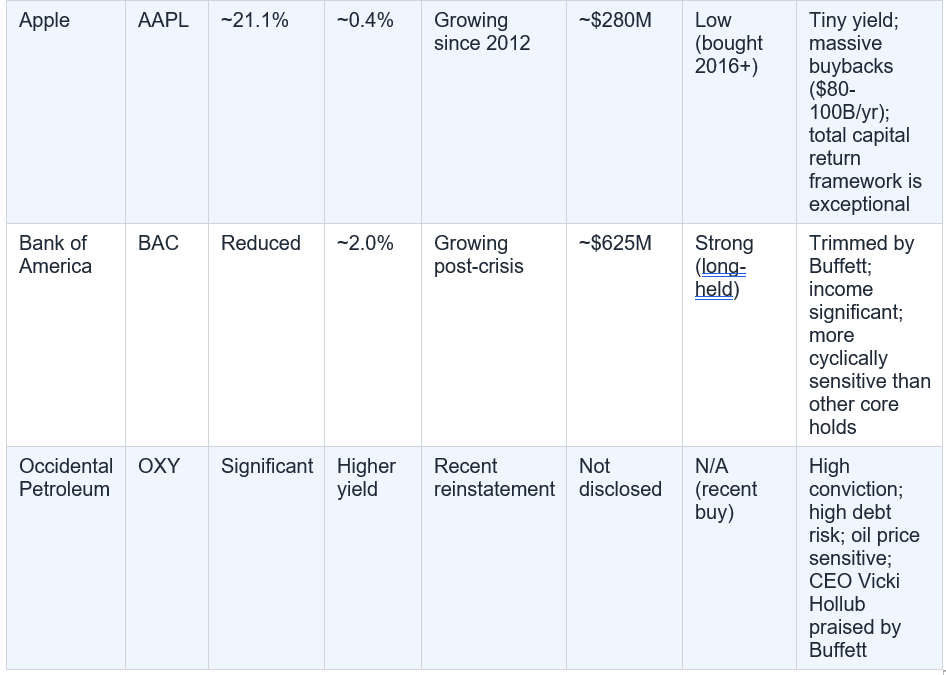
Why is Apple on a Buffett dividend stock list at all? Two reasons. First, the dividend income is real: Apple paid Berkshire approximately $280 million in cash dividends in 2025 (Kiplinger). That is $280 million from a 0.4% yield — which illustrates the scale of Berkshire’s Apple position. Second, and more importantly for Buffett’s framework, Apple supplements its modest dividend with one of the largest stock buyback programmes in history: $80–$100 billion per year. Buybacks reduce the share count, which increases earnings per share, which supports dividend growth over time.
Buffett famously called Apple ‘probably the best business I know in the world.’ Its Services division — App Store, iCloud, Apple TV+, Apple Music, Apple Pay — generates recurring, high-margin revenue that funds both the dividend and the buyback. The dividend growth since Apple initiated its payout in 2012 has been consistent. For income investors focused purely on yield, Apple is not the pick. For those who understand that buybacks and dividend growth compound simultaneously, Apple’s total capital return framework is exceptional. Not financial advice.
The current dividend yield on Bank of America is approximately 2.0% (Kiplinger). The dividend has grown over the years as the bank’s balance sheet recovered from the 2008-09 financial crisis and regulatory capital requirements normalised. Bank of America’s forward P/E ratio is well below that of Apple, American Express, Coca-Cola, and Chevron, making it the most traditionally ‘value-priced’ stock among the major Berkshire holdings.
The fact that Buffett has been trimming BAC while keeping Coca-Cola and American Express untouched tells us something about his conviction hierarchy. He described Coca-Cola and American Express as ‘unassailable franchises’ in the dividend growth context. Bank of America’s franchise is strong but more cyclically sensitive — bank earnings vary more with interest rates and credit cycles than beverage sales or payments network volumes. For income investors, BAC offers a higher yield than Apple or AXP but less dividend growth certainty than KO or CVX. Not financial advice.
The key risk is also the key characteristic: Occidental carries significant debt, making it extremely sensitive to oil and gas price movements. This is the opposite of Buffett’s typical dividend holding profile — most of his core dividend stocks have fortress balance sheets. OXY is more of a high-conviction energy bet than a classic dividend compounder. Its dividend yield is meaningful but the payout is more vulnerable to commodity price cycles than Chevron’s.
Sure Dividend (September 2025) ranks OXY among Berkshire’s highest-yielding stocks and notes it appears at #10 on their list of Buffett’s dividend holdings by yield. For investors who share Buffett’s conviction in Hollub’s management and in long-term oil demand, OXY offers a compelling but higher-risk counterpart to Chevron in the energy income category. Not financial advice.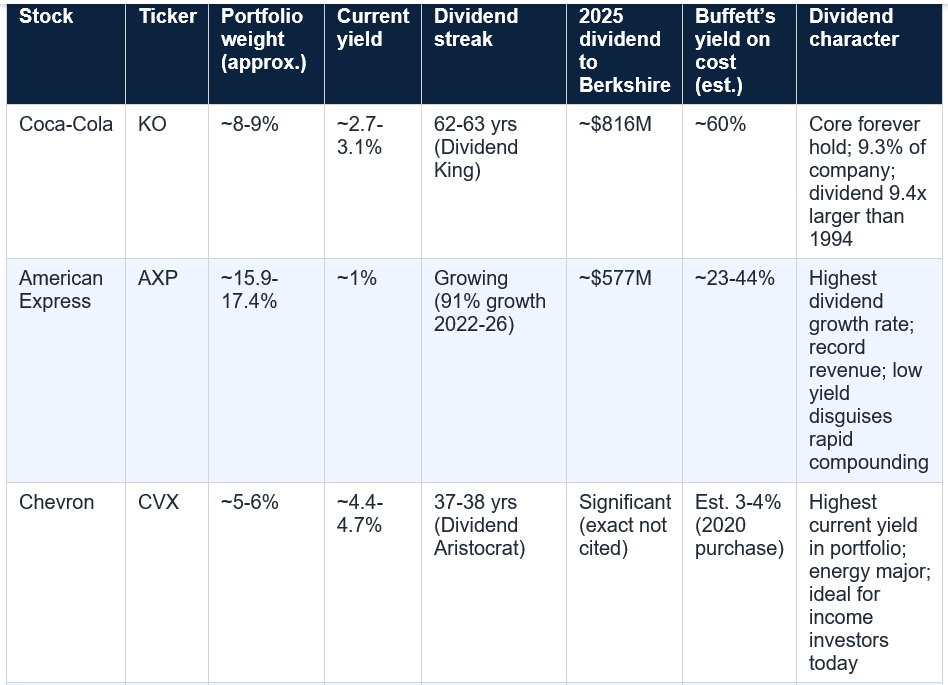
Second: they all have the financial capacity to keep growing their dividends. Coca-Cola’s free cash flow consistently exceeds its dividend payment, leaving room for annual increases regardless of short-term sales fluctuations. American Express is generating record revenue with $57.6 billion in cash on hand. Chevron has increased its dividend through oil price cycles that would have obliterated the payouts of weaker energy companies. Apple spends $80–$100 billion per year on buybacks and still has $146 billion in liquid assets. The dividend is not a drain on the business — it is the overflow of a highly profitable enterprise.
This is what Buffett means by ‘the secret sauce.’ Not the dividend itself — but the business quality that makes the dividend grow reliably, year after year, for decades. Not financial advice.
The six stocks covered — Coca-Cola, American Express, Chevron, Apple, Bank of America, and Occidental Petroleum — all reflect different aspects of the Buffett dividend philosophy. KO is the purest expression: buy an unassailable franchise, hold for 30 years, and the yield on cost becomes extraordinary. AXP shows what rapid dividend growth does to the income stream over time. CVX provides the highest current yield for income-focused investors today. AAPL demonstrates that buybacks and modest dividends can compound as powerfully as high yields when the business has enough free cash flow. BAC and OXY add cyclical energy and financial income to the mix.
The principle tying them together is the one Buffett calls the secret sauce. Not the initial yield. Not the clever trade. Just the business quality, the growing dividend, and the patience to hold. For individual investors seeking to build a long-term income portfolio, the Buffett framework remains the most compelling available. Not financial advice. Consult a qualified CFP for personalised guidance.
Based on historical performance, income generation, and Buffett's own commentary, Coca-Cola (KO) is the strongest candidate for Buffett's best dividend stock. Berkshire paid $1.3 billion for 400 million shares in the period leading up to 1994. In 2025, those shares paid approximately $816 million in annual dividends — a yield on cost of approximately 60% (Kiplinger; Motley Fool January 2026). Coca-Cola is a Dividend King with 62-63 consecutive years of annual dividend increases. Buffett has highlighted this position in multiple shareholder letters as the ultimate example of his 'secret sauce' investment philosophy. However, American Express is also a compelling case: its dividend grew 91% between 2022 and 2026 (Motley Fool September 2025), and it now pays approximately $577 million annually from a $1.3B purchase in 1995. Sources: Buffett 2022 Annual Letter; Kiplinger; Motley Fool. Not financial advice.
How much dividend income does Berkshire Hathaway receive?
Berkshire's expected dividend income from its top five holdings in 2025 totalled approximately $3.07 billion (Motley Fool January 2025). The breakdown by stock: Coca-Cola ~$816M (Kiplinger); American Express ~$577M (Motley Fool/AOL January 2026); Bank of America ~$625M (Kiplinger); Apple ~$280M (Kiplinger prior year). Chevron's contribution is significant but not broken out separately in the same detail in cited sources. All of Buffett's top 10 holdings pay dividends. His top five have an average dividend yield of approximately 2.2% and represent approximately 70% of Berkshire's ~$320B public equity portfolio (Sure Dividend September 2025). Not financial advice.
What is Buffett’s 'secret sauce' in dividend investing?
Buffett's 'secret sauce,' as he described it in his 2022 annual letter to Berkshire Hathaway shareholders, is buying businesses with the ability to grow their earnings and dividends over long periods, then holding them for decades without selling. The result: the dividend income grows far beyond what the original investment cost, while the business also appreciates in value. His Coca-Cola example: $1.3B in 1994; $75M annual dividend that year; $704M by 2022; ~$816M by 2025. His yield on cost: ~60%. The contrast he draws is with a fixed-income alternative (a high-grade 30-year bond bought for the same $1.3B): that bond would deliver an unchanged $80M per year by 2022, vs Coca-Cola's $704M. The growing-dividend business produces 8-10x the income of the fixed-income alternative over 30 years. Source: Buffett 2022 Annual Letter. Not financial advice.
Does Warren Buffett prefer high-yield or dividend growth stocks?
Buffett consistently prioritises business quality and dividend growth potential over starting yield. His two most frequently cited dividend positions — Coca-Cola (currently ~2.7% yield) and American Express (currently ~1% yield) — both had modest starting yields when purchased. His interest is in the 'trajectory of the dividend growth, not the initial yield' (paraphrasing his philosophy from shareholder letters and interviews). The exception in his current portfolio is Chevron, which offers ~4.4-4.7% yield — the highest in his top-five holdings and the most appealing current-income option. But even with Chevron, the 38-year dividend increase streak is a key attraction, not just the yield level. Morningstar Australia (citing Buffett): 'He purchased Coke and American Express because of their ability to grow earnings over the long term.' Not financial advice.
Is Apple a dividend stock in Buffett’s portfolio?
Yes, though its current dividend yield is modest (~0.4%). Apple paid Berkshire approximately $280 million in cash dividends in 2025 (Kiplinger), which is meaningful income at scale despite the low yield percentage. Apple has paid and grown its dividend every year since initiating the payout in 2012. More importantly, Apple supplements its dividend with one of the largest buyback programmes in corporate history: $80-100 billion per year (confirmed in prior session data). Buffett has described Apple as 'probably the best business I know in the world.' Berkshire holds approximately 238 million shares (21.1% of its portfolio) as of the latest 13-F filing, making it the single largest equity holding despite significant sales in 2024-2025. Not financial advice. Sources: Kiplinger; Motley Fool/Webull January 2026.
Table of Contents
- The Buffett Dividend Philosophy: ‘The Secret Sauce’
- The Yield-on-Cost Principle: Why Current Yield Misses the Point
- Berkshire’s Dividend Portfolio at a Glance
- Stock #1: Coca-Cola (KO) — The Forever Dividend King
- Stock #2: American Express (AXP) — The 91% Dividend Grower
- Stock #3: Chevron (CVX) — The Highest Yield in the Portfolio
- Stock #4: Apple (AAPL) — The Buyback Machine with a Dividend
- Stock #5: Bank of America (BAC) — The Trimmed Giant
- Bonus: Occidental Petroleum (OXY) — The New Conviction Buy
- The Full Comparison Table: All Six Stocks Side by Side
- The Core Lesson: Why Buffett Buys Growing Dividends, Not High Yields
- How to Apply the Buffett Dividend Playbook as an Individual Investor
- Conclusion: The Compounding Machine Has a Simple Design
- Frequently Asked Questions
The secret sauce — Coca-Cola and American Express dividend growth
Berkshire's top dividend stocks — current yields and income
Yield on cost — why time destroys the fixed-income alternative
The Buffett Dividend Philosophy: ‘The Secret Sauce’
In his 2022 annual letter to Berkshire Hathaway shareholders, Warren Buffett devoted a section titled ‘The Secret Sauce’ to explaining a principle that sounds obvious but is almost universally ignored in practice: buy businesses with the ability to grow their dividends year after year, hold them for decades, and the income generated will eventually dwarf the original price paid. Buffett’s Berkshire does not pay a dividend itself. But the companies it holds do — and the compounding of those dividends over decades is what Buffett was highlighting.The two examples he used were Coca-Cola and American Express. Berkshire completed its purchase of 400 million Coca-Cola shares in August 1994 for $1.3 billion. In 1994, those shares paid $75 million in dividends. By 2022, the dividend had grown to $704 million — and the original $1.3 billion investment had become a position worth approximately $25 billion. Berkshire had not bought one additional share. It had not done anything except ‘cash Coke’s quarterly dividend checks,’ as Buffett put it. The dividend had grown because the business had grown. That is the secret sauce.
For American Express: purchased for $1.3 billion in 1995. Dividends in 1995: $41 million. By 2022: $302 million. By 2026: approximately $577 million — almost half of Berkshire’s entire original purchase price, arriving annually, indefinitely. This is what distinguishes Buffett’s dividend approach from yield-chasing: he buys businesses with economic moats, waiting for time and compounding to do the work. Not financial advice.
Buffett's 2022 shareholder letter ('The Secret Sauce'): 'In August 1994 — yes, 1994 — Berkshire completed its seven-year purchase of the 400 million shares of Coca-Cola we now own. The total cost was $1.3 billion — then a very meaningful sum at Berkshire. The cash dividend we received from Coke in 1994 was $75 million. By 2022, the dividend had increased to $704 million. All Charlie and I were required to do was cash Coke's quarterly dividend checks.' American Express: 'Berkshire's purchases of Amex were essentially completed in 1995 and, coincidentally, also cost $1.3 billion. Annual dividends received from this investment have grown from $41 million to $302 million.' Kiplinger update: Coca-Cola now pays Berkshire ~$816M/year in dividends (2025). AXP now pays ~$577M/year (2026).
The Yield-on-Cost Principle: Why Current Yield Misses the Point
The most important concept in Buffett’s dividend philosophy is yield on cost: the dividend income expressed as a percentage of the original purchase price, not the current market price. When most investors evaluate a dividend stock, they look at the current yield — the annual dividend divided by today’s share price. Coca-Cola currently yields approximately 2.7–3.1% on today’s price. But Buffett paid $1.3 billion for his 400 million shares in 1994. At $816 million in annual dividends today, his yield on cost is approximately 60%. He is receiving 60% of his original purchase price back every single year, in cash, just from dividends.The contrast Buffett draws in his 2022 letter is the alternative: what if, instead of buying Coke and Amex for $1.3 billion each, Berkshire had bought a high-grade 30-year bond? That bond would now represent 0.3% of Berkshire’s net worth, delivering an unchanged $80 million per year in income. No growth. No appreciation. The fixed-income alternative that seemed prudent in 1994 would have been a multi-decade disaster by comparison.
This is the core lesson: a 2% yield on a business that grows its dividend by 6–8% annually will, over 25–30 years, far outperform a 5% yield on a business that does not grow its dividend. The math is straightforward; the discipline to act on it is not. Most investors anchor on the current yield and ignore the dividend growth rate. Buffett anchors on the business quality and the long-run trajectory of earnings, dividend capacity, and compounding. Not financial advice.
Buffett yield-on-cost examples: Coca-Cola: paid $1.3B in 1994; now receives ~$816M/yr in dividends. Yield on cost: approximately 60%. (Kiplinger; Motley Fool January 2026.) American Express: paid $1.3B in 1995; now receives ~$577M/yr in dividends. Yield on cost: approximately 44%. (Motley Fool/AOL January 2026.) Morningstar Australia: AXP dividends grew 7.4x over 27 years (CAGR 7.7%). Buffett's AXP yield on cost: approximately 23-44% depending on calculation method. The comparison: a 30-year bond bought for the same $1.3B in 1994 would now deliver an unchanged $80M/year (Buffett 2022 letter). The growing-dividend business produces 10x+ the income of the fixed-income alternative over 30 years. Not financial advice.
Berkshire’s Dividend Portfolio at a Glance
Nearly 65% of Berkshire Hathaway’s equity portfolio is concentrated in five stocks as 2026 begins (Motley Fool, January 2026). All of Buffett’s top ten holdings pay dividends. His top five have an average dividend yield of approximately 2.2% and represent approximately 70% of the portfolio (Sure Dividend, September 3, 2025). The expected total dividend income from these top five holdings in 2025 was approximately $3.07 billion (Motley Fool January 2025).Berkshire’s public equity portfolio stands at approximately $320 billion (Motley Fool July 2025). Alongside it, the conglomerate has accumulated approximately $276.9 billion in cash as of mid-2025 — a cash pile that itself represents a commentary on Buffett’s ongoing struggle to find businesses that meet his standards at reasonable prices. The portfolio’s dividend income is generated passively, with no management overhead, no investment banker fees, and no need to time markets. It is buy-and-hold dividend investing at its most institutional scale.
Note: Greg Abel became Berkshire’s new CEO in 2025 after Warren Buffett stepped down from day-to-day management. The portfolio discussed in this article reflects Buffett’s long-term construction philosophy, now continued under Abel. Not financial advice.
#1 KO — Coca-Cola — The Forever Dividend King
Coca-Cola is the quintessential Buffett stock: a simple business with an impenetrable brand moat, global reach, reliable earnings, and a dividend track record that has now spanned 62–63 consecutive years of annual increases. Berkshire owns 400 million shares — 9.3% of the entire company — purchased for approximately $1.3 billion in the period leading up to 1994. In 2025, those shares paid Berkshire approximately $816 million in annual dividends (Kiplinger). In 2026, with the 64th consecutive annual dividend increase expected, that figure is projected to rise further.Coca-Cola is a member of the Dividend Kings — an elite group of fewer than 70 companies that have increased their dividends for at least 50 consecutive years. The current forward dividend yield is approximately 2.7–3.1%, depending on the current share price. But as established in Section 2, the current yield misses the point for Buffett: the yield on his original cost basis is approximately 60%.
The business itself remains exceptional. Coca-Cola owns or licenses more than 500 unique non-alcoholic brands and has 30 brands that each generate at least $1 billion in annual sales (Sure Dividend, September 2025). The brand’s international diversification means it is not dependent on any single market. Coca-Cola Zero Sugar grew volume 14% in Q2 2025. Motley Fool (June 2025): ‘If you’re worried that the stock market could be headed for a rough patch in 2026, Coca-Cola could be an especially smart pick.’ Not financial advice.
Coca-Cola (KO) dividend income to Berkshire: 1994: $75M. 2022: $704M (Buffett 2022 letter). 2025: ~$816M (Kiplinger). 2026 (projected): ~$824M+ (Motley Fool/AOL January 2026 — $206M/quarter after expected 64th consecutive increase). Berkshire shares: 400 million (unchanged for decades). Total cost: $1.3 billion. Current portfolio weight: approximately 8-9%. Dividend King: 62-63 consecutive years of increases. Current forward yield: ~2.7-3.1%. Yield on cost: ~60%. Not financial advice. Source: Kiplinger; Motley Fool January 2026; Buffett 2022 shareholder letter.
#2 AXP — American Express — The 91% Dividend Grower
American Express is now Berkshire’s second-largest holding, representing approximately 15.9–17.4% of the portfolio (Motley Fool July 2025; Kiplinger). Buffett paid $1.3 billion for his stake, essentially completing the purchase in 1995. At the time, American Express paid $41 million in annual dividends to Berkshire. By 2026, that figure has grown to approximately $577 million — almost half of Berkshire’s original purchase price arriving annually in cash.The current yield on American Express shares is less than 1% — almost certainly the lowest of the major dividend stocks in Berkshire’s portfolio. The reason is that the share price has risen approximately 191% over the last five years, which mathematically compresses the yield on today’s price. But AXP’s dividend has grown 91% between 2022 and 2025–26 (Motley Fool September 2025) — far faster than Coca-Cola. Buffett’s yield on cost is now estimated at approximately 23–44%, depending on the calculation method.
The business fundamentals support continued dividend growth. American Express reported record revenue in its July 2025 earnings report, with earnings rising 17% year over year (excluding a one-time sale) and $57.6 billion in cash on hand (Motley Fool September 2025). The company occupies a unique position as both a payments network and a lender — serving a higher-income, less credit-sensitive customer base than mass-market card issuers. For long-term dividend investors, AXP is the proof of concept that a low current yield can disguise a rapidly compounding income stream. Not financial advice.
American Express (AXP) dividend growth and yield on cost: 1995 dividend to Berkshire: $41M. 2022: $302M (7.4x growth, CAGR 7.7%; Morningstar Australia). 2026: ~$577M (Motley Fool/AOL January 2026). Yield on original $1.3B cost: ~$577M/$1.3B = ~44%. Current forward yield: ~1% (share price up 191% over 5 years). Dividend growth 2022-2026: 91% (Motley Fool September 2025). Portfolio weight: ~15.9-17.4%. Berkshire is AXP's largest shareholder. Source: Motley Fool January 2026; Morningstar Australia; Kiplinger. Not financial advice.
#3 CVX — Chevron — The Highest Yield in the Portfolio
For income investors prioritising current yield, Chevron is the standout in Berkshire’s portfolio. The forward dividend yield on Chevron is approximately 4.4–4.7% — making it a rare genuinely high-yield blue chip from Buffett’s holdings (Motley Fool June 2025; December 2025). Buffett first initiated the position in late 2020. Berkshire owned approximately 118–119 million shares as of Q3 2024 filings, making Chevron one of the top five holdings by value.Chevron has increased its dividend for 37–38 consecutive years (Motley Fool 2025 data), qualifying it as a Dividend Aristocrat — the group of S&P 500 stocks with 25+ consecutive years of dividend increases. For an energy company whose profits fluctuate with oil and gas prices, this consistency is remarkable and reflects Chevron’s balance sheet discipline and diversified upstream and downstream business. Motley Fool (June 2025): ‘Chevron has a long runway for sustained dividend growth.’
Buffett trimmed his Chevron position in Q2 2024, but it remains a significant income contributor. If nothing else, Motley Fool (Webull January 2026) notes: ‘Chevron generates substantial income for the conglomerate with its attractive dividend yield of 4.5%.’ For income investors who want the highest current yield among Berkshire’s blue-chip equity holdings, Chevron is the most compelling option. Not financial advice.
Chevron (CVX) stats: Current forward yield: ~4.4-4.7% (highest in Berkshire's top-5 holdings). Consecutive dividend increases: 37-38 years (Dividend Aristocrat). Berkshire shares: ~118-119 million. Portfolio weight: ~5-6%. Buffett first bought: late 2020. Trimmed: Q2 2024. Motley Fool December 2025: 'Chevron, Coca-Cola, and UnitedHealth Group are the best high-yield dividend stocks in Buffett's portfolio for income investors.' Sources: Motley Fool June 2025; December 2025; January 2025; Webull/Motley Fool January 2026. Not financial advice.
#4 AAPL — Apple — The Buyback Machine with a Dividend
Apple is Berkshire’s largest single holding despite significant selling in 2024 and into 2025. As of the latest 13-F filing, Berkshire holds approximately 238 million shares (21.1% of the portfolio), reduced from 300 million shares (24.8%) as of earlier 2025 filings (Motley Fool/Webull January 2026). The current forward dividend yield on Apple is approximately 0.4–0.5% — the lowest of any dividend stock on this list and, in the context of income investing, almost negligible.Why is Apple on a Buffett dividend stock list at all? Two reasons. First, the dividend income is real: Apple paid Berkshire approximately $280 million in cash dividends in 2025 (Kiplinger). That is $280 million from a 0.4% yield — which illustrates the scale of Berkshire’s Apple position. Second, and more importantly for Buffett’s framework, Apple supplements its modest dividend with one of the largest stock buyback programmes in history: $80–$100 billion per year. Buybacks reduce the share count, which increases earnings per share, which supports dividend growth over time.
Buffett famously called Apple ‘probably the best business I know in the world.’ Its Services division — App Store, iCloud, Apple TV+, Apple Music, Apple Pay — generates recurring, high-margin revenue that funds both the dividend and the buyback. The dividend growth since Apple initiated its payout in 2012 has been consistent. For income investors focused purely on yield, Apple is not the pick. For those who understand that buybacks and dividend growth compound simultaneously, Apple’s total capital return framework is exceptional. Not financial advice.
#5 BAC — Bank of America — The Trimmed Giant
Bank of America was once Berkshire’s second-largest holding. Buffett trimmed the position significantly through 2024 and into 2025, but BAC remains a meaningful income contributor. Kiplinger reports Bank of America paid Berkshire approximately $625 million in cash dividends in 2025 — despite the reduced position size — highlighting the scale of Buffett’s original stake.The current dividend yield on Bank of America is approximately 2.0% (Kiplinger). The dividend has grown over the years as the bank’s balance sheet recovered from the 2008-09 financial crisis and regulatory capital requirements normalised. Bank of America’s forward P/E ratio is well below that of Apple, American Express, Coca-Cola, and Chevron, making it the most traditionally ‘value-priced’ stock among the major Berkshire holdings.
The fact that Buffett has been trimming BAC while keeping Coca-Cola and American Express untouched tells us something about his conviction hierarchy. He described Coca-Cola and American Express as ‘unassailable franchises’ in the dividend growth context. Bank of America’s franchise is strong but more cyclically sensitive — bank earnings vary more with interest rates and credit cycles than beverage sales or payments network volumes. For income investors, BAC offers a higher yield than Apple or AXP but less dividend growth certainty than KO or CVX. Not financial advice.
Bonus: Occidental Petroleum (OXY) — The New Conviction Buy
Occidental Petroleum is not in Berkshire’s top five holdings by value, but it represents one of the most interesting recent conviction additions to the portfolio. Buffett has publicly praised Occidental CEO Vicki Hollub on multiple occasions and has accumulated both common stock and warrants. The company grew its reserves from 4.0 billion to 4.6 billion barrels of oil equivalent in 2024 through the CrownRock acquisition (Sure Dividend, September 2025).The key risk is also the key characteristic: Occidental carries significant debt, making it extremely sensitive to oil and gas price movements. This is the opposite of Buffett’s typical dividend holding profile — most of his core dividend stocks have fortress balance sheets. OXY is more of a high-conviction energy bet than a classic dividend compounder. Its dividend yield is meaningful but the payout is more vulnerable to commodity price cycles than Chevron’s.
Sure Dividend (September 2025) ranks OXY among Berkshire’s highest-yielding stocks and notes it appears at #10 on their list of Buffett’s dividend holdings by yield. For investors who share Buffett’s conviction in Hollub’s management and in long-term oil demand, OXY offers a compelling but higher-risk counterpart to Chevron in the energy income category. Not financial advice.
The Full Comparison Table: All Six Stocks Side by Side
The Core Lesson: Why Buffett Buys Growing Dividends, Not High Yields
The six stocks in this article share two qualities that have little to do with their current dividend yield. First: economic moats. Coca-Cola has global brand recognition and a distribution network impossible to replicate. American Express has a customer network with self-reinforcing value to both merchants and cardholders. Chevron has decades of geological expertise and capital infrastructure. Apple has an ecosystem of 2 billion devices, a subscription business, and switching costs baked into every customer relationship. Bank of America has scale, government backstop, and a deposit franchise that is essentially irreplaceable. These are not high-yield utilities. They are dominant franchises that happen to pay growing dividends.Second: they all have the financial capacity to keep growing their dividends. Coca-Cola’s free cash flow consistently exceeds its dividend payment, leaving room for annual increases regardless of short-term sales fluctuations. American Express is generating record revenue with $57.6 billion in cash on hand. Chevron has increased its dividend through oil price cycles that would have obliterated the payouts of weaker energy companies. Apple spends $80–$100 billion per year on buybacks and still has $146 billion in liquid assets. The dividend is not a drain on the business — it is the overflow of a highly profitable enterprise.
This is what Buffett means by ‘the secret sauce.’ Not the dividend itself — but the business quality that makes the dividend grow reliably, year after year, for decades. Not financial advice.
How to Apply the Buffett Dividend Playbook as an Individual Investor
The principles behind Buffett’s dividend portfolio are applicable at any scale. The challenge for individual investors is not understanding the principles — it is having the patience to implement them. Buffett has held Coca-Cola through multiple market crashes, rising interest rate environments, obesity concerns, sugar tax discussions, and the rise of energy drinks. He has never sold. That holding period is what created the 60% yield on cost.- Focus on dividend growth rate, not starting yield. A stock with a 2% yield growing at 8% annually will have a higher yield on cost than a 5% yield growing at 2%, within 15 years. The compound growth of income is as powerful as the compound growth of capital.
- Look for businesses with economic moats. The moat is what protects the dividend: if a business can raise prices annually, maintain market share, and generate excess free cash flow, the dividend is safe and growable. Without the moat, a high yield is temporary.
- Hold through volatility. Buffett’s yield on cost advantage is entirely a function of not selling. Every investor who held Coca-Cola from 1994 to today has a yield on cost approaching the same exceptional level. Those who traded in and out sacrificed the compounding.
- Reinvest dividends in early years. In the accumulation phase, reinvesting dividends back into the same stock or into other dividend growers accelerates the compounding effect dramatically. $816 million reinvested in additional Coca-Cola shares compounds at the same rate as the original investment.
- Do not chase yield. The highest-yielding stocks often have fragile dividends. A 9% yield that gets cut in half is not better than a 3% yield that grows 7% annually. Always check free cash flow coverage of the dividend payout before committing capital. Not financial advice.
Conclusion
Warren Buffett’s dividend portfolio is not complex. It consists of a small number of dominant businesses with durable competitive advantages, purchased at reasonable prices and held indefinitely. The result, over decades, is a dividend income stream that dwarfs the original cost of the investment. Berkshire’s expected dividend income from its top five holdings in 2025 was $3.07 billion. That number arrives every year without Buffett actively managing, trading, or timing anything.The six stocks covered — Coca-Cola, American Express, Chevron, Apple, Bank of America, and Occidental Petroleum — all reflect different aspects of the Buffett dividend philosophy. KO is the purest expression: buy an unassailable franchise, hold for 30 years, and the yield on cost becomes extraordinary. AXP shows what rapid dividend growth does to the income stream over time. CVX provides the highest current yield for income-focused investors today. AAPL demonstrates that buybacks and modest dividends can compound as powerfully as high yields when the business has enough free cash flow. BAC and OXY add cyclical energy and financial income to the mix.
The principle tying them together is the one Buffett calls the secret sauce. Not the initial yield. Not the clever trade. Just the business quality, the growing dividend, and the patience to hold. For individual investors seeking to build a long-term income portfolio, the Buffett framework remains the most compelling available. Not financial advice. Consult a qualified CFP for personalised guidance.
Frequently Asked Questions
What is Warren Buffett’s best dividend stock?Based on historical performance, income generation, and Buffett's own commentary, Coca-Cola (KO) is the strongest candidate for Buffett's best dividend stock. Berkshire paid $1.3 billion for 400 million shares in the period leading up to 1994. In 2025, those shares paid approximately $816 million in annual dividends — a yield on cost of approximately 60% (Kiplinger; Motley Fool January 2026). Coca-Cola is a Dividend King with 62-63 consecutive years of annual dividend increases. Buffett has highlighted this position in multiple shareholder letters as the ultimate example of his 'secret sauce' investment philosophy. However, American Express is also a compelling case: its dividend grew 91% between 2022 and 2026 (Motley Fool September 2025), and it now pays approximately $577 million annually from a $1.3B purchase in 1995. Sources: Buffett 2022 Annual Letter; Kiplinger; Motley Fool. Not financial advice.
How much dividend income does Berkshire Hathaway receive?
Berkshire's expected dividend income from its top five holdings in 2025 totalled approximately $3.07 billion (Motley Fool January 2025). The breakdown by stock: Coca-Cola ~$816M (Kiplinger); American Express ~$577M (Motley Fool/AOL January 2026); Bank of America ~$625M (Kiplinger); Apple ~$280M (Kiplinger prior year). Chevron's contribution is significant but not broken out separately in the same detail in cited sources. All of Buffett's top 10 holdings pay dividends. His top five have an average dividend yield of approximately 2.2% and represent approximately 70% of Berkshire's ~$320B public equity portfolio (Sure Dividend September 2025). Not financial advice.
What is Buffett’s 'secret sauce' in dividend investing?
Buffett's 'secret sauce,' as he described it in his 2022 annual letter to Berkshire Hathaway shareholders, is buying businesses with the ability to grow their earnings and dividends over long periods, then holding them for decades without selling. The result: the dividend income grows far beyond what the original investment cost, while the business also appreciates in value. His Coca-Cola example: $1.3B in 1994; $75M annual dividend that year; $704M by 2022; ~$816M by 2025. His yield on cost: ~60%. The contrast he draws is with a fixed-income alternative (a high-grade 30-year bond bought for the same $1.3B): that bond would deliver an unchanged $80M per year by 2022, vs Coca-Cola's $704M. The growing-dividend business produces 8-10x the income of the fixed-income alternative over 30 years. Source: Buffett 2022 Annual Letter. Not financial advice.
Does Warren Buffett prefer high-yield or dividend growth stocks?
Buffett consistently prioritises business quality and dividend growth potential over starting yield. His two most frequently cited dividend positions — Coca-Cola (currently ~2.7% yield) and American Express (currently ~1% yield) — both had modest starting yields when purchased. His interest is in the 'trajectory of the dividend growth, not the initial yield' (paraphrasing his philosophy from shareholder letters and interviews). The exception in his current portfolio is Chevron, which offers ~4.4-4.7% yield — the highest in his top-five holdings and the most appealing current-income option. But even with Chevron, the 38-year dividend increase streak is a key attraction, not just the yield level. Morningstar Australia (citing Buffett): 'He purchased Coke and American Express because of their ability to grow earnings over the long term.' Not financial advice.
Is Apple a dividend stock in Buffett’s portfolio?
Yes, though its current dividend yield is modest (~0.4%). Apple paid Berkshire approximately $280 million in cash dividends in 2025 (Kiplinger), which is meaningful income at scale despite the low yield percentage. Apple has paid and grown its dividend every year since initiating the payout in 2012. More importantly, Apple supplements its dividend with one of the largest buyback programmes in corporate history: $80-100 billion per year (confirmed in prior session data). Buffett has described Apple as 'probably the best business I know in the world.' Berkshire holds approximately 238 million shares (21.1% of its portfolio) as of the latest 13-F filing, making it the single largest equity holding despite significant sales in 2024-2025. Not financial advice. Sources: Kiplinger; Motley Fool/Webull January 2026.
0 Comments
Be the first to share your thoughts on this article.