
Credits
The Complete UK Debt Handbook: Your Complete Guide


Table of Contents
The State of UK Debt in 2026The UK Debt Picture in 2026: The Statistics That Define the Crisis
Types of UK Household Debt: Understanding What You Owe
UK Debt Solutions in 2026: Your Complete Reference Guide
Priority Debts vs Non-Priority Debts: The Distinction That Matters Most
Priority Debts (pay these first -- the consequences of non-payment are most severe)
Non-Priority Debts (still important -- but the immediate consequences of non-payment are less severe)
Free UK Debt Help in 2026: Every Resource You Need
Conclusion: The Numbers Are Large. The Help Is Real.
Frequently Asked Questions (FAQ)
What is the average UK household debt in 2026?
What is the difference between a DMP, IVA, and DRO?
What is Breathing Space and how do I apply for it?
Should I use a paid debt management company or a free debt charity?
What happens to debt when someone dies in the UK?
External References & Further Reading
The State of UK Debt in 2026
By the end of December 2025, total personal debt in the United Kingdom had reached £1.94 trillion -- up £63.9 billion in a single year, adding an extra £1,141 of debt for every UK adult. UK borrowers are paying £239 million in interest every single day -- £87.4 billion per year -- money that reduces no principal, builds no equity, and produces no financial progress. Personal insolvencies reached 126,240 in 2025, the highest level since 2010. One person entered insolvency every four minutes in Q3 2025 in England and Wales alone.These numbers are significant. They are also, in important ways, manageable -- because 61% of those who sought free debt advice reported that their debts became more manageable as a result (FCA, via TrySnowball, February 2026). Citizens Advice handled 1,250 debt issues every day in the year to December 2025. StepChange reported 17,998 clients receiving debt advice in January 2026 alone. The majority of the people behind these statistics are not reckless or irresponsible. They are households whose income fell short of their costs -- often following the cost of living crisis, a relationship breakdown, a job loss, or a medical event -- and who eventually reached a point where the debt needed addressing.
This handbook covers the complete picture: the types of debt most UK households carry, the current statistics behind each one, the debt solutions available in 2026 (from free debt management plans to formal insolvency proceedings), the psychological reality of living with debt, and the specific steps to take whether you are managing debt proactively or dealing with a crisis. The free help is at the bottom of every section. Use it.
The UK Debt Picture in 2026: The Statistics That Define the Crisis
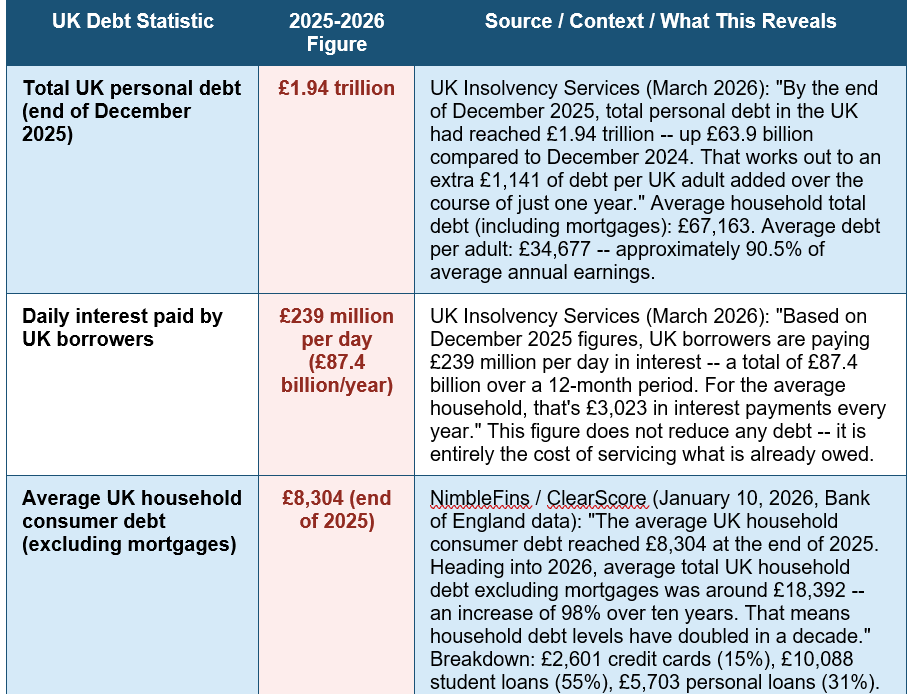
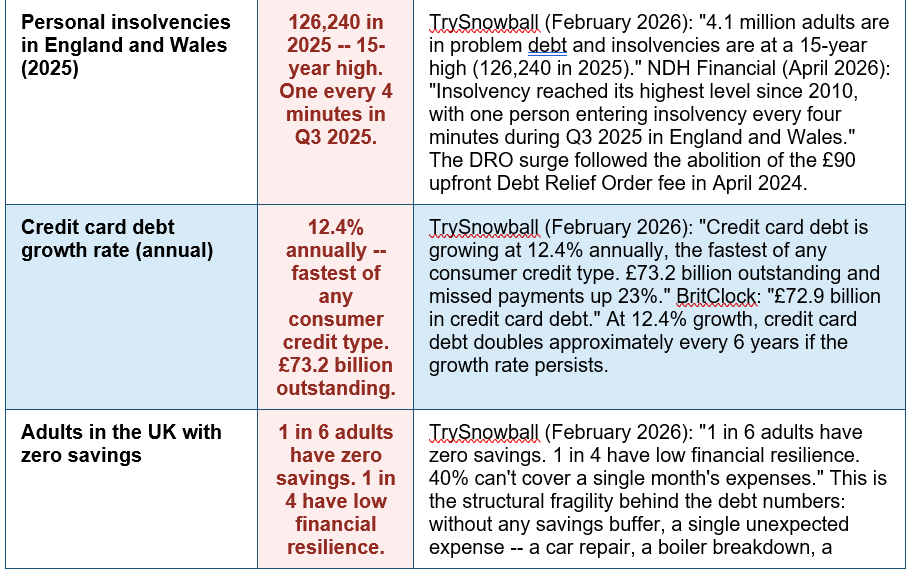
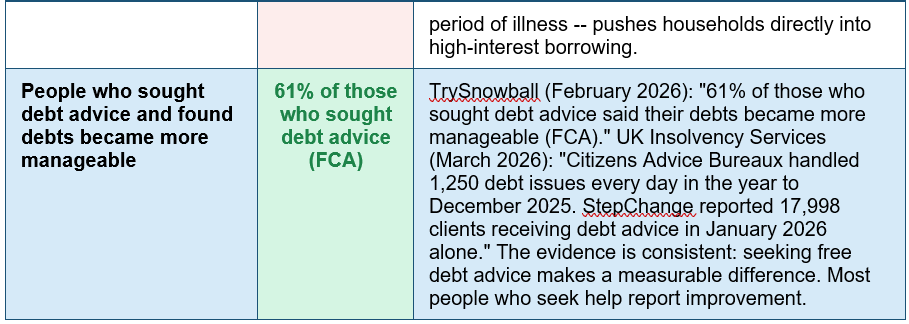
UK debt in 2026 -- the defining numbers: £1.94 trillion total debt. £239m interest per day. £3,023 interest per household per year. 126,240 insolvencies in 2025. 4.1 million in problem debt. — UK Insolvency Services (March 2026, most current comprehensive report): '£1.94 trillion personal debt at end December 2025, up £63.9 billion in one year. £239 million per day in interest. Average household £3,023/year in interest payments.' TrySnowball (February 2026): '4.1 million adults in problem debt. Insolvencies at 15-year high. 126,240 in 2025.' NimbleFins/ClearScore (January 2026, Bank of England data): 'Average household consumer debt £8,304; total excluding mortgages £18,392 -- up 98% in 10 years.'
Types of UK Household Debt: Understanding What You Owe
1 CREDIT CARD DEBT | £73.2 billion outstanding. Growing at 12.4% annually. Missed payments up 23%.
Credit card debt is the fastest-growing and most immediately dangerous form of UK consumer debt. TrySnowball (February 2026): 'Credit card debt is growing at 12.4% annually, the fastest of any consumer credit type. £73.2 billion outstanding and missed payments up 23%.' NimbleFins (January 2026): average credit card debt per household is £2,601 -- at or near the all-time high reached in 2018. NDH Financial (April 2026): 'The average UK credit card balance is £1,900. If this balance is being repaid steadily or sits on a 0% interest deal, it may be manageable. The picture changes when the balance carries a high interest rate with only minimum payments being made.' At the typical UK credit card rate of 21-24% APR, a £2,601 balance paying only the minimum monthly payment takes approximately 12-16 years to clear and costs more in interest than the original balance. The first action for any credit card debt: calculate the actual payoff timeline and total interest cost at your current rate and payment. Then decide whether a balance transfer card (0% for 12-30 months), a consolidation loan, or an accelerated repayment plan is the fastest route to zero. Free help: National Debtline 0808 808 4000.2 PERSONAL LOANS | £5,703 average per household -- a record high. Often carrying rates of 5-25% APR.
NimbleFins (January 10, 2026): 'The average personal loan amount per household in the UK was roughly £5,703 in 2025 (excluding student loans) -- a record high, even higher than post-2008 financial crisis levels.' Personal loans are the second-largest category of non-mortgage, non-student-loan consumer debt. They are used for a wide range of purposes: car purchases, home improvements, debt consolidation, holiday finance, and emergency expenses. Personal loan rates in 2026 vary widely -- from approximately 4-6% APR for well-qualified borrowers to 20-25% APR for those with fair credit. At 12% APR on £5,703 over 5 years, the total interest cost is approximately £1,890. The most common misuse of personal loans is consolidation without behaviour change. NDH Financial (April 2026): Citizens Advice forecast the average shortfall between income and essential spending for negative-budget households will rise to around £396 per month -- which is why many households turn to personal loans to bridge a gap that a loan cannot permanently close.3 STUDENT LOAN DEBT | £10,088 average per household. £268.5 billion total outstanding.
Student loan debt is the largest single component of non-mortgage UK household debt, representing 55% of non-mortgage lending by value. NimbleFins (January 2026): 'Average student loan debt per household is £10,088. Total UK student loans outstanding: £268.5 billion (BritClock).' UK student loans operate differently from commercial debt. They are income-contingent -- repayments only begin when earnings exceed the repayment threshold (£27,295/year for Plan 2 borrowers; £25,000 for Plan 5 from 2023 entry). Unpaid balances under Plan 2 are written off after 30 years. For most graduates, student loans function more like a graduate tax than a conventional debt -- and the mental burden of seeing a large balance should be weighed against the specific terms of the plan. The practical question: are you above the repayment threshold? If yes, repayments happen automatically through payroll. If not, no action is required. The key issue: Plan 5 borrowers (entering university from 2023) face a 40-year repayment window with a £25,000 threshold -- a significantly less favourable arrangement than Plan 2. Check your plan at studentloans.gov.uk and understand the specific terms that apply to you.4 MORTGAGE DEBT | £197,811 average for those with mortgages. 29% of households carry a mortgage.
NimbleFins (January 2026): 'The average home loan per household of the households that have a mortgage is now £197,811 -- an increase of 28% in ten years. According to ONS data, 29% of households now carry a mortgage.' Mortgage debt is secured against the property -- which means the consequences of missed payments (ultimately repossession) are more severe than for unsecured debts. UK Insolvency Services (March 2026): the cost of living crisis has put particular pressure on households with recently remortgaged fixed deals, as those refinancing from 2-year fixes taken at sub-2% rates in 2020-2022 have faced payment increases of hundreds of pounds per month. If you are struggling with mortgage payments: contact your lender before missing a payment. UK lenders are regulated to offer forbearance, payment holidays, and term extensions to borrowers in financial difficulty. Repossession is a last resort that lenders are required to demonstrate they have exhausted other options before pursuing. Free mortgage arrears advice: MoneyHelper 0800 138 7777; Shelter 0808 800 4444.5 BUY NOW PAY LATER (BNPL) AND OVERDRAFT DEBT | Growing rapidly. Less regulated. Often invisible in debt calculations.
Two categories of debt are growing particularly rapidly in the UK but are less consistently tracked in official statistics. BNPL debt: services like Klarna, Clearpay, and Laybuy allow purchases to be split across instalments. NDH Financial (April 2026): 'When you strip out everyday consumer debt like student loans, money borrowed from friends or family, buy now pay later, and people who pay off their credit cards in full each month, around 48% of UK adults hold some form of credit or loan.' BNPL is frequently excluded from formal debt calculations but represents a real and growing obligation, particularly for younger households. FCA regulation of the BNPL sector is ongoing in 2026 -- full affordability checks and clearer credit file reporting are expected to arrive as regulatory changes take effect. Overdraft debt: authorised overdraft interest rates can exceed 39.9% EAR at major banks following FCA rule changes in 2020. An overdraft that is used month-to-month as a structural shortfall (not as an emergency buffer) is effectively the most expensive revolving credit product available to UK consumers -- and one of the most commonly overlooked. Check your bank statement: if you are consistently in your overdraft for more than half the month, this is a structural budget problem, not a timing issue.UK Debt Solutions in 2026: Your Complete Reference Guide
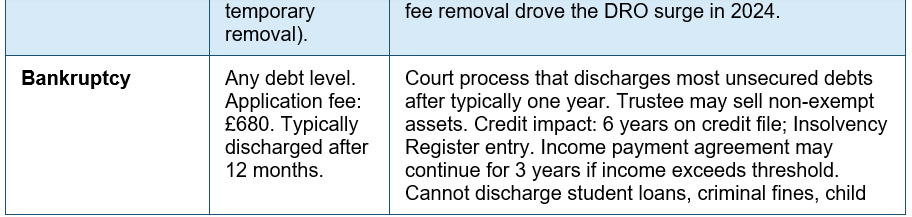
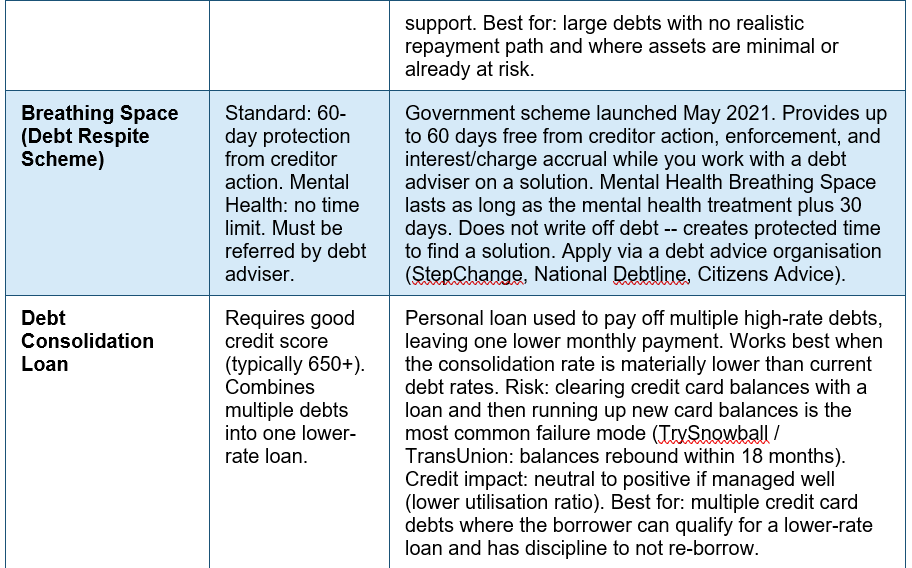
Choosing the right debt solution depends on your specific debt amount, income, asset position, and the types of debt you carry. The following table maps every mainstream UK debt solution: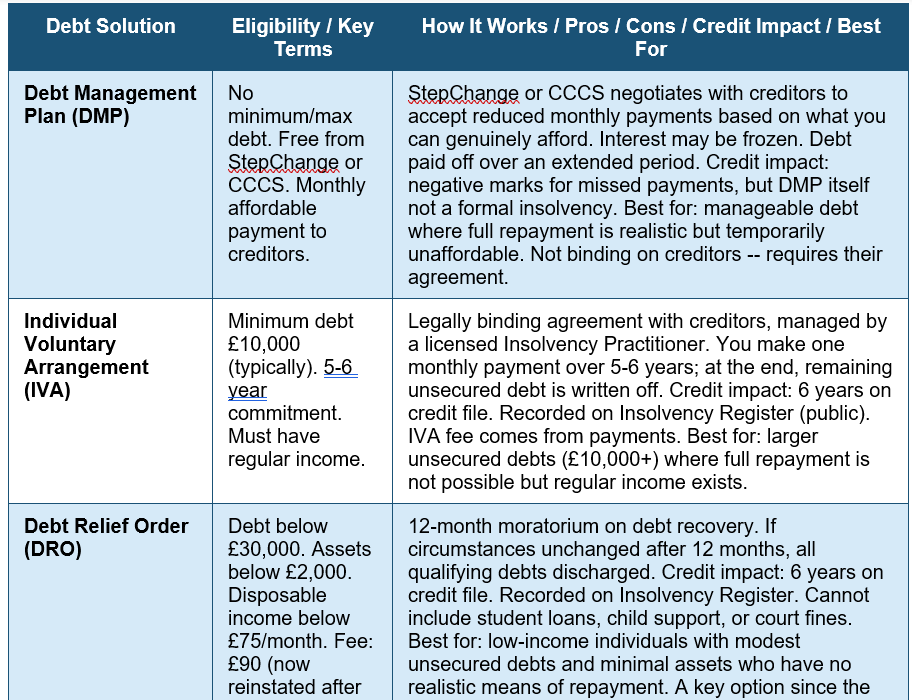
Priority Debts vs Non-Priority Debts: The Distinction That Matters Most
Not all debts carry the same consequences when payments are missed. Understanding the difference between priority and non-priority debts is the most important first step in any debt management situation.Priority Debts (pay these first -- the consequences of non-payment are most severe)
- Mortgage or rent arrears: Can lead to repossession or eviction. Contact your lender or landlord immediately before missing payments. MoneyHelper or Shelter can advise.
- Council tax: Local authorities have strong enforcement powers including bailiff action and in extreme cases imprisonment for wilful non-payment. Pay first. Negotiate second.
- Gas and electricity: Suppliers can disconnect (subject to regulations). Energy debt has grown significantly since the 2021-2023 price surge. Contact your supplier for a payment plan before disconnection.
- Court fines, TV licence fines: Enforcement via bailiffs. Pay or appeal -- ignoring court debt escalates costs rapidly.
- Child maintenance arrears: Enforcement via the Child Maintenance Service can include attachment of earnings, charging orders, and passport seizure.
- Income tax and National Insurance: HMRC has broad enforcement powers including county court judgments, charging orders, and ultimately bankruptcy proceedings for large debts.
Non-Priority Debts (still important -- but the immediate consequences of non-payment are less severe)
- Credit card debt: Missed payments lead to default notices, credit file damage, and ultimately county court judgments (CCJs). Cannot lead directly to imprisonment or loss of home.
- Personal loans: Same consequences as credit cards -- escalating to CCJ if unresolved, but no immediate threat to housing.
- Overdrafts: Banks can demand immediate repayment of overdrafts, which can precipitate an immediate cash flow crisis. Treat as semi-priority.
- Store cards, BNPL: Default and credit file damage, potentially CCJs. Not immediately life-disrupting but damaging to future creditworthiness.
The profile of those seeking debt help in 2026 -- and why it looks like you. UK Insolvency Services (March 2026): 'The majority of StepChange's January 2026 clients were female, under 40, and renting -- reflecting the particular pressures facing younger households in the current economic climate.' StepChange (January 2026 data): 17,998 clients received debt advice in that month alone. 71% had credit card debt. The most common reasons: cost of living increases and lack of control over finances. Citizens Advice: 1,250 debt issues handled every day in the year to December 2025. The data consistently shows that problem debt is not primarily a product of poor financial decisions. It is predominantly a product of income falling below the cost of essential living -- driven by the 2021-2023 inflation surge, real wage stagnation, rental market pressures, and the particular vulnerability of households with variable-rate borrowing when rates rose sharply. TrySnowball (February 2026): '4.1 million adults are in problem debt.' That is 1 in every 13 adults in the UK. If you are in that 4.1 million, you are not alone, and you are not unusual. And 61% of those who sought advice said it became more manageable as a result.
FIVE WARNING SIGNS THAT DEBT IS BECOMING A PROBLEM -- AND WHAT TO DO IMMEDIATELY: (1) USING CREDIT TO PAY FOR ESSENTIALS. If you are using credit cards or BNPL to cover groceries, energy bills, or rent, your monthly budget has a structural shortfall. A consolidation loan will not fix this -- it delays it. The correct action: seek free debt advice immediately (StepChange 0800 138 1111). A debt adviser will help identify whether a Breathing Space period, a Debt Management Plan, or other solution is right for your situation. (2) MISSING MINIMUM PAYMENTS. Once minimum payments are being missed, interest charges compound, default notices arrive, and the debt-to-income ratio worsens every month without intervention. The Breathing Space Debt Respite Scheme provides up to 60 days of protected time from creditor action while you work with an adviser. Contact a debt advice organisation to apply. (3) ONLY MAKING MINIMUM PAYMENTS ON CREDIT CARDS. Paying only the minimum on a £2,601 credit card balance at 22% APR takes approximately 14-16 years to clear and costs more in total interest than the original balance. This is not a repayment plan -- it is a maintenance plan. Use the Snowball or Avalanche methods to eliminate balances. (4) BORROWING TO REPAY BORROWING. Taking out a loan to repay a credit card, then running up the credit card again, creates a debt spiral that accelerates toward insolvency. This cycle is documented in the insolvency statistics: TrySnowball cites TransUnion data showing credit card balances rebound to pre-consolidation levels within 18 months for borrowers who consolidate without addressing spending patterns. (5) FEELING SHAME AND AVOIDING OPENING LETTERS. Debt anxiety is real and well-documented. Avoiding creditor correspondence does not pause debt growth -- it accelerates it, because you miss opportunities to negotiate, and correspondence escalates toward formal enforcement action. Open everything. Seek advice first. Then respond.
Free UK Debt Help in 2026: Every Resource You Need
Every debt advice service listed below is free, confidential, and regulated. They will not charge you, sell you a product, or judge you. TrySnowball (February 2026): '61% of those who sought debt advice said their debts became more manageable (FCA).' The evidence is clear: asking for help works.STEPCHANGE DEBT CHARITY: 0800 138 1111 | stepchange.org. UK's largest free debt advice charity. Online debt assessment tool available 24/7. Arranges Debt Management Plans, advises on IVAs, DROs, bankruptcy, and Breathing Space. 17,998 clients in January 2026 alone. NATIONAL DEBTLINE: 0808 808 4000 | nationaldebtline.org. Free independent advice on all debt types including priority debts, council tax, mortgage arrears, and insolvency options. Fact sheets for specific debt situations. CITIZENS ADVICE: citizensadvice.org.uk | 0800 144 8848. Nationwide network. Handled 1,250 debt issues per day in 2025. Local office appointments and online advice. MONEYHELPER: moneyhelper.org.uk | 0800 138 7777. Government-backed. Debt advice, budget planners, and tools for comparing debt solutions. BREATHING SPACE: Apply through any of the above services. Up to 60 days free from creditor action. Mental Health Breathing Space: unlimited duration during treatment. PAYPLAN: 0800 316 1833 | payplan.com. Free Debt Management Plans. Also advises on IVAs and insolvency. SHELTER: 0808 800 4444 | shelter.org.uk. Specialist advice on mortgage arrears, rent arrears, and housing debt. CHRISTIANS AGAINST POVERTY: capuk.org | 0800 328 0006. Free debt counselling for all faiths (despite the name).
YOUR IMMEDIATE DEBT ACTION CHECKLIST: STEP 1 -- LIST EVERY DEBT (30 minutes): Write down every debt you carry: creditor, balance, interest rate, minimum payment, and whether it is priority or non-priority. Include BNPL, overdraft, council tax arrears -- everything. Calculate the total. Then calculate the total monthly minimum payment and compare it to your monthly income. STEP 2 -- SEPARATE PRIORITY FROM NON-PRIORITY: Identify all priority debts (mortgage/rent, council tax, energy, court debts). These are paid first regardless of amount. Contact those creditors if you are in arrears or at risk of arrears -- before contact is made to you. STEP 3 -- SEEK FREE ADVICE BEFORE MAKING ANY DECISIONS: If your total debt exceeds what you can clear within 5 years at affordable repayments, you need to speak to a regulated debt adviser before choosing a solution. StepChange 0800 138 1111 (free, 24/7 online). National Debtline 0808 808 4000. Citizens Advice citizensadvice.org.uk. Do not pay for debt advice. All legitimate debt advice in the UK is available free. STEP 4 -- CONSIDER THE BREATHING SPACE: If you need protected time to think and plan without creditors contacting you, apply for a Breathing Space through a debt advice organisation. 60 days of protection. Interest and charges frozen. No enforcement action. STEP 5 -- STOP ADDING TO THE DEBT: Until you have a plan, reduce all discretionary spending to essentials. Do not use credit cards for food or bills unless you have spoken to an adviser about whether this is sustainable. STEP 6 -- TRACK THE PLAN: Once a debt solution is in place (DMP, IVA, DRO, or an accelerated self-repayment plan), track monthly progress. Seeing the numbers move in the right direction is the most powerful motivation to sustain the habit.
Conclusion
The UK is carrying £1.94 trillion in personal debt. The average household pays £3,023 per year in interest. 126,240 people entered insolvency in 2025 -- the most in 15 years. 4.1 million adults are in problem debt. These statistics are sobering, and they are real. But they are not the end of the story.TrySnowball (February 2026): 61% of those who sought debt advice said their debts became more manageable. UK Insolvency Services (March 2026): Citizens Advice handled 1,250 debt issues every day and StepChange alone saw 17,998 clients in a single month in January 2026 -- and the majority of those clients found a path through. The debt solutions available in the UK in 2026 are comprehensive: from the Breathing Space scheme's 60-day pause on creditor action, through free Debt Management Plans, to legally binding IVAs, DROs for those with modest debts and low incomes, and bankruptcy for the most severe situations. None of these solutions are shameful. All of them are designed specifically for the circumstances millions of UK households are in.
The handbook you have just read covers every aspect of UK debt: the types, the statistics, the solutions, the priority order, the psychological reality, and every free resource available in 2026. The single most important action you can take if debt is a problem is also the simplest: make one call. StepChange: 0800 138 1111. National Debtline: 0808 808 4000. Citizens Advice: 0800 144 8848. Free. Confidential. No judgement. The debt does not go away on its own. The help is there.
Frequently Asked Questions (FAQ)
What is the average UK household debt in 2026?The average UK household carries multiple types of debt, and the total depends significantly on whether mortgages are included. NimbleFins (January 10, 2026, Bank of England data): average household consumer debt (credit cards and personal loans) reached £8,304 at the end of 2025. Including student loans (£10,088 average) brings total non-mortgage household debt to approximately £18,392 -- up 98% in ten years. For the 29% of households with a mortgage, the average home loan is £197,811. UK Insolvency Services (March 2026): average total household debt including mortgages is £67,163. Average debt per adult across all UK adults (whether or not they have a mortgage) is £34,677 -- approximately 90.5% of average annual earnings. The breakdown of non-mortgage debt: 15% is credit card balances (£2,601 average), 55% is student loans (£10,088), and 31% is other personal loans (£5,703). Critically, UK borrowers as a whole are paying £239 million per day in interest -- £87.4 billion per year -- and for the average household this amounts to £3,023/year spent purely on interest that reduces no debt. Total UK personal debt (all types including mortgages) reached £1.94 trillion at end of December 2025, up £63.9 billion in one year.
What is the difference between a DMP, IVA, and DRO?
These are three different formal debt solutions with different eligibility criteria, legal status, and consequences. A Debt Management Plan (DMP) is an informal arrangement (not legally binding) where a debt charity like StepChange or a commercial debt management company negotiates with your creditors to accept reduced monthly payments based on what you can genuinely afford. There is no minimum or maximum debt, and there are no formal insolvency consequences. StepChange and Citizens Advice offer DMPs completely free -- never pay a commercial company for a DMP. An Individual Voluntary Arrangement (IVA) is a formal, legally binding insolvency procedure that requires a licensed Insolvency Practitioner. It is suitable for larger unsecured debts (typically £10,000+) where full repayment is not possible but regular income exists. You make one affordable monthly payment over 5-6 years; remaining qualifying unsecured debt is written off at the end. The IVA is recorded on your credit file for 6 years and on the Insolvency Register (public record). Fees are paid from your monthly contributions. A Debt Relief Order (DRO) was transformed by the abolition of the £90 application fee in April 2024 (since reinstated). It is suitable for individuals with debt below £30,000, assets below £2,000, and disposable income below £75/month. After 12 months in which your circumstances are reviewed, qualifying debts are discharged. Like an IVA, it appears on your credit file for 6 years. TrySnowball (February 2026): the DRO surge following the fee removal was a significant driver of the 15-year insolvency high in 2025. The right solution depends on your specific debt level, income, assets, and debt types. Always get free regulated advice before choosing.
What is Breathing Space and how do I apply for it?
The Breathing Space Debt Respite Scheme is a government scheme launched in May 2021 that provides a protected period from creditor action while you work with a debt adviser on a longer-term solution. There are two types. Standard Breathing Space: provides up to 60 days of protection during which creditors cannot contact you, add interest or charges, or take enforcement action on qualifying debts. It can be applied to most personal debts including credit cards, personal loans, overdrafts, utility debts, and council tax. Mental Health Breathing Space: available to people receiving mental health treatment and has no time limit -- it lasts for the duration of the mental health treatment plus 30 days. Important: Breathing Space does not write off or reduce debt. It creates protected time to find a sustainable solution with your debt adviser. The 60-day period is intended to give you breathing room to complete a debt advice assessment and agree a plan. Application: you cannot apply for Breathing Space directly. You must be referred by a regulated debt advice provider -- StepChange (stepchange.org), National Debtline (nationaldebtline.org), Citizens Advice, or another FCA-authorised debt advice organisation. Contact any of these services and explain your situation. If you qualify, they will submit the application on your behalf. There is no fee.
Should I use a paid debt management company or a free debt charity?
Always use a free debt charity. This is one of the clearest and most consistent pieces of advice from every regulated financial body in the UK. The debt advice available for free from StepChange, National Debtline, Citizens Advice, and MoneyHelper is exactly the same in quality and scope as that offered by commercial debt management companies -- but without the fees. Commercial debt management companies typically charge a set-up fee (often £200-£300) plus ongoing management fees (often 10-15% of your monthly payment) that come directly out of the money that would otherwise be going to your creditors. This extends the time you spend in the debt management plan and the total cost of managing the debt, for no additional benefit. UK Insolvency Services (March 2026): StepChange reported 17,998 clients in January 2026 alone -- the charity is not a niche or small service but the UK's leading debt advice provider. The Insolvency Service also has a specific warning about paid debt management companies that charge upfront fees, which are a common complaint to the FCA. For IVAs and bankruptcy, you will need a licensed Insolvency Practitioner whose fees are paid from your estate or monthly IVA contributions -- this is regulated and unavoidable for formal insolvency. But for debt management plans, budget advice, and debt assessment, there is absolutely no reason to pay. Free regulated advice is available seven days a week.
What happens to debt when someone dies in the UK?
When someone dies in the UK, their debts do not automatically pass to family members or relatives -- with specific exceptions. The estate (everything the deceased owned) is responsible for paying their debts before any inheritance is distributed to beneficiaries. An executor or administrator is responsible for identifying all debts, notifying creditors, and settling debts from the estate in the correct priority order (funeral expenses, secured debts, then unsecured debts in order). If the estate is insolvent (debts exceed assets), creditors are paid in priority order and beneficiaries receive nothing. Key exceptions: joint debts (such as a joint mortgage, joint bank account with overdraft, or joint credit account) transfer to the surviving account holder, who becomes solely responsible for the full remaining balance. A guarantor on a loan becomes liable if the primary borrower dies. Student loans (government-backed) are written off upon the borrower's death -- they do not form part of the estate. This applies to both Plan 2 and Plan 5 loans. Family members who are not joint account holders or guarantors are not legally liable for the deceased's debts, regardless of the amounts involved. If you are dealing with a deceased person's debt: contact each creditor with a death certificate. The creditor should then deal directly with the estate rather than pursuing family members. Citizens Advice provides specific guidance on dealing with the debts of someone who has died at citizensadvice.org.uk.
0 Comments
Be the first to share your thoughts on this article.