

Hustle
The Next Big Thing in Passive Income for 2027: What Is Real?

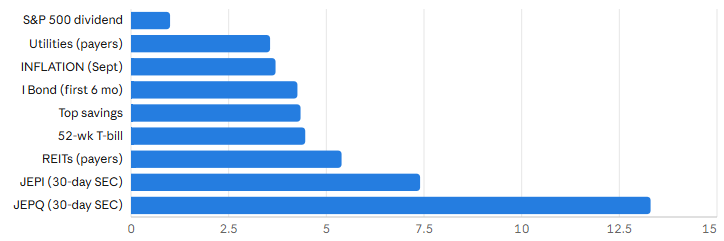
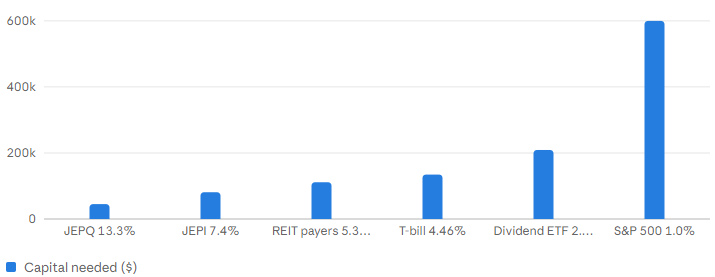
52-week T-bill 4.46%; top savings 4.34%–4.50%; I Bond 4.26%; 10-year Treasury 5.24%; S&P 500 dividend yield about 1.0%; REIT payers 5.39%; utilities payers 3.56%; JEPI 30-day SEC yield 7.4%; JEPQ 13.3%. Inflation 3.7%. Capital for $6,000 a year ($500 a month): about $134,500 at 4.46%; $111,300 at 5.39%; $81,100 at 7.4%; $45,100 at 13.3%; $600,000 at 1.0% (author’s arithmetic). Income-ETF yield ranges: JEPI roughly 6%–11% and JEPQ 8%–13% annualized; payouts fall when volatility falls. Private credit: about $1.7 trillion asset class. Scams: FTC cases involving passive-income schemes include at least $14 million, more than $15.9 million (FBA Machine) and at least $25 million (Ascend Ecom).
So I tried to ignore the hype and follow the numbers. The biggest change for 2027 is not a new gadget. It is that safe yields have come back, which resets what every other idea has to beat. This guide walks through the real options, what each pays, what each costs you in capital, effort and risk, and how to avoid being someone else’s income stream.
For income seekers, higher rates make cash and Treasuries attractive and raise the bar for riskier income. They can also pressure prices of bonds and bond-like stocks, and rates can reverse, so a plan that depends on today’s yields holding forever is fragile. Build streams that make sense across a range of rates. Social Security’s 3.6% cost-of-living increase for 2027 is a reminder of how far prices have moved.
The limits are clear. After 3.7% inflation, a 4.46% bill earns a real return of about 0.7%. It preserves purchasing power but does not build wealth quickly, and rates can fall. Still, it is the benchmark: any riskier idea should offer something meaningfully better than a government-backed 4.46%.
At those yields, $6,000 a year takes a lot of capital: about $209,000 at 2.87% or $600,000 at the S&P 500’s yield. The appeal is growth over time, not high income on day one. Top S&P 500 funds cost as little as 0.015% to 0.04% a year, according to Bankrate. For long horizons it is solid, but it is not a quick route to a big monthly check.
The trade-offs are significant. Selling calls caps upside, so these funds tend to lag in strong bull markets. Payouts depend on volatility: Pluang reported in August that JEPI’s payouts fell as volatility dropped while JEPQ’s rose. The funds can also fall in value in a downturn. And as ETF.com explains, JEPI and JEPQ use equity-linked notes whose distributions are treated as ordinary income, less tax-efficient than qualified dividends, so many investors hold them in an IRA or 401(k).
A high yield is not a guarantee. JEPI’s yield was about 8% in an earlier 2026 article and 7.4% on the latest reading. If you build a budget on a yield that can move by several points, build in a margin.
The risks are real. Private loans are less liquid and less transparent than public bonds, and the same newsletter notes that downturns hit private credit hard. High yields compensate for default risk. If you consider this route, keep it a small portion of an income plan, understand fees and redemption limits and never confuse a high payout with a safe one.
Neither is passive in the strict sense. REIT prices move with interest rates, and a rental involves tenants, repairs and rules. For most people, a REIT fund is the lower-effort version. A rental is a small business and should be priced like one, with allowance for vacancies and repairs.
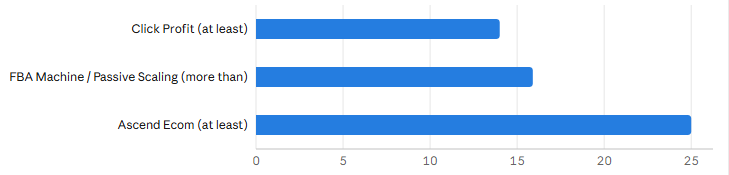
This is also where scams concentrate. The FTC has pursued businesses selling passive income through AI-powered or e-commerce stores, with cases including Click Profit (at least $14 million), FBA Machine and Passive Scaling (more than $15.9 million) and Ascend Ecom (at least $25 million), according to SelfEmployed.com. The pattern is consistent: upfront fees, earnings claims and “autopilot” promises. A real digital product business should be able to show verifiable sales, not testimonials.
FTC passive-income cases reported: Click Profit at least $14 million; FBA Machine and Passive Scaling more than $15.9 million; Ascend Ecom at least $25 million. Pattern: upfront fees, earnings claims and promises of autopilot income.
Yield ranges matter too. If you built a $6,000 plan on JEPI at 7.4%, a fall to 6% would cut your income to about $4,865, while a rise to 11% would lift it to about $8,919. That swing is why income built on variable yields needs a buffer. A decent rule is to budget on the low end of a range, not the high.
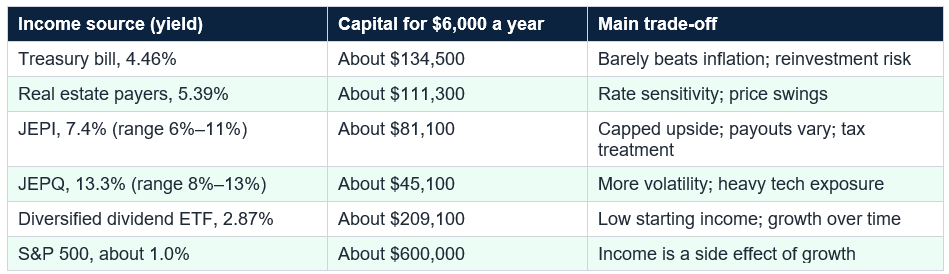
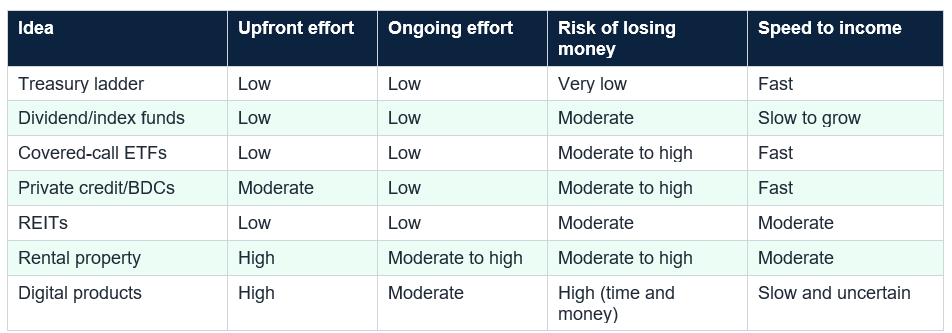
The ratings in this table are my own judgment, not data, and your situation may differ. The point is the pattern: the faster the income and the lower the effort, the more you pay in risk or capital. There is no free corner of the table.
If you want to build a digital product, treat it as a part-time business with a timeline, a budget and a stop-loss, and review everything every six months. The aim for 2027 is not a magical new stream. It is a few reliable ones that you understand.
Write down how much monthly income you want, divide $6,000 per $500 by the yield of the option you are considering and see the capital required. If the number is far from what you have, build capital first, not income promises.
The honest rule is that passive income is paid for with capital, risk or time. Do the capital math, build a buffer for yields that change, avoid anyone who promises autopilot riches and start with a plan you understand. That will serve you in 2027 far better than any trend. This is general education, not personalized advice, and a qualified adviser can help you apply it.
There is no single big thing, and anyone who claims otherwise is selling something. The most important shift is that safe yield is back: 52-week Treasury bills paid about 4.46% in October 2026. Around that anchor, the main options are dividend funds, covered-call income ETFs, private-credit vehicles, real estate and digital products, each with its own trade-offs.
How much money do I need for $500 a month in passive income?
It depends on the yield. At a 4.46% Treasury bill yield, about $134,500 produces $6,000 a year. At a 7.4% income-ETF yield, about $81,000 does, but that yield can fall. At the S&P 500’s roughly 1.0% dividend yield, you would need about $600,000. The higher the yield, the higher the risk, and yields are not guaranteed.
Are covered-call ETFs safe passive income?
They are not risk-free. Covered-call funds such as JEPI and JEPQ sell call options to boost income, which caps their upside and can reduce payouts when market volatility falls. They can also lose value in a downturn. Their distributions are often taxed as ordinary income, so many investors hold them in an IRA or 401(k).
Is passive income really passive?
Rarely at the start. Interest and dividends take capital, not time, but building the capital takes effort. Rentals, businesses and digital products take work upfront and often ongoing. A useful test is to ask what you are paying with: money, time or risk.
How do I spot a passive income scam?
Be wary of promises of guaranteed returns, “autopilot” income, pressure to buy a course or software, and screenshots of earnings. The Federal Trade Commission has pursued schemes selling passive income through AI-powered or e-commerce businesses, with cases involving tens of millions of dollars. If it sounds easy and certain, it is probably neither.
Table of Contents
- The Hunt for the Next Big Thing
- The Short Answer
- The 2027 Backdrop: Rates, Inflation and the Fed
- Idea 1: Cash and Treasury Ladders
- Idea 2: Dividend and Index Income
- Idea 3: Covered-Call Income ETFs
- Idea 4: Private Credit and BDCs
- Idea 5: Real Estate Income
- Idea 6: Digital Products and AI-Assisted Income
- How Much Capital You Really Need
- Effort, Risk and Speed Compared
- Red Flags
- A Starter Plan for 2027
- Conclusion
- Frequently Asked Questions
What passive income pays: yields across options, October 2026 (%)
Yield (%) by MyMoneyBlog, Dividend.com, Fidelity, The Motley Fool; higher yields carry higher risk and are not guaranteed
Capital needed for $500 a month ($6,000 a year) at each yield ($)
Capital required ($) by Author's arithmetic: $6,000 divided by the yield; higher yields carry higher risk
The scam side of passive income: reported FTC case amounts ($ millions)
$ millions by As reported by SelfEmployed.com; common pattern: upfront fees, earnings claims, 'autopilot' promises
The Hunt for the Next Big Thing
Every year, someone announces the next big thing in passive income: dropshipping, print-on-demand, crypto yield, then an “automated” AI business that supposedly ran itself while you slept. The pitch never changes: low effort, high income, act now. The results, for most people who buy the pitch, are also depressingly consistent.So I tried to ignore the hype and follow the numbers. The biggest change for 2027 is not a new gadget. It is that safe yields have come back, which resets what every other idea has to beat. This guide walks through the real options, what each pays, what each costs you in capital, effort and risk, and how to avoid being someone else’s income stream.
The Short Answer
There is no single next big thing. The most useful development is that safe money earns a real return again: a 52-week Treasury bill paid about 4.46% in mid-October and top savings accounts 4.34% to 4.50%, against inflation of 3.7%. Around that anchor sit five other tools: dividend and index funds, covered-call income ETFs, private credit, real estate and digital products. Each trades something for its higher income: capital, upside, liquidity, time or safety. Passive income is a choice about what you pay with.The 2027 Backdrop: Rates, Inflation and the Fed
The Federal Reserve raised its target range to 3.75%–4.00% in September, the 10-year Treasury yield was around 5.24% in mid-October and inflation was 3.7% in September. Leverage Shares noted that futures were pricing further hikes in 2027, the opposite of the “rates are falling” story many income articles assumed at the start of 2026.For income seekers, higher rates make cash and Treasuries attractive and raise the bar for riskier income. They can also pressure prices of bonds and bond-like stocks, and rates can reverse, so a plan that depends on today’s yields holding forever is fragile. Build streams that make sense across a range of rates. Social Security’s 3.6% cost-of-living increase for 2027 is a reminder of how far prices have moved.
Idea 1: Cash and Treasury Ladders
This is the unglamorous contender, and for 2027 it may be the real next big thing. A 52-week Treasury bill yielded about 4.46% on October 9, a top savings account 4.34% to 4.50% and I Bonds 4.26% for their first six months, according to MyMoneyBlog’s October survey. These are insured or government-backed. A ladder of bills maturing at different dates turns a lump sum into a steady stream of maturing principal and interest.The limits are clear. After 3.7% inflation, a 4.46% bill earns a real return of about 0.7%. It preserves purchasing power but does not build wealth quickly, and rates can fall. Still, it is the benchmark: any riskier idea should offer something meaningfully better than a government-backed 4.46%.
Idea 2: Dividend and Index Income
Dividend investing is the classic route, but the numbers deserve a sober look. The S&P 500’s dividend yield is only about 1.0%, according to Fidelity, because the largest weight belongs to technology companies that pay little. Dividend.com’s August survey found utilities yielding about 3.56% and real estate about 5.39% among dividend payers, and a diversified dividend ETF, the iShares Core Dividend ETF, yielded 2.87% in September.At those yields, $6,000 a year takes a lot of capital: about $209,000 at 2.87% or $600,000 at the S&P 500’s yield. The appeal is growth over time, not high income on day one. Top S&P 500 funds cost as little as 0.015% to 0.04% a year, according to Bankrate. For long horizons it is solid, but it is not a quick route to a big monthly check.
Idea 3: Covered-Call Income ETFs
This is where the real attention in 2026 has been. Covered-call ETFs hold stocks and sell call options against them, collecting premiums that fund large monthly payouts. According to The Motley Fool, in an article published September 17, the JPMorgan Equity Premium Income ETF (JEPI) had a 30-day SEC yield of 7.4% at the end of August, and the JPMorgan Nasdaq Equity Premium Income ETF (JEPQ) 13.3%. The same article suggests viewing yields as ranges, roughly 6% to 11% for JEPI and 8% to 13% for JEPQ.The trade-offs are significant. Selling calls caps upside, so these funds tend to lag in strong bull markets. Payouts depend on volatility: Pluang reported in August that JEPI’s payouts fell as volatility dropped while JEPQ’s rose. The funds can also fall in value in a downturn. And as ETF.com explains, JEPI and JEPQ use equity-linked notes whose distributions are treated as ordinary income, less tax-efficient than qualified dividends, so many investors hold them in an IRA or 401(k).
A high yield is not a guarantee. JEPI’s yield was about 8% in an earlier 2026 article and 7.4% on the latest reading. If you build a budget on a yield that can move by several points, build in a margin.
Idea 4: Private Credit and BDCs
Private credit, meaning loans made by non-bank lenders, has grown into an asset class of about $1.7 trillion, according to one 2026 industry newsletter, a secondary source. Retail investors can reach it through business development companies (BDCs) and some funds, which often pay high yields.The risks are real. Private loans are less liquid and less transparent than public bonds, and the same newsletter notes that downturns hit private credit hard. High yields compensate for default risk. If you consider this route, keep it a small portion of an income plan, understand fees and redemption limits and never confuse a high payout with a safe one.
Idea 5: Real Estate Income
Real estate income comes in two forms. Real estate investment trusts, or REITs, let you own property through a listed fund; Dividend.com found real estate payers yielding about 5.39% in August. Direct rentals offer control and leverage but require capital, management, maintenance and exposure to a single market. With the 30-year mortgage rate at 7.40% in mid-October, financing costs are high.Neither is passive in the strict sense. REIT prices move with interest rates, and a rental involves tenants, repairs and rules. For most people, a REIT fund is the lower-effort version. A rental is a small business and should be priced like one, with allowance for vacancies and repairs.
Idea 6: Digital Products and AI-Assisted Income
AI tools have made it easier to produce templates, courses, guides, designs and software, which is the nearest thing to a genuinely new opportunity for 2027. But easy to make does not mean easy to sell. Treat any promise of automated, effortless income skeptically, and remember that building an audience or a product takes real work, usually for months before any payoff.This is also where scams concentrate. The FTC has pursued businesses selling passive income through AI-powered or e-commerce stores, with cases including Click Profit (at least $14 million), FBA Machine and Passive Scaling (more than $15.9 million) and Ascend Ecom (at least $25 million), according to SelfEmployed.com. The pattern is consistent: upfront fees, earnings claims and “autopilot” promises. A real digital product business should be able to show verifiable sales, not testimonials.
FTC passive-income cases reported: Click Profit at least $14 million; FBA Machine and Passive Scaling more than $15.9 million; Ascend Ecom at least $25 million. Pattern: upfront fees, earnings claims and promises of autopilot income.
How Much Capital You Really Need
Here is the arithmetic most pitches skip. To produce $6,000 a year, or $500 a month, you need capital equal to $6,000 divided by the yield. At a 4.46% Treasury bill yield, that is about $134,500. At a 5.39% REIT yield, about $111,300. At JEPI’s 7.4%, about $81,100, and at JEPQ’s 13.3%, about $45,100. At the S&P 500’s 1.0%, it is $600,000. These are my own calculations, and every higher yield comes with higher risk.Yield ranges matter too. If you built a $6,000 plan on JEPI at 7.4%, a fall to 6% would cut your income to about $4,865, while a rise to 11% would lift it to about $8,919. That swing is why income built on variable yields needs a buffer. A decent rule is to budget on the low end of a range, not the high.
Effort, Risk and Speed Compared
The ratings in this table are my own judgment, not data, and your situation may differ. The point is the pattern: the faster the income and the lower the effort, the more you pay in risk or capital. There is no free corner of the table.
Red Flags
Be cautious of guaranteed returns, “autopilot” income, pressure to act quickly, requirements to buy a course or software first, screenshots instead of verified statements and requests to recruit others, and of yields far above the market with no clear explanation of the risk. Check registration and complaints before sending money. If an opportunity is genuinely good, it will survive a few days of questions.A Starter Plan for 2027
Start with the foundation. Pay off high-interest debt first: with credit cards owing $1.263 trillion nationally and average rates near 21%, paying off a card beats any income investment. Build an emergency fund, then park near-term money in Treasury bills or insured savings. For long-term growth, use low-cost diversified funds, ideally inside tax-advantaged accounts. If you want extra income, add a small slice of an income fund, sized so a bad year would not hurt, and consider the tax treatment.If you want to build a digital product, treat it as a part-time business with a timeline, a budget and a stop-loss, and review everything every six months. The aim for 2027 is not a magical new stream. It is a few reliable ones that you understand.
Write down how much monthly income you want, divide $6,000 per $500 by the yield of the option you are considering and see the capital required. If the number is far from what you have, build capital first, not income promises.
Conclusion
The next big thing in passive income for 2027 is less exciting than the headlines promise: safe yield is back, and every other idea now has to beat a 4.46% Treasury bill and 3.7% inflation. Dividend and index funds offer growth more than income. Covered-call ETFs offer high, variable yields at the cost of upside and tax efficiency. Private credit and real estate offer income with liquidity and rate risks. Digital products offer upside to those willing to work, and a minefield of scams for those who are not.The honest rule is that passive income is paid for with capital, risk or time. Do the capital math, build a buffer for yields that change, avoid anyone who promises autopilot riches and start with a plan you understand. That will serve you in 2027 far better than any trend. This is general education, not personalized advice, and a qualified adviser can help you apply it.
Frequently Asked Questions
What is the next big thing in passive income for 2027?There is no single big thing, and anyone who claims otherwise is selling something. The most important shift is that safe yield is back: 52-week Treasury bills paid about 4.46% in October 2026. Around that anchor, the main options are dividend funds, covered-call income ETFs, private-credit vehicles, real estate and digital products, each with its own trade-offs.
How much money do I need for $500 a month in passive income?
It depends on the yield. At a 4.46% Treasury bill yield, about $134,500 produces $6,000 a year. At a 7.4% income-ETF yield, about $81,000 does, but that yield can fall. At the S&P 500’s roughly 1.0% dividend yield, you would need about $600,000. The higher the yield, the higher the risk, and yields are not guaranteed.
Are covered-call ETFs safe passive income?
They are not risk-free. Covered-call funds such as JEPI and JEPQ sell call options to boost income, which caps their upside and can reduce payouts when market volatility falls. They can also lose value in a downturn. Their distributions are often taxed as ordinary income, so many investors hold them in an IRA or 401(k).
Is passive income really passive?
Rarely at the start. Interest and dividends take capital, not time, but building the capital takes effort. Rentals, businesses and digital products take work upfront and often ongoing. A useful test is to ask what you are paying with: money, time or risk.
How do I spot a passive income scam?
Be wary of promises of guaranteed returns, “autopilot” income, pressure to buy a course or software, and screenshots of earnings. The Federal Trade Commission has pursued schemes selling passive income through AI-powered or e-commerce businesses, with cases involving tens of millions of dollars. If it sounds easy and certain, it is probably neither.
0 Comments
Be the first to share your thoughts on this article.