

Financial Literacy
The Silent Wealth Killer Hiding in Your Bank Account: Explained

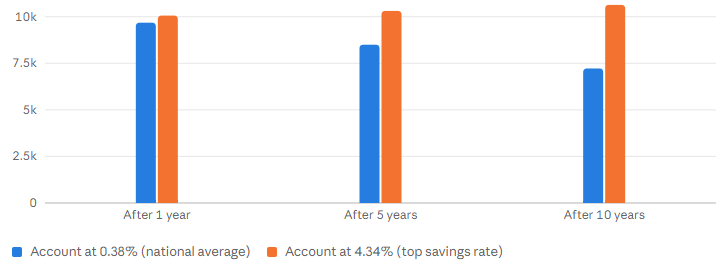
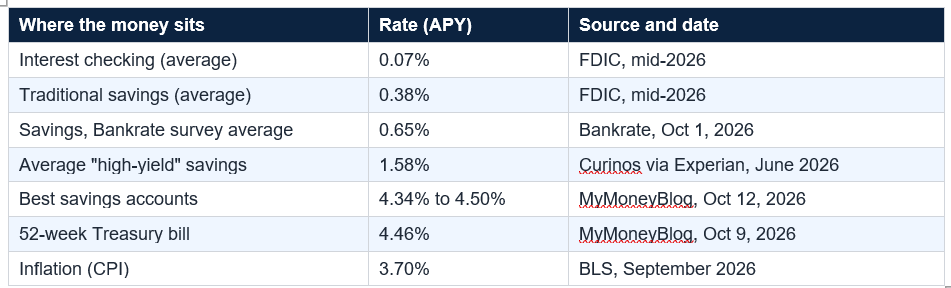
FDIC national average savings rate 0.38% APY and interest checking 0.07% (mid-2026); Bankrate survey average 0.65% (October 1); best savings accounts about 4.34%–4.50% (October 12); 52-week T-bill 4.46%. Inflation: 3.70% (September 2026 CPI). Real return on cash at 0.38%: about −3.2% a year. $10,000 at 0.38% buys about $8,498 worth (in today’s dollars) after 5 years and $7,222 after 10, at 3.70% inflation; at 4.34% it stays near $10,312 and $10,635 (illustrative). Fees: average monthly maintenance fee $13.24 ($158.88 a year); only 27.88% of checking accounts are free (MoneyRates 2026); banks collected $5.83 billion in overdraft and NSF fees in 2023 (CFPB). Average account tenure 19 years (checking) and 17 years (savings) (Bankrate); about 82% of Americans do not use a high-yield savings account (CNBC/Dynata, via Walnut Invest).
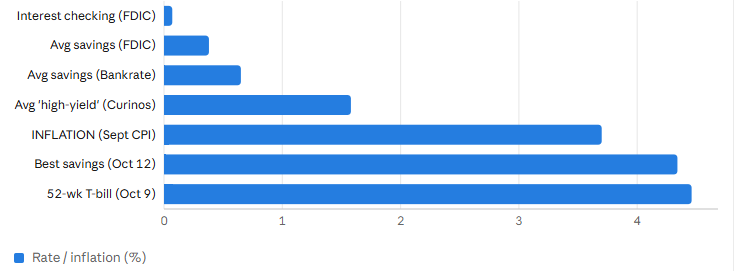
That is the silent wealth killer: cash sitting in an account that pays far less than prices are rising, often topped off with fees. It is not a scam or a mistake. It is the default. And with inflation at 3.70% and the national average savings rate at 0.38%, the gap is wide.
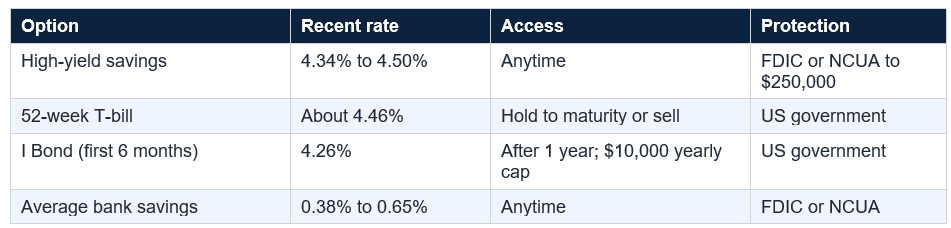
Now compare the best. MyMoneyBlog’s October 12 survey found savings accounts at 4.50% and 4.34%, a 52-week Treasury bill at 4.46% and I Bonds at 4.26% for the first six months. That is roughly ten times the national average. And note a trap: the label "high-yield" does not guarantee a high yield. Experian, citing Curinos data for June 2026, put the average high-yield savings account at just 1.58% and the average one-year CD at 2.43%, well below the best available.
Run that forward and the effect compounds. At a constant 3.70% inflation, money earning 0.38% loses about 10% of its purchasing power in roughly three years and three months. Nothing dramatic happens in any single month. That is exactly why people ignore it. There is no event to react to, only an erosion that adds up over years.
The purchasing-power math is sharper. Suppose inflation averages 3.70%. After five years, $10,000 earning 0.38% has grown to about $10,191 on paper, but it buys what $8,498 buys today, a loss of about $1,500 in real terms. After ten years, it is worth about $7,222 in today’s dollars. The same $10,000 at 4.34% roughly holds its value, worth about $10,312 after five years and $10,635 after ten in today’s dollars. The difference between the two accounts over a decade is more than $3,400 of buying power.
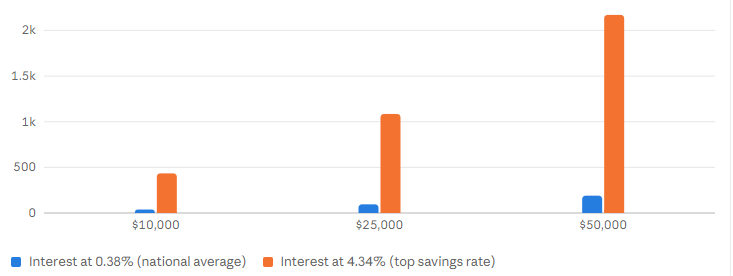
The numbers: At 3.70% inflation, $10,000 in a 0.38% account is worth about $8,498 in today’s dollars after 5 years and $7,222 after 10. At 4.34%, it is worth about $10,312 and $10,635. Interest gap per year: about $396 on $10,000; $990 on $25,000. Illustrative constant-rate arithmetic.
The industry-wide totals are huge. The Consumer Financial Protection Bureau reported that banks collected $5.83 billion in overdraft and non-sufficient funds fees in 2023, and the Financial Health Network estimated about $20.3 billion across overdraft, ATM, maintenance and other service fees. Now combine the layers. A $10,000 balance earning 0.38% makes $38 a year. If the account charges that average fee, subtract $158.88 a year, and it loses about $121 before inflation touches it.
Many fees can be waived with direct deposit, minimum balances or by switching to fee-free checking, according to Bankrate. Ask your bank before assuming you are stuck.
Awareness is another barrier. A CNBC Select and Dynata survey, reported by Walnut Invest, found that about 82% of Americans do not use a high-yield savings account, and a Santander survey found that most customers do not realize you can open a high-yield savings account without leaving your main bank, or that such accounts are generally FDIC-insured. In surveys, people also say fees matter most when picking an account, above interest rates. We tend to fear the visible cost and ignore the invisible one.
There is also a plain incentive explanation, which is my reading rather than a survey finding. Checking rates have barely moved in years even as the Fed raised rates, which suggests banks pay more only where customers demand it. Where customers do not shop, the rate stays low.
None of these is exciting. All of them beat 0.38% by a wide margin, and for an emergency fund the goal is exactly that: safe, accessible and not losing to inflation. At 4.34%, the real return after 3.70% inflation is about 0.6%, which is thin but positive. For $20,000 of emergency savings, that is about $868 a year in interest versus $76 at the national average.
The fix takes less than an hour and costs nothing. Check your rate, tally your fees, move your safety money to an insured account that pays something real, and look again in a few months. Then, once your cash is working properly, turn your attention to the money that is meant to grow. This is general education, not personalized advice, and your bank can confirm the current terms.
It is the gap between what your cash earns and how fast prices rise, made worse by account fees. The FDIC’s national average savings rate was 0.38% in mid-2026, while inflation was 3.70% in September. Money earning less than inflation buys less every year, even though the balance never drops.
Is a high-yield savings account safe?
Online high-yield savings accounts are generally as safe as other bank accounts if the bank is FDIC-insured (or the credit union NCUA-insured), up to the standard $250,000 limit per depositor, per institution, per ownership category. Many people do not realize that. Confirm insurance on the bank’s site before you deposit.
How much interest am I missing out on?
On $10,000, the national average rate of 0.38% earns about $38 a year, while a top savings account at 4.34% earns about $434, a difference of roughly $396. On $25,000 the gap is about $990. These are simple one-year illustrations that ignore compounding and rate changes.
Will high-yield savings rates stay this high?
Not necessarily. Savings rates are variable and can fall at any time, especially if the Fed cuts rates. Some banks advertise teaser rates that drop later. Check your rate every few months, and consider a CD or Treasury bill if you want to lock in a rate for a fixed period.
Should I put all my money in a savings account to avoid inflation?
No. Savings accounts protect against losing principal, and top accounts now roughly match inflation, but they are not designed to build wealth. Long-term money that you will not need for many years usually belongs in diversified investments. Cash is for emergencies and near-term goals.
Table of Contents
- The Leak You Cannot See
- The Short Answer
- The Rate Gap: What Banks Pay vs. What You Could Earn
- Inflation: The Part That Makes It Silent
- What It Costs in Dollars
- The Fee Layer
- Why It Persists: The Inertia Trap
- How to Fix It, Step by Step
- Where to Put the Money Now
- The Fine Print and Caveats
- A 30-Minute Action Plan
- Conclusion
- Frequently Asked Questions
What your cash earns vs. inflation (%, 2026)
% per year by Account type / benchmark
What $10,000 can buy later, in today's dollars (3.70% inflation)
Purchasing power ($, today's dollars) by Illustration: constant rates, inflation 3.70%
One year of interest by balance: average account vs. top account ($)
Interest earned in one year ($) by Balance (simple one-year illustration)
The Leak You Cannot See
Most financial disasters make noise. A market crash fills the news. A job loss arrives with an email. An overdraft shows up as a red number. But the most expensive thing happening to many people’s money right now makes no sound at all. Your balance stays the same, or even grows by a few dollars a year, and nothing on your screen suggests anything is wrong. Meanwhile, the same dollars buy a little less each month.That is the silent wealth killer: cash sitting in an account that pays far less than prices are rising, often topped off with fees. It is not a scam or a mistake. It is the default. And with inflation at 3.70% and the national average savings rate at 0.38%, the gap is wide.
The Short Answer
The wealth killer hiding in your bank account is the combination of near-zero interest, inflation and account fees. Together they mean your money loses purchasing power even while the number on your statement looks safe. It is easy to fix with insured options that pay far more, but only if you notice it, because nothing forces you to.The Rate Gap: What Banks Pay vs. What You Could Earn
Start with what the average account pays. The FDIC’s national average savings rate was 0.38% APY in mid-2026, and the average for interest-bearing checking was 0.07%. Bankrate, which surveys more than 500 banks and credit unions weekly, put the national average savings yield at 0.65% as of October 1. Most standard checking accounts pay nothing at all, and the national checking average has hovered between 0.03% and 0.08% since 2021, even as the Federal Reserve raised rates to a two-decade high.Now compare the best. MyMoneyBlog’s October 12 survey found savings accounts at 4.50% and 4.34%, a 52-week Treasury bill at 4.46% and I Bonds at 4.26% for the first six months. That is roughly ten times the national average. And note a trap: the label "high-yield" does not guarantee a high yield. Experian, citing Curinos data for June 2026, put the average high-yield savings account at just 1.58% and the average one-year CD at 2.43%, well below the best available.
Inflation: The Part That Makes It Silent
A savings rate means little without inflation beside it. Headline inflation was 3.70% in September 2026. If your account pays 0.38%, your real return is about negative 3.2% a year. In plain terms, a basket of goods that costs $100 today costs about $103.70 a year from now, but your $100 has grown to only $100.38. Your balance rose, and you got poorer.Run that forward and the effect compounds. At a constant 3.70% inflation, money earning 0.38% loses about 10% of its purchasing power in roughly three years and three months. Nothing dramatic happens in any single month. That is exactly why people ignore it. There is no event to react to, only an erosion that adds up over years.
What It Costs in Dollars
Here are my own illustrations, using round numbers and constant rates. On $10,000 held for a year, the national average of 0.38% pays about $38, while a top account at 4.34% pays about $434, a difference of $396. On $25,000, the gap is roughly $990. On $50,000, it is about $1,980. And all of that is money that costs you nothing but the effort to move it.The purchasing-power math is sharper. Suppose inflation averages 3.70%. After five years, $10,000 earning 0.38% has grown to about $10,191 on paper, but it buys what $8,498 buys today, a loss of about $1,500 in real terms. After ten years, it is worth about $7,222 in today’s dollars. The same $10,000 at 4.34% roughly holds its value, worth about $10,312 after five years and $10,635 after ten in today’s dollars. The difference between the two accounts over a decade is more than $3,400 of buying power.
The numbers: At 3.70% inflation, $10,000 in a 0.38% account is worth about $8,498 in today’s dollars after 5 years and $7,222 after 10. At 4.34%, it is worth about $10,312 and $10,635. Interest gap per year: about $396 on $10,000; $990 on $25,000. Illustrative constant-rate arithmetic.
The Fee Layer
Low interest is the first layer. Fees are the second. MoneyRates’ 2026 survey put the average monthly maintenance fee at $13.24, or $158.88 a year just to keep an account open, and found that just 27.88% of checking accounts surveyed had no monthly fee. Online accounts fare far better: 69.6% have no monthly fee, versus 24.8% of traditional branch-based accounts. Compared with five years ago, monthly maintenance fees are up 8%, overdraft fees are up 9.4% and ATM fees are up 10.7%.The industry-wide totals are huge. The Consumer Financial Protection Bureau reported that banks collected $5.83 billion in overdraft and non-sufficient funds fees in 2023, and the Financial Health Network estimated about $20.3 billion across overdraft, ATM, maintenance and other service fees. Now combine the layers. A $10,000 balance earning 0.38% makes $38 a year. If the account charges that average fee, subtract $158.88 a year, and it loses about $121 before inflation touches it.
Many fees can be waived with direct deposit, minimum balances or by switching to fee-free checking, according to Bankrate. Ask your bank before assuming you are stuck.
Why It Persists: The Inertia Trap
If the fix is so simple, why do so many people not make it? Inertia. A Bankrate survey found that Americans have kept the same checking account for an average of 19 years and the same savings account for 17 years, and only about one in four account holders opened theirs in the past five years. Switching feels like a hassle: new bill payments, new direct deposits, new passwords.Awareness is another barrier. A CNBC Select and Dynata survey, reported by Walnut Invest, found that about 82% of Americans do not use a high-yield savings account, and a Santander survey found that most customers do not realize you can open a high-yield savings account without leaving your main bank, or that such accounts are generally FDIC-insured. In surveys, people also say fees matter most when picking an account, above interest rates. We tend to fear the visible cost and ignore the invisible one.
There is also a plain incentive explanation, which is my reading rather than a survey finding. Checking rates have barely moved in years even as the Fed raised rates, which suggests banks pay more only where customers demand it. Where customers do not shop, the rate stays low.
How to Fix It, Step by Step
Step one: look at your numbers. Log in, find the APY on each account and add up your fees over the past year. Step two: sort your cash into tiers. Keep a month or so of expenses in checking for bills. Put your emergency fund and near-term goals, such as a down payment or a tax bill, where they can earn a competitive rate. Step three: compare options, which the next section covers. Step four: confirm insurance. Step five: set up an automatic transfer so the money moves itself. Step six: review every few months, because rates change.Where to Put the Money Now
Four insured or government-backed options stand out, using the October 12 figures. A high-yield savings account pays about 4.34% to 4.50% with no lock-up. A 52-week Treasury bill pays about 4.46%, exempt from state and local income tax, and is backed by the US government. I Bonds bought through October pay 4.26% for the first six months, then reset with inflation, with a one-year minimum hold and a $10,000 annual cap. And a CD can lock in a rate for a fixed period, which helps if you expect rates to fall.None of these is exciting. All of them beat 0.38% by a wide margin, and for an emergency fund the goal is exactly that: safe, accessible and not losing to inflation. At 4.34%, the real return after 3.70% inflation is about 0.6%, which is thin but positive. For $20,000 of emergency savings, that is about $868 a year in interest versus $76 at the national average.
10. The Fine Print and Caveats
A few honest cautions. Savings rates are variable, and they may fall if the Fed cuts, so a 4.34% account today could pay less next year. Watch for teaser rates and minimum-balance conditions. Interest on savings is taxable, which trims the real return further. Do not move so much that you cannot cover bills; keep a buffer in checking. And remember that even a top savings account only roughly matches inflation. Cash is a safe harbor, not a growth engine. Money you will not need for many years usually belongs in diversified investments, which carry risk but have historically outpaced inflation by a wider margin.A 30-Minute Action Plan
You can do this in one sitting. In the first ten minutes, write down each account’s balance, APY and fees. In the next ten, look up two or three insured alternatives and confirm FDIC or NCUA coverage on the institution’s website. In the final ten, open the account and schedule a transfer. Then set a calendar reminder for three months from now to check whether your rate still competes. If your current bank will match a better rate, that is an easy win, but do not count on it.Conclusion
The silent wealth killer is not an exotic investment or a market crash. It is a savings balance earning 0.38% in a world of 3.70% inflation, quietly stacked with fees. Over ten years, $10,000 left in an average account loses more than a quarter of its purchasing power, while the same money in a top account roughly holds its value. Nobody sends you an alert, which is the whole problem.The fix takes less than an hour and costs nothing. Check your rate, tally your fees, move your safety money to an insured account that pays something real, and look again in a few months. Then, once your cash is working properly, turn your attention to the money that is meant to grow. This is general education, not personalized advice, and your bank can confirm the current terms.
Frequently Asked Questions
What is the silent wealth killer in a bank account?It is the gap between what your cash earns and how fast prices rise, made worse by account fees. The FDIC’s national average savings rate was 0.38% in mid-2026, while inflation was 3.70% in September. Money earning less than inflation buys less every year, even though the balance never drops.
Is a high-yield savings account safe?
Online high-yield savings accounts are generally as safe as other bank accounts if the bank is FDIC-insured (or the credit union NCUA-insured), up to the standard $250,000 limit per depositor, per institution, per ownership category. Many people do not realize that. Confirm insurance on the bank’s site before you deposit.
How much interest am I missing out on?
On $10,000, the national average rate of 0.38% earns about $38 a year, while a top savings account at 4.34% earns about $434, a difference of roughly $396. On $25,000 the gap is about $990. These are simple one-year illustrations that ignore compounding and rate changes.
Will high-yield savings rates stay this high?
Not necessarily. Savings rates are variable and can fall at any time, especially if the Fed cuts rates. Some banks advertise teaser rates that drop later. Check your rate every few months, and consider a CD or Treasury bill if you want to lock in a rate for a fixed period.
Should I put all my money in a savings account to avoid inflation?
No. Savings accounts protect against losing principal, and top accounts now roughly match inflation, but they are not designed to build wealth. Long-term money that you will not need for many years usually belongs in diversified investments. Cash is for emergencies and near-term goals.
0 Comments
Be the first to share your thoughts on this article.