

Real Estate
The Simple Request That Could Lower Your Mortgage Rate
The 30-year fixed mortgage averaged 6.76% this week — the highest since July 2025, according to Freddie Mac's survey published just four days ago. At this rate, nearly half of homebuyers will take the first quote they receive and sign. But a Freddie Mac study found that getting just one additional quote saves $1,500 on average. Getting five quotes doubles that saving. And the single most effective tactic — showing one lender a competitor's lower Loan Estimate — is a conversation most borrowers never have. This guide explains exactly what to ask, what to say, and what the maths look like.
Buying a home is the largest financial transaction most people make in their lives. The mortgage that funds it is the most significant financial commitment most people will ever sign. And yet the most expensive mistake in the entire process — accepting the first mortgage rate quoted without shopping or negotiating — is made by nearly half of all homebuyers.
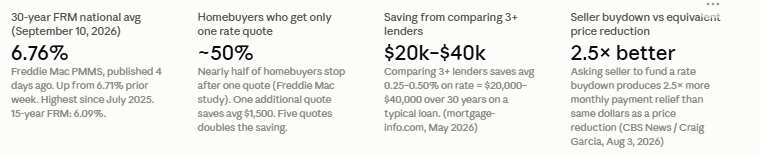
Freddie Mac's research is unambiguous: nearly half of homebuyers stop after getting just one rate quote. In a market where the 30-year fixed-rate mortgage averaged 6.76% as of September 10, 2026 — the highest since July 2025 (Freddie Mac PMMS, published four days ago) — that single quote is costing borrowers real money. Not a marginal amount. A Freddie Mac study found that getting one additional quote saves an average of $1,500. Getting five quotes doubles that saving. And comparing three or more lenders can reduce the rate by 0.25 to 0.50 percentage points — worth $20,000 to $40,000 over the life of a 30-year mortgage on a typical loan.
This guide is about the specific request that unlocks these savings: asking a lender to match or beat a competitor's rate. It is, in practice, one of the simplest conversations in personal finance. It requires no special knowledge, no financial sophistication, and no confrontation. It requires a Loan Estimate from a second lender and a willingness to say four words: 'Can you beat this?' The borrowers who make this request consistently get better rates. The borrowers who don't consistently overpay. This guide explains how to make it work.
30-year FRM: 6.76% (Freddie Mac PMMS, September 10, 2026 — 4 days ago). 15-year FRM: 6.09%. Bankrate national survey: 6.78% (4 days ago) — highest since July 2025. Nearly half of homebuyers get only one rate quote (Freddie Mac). One additional quote: saves $1,500 average. Five quotes: doubles the saving. Comparing 3+ lenders: saves 0.25–0.50% = $20,000–$40,000 over 30 years on a typical loan. On $380,000 at 0.125% reduction: $28/month = $10,000 over 30 years (The Lenders Network June 2026).
Freddie Mac's Chief Economist Sam Khater accompanied the September 10 release with a statement that speaks directly to this article's subject: 'Aspiring buyers should remember shopping around for the best mortgage rate and getting multiple quotes can potentially save them thousands.' That statement — from the official government-sponsored mortgage market monitor — is not a generic piece of advice. It is an acknowledgement, from the institution that tracks what every lender in America charges, that meaningful variation exists between lenders for identical borrowers.
To put the current rate environment in context: at the start of 2025, the 30-year fixed-rate surpassed 7%. By October 2025, it had fallen to 6.19% — its lowest level in over a year. By December 2025, it averaged 6.21%. The 2026 trajectory has been upward from that December trough, returning to current levels of 6.76%. CBS News' May 2026 analysis noted that 'at just under 6.4% average, today's mortgage rates are still high enough that even small rate differences can matter substantially to borrowers, who are already grappling with high home prices, insurance costs and rising inflation.' At 6.76%, that observation is more relevant, not less.
Bankrate's analysis of this research frames it precisely: 'Shopping with multiple lenders can save you over $1,000 a year, according to research from Freddie Mac.' That is an annual saving, not a one-time figure — the rate reduction compounds year after year for the life of the loan.
Mortgage-info.com's May 2026 guide, based on current market conditions, updates the Freddie Mac finding: 'Borrowers who compare 3+ lenders save an average of 0.25-0.50% on their rate, worth $20,000-$40,000 over 30 years.' At current 30-year rates of 6.76%, a 0.25% reduction to 6.51% on a $400,000 mortgage saves approximately $65 per month — $23,400 over a 30-year term.
The Lenders Network's June 2026 guide quantifies the smallest meaningful saving: 'The math is simple: even 0.125% on a $380,000 loan saves $28 per month and $10,000 over 30 years.' The 0.125% figure is significant because it represents what many borrowers could save simply by asking for a rate match rather than needing the second lender to be dramatically cheaper. In many cases, the difference between lenders is larger than 0.125% — making the potential saving considerably greater.
Example at current September 2026 rates on a $400,000, 30-year fixed mortgage. First quote at 6.76% (Freddie Mac national average, September 10, 2026): monthly payment approximately $2,595/month. After shopping and securing 6.51% (0.25% reduction): approximately $2,530/month. Monthly saving: $65. Annual saving: $780. 30-year total saving: approximately $23,400. After shopping and securing 6.26% (0.50% reduction, achievable with 3+ quotes per mortgage-info.com framework): approximately $2,465/month. Monthly saving: $130. Annual saving: $1,560. 30-year total saving: approximately $46,800. All figures illustrative; actual payments depend on taxes, insurance, and loan specifics. Not financial advice.
The Mortgage Reports (January 2026) provides the borrower-friendly framing: 'If you've been quoted 6.875% by one lender and 6.625% by another, taking the lower offer back to the first lender and asking them to match or beat it is a legitimate and often successful strategy.' The CBS News May 2026 analysis confirms the market context: at current rates, every fraction of a percentage point counts. Lenders who want the business know this.
Renee Coleman, mortgage lender at CrossCountry Mortgage, quoted in Yahoo Finance (June 2025), acknowledges the borrower's leverage directly: 'Rates are negotiable, to a point. Lenders have certain rules they must follow, but there is room for adjustment.' That room for adjustment — the margin built into every rate quote — is what the simple request accesses.
The key to making the request land: do it with a Loan Estimate in hand, not just a verbal quote. The standardised Loan Estimate form (required by the CFPB within three business days of application) shows the rate, APR, monthly payment, and all fees in a directly comparable format. Walking in with a competitor's Loan Estimate eliminates ambiguity and signals that you have done the work — which almost always produces a more serious pricing response.
The mathematics: on a $380,000 loan, one discount point costs $3,800. At 0.25% rate reduction, the monthly saving is approximately $57. The break-even period — the time required for the monthly saving to recover the upfront cost — is approximately 67 months, or just under six years ($3,800 ÷ $57 ≈ 66.7 months). If you plan to stay in the home for more than six years, buying a point is likely financially advantageous. If you plan to move or refinance sooner, it probably is not.
Discount point calculation on a $380,000 loan at 6.76% (September 2026 national average). Without points: 6.76%, monthly payment approximately $2,475. Buy 1 point ($3,800): rate falls to approximately 6.51%, monthly payment approximately $2,415. Monthly saving: $60. Break-even: $3,800 ÷ $60 = 63 months (~5.3 years). Buy 2 points ($7,600): rate falls to approximately 6.26%, monthly payment approximately $2,355. Monthly saving: $120. Break-even: $7,600 ÷ $120 = 63 months (~5.3 years). All figures illustrative. Actual rate reduction per point varies by lender and market conditions. Not financial advice.
The negotiation opportunity with points is different from the rate negotiation: you can ask a lender to specify exactly what rate you would receive at different point levels, and you can use the resulting schedule as part of your cross-lender comparison. Some lenders are more generous than others in the rate reduction they offer per point — meaning the point purchase can itself be a lever in the competitive Loan Estimate comparison.
Mortgage-info.com's May 2026 framework identifies the total savings potential: '$1,500 to $4,500 on a typical $400,000 purchase' from closing cost negotiation alone. The origination fee — which typically ranges from 0.5% to 1% of the loan amount — is the single most negotiable line item. On a $400,000 loan, a 0.5% origination fee is $2,000. Some lenders waive it entirely in a competitive situation; others reduce it to 0.25% ($1,000). Simply asking — with a competing Loan Estimate showing a lower fee — is often sufficient.
The Mortgage Reports (January 2026) names the request explicitly: 'You can request a reduction in points, origination fees or even waiving the appraisal fee. If you approach negotiations with the right attitude and come armed with knowledge, securing a lower rate could be as simple as asking.' The combination of rate negotiation and fee negotiation can produce a substantially better overall package than either alone.
End-of-month closing timing is another closing cost lever: mortgage interest is prepaid from the closing date to the end of the month. Closing on the 28th means only 2–3 days of prepaid interest. Closing on the 1st means approximately 30 days of prepaid interest — potentially a difference of $500–$900 for a typical loan. This cannot be negotiated, but it can be timed. The Mortgage Reports: 'Time your closing carefully: end-of-month closings often mean less prepaid interest.'
A seller buydown is a closing cost concession in which the seller pays upfront to permanently (or temporarily) reduce the buyer's mortgage interest rate. In Q1 2025, 44.4% of sellers agreed to some form of concession (Redfin, cited Yahoo Finance). In a market where higher rates are reducing buyer pool sizes — mortgage applications fell 6.4% for the week ending July 24, 2026 when rates hit their highest since August 2025 (Mortgage Bankers Association, cited CBS News August 2026) — sellers have incentive to offer buydowns to attract serious buyers.
CBS News' August 2026 analysis quotes Craig Garcia, president at Capital Partners Mortgage, on the comparative value: 'Buyers can get significantly more bang for their buck when asking for rate buydown concessions from sellers in lieu of price reductions. When using the equivalent dollars of a price reduction instead of a permanent rate buydown, the payment impact was 2.5 times greater than just reducing the price.'
The mechanism: the seller agrees to pay a specific number of discount points at closing, permanently reducing the buyer's rate. The dollars come from the seller — not the buyer — and the lower rate benefit flows to the buyer for the life of the loan. Because the monthly payment reduction from a lower rate compounds over decades, the same seller dollars have far more impact as a rate buydown than as a price reduction.
Credit score is the most significant single factor after the loan amount and down payment. A borrower with a 760+ credit score will typically be offered rates that are meaningfully better than those offered to a 700-score borrower on an identical loan from the same lender. Improving your credit score before applying — by paying down credit card balances, removing errors from your credit report, and avoiding new credit applications for six months before applying — can access rates that are inaccessible regardless of how well you negotiate.
Debt-to-income ratio (DTI) matters almost as much as credit score. Lenders generally want to see total housing costs at no more than 28–31% of gross monthly income, and total debt at no more than 43% of gross monthly income for most conventional loans. A lower DTI signals lower default risk and makes a lender more willing to reduce rate or waive fees to win the business.
Brian Green of Xpert Home Lending, quoted in Yahoo Finance (June 2025): 'Working with an independent mortgage broker will give you more flexibility because they can shop multiple lenders for you to find a low rate and low cost.' The broker's business model aligns with the borrower's interest in finding the lowest rate: brokers are paid a commission by the lender, not by the borrower (in most structures), and their ability to win repeat business depends on consistently delivering competitive rates.
The practical benefit of a broker: instead of applying to five lenders separately and comparing five Loan Estimates yourself, a broker submits your application to multiple lenders within their network and brings you the best offers. They can often access wholesale rates not directly available to consumers, and they know which lenders have the best appetite for specific borrower profiles (first-time buyers, self-employed, jumbo loans, lower credit scores).
The limitation: brokers do not have access to all lenders. Major banks like Chase, Wells Fargo, and Bank of America do not work with brokers — borrowers must approach them directly. A comprehensive rate-shopping strategy often combines broker quotes (for wholesale lender access) with direct lender applications (for major bank access) to cover the full market.
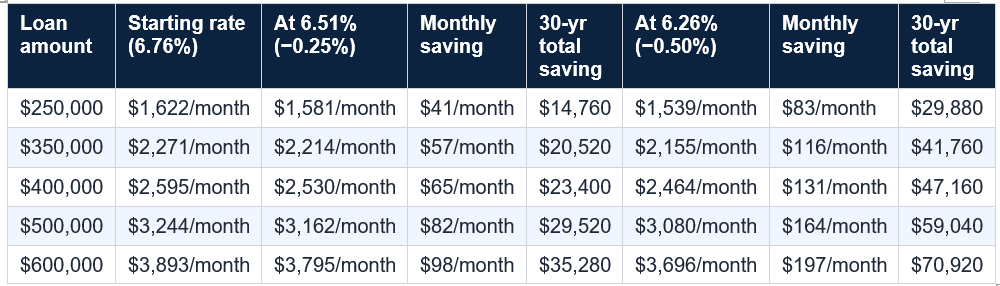
All figures are illustrative, rounded to nearest dollar, and based on a 30-year fixed-rate mortgage at the stated interest rate with no points. They do not include taxes, insurance, or PMI. Actual payments will differ. Not financial advice. Use the Consumer Financial Protection Bureau's mortgage calculator at consumerfinance.gov/owning-a-home/mortgage-estimate/ for personalised calculations.
Freddie Mac, CBS News, The Lenders Network, mortgage-info.com, and Bankrate all say the same thing with different numbers: shopping around works. Getting three or more Loan Estimates and presenting the best one to a competing lender with the words 'Can you match or beat this?' is the most powerful, most accessible, and most underused tool in mortgage borrowing. For a $400,000 loan, the 30-year saving from a 0.25% rate reduction is approximately $23,400. For a 0.50% reduction, it approaches $47,000. These are not marginal savings. They are meaningful financial outcomes from a five-minute phone call.
The conversation most buyers never have is the one that says: 'I'm comparing multiple lenders and I'd like to give you the opportunity to earn my business.' Make that call. Get the Loan Estimates. Make the simple request. The lender who wants your business will respond.
The 30-year fixed-rate mortgage averaged 6.76% as of September 10, 2026, according to Freddie Mac's Primary Mortgage Market Survey (PMMS) — the benchmark US mortgage rate index published weekly since 1971. This is up from 6.71% the prior week and up from 6.35% a year ago, and is the highest level since July 2025 according to Bankrate's national survey of lenders (also published four days ago, showing 6.78%). The 15-year fixed-rate mortgage averaged 6.09%. These are national averages for borrowers with 20% down payments and excellent credit — individual rates vary based on credit score, loan amount, loan type, lender, location, and other factors.
How much can I save by shopping around for a mortgage?
Freddie Mac's research found that borrowers who get at least one additional rate quote save an average of $1,500 over the loan's life. Getting five quotes doubles that saving. Mortgage-info.com's May 2026 framework, updated for current market conditions, shows that comparing three or more lenders saves an average of 0.25–0.50% on the rate — worth $20,000 to $40,000 over 30 years on a typical loan. The Lenders Network (June 2026) quantifies the smaller end: even a 0.125% savings on a $380,000 loan saves $28 per month and approximately $10,000 over 30 years. The crucial finding from Freddie Mac's research is that the saving comes from shopping and comparing — not from any special negotiating skill or market knowledge.
Will applying to multiple lenders hurt my credit score?
No — if you apply within a 14–45 day window. Credit bureaus treat multiple mortgage inquiries within this period as a single inquiry for credit scoring purposes. This protects borrowers who are rate shopping from being penalised for doing something that benefits them financially. There is no credit score penalty for aggressive rate shopping within this window. The practical implication: submit all your mortgage applications within a 2–3 week period to ensure all inquiries fall within the window and count as a single hit on your credit score (The Lenders Network, June 2026).
What is the most effective script for negotiating a lower mortgage rate?
The most effective script, per mortgage-info.com's May 2026 guide: 'I have a competing offer from [Lender B] at [X]%. Can you match or beat that?' Show the actual Loan Estimate from the competing lender. For fee negotiation: 'Your origination fee is [X%]. [Lender B]'s fee is [Y%]. Can you reduce yours to match?' For upfront signalling at the start of the process: 'I plan to speak with at least three lenders before making a decision, and I'd like to give you the opportunity to offer your best terms.' Brian Green of Xpert Home Lending (Yahoo Finance/Farris June 2025) confirms: 'Being transparent that you plan on talking to multiple lenders helps make sure each lender is putting their best foot forward.' The Loan Estimate is the key document — it is standardised, directly comparable, and immediately credible to a competing lender.
What is a seller buydown and how does it compare to a price reduction?
A seller buydown is a concession in which the seller pays upfront to permanently reduce the buyer's mortgage interest rate, via discount points. It differs from a price reduction in that the dollars spent produce much more monthly payment relief: Craig Garcia of Capital Partners Mortgage, quoted in CBS News (August 3, 2026), found that 'the payment impact was 2.5 times greater than just reducing the price' when an equivalent dollar amount is used for a rate buydown instead. Example: on a $400,000 mortgage at 6.76%, a seller contributing $10,000 toward a rate buydown could reduce the rate to approximately 6.14%, saving approximately $165 per month — $59,400 over 30 years. The same $10,000 price reduction would only save approximately $63 per month. In Q1 2025, 44.4% of sellers agreed to some form of concession (Redfin). Seller buydowns are most effective in markets where buyer demand has softened — precisely the environment of late 2026 where mortgage applications are declining at higher rates.
Should I pay discount points to lower my mortgage rate?
Whether to pay discount points depends primarily on how long you plan to keep the mortgage. Each point costs 1% of the loan amount and reduces the rate by approximately 0.25% (The Lenders Network, June 2026). On a $380,000 loan, one point costs $3,800 and saves approximately $57 per month — a break-even of approximately 67 months (5.6 years). If you plan to stay in the home and keep the mortgage for longer than that, buying points is financially advantageous. If you plan to move or refinance within five years, the upfront cost is unlikely to be fully recovered. The correct comparison is between buying points now versus keeping that cash in a savings account or investment — particularly at current savings rates of 4–5%, where the opportunity cost of paying points upfront is meaningful. Use the CFPB's mortgage calculator to model specific scenarios for your loan amount, rate, and planned holding period.
Table of Contents
- The Most Expensive Mistake in Home Buying
- Current Mortgage Rates: Where We Are in September 2026
- Why Nearly Half of Buyers Get Only One Quote
- The Freddie Mac Finding: What Shopping Around Is Actually Worth
- The Simple Request: How to Ask a Lender to Beat a Competitor's Rate
- What Is Negotiable and What Isn't
- The Competing Loan Estimate Tactic — Step by Step
- Discount Points: Buying Your Rate Down
- Beyond the Rate: Negotiating Closing Costs
- The Seller Buydown: A Rate Reduction You Never Ask the Lender For
- How Your Credit Profile Affects What's Available to Negotiate
- Using a Mortgage Broker vs Going Directly to a Lender
- The Maths: What Different Rate Reductions Are Worth
- Conclusion: The Conversation Most Buyers Never Have
- Frequently Asked Questions
30 - Year Savings From Rate Negotiation By Loan Size.
Seller Buydown vs Price Reduction: Which Is Worth More?
The Most Expensive Mistake in Home Buying
Buying a home is the largest financial transaction most people make in their lives. The mortgage that funds it is the most significant financial commitment most people will ever sign. And yet the most expensive mistake in the entire process — accepting the first mortgage rate quoted without shopping or negotiating — is made by nearly half of all homebuyers.Freddie Mac's research is unambiguous: nearly half of homebuyers stop after getting just one rate quote. In a market where the 30-year fixed-rate mortgage averaged 6.76% as of September 10, 2026 — the highest since July 2025 (Freddie Mac PMMS, published four days ago) — that single quote is costing borrowers real money. Not a marginal amount. A Freddie Mac study found that getting one additional quote saves an average of $1,500. Getting five quotes doubles that saving. And comparing three or more lenders can reduce the rate by 0.25 to 0.50 percentage points — worth $20,000 to $40,000 over the life of a 30-year mortgage on a typical loan.
This guide is about the specific request that unlocks these savings: asking a lender to match or beat a competitor's rate. It is, in practice, one of the simplest conversations in personal finance. It requires no special knowledge, no financial sophistication, and no confrontation. It requires a Loan Estimate from a second lender and a willingness to say four words: 'Can you beat this?' The borrowers who make this request consistently get better rates. The borrowers who don't consistently overpay. This guide explains how to make it work.
30-year FRM: 6.76% (Freddie Mac PMMS, September 10, 2026 — 4 days ago). 15-year FRM: 6.09%. Bankrate national survey: 6.78% (4 days ago) — highest since July 2025. Nearly half of homebuyers get only one rate quote (Freddie Mac). One additional quote: saves $1,500 average. Five quotes: doubles the saving. Comparing 3+ lenders: saves 0.25–0.50% = $20,000–$40,000 over 30 years on a typical loan. On $380,000 at 0.125% reduction: $28/month = $10,000 over 30 years (The Lenders Network June 2026).
Current Mortgage Rates: Where We Are in September 2026
Freddie Mac's Primary Mortgage Market Survey — the benchmark for US mortgage rate tracking since 1971 — reported the 30-year fixed-rate mortgage at 6.76% on September 10, 2026. This is up from 6.71% the previous week and up from 6.35% a year ago. The 15-year fixed-rate mortgage averaged 6.09%, up from 6.04% the prior week. Bankrate's national survey of lenders, also published four days ago, showed 6.78% — the highest level since July 2025.Freddie Mac's Chief Economist Sam Khater accompanied the September 10 release with a statement that speaks directly to this article's subject: 'Aspiring buyers should remember shopping around for the best mortgage rate and getting multiple quotes can potentially save them thousands.' That statement — from the official government-sponsored mortgage market monitor — is not a generic piece of advice. It is an acknowledgement, from the institution that tracks what every lender in America charges, that meaningful variation exists between lenders for identical borrowers.
To put the current rate environment in context: at the start of 2025, the 30-year fixed-rate surpassed 7%. By October 2025, it had fallen to 6.19% — its lowest level in over a year. By December 2025, it averaged 6.21%. The 2026 trajectory has been upward from that December trough, returning to current levels of 6.76%. CBS News' May 2026 analysis noted that 'at just under 6.4% average, today's mortgage rates are still high enough that even small rate differences can matter substantially to borrowers, who are already grappling with high home prices, insurance costs and rising inflation.' At 6.76%, that observation is more relevant, not less.
Why Nearly Half of Buyers Get Only One Quote
If the evidence that shopping for mortgage rates saves thousands is so clear, why do nearly half of buyers still accept the first quote? The reasons are psychological and structural — and understanding them is part of avoiding the trap.- The mortgage process feels overwhelming: buying a home involves attorneys, surveys, estate agents, conveyancers, insurers, and surveyors — all simultaneously. Adding the complexity of comparing multiple lenders feels like one more complication in an already complicated process. The path of least resistance is to let the bank or the estate agent's preferred lender handle everything.
- Perceived credit score risk: many buyers believe that applying to multiple lenders will damage their credit score through multiple hard inquiries. This concern is largely unfounded — the credit bureaus treat multiple mortgage inquiries within a 14 to 45 day window as a single inquiry for credit scoring purposes (The Lenders Network, June 2026). There is no credit penalty for aggressive rate shopping within that window.
- Loyalty to a familiar bank: many buyers approach their existing bank first and, having received a rate, feel an implicit obligation to proceed with it. There is no such obligation — a mortgage is a commodity product where price (rate and fees) is the primary differentiator. Your bank has no loyalty advantage in mortgage pricing.
- Underestimating the saving: a difference of 0.25% sounds small. On a $400,000 mortgage, it represents approximately $55 per month — easy to dismiss. Over 30 years, it represents $20,000. Few people would leave $20,000 on a table in a house purchase negotiation; the same logic applies to mortgage rate comparison.
- Time pressure: in competitive markets, buyers under contract feel pressure to proceed quickly. The good news: getting three to five Loan Estimates takes only a few days. The CFPB requires lenders to issue a Loan Estimate within three business days of a completed application — and the standardised Loan Estimate form makes direct comparison straightforward.
The Freddie Mac Finding: What Shopping Around Is Actually Worth
The Freddie Mac study on mortgage rate shopping is the most frequently cited piece of evidence in the mortgage industry — and it remains one of the clearest demonstrations of what a simple, cost-free action is worth financially. The headline finding: homebuyers who get at least one additional rate quote save $1,500 over the loan's life on average. Getting five quotes doubles that saving.Bankrate's analysis of this research frames it precisely: 'Shopping with multiple lenders can save you over $1,000 a year, according to research from Freddie Mac.' That is an annual saving, not a one-time figure — the rate reduction compounds year after year for the life of the loan.
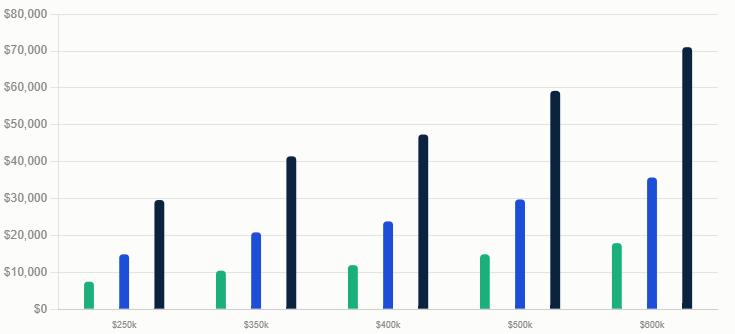
Mortgage-info.com's May 2026 guide, based on current market conditions, updates the Freddie Mac finding: 'Borrowers who compare 3+ lenders save an average of 0.25-0.50% on their rate, worth $20,000-$40,000 over 30 years.' At current 30-year rates of 6.76%, a 0.25% reduction to 6.51% on a $400,000 mortgage saves approximately $65 per month — $23,400 over a 30-year term.
The Lenders Network's June 2026 guide quantifies the smallest meaningful saving: 'The math is simple: even 0.125% on a $380,000 loan saves $28 per month and $10,000 over 30 years.' The 0.125% figure is significant because it represents what many borrowers could save simply by asking for a rate match rather than needing the second lender to be dramatically cheaper. In many cases, the difference between lenders is larger than 0.125% — making the potential saving considerably greater.
Example at current September 2026 rates on a $400,000, 30-year fixed mortgage. First quote at 6.76% (Freddie Mac national average, September 10, 2026): monthly payment approximately $2,595/month. After shopping and securing 6.51% (0.25% reduction): approximately $2,530/month. Monthly saving: $65. Annual saving: $780. 30-year total saving: approximately $23,400. After shopping and securing 6.26% (0.50% reduction, achievable with 3+ quotes per mortgage-info.com framework): approximately $2,465/month. Monthly saving: $130. Annual saving: $1,560. 30-year total saving: approximately $46,800. All figures illustrative; actual payments depend on taxes, insurance, and loan specifics. Not financial advice.
The Simple Request: How to Ask a Lender to Beat a Competitor's Rate
The 'simple request' that gives this article its title is not a hack or a secret tactic known only to finance professionals. It is a straightforward business conversation that most people have never had because no one told them to have it. It goes like this:The most effective script (mortgage-info.com May 2026 framework): 'I have a competing offer from [Lender B] at [X]%. Can you match or beat that?' Then show the Loan Estimate from Lender B. That is the entire conversation. The Lenders Network's June 2026 guide confirms it works: 'Showing lender B that lender A quoted a lower rate forces a pricing conversation that almost always results in a better offer.'
Brian Green, senior loan advisor at Xpert Home Lending, describes the approach from the lender's perspective (Yahoo Finance/Farris, June 2025): 'Being transparent that you plan on talking to multiple lenders before making a decision helps make sure each lender is putting their best foot forward.' The message here is important: the request does not have to happen after you have already received a competing quote. Simply telling a lender at the outset that you are comparing multiple lenders is itself a signal that changes their pricing incentive.The Mortgage Reports (January 2026) provides the borrower-friendly framing: 'If you've been quoted 6.875% by one lender and 6.625% by another, taking the lower offer back to the first lender and asking them to match or beat it is a legitimate and often successful strategy.' The CBS News May 2026 analysis confirms the market context: at current rates, every fraction of a percentage point counts. Lenders who want the business know this.
Renee Coleman, mortgage lender at CrossCountry Mortgage, quoted in Yahoo Finance (June 2025), acknowledges the borrower's leverage directly: 'Rates are negotiable, to a point. Lenders have certain rules they must follow, but there is room for adjustment.' That room for adjustment — the margin built into every rate quote — is what the simple request accesses.
The key to making the request land: do it with a Loan Estimate in hand, not just a verbal quote. The standardised Loan Estimate form (required by the CFPB within three business days of application) shows the rate, APR, monthly payment, and all fees in a directly comparable format. Walking in with a competitor's Loan Estimate eliminates ambiguity and signals that you have done the work — which almost always produces a more serious pricing response.
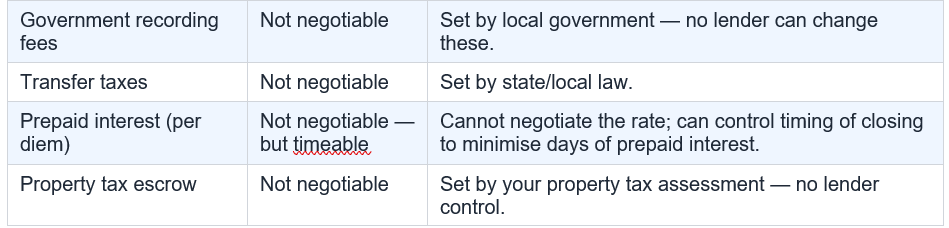
What Is Negotiable and What Isn't
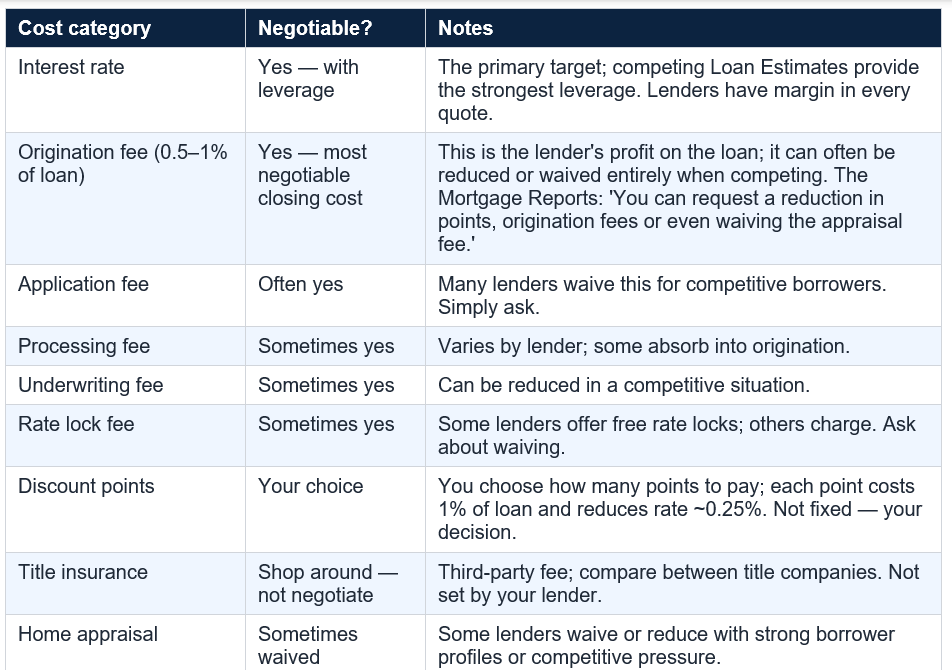
Not everything on a mortgage quote can be negotiated. Understanding what is movable and what is fixed is essential for focusing the conversation where it can actually produce results.
The Competing Loan Estimate Tactic — Step by Step
The competing Loan Estimate tactic is the most powerful rate-reduction tool available to any borrower, requiring no special financial skills. Here is the step-by-step process:- Step 1 — Contact at least three lenders (ideally five) and submit a formal application to each. The CFPB requires lenders to issue a Loan Estimate within three business days. Multiple mortgage applications within a 14–45 day window count as a single credit inquiry — there is no credit score penalty for this.
- Step 2 — Receive Loan Estimates from each lender. The Loan Estimate is a standardised three-page form that shows: the interest rate; APR; estimated monthly payment; closing costs broken down by category; and the total cost over five years. Because the format is identical across all lenders, comparison is straightforward.
- Step 3 — Identify the best overall offer. This is not necessarily the lowest rate — it is the lowest total cost when rate, APR (which includes fees), and closing costs are considered together. A lower rate with very high origination fees may cost more in total than a slightly higher rate with lower fees, particularly if you plan to sell or refinance within five to seven years.
- Step 4 — Take the best Loan Estimate to your preferred lender (whether that is the current front-runner or an institution you prefer for other reasons) and make the simple request: 'I have a competing offer from [Lender Name] at [X]% with [Y] in fees. Can you match or beat this?' Show the actual Loan Estimate.
- Step 5 — Evaluate the response. A good lender will either match the competing offer, beat it, or explain clearly why they cannot. If they match, you have secured the better rate at your preferred institution. If they cannot match it, you now have clear information to make your final decision. Either way, you are better positioned than if you had never asked.
- Step 6 — If rate is fixed and fees are the issue, ask about lender credits. Some lenders will offer a slightly higher rate in exchange for a credit toward closing costs — useful if upfront cash is tight. The Mortgage Reports: 'Use lender credits strategically: a slightly higher rate can sometimes offset upfront costs.'
what to say: The exact words (mortgage-info.com May 2026): 'I have a competing offer from [Lender B] at [rate]%. Can you match or beat that?' Show the Loan Estimate. For fees: 'I also notice your origination fee is [X%]. [Lender B]'s fee is [Y%]. Can you reduce yours to match?' For comprehensive negotiation: 'I'm comparing multiple Loan Estimates and would like to give you the opportunity to match the best terms before I make my final decision.' These are not aggressive or unusual requests. They are standard professional conversations that every lender expects from a well-informed borrower.
Discount Points: Buying Your Rate Down
Discount points are an upfront payment to the lender in exchange for a permanently lower interest rate. Each point costs 1% of the loan amount and typically reduces the rate by approximately 0.25 percentage points (The Lenders Network, June 2026). They are not a negotiation in the traditional sense — you are paying for the reduction — but they represent a choice that many borrowers do not know they have.The mathematics: on a $380,000 loan, one discount point costs $3,800. At 0.25% rate reduction, the monthly saving is approximately $57. The break-even period — the time required for the monthly saving to recover the upfront cost — is approximately 67 months, or just under six years ($3,800 ÷ $57 ≈ 66.7 months). If you plan to stay in the home for more than six years, buying a point is likely financially advantageous. If you plan to move or refinance sooner, it probably is not.
Discount point calculation on a $380,000 loan at 6.76% (September 2026 national average). Without points: 6.76%, monthly payment approximately $2,475. Buy 1 point ($3,800): rate falls to approximately 6.51%, monthly payment approximately $2,415. Monthly saving: $60. Break-even: $3,800 ÷ $60 = 63 months (~5.3 years). Buy 2 points ($7,600): rate falls to approximately 6.26%, monthly payment approximately $2,355. Monthly saving: $120. Break-even: $7,600 ÷ $120 = 63 months (~5.3 years). All figures illustrative. Actual rate reduction per point varies by lender and market conditions. Not financial advice.
The negotiation opportunity with points is different from the rate negotiation: you can ask a lender to specify exactly what rate you would receive at different point levels, and you can use the resulting schedule as part of your cross-lender comparison. Some lenders are more generous than others in the rate reduction they offer per point — meaning the point purchase can itself be a lever in the competitive Loan Estimate comparison.
Beyond the Rate: Negotiating Closing Costs
Mortgage rate negotiation gets most of the attention, but closing cost negotiation can produce equally significant savings — particularly for borrowers who plan to move or refinance within five years, where the upfront cost has less time to amortise against the ongoing rate benefit.Mortgage-info.com's May 2026 framework identifies the total savings potential: '$1,500 to $4,500 on a typical $400,000 purchase' from closing cost negotiation alone. The origination fee — which typically ranges from 0.5% to 1% of the loan amount — is the single most negotiable line item. On a $400,000 loan, a 0.5% origination fee is $2,000. Some lenders waive it entirely in a competitive situation; others reduce it to 0.25% ($1,000). Simply asking — with a competing Loan Estimate showing a lower fee — is often sufficient.
The Mortgage Reports (January 2026) names the request explicitly: 'You can request a reduction in points, origination fees or even waiving the appraisal fee. If you approach negotiations with the right attitude and come armed with knowledge, securing a lower rate could be as simple as asking.' The combination of rate negotiation and fee negotiation can produce a substantially better overall package than either alone.
End-of-month closing timing is another closing cost lever: mortgage interest is prepaid from the closing date to the end of the month. Closing on the 28th means only 2–3 days of prepaid interest. Closing on the 1st means approximately 30 days of prepaid interest — potentially a difference of $500–$900 for a typical loan. This cannot be negotiated, but it can be timed. The Mortgage Reports: 'Time your closing carefully: end-of-month closings often mean less prepaid interest.'
The Seller Buydown: A Rate Reduction You Never Ask the Lender For
In the current market, there is a rate-reduction strategy that most buyers overlook because it does not involve the lender at all: the seller-paid mortgage rate buydown.A seller buydown is a closing cost concession in which the seller pays upfront to permanently (or temporarily) reduce the buyer's mortgage interest rate. In Q1 2025, 44.4% of sellers agreed to some form of concession (Redfin, cited Yahoo Finance). In a market where higher rates are reducing buyer pool sizes — mortgage applications fell 6.4% for the week ending July 24, 2026 when rates hit their highest since August 2025 (Mortgage Bankers Association, cited CBS News August 2026) — sellers have incentive to offer buydowns to attract serious buyers.
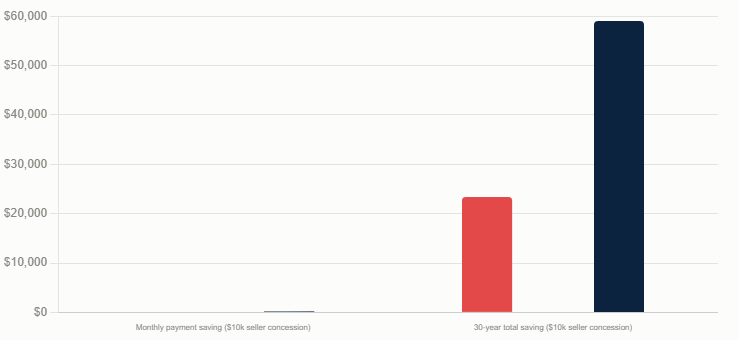
CBS News' August 2026 analysis quotes Craig Garcia, president at Capital Partners Mortgage, on the comparative value: 'Buyers can get significantly more bang for their buck when asking for rate buydown concessions from sellers in lieu of price reductions. When using the equivalent dollars of a price reduction instead of a permanent rate buydown, the payment impact was 2.5 times greater than just reducing the price.'
The mechanism: the seller agrees to pay a specific number of discount points at closing, permanently reducing the buyer's rate. The dollars come from the seller — not the buyer — and the lower rate benefit flows to the buyer for the life of the loan. Because the monthly payment reduction from a lower rate compounds over decades, the same seller dollars have far more impact as a rate buydown than as a price reduction.
what to say: In a negotiation: instead of asking the seller to reduce the price by $10,000, ask the seller to contribute $10,000 toward a permanent rate buydown. On a $400,000 mortgage at 6.76%, $10,000 in points buys approximately 2.5 points. At 0.25% per point, that reduces the rate to approximately 6.14% — a monthly saving of approximately $165, or $59,400 over 30 years. The same $10,000 price reduction would only reduce the monthly payment by approximately $63, or approximately $22,680 over 30 years. The rate buydown produces 2.6× more monthly payment relief and 2.6× more total saving from the same seller dollars. This is the 2.5× calculation cited by Craig Garcia and confirmed by CBS News (August 2026).
How Your Credit Profile Affects What's Available to Negotiate
Mortgage rate negotiation does not happen in a vacuum — the starting rate you are offered, and the range of rates you can realistically negotiate toward, depends substantially on your credit profile. Lenders price risk, and a stronger credit profile gives you more room to negotiate from a position of strength.Credit score is the most significant single factor after the loan amount and down payment. A borrower with a 760+ credit score will typically be offered rates that are meaningfully better than those offered to a 700-score borrower on an identical loan from the same lender. Improving your credit score before applying — by paying down credit card balances, removing errors from your credit report, and avoiding new credit applications for six months before applying — can access rates that are inaccessible regardless of how well you negotiate.
Debt-to-income ratio (DTI) matters almost as much as credit score. Lenders generally want to see total housing costs at no more than 28–31% of gross monthly income, and total debt at no more than 43% of gross monthly income for most conventional loans. A lower DTI signals lower default risk and makes a lender more willing to reduce rate or waive fees to win the business.
- Down payment: 20% or more eliminates private mortgage insurance (PMI), which reduces the loan's actual cost substantially and signals lower risk to the lender. A 20% down payment typically accesses better rates than a 10% or 5% down payment on the same loan.
- Employment stability: two years of steady employment in the same field is the standard lender benchmark. Self-employed borrowers typically need two years of tax returns showing stable income. Lenders offer their best rates to the profiles they can most easily underwrite.
- Loan-to-value ratio: the lower the LTV (the more equity or down payment), the lower the risk, and the better the available rate. A 60% LTV borrower will access better rates than an 80% LTV borrower — use this as a negotiating point if you are bringing significant equity from a prior home sale.
what to say: Before applying for any mortgage: pull your credit report from all three bureaus (free at annualcreditreport.com) and dispute any errors. Pay down credit card balances to below 30% of each card's limit — ideally below 10%. Do not open any new credit accounts for at least six months before applying. Calculate your DTI: add up all monthly debt payments (car loan, student loan, credit card minimums) and divide by gross monthly income. If it is above 36%, consider paying down debt before applying. These steps, completed before you begin rate shopping, give you access to the best tier of available rates — giving the subsequent negotiation a lower starting point to work from.
Using a Mortgage Broker vs Going Directly to a Lender
One of the most valuable tools for mortgage rate shopping is a mortgage broker — an independent intermediary who works with multiple lenders and can shop your application across their network simultaneously.Brian Green of Xpert Home Lending, quoted in Yahoo Finance (June 2025): 'Working with an independent mortgage broker will give you more flexibility because they can shop multiple lenders for you to find a low rate and low cost.' The broker's business model aligns with the borrower's interest in finding the lowest rate: brokers are paid a commission by the lender, not by the borrower (in most structures), and their ability to win repeat business depends on consistently delivering competitive rates.
The practical benefit of a broker: instead of applying to five lenders separately and comparing five Loan Estimates yourself, a broker submits your application to multiple lenders within their network and brings you the best offers. They can often access wholesale rates not directly available to consumers, and they know which lenders have the best appetite for specific borrower profiles (first-time buyers, self-employed, jumbo loans, lower credit scores).
The limitation: brokers do not have access to all lenders. Major banks like Chase, Wells Fargo, and Bank of America do not work with brokers — borrowers must approach them directly. A comprehensive rate-shopping strategy often combines broker quotes (for wholesale lender access) with direct lender applications (for major bank access) to cover the full market.
The Maths: What Different Rate Reductions Are Worth
The following table shows the financial impact of different rate reductions on mortgages of varying sizes at the September 2026 national average starting rate of 6.76% (Freddie Mac, September 10, 2026). These figures illustrate why the simple request described in this article is worth making, regardless of loan size.All figures are illustrative, rounded to nearest dollar, and based on a 30-year fixed-rate mortgage at the stated interest rate with no points. They do not include taxes, insurance, or PMI. Actual payments will differ. Not financial advice. Use the Consumer Financial Protection Bureau's mortgage calculator at consumerfinance.gov/owning-a-home/mortgage-estimate/ for personalised calculations.
Conclusion
At 6.76% — the highest 30-year mortgage rate since July 2025 — every basis point matters more than it did when rates were 3%. The difference between accepting the first quote and making the simple request that could lower your rate is not a matter of negotiating skill, financial sophistication, or market timing. It is a matter of having the conversation.Freddie Mac, CBS News, The Lenders Network, mortgage-info.com, and Bankrate all say the same thing with different numbers: shopping around works. Getting three or more Loan Estimates and presenting the best one to a competing lender with the words 'Can you match or beat this?' is the most powerful, most accessible, and most underused tool in mortgage borrowing. For a $400,000 loan, the 30-year saving from a 0.25% rate reduction is approximately $23,400. For a 0.50% reduction, it approaches $47,000. These are not marginal savings. They are meaningful financial outcomes from a five-minute phone call.
The conversation most buyers never have is the one that says: 'I'm comparing multiple lenders and I'd like to give you the opportunity to earn my business.' Make that call. Get the Loan Estimates. Make the simple request. The lender who wants your business will respond.
15. Frequently Asked Questions
What is the current 30-year mortgage rate in September 2026?The 30-year fixed-rate mortgage averaged 6.76% as of September 10, 2026, according to Freddie Mac's Primary Mortgage Market Survey (PMMS) — the benchmark US mortgage rate index published weekly since 1971. This is up from 6.71% the prior week and up from 6.35% a year ago, and is the highest level since July 2025 according to Bankrate's national survey of lenders (also published four days ago, showing 6.78%). The 15-year fixed-rate mortgage averaged 6.09%. These are national averages for borrowers with 20% down payments and excellent credit — individual rates vary based on credit score, loan amount, loan type, lender, location, and other factors.
How much can I save by shopping around for a mortgage?
Freddie Mac's research found that borrowers who get at least one additional rate quote save an average of $1,500 over the loan's life. Getting five quotes doubles that saving. Mortgage-info.com's May 2026 framework, updated for current market conditions, shows that comparing three or more lenders saves an average of 0.25–0.50% on the rate — worth $20,000 to $40,000 over 30 years on a typical loan. The Lenders Network (June 2026) quantifies the smaller end: even a 0.125% savings on a $380,000 loan saves $28 per month and approximately $10,000 over 30 years. The crucial finding from Freddie Mac's research is that the saving comes from shopping and comparing — not from any special negotiating skill or market knowledge.
Will applying to multiple lenders hurt my credit score?
No — if you apply within a 14–45 day window. Credit bureaus treat multiple mortgage inquiries within this period as a single inquiry for credit scoring purposes. This protects borrowers who are rate shopping from being penalised for doing something that benefits them financially. There is no credit score penalty for aggressive rate shopping within this window. The practical implication: submit all your mortgage applications within a 2–3 week period to ensure all inquiries fall within the window and count as a single hit on your credit score (The Lenders Network, June 2026).
What is the most effective script for negotiating a lower mortgage rate?
The most effective script, per mortgage-info.com's May 2026 guide: 'I have a competing offer from [Lender B] at [X]%. Can you match or beat that?' Show the actual Loan Estimate from the competing lender. For fee negotiation: 'Your origination fee is [X%]. [Lender B]'s fee is [Y%]. Can you reduce yours to match?' For upfront signalling at the start of the process: 'I plan to speak with at least three lenders before making a decision, and I'd like to give you the opportunity to offer your best terms.' Brian Green of Xpert Home Lending (Yahoo Finance/Farris June 2025) confirms: 'Being transparent that you plan on talking to multiple lenders helps make sure each lender is putting their best foot forward.' The Loan Estimate is the key document — it is standardised, directly comparable, and immediately credible to a competing lender.
What is a seller buydown and how does it compare to a price reduction?
A seller buydown is a concession in which the seller pays upfront to permanently reduce the buyer's mortgage interest rate, via discount points. It differs from a price reduction in that the dollars spent produce much more monthly payment relief: Craig Garcia of Capital Partners Mortgage, quoted in CBS News (August 3, 2026), found that 'the payment impact was 2.5 times greater than just reducing the price' when an equivalent dollar amount is used for a rate buydown instead. Example: on a $400,000 mortgage at 6.76%, a seller contributing $10,000 toward a rate buydown could reduce the rate to approximately 6.14%, saving approximately $165 per month — $59,400 over 30 years. The same $10,000 price reduction would only save approximately $63 per month. In Q1 2025, 44.4% of sellers agreed to some form of concession (Redfin). Seller buydowns are most effective in markets where buyer demand has softened — precisely the environment of late 2026 where mortgage applications are declining at higher rates.
Should I pay discount points to lower my mortgage rate?
Whether to pay discount points depends primarily on how long you plan to keep the mortgage. Each point costs 1% of the loan amount and reduces the rate by approximately 0.25% (The Lenders Network, June 2026). On a $380,000 loan, one point costs $3,800 and saves approximately $57 per month — a break-even of approximately 67 months (5.6 years). If you plan to stay in the home and keep the mortgage for longer than that, buying points is financially advantageous. If you plan to move or refinance within five years, the upfront cost is unlikely to be fully recovered. The correct comparison is between buying points now versus keeping that cash in a savings account or investment — particularly at current savings rates of 4–5%, where the opportunity cost of paying points upfront is meaningful. Use the CFPB's mortgage calculator to model specific scenarios for your loan amount, rate, and planned holding period.

0 Comments Comments