
Sports
Tyson Fury vs Anthony Joshua: The Big Money Fight

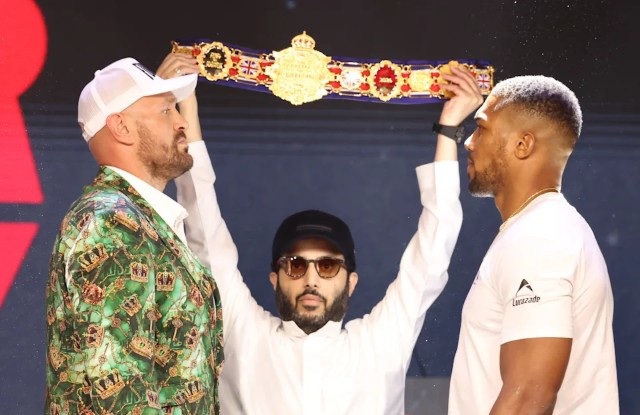
A decade in the making. Two former two-time world heavyweight champions. Two men who both lost to the same fighter — Oleksandr Usyk — within the space of three years. A purse reportedly worth £75M–£100M each. And as of August 2026, a negotiation that Fury himself said ‘doesn’t look like it’s going to happen.’ Welcome to Fury vs Joshua: the biggest fight in British boxing history that has still, somehow, not been signed, sealed, and delivered. This article covers the money, the records, the history of near-misses, the Saudi context, and everything you need to know about the most talked-about heavyweight showdown of 2026. Informational and entertainment purposes only — not betting advice.
That was the first near-miss. There have been at least five more since. Joshua lost to Usyk (twice). Fury beat Wilder (twice more) before also losing to Usyk (twice). The window where both men were simultaneously unbeaten and in possession of major world titles closed and never reopened. As Fury himself admitted in December 2025: ‘I give up on the motherf—ker.’ Colourful language, but it captured the exhaustion of a fanbase that had watched this fight teased, confirmed, collapsed, and re-teased on a near-annual basis for six years.
And yet. In 2026, both men signed a contract facilitated by Turki Alalshikh, Saudi Arabia’s General Entertainment Authority chairman. Both fighters took tune-up fights. The Ring Magazine reported a Riyadh Season mega-event. A date in Q4 2026 — most likely November — was targeted. The fight was finally, genuinely, almost certainly happening. Then in August 2026, Fury said it ‘doesn’t look like it’s going to happen’ over a purse dispute. For this fight, that counts as progress. Not betting advice.
The financial engine behind these numbers is Saudi Arabia’s General Entertainment Authority, chaired by Turki Alalshikh. The Saudi model bypasses traditional revenue structures: rather than relying primarily on gate receipts and PPV sales, the GEA pays a large flat-fee site fee directly to the promoters, which is then distributed to the fighters. BoxingShowTimes reported that Turki was likely to offer Fury approximately $150 million to come out of retirement — a figure comparable to Canelo Alvarez’s reported purse for his 2025 fight with Terence Crawford in the same ecosystem.
Frank Warren, Fury’s promoter, was characteristically blunt: ‘What will encourage Tyson is the financial aspect of it. It’s a big fight and it’s worth a lot of money. Tyson has his price.’ (Sky Sports, January 2026.) The tension in August 2026, when Fury accused Joshua of being ‘money-thirsty’ and demanding a bigger share, is itself evidence of how enormous the pot has become: both fighters are fighting over a slice of £150M–£200M total. Not betting or financial advice.
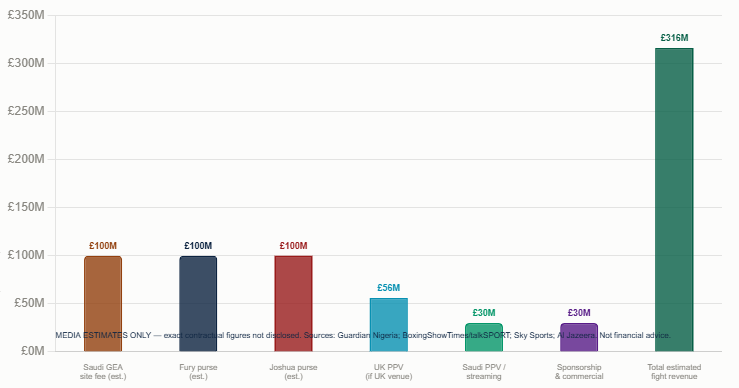
The fight’s financial structure (media estimates — exact contractual figures not disclosed): total fight purse pot: approximately £150M-£200M+. Fury share: ~£75M-£100M ($100M). Joshua share: ~£75M-£100M ($100M) — 50-50 first fight split (Guardian Nigeria). Saudi GEA site fee: likely exceeds £50M-£100M+. Comparison: Canelo Alvarez vs Terence Crawford (2025 Riyadh Season) — Canelo reportedly ~$150M. UK PPV context: 1.5-2.5M buys at £25-£30 per buy = £37M-£75M UK PPV alone. Additional global streaming, sponsorship, merchandise, and broadcast rights. Sources: Guardian Nigeria; BoxingShowTimes citing Eddie Hearn/talkSPORT; Sky Sports January 2026. Not financial advice.
The mechanism is straightforward: the General Entertainment Authority, under Turki Alalshikh, pays site fees that dwarf what any traditional venue could generate from gate receipts and local broadcasting alone. For Fury vs Joshua, the expected venue is either the Kingdom Arena in Riyadh or a UK stadium — but as Frank Warren put it: ‘Money will dictate where the fight takes place. They will go where the money is.’ When Saudi Arabia’s offer exceeds what even a Wembley Stadium sellout plus full UK PPV can generate, the fight goes to Riyadh.
Turki Alalshikh himself teased in late 2025 that ‘one of the greatest fights in the history of boxing’ would take place in London in September 2026 — the rare acknowledgement that UK domestic staging remains on the table. Whether that happens, or whether economics again push the fight to Saudi Arabia, remains the single biggest venue variable in the fight’s planning. Not financial advice.
On Record: Eddie Hearn (talkSPORT, early 2026): 'We spoke with him in London this week. Everything that we do with Anthony Joshua will be in accordance with and under the guidance of Turki Alalshikh. We have accepted. Is the fight made? Because I don’t know where he’s at with Tyson Fury. All I know is he’s yet to fail in delivering a fight.'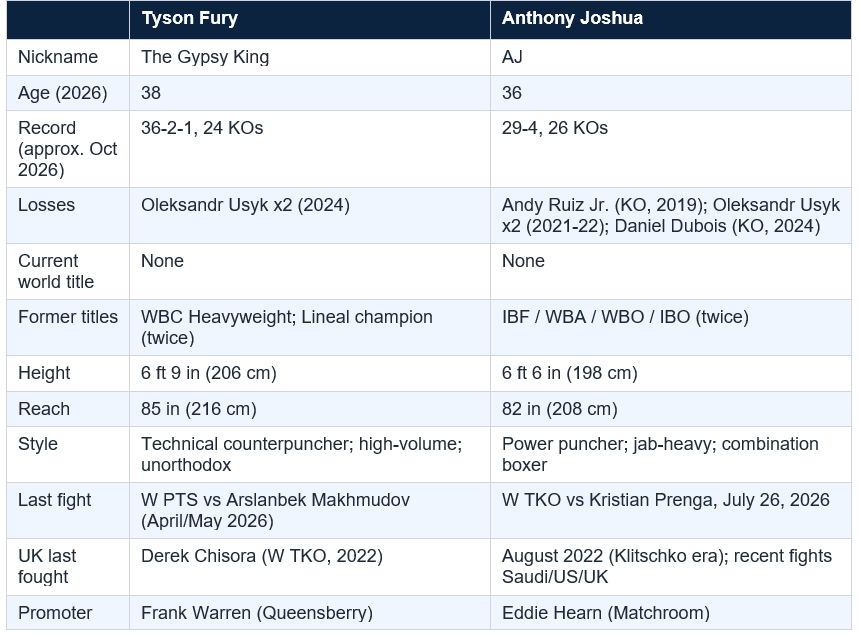
Both fighters followed the script for a mega-fight warm-up: low-risk, high-profile, designed to shake off the cobwebs and confirm they are still capable of performing at a high level without risking the multi-million-pound showdown.
Fury returned from his 16-month retirement to face Arslanbek Makhmudov at London’s Tottenham Hotspur Stadium in April/May 2026. The choice of venue was symbolically significant — Fury’s first fight on British soil since his 2022 knockout of Derek Chisora, and a deliberate homecoming statement ahead of the Joshua fight. Fury won on points, was dominant if not spectacular, and used the post-fight platform to issue a direct, ringside challenge to Joshua, who was in attendance.
Joshua’s tune-up came against Albanian heavyweight Kristian Prenga at the Jeddah Superdome on July 26, 2026. Joshua won by TKO — as expected from a match that Guardian Nigeria described as ‘not intended to be a stiff test for AJ, it is a tune-up with little risk, this is no time to fumble that enormous bag.’ The Prenga fight was Joshua’s first outing since his 2024 TKO loss to Daniel Dubois, and while the opposition was modest, Joshua got through unscathed, which was entirely the point. The fight pipeline — Fury vs Makhmudov in spring, Joshua vs Prenga in July, Fury vs Joshua in Q4 — proceeded exactly as Turki’s playbook designed. Not betting advice.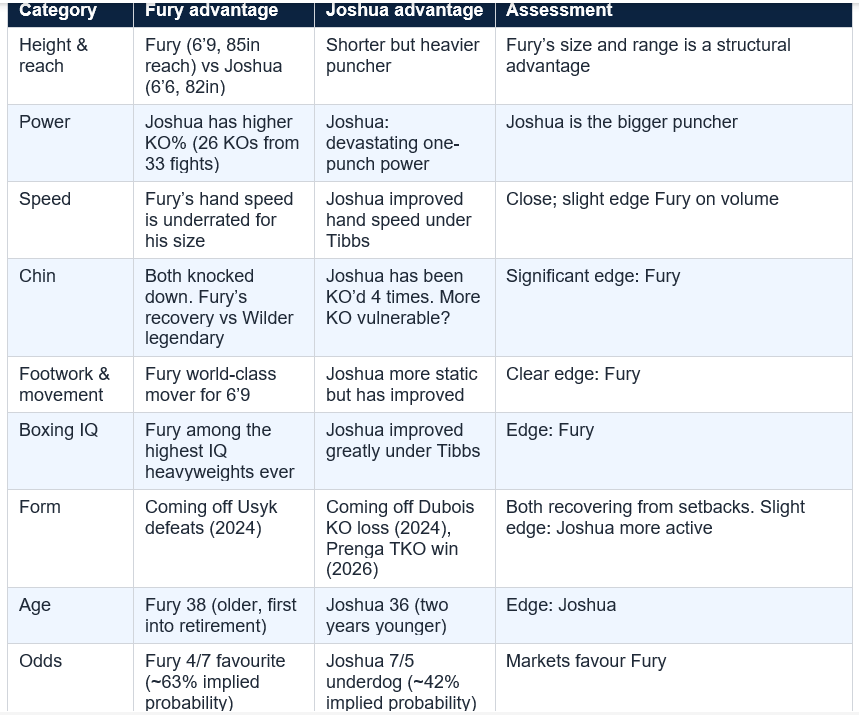
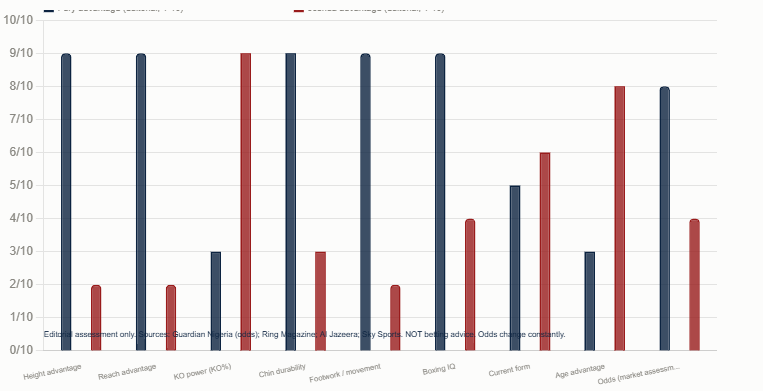
The decisive factor, boxing observers consistently argue, is Joshua’s chin. In his four professional losses, Joshua has been knocked out or stopped in three of them (Andy Ruiz Jr., Daniel Dubois, and controversially the second Usyk fight stoppage). Fury has been hurt — dramatically so against Wilder — but has never been stopped and has shown a supernatural ability to recover. Frank Warren’s confidence that ‘Tyson will knock him out’ is rooted in this analysis: if Fury can land his jab and move for eight rounds, eventually his size and pressure will find Joshua’s vulnerability. Joshua’s camp, meanwhile, believes that Fury’s two Usyk defeats revealed a slower, more hittable fighter — one that Joshua’s power can exploit.
The honest assessment is that both men are past their peaks. Fury is 38 and coming back from a second Usyk loss and a retirement period. Joshua is 36 and has lost to Usyk, Ruiz, and Dubois. But the British public and global boxing audience do not always care about peak-versus-peak analysis. They want the fight. And on any given night, either man is capable of winning. Not betting advice.
Fight analysis: FURY’S ROUTE TO VICTORY: Control distance with the jab, use movement to frustrate Joshua, look for the counter right hand. If Fury lands his jab and stays disciplined for 8-10 rounds, Joshua’s historically fragile chin becomes a factor. Frank Warren: 'Tyson will knock him out.' (Sky Sports, January 2026.) JOSHUA’S ROUTE TO VICTORY: Use his physical strength in the clinch, land the straight right hand early when Fury is still warming up, and target the body to slow Fury’s movement in the middle rounds. The Usyk fights showed Fury’s jab can be negated by a disciplined pressure fighter. If Joshua’s power-punching lands against a slower Fury, one big shot could change the fight. VERDICT: Markets favour Fury 4/7. The fight likely goes to the championship rounds. Not betting advice. Indicative analysis only.
The odds will shift significantly as the fight approaches, based on the weight of public money (UK fans heavily backing Joshua inflating his odds), both fighters’ condition in training camp media, and any pre-fight narratives that emerge. Joshua’s knockout of Jake Paul — a media event rather than a serious fight — moved little meaningful information about his capabilities. His TKO win over Prenga in July 2026 was similarly uninformative regarding his readiness for elite opposition. Fury’s points win over Makhmudov was more telling: he looked controlled and disciplined, though Makhmudov is not close to Usyk’s level.
For context: the implied odds add to approximately 105%, reflecting the bookmaker’s margin (the vig). The true probability implied by the market is approximately 60% Fury / 40% Joshua before adjusting for margin. These are indicative figures only, drawn from Guardian Nigeria’s reporting in 2026. Odds change constantly. This is not a betting recommendation. Always gamble responsibly. Not betting advice.
A UK staging — Wembley Stadium (90,000 capacity) or Tottenham Hotspur Stadium (62,850) — would generate approximately 1.5–2.5 million PPV buys at £25–30 each on Sky Sports Box Office or TNT Sports, generating £37M–£75M in UK PPV revenue alone, plus gate receipts of approximately £5M–£15M. Total UK revenue: approximately £42M–£90M. That figure, while substantial, falls well short of the Saudi guarantee. Unless the Saudi site fee is paid regardless of where the fight is staged — a scenario that has happened with some Riyadh Season events staged abroad — the fight goes to Saudi Arabia.
Turki Alalshikh’s tease about a London staging in September 2026 remains tantalisingly possible. A Wembley Stadium fight under the UK lights, with 90,000 British fans, would generate an atmosphere unmatched by anything the Kingdom Arena could produce. For both fighters’ legacies, and for the British public that has waited a decade, that option carries emotional weight. But as Frank Warren said: ‘Money will dictate where the fight takes place.’ Not financial advice.
This is not the first time Fury has publicly declared the fight dead. Boxing negotiations, particularly at this level with these personalities and these sums, routinely involve public brinkmanship and provocations designed to gain leverage. The Ring Magazine’s original report of the fight as a signed Riyadh Season mega-event still stands as the foundational confirmation. Both fighters have completed their tune-up bouts. Turki Alalshikh has not publicly backed down from his commitment to deliver the fight. Eddie Hearn has confirmed Joshua’s acceptance.
The pattern of this fight’s negotiating history suggests that the August 2026 breakdown, while real and frustrating, is unlikely to be the final word. Both fighters have a commercial and reputational incentive to compete. Neither holds a world title. Neither is likely to get a more lucrative offer than what Turki Alalshikh is putting on the table. The fight’s delay into late Q4 2026 or early 2027 remains the most plausible outcome. But for a fight this long in the making, nothing is certain. Not financial advice.
What remains is the same obstacle that has derailed this fight at least five times before: two very large personalities, two very motivated promoters, and a purse split argument that could always be resolved by Turki Alalshikh making both sides an offer they cannot refuse. For British boxing fans, the calculation is simple: this is the fight they have been waiting for since 2020. It is five years late. It involves two men who are no longer in their prime. And it is still, by a comfortable margin, the most compelling heavyweight matchup available in 2026. When it happens — and the weight of evidence suggests it eventually will — it will be unmissable. Not betting or financial advice.
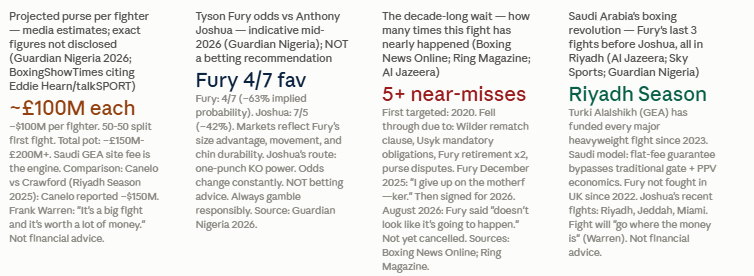
Both fighters are projected to earn approximately £75M-£100M each (approximately $100 million per fighter), based on a reported 50-50 purse split for the first fight. These are media estimates; exact contractual figures have not been officially disclosed. Guardian Nigeria reported the £100M each figure in 2026 coverage. The financial engine is Saudi Arabia's General Entertainment Authority (GEA), chaired by Turki Alalshikh, which pays large flat-fee site fees that allow purses to exceed what the traditional PPV model generates. For comparison, Turki reportedly offered Fury approximately $150 million to come out of retirement, similar to Canelo Alvarez's reported purse for his Riyadh Season fight with Terence Crawford in 2025. The dispute in August 2026 centred on Joshua demanding a larger share of this pot. Not financial advice.
Where will Fury vs Joshua take place?
As of October 2026, no venue has been confirmed. The most likely options are: Riyadh, Saudi Arabia (Kingdom Arena or a temporary outdoor stadium); or a UK venue (Wembley Stadium: 90,000 capacity; Tottenham Hotspur Stadium: 62,850 capacity — where Fury fought Makhmudov in spring 2026). Saudi Arabia has hosted all of Fury's last three fights and most of Joshua's recent bouts, and the Saudi GEA site fee makes Riyadh the financially dominant option. However, Turki Alalshikh teased a London staging in September 2026, and UK domestic demand — and the atmosphere of 90,000 British fans at Wembley — remains a compelling argument. Frank Warren (Fury's promoter): 'Money will dictate where the fight takes place.' Sources: Al Jazeera August 2026; Ring Magazine; Guardian Nigeria; Sky Sports January 2026.
What are the current records of Fury and Joshua?
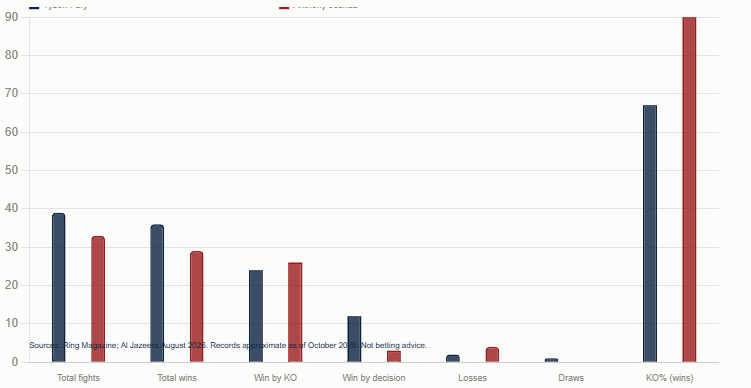
As of October 2026: Tyson Fury — approximately 36-2-1, 24 KOs. Age 38. Losses: Oleksandr Usyk twice in 2024 (split decision first fight; KO second fight). Last win: Arslanbek Makhmudov (W PTS, spring 2026). Former WBC heavyweight champion and two-time world champion. Anthony Joshua — approximately 29-4, 26 KOs. Age 36. Losses: Andy Ruiz Jr. (KO, 2019); Oleksandr Usyk (twice, 2021-22); Daniel Dubois (KO, 2024). Last win: Kristian Prenga (W TKO, July 26, 2026). Former IBF/WBA/WBO/IBO heavyweight champion and two-time world champion. Neither fighter currently holds a world title. Sources: Al Jazeera August 2026; Ring Magazine.
Why has this fight taken so long to happen?
The fight has been close to being made at least five times since 2020 and has repeatedly fallen through. The primary reasons: mandatory challenger obligations (Fury had to fight Wilder a third time; Joshua had to fight Usyk twice); purse disputes (the fight has consistently broken down over money, most recently in August 2026 with Fury accusing Joshua of demanding a bigger split); Fury's announcements of retirement (after his December 2024 loss to Usyk); and the general complexity of negotiating between two separate promotional teams (Frank Warren/Queensberry for Fury; Eddie Hearn/Matchroom for Joshua). The arrival of Turki Alalshikh as a neutral financial facilitator has been the single biggest catalyst for finally getting the deal closest to done. Boxing News Online December 2025; Ring Magazine; Al Jazeera August 2026.
Who is favoured to win Fury vs Joshua?
As of mid-2026, Tyson Fury is the favourite at approximately 4/7 (implied probability ~63%), with Anthony Joshua the underdog at approximately 7/5 (implied probability ~42%). These figures are from Guardian Nigeria's 2026 coverage and are indicative only — odds change constantly. The betting market's assessment reflects Fury's technical superiority, size advantage (3 inches of height, 3 inches of reach), superior footwork, and the view that his chin is more durable than Joshua's (Joshua has been stopped or knocked down in four of his 33 fights). Joshua's route to victory relies on landing his significant one-punch power before Fury's movement and volume take over. IMPORTANT: These odds are for informational context only. This is not a betting recommendation. Always gamble responsibly. Not betting advice.
Table of Contents
- The Fight That Almost Wasn’t: A Decade of Near-Misses
- The Money: What Each Fighter Stands to Earn
- The Saudi Factor: Why Riyadh Changed Everything
- Fighter Profiles: Records, Stats, and Career Paths
- The Road to the Fight: Tune-Ups and Tune-Up Results
- Head-to-Head: Fury vs Joshua on Paper
- The Fight Analysis: Styles, Strengths, and the Decisive Factor
- The Odds and What They Imply
- The Venue Debate: Riyadh vs London
- Will It Actually Happen? The August 2026 Breakdown
- Conclusion: The Biggest Fight in British Boxing History — Eventually
- Frequently Asked Questions
The money — purse, revenue streams, and Saudi context
Fighter careers — records, knockouts, and trajectory
Head-to-head — who has the edge and where
The Fight That Almost Wasn’t: A Decade of Near-Misses
Tyson Fury versus Anthony Joshua should have happened in 2020. Both men were at the absolute peak of their powers: Fury had just outpointed Wilder in their rematch and was the undisputed king of the division in the eyes of British fans, while Joshua was the unified IBF, WBA, WBO, and IBO heavyweight champion having beaten Andy Ruiz Jr. in their Saudi rematch. The purse talks began, the posters were practically printed, and then the whole thing fell apart — Deontay Wilder exercised his rematch clause against Fury, and Joshua was forced into his first fight with Oleksandr Usyk by a mandatory challenger obligation.That was the first near-miss. There have been at least five more since. Joshua lost to Usyk (twice). Fury beat Wilder (twice more) before also losing to Usyk (twice). The window where both men were simultaneously unbeaten and in possession of major world titles closed and never reopened. As Fury himself admitted in December 2025: ‘I give up on the motherf—ker.’ Colourful language, but it captured the exhaustion of a fanbase that had watched this fight teased, confirmed, collapsed, and re-teased on a near-annual basis for six years.
And yet. In 2026, both men signed a contract facilitated by Turki Alalshikh, Saudi Arabia’s General Entertainment Authority chairman. Both fighters took tune-up fights. The Ring Magazine reported a Riyadh Season mega-event. A date in Q4 2026 — most likely November — was targeted. The fight was finally, genuinely, almost certainly happening. Then in August 2026, Fury said it ‘doesn’t look like it’s going to happen’ over a purse dispute. For this fight, that counts as progress. Not betting advice.
The Money: What Each Fighter Stands to Earn
The purse figures being discussed for Fury vs Joshua are genuinely extraordinary, even by the inflated standards of modern heavyweight boxing. Guardian Nigeria, covering the fight’s financial structure in 2026, projected both Tyson Fury and Anthony Joshua earning approximately £75M–£100M+ each — approximately $100 million per fighter. The split is reported to be 50-50 for the first fight. These figures would represent the largest purse ever paid to a British boxer and place the fight among the highest-paying bouts in boxing history globally.The financial engine behind these numbers is Saudi Arabia’s General Entertainment Authority, chaired by Turki Alalshikh. The Saudi model bypasses traditional revenue structures: rather than relying primarily on gate receipts and PPV sales, the GEA pays a large flat-fee site fee directly to the promoters, which is then distributed to the fighters. BoxingShowTimes reported that Turki was likely to offer Fury approximately $150 million to come out of retirement — a figure comparable to Canelo Alvarez’s reported purse for his 2025 fight with Terence Crawford in the same ecosystem.
Frank Warren, Fury’s promoter, was characteristically blunt: ‘What will encourage Tyson is the financial aspect of it. It’s a big fight and it’s worth a lot of money. Tyson has his price.’ (Sky Sports, January 2026.) The tension in August 2026, when Fury accused Joshua of being ‘money-thirsty’ and demanding a bigger share, is itself evidence of how enormous the pot has become: both fighters are fighting over a slice of £150M–£200M total. Not betting or financial advice.
The fight’s financial structure (media estimates — exact contractual figures not disclosed): total fight purse pot: approximately £150M-£200M+. Fury share: ~£75M-£100M ($100M). Joshua share: ~£75M-£100M ($100M) — 50-50 first fight split (Guardian Nigeria). Saudi GEA site fee: likely exceeds £50M-£100M+. Comparison: Canelo Alvarez vs Terence Crawford (2025 Riyadh Season) — Canelo reportedly ~$150M. UK PPV context: 1.5-2.5M buys at £25-£30 per buy = £37M-£75M UK PPV alone. Additional global streaming, sponsorship, merchandise, and broadcast rights. Sources: Guardian Nigeria; BoxingShowTimes citing Eddie Hearn/talkSPORT; Sky Sports January 2026. Not financial advice.
The Saudi Factor: Why Riyadh Changed Everything
Saudi Arabia’s intervention in boxing has been the single most transformative development in the sport since the pay-per-view era. Since 2023, virtually every major heavyweight fight has either taken place in Saudi Arabia or been bankrolled by Saudi money. Fury’s last three fights before the Joshua bout were all in Riyadh. Joshua fought in Riyadh and Jeddah as part of the Riyadh Season programme. Canelo Alvarez’s fights, Usyk’s fights, and the marquee bouts on the Riyadh Season calendar have collectively relocated the centre of gravity of global boxing from Las Vegas to the Gulf.The mechanism is straightforward: the General Entertainment Authority, under Turki Alalshikh, pays site fees that dwarf what any traditional venue could generate from gate receipts and local broadcasting alone. For Fury vs Joshua, the expected venue is either the Kingdom Arena in Riyadh or a UK stadium — but as Frank Warren put it: ‘Money will dictate where the fight takes place. They will go where the money is.’ When Saudi Arabia’s offer exceeds what even a Wembley Stadium sellout plus full UK PPV can generate, the fight goes to Riyadh.
Turki Alalshikh himself teased in late 2025 that ‘one of the greatest fights in the history of boxing’ would take place in London in September 2026 — the rare acknowledgement that UK domestic staging remains on the table. Whether that happens, or whether economics again push the fight to Saudi Arabia, remains the single biggest venue variable in the fight’s planning. Not financial advice.
On Record: Eddie Hearn (talkSPORT, early 2026): 'We spoke with him in London this week. Everything that we do with Anthony Joshua will be in accordance with and under the guidance of Turki Alalshikh. We have accepted. Is the fight made? Because I don’t know where he’s at with Tyson Fury. All I know is he’s yet to fail in delivering a fight.'
Fighter Profiles: Records, Stats, and Career Paths
The Road to the Fight: Tune-Ups and Tune-Up Results
Both fighters followed the script for a mega-fight warm-up: low-risk, high-profile, designed to shake off the cobwebs and confirm they are still capable of performing at a high level without risking the multi-million-pound showdown.Fury returned from his 16-month retirement to face Arslanbek Makhmudov at London’s Tottenham Hotspur Stadium in April/May 2026. The choice of venue was symbolically significant — Fury’s first fight on British soil since his 2022 knockout of Derek Chisora, and a deliberate homecoming statement ahead of the Joshua fight. Fury won on points, was dominant if not spectacular, and used the post-fight platform to issue a direct, ringside challenge to Joshua, who was in attendance.
Joshua’s tune-up came against Albanian heavyweight Kristian Prenga at the Jeddah Superdome on July 26, 2026. Joshua won by TKO — as expected from a match that Guardian Nigeria described as ‘not intended to be a stiff test for AJ, it is a tune-up with little risk, this is no time to fumble that enormous bag.’ The Prenga fight was Joshua’s first outing since his 2024 TKO loss to Daniel Dubois, and while the opposition was modest, Joshua got through unscathed, which was entirely the point. The fight pipeline — Fury vs Makhmudov in spring, Joshua vs Prenga in July, Fury vs Joshua in Q4 — proceeded exactly as Turki’s playbook designed. Not betting advice.
Head-to-Head: Fury vs Joshua on Paper
The Fight Analysis: Styles, Strengths, and the Decisive Factor
On paper, Fury vs Joshua is a stylistically compelling matchup, even if it arrives two or three years past the moment when it would have been the definitive all-British heavyweight clash. Fury at his best is perhaps the most technically accomplished heavyweight in the modern era: a 6’ 9 counterpuncher with extraordinary footwork, a granite chin (demonstrated by climbing off the canvas twice against Wilder in their second fight), and a boxing IQ that allows him to outbox opponents from angles they cannot anticipate. Joshua, at his best, is a textbook combination boxer with elite power — 26 knockouts from 33 fights — and a punishing jab that creates the openings for his right hand.The decisive factor, boxing observers consistently argue, is Joshua’s chin. In his four professional losses, Joshua has been knocked out or stopped in three of them (Andy Ruiz Jr., Daniel Dubois, and controversially the second Usyk fight stoppage). Fury has been hurt — dramatically so against Wilder — but has never been stopped and has shown a supernatural ability to recover. Frank Warren’s confidence that ‘Tyson will knock him out’ is rooted in this analysis: if Fury can land his jab and move for eight rounds, eventually his size and pressure will find Joshua’s vulnerability. Joshua’s camp, meanwhile, believes that Fury’s two Usyk defeats revealed a slower, more hittable fighter — one that Joshua’s power can exploit.
The honest assessment is that both men are past their peaks. Fury is 38 and coming back from a second Usyk loss and a retirement period. Joshua is 36 and has lost to Usyk, Ruiz, and Dubois. But the British public and global boxing audience do not always care about peak-versus-peak analysis. They want the fight. And on any given night, either man is capable of winning. Not betting advice.
Fight analysis: FURY’S ROUTE TO VICTORY: Control distance with the jab, use movement to frustrate Joshua, look for the counter right hand. If Fury lands his jab and stays disciplined for 8-10 rounds, Joshua’s historically fragile chin becomes a factor. Frank Warren: 'Tyson will knock him out.' (Sky Sports, January 2026.) JOSHUA’S ROUTE TO VICTORY: Use his physical strength in the clinch, land the straight right hand early when Fury is still warming up, and target the body to slow Fury’s movement in the middle rounds. The Usyk fights showed Fury’s jab can be negated by a disciplined pressure fighter. If Joshua’s power-punching lands against a slower Fury, one big shot could change the fight. VERDICT: Markets favour Fury 4/7. The fight likely goes to the championship rounds. Not betting advice. Indicative analysis only.
The Odds and What They Imply
As of mid-2026, Fury is the favourite at approximately 4/7 (implied probability approximately 63%), with Joshua the underdog at approximately 7/5 (implied probability approximately 42%). These odds reflect the betting market’s collective assessment that Fury’s technical superiority, size advantage, and superior chin make him the more likely winner on the night. The gap is meaningful but not enormous — this is not a prohibitive favourite situation.The odds will shift significantly as the fight approaches, based on the weight of public money (UK fans heavily backing Joshua inflating his odds), both fighters’ condition in training camp media, and any pre-fight narratives that emerge. Joshua’s knockout of Jake Paul — a media event rather than a serious fight — moved little meaningful information about his capabilities. His TKO win over Prenga in July 2026 was similarly uninformative regarding his readiness for elite opposition. Fury’s points win over Makhmudov was more telling: he looked controlled and disciplined, though Makhmudov is not close to Usyk’s level.
For context: the implied odds add to approximately 105%, reflecting the bookmaker’s margin (the vig). The true probability implied by the market is approximately 60% Fury / 40% Joshua before adjusting for margin. These are indicative figures only, drawn from Guardian Nigeria’s reporting in 2026. Odds change constantly. This is not a betting recommendation. Always gamble responsibly. Not betting advice.
The Venue Debate: Riyadh vs London
The venue question is both a financial and a cultural one. Saudi Arabia has the financial muscle — the GEA’s site fee for a Fury vs Joshua fight would almost certainly exceed what any UK venue can generate from gate revenue plus PPV alone. The Kingdom Arena in Riyadh holds approximately 20,000 people, but the Saudi state subsidy makes the economics irrelevant: the fighters get paid their £75M–£100M+ regardless of gate revenue. That model is only possible because the Saudi government treats boxing as a tool of national branding and soft power, not a commercial proposition that needs to turn a profit.A UK staging — Wembley Stadium (90,000 capacity) or Tottenham Hotspur Stadium (62,850) — would generate approximately 1.5–2.5 million PPV buys at £25–30 each on Sky Sports Box Office or TNT Sports, generating £37M–£75M in UK PPV revenue alone, plus gate receipts of approximately £5M–£15M. Total UK revenue: approximately £42M–£90M. That figure, while substantial, falls well short of the Saudi guarantee. Unless the Saudi site fee is paid regardless of where the fight is staged — a scenario that has happened with some Riyadh Season events staged abroad — the fight goes to Saudi Arabia.
Turki Alalshikh’s tease about a London staging in September 2026 remains tantalisingly possible. A Wembley Stadium fight under the UK lights, with 90,000 British fans, would generate an atmosphere unmatched by anything the Kingdom Arena could produce. For both fighters’ legacies, and for the British public that has waited a decade, that option carries emotional weight. But as Frank Warren said: ‘Money will dictate where the fight takes place.’ Not financial advice.
Will It Actually Happen? The August 2026 Breakdown
In August 2026, Fury told Al Jazeera that the fight ‘doesn’t look like it’s going to happen,’ accusing Joshua and Hearn of being ‘money-thirsty’ and demanding a bigger purse split. He called Joshua and Hearn ‘disgusting’ and added: ‘Just know you never had the guts to fight Tyson Fury, ever, you little coward.’ Strong words, but worth contextualising.This is not the first time Fury has publicly declared the fight dead. Boxing negotiations, particularly at this level with these personalities and these sums, routinely involve public brinkmanship and provocations designed to gain leverage. The Ring Magazine’s original report of the fight as a signed Riyadh Season mega-event still stands as the foundational confirmation. Both fighters have completed their tune-up bouts. Turki Alalshikh has not publicly backed down from his commitment to deliver the fight. Eddie Hearn has confirmed Joshua’s acceptance.
The pattern of this fight’s negotiating history suggests that the August 2026 breakdown, while real and frustrating, is unlikely to be the final word. Both fighters have a commercial and reputational incentive to compete. Neither holds a world title. Neither is likely to get a more lucrative offer than what Turki Alalshikh is putting on the table. The fight’s delay into late Q4 2026 or early 2027 remains the most plausible outcome. But for a fight this long in the making, nothing is certain. Not financial advice.
Conclusion
Fury vs Joshua is the biggest fight in British boxing history — the two most recognisable British boxers of their generation, both former two-time world heavyweight champions, both having lost to the same man in Oleksandr Usyk, both still capable of producing the defining performance of their careers on the right night. The money — £75M–£100M each — is historically unprecedented for British fighters. The Saudi financial machine has made it possible in a way that the traditional PPV model never could. The will is there, the contract has been signed, and the tune-ups have been completed.What remains is the same obstacle that has derailed this fight at least five times before: two very large personalities, two very motivated promoters, and a purse split argument that could always be resolved by Turki Alalshikh making both sides an offer they cannot refuse. For British boxing fans, the calculation is simple: this is the fight they have been waiting for since 2020. It is five years late. It involves two men who are no longer in their prime. And it is still, by a comfortable margin, the most compelling heavyweight matchup available in 2026. When it happens — and the weight of evidence suggests it eventually will — it will be unmissable. Not betting or financial advice.
Frequently Asked Questions
How much will Fury and Joshua earn from their fight?Both fighters are projected to earn approximately £75M-£100M each (approximately $100 million per fighter), based on a reported 50-50 purse split for the first fight. These are media estimates; exact contractual figures have not been officially disclosed. Guardian Nigeria reported the £100M each figure in 2026 coverage. The financial engine is Saudi Arabia's General Entertainment Authority (GEA), chaired by Turki Alalshikh, which pays large flat-fee site fees that allow purses to exceed what the traditional PPV model generates. For comparison, Turki reportedly offered Fury approximately $150 million to come out of retirement, similar to Canelo Alvarez's reported purse for his Riyadh Season fight with Terence Crawford in 2025. The dispute in August 2026 centred on Joshua demanding a larger share of this pot. Not financial advice.
Where will Fury vs Joshua take place?
As of October 2026, no venue has been confirmed. The most likely options are: Riyadh, Saudi Arabia (Kingdom Arena or a temporary outdoor stadium); or a UK venue (Wembley Stadium: 90,000 capacity; Tottenham Hotspur Stadium: 62,850 capacity — where Fury fought Makhmudov in spring 2026). Saudi Arabia has hosted all of Fury's last three fights and most of Joshua's recent bouts, and the Saudi GEA site fee makes Riyadh the financially dominant option. However, Turki Alalshikh teased a London staging in September 2026, and UK domestic demand — and the atmosphere of 90,000 British fans at Wembley — remains a compelling argument. Frank Warren (Fury's promoter): 'Money will dictate where the fight takes place.' Sources: Al Jazeera August 2026; Ring Magazine; Guardian Nigeria; Sky Sports January 2026.
What are the current records of Fury and Joshua?
As of October 2026: Tyson Fury — approximately 36-2-1, 24 KOs. Age 38. Losses: Oleksandr Usyk twice in 2024 (split decision first fight; KO second fight). Last win: Arslanbek Makhmudov (W PTS, spring 2026). Former WBC heavyweight champion and two-time world champion. Anthony Joshua — approximately 29-4, 26 KOs. Age 36. Losses: Andy Ruiz Jr. (KO, 2019); Oleksandr Usyk (twice, 2021-22); Daniel Dubois (KO, 2024). Last win: Kristian Prenga (W TKO, July 26, 2026). Former IBF/WBA/WBO/IBO heavyweight champion and two-time world champion. Neither fighter currently holds a world title. Sources: Al Jazeera August 2026; Ring Magazine.
Why has this fight taken so long to happen?
The fight has been close to being made at least five times since 2020 and has repeatedly fallen through. The primary reasons: mandatory challenger obligations (Fury had to fight Wilder a third time; Joshua had to fight Usyk twice); purse disputes (the fight has consistently broken down over money, most recently in August 2026 with Fury accusing Joshua of demanding a bigger split); Fury's announcements of retirement (after his December 2024 loss to Usyk); and the general complexity of negotiating between two separate promotional teams (Frank Warren/Queensberry for Fury; Eddie Hearn/Matchroom for Joshua). The arrival of Turki Alalshikh as a neutral financial facilitator has been the single biggest catalyst for finally getting the deal closest to done. Boxing News Online December 2025; Ring Magazine; Al Jazeera August 2026.
Who is favoured to win Fury vs Joshua?
As of mid-2026, Tyson Fury is the favourite at approximately 4/7 (implied probability ~63%), with Anthony Joshua the underdog at approximately 7/5 (implied probability ~42%). These figures are from Guardian Nigeria's 2026 coverage and are indicative only — odds change constantly. The betting market's assessment reflects Fury's technical superiority, size advantage (3 inches of height, 3 inches of reach), superior footwork, and the view that his chin is more durable than Joshua's (Joshua has been stopped or knocked down in four of his 33 fights). Joshua's route to victory relies on landing his significant one-punch power before Fury's movement and volume take over. IMPORTANT: These odds are for informational context only. This is not a betting recommendation. Always gamble responsibly. Not betting advice.
0 Comments
Be the first to share your thoughts on this article.