

Insurance
Understanding Silent Risks in Insurance Coverage

Two in three homeowners are underinsured. 40% of adults have no life insurance. 75% of homes lack flood coverage. 74% of Marshall Fire victims were underinsured by an average $139,000. The risks no one talks about — until the claim is denied.

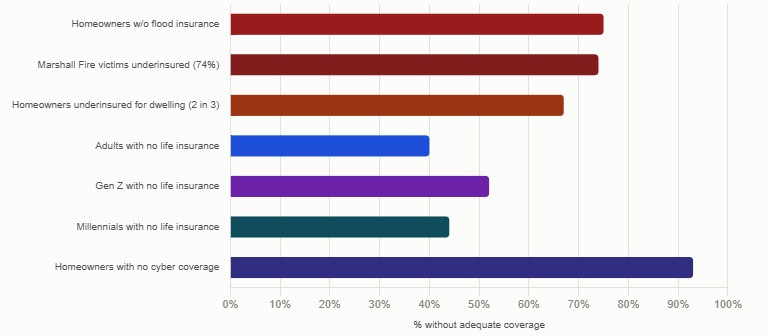
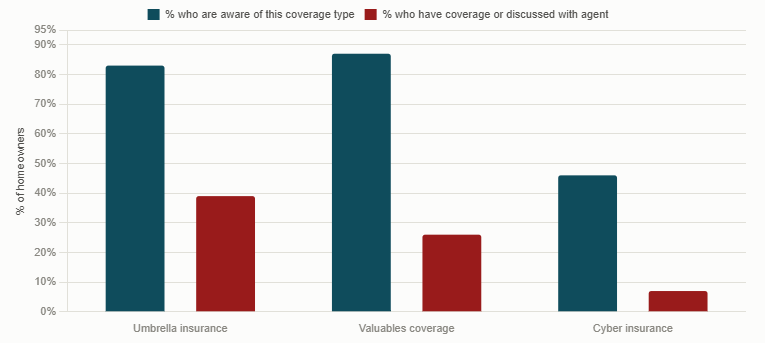
Seventy-four percent of homeowners affected by Colorado’s 2021 Marshall Fire discovered they were underinsured when it mattered most, with an average coverage shortfall of $139,000 per household (University of Colorado 2025 study, cited by Insurify June 2026). Forty percent of American adults have no life insurance whatsoever, and among those who do, nearly half say they need more (LIMRA 2024 Insurance Barometer). Approximately 75 percent of homeowners have no flood coverage, yet flooding is among the most common natural disasters in the United States (Insurance.com May 2026). Only 7 percent of homeowners have cyber insurance, despite cyber crime losses being the third-largest reported crime category in the United States (The Hanover 2025 Coverage Awareness Report).
These are not obscure edge cases. They are the silent risks — the coverage gaps that exist quietly inside policies that look complete from the outside, invisible until the moment a claim is filed and denied or dramatically underpaid. This guide identifies the eight most significant silent risks in American insurance coverage, explains why they exist, and provides the specific checks that reveal whether you are genuinely protected or only appear to be.
The Numbers: 2 in 3 homeowners are underinsured (80+ million Americans, Harris Poll/APCIA). 74% of Marshall Fire victims underinsured by avg $139,000 (UC 2025 study). 40% of adults have no life insurance (102 million people, LIMRA 2024). 75% of homeowners have no flood insurance (Insurance.com May 2026).
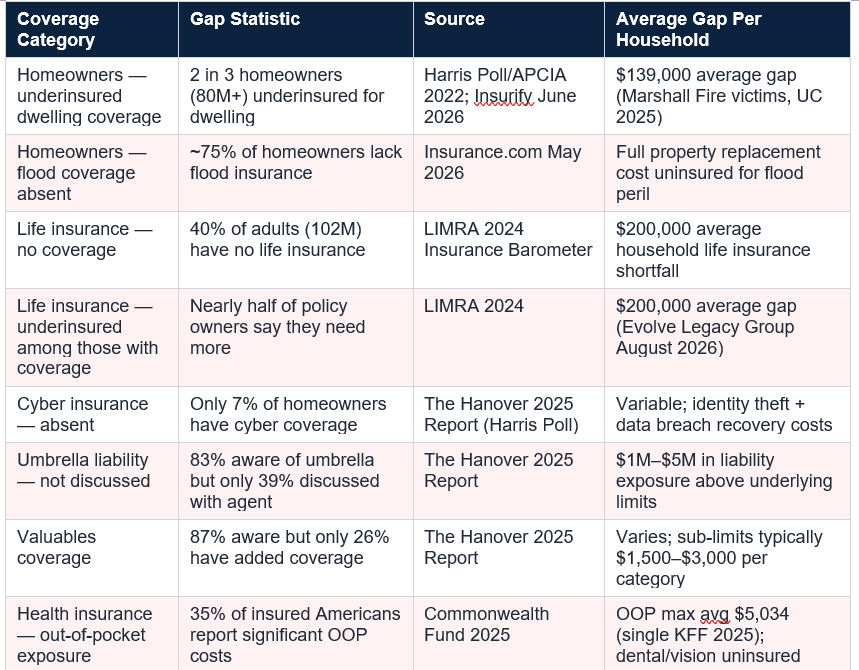
The common thread across all categories: the gap is not primarily a product of people choosing not to buy insurance. It is primarily a product of people buying insurance that they believe is adequate and then discovering, at claim time, that it is not. As Insurify’s June 2026 analysis noted: ‘Many homeowners don’t understand their insurance needs or coverage.’ The knowledge gap is the root cause of the coverage gap.
Ian Skjervem of Smart Investors Daily explained the mechanism directly to Insurify: ‘Many homeowners are simply unaware that a standard property insurance policy covers only the original amount borrowed or the home’s original purchase price. It doesn’t account for inflationary increases in building materials and labor costs associated with construction.’
The numbers are stark: construction and materials costs surged dramatically from 2021 through 2025. A home insured for $300,000 in 2018 — adequate at that time — may now have a rebuilding cost of $400,000 or more. If the policy’s Coverage A limit has not been updated, the homeowner has a silent $100,000 coverage gap. The Marshall Fire data makes this concrete: 74 percent of affected homeowners were underinsured by an average of $139,000.
Two types of coverage address this:
The FEMA statistic that has long anchored the flood insurance discussion: as few as one inch of water in a home can cause $25,000 in damage. The average flood claim pays approximately $52,000 (FEMA data). Without a separate flood policy — either through the National Flood Insurance Program (NFIP) or a private flood insurer — every dollar of that claim is the homeowner’s personal financial loss.
The dangerous misconception: many homeowners believe flood coverage is only relevant if they live in a designated flood zone. FEMA data shows that approximately 25 percent of all flood insurance claims come from properties outside high-risk flood zones. Flooding from heavy rainfall, overwhelmed drainage systems, and rapid snowmelt can affect any property, regardless of flood zone designation.
Earthquake insurance faces the same awareness and uptake problem. Outside of California (where the California Earthquake Authority exists as a separate market), earthquake coverage requires a separate endorsement or standalone policy from most insurers. The Hanover’s 2025 report did not specifically quantify earthquake coverage gaps, but industry estimates consistently place earthquake insurance uptake well below 20 percent nationally, including in moderate-risk zones.
The MoneyGeek May 2026 analysis summarises the combined scale: the life insurance protection gap affects 75 million Americans without adequate coverage. Of these, 102 million have no life insurance at all. The generational distribution is stark: 52 percent of Gen Z adults have no life coverage, and 44 percent of Millennials are completely uninsured for life. These are the generations that also face the highest student debt burdens, the highest housing costs, and the greatest long-term financial uncertainty.
The employer-provided life insurance misconception compounds the problem. Many Americans who have employer-sponsored group life insurance — typically one to two times annual salary — believe they are adequately covered. Standard financial planning guidance recommends life insurance coverage of 10 to 12 times annual income, plus outstanding debts. For a household earning $70,000 per year, this means $700,000 to $840,000 in coverage. An employer-provided policy of $70,000 to $140,000 leaves a gap of more than $600,000 — and that employer-provided coverage disappears if the insured changes jobs.
Watch Out: Employer-provided life insurance is not portable. When you leave a job, you leave behind your group life coverage. In a labour market where median tenure is under four years, relying on employer-provided life insurance as your primary coverage is a systematic risk that most financial advisers recommend against. Individual term life insurance remains in force regardless of employment status.
The out-of-pocket exposure facts from KFF’s 2025 Employer Health Benefits Survey:
The three most common auto insurance silent risks:
Standard homeowners insurance was designed in a pre-digital era. It covers physical property losses from covered perils. It does not cover:
Typical sub-limits in a standard homeowners policy:
What umbrella insurance covers that standard policies do not:
An example: a home with a replacement cost of $400,000 is insured for $240,000 (60% of replacement cost). The coinsurance requirement is 80%, meaning the policy should be $320,000. A $50,000 kitchen fire loss is filed. Rather than paying the full $50,000, the insurance company applies the coinsurance formula:
Insurance carried ($240,000) ÷ Insurance required ($320,000) × Loss ($50,000) = $37,500 paid, not $50,000. The homeowner personally bears the remaining $12,500.
This outcome is entirely legal and explicitly provided for in the policy. But most homeowners who have not read their policy carefully — which is most homeowners — do not know it exists. The solution is ensuring Coverage A equals or exceeds 80 percent (ideally 100 percent) of the current replacement cost — which connects directly to Silent Risk #1.
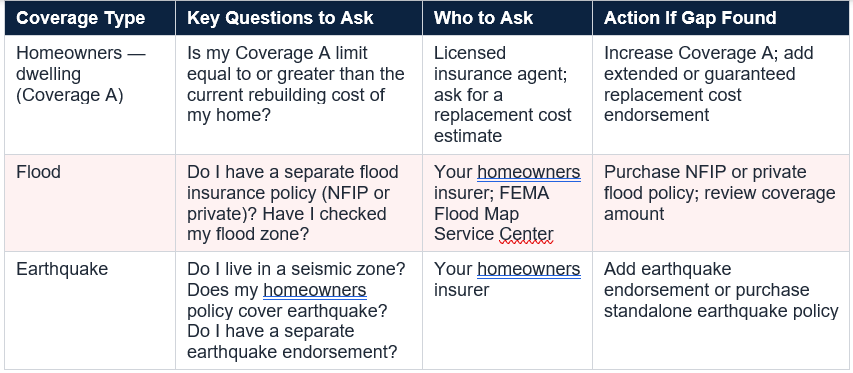
The most common reason insurance coverage goes stale: it is set up once and then not reviewed. A homeowners policy written in 2016, renewed automatically every year, has a Coverage A limit set in 2016. An auto policy renewed annually still has the same liability limits chosen in 2019. A life insurance policy bought at age 30 with a 20-year term is the right policy at age 30. It may not be the right policy when a second child is born, a home is purchased, or income doubles.
Life events that should trigger an immediate insurance review:
The data in this guide tells a consistent story: two in three homeowners are underinsured for their dwelling; 75 percent have no flood insurance; 40 percent have no life insurance at all; 7 percent have cyber coverage against a cyber threat environment that generated $20.9 billion in US internet crime losses in 2025; and 61 percent of homeowners who are aware of umbrella insurance have not discussed it with their agent. These are not isolated gaps in fringe coverage categories. They are mainstream coverage deficiencies affecting the majority of households.
The solution is not buying more insurance indiscriminately. It is conducting a deliberate, specific coverage audit that identifies which silent risks apply to your specific situation, reviews the actual policy language that governs each coverage type, and closes the gaps that represent meaningful financial exposure. The annual insurance review — not the automatic renewal, but the deliberate conversation with a licensed professional about what has changed and what the coverage actually provides — is the difference between the illusion of protection and the reality of it.
The most common and most financially damaging silent risk in homeowners insurance is outdated dwelling coverage (Coverage A) that has not kept pace with rising rebuilding costs. A 2025 University of Colorado study of homeowners affected by Colorado's 2021 Marshall Fire found that 74% were underinsured, with an average coverage gap of $139,000 per household. The broader problem: two out of three homeowners — more than 80 million Americans — are underinsured according to a Harris Poll survey for the American Property Casualty Insurance Association (cited by Insurify, June 2026). Standard homeowners policies cover the dwelling at the Coverage A limit, which was set when the policy was first written. Construction costs have risen significantly since 2021, but policy limits only change when the policyholder requests an update. Review your Coverage A limit against the current cost to rebuild your home annually.
Does homeowners insurance cover floods?
No. Standard homeowners insurance explicitly excludes flood damage as a covered peril. Flood requires a separate flood insurance policy, available either through the National Flood Insurance Program (NFIP) or private flood insurers. Approximately 75% of homeowners do not have flood insurance, according to Insurance.com's May 2026 home insurance trends analysis. The risk is broader than most homeowners recognize: approximately 25% of all flood insurance claims come from properties outside high-risk flood zones. Even moderate rainfall events, overwhelmed drainage systems, and storm surge can cause flooding that a standard homeowners policy will not cover. To find out your flood zone, visit FEMA's Flood Map Service Center at msc.fema.gov. Separately, earthquake damage is also excluded from standard homeowners insurance in most states and requires a separate endorsement or policy.
What is the life insurance coverage gap in the US?
The life insurance gap in the US is substantial across two dimensions: breadth and depth. Forty percent of American adults — approximately 102 million people — have no life insurance coverage at all (LIMRA 2024 Insurance Barometer Study, cited by MoneyGeek May 2026 and Evolve Legacy Group August 2026). Among those who do have life insurance, nearly half say they need more coverage. The average American household is underinsured by approximately $200,000 in life coverage (LIMRA 2024). The life insurance protection gap affects 75 million Americans without adequate coverage (MoneyGeek). The generational gap is stark: 52% of Gen Z adults and 44% of Millennials have no life insurance at all. The standard financial planning recommendation is 10–12 times annual income in life coverage, plus outstanding debts — which far exceeds the employer-provided group life insurance that many Americans rely on as their primary or only coverage.
What is cyber insurance and why is the coverage gap so large?
Cyber insurance is a coverage type specifically designed to address financial losses from digital threats: identity theft and account takeover, ransomware and cyber extortion, online fraud, data breach expenses, and cyber harassment. Standard homeowners insurance was designed before the digital era and does not cover these risks (or covers them only with modest, inadequate sub-limits). The Hanover's 2025 Homeowners Coverage Awareness Report (Harris Poll) found that only 7% of homeowners have cyber insurance, despite it being one of the most common and costly risks facing American households. The FBI's 2025 IC3 Annual Report documented $20.9 billion in US internet crime losses in 2025. The awareness gap is also significant: 46% of homeowners had never even heard of cyber insurance as a coverage option. Cyber endorsements are now available from many major homeowners insurers and typically cover identity theft restoration, financial fraud losses, and cyber extortion.
What does umbrella insurance cover and who needs it?
Umbrella insurance is a personal liability policy that provides coverage above and beyond the liability limits in your homeowners and auto policies. A $1 million umbrella policy pays liability claims that exceed your underlying policy limits — for example, if you cause a serious automobile accident generating $800,000 in claims but your auto policy only carries $300,000 in liability coverage, the umbrella policy covers the remaining $500,000. Umbrella insurance typically costs $150 to $300 per year for a $1 million policy. The Hanover's 2025 report found that 83% of homeowners are aware of umbrella insurance, but only 39% have discussed it with their insurance agent. Financial planners generally recommend umbrella insurance for any household with a net worth above $500,000, significant income, or activities that increase liability exposure (dogs, pools, trampolines, teenage drivers, rental properties, or frequent hosting of guests).
How often should I review my insurance coverage?
At minimum, review all insurance policies annually — ideally at the same time each year, coinciding with major renewal dates. Beyond the annual review, conduct an immediate insurance review following any significant life event: purchasing, refinancing, or renovating a home; marriage, divorce, or domestic partnership change; birth or adoption of a child; significant income change; receiving an inheritance or significant asset increase; retirement or change in employment; purchasing a new vehicle; starting a home-based business; or acquiring high-value items (jewellery, art, collectibles) above policy sub-limits. Insurance coverage that was appropriate at the time it was purchased may become dangerously inadequate over time as your assets, income, family circumstances, and rebuilding costs change. The automatic policy renewal is not a coverage review. A deliberate conversation with a licensed insurance professional is the only reliable way to identify and close silent coverage gaps.
Table of Contents
- The Illusion of Being Covered
- What a ‘Silent Risk’ in Insurance Actually Means
- The Scale of America’s Insurance Gap Problem
- Silent Risk #1: Homeowners Are Insured for What Their Home Cost, Not What It Would Cost to Rebuild
- Silent Risk #2: Flood and Earthquake Are Not in Your Homeowners Policy
- Silent Risk #3: Life Insurance Coverage That Is Nowhere Near Enough
- Silent Risk #4: Health Insurance Out-of-Pocket Exposure
- Silent Risk #5: Auto Insurance Gaps — Liability, Uninsured Motorists, and Gap Coverage
- Silent Risk #6: Cyber Threats That Standard Homeowners Policies Do Not Cover
- Silent Risk #7: High-Value Personal Property Sub-Limits
- Silent Risk #8: The Liability Gap That Umbrella Insurance Fills
- The Coinsurance Clause: The Policy Fine Print That Reduces Your Claim
- How to Audit Your Insurance Coverage
- When Did You Last Review Your Policies?
- Conclusion: Insurance You Thought You Had Is Not the Same as Insurance That Pays
- Frequently Asked Questions
Coverage Gap By category
Awareness vs Actual
The Illusion of Being Covered
Most Americans who own insurance believe they are protected. They pay their premiums every month, they receive their policy documents every year, and they operate under the reasonable assumption that if something significant goes wrong, their insurance will cover it. The data says otherwise — not because insurance is fraudulent, but because the gap between what people think their policies cover and what those policies actually cover is consistently enormous.Seventy-four percent of homeowners affected by Colorado’s 2021 Marshall Fire discovered they were underinsured when it mattered most, with an average coverage shortfall of $139,000 per household (University of Colorado 2025 study, cited by Insurify June 2026). Forty percent of American adults have no life insurance whatsoever, and among those who do, nearly half say they need more (LIMRA 2024 Insurance Barometer). Approximately 75 percent of homeowners have no flood coverage, yet flooding is among the most common natural disasters in the United States (Insurance.com May 2026). Only 7 percent of homeowners have cyber insurance, despite cyber crime losses being the third-largest reported crime category in the United States (The Hanover 2025 Coverage Awareness Report).
These are not obscure edge cases. They are the silent risks — the coverage gaps that exist quietly inside policies that look complete from the outside, invisible until the moment a claim is filed and denied or dramatically underpaid. This guide identifies the eight most significant silent risks in American insurance coverage, explains why they exist, and provides the specific checks that reveal whether you are genuinely protected or only appear to be.
The Numbers: 2 in 3 homeowners are underinsured (80+ million Americans, Harris Poll/APCIA). 74% of Marshall Fire victims underinsured by avg $139,000 (UC 2025 study). 40% of adults have no life insurance (102 million people, LIMRA 2024). 75% of homeowners have no flood insurance (Insurance.com May 2026).
What a ‘Silent Risk’ in Insurance Actually Means
A silent risk in insurance is a coverage gap that is not apparent from a surface reading of the policy — one that the policyholder does not know about and would not discover until a claim is filed, denied, or paid at a fraction of the expected amount. Silent risks typically arise from five sources:- • Explicit exclusions buried in policy language: standard homeowners policies contain explicit exclusions for flood, earthquake, surface water, and a range of other perils. These exclusions are in the policy document, but most policyholders never read their full policy.
- • Sub-limits within covered categories: most homeowners policies cover personal property, but with strict sub-limits on specific categories — typically $1,500 to $3,000 for jewellery, $2,500 for firearms, $2,500 for silverware, $2,000 to $3,500 for business equipment. A single valuable item can exceed the entire sub-limit for its category.
- • Outdated coverage levels that have not kept pace with rising costs: a homeowners policy purchased in 2018 may have been adequate then but may be 30 to 40 percent below the current rebuilding cost, given construction cost inflation since 2021.
- • Missing coverage types that most people do not know exist: cyber insurance, umbrella liability, sewer backup coverage, equipment breakdown endorsements. These products exist to fill known gaps in standard policies, but awareness and uptake rates are both low.
- • Policy fine print that adjusts claim payments: the coinsurance clause, the actual cash value versus replacement cost distinction, depreciation schedules, and deductibles specific to certain perils (hurricane deductibles expressed as a percentage of coverage rather than a flat dollar amount).
The Scale of America’s Insurance Gap Problem
Insurance gap data paints a consistent picture across every major coverage category:The common thread across all categories: the gap is not primarily a product of people choosing not to buy insurance. It is primarily a product of people buying insurance that they believe is adequate and then discovering, at claim time, that it is not. As Insurify’s June 2026 analysis noted: ‘Many homeowners don’t understand their insurance needs or coverage.’ The knowledge gap is the root cause of the coverage gap.
Silent Risk #1: Homeowners Are Insured for What Their Home Cost, Not What It Would Cost to Rebuild
Silent Risk #1: Your Dwelling Coverage May Be Based on Purchase Price, Not Current Rebuilding Cost
This is the most prevalent and most financially damaging silent risk in homeowners insurance. A standard homeowners policy covers your dwelling at the Coverage A limit — the maximum the insurance company will pay to rebuild your home if it is destroyed. For most policyholders, this limit was set at or near the home’s purchase price or mortgage amount when the policy was first written. It may not have been updated since.Ian Skjervem of Smart Investors Daily explained the mechanism directly to Insurify: ‘Many homeowners are simply unaware that a standard property insurance policy covers only the original amount borrowed or the home’s original purchase price. It doesn’t account for inflationary increases in building materials and labor costs associated with construction.’
The numbers are stark: construction and materials costs surged dramatically from 2021 through 2025. A home insured for $300,000 in 2018 — adequate at that time — may now have a rebuilding cost of $400,000 or more. If the policy’s Coverage A limit has not been updated, the homeowner has a silent $100,000 coverage gap. The Marshall Fire data makes this concrete: 74 percent of affected homeowners were underinsured by an average of $139,000.
Two types of coverage address this:
- • Extended replacement cost coverage: pays a defined percentage above the policy limit (typically 25 to 50 percent) if rebuilding costs exceed the Coverage A amount. This provides a buffer against moderate cost increases.
- • Guaranteed replacement cost coverage: pays the actual cost to rebuild regardless of the policy limit. More expensive but provides complete protection against the rebuilding cost gap.
Silent Risk #2: Flood and Earthquake Are Not in Your Homeowners Policy
Silent Risk #2: Flood and Earthquake Are Explicitly Excluded from Standard Homeowners Insurance
This is perhaps the most widely documented insurance gap in America, yet it persists: standard homeowners insurance policies explicitly exclude flood damage and, in most parts of the country, earthquake damage. These exclusions are stated in the policy. But Insurance.com’s May 2026 survey found that approximately 75 percent of homeowners do not have flood insurance.The FEMA statistic that has long anchored the flood insurance discussion: as few as one inch of water in a home can cause $25,000 in damage. The average flood claim pays approximately $52,000 (FEMA data). Without a separate flood policy — either through the National Flood Insurance Program (NFIP) or a private flood insurer — every dollar of that claim is the homeowner’s personal financial loss.
The dangerous misconception: many homeowners believe flood coverage is only relevant if they live in a designated flood zone. FEMA data shows that approximately 25 percent of all flood insurance claims come from properties outside high-risk flood zones. Flooding from heavy rainfall, overwhelmed drainage systems, and rapid snowmelt can affect any property, regardless of flood zone designation.
Earthquake insurance faces the same awareness and uptake problem. Outside of California (where the California Earthquake Authority exists as a separate market), earthquake coverage requires a separate endorsement or standalone policy from most insurers. The Hanover’s 2025 report did not specifically quantify earthquake coverage gaps, but industry estimates consistently place earthquake insurance uptake well below 20 percent nationally, including in moderate-risk zones.
Silent Risk #3: Life Insurance Coverage That Is Nowhere Near Enough
Silent Risk #3: The Average American Household Is Underinsured by $200,000 in Life Coverage
Life insurance has a two-layered silent risk problem: 40 percent of American adults have none at all, and among those who do, nearly half say they do not have enough. LIMRA’s 2024 Insurance Barometer Study, cited by Evolve Legacy Group and MoneyGeek, puts the average household life insurance shortfall at approximately $200,000 — the gap between the coverage amount in force and what the family would actually need if the primary breadwinner died.The MoneyGeek May 2026 analysis summarises the combined scale: the life insurance protection gap affects 75 million Americans without adequate coverage. Of these, 102 million have no life insurance at all. The generational distribution is stark: 52 percent of Gen Z adults have no life coverage, and 44 percent of Millennials are completely uninsured for life. These are the generations that also face the highest student debt burdens, the highest housing costs, and the greatest long-term financial uncertainty.
The employer-provided life insurance misconception compounds the problem. Many Americans who have employer-sponsored group life insurance — typically one to two times annual salary — believe they are adequately covered. Standard financial planning guidance recommends life insurance coverage of 10 to 12 times annual income, plus outstanding debts. For a household earning $70,000 per year, this means $700,000 to $840,000 in coverage. An employer-provided policy of $70,000 to $140,000 leaves a gap of more than $600,000 — and that employer-provided coverage disappears if the insured changes jobs.
Watch Out: Employer-provided life insurance is not portable. When you leave a job, you leave behind your group life coverage. In a labour market where median tenure is under four years, relying on employer-provided life insurance as your primary coverage is a systematic risk that most financial advisers recommend against. Individual term life insurance remains in force regardless of employment status.
Silent Risk #4: Health Insurance Out-of-Pocket Exposure
Silent Risk #4: Health Insurance Covers Far Less Than Most People Expect at Point of Care
Health insurance is the coverage Americans most directly interact with, yet it contains silent risks that are among the most financially damaging: out-of-pocket maximums that sound protective but can reach $5,034 for a single-person plan (KFF 2025 Employer Health Benefits Survey average), and explicit exclusions for dental, vision, long-term care, and many mental health services that people assume are covered.The out-of-pocket exposure facts from KFF’s 2025 Employer Health Benefits Survey:
- Average employee contribution: $1,368 per year for single coverage; $6,296 per year for family coverage.
- Average deductible for single-person employer plans: $1,787.
- Average out-of-pocket maximum (the most you can pay before insurance covers 100%): $5,034 for single coverage.
- These figures represent averages; high-deductible health plans (HDHPs) have higher deductibles and are increasingly common.
- Dental and vision: standard health insurance does not cover routine dental or vision care. Dental emergencies — root canals, crowns, implants — can cost $1,500 to $5,000 or more per procedure without dental insurance. Emergency dental care is among the top unplanned medical expenses for American households.
- Long-term care: Medicare covers only short-term post-acute care. It does not cover the ongoing personal care in nursing homes or assisted living that constitutes most ‘long-term care.’ The Fidelity 2025 Retiree Health Care Cost Estimate projects a 65-year-old retiring today needs approximately $172,500 for healthcare through retirement, not including long-term care. A two-year nursing home stay at $108,405 per year (Genworth 2024) represents $216,810 in completely uncovered costs for most households.
- Out-of-network coverage gaps: even with PPO plans, out-of-network providers often result in significantly higher cost-sharing. Surprise billing reform has addressed some of this, but out-of-network gaps remain a significant source of unexpected medical bills.
8. Silent Risk #5: Auto Insurance Gaps — Liability, Uninsured Motorists, and Gap Coverage
Silent Risk #5: Auto Insurance Minimums Leave Drivers Massively Exposed to Liability and Loss
Auto insurance costs rose 64 percent cumulatively from September 2020 through September 2025, per Bureau of Labor Statistics data cited by ECIKS.org. This premium pressure has driven many drivers toward minimum-coverage policies to reduce costs — a decision that creates significant silent financial risk.The three most common auto insurance silent risks:
Inadequate Liability Limits
State minimum liability requirements — often expressed as limits like 25/50/25 ($25,000 per person for bodily injury, $50,000 per accident total, $25,000 for property damage) — were last updated in most states decades ago and are grossly inadequate by current standards. A serious accident resulting in significant injuries to multiple people can easily generate liability claims of $500,000 or more. A driver with a 25/50/25 policy who causes such an accident is personally liable for the amount above their policy limits.Uninsured and Underinsured Motorist Coverage
Approximately one in eight US drivers is uninsured, per Insurance Research Council data. Uninsured motorist coverage (UM) and underinsured motorist coverage (UIM) pay your costs if you are injured by a driver who has no insurance or insufficient insurance to cover your damages. In states where UM/UIM is not mandatory, many drivers skip it — exposing themselves to potentially catastrophic losses from an accident that is not their fault.Gap Insurance for Financed Vehicles
When a financed vehicle is totalled, the insurance company pays the current market value of the vehicle — which may be significantly less than the outstanding loan balance. If you owe $28,000 on a vehicle that the insurer values at $22,000 at the time of the total loss, you receive $22,000 and remain personally responsible for the $6,000 difference. Gap insurance (or a loan/lease payoff endorsement) covers this difference. Most auto insurers offer it; few buyers purchase it.Silent Risk #6: Cyber Threats That Standard Homeowners Policies Do Not Cover
Silent Risk #6: Only 7% of Homeowners Have Cyber Insurance, Despite Rising Cyber Crime Losses
The Hanover’s 2025 Homeowners Coverage Awareness Report found that cyber insurance had the lowest awareness of any supplemental coverage category, at 46 percent, and that only 7 percent of homeowners actually had cyber coverage. This is the largest awareness-to-coverage gap of any category in the survey.Standard homeowners insurance was designed in a pre-digital era. It covers physical property losses from covered perils. It does not cover:
- Financial losses from identity theft and account takeover, beyond modest sub-limits some modern policies include.
- Ransomware attacks on home computers or home office equipment.
- Cyberstalking and cyber harassment costs.
- Online fraud and social engineering losses (which the FBI’s 2025 IC3 report showed totalling $20.9 billion in reported internet crime losses for Americans).
- Data breach expenses if you operate a home business that stores client data.
Silent Risk #7: High-Value Personal Property Sub-Limits
Silent Risk #7: Your Jewellery, Art, and Collectibles Are Almost Certainly Under-Covered
Standard homeowners policies include personal property coverage — but with strict sub-limits for specific categories of high-value items. The Hanover’s 2025 report found that 87 percent of homeowners are aware of valuables coverage as a concept, yet only 26 percent have added it to their policy. The gap between awareness and action leaves the majority of homeowners with high-value items significantly underinsured.Typical sub-limits in a standard homeowners policy:
- Jewellery: $1,500 to $3,000 for theft losses (some policies are higher; check yours specifically).
- Firearms: $2,500 for theft.
- Silverware and goldware: $2,500 for theft.
- Business property at home: $2,500.
- Collectibles (stamps, coins, sports memorabilia): typically limited or excluded.
- Fine art: often excluded or severely limited.
Silent Risk #8: The Liability Gap That Umbrella Insurance Fills
Silent Risk #8: 83% of Homeowners Know About Umbrella Insurance — Only 39% Have Talked to Their Agent
The Hanover’s 2025 report found the striking awareness-action gap in umbrella insurance: 83 percent of homeowners are aware of it, but only 39 percent have discussed it with their insurance company or agent. Umbrella insurance provides a layer of liability protection above and beyond the liability limits in homeowners and auto policies — typically in $1 million increments at relatively modest annual cost.What umbrella insurance covers that standard policies do not:
- Liability claims that exceed your homeowners liability limit: if someone is seriously injured on your property and sues for $800,000 while your homeowners policy carries $300,000 in liability coverage, umbrella insurance covers the difference.
- Liability claims that exceed your auto liability limits: a serious multi-party automobile accident can generate liability claims well above standard auto policy limits.
- Personal injury liability: defamation, libel, slander, invasion of privacy, wrongful eviction — claims that standard policies often do not cover.
- Landlord liability: rental property liability above the landlord’s property policy limits.
The Coinsurance Clause: The Policy Fine Print That Reduces Your Claim
The coinsurance clause is one of the most consequential and least understood provisions in homeowners insurance. It establishes a requirement that homeowners maintain coverage equal to at least 80 percent (or sometimes 90 percent) of the home’s full replacement cost. If a homeowner fails to maintain this minimum, the insurance company may only pay a proportional share of any partial loss claim — even if the loss is well within the policy limit.An example: a home with a replacement cost of $400,000 is insured for $240,000 (60% of replacement cost). The coinsurance requirement is 80%, meaning the policy should be $320,000. A $50,000 kitchen fire loss is filed. Rather than paying the full $50,000, the insurance company applies the coinsurance formula:
Insurance carried ($240,000) ÷ Insurance required ($320,000) × Loss ($50,000) = $37,500 paid, not $50,000. The homeowner personally bears the remaining $12,500.
This outcome is entirely legal and explicitly provided for in the policy. But most homeowners who have not read their policy carefully — which is most homeowners — do not know it exists. The solution is ensuring Coverage A equals or exceeds 80 percent (ideally 100 percent) of the current replacement cost — which connects directly to Silent Risk #1.
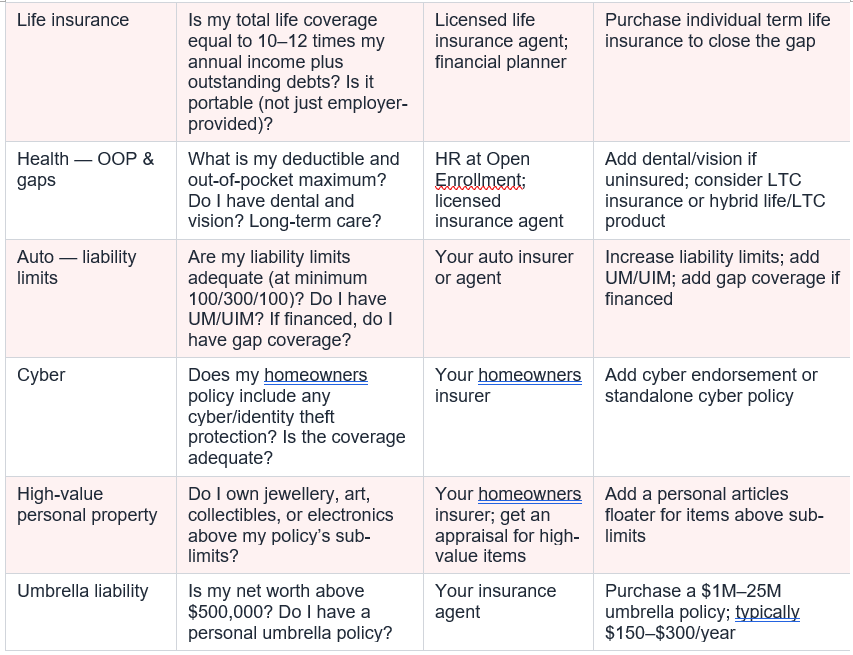
How to Audit Your Insurance Coverage
The most effective protection against silent insurance risks is an annual coverage review that specifically addresses each risk category. The checklist:
When Did You Last Review Your Policies?
Pew Research Center’s May 2026 survey found that 71 percent of US homeowners have noticed premium increases — yet Insurance.com’s 2026 home insurance trends analysis found that almost 98 percent of homeowners did not cancel coverage due to premiums. People are paying more and staying covered. But paying more for a policy with the same silent risks as before is not the same as having better coverage. Premium increases do not automatically resolve the coverage gap.The most common reason insurance coverage goes stale: it is set up once and then not reviewed. A homeowners policy written in 2016, renewed automatically every year, has a Coverage A limit set in 2016. An auto policy renewed annually still has the same liability limits chosen in 2019. A life insurance policy bought at age 30 with a 20-year term is the right policy at age 30. It may not be the right policy when a second child is born, a home is purchased, or income doubles.
Life events that should trigger an immediate insurance review:
- Home purchase, refinance, or major renovation.
- Marriage, divorce, or domestic partnership change.
- Birth or adoption of a child.
- Significant income change (increase or decrease).
- Inheritance, large asset acquisition, or significant increase in net worth.
- Retirement or change in employment status.
- Purchase of a new vehicle or significant vehicle change.
- Starting a home-based business.
Conclusion
The most financially damaging insurance outcome is not failing to buy insurance at all — which at least leaves the risk clear and visible. It is buying insurance that appears to cover the risk, paying premiums on it for years, and then discovering at claim time that the coverage has a gap that transfers the loss back to the policyholder. That is the silent risk, and it affects most American households in at least one coverage category.The data in this guide tells a consistent story: two in three homeowners are underinsured for their dwelling; 75 percent have no flood insurance; 40 percent have no life insurance at all; 7 percent have cyber coverage against a cyber threat environment that generated $20.9 billion in US internet crime losses in 2025; and 61 percent of homeowners who are aware of umbrella insurance have not discussed it with their agent. These are not isolated gaps in fringe coverage categories. They are mainstream coverage deficiencies affecting the majority of households.
The solution is not buying more insurance indiscriminately. It is conducting a deliberate, specific coverage audit that identifies which silent risks apply to your specific situation, reviews the actual policy language that governs each coverage type, and closes the gaps that represent meaningful financial exposure. The annual insurance review — not the automatic renewal, but the deliberate conversation with a licensed professional about what has changed and what the coverage actually provides — is the difference between the illusion of protection and the reality of it.
Frequently Asked Questions
What is the most common silent risk in homeowners insurance?The most common and most financially damaging silent risk in homeowners insurance is outdated dwelling coverage (Coverage A) that has not kept pace with rising rebuilding costs. A 2025 University of Colorado study of homeowners affected by Colorado's 2021 Marshall Fire found that 74% were underinsured, with an average coverage gap of $139,000 per household. The broader problem: two out of three homeowners — more than 80 million Americans — are underinsured according to a Harris Poll survey for the American Property Casualty Insurance Association (cited by Insurify, June 2026). Standard homeowners policies cover the dwelling at the Coverage A limit, which was set when the policy was first written. Construction costs have risen significantly since 2021, but policy limits only change when the policyholder requests an update. Review your Coverage A limit against the current cost to rebuild your home annually.
Does homeowners insurance cover floods?
No. Standard homeowners insurance explicitly excludes flood damage as a covered peril. Flood requires a separate flood insurance policy, available either through the National Flood Insurance Program (NFIP) or private flood insurers. Approximately 75% of homeowners do not have flood insurance, according to Insurance.com's May 2026 home insurance trends analysis. The risk is broader than most homeowners recognize: approximately 25% of all flood insurance claims come from properties outside high-risk flood zones. Even moderate rainfall events, overwhelmed drainage systems, and storm surge can cause flooding that a standard homeowners policy will not cover. To find out your flood zone, visit FEMA's Flood Map Service Center at msc.fema.gov. Separately, earthquake damage is also excluded from standard homeowners insurance in most states and requires a separate endorsement or policy.
What is the life insurance coverage gap in the US?
The life insurance gap in the US is substantial across two dimensions: breadth and depth. Forty percent of American adults — approximately 102 million people — have no life insurance coverage at all (LIMRA 2024 Insurance Barometer Study, cited by MoneyGeek May 2026 and Evolve Legacy Group August 2026). Among those who do have life insurance, nearly half say they need more coverage. The average American household is underinsured by approximately $200,000 in life coverage (LIMRA 2024). The life insurance protection gap affects 75 million Americans without adequate coverage (MoneyGeek). The generational gap is stark: 52% of Gen Z adults and 44% of Millennials have no life insurance at all. The standard financial planning recommendation is 10–12 times annual income in life coverage, plus outstanding debts — which far exceeds the employer-provided group life insurance that many Americans rely on as their primary or only coverage.
What is cyber insurance and why is the coverage gap so large?
Cyber insurance is a coverage type specifically designed to address financial losses from digital threats: identity theft and account takeover, ransomware and cyber extortion, online fraud, data breach expenses, and cyber harassment. Standard homeowners insurance was designed before the digital era and does not cover these risks (or covers them only with modest, inadequate sub-limits). The Hanover's 2025 Homeowners Coverage Awareness Report (Harris Poll) found that only 7% of homeowners have cyber insurance, despite it being one of the most common and costly risks facing American households. The FBI's 2025 IC3 Annual Report documented $20.9 billion in US internet crime losses in 2025. The awareness gap is also significant: 46% of homeowners had never even heard of cyber insurance as a coverage option. Cyber endorsements are now available from many major homeowners insurers and typically cover identity theft restoration, financial fraud losses, and cyber extortion.
What does umbrella insurance cover and who needs it?
Umbrella insurance is a personal liability policy that provides coverage above and beyond the liability limits in your homeowners and auto policies. A $1 million umbrella policy pays liability claims that exceed your underlying policy limits — for example, if you cause a serious automobile accident generating $800,000 in claims but your auto policy only carries $300,000 in liability coverage, the umbrella policy covers the remaining $500,000. Umbrella insurance typically costs $150 to $300 per year for a $1 million policy. The Hanover's 2025 report found that 83% of homeowners are aware of umbrella insurance, but only 39% have discussed it with their insurance agent. Financial planners generally recommend umbrella insurance for any household with a net worth above $500,000, significant income, or activities that increase liability exposure (dogs, pools, trampolines, teenage drivers, rental properties, or frequent hosting of guests).
How often should I review my insurance coverage?
At minimum, review all insurance policies annually — ideally at the same time each year, coinciding with major renewal dates. Beyond the annual review, conduct an immediate insurance review following any significant life event: purchasing, refinancing, or renovating a home; marriage, divorce, or domestic partnership change; birth or adoption of a child; significant income change; receiving an inheritance or significant asset increase; retirement or change in employment; purchasing a new vehicle; starting a home-based business; or acquiring high-value items (jewellery, art, collectibles) above policy sub-limits. Insurance coverage that was appropriate at the time it was purchased may become dangerously inadequate over time as your assets, income, family circumstances, and rebuilding costs change. The automatic policy renewal is not a coverage review. A deliberate conversation with a licensed insurance professional is the only reliable way to identify and close silent coverage gaps.
0 Comments
Be the first to share your thoughts on this article.