

Real Estate
Vacation Home Estate Planning Mistakes to Avoid
Two out of three high-net-worth individuals own a second home. Probate on an $800,000 California property runs $19,000 in fees and 12 to 18 months of court time. California's Prop 19 can increase annual property taxes by $8,000 to $10,000 when a vacation home is inherited without planning. And a will alone — the structure most families default to — leaves co-inheriting siblings without any governance for costs, scheduling, or the day one of them wants to sell. This guide identifies the eight most costly vacation home estate planning mistakes and the specific structures that prevent each one.
That sentimental value is also what makes the transfer go wrong. The parents who assumed their children love the vacation home as much as they do. The will that left equal shares to three siblings without any guidance on who pays maintenance, who can book the summer weeks, or what happens if one sibling needs cash and wants to sell. The lifetime gift that preserved the property in the family but handed the recipients a capital gains tax liability measured in hundreds of thousands of dollars. The California property that passed to the next generation and triggered a Proposition 19 reassessment that increased annual property tax by $9,000.
The Great Wealth Transfer — $124 trillion expected to change hands by 2048, according to Cerulli Associates — means that these scenarios are playing out across American families at an increasing rate. Baby Boomers hold $93 trillion in wealth, and vacation properties represent a significant slice of it. The planning structures that prevent the most common mistakes are well-established. The families who deploy them before the first health crisis avoid the disputes, the probate costs, and the tax surprises that follow poor planning. This guide names the eight most costly mistakes and the specific structures that prevent each one.
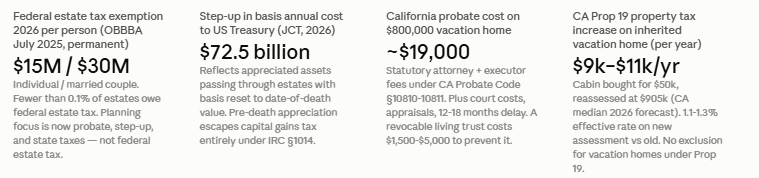
Federal estate exemption 2026: $15M per person / $30M per couple (OBBBA July 2025, permanent). Fewer than 0.1% of estates owe federal estate tax (beancount.io May 2026). Step-up in basis costs US government $72.5B in 2026 (JCT). Probate: 4-10% of estate value, 12-18 months (California: specific statutory fee schedule). CA probate on $800k property: ~$19,000 in attorney/executor fees alone. Prop 19 reassessment on inherited vacation home: annual property tax increase of $8,000-$10,000 for a previously low-assessed California cabin. 2/3 of high-net-worth individuals own a second home (2023 financial adviser survey). Great Wealth Transfer: $2.5 trillion/year currently transferring.
The federal estate tax, with its 2026 exemption of $15 million per person under the One Big Beautiful Bill Act signed July 4, 2025, is no longer the central concern it once was — fewer than 0.1% of estates owe any federal estate tax in 2026. But the state-level picture is very different. Twelve states plus Washington D.C. impose state estate taxes, often with dramatically lower exemptions: Massachusetts at $2 million, Oregon at $1 million, New York at $7.35 million with its notorious 'cliff' structure. And California's Proposition 19, which came into effect in 2021, has fundamentally changed the vacation home inheritance calculation for millions of California families in ways that no federal exemption change can address.
The real planning stakes in 2026 are not primarily estate tax — they are probate costs, property tax reassessment, capital gains tax on the step-up (or its absence), and the co-ownership disputes that emerge when multiple heirs inherit shared property without governance. These four forces, not federal estate tax, are what turns the family vacation home from a legacy into a liability for the heirs who receive it without a plan.
The Charleston Estate Planning Law Firm's May 2026 analysis makes the critical distinction: 'Families with a beach house often need a framework for life after the transfer, not only the transfer itself.' A will answers one question — who gets the property — but leaves four more unanswered: who pays carrying costs, how is usage scheduled, who decides on major expenses, and what happens when a beneficiary wants to sell their share. These unresolved questions are where family relationships fracture.
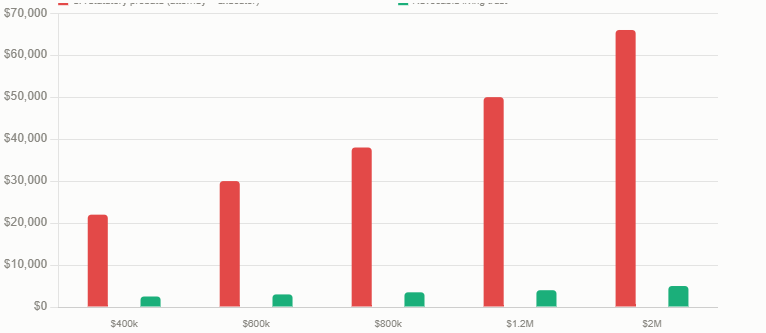
California's statutory probate fee schedule is among the most transparent examples of why this matters. Under California Probate Code §10810-10811, attorney and executor fees are calculated as: 4% of the first $100,000 of the gross estate; 3% of the next $100,000; 2% of the next $800,000; 1% of the next $9 million; and 0.5% of the next $15 million. On an $800,000 vacation home, the combined attorney and executor fees run approximately $19,000 — before court fees, appraisal costs, or any contested proceedings. The process takes 12 to 18 months in California. During that time, no one can sell, refinance, or use the property without court approval.
New York's probate structure produces similar numbers from a different formula. As The Village Law Firm's September 2026 guide notes, a New York estate valued at $1 million carries a mandatory executor commission of $34,000 before a single dollar reaches a beneficiary. Across all states, probate typically costs between 4% and 10% of the gross estate value (Lawvex, September 2026). On an $800,000 vacation home, that is $32,000 to $80,000 in costs that could have been avoided with a revocable living trust, which costs a fraction of that amount to establish.
The do-nothing mistake is especially costly for vacation homes because probate fees are based on the gross value of the property — not its equity or its net value after any mortgage. A $800,000 vacation home with a $400,000 mortgage still generates probate fees based on $800,000. The probate process also exposes the property to public record — anyone can look up what a deceased person owned and what it was worth, which can attract creditors, contested claims, and in some cases, fraud targeting grieving families.
The solution to Mistake #1: a revocable living trust (RLT). The property is transferred into the trust during the owner's lifetime. The owner retains full control as trustee. On death, the successor trustee distributes the property to the named beneficiaries without any court involvement, in weeks rather than months, at a fraction of the cost. The step-up in basis is fully preserved under an RLT. For most families, this is the single most cost-effective estate planning tool for vacation property. Cost to establish: $1,500 to $5,000 for a qualified estate planning attorney. Cost of NOT doing it: $19,000 to $80,000+ in probate fees on a property of similar value.
The Heritage Law Office's 2026 estate planning guide for vacation properties describes the patterns that emerge without a governance structure: 'Some siblings may want to use the house, while others may need cash and want to sell. There may also be disputes over who pays maintenance costs or when different families can use the house.' These disputes are not exceptional — they are the predictable consequence of co-ownership without rules. Probate disputes involving estates rose 32% between 2020 and 2024 (prior session data, Great Wealth Transfer context).
The solution is not simply to add a governance document to the will — it is to choose a transfer structure that embeds governance from the beginning. A trust for the property can specify who has the right to use the home and when, how costs are allocated, how decisions are made, and what the process is when a beneficiary wants to sell their interest. An LLC with a detailed operating agreement provides the same governance with the additional benefit of limited liability protection for the property's activities.
For vacation homes passing to multiple heirs, the minimum planning document is a family property agreement: a written document that addresses scheduling (who can book the property and when), cost allocation (how maintenance, insurance, property tax, and capital improvements are shared), decision-making (what requires unanimous consent vs majority approval), and exit (what happens when a beneficiary wants to sell their interest, including a buy-sell mechanism with defined valuation methodology). This document can be embedded in a trust or LLC operating agreement. Without it, the equal inheritance that feels like fairness on paper becomes the source of a conflict that splits families. Consult a qualified estate planning attorney to create a structure appropriate to your family's specific situation.
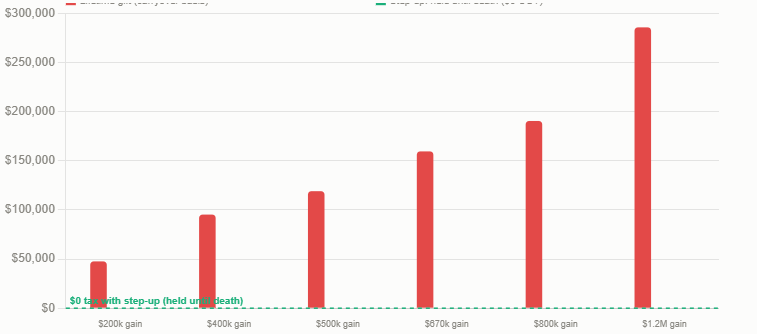
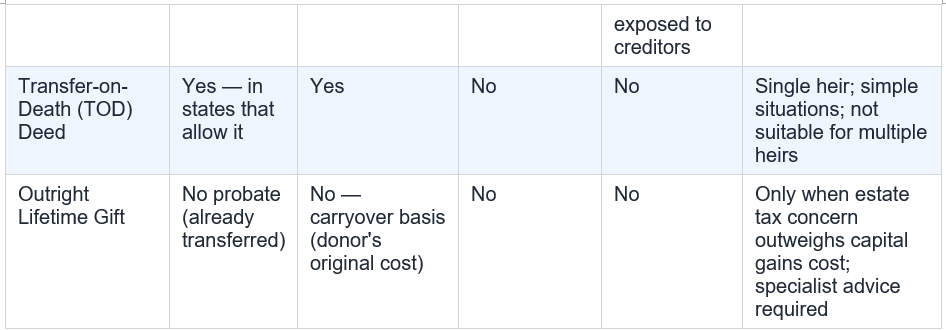
The issue is basis. When property is gifted during the owner's lifetime, the recipient takes the donor's original cost basis — the carryover basis. If parents purchased a beach house in 1982 for $80,000 and it is now worth $750,000, the gain is $670,000. If the parents gift the property to a child today, the child inherits a cost basis of $80,000. When the child eventually sells the property — whether in five years or thirty — they will owe capital gains tax on the entire $670,000 of appreciation, less any improvements. At the combined federal rate of 20% plus 3.8% NIIT for higher earners, plus state capital gains tax, the tax on that gain could exceed $160,000.
The alternative — holding the property until death and passing it through the estate — produces an entirely different outcome. Under IRC §1014, assets held at death receive a step-up in basis to fair market value at the date of death. The beach house worth $750,000 at the owner's death has a new basis of $750,000 for the heir. If the heir sells it the following year for $780,000, they owe capital gains tax only on $30,000 — not $670,000. The step-up effectively eliminates the $670,000 of pre-death appreciation from the capital gains calculation entirely.
Step-up vs carryover basis comparison on a vacation home. Purchase price (1982): $80,000. Current value (2026): $750,000. Unrealised gain: $670,000. Scenario A — Lifetime gift (carryover basis): heir receives $80,000 basis. If heir sells at $750,000: gain of $670,000. At 23.8% combined federal rate (20% LTCG + 3.8% NIIT): tax of approximately $159,460. Plus state capital gains tax (e.g., California 13.3% on full gain): approximately $89,110. Total potential tax on gain: $248,570+ in a high-tax state. Scenario B — Held until death (step-up in basis, IRC §1014): heir receives $750,000 basis. If heir sells at $750,000: gain of $0. Tax: $0. The step-up eliminates all $670,000 of pre-death appreciation from taxation. The estate planning decision to gift vs hold produces a potential $248,570 difference in outcomes in this example. Not tax advice — individual capital gains tax depends on income, state, and sale price.
The annual gift tax exclusion ($19,000 per recipient in 2026; $38,000 per recipient for married couples) does allow fractional interest gifts of the vacation property over multiple years — which can reduce the size of the eventual estate without triggering the full carryover basis problem on the entire property, since each fraction gifted each year carries a basis equal to its pro-rated share of the original cost plus appreciation to the date of each gift. This is a specialist strategy that requires annual property appraisals, careful tax filing, and the guidance of an estate planning attorney and accountant working together. Not tax advice.
When a vacation home passes to the next generation in California under Prop 19, the county assessor treats it as a new purchase at today's market value. The California median home price is forecast at $905,000 for 2026, according to lawbob.com's July 2026 California cabin succession guide. A cabin purchased by parents for $50,000 decades ago may now be assessed at $905,000 — or more, in premium coastal or mountain locations. California's base property tax rate is 1%, plus local assessments that typically bring the effective rate to 1.1% to 1.3%. On a $905,000 assessment, annual property tax runs approximately $9,953 to $11,765. On the original $50,000 assessment under the prior rules, it would have been approximately $550 to $650. The reassessment adds approximately $9,000 to $11,000 per year in property tax — permanently, for as long as the heirs own the property.
The primary residence exception under Prop 19 does not help for vacation homes. A child who inherits a vacation home and uses it as their primary residence within one year of inheriting it benefits from the exclusion cap of $1,044,586 (through early 2027). But a vacation home that remains a vacation home receives no reassessment protection whatsoever. For California families, this makes the timing and structure of the vacation home transfer a critical decision with permanent property tax consequences.
Prop 19 is California-specific, but other states have analogous issues. States that impose inheritance taxes on property (not estate taxes on the estate) include Iowa, Kentucky, Maryland, Nebraska, New Jersey, and Pennsylvania. These states tax the heir's receipt of the property based on the value and the heir's relationship to the deceased. Planning around these state-level impositions requires state-specific advice, not generic national estate planning guidance.
The Mistake: The California Prop 19 trap most often catches families who plan the federal estate tax correctly — using a trust that preserves the step-up in basis — but fail to address the state property tax consequence of the transfer. The step-up in basis benefit and the Prop 19 reassessment are entirely separate events triggered by the same inheritance. A family can receive the full step-up in basis under IRC §1014 AND experience a full Prop 19 reassessment at the same time. The federal capital gains planning does not mitigate the state property tax planning problem. Both must be addressed separately, with state-specific legal guidance.
The step-up in basis under joint tenancy is partial, not full. When one joint tenant dies and the property passes to the surviving tenant, only the decedent's share of the property receives a step-up to fair market value. In a community property state like California, the rules are more favorable — both halves of community property receive a full step-up when one spouse dies (IRC §1014(b)(6)) — but for non-spousal joint tenancy, only the departing owner's share is stepped up. A parent who adds a child as a joint tenant on a $750,000 vacation home — the child owning half — may be limiting the child's eventual step-up to only 50% of the property's appreciation, not the full amount.
The more fundamental problem with adding children as joint tenants is that it gives them an immediate, irrevocable ownership interest in the property. If a child faces creditors, divorce, or bankruptcy, the child's joint tenancy interest in the vacation home is an asset that can be reached by those creditors or become part of a divorce settlement. The parent who added the child to the deed to simplify the inheritance has inadvertently exposed the property to the child's personal liabilities — a risk that a properly structured trust or LLC would have entirely prevented.
Joint tenancy also provides no scheduling, cost-sharing, or governance structure for the period when multiple family members co-own the property. Unlike a trust or LLC, which can contain detailed operating rules, joint tenancy is purely an ownership structure with no embedded framework for the management questions that will arise from day one.
The conversation is uncomfortable precisely because it requires the family to discuss scenarios that feel premature or morbid — who will die when, who will inherit what, who will be responsible for what costs. But the alternative is a family discovering, in the acute grief of a bereavement, that one sibling who was allocated a one-third share desperately wants to sell, another wants to keep it, and a third cannot afford the carrying costs. Without prior agreement, this scenario ends in court — or in a forced sale that no one wanted.
The conversation should address at minimum: who in the family has genuine desire to keep and use the property; who has the financial capacity to contribute to ongoing costs; whether co-ownership is genuinely viable given the family's relationships and geographic distribution; and what the realistic alternatives are if full family agreement is not achievable — including sale and division of proceeds, or buy-out of the dissenting heir. This conversation is the foundation of the legal structure that follows. A family that has had it enters the estate planning process knowing what outcome they are trying to achieve. A family that has not had it builds legal structures on assumptions that may be entirely incorrect.
Framework for the family vacation home conversation. Before meeting with an estate planning attorney, convene a family discussion — parents and all potential heirs — covering these five questions: 1) Who actively wants to keep the property for regular personal use? 2) Who can realistically contribute to ongoing costs (property tax, insurance, maintenance, capital improvements)? 3) Are there heirs who would prefer a cash equivalent rather than a share of the property? 4) Can the potential co-owners commit to working through scheduling, maintenance, and cost decisions without the parents present? 5) What is the family's preference if co-ownership becomes unworkable — sale, buy-out, or other mechanism? Document the answers. Take them to the estate planning attorney as the brief for the legal structure. This conversation takes one afternoon. The litigation it prevents can take years.
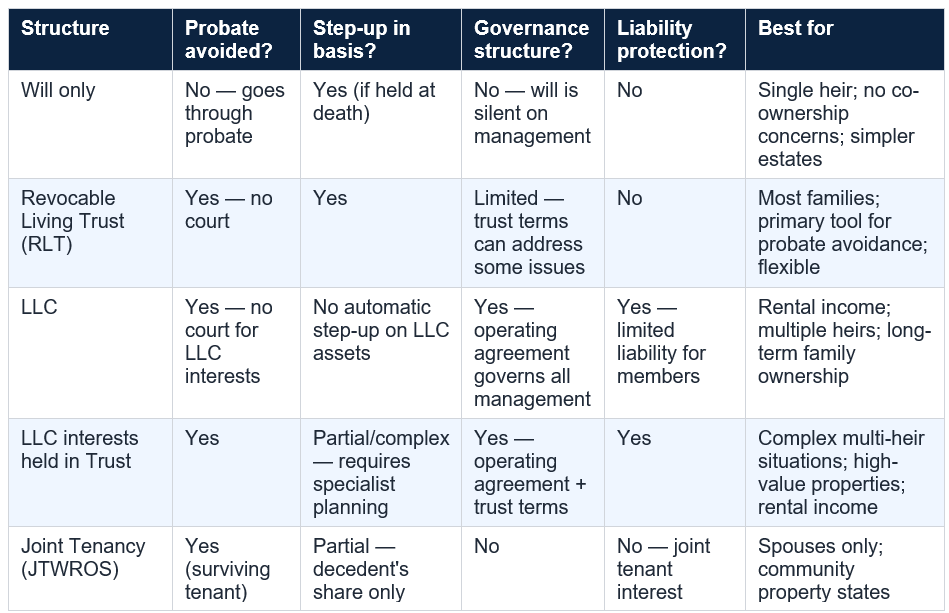
An LLC is most appropriate when: the property is used as a rental and generates income that creates liability exposure; the family wants a specific governance structure with voting rules, usage schedules, and transfer restrictions codified in an operating agreement; or there is a desire to transfer fractional interests over time using valuation discounts. The Wealth Management publication (August 2026) notes that an LLC provides 'centralised management, outlining when and how additional funds should be added to cover carrying costs and, arguably most importantly, restriction of transfer of interests in the LLC to third parties.' An LLC operating agreement can prevent an heir from selling their share to an outside party without the consent of the other members — a powerful tool for preserving family ownership.
A revocable living trust (RLT) is most appropriate when: the primary goal is probate avoidance; the owner wants to retain full control during their lifetime; flexibility to change the plan is important; and the step-up in basis must be fully preserved. Unlike an LLC, an RLT does not typically provide operational governance for co-ownership after the transfer — it addresses the transfer itself but not the management of the property post-transfer. An RLT also does not provide liability protection for the property's activities in the way an LLC does.
The combination of both structures — placing the vacation home in an LLC and then transferring the LLC interests through a trust — allows a family to capture probate avoidance, liability protection, governance structure, and step-up planning in a single arrangement. This combined structure requires more legal complexity and cost to establish, but for a high-value vacation property with multiple intended heirs and rental income, it is often the most comprehensive solution available.
Under IRC §1014, assets owned by the decedent at the time of death receive a new cost basis equal to their fair market value on the date of death. This applies whether the asset passes through probate, through a revocable living trust, through a transfer-on-death deed, or through joint tenancy on the decedent's share. Beancount.io's May 2026 analysis states it clearly: 'The step-up applies to capital assets owned by the decedent at the time of death. For nearly every American family, estate tax is no longer the central concern. Income tax planning — particularly capital gains tax planning — has taken its place.'
The 2026 context makes this particularly relevant. The step-up in basis costs the federal government an estimated $72.5 billion in 2026, according to the Joint Committee on Taxation — reflecting the scale of appreciated assets passing through estates and receiving the basis adjustment. This is not a niche benefit for wealthy families. It is the primary tax benefit available to the middle-class family whose beach house has appreciated from $150,000 to $900,000 over forty years. The entire $750,000 of appreciation escapes capital gains tax if the property is held until death and the heirs receive the full step-up.
The step-up is lost or impaired in several common situations: when property is gifted during the owner's lifetime (carryover basis rather than step-up); when property is placed in an irrevocable trust more than three years before death (depending on structure); and when LLC interests rather than the underlying property are transferred, since the step-up applies to the LLC interest's fair market value, not necessarily the property's appreciated value within the LLC. These are precisely the situations where the most enthusiastic planning produces the worst tax outcome — strategies that reduce the estate without considering what they do to the beneficiary's eventual capital gains position.
The revocable living trust remains the most broadly applicable single tool for vacation home estate planning in 2026. It avoids probate entirely, preserves the full step-up in basis, retains full flexibility for the owner during their lifetime, can be amended at any time before incapacity or death, and can contain specific provisions for how the property is managed by successor trustees and eventually distributed. For a family where a single heir will inherit the property, or where parents want the property distributed outright to heirs who will make their own decisions about use or sale, the RLT provides probate avoidance and step-up preservation at a fraction of the cost of the problems it prevents.
For families with multiple heirs who want to maintain the vacation home as a shared family property for generations, the LLC is the governance tool that makes co-ownership workable. An LLC operating agreement can specify: usage schedules by member; cost-sharing formulas; decision-making procedures for maintenance, capital improvements, and sale; transfer restrictions that prevent any member from selling their interest to a third party without unanimous consent; and a buy-sell mechanism with a defined valuation process for when a member wants to exit. The Wealth Management August 2026 guide adds an important caution: 'even with the best planning, family dynamics can change over time, so the LLC should also provide a way to unwind the arrangement fairly.' The exit mechanism is as important as the entry structure.
The Qualified Personal Residence Trust (QPRT) is a specialist strategy for families where federal estate tax remains a concern — typically estates above $15 million per person — or where state estate tax exposure exists at lower thresholds. In a QPRT, the owner transfers the vacation home to an irrevocable trust while retaining the right to use it for a defined period (typically 5 to 15 years). The taxable gift is the remainder interest's discounted present value, not the full property value. If the owner survives the trust term, the property passes to the beneficiaries without further estate tax. If the owner dies during the trust term, the property returns to the estate for tax purposes. The QPRT forfeits the step-up in basis — the property passes at the owner's original carryover basis — making it unsuitable for highly appreciated property unless estate tax savings exceed the capital gains cost. Specialist legal and tax advice is essential before considering a QPRT.
The structures that prevent these mistakes are not exotic. A revocable living trust avoids $19,000 to $80,000 in probate costs on an $800,000 property. A family LLC operating agreement prevents the scheduling disputes that erode sibling relationships. An honest conversation before any legal document is drafted prevents the legal structure from being built on wrong assumptions. And understanding the step-up in basis — the $72.5 billion annual tax benefit that most families never claim because they gave the property away too soon — prevents the single most expensive well-intentioned mistake in vacation home planning.
The 2026 federal estate tax exemption of $15 million per person means that for most families, the primary planning objectives are no longer about avoiding estate tax. They are about avoiding probate, preserving the step-up, managing co-ownership fairly, and keeping a property that took a lifetime to acquire in a family that can afford to keep it. These are achievable goals with the right legal structure, the right conversation, and an estate planning attorney who understands both the federal and state-specific dimensions of the problem.
The most common mistake, consistently identified across estate planning attorneys and wealth management advisers, is leaving a vacation home to multiple heirs in a will without any governance structure for managing the property after the transfer. A will can specify that three children each inherit a one-third share, but it says nothing about who pays property taxes, insurance, and maintenance; who books the summer weeks; what happens when one sibling wants to sell; or how major repair decisions are made. Without these answers embedded in a trust or LLC operating agreement, the equal inheritance that feels fair on paper becomes the source of conflict that splits families. The Charleston Estate Planning Law Firm (May 2026) states it clearly: families with shared vacation property need a framework for life after the transfer, not only for the transfer itself. The solution is a trust with embedded governance provisions, or an LLC with a detailed operating agreement, drafted before the first health crisis.
Does a revocable living trust avoid probate for a vacation home?
Yes — a revocable living trust (RLT) is the primary tool for avoiding probate on a vacation home in most states. When the property is titled in the name of the trust (e.g., 'The Smith Family Revocable Living Trust'), it does not pass through the deceased owner's estate for probate purposes. The successor trustee distributes or manages the property according to the trust's terms, without court involvement, in weeks rather than months. The step-up in basis under IRC §1014 is fully preserved for assets held in a revocable living trust — the property receives a new cost basis equal to its fair market value at the owner's date of death. The cost of establishing a revocable living trust is typically $1,500 to $5,000 with a qualified estate planning attorney. The cost of California probate on an $800,000 vacation home is approximately $19,000 in attorney and executor fees under the statutory fee schedule (California Probate Code §10810-10811), plus court costs and 12 to 18 months of delay (Lawvex, September 2026; Forbes/Kelly Phillips Erb May 2026).
What is California Proposition 19 and how does it affect vacation home inheritance?
Proposition 19, effective February 2021, changed California's property tax rules for inherited real estate. Before Prop 19, children could inherit a parent's property — including vacation homes — and retain the parent's low assessed value for property tax purposes. Under Prop 19, a vacation home (second home) that passes to the next generation is fully reassessed to current market value for property tax purposes. There is no exclusion or cap for vacation homes. Only a primary residence transfer to a child who uses it as their primary residence within one year receives any reassessment protection (and that protection is capped at $1,044,586 for transfers through early 2027). California's median home price is forecast at $905,000 for 2026 (lawbob.com July 2026). A cabin purchased for $50,000 decades ago and inherited at current market value triggers annual property taxes based on $905,000 — potentially $9,000 to $11,000 more per year than the prior assessment would have produced. Planning around Prop 19 requires California-specific legal advice and may involve timing strategies, partial interest transfers, or other approaches that carry audit risks if executed without specialist guidance.
Should I gift my vacation home to my children now to avoid estate taxes?
For most families in 2026, gifting the vacation home during your lifetime is not the optimal strategy — primarily because of the step-up in basis. The federal estate tax exemption is $15 million per person (One Big Beautiful Bill Act, signed July 4, 2025), and fewer than 0.1% of estates owe any federal estate tax (beancount.io May 2026). For the vast majority of families, estate tax is not the primary concern. When a vacation home is gifted during the owner's lifetime, the recipient takes the donor's original cost basis (carryover basis) — not a step-up. If a beach house was purchased for $80,000 and is now worth $750,000, the recipient of a lifetime gift inherits an $80,000 basis and potential capital gains tax on the full $670,000 of appreciation when they sell. If the same property is held until death and passed through a revocable living trust, the heir receives a $750,000 basis and owes zero capital gains tax on the pre-death appreciation under IRC §1014. Holding until death and using a trust is the tax-optimal strategy for most appreciated vacation properties. Exceptions exist for very large estates facing state estate tax exposure at lower thresholds, or where Prop 19 reassessment concerns apply in California — both require specialist legal and tax advice.
What is an LLC and is it right for a vacation home?
A Family Limited Liability Company (LLC) is a legal entity that can hold and manage property on behalf of its members. For a vacation home, an LLC provides: (1) limited liability protection — the LLC structure separates the property's liability exposure from the personal assets of the family members; (2) a centralised governance framework through an operating agreement that specifies usage rules, cost-sharing, decision-making authority, and transfer restrictions; (3) the ability to restrict transfers of LLC interests to third parties — no member can sell their share to an outsider without consent of the other members; and (4) probate avoidance for the LLC interests held by members. An LLC is particularly suited for vacation homes that are also rental properties (where liability exposure from guests is a real risk) and for families with multiple heirs who want to maintain the property long-term with clear co-ownership rules. The limitation: an LLC does not automatically preserve the step-up in basis in the way a revocable living trust does — the tax treatment of LLC interests at death requires specialist planning. Costs to establish vary by state; annual filing fees typically range from $50 to $800 per year. Consult a qualified estate planning attorney and tax professional to determine whether an LLC, a trust, or a combination is appropriate for your specific situation.
What is the step-up in basis and why does it matter for a vacation home?
The step-up in basis (IRC §1014) is the tax rule that resets the cost basis of an inherited asset to its fair market value on the date of the owner's death. For a vacation home, this means that all appreciation in the property's value that occurred during the deceased owner's lifetime is not subject to capital gains tax when the heir sells. Example: parents buy a beach house in 1985 for $120,000. By 2026, it is worth $900,000. If the parents hold the property until death and it passes through their estate (via a revocable living trust or probate), the heir's basis is reset to $900,000. If the heir sells the next year for $920,000, they owe capital gains tax only on $20,000 of gain. Without the step-up — if the property had been gifted to the child during the parents' lifetime — the child's basis would be $120,000, and the sale for $920,000 would produce a $800,000 taxable gain. At the combined federal rate of 23.8% (20% LTCG + 3.8% NIIT) plus state capital gains tax, the difference in outcomes can be hundreds of thousands of dollars. Beancount.io (May 2026) reports that the step-up in basis costs the US government $72.5 billion annually in foregone capital gains tax revenue — reflecting the enormous scale of appreciated assets passing through estates and receiving the basis reset. Always consult a qualified tax professional to confirm how the step-up applies in your specific situation.
Table of Contents
- Why the Family Vacation Home Is an Estate Planning Minefield
- The Landscape: Who Owns Vacation Homes and What Is at Stake
- Mistake #1 — Doing Nothing and Letting Probate Handle It
- Mistake #2 — Leaving the Home to Multiple Heirs in a Will With No Governance
- Mistake #3 — Gifting the Property During Your Lifetime Without Knowing the Tax Cost
- Mistake #4 — Ignoring California's Proposition 19 — or Your State's Equivalent
- Mistake #5 — Putting the Property in Joint Tenancy Without Understanding What That Means
- Mistake #6 — Never Having the Conversation About Who Actually Wants the Property
- Mistake #7 — Using an LLC When a Trust Would Serve Better — or Vice Versa
- Mistake #8 — Forgetting the Step-Up in Basis and Its Planning Implications
- The Transfer Structures Compared: Will, Trust, LLC, TOD Deed, and Outright Gift
- The Pre-Transfer Checklist: What to Settle Before Choosing a Structure
- Conclusion: The Vacation Home That Keeps the Family Together
- Frequently Asked Questions
Probate costs across property values vs cost of a trust
Step-up vs carryover basis: the lifetime gift tax cost
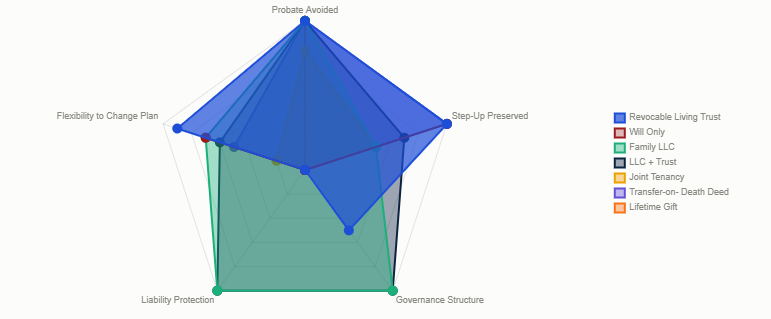
Transfer structures compared: 7 options at a glance
Why the Family Vacation Home Is an Estate Planning Minefield
The family vacation home is, in many households, the most emotionally loaded asset in the estate — and one of the most legally complex to transfer. Bill Ringham, director of private wealth strategies with RBC Wealth Management, captures the sentiment: 'What I find with a vacation property is that there is more sentimental value to it than your residential real estate. That's where families tend to congregate — whether it's a family cabin or a condo in Florida.'That sentimental value is also what makes the transfer go wrong. The parents who assumed their children love the vacation home as much as they do. The will that left equal shares to three siblings without any guidance on who pays maintenance, who can book the summer weeks, or what happens if one sibling needs cash and wants to sell. The lifetime gift that preserved the property in the family but handed the recipients a capital gains tax liability measured in hundreds of thousands of dollars. The California property that passed to the next generation and triggered a Proposition 19 reassessment that increased annual property tax by $9,000.
The Great Wealth Transfer — $124 trillion expected to change hands by 2048, according to Cerulli Associates — means that these scenarios are playing out across American families at an increasing rate. Baby Boomers hold $93 trillion in wealth, and vacation properties represent a significant slice of it. The planning structures that prevent the most common mistakes are well-established. The families who deploy them before the first health crisis avoid the disputes, the probate costs, and the tax surprises that follow poor planning. This guide names the eight most costly mistakes and the specific structures that prevent each one.
Federal estate exemption 2026: $15M per person / $30M per couple (OBBBA July 2025, permanent). Fewer than 0.1% of estates owe federal estate tax (beancount.io May 2026). Step-up in basis costs US government $72.5B in 2026 (JCT). Probate: 4-10% of estate value, 12-18 months (California: specific statutory fee schedule). CA probate on $800k property: ~$19,000 in attorney/executor fees alone. Prop 19 reassessment on inherited vacation home: annual property tax increase of $8,000-$10,000 for a previously low-assessed California cabin. 2/3 of high-net-worth individuals own a second home (2023 financial adviser survey). Great Wealth Transfer: $2.5 trillion/year currently transferring.
The Landscape: Who Owns Vacation Homes and What Is at Stake
Second home ownership is concentrated but not limited to the ultra-wealthy. A 2023 survey of financial advisers who work with high-net-worth clients found that approximately two out of three of their clients own a second home — and one-third of those who do not say they are interested in buying one. But the estate planning challenge extends well beyond the traditional high-net-worth demographic: a beach house purchased in 1985 for $120,000 in a coastal community that has since appreciated to $900,000 is an estate planning challenge for a middle-income family who never considered themselves wealthy.The federal estate tax, with its 2026 exemption of $15 million per person under the One Big Beautiful Bill Act signed July 4, 2025, is no longer the central concern it once was — fewer than 0.1% of estates owe any federal estate tax in 2026. But the state-level picture is very different. Twelve states plus Washington D.C. impose state estate taxes, often with dramatically lower exemptions: Massachusetts at $2 million, Oregon at $1 million, New York at $7.35 million with its notorious 'cliff' structure. And California's Proposition 19, which came into effect in 2021, has fundamentally changed the vacation home inheritance calculation for millions of California families in ways that no federal exemption change can address.
The real planning stakes in 2026 are not primarily estate tax — they are probate costs, property tax reassessment, capital gains tax on the step-up (or its absence), and the co-ownership disputes that emerge when multiple heirs inherit shared property without governance. These four forces, not federal estate tax, are what turns the family vacation home from a legacy into a liability for the heirs who receive it without a plan.
The Charleston Estate Planning Law Firm's May 2026 analysis makes the critical distinction: 'Families with a beach house often need a framework for life after the transfer, not only the transfer itself.' A will answers one question — who gets the property — but leaves four more unanswered: who pays carrying costs, how is usage scheduled, who decides on major expenses, and what happens when a beneficiary wants to sell their share. These unresolved questions are where family relationships fracture.
Mistake #1 — Doing Nothing and Letting Probate Handle It
Probate is the court-supervised process by which a deceased person's assets are inventoried, debts are paid, and the remainder is distributed to heirs. For a vacation home, it is the default outcome when no other planning structure has been put in place. It is also one of the most expensive and time-consuming ways to transfer property.California's statutory probate fee schedule is among the most transparent examples of why this matters. Under California Probate Code §10810-10811, attorney and executor fees are calculated as: 4% of the first $100,000 of the gross estate; 3% of the next $100,000; 2% of the next $800,000; 1% of the next $9 million; and 0.5% of the next $15 million. On an $800,000 vacation home, the combined attorney and executor fees run approximately $19,000 — before court fees, appraisal costs, or any contested proceedings. The process takes 12 to 18 months in California. During that time, no one can sell, refinance, or use the property without court approval.
New York's probate structure produces similar numbers from a different formula. As The Village Law Firm's September 2026 guide notes, a New York estate valued at $1 million carries a mandatory executor commission of $34,000 before a single dollar reaches a beneficiary. Across all states, probate typically costs between 4% and 10% of the gross estate value (Lawvex, September 2026). On an $800,000 vacation home, that is $32,000 to $80,000 in costs that could have been avoided with a revocable living trust, which costs a fraction of that amount to establish.
The do-nothing mistake is especially costly for vacation homes because probate fees are based on the gross value of the property — not its equity or its net value after any mortgage. A $800,000 vacation home with a $400,000 mortgage still generates probate fees based on $800,000. The probate process also exposes the property to public record — anyone can look up what a deceased person owned and what it was worth, which can attract creditors, contested claims, and in some cases, fraud targeting grieving families.
The solution to Mistake #1: a revocable living trust (RLT). The property is transferred into the trust during the owner's lifetime. The owner retains full control as trustee. On death, the successor trustee distributes the property to the named beneficiaries without any court involvement, in weeks rather than months, at a fraction of the cost. The step-up in basis is fully preserved under an RLT. For most families, this is the single most cost-effective estate planning tool for vacation property. Cost to establish: $1,500 to $5,000 for a qualified estate planning attorney. Cost of NOT doing it: $19,000 to $80,000+ in probate fees on a property of similar value.
Mistake #2 — Leaving the Home to Multiple Heirs in a Will With No Governance
Leaving a vacation home equally to three children in a will is the planning move that produces the most family conflict, most consistently. The will answers the ownership question — each child gets one third — but leaves every operational question unanswered. Who pays the property taxes, insurance, and maintenance? Who books the summer weeks? What happens when the HVAC system fails and costs $8,000 to replace? What happens when one sibling's financial situation changes and they need to liquidate their share?The Heritage Law Office's 2026 estate planning guide for vacation properties describes the patterns that emerge without a governance structure: 'Some siblings may want to use the house, while others may need cash and want to sell. There may also be disputes over who pays maintenance costs or when different families can use the house.' These disputes are not exceptional — they are the predictable consequence of co-ownership without rules. Probate disputes involving estates rose 32% between 2020 and 2024 (prior session data, Great Wealth Transfer context).
The solution is not simply to add a governance document to the will — it is to choose a transfer structure that embeds governance from the beginning. A trust for the property can specify who has the right to use the home and when, how costs are allocated, how decisions are made, and what the process is when a beneficiary wants to sell their interest. An LLC with a detailed operating agreement provides the same governance with the additional benefit of limited liability protection for the property's activities.
For vacation homes passing to multiple heirs, the minimum planning document is a family property agreement: a written document that addresses scheduling (who can book the property and when), cost allocation (how maintenance, insurance, property tax, and capital improvements are shared), decision-making (what requires unanimous consent vs majority approval), and exit (what happens when a beneficiary wants to sell their interest, including a buy-sell mechanism with defined valuation methodology). This document can be embedded in a trust or LLC operating agreement. Without it, the equal inheritance that feels like fairness on paper becomes the source of a conflict that splits families. Consult a qualified estate planning attorney to create a structure appropriate to your family's specific situation.
Mistake #3 — Gifting the Property During Your Lifetime Without Knowing the Tax Cost
Transferring a vacation home to children as a gift during the owner's lifetime is sometimes recommended as a way to reduce the taxable estate and simplify the eventual transfer. It can be a sound strategy in specific circumstances. But the capital gains tax consequence of a lifetime gift is one of the most frequently misunderstood aspects of vacation home planning, and it is the mistake that produces the largest unexpected tax bills.The issue is basis. When property is gifted during the owner's lifetime, the recipient takes the donor's original cost basis — the carryover basis. If parents purchased a beach house in 1982 for $80,000 and it is now worth $750,000, the gain is $670,000. If the parents gift the property to a child today, the child inherits a cost basis of $80,000. When the child eventually sells the property — whether in five years or thirty — they will owe capital gains tax on the entire $670,000 of appreciation, less any improvements. At the combined federal rate of 20% plus 3.8% NIIT for higher earners, plus state capital gains tax, the tax on that gain could exceed $160,000.
The alternative — holding the property until death and passing it through the estate — produces an entirely different outcome. Under IRC §1014, assets held at death receive a step-up in basis to fair market value at the date of death. The beach house worth $750,000 at the owner's death has a new basis of $750,000 for the heir. If the heir sells it the following year for $780,000, they owe capital gains tax only on $30,000 — not $670,000. The step-up effectively eliminates the $670,000 of pre-death appreciation from the capital gains calculation entirely.
Step-up vs carryover basis comparison on a vacation home. Purchase price (1982): $80,000. Current value (2026): $750,000. Unrealised gain: $670,000. Scenario A — Lifetime gift (carryover basis): heir receives $80,000 basis. If heir sells at $750,000: gain of $670,000. At 23.8% combined federal rate (20% LTCG + 3.8% NIIT): tax of approximately $159,460. Plus state capital gains tax (e.g., California 13.3% on full gain): approximately $89,110. Total potential tax on gain: $248,570+ in a high-tax state. Scenario B — Held until death (step-up in basis, IRC §1014): heir receives $750,000 basis. If heir sells at $750,000: gain of $0. Tax: $0. The step-up eliminates all $670,000 of pre-death appreciation from taxation. The estate planning decision to gift vs hold produces a potential $248,570 difference in outcomes in this example. Not tax advice — individual capital gains tax depends on income, state, and sale price.
The annual gift tax exclusion ($19,000 per recipient in 2026; $38,000 per recipient for married couples) does allow fractional interest gifts of the vacation property over multiple years — which can reduce the size of the eventual estate without triggering the full carryover basis problem on the entire property, since each fraction gifted each year carries a basis equal to its pro-rated share of the original cost plus appreciation to the date of each gift. This is a specialist strategy that requires annual property appraisals, careful tax filing, and the guidance of an estate planning attorney and accountant working together. Not tax advice.
Mistake #4 — Ignoring California's Proposition 19 — or Your State's Equivalent
California's Proposition 19, which took effect in February 2021, changed the property tax inheritance rules for vacation homes in the most significant way in decades. Before Prop 19, a parent could transfer a vacation home to a child and the child would retain the parent's low assessed value for property tax purposes — a benefit that had protected California families from dramatic property tax increases for decades. Under Prop 19, that protection no longer applies to vacation homes.When a vacation home passes to the next generation in California under Prop 19, the county assessor treats it as a new purchase at today's market value. The California median home price is forecast at $905,000 for 2026, according to lawbob.com's July 2026 California cabin succession guide. A cabin purchased by parents for $50,000 decades ago may now be assessed at $905,000 — or more, in premium coastal or mountain locations. California's base property tax rate is 1%, plus local assessments that typically bring the effective rate to 1.1% to 1.3%. On a $905,000 assessment, annual property tax runs approximately $9,953 to $11,765. On the original $50,000 assessment under the prior rules, it would have been approximately $550 to $650. The reassessment adds approximately $9,000 to $11,000 per year in property tax — permanently, for as long as the heirs own the property.
The primary residence exception under Prop 19 does not help for vacation homes. A child who inherits a vacation home and uses it as their primary residence within one year of inheriting it benefits from the exclusion cap of $1,044,586 (through early 2027). But a vacation home that remains a vacation home receives no reassessment protection whatsoever. For California families, this makes the timing and structure of the vacation home transfer a critical decision with permanent property tax consequences.
Prop 19 is California-specific, but other states have analogous issues. States that impose inheritance taxes on property (not estate taxes on the estate) include Iowa, Kentucky, Maryland, Nebraska, New Jersey, and Pennsylvania. These states tax the heir's receipt of the property based on the value and the heir's relationship to the deceased. Planning around these state-level impositions requires state-specific advice, not generic national estate planning guidance.
The Mistake: The California Prop 19 trap most often catches families who plan the federal estate tax correctly — using a trust that preserves the step-up in basis — but fail to address the state property tax consequence of the transfer. The step-up in basis benefit and the Prop 19 reassessment are entirely separate events triggered by the same inheritance. A family can receive the full step-up in basis under IRC §1014 AND experience a full Prop 19 reassessment at the same time. The federal capital gains planning does not mitigate the state property tax planning problem. Both must be addressed separately, with state-specific legal guidance.
Mistake #5 — Putting the Property in Joint Tenancy Without Understanding What That Means
Joint tenancy with rights of survivorship (JTWROS) is a common default for married couples buying a vacation home together — and a frequent mistake when parents add children as joint tenants in an attempt to simplify the eventual transfer. Joint tenancy means that when one joint tenant dies, their share passes automatically to the surviving joint tenant(s), bypassing probate. This avoidance of probate is the feature that makes it appealing. The limitations are what make it dangerous as an estate planning tool.The step-up in basis under joint tenancy is partial, not full. When one joint tenant dies and the property passes to the surviving tenant, only the decedent's share of the property receives a step-up to fair market value. In a community property state like California, the rules are more favorable — both halves of community property receive a full step-up when one spouse dies (IRC §1014(b)(6)) — but for non-spousal joint tenancy, only the departing owner's share is stepped up. A parent who adds a child as a joint tenant on a $750,000 vacation home — the child owning half — may be limiting the child's eventual step-up to only 50% of the property's appreciation, not the full amount.
The more fundamental problem with adding children as joint tenants is that it gives them an immediate, irrevocable ownership interest in the property. If a child faces creditors, divorce, or bankruptcy, the child's joint tenancy interest in the vacation home is an asset that can be reached by those creditors or become part of a divorce settlement. The parent who added the child to the deed to simplify the inheritance has inadvertently exposed the property to the child's personal liabilities — a risk that a properly structured trust or LLC would have entirely prevented.
Joint tenancy also provides no scheduling, cost-sharing, or governance structure for the period when multiple family members co-own the property. Unlike a trust or LLC, which can contain detailed operating rules, joint tenancy is purely an ownership structure with no embedded framework for the management questions that will arise from day one.
Mistake #6 — Never Having the Conversation About Who Actually Wants the Property
Of all the vacation home estate planning mistakes, the one that causes the most conflict and the most wasted legal cost is also the most preventable: assuming that the children want the vacation home, or assuming they do not want it, without ever asking. RBC Wealth Management's Bill Ringham identifies this as a primary planning error: 'Another common mistake is for parents to think their children love the vacation home as much as they do and want to keep it, but that's not always the case. When thinking about what to do with the family vacation property, the first step should be to talk to your children. Who wants the property? Who can afford it? Will the beneficiaries get along as co-owners?'The conversation is uncomfortable precisely because it requires the family to discuss scenarios that feel premature or morbid — who will die when, who will inherit what, who will be responsible for what costs. But the alternative is a family discovering, in the acute grief of a bereavement, that one sibling who was allocated a one-third share desperately wants to sell, another wants to keep it, and a third cannot afford the carrying costs. Without prior agreement, this scenario ends in court — or in a forced sale that no one wanted.
The conversation should address at minimum: who in the family has genuine desire to keep and use the property; who has the financial capacity to contribute to ongoing costs; whether co-ownership is genuinely viable given the family's relationships and geographic distribution; and what the realistic alternatives are if full family agreement is not achievable — including sale and division of proceeds, or buy-out of the dissenting heir. This conversation is the foundation of the legal structure that follows. A family that has had it enters the estate planning process knowing what outcome they are trying to achieve. A family that has not had it builds legal structures on assumptions that may be entirely incorrect.
Framework for the family vacation home conversation. Before meeting with an estate planning attorney, convene a family discussion — parents and all potential heirs — covering these five questions: 1) Who actively wants to keep the property for regular personal use? 2) Who can realistically contribute to ongoing costs (property tax, insurance, maintenance, capital improvements)? 3) Are there heirs who would prefer a cash equivalent rather than a share of the property? 4) Can the potential co-owners commit to working through scheduling, maintenance, and cost decisions without the parents present? 5) What is the family's preference if co-ownership becomes unworkable — sale, buy-out, or other mechanism? Document the answers. Take them to the estate planning attorney as the brief for the legal structure. This conversation takes one afternoon. The litigation it prevents can take years.
Mistake #7 — Using an LLC When a Trust Would Serve Better — or Vice Versa
Both a Limited Liability Company (LLC) and a revocable or irrevocable trust are legitimate, widely used structures for vacation home estate planning. The mistake is using one when the family's goals are better served by the other — or by a combination of both.An LLC is most appropriate when: the property is used as a rental and generates income that creates liability exposure; the family wants a specific governance structure with voting rules, usage schedules, and transfer restrictions codified in an operating agreement; or there is a desire to transfer fractional interests over time using valuation discounts. The Wealth Management publication (August 2026) notes that an LLC provides 'centralised management, outlining when and how additional funds should be added to cover carrying costs and, arguably most importantly, restriction of transfer of interests in the LLC to third parties.' An LLC operating agreement can prevent an heir from selling their share to an outside party without the consent of the other members — a powerful tool for preserving family ownership.
A revocable living trust (RLT) is most appropriate when: the primary goal is probate avoidance; the owner wants to retain full control during their lifetime; flexibility to change the plan is important; and the step-up in basis must be fully preserved. Unlike an LLC, an RLT does not typically provide operational governance for co-ownership after the transfer — it addresses the transfer itself but not the management of the property post-transfer. An RLT also does not provide liability protection for the property's activities in the way an LLC does.
The combination of both structures — placing the vacation home in an LLC and then transferring the LLC interests through a trust — allows a family to capture probate avoidance, liability protection, governance structure, and step-up planning in a single arrangement. This combined structure requires more legal complexity and cost to establish, but for a high-value vacation property with multiple intended heirs and rental income, it is often the most comprehensive solution available.
Mistake #8 — Forgetting the Step-Up in Basis and Its Planning Implications
The step-up in basis is the single largest income tax benefit available to families inheriting appreciated property — and the one most frequently undermined by well-intentioned but poorly sequenced estate planning decisions. Understanding it is essential to avoiding the lifetime gift trap (Mistake #3), the joint tenancy partial-step-up problem (Mistake #5), and the LLC basis complexity (Mistake #7).Under IRC §1014, assets owned by the decedent at the time of death receive a new cost basis equal to their fair market value on the date of death. This applies whether the asset passes through probate, through a revocable living trust, through a transfer-on-death deed, or through joint tenancy on the decedent's share. Beancount.io's May 2026 analysis states it clearly: 'The step-up applies to capital assets owned by the decedent at the time of death. For nearly every American family, estate tax is no longer the central concern. Income tax planning — particularly capital gains tax planning — has taken its place.'
The 2026 context makes this particularly relevant. The step-up in basis costs the federal government an estimated $72.5 billion in 2026, according to the Joint Committee on Taxation — reflecting the scale of appreciated assets passing through estates and receiving the basis adjustment. This is not a niche benefit for wealthy families. It is the primary tax benefit available to the middle-class family whose beach house has appreciated from $150,000 to $900,000 over forty years. The entire $750,000 of appreciation escapes capital gains tax if the property is held until death and the heirs receive the full step-up.
The step-up is lost or impaired in several common situations: when property is gifted during the owner's lifetime (carryover basis rather than step-up); when property is placed in an irrevocable trust more than three years before death (depending on structure); and when LLC interests rather than the underlying property are transferred, since the step-up applies to the LLC interest's fair market value, not necessarily the property's appreciated value within the LLC. These are precisely the situations where the most enthusiastic planning produces the worst tax outcome — strategies that reduce the estate without considering what they do to the beneficiary's eventual capital gains position.
The Transfer Structures Compared: Will, Trust, LLC, TOD Deed, and Outright Gift
The table in Section 9 provides the top-level comparison of the major transfer structures. This section adds the practical use cases and the critical questions that determine which structure — or combination of structures — is appropriate for a specific family's situation.The revocable living trust remains the most broadly applicable single tool for vacation home estate planning in 2026. It avoids probate entirely, preserves the full step-up in basis, retains full flexibility for the owner during their lifetime, can be amended at any time before incapacity or death, and can contain specific provisions for how the property is managed by successor trustees and eventually distributed. For a family where a single heir will inherit the property, or where parents want the property distributed outright to heirs who will make their own decisions about use or sale, the RLT provides probate avoidance and step-up preservation at a fraction of the cost of the problems it prevents.
For families with multiple heirs who want to maintain the vacation home as a shared family property for generations, the LLC is the governance tool that makes co-ownership workable. An LLC operating agreement can specify: usage schedules by member; cost-sharing formulas; decision-making procedures for maintenance, capital improvements, and sale; transfer restrictions that prevent any member from selling their interest to a third party without unanimous consent; and a buy-sell mechanism with a defined valuation process for when a member wants to exit. The Wealth Management August 2026 guide adds an important caution: 'even with the best planning, family dynamics can change over time, so the LLC should also provide a way to unwind the arrangement fairly.' The exit mechanism is as important as the entry structure.
The Qualified Personal Residence Trust (QPRT) is a specialist strategy for families where federal estate tax remains a concern — typically estates above $15 million per person — or where state estate tax exposure exists at lower thresholds. In a QPRT, the owner transfers the vacation home to an irrevocable trust while retaining the right to use it for a defined period (typically 5 to 15 years). The taxable gift is the remainder interest's discounted present value, not the full property value. If the owner survives the trust term, the property passes to the beneficiaries without further estate tax. If the owner dies during the trust term, the property returns to the estate for tax purposes. The QPRT forfeits the step-up in basis — the property passes at the owner's original carryover basis — making it unsuitable for highly appreciated property unless estate tax savings exceed the capital gains cost. Specialist legal and tax advice is essential before considering a QPRT.
The Pre-Transfer Checklist: What to Settle Before Choosing a Structure
The legal structure for a vacation home transfer is only as good as the clarity of the decisions it encodes. Before meeting with an estate planning attorney, the following questions should be resolved — or at least actively considered — by the property owners.- Who are the intended beneficiaries, and do they know about and want the property? The family conversation described in Section 8 is the prerequisite for every other decision.
- What is the property's current fair market value, and what is the owner's original cost basis? These two numbers determine the size of the potential step-up benefit and the cost of a lifetime gift. A professional appraisal establishes the basis for both estate planning and property tax purposes.
- Is the property in a state with a state estate tax (Massachusetts $2M, Oregon $1M, New York $7.35M) or a state with inheritance taxes? State-specific exposure requires state-specific advice.
- Is the property in California? If yes, Proposition 19 reassessment must be specifically addressed in the plan, including the timing and structure of the transfer.
- Does the property generate rental income? If yes, the liability exposure of the rental activity argues strongly for an LLC structure — a trust alone does not provide liability protection.
- Is the property mortgaged? Due-on-sale clauses in mortgages can be triggered by transfers into LLCs; revocable living trusts generally do not trigger due-on-sale clauses when the borrower is also the trustee. Confirm with the lender before any transfer.
- Is there a mismatch between the intended heirs' ability to afford carrying costs? If one heir will use the property regularly and another cannot contribute to costs, the governance structure must address this explicitly — otherwise the disparity becomes the first dispute.
- What is the owner's health and life expectancy? This affects the timing of any QPRT term, the urgency of planning, and whether a trust that preserves the step-up is more valuable than a structure that minimises the estate now.
Conclusion
The family vacation home becomes a cause of conflict, financial strain, or unwanted sale when the planning stops at 'who gets it.' The eight mistakes in this guide share a common feature: they address the transfer without addressing the transition — the period after the transfer when multiple heirs must manage a shared property together without the unifying presence of the parents who created the tradition.The structures that prevent these mistakes are not exotic. A revocable living trust avoids $19,000 to $80,000 in probate costs on an $800,000 property. A family LLC operating agreement prevents the scheduling disputes that erode sibling relationships. An honest conversation before any legal document is drafted prevents the legal structure from being built on wrong assumptions. And understanding the step-up in basis — the $72.5 billion annual tax benefit that most families never claim because they gave the property away too soon — prevents the single most expensive well-intentioned mistake in vacation home planning.
The 2026 federal estate tax exemption of $15 million per person means that for most families, the primary planning objectives are no longer about avoiding estate tax. They are about avoiding probate, preserving the step-up, managing co-ownership fairly, and keeping a property that took a lifetime to acquire in a family that can afford to keep it. These are achievable goals with the right legal structure, the right conversation, and an estate planning attorney who understands both the federal and state-specific dimensions of the problem.
Frequently Asked Questions
What is the most common vacation home estate planning mistake?The most common mistake, consistently identified across estate planning attorneys and wealth management advisers, is leaving a vacation home to multiple heirs in a will without any governance structure for managing the property after the transfer. A will can specify that three children each inherit a one-third share, but it says nothing about who pays property taxes, insurance, and maintenance; who books the summer weeks; what happens when one sibling wants to sell; or how major repair decisions are made. Without these answers embedded in a trust or LLC operating agreement, the equal inheritance that feels fair on paper becomes the source of conflict that splits families. The Charleston Estate Planning Law Firm (May 2026) states it clearly: families with shared vacation property need a framework for life after the transfer, not only for the transfer itself. The solution is a trust with embedded governance provisions, or an LLC with a detailed operating agreement, drafted before the first health crisis.
Does a revocable living trust avoid probate for a vacation home?
Yes — a revocable living trust (RLT) is the primary tool for avoiding probate on a vacation home in most states. When the property is titled in the name of the trust (e.g., 'The Smith Family Revocable Living Trust'), it does not pass through the deceased owner's estate for probate purposes. The successor trustee distributes or manages the property according to the trust's terms, without court involvement, in weeks rather than months. The step-up in basis under IRC §1014 is fully preserved for assets held in a revocable living trust — the property receives a new cost basis equal to its fair market value at the owner's date of death. The cost of establishing a revocable living trust is typically $1,500 to $5,000 with a qualified estate planning attorney. The cost of California probate on an $800,000 vacation home is approximately $19,000 in attorney and executor fees under the statutory fee schedule (California Probate Code §10810-10811), plus court costs and 12 to 18 months of delay (Lawvex, September 2026; Forbes/Kelly Phillips Erb May 2026).
What is California Proposition 19 and how does it affect vacation home inheritance?
Proposition 19, effective February 2021, changed California's property tax rules for inherited real estate. Before Prop 19, children could inherit a parent's property — including vacation homes — and retain the parent's low assessed value for property tax purposes. Under Prop 19, a vacation home (second home) that passes to the next generation is fully reassessed to current market value for property tax purposes. There is no exclusion or cap for vacation homes. Only a primary residence transfer to a child who uses it as their primary residence within one year receives any reassessment protection (and that protection is capped at $1,044,586 for transfers through early 2027). California's median home price is forecast at $905,000 for 2026 (lawbob.com July 2026). A cabin purchased for $50,000 decades ago and inherited at current market value triggers annual property taxes based on $905,000 — potentially $9,000 to $11,000 more per year than the prior assessment would have produced. Planning around Prop 19 requires California-specific legal advice and may involve timing strategies, partial interest transfers, or other approaches that carry audit risks if executed without specialist guidance.
Should I gift my vacation home to my children now to avoid estate taxes?
For most families in 2026, gifting the vacation home during your lifetime is not the optimal strategy — primarily because of the step-up in basis. The federal estate tax exemption is $15 million per person (One Big Beautiful Bill Act, signed July 4, 2025), and fewer than 0.1% of estates owe any federal estate tax (beancount.io May 2026). For the vast majority of families, estate tax is not the primary concern. When a vacation home is gifted during the owner's lifetime, the recipient takes the donor's original cost basis (carryover basis) — not a step-up. If a beach house was purchased for $80,000 and is now worth $750,000, the recipient of a lifetime gift inherits an $80,000 basis and potential capital gains tax on the full $670,000 of appreciation when they sell. If the same property is held until death and passed through a revocable living trust, the heir receives a $750,000 basis and owes zero capital gains tax on the pre-death appreciation under IRC §1014. Holding until death and using a trust is the tax-optimal strategy for most appreciated vacation properties. Exceptions exist for very large estates facing state estate tax exposure at lower thresholds, or where Prop 19 reassessment concerns apply in California — both require specialist legal and tax advice.
What is an LLC and is it right for a vacation home?
A Family Limited Liability Company (LLC) is a legal entity that can hold and manage property on behalf of its members. For a vacation home, an LLC provides: (1) limited liability protection — the LLC structure separates the property's liability exposure from the personal assets of the family members; (2) a centralised governance framework through an operating agreement that specifies usage rules, cost-sharing, decision-making authority, and transfer restrictions; (3) the ability to restrict transfers of LLC interests to third parties — no member can sell their share to an outsider without consent of the other members; and (4) probate avoidance for the LLC interests held by members. An LLC is particularly suited for vacation homes that are also rental properties (where liability exposure from guests is a real risk) and for families with multiple heirs who want to maintain the property long-term with clear co-ownership rules. The limitation: an LLC does not automatically preserve the step-up in basis in the way a revocable living trust does — the tax treatment of LLC interests at death requires specialist planning. Costs to establish vary by state; annual filing fees typically range from $50 to $800 per year. Consult a qualified estate planning attorney and tax professional to determine whether an LLC, a trust, or a combination is appropriate for your specific situation.
What is the step-up in basis and why does it matter for a vacation home?
The step-up in basis (IRC §1014) is the tax rule that resets the cost basis of an inherited asset to its fair market value on the date of the owner's death. For a vacation home, this means that all appreciation in the property's value that occurred during the deceased owner's lifetime is not subject to capital gains tax when the heir sells. Example: parents buy a beach house in 1985 for $120,000. By 2026, it is worth $900,000. If the parents hold the property until death and it passes through their estate (via a revocable living trust or probate), the heir's basis is reset to $900,000. If the heir sells the next year for $920,000, they owe capital gains tax only on $20,000 of gain. Without the step-up — if the property had been gifted to the child during the parents' lifetime — the child's basis would be $120,000, and the sale for $920,000 would produce a $800,000 taxable gain. At the combined federal rate of 23.8% (20% LTCG + 3.8% NIIT) plus state capital gains tax, the difference in outcomes can be hundreds of thousands of dollars. Beancount.io (May 2026) reports that the step-up in basis costs the US government $72.5 billion annually in foregone capital gains tax revenue — reflecting the enormous scale of appreciated assets passing through estates and receiving the basis reset. Always consult a qualified tax professional to confirm how the step-up applies in your specific situation.

0 Comments Comments