

Retirement
What an 1835 Hoax Teaches Us About Retirement Today

Table of Contents
- The Real Pension System of the 1820s and 1830s
- Why Age and Identity Verification Was So Difficult in 1830s America
- From Paper Ledgers to Social Security: A Century of Building Better Verification
- Modern Echoes: Improper Payments and Identity Fraud in Today's Retirement System
- Practical Lessons for Protecting Your Own Retirement Income Today
- Conclusion
- Frequently Asked Questions (FAQ)
- External References & Further Reading
In August 1835, a young showman named Phineas Taylor Barnum paid $1,000 to lease the exhibition rights to an elderly, blind, and partially paralysed enslaved woman named Joice Heth. Advertised as 161 years old and billed as the childhood nursemaid of George Washington, Heth toured theatres and halls across the American Northeast for seven months, drawing enormous paying crowds curious to see and touch a supposed living relic of the Revolutionary era. When she died in February 1836, Barnum staged a public autopsy — charging fifty cents admission — at which the examining physician concluded she had almost certainly been no older than 80.
The Heth hoax is, on its surface, a story about exploitation, racism, and the birth of American mass entertainment. But it also lands at a remarkably specific moment in US financial history: the very years in which the federal government was, for the first time, attempting to verify the ages, identities, and life circumstances of an entire generation of ageing Americans in order to administer the country's earliest large-scale pension system — the Revolutionary War pensions established by a series of Acts passed between 1818 and 1836.
This is not a coincidence worth ignoring. The same decade that saw Americans pay to gawk at an impossible age claim also saw the federal government wrestling, often badly, with the very real challenge of verifying genuine age and identity claims from thousands of ageing veterans and widows applying for pension support — many with no birth certificates, no photographs, and no central recordkeeping to rely on. This article uses Heth's story as a way into that history, and draws out what it still has to teach anyone managing their own retirement income today, two centuries later.
The Real Pension System of the 1820s and 1830s
While Heth herself was never a government pensioner, the era she became famous in was defined by a genuinely new and significant federal undertaking: paying pensions to the dwindling generation of Revolutionary War veterans and, eventually, their widows. President James Monroe had flagged the issue in his first State of the Union address in December 1817, noting that many surviving veterans had been left in poverty and deserved the nation's support. Congress responded with a sequence of Acts that progressively expanded — and tightened — eligibility.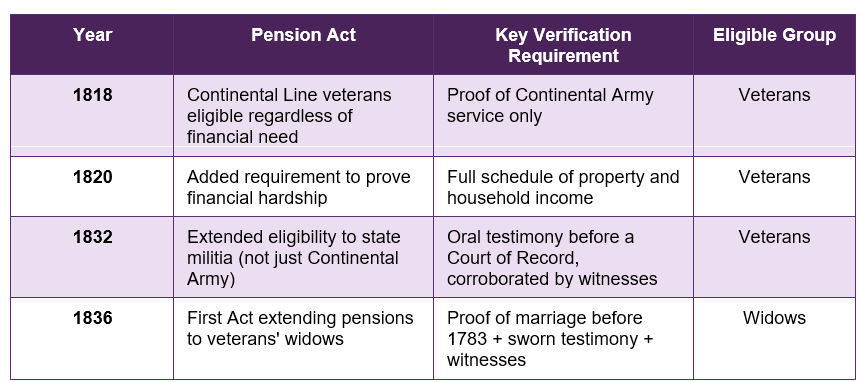
Each of these Acts required claimants to prove something that, in an era without centralised civil recordkeeping, was genuinely difficult to establish beyond doubt: who they were, how old they were, and whether their account of decades-old military service or marriage was true. Applicants typically had to appear in person before a local Court of Record, swear an oral testimony, and produce corroborating witnesses — often elderly neighbours whose own memories were, by the 1830s, fading just as fast as the applicants'.
A devastating setback: A fire in the War Department on November 8, 1800 destroyed nearly all pension and bounty-land records filed before that date. Every pension file that survives in the National Archives today dates from after the fire — meaning the system that processed Heth-era applications was already working from incomplete records for an entire generation of earlier claims, compounding the verification challenge further.
Why Age and Identity Verification Was So Difficult in 1830s America
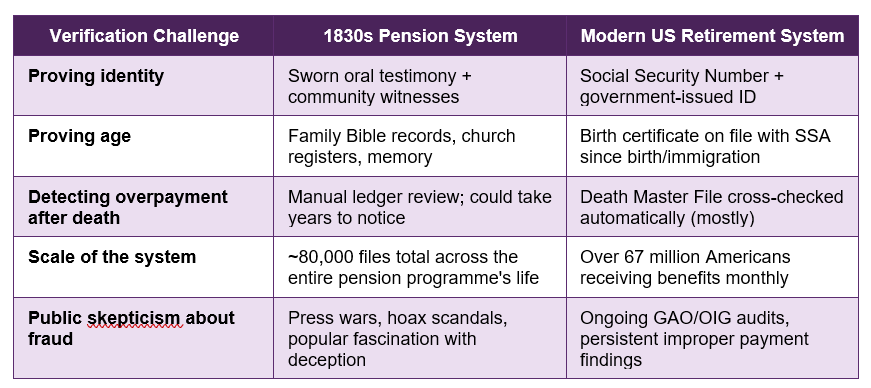
It is worth pausing on just how primitive identity verification was in this period, because it explains both why a claim like Heth's could gain any traction at all and why the government's own pension system struggled with similar problems on a much larger and more consequential scale.There was no Social Security Administration, no centralised birth registry, no standardised identification documents, and no photographic record of most ordinary Americans. A person's age was typically established through family Bible entries, church baptismal registers, or simply the collective memory of a community — all of which were imperfect, easily lost, and occasionally manipulated. The 1836 Widows' Act required proof of marriage before 1783 and oral testimony corroborated by credible witnesses, precisely because no more reliable form of verification existed.
Joice Heth's exhibitors exploited exactly this gap. They produced a supposed bill of sale dating to 1727 as 'proof' of her age — a document Barnum himself later admitted had 'all the marks of authenticity' only in the sense that it looked old, not that it had been genuinely verified. The same vulnerability that let a sideshow promoter claim a woman was 161 years old also meant that the federal government, processing tens of thousands of genuine pension claims with comparably thin documentation, faced real and unavoidable rates of error, both honest and fraudulent.
Scale of the historical pension archive: ~80,000 files — the total number of Revolutionary War pension and bounty-land files preserved in the National Archives, covering roughly 20% of all Americans who served — a programme administered entirely through paper testimony and local witnesses (National Archives, NARA M804)
From Paper Ledgers to Social Security: A Century of Building Better Verification
The verification challenges visible in the 1830s pension system did not disappear; they evolved, and the institutions built to solve them eventually became the backbone of the modern American retirement system. The Social Security Act of 1935 — exactly a century after Heth's exhibition — created, for the first time, a single, centralised, numerically tracked record of nearly every working American's income history, explicitly designed to solve the identity and benefit-verification problems that had plagued earlier, fragmented pension efforts.The Social Security Number, introduced in 1936, was the modern descendant of the witness testimony and church records that 1830s pension clerks had relied on. Where a Revolutionary War widow needed a neighbour to vouch for her marriage decades earlier, a modern retiree's earnings record, age, and identity are verified electronically against records the government has maintained continuously since the person's first job or arrival in the country. The system is dramatically more accurate than its 19th-century predecessor — but it is not infallible, and the underlying challenge — confirming that the person claiming a benefit is who, and how old, they say they are — has never fully disappeared.
Modern Echoes: Improper Payments and Identity Fraud in Today's Retirement System
The Social Security Administration's own Office of Inspector General and the Government Accountability Office have repeatedly identified categories of improper payments that bear a striking structural resemblance to the 1830s problem, even though the scale and mechanisms are entirely modern. Payments to deceased beneficiaries whose deaths were not promptly recorded, benefits continuing to be paid on accounts compromised by identity theft, and overpayments later requiring clawback from recipients are all, at their core, the same verification problem the Revolutionary War pension clerks faced — now operating across tens of millions of records instead of tens of thousands.For individual savers and retirees, this history is a useful reminder that the integrity of any retirement income system — whether an 1830s federal pension or a 21st-century Social Security account — depends on an ongoing, active relationship between the individual and the institution, not a one-time application that can simply be filed and forgotten. A Revolutionary War widow had to periodically reappear before a Court of Record to keep her pension active. A modern retiree similarly has an ongoing responsibility: monitoring their Social Security earnings record for accuracy, protecting their Social Security Number from theft, and promptly reporting changes in circumstances that affect benefit eligibility.
The enduring lesson: Every era's retirement and pension system has had to solve the same fundamental problem — proving that a real, specific, living person is entitled to an ongoing benefit. The tools have changed from sworn neighbour testimony to encrypted federal databases, but the underlying vulnerability — that verification systems can be gamed, whether by a 19th-century showman or a 21st-century identity thief — has never gone away.
Practical Lessons for Protecting Your Own Retirement Income Today
Drawing a direct line from an 1830s pension clerk's challenges to your own retirement planning might seem like a stretch, but the parallels point to genuinely useful, modern actions:- Check your Social Security earnings record annually: Just as a Revolutionary War pensioner needed an accurate record of service to receive the correct benefit, your future Social Security benefit is calculated from your recorded earnings history. Errors — a missing year of income, a misattributed employer — can permanently reduce your benefit if never corrected. Create a 'my Social Security' account at ssa.gov and review your earnings record at least once a year.
- Protect your Social Security Number as the modern equivalent of irreplaceable proof of identity: In the 1830s, a forged bill of sale or a coached witness could fraudulently establish someone's claimed identity. Today, a stolen Social Security Number can be used to file fraudulent benefit claims or open credit in your name. Treat your SSN with the same protective seriousness that genuine 19th-century pension applicants had to apply to their sworn testimony and documentation — never share it unnecessarily, and monitor your credit report regularly.
- Understand that benefit systems require active stewardship, not passive trust: Pension acts of the 1820s and 1830s repeatedly required claimants to reappear, re-testify, and re-prove their circumstances. Modern retirees similarly need to actively manage required minimum distributions, report life changes that affect benefits, and respond promptly to any official correspondence about their accounts — passive assumption that 'the system has it handled' has never been a safe assumption, then or now.
- Recognise that institutional verification failures cut both ways: Just as the 1830s system occasionally failed to catch fraud (and likely also wrongly rejected some genuine claimants who lacked surviving witnesses), modern systems make mistakes too. If you believe your Social Security benefit calculation is wrong, you have the right to request a correction — do not assume an official-looking number is automatically accurate.
- Diversify your retirement income sources, just as the system itself has had to evolve beyond a single pension model: The Revolutionary War pension system was eventually supplemented and then replaced by a much broader Social Security framework, and modern retirement planning experts consistently recommend not relying on any single income source — Social Security, a pension, or savings — in isolation. The 200-year evolution from a single veterans' pension fund to today's multi-pillar system (Social Security, employer retirement plans, personal savings) reflects a hard-won lesson: concentration in a single, single-point-of-failure income source is a structural risk worth actively managing against.
Conclusion
Joice Heth was never a government pensioner — she was an enslaved woman exploited for profit through a commercial hoax, and her story deserves to be remembered honestly as exactly that. But the decade in which her exhibition captivated paying crowds across the American Northeast was also the decade in which the United States government was, for the first time, building the institutional machinery to verify age, identity, and entitlement at national scale — work that would eventually evolve, a century later, into the Social Security system tens of millions of Americans depend on today.The thread connecting an 1830s sideshow hoax to your own retirement account is not a literal one, but it is a genuinely instructive one: every system designed to deliver income to people based on who they are and how old they are has had to solve the perennial problem of verification, and every such system — from sworn neighbour testimony in a 1830s courthouse to an encrypted federal database today — has imperfections that can be exploited if individuals are not actively engaged in protecting their own records and benefits.
The most useful thing you can take from this 190-year-old story is not a history trivia fact, but a habit: check your Social Security earnings record, protect your identity documents and numbers as the irreplaceable assets they are, and stay an active participant in your own retirement system rather than a passive claimant who simply assumes the paperwork will sort itself out. The pension clerks of the 1830s, working with quill pens and sworn witnesses, would likely recognise that advice instantly — it was, in essence, the only protection their own claimants had too.
Frequently Asked Questions (FAQ)
Did the US government actually pay Joice Heth a pension?
No. There is no historical record of any government pension payment to Joice Heth or to anyone matching her described circumstances. Heth was an enslaved woman exhibited commercially by P.T. Barnum and earlier promoters for paid public admission — a private, for-profit sideshow attraction, not a government benefit recipient. Her story is genuinely remarkable on its own terms, but it should not be confused with the separate, real history of federal Revolutionary War pensions discussed in this article.How did the US government verify ages and identities before modern records existed?
Before centralised civil registration, age and identity were typically established through family Bible records, church baptismal and marriage registers, and sworn testimony from community members who could vouch for a person's history. Revolutionary War pension applicants were required to appear before a local Court of Record, testify under oath, and provide corroborating witnesses — a system that was inherently dependent on the honesty and memory of both the applicant and their community, with no centralised way to cross-check claims nationally.How is Social Security different from the original Revolutionary War pension system?
Social Security, established in 1935, created a single centralised, continuously updated earnings record for nearly every working American, identified through a unique Social Security Number — a dramatic improvement over the fragmented, locally-verified pension system of the early 1800s. Rather than requiring repeated sworn testimony and local witnesses, Social Security benefits are calculated automatically from a worker's recorded lifetime earnings history, verified electronically against employer-reported wage data. It is far more accurate and scalable, but, as with any large records-based system, it remains subject to its own categories of error and fraud risk, which the SSA's Office of Inspector General actively audits and investigates.What should I actually do to protect my own Social Security and retirement benefits?
Create and regularly check your 'my Social Security' account at ssa.gov to verify your earnings record is accurate, since errors can reduce your future benefit calculation. Protect your Social Security Number and other identifying documents carefully, as identity theft is the modern equivalent of the fraudulent claims earlier pension systems struggled to prevent. Respond promptly to any official correspondence about your benefits, and report life changes — such as a change of address or marital status — that could affect your eligibility or payment amount. Finally, avoid relying on any single income source in retirement; diversifying across Social Security, employer retirement accounts, and personal savings reduces your exposure if any one system experiences an error or disruption.Are there real historical examples of pension fraud from this era, even if Heth's case wasn't one?
Yes. Historical pension administration records and genealogical research document real instances of disputed, rejected, and occasionally fraudulent Revolutionary War pension claims, reflecting the genuine difficulty of verifying decades-old military service and marriages with the limited documentation available at the time. The National Archives' own guidance to researchers notes that some applications were rejected specifically because claims could not be verified or were suspected to be fraudulent — a real and acknowledged feature of the system, distinct from the separate Joice Heth exhibition discussed in this article.External References
The following authoritative sources were used in researching this article and are recommended for further reading:1. George Washington's Mount Vernon — Joice Heth (c. 1756–1836): The Documented History
https://www.mountvernon.org/library/digitalhistory/digital-encyclopedia/article/joice-heth-c-1756-1836
2. Wikipedia — Joice Heth (Summary and Citations)
https://en.wikipedia.org/wiki/Joice_Heth
3. US National Park Service — Revolutionary War Veteran and Widow Pensions
https://www.nps.gov/articles/000/revolutionary-war-veteran-and-widow-pensions.htm
4. US National Archives — Using Revolutionary War Pension Files to Find Family Information
https://www.archives.gov/publications/prologue/2015/summer/rev-war-pensions.html
5. Wharton Pension Research Council — A History of Public Sector Pensions in the United States
https://pensionresearchcouncil.wharton.upenn.edu/wp-content/uploads/2015/09/0-8122-3714-5-4.pdf
6. Social Security Administration — Historical Background and Development of Social Security
https://www.ssa.gov/history/briefhistory3.html
7. Social Security Administration Office of the Inspector General — Reports on Improper Payments
https://oig.ssa.gov/
8. JSTOR Daily — Joice Heth: How an Elderly Slave Launched P.T. Barnum's Career
https://daily.jstor.org/joice-heth-how-an-elderly-slave-launched-p-t-barnum-career/
0 Comments
Be the first to share your thoughts on this article.