
Computer
What Happens When AI Kills the Need to Click Websites

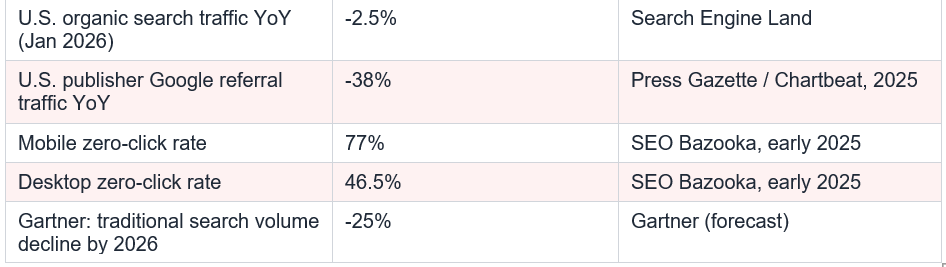
Key Statistics (August 2026): 68.01% of Google searches ended without a click in Jan–Apr 2026 (SparkToro / Similarweb, June 2026). Zero-click rate was 60.45% in 2024 — a 7.5 percentage point increase in two years. 83% of searches triggering AI Overviews end without a click (multiple sources, 2026). 93% of Google AI Mode sessions end without a click (Semrush, September 2025). Only 1% of users click links inside an AI Overview (Pew Research, July 2025). Organic CTR for informational queries fell from 1.76% to 0.61% — a 61% decline (Seer Interactive, November 2025). Position-one CTR on AI Overview keywords fell from 7.3% (March 2024) to 2.6% (March 2025) — a 64.5% collapse in 12 months (Digital Content Next). AI Overviews now appear on 48% of all tracked queries; up 58% YoY (BrightEdge, March 2026). Gartner: 25% decline in traditional search volume by 2026. U.S. publisher Google referral traffic fell 38% YoY (Press Gazette / Chartbeat). HubSpot: estimated 70–80% organic traffic decline. Business Insider: 55% organic traffic decline + cut 21% of staff. Daily Mail (DMG Media): CTR drops up to 89% on AI Overview queries. Chegg: 49% decline in non-subscriber traffic Jan 2024–Jan 2025. BrightEdge: -30% YoY clicks across billions of queries. AI clicks convert at 23x the rate of traditional search visitors (DigitalApplied, 2026). Brands cited in AI Overviews earn 35% more organic clicks and 91% more paid clicks than uncited competitors (ZipTie.dev, 2026). 80% of consumers rely on AI-generated results for 40%+ of their searches (Bain & Company, February 2025). ChatGPT: over 1 billion searches/week. Perplexity: over 1 billion queries/month. OpenAI began selling ads in ChatGPT in February 2026 at $60 CPM. Mobile: 77% of queries end without visiting a website; Desktop: 46.5% (SEO Bazooka, early 2025).
Something fundamental changed in how people use the internet, and it happened faster than most businesses were prepared for. In the first four months of 2026, a record 68.01 percent of Google searches ended without a single click to any website, according to SparkToro and Similarweb’s June 2026 analysis. Two years earlier, in 2024, the same figure was 60.45 percent. In ten years, it stood at approximately 43 percent. The click — the foundational mechanism of the web, the unit by which advertising is sold, the currency through which publishers generate revenue, and the pipeline through which businesses find customers — is becoming optional.
This is not primarily a story about one company’s product decision. It is a story about a structural shift in what search engines are for. For most of their history, search engines were answer-finding directories: they showed you where the answer was, and you went there. Now, increasingly, they are the answer. Google’s AI Overviews, rolled out globally in late 2024, synthesise content from across the web and deliver it directly on the search results page. ChatGPT handles over a billion searches per week. Perplexity processes over a billion queries monthly. Each of these systems reads website content, extracts the useful parts, and delivers them to users who never visit the source.
This article examines exactly what happens when AI eliminates the need to click on websites: the data on how far the collapse of the click has gone, which businesses are being hit hardest, the counterintuitive findings about the clicks that remain, and the specific strategies that are working in a world where visibility and traffic have become two entirely different things.
Zero-click search is not new. SparkToro’s Rand Fishkin documented the trend as early as 2019, when approximately 50 percent of searches were already ending without a click. What changed between 2024 and 2026 is the acceleration rate. Google’s AI Overviews turned a structural trend into a structural break. Queries that previously would have generated clicks — informational and research-intent queries — now resolve on the search results page. The user does not need to go anywhere.
The distinction between ‘helpful’ and ‘harmful’ zero-click searches illustrates the complexity of the phenomenon. When someone searches ‘weather today’ and gets the answer without clicking, that is helpful — the search succeeded. When someone searches ‘best camera for wildlife photography’ and a 300-word AI summary synthesises content from five review sites without sending the user to any of them, the equation is different. Those review sites created the content. They received none of the traffic that content would previously have generated.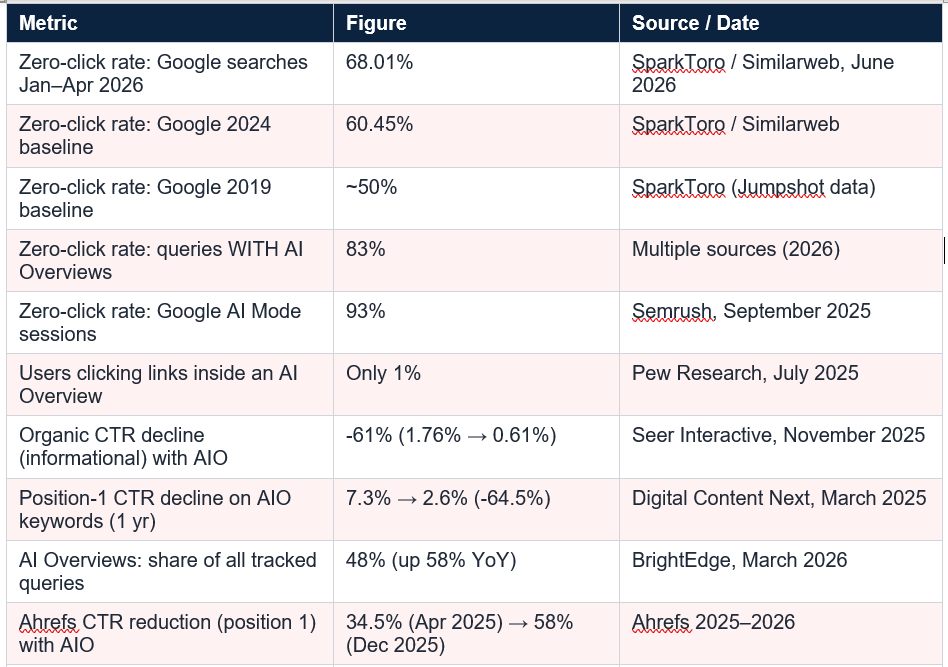
The Data: 68.01% of Google searches in Jan–Apr 2026 ended without a click. 93% of AI Mode sessions end without a click. Only 1% of users click links inside an AI Overview. Position-1 CTR collapsed 64.5% in one year on AI Overview keywords.
The impact is specific and measurable. Seer Interactive’s study — the most rigorous primary dataset on this question, analysing 3,119 informational queries across 42 organisations covering 25.1 million organic impressions and 1.1 million paid impressions over 15 consecutive months — found that organic CTR on AI Overview keywords fell 61 percent year-over-year. This is not a traffic plateau. It is a structural decline in the value of position.
The most important specific metric from Digital Content Next’s tracking: position-one CTR on AI Overview keywords fell from 7.3 percent in March 2024 to 2.6 percent in March 2025 — a 64.5 percent decline in a single year. Reaching the number one organic search position — the goal of virtually every SEO investment for the past two decades — now delivers less than a third of the traffic it delivered twelve months earlier for queries with AI Overviews. And AI Overviews are expanding to cover nearly half of all queries.
Stuart Forrest, Global Director of SEO, Bauer Media (BBC interview, 2025): We’re definitely moving into the era of lower clicks and lower referral traffic for publishers. Not with a dramatic impact, but with a steady decline in clicks as AI meets users’ needs before they ever leave Google’s ecosystem.
SparkToro’s June 2026 analysis illustrated this with a specific finding: over the same period in which Google’s zero-click share increased by 9.51 percentage points, the share of searches that led to another Google search (a refinement or follow-up query within Google) rose by 7.2 percentage points. Google is successfully keeping users within its ecosystem — answering their initial question and encouraging them to ask a follow-up — rather than sending them to the web.
The commercial logic is clear. AI Overviews, and the ads placed alongside them, generate revenue for Google without sending users anywhere. By October 2025, ads appeared alongside AI Overviews in over 40 percent of cases, up from roughly 3 percent in January 2025. Google’s financial performance has improved as click-through rates to third-party websites have declined. The company’s interests and the web’s interests have, for the first time in its history, structurally diverged
The mobile differential reflects several specific factors: mobile screen real estate makes AI Overviews more prominent relative to organic results; mobile users are more likely to be satisfied with a quick answer than desktop users conducting deeper research; and the mobile interface makes clicking through to a website and reading it a more friction-filled experience than seeing the answer directly in the search results page.
For businesses evaluating their exposure to the zero-click phenomenon, segmenting their organic traffic data by device type is essential. A site that appears to have maintained stable traffic on desktop may have lost 30 to 40 percent of its mobile traffic to zero-click behaviour without the aggregate figure making the damage visible.
DigitalApplied’s 2026 analysis found that AI search visitors who click through to websites convert at 23 times the rate of traditional search visitors. ZipTie.dev’s analysis confirmed that brands cited in AI Overviews earn 35 percent more organic clicks and 91 percent more paid clicks than uncited competitors on the same queries. DigitalApplied’s additional data point: AI Overviews reduce organic CTR by an average of 18 percent, but the clicks that survive convert 23 percent better.
The mechanism is straightforward: a user who receives a 200-word AI summary of the answer to their question and then clicks through to the source website has made a deliberate, informed decision to go deeper. They are not casually clicking the first result. They are seeking the complete picture, the vendor relationship, the purchase, or the deeper expertise. These are the clicks that convert.
Adapt: Stop measuring success by traffic volume alone. In the zero-click era, a website with half the visitors that converts at three times the rate is more valuable than one chasing raw traffic. Reframe your analytics around revenue and conversion, not sessions and pageviews.
AI Mode is currently available in the US and represents what Google’s search interface will increasingly look like as the company extends the feature. The arrival of AI Mode in Europe is expected by end of 2026, subject to compliance with the EU AI Act. For organic SEO, AI Mode is the end state: not a search result with an AI summary at the top, but a search experience in which the AI is the only result, and the only pathway to being seen is citation within the AI’s response.
ZipTie.dev’s analysis of AI Mode sessions is particularly stark: ‘93 percent of Google AI Mode sessions end without visiting an external website. AI Mode is distinct from AI Overviews — more conversational, more capable — and it previews where the trend is heading.” If the trajectory of AI Mode adoption mirrors that of AI Overviews, the 93 percent zero-click rate of AI Mode will define the search experience for the majority of users within the next two to three years.
The specific strategies that are working in 2026:
The responses emerging in 2026 cluster into several categories:
The businesses and publishers that will navigate this transition most successfully are those that recognise two things simultaneously. First, that the decline of the click does not mean the decline of search as a channel — the clicks that survive are genuinely more valuable, the users who reach websites in a zero-click world are more intentional and convert better, and citation within AI systems delivers brand value that does not appear in traffic metrics. Second, that depending on search-delivered clicks as the primary basis of a digital business model is now structurally fragile in a way it was not two years ago.
The new goal is visibility without clicks — being cited, mentioned, referenced, and associated with the answers that AI systems provide, whether or not that citation sends a user to your website immediately. This is a different game from SEO, with different rules, different metrics, and different winners. The businesses building for it now have a genuine advantage over those still optimising for a search landscape that no longer exists.
According to SparkToro and Similarweb’s June 2026 analysis, 68.01% of Google searches in the first four months of 2026 ended without a click to any website. This is up from 60.45% in 2024, representing the fastest two-year acceleration in zero-click behaviour in a decade. When AI Overviews are present, the zero-click rate reaches 83%. In Google’s AI Mode, it reaches 93%.
What is the impact of Google AI Overviews on click-through rates?
AI Overviews have significantly reduced click-through rates for websites. Seer Interactive’s 15-month study found organic CTR on informational queries fell 61% — from 1.76% to 0.61%. Position-one CTR on AI Overview keywords fell from 7.3% to 2.6% in a single year (Digital Content Next). Ahrefs found that AI Overviews reduced clicks to the number-one result by 34.5% in April 2025, worsening to 58% by December 2025.
Which websites have been most affected by zero-click search?
The most affected publishers include: HubSpot (estimated 70-80% organic traffic decline); Business Insider (55% decline, staff cuts of 21%); CNN (27-38% decline); the Daily Mail (up to 89% CTR drop on AI Overview queries); Chegg (49% decline in non-subscriber traffic); and Stereogum (70% ad revenue loss). Educational reference sites, how-to content, recipe sites, and news publishers have experienced the steepest declines because AI handles these content types most effectively.
Are there any types of clicks that AI search has not reduced?
Yes. Transactional searches (purchase intent) still drive clicks because completion requires a destination. Branded navigational searches actually see CTR increases when AI Overviews are present, as the AI confirms brand legitimacy. Content that cannot be synthesised by AI — proprietary data, original research, interactive tools, multimedia — continues to earn clicks. Brands cited within AI Overviews earn 35% more organic clicks and 91% more paid clicks than uncited competitors (ZipTie.dev, 2026).
What is GEO and how does it differ from SEO?
GEO stands for Generative Engine Optimisation — the practice of optimising content, authorship, schema markup, and link building to be cited within AI-generated answers, not just indexed by search engines. Unlike traditional SEO, which optimises for ranking position on a results page, GEO optimises for citation within AI summaries produced by Google’s AI Overviews, ChatGPT, Perplexity, and other AI search systems. Ahrefs’ research found that 88% of AI-cited URLs do not rank in Google’s Top 10 for the same query, confirming that citation and ranking are now different games.
What can businesses do to adapt to zero-click search?
Key strategies include: optimising for AI citation rather than position-one ranking; investing in E-E-A-T signals (Experience, Expertise, Authoritativeness, Trustworthiness); building audience-owned channels (email newsletters, communities, direct subscriptions) that do not depend on search intermediaries; focusing content creation on queries where user intent cannot be satisfied by an AI summary; measuring success by revenue and conversion rather than traffic volume; and tracking Google Search Console impressions vs clicks to distinguish between zero-click displacement and ranking loss.
Will the zero-click trend continue or reverse?
All major industry forecasts point toward continuation and acceleration. Gartner projects a 25% decline in traditional search volume by 2026 and 50% by 2028. SparkToro’s Rand Fishkin noted that Google’s financial and stock performance suggests these changes have boosted both ad revenue and investor confidence, making reversal unlikely. AI Mode, which produces a 93% zero-click rate and is expected to expand to Europe by end of 2026, represents the next escalation. News publishers anticipate a 43% organic traffic loss by 2029 (extrapolated from measured trajectories).
Table of Contents
- The Click Is Disappearing
- What Is Zero-Click Search? A Plain-English Definition
- The Data: How Far Has the Click Declined?
- How Google’s AI Overviews Changed Everything
- The Three Layers of AI Search Impact
- Who Is Being Hit Hardest?
- The ‘Great Decoupling’: When Search Volume Rises But Clicks Fall
- The Mobile Crisis Within the Crisis
- The Counterintuitive Finding: Fewer Clicks, Better Clicks
- AI Mode: The Next Escalation
- Beyond Google: ChatGPT, Perplexity, and the New Search Landscape
- What Gets Clicked in a Zero-Click World?
- How to Adapt: From SEO to GEO
- The Business Model Reckoning
- Conclusion: Visibility Without Clicks Is the New Goal
- Frequently Asked Questions
- External References and Further Reading
The Click Is Disappearing
Something fundamental changed in how people use the internet, and it happened faster than most businesses were prepared for. In the first four months of 2026, a record 68.01 percent of Google searches ended without a single click to any website, according to SparkToro and Similarweb’s June 2026 analysis. Two years earlier, in 2024, the same figure was 60.45 percent. In ten years, it stood at approximately 43 percent. The click — the foundational mechanism of the web, the unit by which advertising is sold, the currency through which publishers generate revenue, and the pipeline through which businesses find customers — is becoming optional.This is not primarily a story about one company’s product decision. It is a story about a structural shift in what search engines are for. For most of their history, search engines were answer-finding directories: they showed you where the answer was, and you went there. Now, increasingly, they are the answer. Google’s AI Overviews, rolled out globally in late 2024, synthesise content from across the web and deliver it directly on the search results page. ChatGPT handles over a billion searches per week. Perplexity processes over a billion queries monthly. Each of these systems reads website content, extracts the useful parts, and delivers them to users who never visit the source.
This article examines exactly what happens when AI eliminates the need to click on websites: the data on how far the collapse of the click has gone, which businesses are being hit hardest, the counterintuitive findings about the clicks that remain, and the specific strategies that are working in a world where visibility and traffic have become two entirely different things.
What Is Zero-Click Search? A Plain-English Definition
A zero-click search is a search query that results in the user getting what they need without clicking on any website. The answer is delivered directly within the search results interface — through a featured snippet, a knowledge panel, a map result, a calculator, a weather widget, or increasingly, an AI-generated summary. The user asks their question. The search engine answers it. The browser tab stays closed.Zero-click search is not new. SparkToro’s Rand Fishkin documented the trend as early as 2019, when approximately 50 percent of searches were already ending without a click. What changed between 2024 and 2026 is the acceleration rate. Google’s AI Overviews turned a structural trend into a structural break. Queries that previously would have generated clicks — informational and research-intent queries — now resolve on the search results page. The user does not need to go anywhere.
The distinction between ‘helpful’ and ‘harmful’ zero-click searches illustrates the complexity of the phenomenon. When someone searches ‘weather today’ and gets the answer without clicking, that is helpful — the search succeeded. When someone searches ‘best camera for wildlife photography’ and a 300-word AI summary synthesises content from five review sites without sending the user to any of them, the equation is different. Those review sites created the content. They received none of the traffic that content would previously have generated.
The Data: How Far Has the Click Declined?
The Data: 68.01% of Google searches in Jan–Apr 2026 ended without a click. 93% of AI Mode sessions end without a click. Only 1% of users click links inside an AI Overview. Position-1 CTR collapsed 64.5% in one year on AI Overview keywords.
How Google’s AI Overviews Changed Everything
The single largest accelerant of zero-click search is Google’s AI Overviews (AIO), the AI-generated summaries that appear at the top of search results pages above all organic and paid results. Launched broadly in the US in May 2024 and expanded globally through late 2024 and 2025, AI Overviews now appear on approximately 48 percent of all tracked queries, according to BrightEdge’s March 2026 data — a 58 percent year-over-year increase.The impact is specific and measurable. Seer Interactive’s study — the most rigorous primary dataset on this question, analysing 3,119 informational queries across 42 organisations covering 25.1 million organic impressions and 1.1 million paid impressions over 15 consecutive months — found that organic CTR on AI Overview keywords fell 61 percent year-over-year. This is not a traffic plateau. It is a structural decline in the value of position.
The most important specific metric from Digital Content Next’s tracking: position-one CTR on AI Overview keywords fell from 7.3 percent in March 2024 to 2.6 percent in March 2025 — a 64.5 percent decline in a single year. Reaching the number one organic search position — the goal of virtually every SEO investment for the past two decades — now delivers less than a third of the traffic it delivered twelve months earlier for queries with AI Overviews. And AI Overviews are expanding to cover nearly half of all queries.
Stuart Forrest, Global Director of SEO, Bauer Media (BBC interview, 2025): We’re definitely moving into the era of lower clicks and lower referral traffic for publishers. Not with a dramatic impact, but with a steady decline in clicks as AI meets users’ needs before they ever leave Google’s ecosystem.
The Three Layers of AI Search Impact
The zero-click phenomenon is not uniform. Its impact operates at three distinct layers, each of which requires different responses:Layer 1: Informational Content (Worst Affected)
Guides, tutorials, explainers, how-to articles, definitions, and research content — the category of content that built most of the web’s major publishers — is the most severely affected. AI Overviews handle informational queries most easily because the answers can be synthesised from multiple sources and delivered in a single, coherent summary. The DigitalBloom analysis found that informational niches — DIY, recipes, health, how-to content — often see 40 to 70 percent traffic drops as answers become ‘good enough’ in the AI Overview. ZipTie.dev’s analysis confirmed that 99.9 percent of informational keywords now trigger an AI Overview.Layer 2: Commercial Content (Rapidly Expanding)
In January 2025, 91.3 percent of queries triggering AI Overviews were informational. By October 2025, that share had dropped to 57.1 percent, with commercial queries growing rapidly. Google is no longer just answering ‘what is’ questions. It is intercepting ‘which should I buy’ and ‘what is the best’ searches. This commercial expansion is the most commercially significant development of the zero-click era: it means e-commerce, financial services, insurance, and software businesses — which had previously assumed their transactional content was protected from zero-click impact — are now being affected.Layer 3: Transactional Content (Still Relatively Protected)
Purchase-intent searches (‘buy iPhone 16,’ ‘order pizza near me,’ ‘book a hotel in Edinburgh’) still generate clicks because the user intent demands a destination. You cannot complete a purchase in a search result. But the boundaries of what counts as ‘transactional’ are narrowing: AI Overviews increasingly compare products, aggregate reviews, and recommend options before the transactional search is even needed, interception occurring one step earlier in the funnel.6. Who Is Being Hit Hardest?
The zero-click collapse has not been uniform across publishers and businesses. The most severe impacts:- Educational and reference content: Chegg reported a 49 percent decline in non-subscriber traffic between January 2024 and January 2025, attributing the decline directly to AI Overviews answering homework and study questions. The company filed an antitrust lawsuit against Google alleging that it used educational publisher content to train AI systems that now compete directly with those publishers.
- Major news and content publishers: HubSpot lost an estimated 70 to 80 percent of organic traffic. Business Insider lost 55 percent of organic traffic and cut 21 percent of its staff. CNN saw approximately 27 to 38 percent year-over-year traffic decline. The Daily Mail’s CTR dropped up to 89 percent on queries affected by AI Overviews.
- DIY, recipe, and how-to content: 40 to 70 percent traffic drops are typical in these categories, which have historically been the highest-traffic editorial categories on the web.
- Stereogum: lost 70 percent of ad revenue and pivoted to paid subscriptions — one of the most dramatic individual publisher responses to the AI search transition.
- Small businesses relying on informational SEO: businesses that built their entire customer acquisition strategy around ranking for informational ‘how-to’ and ‘what is’ content are disproportionately affected because this content category is the one AI handles most competently.
The ‘Great Decoupling’: When Search Volume Rises But Clicks Fall
One of the most counterintuitive features of the zero-click era is what analysts have called the Great Decoupling: the observation that total Google search volume continues to grow — people are asking more questions than ever — while the proportion of those searches that send a click to any website continues to fall.SparkToro’s June 2026 analysis illustrated this with a specific finding: over the same period in which Google’s zero-click share increased by 9.51 percentage points, the share of searches that led to another Google search (a refinement or follow-up query within Google) rose by 7.2 percentage points. Google is successfully keeping users within its ecosystem — answering their initial question and encouraging them to ask a follow-up — rather than sending them to the web.
The commercial logic is clear. AI Overviews, and the ads placed alongside them, generate revenue for Google without sending users anywhere. By October 2025, ads appeared alongside AI Overviews in over 40 percent of cases, up from roughly 3 percent in January 2025. Google’s financial performance has improved as click-through rates to third-party websites have declined. The company’s interests and the web’s interests have, for the first time in its history, structurally diverged
The Mobile Crisis Within the Crisis
The zero-click phenomenon is significantly more advanced on mobile than desktop, a fact that dramatically changes the scale of the problem given that mobile now accounts for more than 63 percent of total Google queries. On mobile, 77 percent of queries end without visiting any website. On desktop, that figure is 46.5 percent. The device on which the majority of searches now happen is also the device on which zero-click behaviour is most dominant.The mobile differential reflects several specific factors: mobile screen real estate makes AI Overviews more prominent relative to organic results; mobile users are more likely to be satisfied with a quick answer than desktop users conducting deeper research; and the mobile interface makes clicking through to a website and reading it a more friction-filled experience than seeing the answer directly in the search results page.
For businesses evaluating their exposure to the zero-click phenomenon, segmenting their organic traffic data by device type is essential. A site that appears to have maintained stable traffic on desktop may have lost 30 to 40 percent of its mobile traffic to zero-click behaviour without the aggregate figure making the damage visible.
The Counterintuitive Finding: Fewer Clicks, Better Clicks
The most surprising and most strategically important finding in the 2026 zero-click data is this: the users who do click through from AI-augmented search results are dramatically more valuable than the users who used to click through from traditional organic results.DigitalApplied’s 2026 analysis found that AI search visitors who click through to websites convert at 23 times the rate of traditional search visitors. ZipTie.dev’s analysis confirmed that brands cited in AI Overviews earn 35 percent more organic clicks and 91 percent more paid clicks than uncited competitors on the same queries. DigitalApplied’s additional data point: AI Overviews reduce organic CTR by an average of 18 percent, but the clicks that survive convert 23 percent better.
The mechanism is straightforward: a user who receives a 200-word AI summary of the answer to their question and then clicks through to the source website has made a deliberate, informed decision to go deeper. They are not casually clicking the first result. They are seeking the complete picture, the vendor relationship, the purchase, or the deeper expertise. These are the clicks that convert.
Adapt: Stop measuring success by traffic volume alone. In the zero-click era, a website with half the visitors that converts at three times the rate is more valuable than one chasing raw traffic. Reframe your analytics around revenue and conversion, not sessions and pageviews.
AI Mode: The Next Escalation
If AI Overviews represent the current disruption, Google’s AI Mode — a fully conversational AI search interface that replaces traditional search results entirely with an AI conversation — represents the next one. Semrush’s September 2025 analysis found that 93 percent of Google AI Mode sessions end without visiting an external website. In 75 percent of AI Mode sessions, users never leave the Google interface at all.AI Mode is currently available in the US and represents what Google’s search interface will increasingly look like as the company extends the feature. The arrival of AI Mode in Europe is expected by end of 2026, subject to compliance with the EU AI Act. For organic SEO, AI Mode is the end state: not a search result with an AI summary at the top, but a search experience in which the AI is the only result, and the only pathway to being seen is citation within the AI’s response.
ZipTie.dev’s analysis of AI Mode sessions is particularly stark: ‘93 percent of Google AI Mode sessions end without visiting an external website. AI Mode is distinct from AI Overviews — more conversational, more capable — and it previews where the trend is heading.” If the trajectory of AI Mode adoption mirrors that of AI Overviews, the 93 percent zero-click rate of AI Mode will define the search experience for the majority of users within the next two to three years.
Beyond Google: ChatGPT, Perplexity, and the New Search Landscape
The zero-click phenomenon is not limited to Google. A parallel ecosystem of AI-native search engines is building search experiences in which the click was never the design intent:- ChatGPT Search: as of 2026, ChatGPT handles over 1 billion search queries per week. In February 2026, OpenAI launched advertising within ChatGPT at a CPM of $60 and a minimum spend of $200,000 per brand — a formal signal that AI search platforms are maturing into advertising businesses. ChatGPT does not send users to websites by default; it synthesises answers from its training data and web browsing capability.
- Perplexity: processes over 1 billion queries monthly. Its model is citation-heavy — it shows the sources of its answers — but the design is still answer-first. Users receive a complete answer before they are given the option to visit a source, and most do not.
- Gemini, Claude, Copilot: each handles hundreds of millions of queries that would previously have been sent to Google. Each reads website content to inform its answers. None sends users to those websites as a default outcome.
What Gets Clicked in a Zero-Click World?
Not all clicks have disappeared. Understanding what survives is as important as understanding what has been lost:- Transactional searches: purchase-intent queries still drive clicks because completion requires a destination. ‘Buy running shoes’ cannot be resolved by an AI summary.
- Navigational searches: users searching for a specific website or brand still click through. Branded searches with AI Overviews see CTR increases of 18.68 percent (Amsive, 2025) — the AI Overview confirms the brand’s legitimacy and the user clicks through to complete an action.
- Deep expertise and unique content: content that AI cannot easily synthesise — proprietary data, original research, specialist analysis, personal experience — continues to earn clicks from users who recognise that the AI summary is a starting point, not a destination.
- Content cited in AI Overviews: brands cited in AI Overviews earn 35 percent more organic clicks than uncited competitors. The citation creates branded awareness and drives direct searches and direct visits that are not captured by standard organic traffic metrics.
- Multimedia and interactive content: video, tools, calculators, configurators, and interactive experiences cannot be replicated within a text-based AI summary. These content formats are structurally protected from zero-click displacement.
How to Adapt: From SEO to GEO
The strategic response to zero-click search requires a fundamental reorientation of what digital marketing is trying to achieve. The emerging framework is Generative Engine Optimisation (GEO) — optimising content, authorship, schema markup, and link building to be cited in AI answers, not just indexed by search engines.The specific strategies that are working in 2026:
- Optimise for citation rather than position: the goal of content creation for informational queries is no longer to rank first. It is to be cited within the AI Overview. This requires clear, well-structured, direct answers near the top of the page, credible sourcing, and content that resolves search intent without unnecessary filler. Ahrefs’ research found that 88 percent of AI-cited URLs do not rank in Google’s Top 10 for that query — meaning citation and ranking are different games.
- Invest in E-E-A-T signals: Experience, Expertise, Authoritativeness, and Trustworthiness are the signals Google’s AI systems use to decide which sources to cite. Domain authority is the number one predictor of AI citations (SE Ranking, 2025). High-authority sites earn three times more AI citations than low-authority sites.
- Build audience-owned channels: email newsletters, communities, direct subscribers, and social media followings are the assets that survive zero-click search because they do not depend on search intermediaries. Stereogum’s pivot to paid subscriptions is the extreme version of this; most publishers should be investing in building owned audience as a complement, not a replacement, to search.
- Shift from volume to intent: focus content creation on queries where the user intent cannot be satisfied by a 200-word AI summary — proprietary data, original research, product pages, community and forum content, and interactive tools.
- Track Google Search Console impressions vs clicks: if impressions are stable but clicks are falling, the site is experiencing zero-click displacement, not a ranking loss. This distinction determines the correct response.
The Business Model Reckoning
The zero-click transition is not just a technical SEO challenge. It is a business model crisis for a significant portion of the web’s commercial ecosystem. The advertising model that has funded most of the internet’s free content depends on users visiting websites. If users stop visiting, the pageview inventory that advertising is sold against disappears.The responses emerging in 2026 cluster into several categories:
- Subscription pivots: Stereogum, The Information, and numerous smaller publishers are moving to reader-funded models that are independent of search traffic.
- Direct audience investment: email newsletters, podcasts, YouTube channels, and community platforms are becoming the primary distribution channels for publishers who have lost faith in search as a reliable traffic source.
- B2B and enterprise focus: publishers that can serve institutional customers — businesses, governments, professional associations — with licensed data, research, and analysis are less exposed to the zero-click phenomenon than consumer-facing content businesses.
- AI platform collaboration: some publishers are negotiating licensing agreements with AI companies to be cited within AI-generated answers. News Corp, The Guardian, and others have struck licensing deals with OpenAI. The terms and value of these deals are still being established.
Conclusion
What happens when AI eliminates the need to click on websites is already happening. In 2026, 68 percent of Google searches end without a click. On AI Mode, that figure reaches 93 percent. The click — the atomic unit of the web economy for 30 years — is becoming a premium event rather than a standard outcome of search.The businesses and publishers that will navigate this transition most successfully are those that recognise two things simultaneously. First, that the decline of the click does not mean the decline of search as a channel — the clicks that survive are genuinely more valuable, the users who reach websites in a zero-click world are more intentional and convert better, and citation within AI systems delivers brand value that does not appear in traffic metrics. Second, that depending on search-delivered clicks as the primary basis of a digital business model is now structurally fragile in a way it was not two years ago.
The new goal is visibility without clicks — being cited, mentioned, referenced, and associated with the answers that AI systems provide, whether or not that citation sends a user to your website immediately. This is a different game from SEO, with different rules, different metrics, and different winners. The businesses building for it now have a genuine advantage over those still optimising for a search landscape that no longer exists.
Frequently Asked Questions
How many Google searches now end without a click?According to SparkToro and Similarweb’s June 2026 analysis, 68.01% of Google searches in the first four months of 2026 ended without a click to any website. This is up from 60.45% in 2024, representing the fastest two-year acceleration in zero-click behaviour in a decade. When AI Overviews are present, the zero-click rate reaches 83%. In Google’s AI Mode, it reaches 93%.
What is the impact of Google AI Overviews on click-through rates?
AI Overviews have significantly reduced click-through rates for websites. Seer Interactive’s 15-month study found organic CTR on informational queries fell 61% — from 1.76% to 0.61%. Position-one CTR on AI Overview keywords fell from 7.3% to 2.6% in a single year (Digital Content Next). Ahrefs found that AI Overviews reduced clicks to the number-one result by 34.5% in April 2025, worsening to 58% by December 2025.
Which websites have been most affected by zero-click search?
The most affected publishers include: HubSpot (estimated 70-80% organic traffic decline); Business Insider (55% decline, staff cuts of 21%); CNN (27-38% decline); the Daily Mail (up to 89% CTR drop on AI Overview queries); Chegg (49% decline in non-subscriber traffic); and Stereogum (70% ad revenue loss). Educational reference sites, how-to content, recipe sites, and news publishers have experienced the steepest declines because AI handles these content types most effectively.
Are there any types of clicks that AI search has not reduced?
Yes. Transactional searches (purchase intent) still drive clicks because completion requires a destination. Branded navigational searches actually see CTR increases when AI Overviews are present, as the AI confirms brand legitimacy. Content that cannot be synthesised by AI — proprietary data, original research, interactive tools, multimedia — continues to earn clicks. Brands cited within AI Overviews earn 35% more organic clicks and 91% more paid clicks than uncited competitors (ZipTie.dev, 2026).
What is GEO and how does it differ from SEO?
GEO stands for Generative Engine Optimisation — the practice of optimising content, authorship, schema markup, and link building to be cited within AI-generated answers, not just indexed by search engines. Unlike traditional SEO, which optimises for ranking position on a results page, GEO optimises for citation within AI summaries produced by Google’s AI Overviews, ChatGPT, Perplexity, and other AI search systems. Ahrefs’ research found that 88% of AI-cited URLs do not rank in Google’s Top 10 for the same query, confirming that citation and ranking are now different games.
What can businesses do to adapt to zero-click search?
Key strategies include: optimising for AI citation rather than position-one ranking; investing in E-E-A-T signals (Experience, Expertise, Authoritativeness, Trustworthiness); building audience-owned channels (email newsletters, communities, direct subscriptions) that do not depend on search intermediaries; focusing content creation on queries where user intent cannot be satisfied by an AI summary; measuring success by revenue and conversion rather than traffic volume; and tracking Google Search Console impressions vs clicks to distinguish between zero-click displacement and ranking loss.
Will the zero-click trend continue or reverse?
All major industry forecasts point toward continuation and acceleration. Gartner projects a 25% decline in traditional search volume by 2026 and 50% by 2028. SparkToro’s Rand Fishkin noted that Google’s financial and stock performance suggests these changes have boosted both ad revenue and investor confidence, making reversal unlikely. AI Mode, which produces a 93% zero-click rate and is expected to expand to Europe by end of 2026, represents the next escalation. News publishers anticipate a 43% organic traffic loss by 2029 (extrapolated from measured trajectories).
0 Comments
Be the first to share your thoughts on this article.